





In This Article (8 sections)
Blizzard Employee Dismissed Over World of Warcraft Development-Tool Cheating Scandal
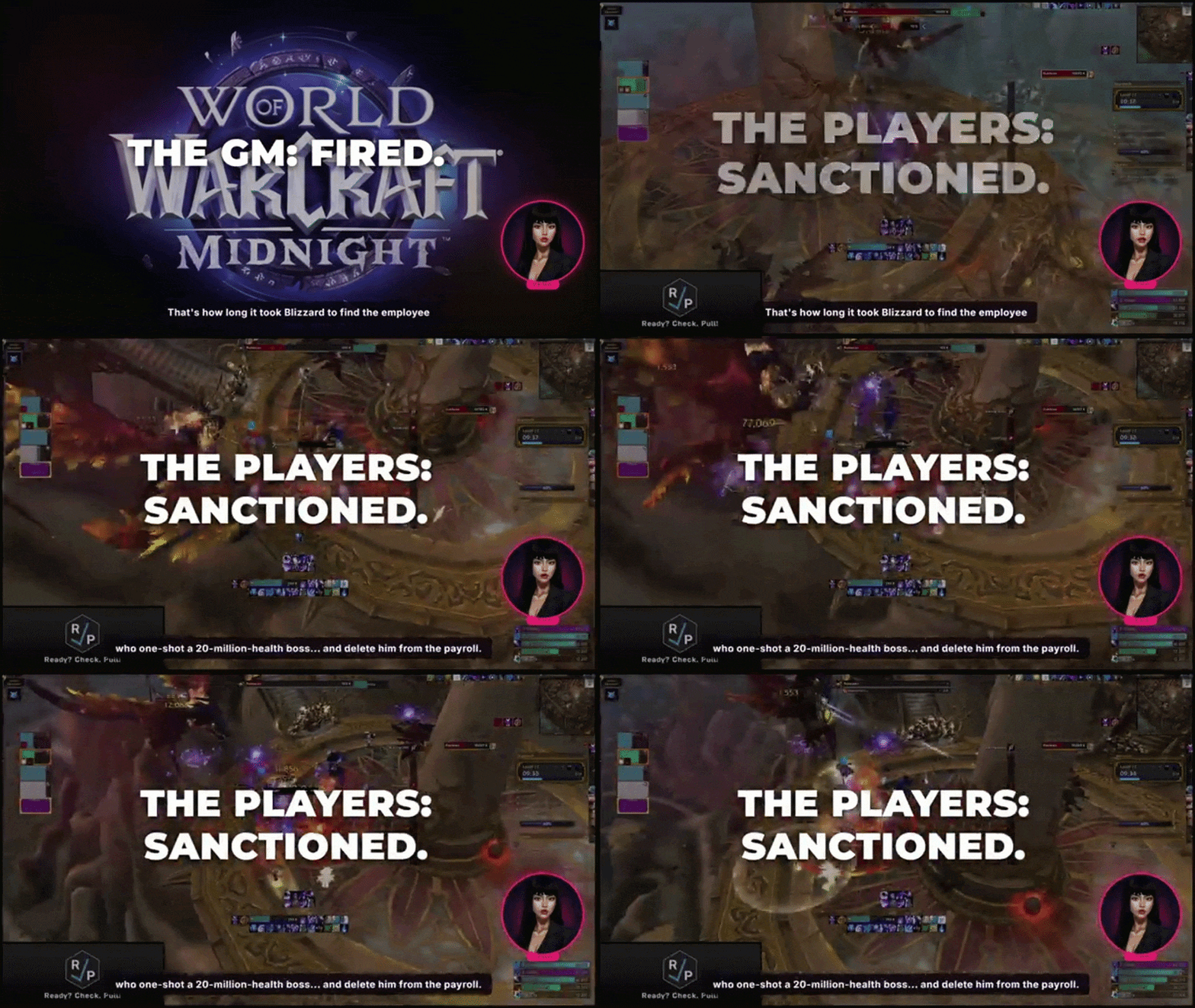
Blizzard Fires Dev after a World of Warcraft cheating scandal involving developer-only spells and privileged access abuse. Blizzard confirmed on July 23, 2026, that a World of Warcraft employee had been dismissed after an internal investigation found that development-only spells were used on a live server. The company described the incident as a violation of its Code of Conduct and confirmed that action was also being taken against player accounts involved in or benefiting from the misconduct.
Some reports identified the dismissed employee as a developer, quality assurance worker, senior QA developer, or Game Master. Blizzard did not publicly disclose the person’s real name, exact role, department, or employment history. The most reliable conclusion is that the individual was a Blizzard employee with authorized access to internal tools capable of affecting live World of Warcraft realms. More specific job titles remain based on secondary reporting rather than Blizzard’s formal statement.
The dismissal showed that Blizzard considered the misuse of internal commands an employment-level violation rather than a minor lapse in judgment. The employee did not exploit a normal game bug available to the public. The incident involved privileged access intended for testing, troubleshooting, and urgent intervention in the live game. Using those permissions to assist ordinary players crossed the boundary between authorized development work and deliberate manipulation of a production environment.
The scandal centered on a completed level 23 Nexus-Point Xenas Mythic Plus run. Players reviewing the Warcraft Logs data noticed combat events that could not be explained by normal abilities. Near the end of the dungeon, a sixth entity named Daijosai appeared in the log and used internal-looking spells to kill enemies instantly.
The timing made the intervention especially suspicious. The group was approaching the dungeon’s time limit while still needing to defeat the final boss and complete the required enemy count. According to the log, Lothraxion was struck by an ability called “Death Touch,” while another enemy needed for the final percentage requirement was killed with “Area Death (TEST).” Reports examining the event described the second spell as a testing or development command capable of killing enemies within a specified area.
Because the source of those abilities was not one of the five players in the Mythic Plus group, community members initially considered several explanations. Some believed a player might have discovered an exploit granting access to restricted commands, while others suspected direct intervention by a Blizzard employee using a hidden or privileged character. The second explanation became more credible as public discussion connected the unusual combat data to someone with internal access.
The controversy escalated when one of the participants discussed the run during a livestream conversation. According to reports, the player acknowledged asking a friend with elevated access for help and described requesting that the friend eliminate an enemy. That admission changed the incident from a technical mystery into an apparent case of intentional assistance designed to help the group complete the run.
Blizzard initially said it was reviewing the allegations and would take appropriate action. Its later announcement confirmed that an employee had been involved, that the use of development-only spells violated company policy, and that the employee had been dismissed. Player accounts considered complicit were also subject to disciplinary action.
The case demonstrated why privileged access in live-service games requires strict controls. Employees with development commands can alter encounters, remove enemies, change character states, investigate bugs, and respond to emergencies. Those abilities are necessary for operating a large online game, but they also create serious risks if they are used for personal relationships, competitive advantages, or unofficial assistance.
Blizzard’s response therefore served as a warning to both employees and players. Internal access cannot be treated as a private advantage that can be shared with friends, while players who knowingly request or accept unauthorized intervention may still face penalties even when they do not personally execute the restricted commands.

Blizzard Fires Dev: Employee Identity and Developer Tool Abuse
Blizzard did not disclose the real identity of the employee involved in the World of Warcraft cheating scandal. The Blizzard Fires Dev decision became the central consequence of the investigation because the employee violated rules governing internal tools. The company did not confirm the person’s legal name, gender, exact job title, department, location, or length of employment.
The name Daijosai appeared in the combat log as the source of the restricted abilities used during the disputed Mythic Plus run. However, Daijosai should be understood as the in-game or logged identity associated with the intervention rather than the employee’s confirmed real-world name. Community discussions and reports frequently described Daijosai as a Game Master character because the entity behaved like an invisible sixth participant with access to commands unavailable to ordinary players.
Kotaku reported that the employee was a senior QA developer, while other coverage used broader descriptions such as developer, employee, quality assurance worker, or Game Master. Blizzard did not verify those details. The safest conclusion is that the individual was an employee with authorized access to development-only tools on live World of Warcraft servers.
Blizzard’s decision not to identify the employee is consistent with how companies often handle internal disciplinary matters. The facts necessary to explain the enforcement action were the misuse of privileged access, the unfair advantage given to players, the violation of company policy, and the resulting dismissal. Publishing personal employment information was not necessary to establish what happened.
The employee used development-only spells during a live level 23 Nexus-Point Xenas Mythic Plus run. Combat logs attributed at least two suspicious interventions to Daijosai. “Death Touch” was used against Lothraxion, while “Area Death (TEST)” eliminated another enemy needed to complete the dungeon’s remaining enemy-forces requirement.
These actions were especially significant because Mythic Plus dungeons require teams to defeat bosses, kill enough non-boss enemies to fill the required percentage, and complete those objectives before the timer expires. Instantly removing a boss or required enemy can directly determine whether a run is recorded as a successful timed completion.
Normal players must manage damage rotations, healing, defensive abilities, interrupts, positioning, encounter mechanics, deaths, and time loss. A development-only instant-kill command bypasses those systems completely, removing millions of points of enemy health without requiring the gear, execution, or coordination expected from the group.
The logged presence of a sixth actor made the intervention easier to identify. A Mythic Plus party normally contains five players, but Daijosai appeared as the source of decisive combat events without being recorded as a standard group member. The misconduct might have been more difficult to detect if the employee had altered another player’s damage, changed enemy health indirectly, or used a command that did not appear clearly in the combat record.
“Death Touch” and “Area Death (TEST)” were internal instant-kill effects rather than normal abilities available to World of Warcraft players. Area Death (TEST) has been described in databases and reports as an ability capable of killing enemies within a 30-yard radius. Its reported description includes the word “Cheater,” reinforcing its role as a testing or administrative effect rather than a balanced gameplay skill.
The internal Death Touch command should not be confused with the Monk ability Touch of Death. Touch of Death is a legitimate player skill governed by class mechanics, enemy health conditions, cooldowns, scaling, and encounter balance. The spell used during the scandal was a privileged internal effect capable of eliminating a target outside those normal restrictions.
Development commands of this kind have legitimate purposes. Testers may need to skip an encounter phase, verify what happens after an enemy dies, remove a bugged creature, reset a scenario, or prevent a live event from becoming stuck. The existence of instant-kill tools was not itself the problem. The violation occurred because those tools were used to influence real player progression and a competitive dungeon result.
The Blizzard Fires Dev case highlighted why development commands must remain restricted on live servers. Blizzard fired the employee because the person used privileged access for a purpose unrelated to development, testing, troubleshooting, or live-game maintenance. The company stated that development tools and spells may be used only for legitimate work and that the incident violated its Code of Conduct.
The phrase “effective immediately” showed the severity of the decision. Blizzard did not describe the action as a suspension pending further investigation. It said it had carefully investigated the incident, confirmed the misuse through its own systems, and ended the employee’s relationship with the company.
Several factors justified the immediate termination. The employee intentionally used restricted powers on a live realm, assisted ordinary players in competitive content, influenced a recorded Mythic Plus completion, and damaged confidence in the integrity of the game. The conduct also represented an abuse of workplace trust because the access had been granted so the employee could perform authorized duties.
A player using an exploit may face a suspension or permanent account closure. An employee who uses company-provided powers to create the unfair advantage commits both a gameplay violation and an employment violation. That combination explains why Blizzard imposed a consequence more serious than an ordinary account penalty.

Blizzard Fires Dev: Official Findings, Player Involvement, Raider.IO Response, and Community Reaction
Blizzard’s official statement confirmed the central facts behind why Blizzard Fires Dev became the defining headline of the World of Warcraft cheating controversy. The development team said it had internally monitored and verified an incident in which a dungeon group gained an unfair advantage through the misuse of development-only spells on a live realm. Its investigation produced four central findings:
- A single Blizzard employee was responsible for the intervention.
- The employee violated Blizzard’s Code of Conduct.
- The employee was no longer with the company, effective immediately.
- Blizzard was taking action against player accounts found to have been complicit.
Blizzard explained that a limited number of employees can access development tools, commands, and spells on live servers when testing systems, investigating problems, or performing urgent corrective work. Every use of those abilities on a live realm is logged and shared with the Platform Security team. This monitoring allowed the company to investigate the allegations using internal evidence rather than relying entirely on public speculation, and Blizzard said the available records gave it confidence that the misconduct was isolated to one employee.
The evidence that led to Blizzard Fires Dev first gained public attention through detailed combat-log analysis. Warcraft Logs allows users to examine encounter events such as damage, healing, deaths, spell usage, timestamps, and the characters responsible for each action. A community member reviewing the affected run noticed that its ending did not appear possible under normal gameplay conditions. The team had little time remaining, yet its final objectives were completed through unusual instant-kill events. Further examination reportedly revealed Daijosai and the use of restricted abilities unavailable to ordinary players.
The discovery demonstrated the importance of community logging within competitive World of Warcraft. The game itself may record a dungeon as completed because the required enemies died and the timer conditions were satisfied, but Warcraft Logs can reveal how those deaths occurred. Community members collaboratively examined the recorded events, livestream comments, and other available information, gradually producing a coherent explanation before Blizzard published its final findings. The case escalated further when one participant reportedly acknowledged asking a friend with elevated access for assistance and requesting that the friend eliminate an enemy. That admission strengthened the argument that the intervention was intentional rather than an accidental test command or unrelated server event.
Blizzard later confirmed that its own monitoring systems independently verified the misconduct. The public Warcraft Logs data did not constitute the company’s only evidence, but it brought the run to wider attention and ensured that the completion received scrutiny. Blizzard thanked community members who reported the incident and provided information, while also acknowledging community websites that removed the affected result from their records. Its response attempted to provide transparency without identifying the employee, publishing a complete list of the players involved, or revealing technical instructions for using internal commands.
The immediate beneficiaries were the five players completing the level 23 Nexus-Point Xenas Mythic Plus dungeon. The employee’s intervention helped the group defeat required enemies and secure a completion that might otherwise have failed or exceeded the timer. Public reporting connected the controversy to aliases including Yiesus and Yarabyte, also referred to as Yara. However, Blizzard did not confirm the knowledge or actions of every group member, identify all affected accounts, or state which participants directly requested the intervention. It would therefore be inaccurate to assume that all five players were equally involved.
This distinction became particularly important because community members described at least one participant as a pickup player who may not have known that a Blizzard employee planned to interfere. Players on Blizzard’s forums argued that an uninvolved individual should not be punished merely for joining the group or recording its combat data. Blizzard said it was acting against accounts found to have been complicit, suggesting that the investigation attempted to distinguish deliberate participation from accidental involvement.
The advantage extended beyond completing a single dungeon. A high Mythic Plus score can improve a player’s public ranking, strengthen their reputation, increase access to future groups, and contribute toward qualification for limited seasonal titles. One assisted run may not guarantee a title, but an illegitimate score can still alter the competitive ladder and raise the threshold that legitimate players must reach.
Raider.IO removed the affected run from its active ranking records after evidence of prohibited assistance emerged. Reports indicated that the run remained visible for transparency, but its score was disqualified and was no longer treated as a legitimate competitive completion. This action mattered because Raider.IO is widely used to assess Mythic Plus experience, compare performance, recruit players, and maintain high-level rankings. Allowing an assisted result to remain active could have rewarded those involved and distorted comparisons with groups that completed similar content using only abilities available to ordinary players.
Removing the run also protected legitimate competitors by reinforcing the expectation that every ranked team must operate under the same rules. A developer-only instant-kill spell provides an advantage that no legitimate group can reproduce. Blizzard’s statement thanked community websites working to remove results connected to the violation, and although it did not identify every platform by name, its wording aligned with reports about Raider.IO’s response.
Community reaction was overwhelmingly critical of the employee’s actions. Many players regarded using administrative powers to help friends as one of the clearest possible forms of cheating, regardless of whether the incident occurred during a professional tournament. High-level Mythic Plus players emphasized that competitive rankings and seasonal titles require extensive preparation, coordination, practice, and repeated attempts. An illegitimate completion can alter score thresholds and potentially disadvantage players who earned comparable results fairly.
Many observers also struggled to understand why an employee would risk their career for the limited benefit of completing one dungeon. The contrast between the small in-game reward and the severe professional consequence became one of the most widely discussed aspects of the controversy. Opinions were more divided regarding the appropriate punishment for participating players. Some community members called for permanent account bans, while others argued that score removal, title disqualification, and temporary suspensions would be more proportionate. Blizzard confirmed that disciplinary action was being taken but did not publicly disclose the type or duration of every penalty, leaving later claims about specific suspension periods unverified unless directly confirmed by the company.
The controversy also raised broader questions about privileged access in live-service games. Blizzard’s logging system made accountability possible after the event by recording every use of development spells and commands on live realms and sharing that information with Platform Security. Without such records, an employee could potentially alter encounters without leaving an obvious internal trail. However, the incident also showed that monitoring did not prevent the intervention before it affected a competitive run. Player confidence depends not only on detecting abuse afterward but also on restricting access, reviewing unusual activity quickly, and ensuring that production commands cannot be misused without immediate consequences.
Some players questioned whether similar interventions might have occurred without appearing in widely examined public logs. Blizzard attempted to address that concern by stating that every live use of internal development abilities is recorded and reviewed and that its investigation indicated the violation was isolated to one employee. Ultimately, the combination of public combat logs, livestream comments, community investigation, Raider.IO’s response, and Blizzard’s internal monitoring transformed what initially appeared to be an unexplained combat event into a confirmed abuse of employee access.

Blizzard Fires Dev: Impact on WoW Competitive Integrity
The Blizzard Fires Dev incident showed that insider access can create serious problems for competitive systems. The Blizzard Fires Dev case highlighted why development spells and commands require strict controls, as the company said only a small number of employees can use development spells and commands on live servers and that every use is recorded and shared with Platform Security.
These tools exist because employees sometimes need to test content, investigate technical problems, remove bugged enemies, or perform urgent corrections in the live game. Their use is permitted only when it has a legitimate development or operational purpose, which is why the Blizzard Fires Dev situation became a major example of what happens when those permissions are misused.
Blizzard said its monitoring allowed the company to conclude that the scandal involved one employee rather than widespread internal misconduct. That conclusion appears to have come from reviewing command logs and access records rather than simply assuming that no other employee had behaved similarly, a process that supported the actions taken after Blizzard Fires Dev.
Some players still questioned whether using an instant-kill ability inside a live Mythic Plus dungeon should have generated an immediate automated warning. They also asked why the public community appeared to identify the incident before Blizzard announced enforcement and why the Blizzard Fires Dev controversy gained attention through community investigation.
The most reasonable interpretation is that Blizzard had sufficient internal records to investigate but benefited from the public evidence supplied by Warcraft Logs, Reddit users, streamers, and other community members. Logging supports retrospective verification, while automated alerting and access restrictions determine whether suspicious behavior can be detected or stopped in real time. The evidence eventually explained why Blizzard Fires Dev became the headline surrounding the incident.
The incident demonstrated that competitive integrity in World of Warcraft depends on more than detecting hacks, exploits, bots, and unauthorized player software. Blizzard must also control employee accounts, administrative permissions, internal commands, and access to the live production environment, which were central concerns in the Blizzard Fires Dev case.
Mythic Plus occupies a position between ordinary progression and formal esports. Most dungeon runs do not offer direct prize money, but the highest levels involve public rankings, seasonal titles, streaming audiences, sponsorship opportunities, recruitment value, and community prestige. Manipulating a high-level completion can therefore damage confidence even outside an official tournament, making the Blizzard Fires Dev incident significant for competitive players.
The scandal also demonstrated the importance of independent community records. World of Warcraft’s systems recorded the dungeon as completed because the required enemies had died and the timer conditions were satisfied. Warcraft Logs revealed that the result had been achieved through abilities unavailable to normal players, exposing the circumstances behind Blizzard Fires Dev.
Warcraft Logs, Reddit investigators, livestream discussions, news coverage, Raider.IO, and Blizzard’s Platform Security team each contributed a different part of the accountability process. Public logs revealed the suspicious events, the community investigated them, ranking services removed the result, and Blizzard used internal records to confirm the employee’s involvement in the Blizzard Fires Dev controversy.
The incident may encourage greater transparency in high-level Mythic Plus. Players could place more importance on publicly available logs, while ranking websites may develop better methods for detecting administrator-only abilities, unknown combat actors, impossible damage events, and other irregularities. Blizzard may also strengthen automatic alerts when restricted commands are used inside ranked or competitive instances because of lessons learned from Blizzard Fires Dev.
The case should not be interpreted as proof that all high-level World of Warcraft results are unreliable. Blizzard stated that it found the incident isolated to one employee. However, even one confirmed abuse justifies stronger safeguards because a single insider can undermine trust in an entire competitive system, which is why Blizzard Fires Dev remains an important discussion point.
Blizzard’s anti-cheat responsibilities apply to employees as well as players. Customers are prohibited from using unauthorized software, exploits, account manipulation, and other methods that create unfair advantages. Employees face additional workplace rules governing access to internal tools and live systems, the same rules involved in Blizzard Fires Dev.
In this case, Blizzard cited its Code of Conduct and its policy prohibiting the use of development tools for non-development purposes. The employee’s behavior violated both game integrity and the conditions under which privileged access had been granted, leading to the outcome where Blizzard Fires Dev became the defining action.
A strong developer code of conduct should require least-privilege access, separation between personal and work accounts, complete command logging, security review, conflict-of-interest restrictions, and clear prohibitions on helping friends or guild members. Employees with privileged access should never use internal commands to influence their own gameplay relationships, preventing another Blizzard Fires Dev situation.
The safeguards discussed after Blizzard Fires Dev include better monitoring of developer commands. The Blizzard Fires Dev investigation showed that access was limited, commands were logged, Platform Security received records, company policy prohibited personal use, and the employee was identified and dismissed after the investigation.
The remaining question is whether the safeguards acted quickly enough after Blizzard Fires Dev. Security controls can be preventive, detective, or corrective. Blizzard’s command logging functioned as a detective control, while termination and player sanctions were corrective actions. Stronger preventive measures could require an approved test session, incident ticket, or emergency authorization before a development-only spell can affect an active ranked dungeon.
The scandal therefore revealed both the value and the limitations of Blizzard’s existing controls. Internal logging made it possible to verify the abuse and impose consequences, but it did not prevent the employee from altering the run before the damage occurred. The final lesson from Blizzard Fires Dev is that monitoring must work alongside stronger prevention methods to protect World of Warcraft’s competitive integrity.

Frequently Asked Question (FAQs)
- Why did Blizzard Fires Dev become a major World of Warcraft story?
Blizzard Fires Dev because the employee used restricted development tools to influence a live Mythic Plus result. The company said the employee had used privileged tools for a purpose unrelated to testing, troubleshooting, or legitimate development work. This violated Blizzard’s Code of Conduct and the rules governing access to internal commands, leading to immediate termination. - Which dungeon was involved in the cheating scandal?
The incident involved a level 23 Nexus-Point Xenas Mythic Plus dungeon. The group was close to the end of the run when unusual instant-kill events appeared in its combat data. Those interventions helped the players defeat required enemies and secure a completion that might otherwise have failed or exceeded the timer. - What abilities were used to help the group?
The combat log identified the abilities as Death Touch and Area Death (TEST). These were internal instant-kill effects intended for development, testing, or administrative purposes rather than abilities available to ordinary players. They bypassed the usual combat mechanics by immediately killing enemies the group was expected to defeat through normal gameplay. - Who was Daijosai?
Daijosai was the name shown in the combat log for the sixth entity that used the restricted abilities. The name appears to have been connected to the privileged character or account involved in the intervention. Blizzard did not confirm that Daijosai was the employee’s legal name, regular character name, or public identity. - Did Blizzard identify the fired employee?
No. Blizzard confirmed that one employee was responsible but did not disclose the person’s real name, exact job title, department, location, or employment history. Some reports described the person as a developer, senior QA developer, or Game Master, but Blizzard’s official statement used only the broader term “employee.” - Were the players involved punished?
Blizzard said it was taking action against player accounts found to have been complicit in the violation. The company did not publish a full list of affected accounts or reveal the exact punishment given to each player. Its use of the word “complicit” suggests that investigators attempted to distinguish players who knowingly requested or accepted assistance from anyone who may have joined the group without understanding what would happen. - How was the cheating discovered?
Players reviewing the Warcraft Logs report noticed a sixth actor using abilities unavailable to normal characters. Community investigators examined the timestamps, spell names, enemy deaths, party composition, and the dungeon’s remaining timer. Livestream comments and public ranking information were then compared with the combat data before Blizzard confirmed the misconduct using its own internal records. - Was the Mythic Plus run removed from Raider.IO?
Yes. Raider.IO disqualified the run from its active competitive rankings after the prohibited assistance was identified. Reports indicated that the record remained viewable for transparency, allowing people to examine what happened, but it no longer counted as a legitimate Mythic Plus result or contributed to the players’ valid ranking. - Can Blizzard employees normally use developer spells on live servers?
A small number of authorized employees can use internal commands and development spells on live servers when testing, investigating bugs, or making urgent fixes. Blizzard said every use of those tools is logged and shared with its Platform Security team. The tools themselves are legitimate, but using them to help friends, influence rankings, or alter normal player progression is prohibited. - Did Blizzard say the cheating was widespread?
No. Blizzard said its internal investigation and command-monitoring records gave it confidence that the incident was isolated to one employee. The company did not report evidence of a larger organized scheme or repeated abuse involving several staff members. However, the case still raised questions about whether stronger real-time alerts could prevent similar misuse before it affects competitive content.he incident was isolated to one employee. The company did not report evidence of a broader organized pattern.
Conclusion
Blizzard Fires Dev became one of the most discussed World of Warcraft cheating incidents because it involved an employee rather than a normal player exploit. The Blizzard Fires Dev controversy was a direct test of the safeguards that protect a live competitive game from insider abuse.
The incident that led to Blizzard Fires Dev began with a suspicious combat log from a level 23 Nexus-Point Xenas run. The data showed a sixth entity named Daijosai using Death Touch and Area Death (TEST), two restricted abilities capable of instantly eliminating enemies. Community investigators connected those actions to public statements from a participant, and Blizzard launched an internal review.
Blizzard ultimately confirmed the details behind Blizzard Fires Dev, revealing that a single employee had used development-only spells to give the group an unfair advantage. The employee was dismissed effective immediately, complicit player accounts faced action, and the invalid run was removed from competitive records.
The company’s response in the Blizzard Fires Dev case was appropriately firm, but the scandal exposed areas where stronger preventive safeguards may be necessary. Logging internal commands made it possible to verify the misconduct after it happened. Automatic alerts, ranked-instance restrictions, approval requirements, and immediate quarantine of affected results could help stop or contain similar abuse earlier.
The World of Warcraft community also played a central role in the events surrounding Blizzard Fires Dev. A recorded combat log, careful analysis, public discussion, and independent ranking services ensured that an illegitimate result did not pass unnoticed. Blizzard acknowledged that community findings aligned with its own tools and thanked players and websites that helped protect the integrity of the game.
The Blizzard Fires Dev controversy will likely remain a reference point for discussions about MMO security. The Blizzard Fires Dev incident demonstrated why competitive systems depend on confidence that every participant operates under the same rules. When an insider uses powers unavailable to the public, even one altered run can create widespread doubt. Blizzard’s termination of the employee established that privileged access does not excuse cheating. The lasting measure of the Blizzard Fires Dev response, however, will be whether the lessons from this incident produce stronger controls that prevent the next attempted abuse from affecting a live World of Warcraft competition.
Sources and Citations
- Coverage of Blizzard Fires Dev came from Blizzard’s official response and reporting from major gaming outlets.
- Blizzard Entertainment, “Prohibited Gameplay Incident and Response,” World of Warcraft Forums, July 23, 2026. (Blizzard Forums)
https://us.forums.blizzard.com/en/wow/t/prohibited-gameplay-incident-and-response/2329585
- Blizzard Entertainment, “Prohibited Gameplay Incident and Response,” World of Warcraft Forums, July 23, 2026. (Blizzard Forums)
- PC Gamer coverage
- PC Gamer, “Blizzard Fires World of Warcraft Game Master Who Insta-Killed Bosses for Friends.” (PC Gamer)
https://www.pcgamer.com/games/world-of-warcraft/blizzard-fires-world-of-warcraft-game-master-who-insta-killed-bosses-for-friends/ - PC Gamer, “Blizzard Investigating World of Warcraft Cheating Scandal After Game Master Death-Touched Bosses.” (GamesRadar+)
https://www.pcgamer.com/games/world-of-warcraft/blizzard-investigating-world-of-warcraft-cheating-scandal-after-game-master-death-touched-bosses/
- PC Gamer, “Blizzard Fires World of Warcraft Game Master Who Insta-Killed Bosses for Friends.” (PC Gamer)
- Video Games Chronicle coverage
- Video Games Chronicle, “Blizzard Fired an Employee for Cheating With a Developer-Only Instakill Move in World of Warcraft.” (GamesRadar+)
https://www.videogameschronicle.com/ (search: Blizzard fired an employee for cheating with a developer-only instakill move in World of Warcraft)
- Video Games Chronicle, “Blizzard Fired an Employee for Cheating With a Developer-Only Instakill Move in World of Warcraft.” (GamesRadar+)
- Wowhead coverage
- Wowhead, “Blizzard Confirms GM Tools Used to Cheat in Recent Mythic+ Dungeon – Employee Fired.” (Wowhead)
https://www.wowhead.com/news/blizzard-confirms-gm-tools-used-to-cheat-in-recent-mythic-dungeon-382246 - Wowhead, “Blizzard Responds to Accusations About Cheated +23 Nexus Point Xe’nas.” (Wowhead)
https://www.wowhead.com/news/blizzard-responds-to-accusations-about-cheated-23-nexus-point-xenas-382233
- Wowhead, “Blizzard Confirms GM Tools Used to Cheat in Recent Mythic+ Dungeon – Employee Fired.” (Wowhead)
- Blizzard Watch coverage
- Blizzard Watch, “Blizzard Employee Cheats to Help Players During Mythic Plus Dungeon.”
https://blizzardwatch.com/ (search: Blizzard Employee Cheats to Help Players During Mythic Plus Dungeon) - These sources cover Blizzard’s official investigation, the GM tool abuse confirmation, employee termination, player penalties, Mythic+ incident details, and community reporting surrounding the World of Warcraft cheating controversy. (Blizzard Forums)
- Blizzard Watch, “Blizzard Employee Cheats to Help Players During Mythic Plus Dungeon.”
Recommendations
- Love Death and Robots on Netflix: Everything You Need to Know About the Groundbreaking Animated Anthology Series
- PlayStation Pricing Is On Trial Again: Why Sony Is Fighting to Keep 30‑Percent PlayStation Store Fees
- Boris Gertsovsky Got Rid of His Stake in GDEV: What the March 2026 Share Sale Means
- Nearly Done Games’ Roll Together: Everything We Know About the Upcoming Online Co-Op Physics Adventure
- Xbox Game Pass July 2026 Lineup Announced
- The Audience for the Silent Hill 2 Remake Has Surpassed 5 Million People: What Konami Announced and What It Means
- Steam Deck Vs Nintendo Switch 2: Which Handheld Is Worth Buying?
- The Next Fatal Fury Character Comes from Another SNK Franchise: Mr. Karate’s “Disguised” Identity Explained
- Where to Find Mordrag in Gothic 1 Remake (Location and What He Sells)
- Fortnite Mastery Monday Guide for July 20: Start Time, Bonuses, and Sprite XP



































































































