










In This Article (8 sections)
Siemens’ Investment, Skeleton’s Unicorn Valuation, and the Strategic Partnership
Siemens’ investment in Skeleton Technologies pushed the energy storage company’s valuation above $1 billion, placing it among the private technology businesses commonly described as unicorns. The agreement was announced on October 14, 2026, ahead of broader October 15 coverage, and links Skeleton’s supercapacitor expertise with Siemens’ electrical infrastructure business as AI data center operators look for better ways to manage rapidly changing power demand.
Skeleton described the financing as a nine-digit round led by Siemens, but the companies did not disclose the precise investment amount, Siemens’ resulting ownership percentage, or a full breakdown of participating investors. The investment and the company valuation should therefore remain separate figures, since a business can reach a valuation above $1 billion through an investment much smaller than that amount.
For Skeleton, the strategic value lies in combining specialized energy storage technology with an established infrastructure supplier. EIT’s account of the agreement says Siemens receives exclusive global rights to sell and scale Skeleton’s products in the data center market. This gives Skeleton a commercial route into facilities where fast storage must work alongside broader electrical systems rather than as an isolated component. Customers could potentially assess the technology as part of a wider power architecture, although the exact responsibilities for integration, support, and deployment will depend on individual agreements.
For Siemens, the rationale is complementary. AI computing creates rapidly changing electrical loads, so supplying data center infrastructure increasingly requires attention to how quickly power demand moves as well as how much total electricity the facility consumes. Storage positioned close to the computing load provides another way to control those swings before they propagate upstream. Siemens says it plans to integrate Skeleton’s supercapacitor technology into its electrical infrastructure portfolio, but the announcement does not establish that every product will immediately operate through a unified system or that every customer will receive the same capabilities.
The partnership should also be distinguished from other Skeleton collaborations. Its July 2026 work with DG Matrix addresses 800-volt DC infrastructure and solid-state transformer platforms, while its September 2026 work with Infineon involves solid-state transformers, silicon carbide semiconductors, and gallium nitride-based peak-shaving systems. Those agreements provide context for how storage and power conversion are developing together, but they are separate from what Siemens has committed to commercialize. The broader engineering implication is that the storage device cannot be evaluated in isolation because interface voltage, conversion losses, protection behavior, and control strategy all affect system performance.
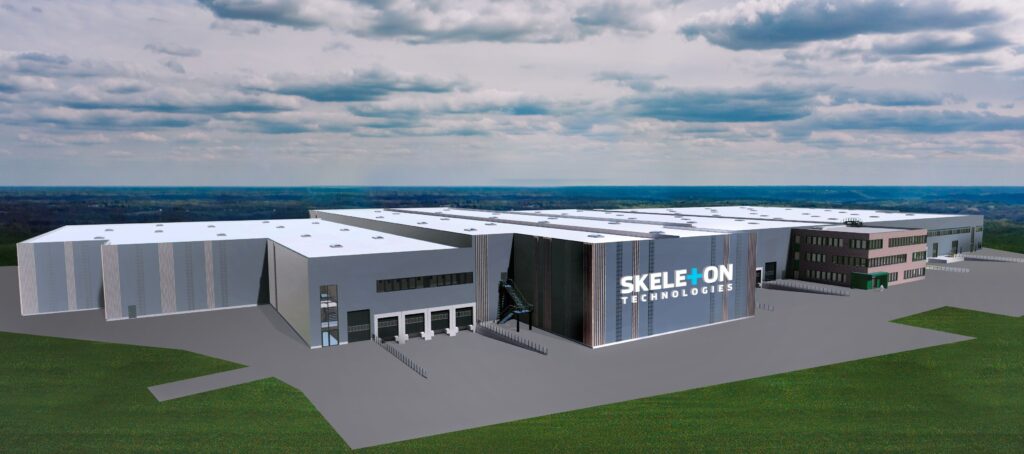
The companies already had an industrial relationship before the 2026 investment. Siemens announced a manufacturing partnership with Skeleton in July 2022 to develop automated and digital production technology for a planned factory in Markranstädt near Leipzig. That project included an ambition to reduce production costs by approximately 90% over five years, which was a target rather than evidence of an achieved reduction. Skeleton later announced that its €220 million SuperFactory officially opened on November 28, 2025, and said the facility was already delivering products for electrical grid and AI infrastructure applications. This history gives the 2026 commercial agreement a manufacturing foundation, although factory opening alone does not establish full utilization, profitability, or production yield.

Why AI Data Centers Need Fast Storage and How Skeleton’s Technology Works
The power challenge behind the partnership is not only the total amount of electricity consumed by data centers, but also how rapidly demand can change. The International Energy Agency projects global data center electricity use at about 485 terawatt-hours in 2025 and roughly 950 terawatt-hours in 2030, with electricity use by AI-focused data centers expected to triple over that period. Those are forecasts rather than guaranteed outcomes, but they illustrate the scale of the broader energy challenge. Annual consumption alone does not reveal how quickly load can rise or fall over milliseconds and seconds, which matters for electrical infrastructure design.
Siemens identifies synchronized computing activity as a source of sharp demand changes. Individual chip demand can shift within milliseconds, while aggregated swings across large systems can reach megawatt scale within seconds. Fast storage can act as a buffer between the computing equipment and upstream electrical infrastructure by supplying power during brief peaks and absorbing energy when demand falls. This changes the shape of the load presented to the grid or facility equipment without creating additional energy.
Skeleton describes GrapheneGPU as a system that provides power during computing peaks and recharges during lower-demand periods. Its product materials advertise a reaction speed below 10 microseconds, which is a manufacturer specification tied to the stated configuration. A hypothetical example would be a cluster that briefly demands more power than the upstream system is intended to deliver. A charged buffer could supply the difference during the peak and replenish itself when demand falls again, reducing the abruptness of the load seen by upstream equipment.
Fast response alone does not determine whether such a system is effective. Sensors must detect changes, power electronics must deliver the required current, and controls must keep the storage system within acceptable voltage and thermal limits. The buffer must also contain enough usable energy for the duration of the event. A system can have very high power capability while sustaining that output only briefly, which is why engineers need workload measurements rather than reaction speed alone.
This distinction also explains the role of peak shaving. Consider a load that alternates between 8 megawatts and 12 megawatts for equal periods, giving an average of 10 megawatts if losses are ignored. Properly sized storage could charge during the lower-demand period and discharge during the higher-demand period, reducing the upstream swing. The storage does not reduce the underlying useful work by itself or create energy, and real systems introduce charging and conversion losses. The economic value depends on which infrastructure limit or electricity tariff creates the constraint.
Supercapacitors and batteries also solve different parts of the power problem. The US Department of Energy describes supercapacitors as having high specific power, rapid charging and discharging, and strong cycle life, but comparatively low energy density and higher self-discharge. Batteries can provide more stored energy for longer-duration needs, while supercapacitors are better suited to frequent short power events. Hybrid arrangements can combine both technologies where an application needs both rapid response and a larger energy reserve, but the economics and control strategy remain application-specific.
Skeleton attributes part of its performance to Curved Graphene, its proprietary electrode material. The company emphasizes control over pore structure and a vertically integrated approach spanning materials, cells, modules, systems, and software. Research on curved graphene and porous electrodes supports the broader importance of balancing surface area with ion transport, although independent academic work should not be treated as direct validation of Skeleton’s commercial products. At system level, the material is only one part of performance because power electronics, thermal management, electrical connections, and controls determine how much of that capability reaches the application.

Energy Savings, GPU Performance Claims, and US Manufacturing Expansion
Skeleton’s October investment announcement claims energy savings of up to 40% and double-digit GPU performance improvements. Its GrapheneGPU materials also cite up to 40% more computing output and reductions of up to 44% in peak connection requirements. These figures describe different measurements and should not be combined into one guaranteed benefit. An earlier May 2025 launch announcement also used separate measures for energy use, connection requirements, and floating-point computing performance, making the baseline and test conditions especially important when interpreting the claims.
A fair evaluation should define what is being measured. If the claim concerns lower energy use, the useful workload should remain constant while electricity consumption is measured at a defined system boundary. If the claim concerns increased useful compute, then output per unit of energy should be reported alongside total energy consumption. GPU performance itself can refer to floating-point operations, tokens per second, completed training work, or application latency, and those metrics are not interchangeable.
Skeleton’s materials also discuss eliminating deliberately wasted work or artificial loads. Removing such behavior could improve useful computation per unit of electricity, but a facility that does not use that operating approach would need a different comparison. The amount of benefit will therefore depend on workload design, electrical architecture, the duration of power excursions, and how the facility currently manages peaks. Claims demonstrated under one constraint should not automatically be generalized to every AI data center.
The Siemens investment is also intended to support Skeleton’s manufacturing expansion in the United States. Skeleton says the financing will accelerate its American manufacturing footprint and plans for domestic cell production, with the goal of creating an integrated US chain from cells through complete systems. This is a manufacturing ambition rather than evidence that the full planned footprint is already operating. Building that capability requires equipment installation, process validation, workforce development, consistent production, and customer qualification.
Skeleton has separately stated plans to invest more than $200 million in Silicon Valley operational expansion and research and development while working directly with hyperscalers. That planned spending should not be confused with the amount of Siemens’ investment or the company’s valuation. The round, the valuation, and the planned expansion budget are different figures. The company has not publicly provided a detailed allocation showing how much of the Silicon Valley spending will go to buildings, equipment, personnel, or individual product programs.
Closer proximity to hyperscale customers could support faster iteration because power systems must be tested against real workload behavior, interfaces, and operating requirements. Manufacturing engineering, field support, product qualification, and testing all contribute to turning a laboratory design into a repeatable commercial product. The relevant milestones will therefore include qualified production lines, saleable output, customer acceptance, reliable delivery, and repeat deployments. Financing supplies resources for those steps, while execution determines whether the scale-up succeeds.
The exclusive Siemens data center agreement may help create a clearer route to market for that expanded capacity. However, exclusivity in the data center sector does not establish Siemens ownership of Skeleton’s intellectual property or exclusive rights in every other industry. It also does not reveal pricing terms, minimum purchase commitments, or all customer support obligations. The practical value for operators will depend on whether the relationship simplifies procurement, commissioning, integration, and maintenance in real installations.
What Remains to Be Proven About Deployment, Economics, and Long-Term Impact
The public announcements establish a substantial financing milestone and a strategic commercial partnership, but they leave important financial and operational questions unanswered. Skeleton’s valuation above $1 billion does not establish profitability, annual revenue, margins, manufacturing utilization, or the exact ownership change created by the round. Assessing those issues would require more detailed financial disclosures. Siemens’ investment also does not by itself prove that customer demand will convert into sustained deployments.
The same caution applies to technical performance. Buyers need to understand how benefits change with workload type, pulse duration, facility architecture, control policies, and existing electrical constraints. A short, high-power excursion may be well suited to a supercapacitor buffer, while sustained demand above available supply creates a different problem because any finite storage system will eventually deplete. The useful question is therefore not whether the technology responds quickly, but whether it is correctly sized and controlled for the actual workload.
Qualification should also include abnormal operating conditions. A storage system needs predictable behavior during faults, communications failures, maintenance, and transitions between operating modes. Reliability depends on the entire design, not only the cell chemistry or advertised reaction time. Conversion losses, thermal limits, protection systems, and control interactions can all influence the delivered benefit.
Commercial success will depend on economics as much as technical capability. Purchase price alone is not enough because installation, maintenance, conversion losses, replacement requirements, service arrangements, and the value of additional useful computing capacity all contribute to the outcome. A data center constrained by short peaks may calculate the value very differently from one already limited by average power availability. Site-specific analysis is therefore essential.
The reported energy savings and GPU performance improvements also need transparent measurement. Operators should know what baseline was used, where electricity was measured, what useful workload was held constant, and whether any improvement came from eliminating artificial loads rather than from the storage device alone. Reproducible results across different facilities would provide stronger evidence than a single headline percentage. The same principle applies to peak connection reductions and claims of higher compute output.
The partnership’s long-term importance will ultimately depend on repeatable deployment. Siemens and Skeleton have a credible strategic rationale for connecting fast storage with grid-to-rack electrical infrastructure, and the investment provides resources for manufacturing and research expansion. The next stage is proving that the combination can be integrated reliably, supported at scale, and delivered with transparent performance and economic results. A unicorn valuation marks a financing milestone, while sustained customer adoption will determine whether the technology becomes a meaningful part of AI data center power architecture.

Frequently Asked Questions (FAQs)
- What did Siemens’ investment change for Skeleton Technologies?
The investment pushed Skeleton Technologies’ valuation above $1 billion and was announced alongside a commercial partnership focused on data center power systems. That valuation represents the implied value of the company based on the financing terms rather than the amount of cash Siemens invested. The agreement also gives Skeleton a stronger commercial route into the data center market through Siemens’ electrical infrastructure business. For Skeleton, this could support manufacturing expansion, product development, and access to larger customers. The real impact will depend on whether the company can turn the new capital and partnership into repeat deployments, reliable manufacturing, and measurable customer benefits. - Was the announcement made on October 15, 2026?
No. The companies’ original announcements were dated October 14, 2026. October 15 appears in later reporting and coverage discussing the transaction after it had already been announced. Keeping those dates separate helps avoid confusing the date of the underlying event with the publication date of follow-up articles. The most accurate way to describe the timing is that Siemens and Skeleton announced the investment and partnership on October 14. Subsequent October 15 reports then provided additional coverage and interpretation. - How much did Siemens invest?
Skeleton described the financing as a nine-digit round led by Siemens, but the exact amount contributed by Siemens was not disclosed in the announcement. The company also did not publish Siemens’ resulting ownership percentage or a detailed breakdown of every participant in the round. Skeleton’s valuation above $1 billion should not be mistaken for the amount invested because valuation and funding are different measurements. The planned US expansion spending, including more than $200 million in Silicon Valley activity, is also a separate figure. The public information therefore supports describing the financing as substantial without assigning Siemens a precise investment amount. - What does Siemens’ exclusivity cover?
The disclosed agreement gives Siemens exclusive global rights to sell and scale Skeleton’s products in the data center market. That exclusivity applies to the market identified in the announcement and should not automatically be extended to unrelated industries where Skeleton may also operate. The public materials do not provide every contractual detail, such as possible exceptions, minimum purchase commitments, pricing terms, or customer-specific arrangements. Siemens also plans to integrate Skeleton’s technology into its wider electrical infrastructure offering. The practical scope of the exclusivity will therefore become clearer as products, customer agreements, and deployment models are announced. - Why are supercapacitors relevant to AI computing?
AI computing systems can create extremely fast changes in power demand as processors move between different workloads. Supercapacitors are well suited to brief, repetitive power events because they can charge and discharge quickly and tolerate many cycles. Positioned close to the computing load, they can temporarily supply part of a power spike and recharge when demand falls. This can reduce the size of the rapid load swing seen by upstream electrical equipment. Their usefulness still depends on having enough power capability and stored energy for the event, as well as proper integration with power electronics, controls, and the rest of the facility. - Can these systems replace long-duration batteries?
Not automatically. Supercapacitors and batteries have different strengths, so the correct choice depends on how long the storage system needs to provide power and how frequently it must cycle. Supercapacitors generally offer very fast response and high cycle life but lower energy density, making them well suited to short bursts. Batteries can store more energy for longer-duration events such as extended backup requirements. A data center may therefore use both technologies, assigning each to the type of event it handles best. - Does peak shaving reduce total electricity consumption?
Not necessarily. Peak shaving primarily reshapes when power is drawn by using storage to absorb or supply energy during short changes in demand. A smoother demand profile can reduce stress on upstream equipment or lower a facility’s maximum connection requirement without automatically reducing the total amount of useful energy consumed. Storage also introduces charging and conversion losses, so simply moving energy between time periods does not create a guaranteed reduction in overall consumption. Energy savings may occur if the system allows inefficient operating practices or artificial loads to be removed. Any claimed saving therefore needs a clearly defined baseline and measurement boundary. - Are the advertised GPU performance gains guaranteed?
No. Skeleton’s published performance figures are company claims tied to particular configurations, workloads, and measurement methods. Results can vary depending on the existing power architecture, workload behavior, thermal limits, controls, and whether the site already uses techniques that the storage system is intended to replace. A percentage increase in floating-point performance is also not the same as an identical improvement in tokens per second, application latency, or completed training work. Buyers should compare useful output and energy consumption under equivalent conditions. The most reliable evidence would come from measurements taken on representative workloads within the customer’s own environment. - What is the purpose of the planned US expansion?
Skeleton says the investment will support a larger American manufacturing and development presence, including plans for domestic cell production. The goal is broader than adding a sales operation because a full manufacturing chain can involve electrode materials, cells, modules, complete systems, testing, and supporting engineering. The company has also announced plans to invest more than $200 million in Silicon Valley operational expansion and research and development. That spending is intended to bring product development closer to hyperscale customers and support faster qualification and deployment. The commercial value will depend on whether those plans lead to qualified production, consistent output, reliable delivery, and successful customer installations. - What evidence would demonstrate the partnership’s success?
The strongest evidence would come from repeatable customer deployments rather than the investment announcement alone. Buyers and investors would want to see dependable manufacturing output, successful qualification, transparent performance measurements, and systems that operate reliably under real data center workloads. Customer economics are equally important, including whether the technology lowers infrastructure constraints or improves useful computing enough to justify its installation and operating costs. Repeat purchases would provide further evidence that initial deployments created practical value rather than serving only as demonstrations. Together, those results would show whether the Siemens and Skeleton partnership can translate its strategic promise into a sustainable data center business.
Conclusion
Siemens’ investment represents both a financing milestone and a broader commercialization opportunity for Skeleton Technologies as AI data centers place greater demands on electrical infrastructure. The move above a $1 billion valuation reflects investor interest in fast-response energy storage, but the engineering case still depends on whether supercapacitors can reliably smooth short power fluctuations and reduce pressure on upstream systems in real deployments.
The announcement’s different elements should therefore remain distinct: the valuation reflects the financing outcome, the exclusive partnership defines commercial rights, the US expansion plans describe intended scale-up, and the performance claims still require workload-specific validation. The partnership will become more meaningful if those commitments translate into dependable manufacturing, repeat customer deployments, and measurable improvements in how efficiently data centers use available power and infrastructure. Those operating results, rather than the valuation or investment announcement alone, will provide the clearest evidence of the partnership’s long-term importance to AI data center power design.
Sources and Citations
- Skeleton Technologies, October 14, 2026: Skeleton’s primary announcement confirms a Siemens-led nine-digit investment round, a valuation of more than $1 billion, plans to expand U.S. manufacturing and Silicon Valley R&D, domestic cell-production ambitions, and company claims of up to 40% energy savings and double-digit GPU-performance improvements. It also says Skeleton plans to invest more than $200 million in Silicon Valley operations and R&D. skeletontech.com
Skeleton Technologies, Siemens-led investment announcement - Siemens, October 14, 2026: Siemens confirms the strategic investment and an exclusive global data-center partnership, under which Siemens plans to integrate Skeleton’s supercapacitor technology into its electrical-infrastructure portfolio and gains exclusivity to sell and scale Skeleton products in the data-center market. Siemens Press
Siemens investment and partnership announcement - European Institute of Innovation and Technology, October 21, 2026: EIT confirms that the Siemens investment pushed Skeleton into unicorn status above $1 billion and notes InnoEnergy’s longstanding financial and business-development support for the company. EIT
EIT, Skeleton Technologies reaches unicorn status - International Energy Agency, “Key Questions on Energy and AI,” April 16, 2026: The IEA projects global data-center electricity consumption rising from about 485 TWh in 2025 to 950 TWh in 2030, while electricity use by AI-focused data centers is projected to triple over the same period. IEA
IEA, Key Questions on Energy and AI - U.S. Department of Energy, “Findings from Storage Innovations 2030: Supercapacitors”: DOE explains that supercapacitors offer high specific power, very fast charging/discharging, long cycle life and broad operating-temperature capability, but have comparatively low energy density and high self-discharge, making them better suited to frequent short-duration power events than long-duration storage. The document itself is dated July 2023, despite the newer file-path date. The Department of Energy’s Energy.gov
DOE Supercapacitors Technology Strategy Assessment - University of Washington Clean Energy Institute, “Supercapacitor”: The Clean Energy Institute explains the electrostatic storage mechanism, porous electrode structure, rapid charge/discharge behavior, long cycle life, and the key trade-off with lithium-ion batteries: supercapacitors provide much higher power but considerably lower energy density. CEI Washington
University of Washington Clean Energy Institute, Supercapacitor - NASA, 2026 State-of-the-Art of Small Spacecraft Technology, Power: NASA’s updated power chapter compares Li-ion batteries and supercapacitors and discusses hybrid battery-supercapacitor energy-storage systems, where batteries provide energy capacity while supercapacitors handle short peak-power demands. NASA also emphasizes the much higher power density and cycle life of supercapacitors versus their lower energy density. NASA
NASA Small Spacecraft Technology, Power Subsystems - Skeleton Technologies, GrapheneGPU: Skeleton’s product page claims up to 40% more FLOPS, up to 44% lower peak grid-connection requirements, and up to 45% higher energy efficiency by smoothing GPU load swings and eliminating artificial compute loads. These are manufacturer claims rather than independently established universal results. skeletontech.com
Skeleton GrapheneGPU product page - Skeleton Technologies, May 28, 2025: Skeleton’s original GrapheneGPU launch announcement claimed up to 45% lower AI energy consumption, a 44% reduction in power-connection requirements, and a 40% FLOPS improvement, while describing the system as storing energy during lower-demand periods and releasing it during GPU peaks. skeletontech.com
Skeleton GrapheneGPU launch announcement - Siemens, October 2026, “What is a supercapacitor used for?”: Siemens explains the relevance of supercapacitors to AI data centers as fast “shock absorbers” for megawatt-scale power fluctuations. It describes peak shaving, rapid charge/discharge and reduced stress on electrical infrastructure while noting that supercapacitors are less suitable for long-duration storage. Siemens Blog
Siemens, What is a supercapacitor used for? - Infineon Technologies, September 2, 2026: Infineon and Skeleton announced an MoU covering solid-state transformers, high-power sidecars, silicon-carbide power semiconductors, gallium-nitride peak-shaving systems, and supercapacitor integration for next-generation AI data centers. Infineon Technologies
Infineon and Skeleton AI data-center collaboration - Skeleton Technologies / DG Matrix, July 22, 2026: The companies announced a collaboration to integrate Skeleton’s high-power fast-response storage with DG Matrix’s 800 VDC Interport solid-state transformer architecture, including solutions intended to mitigate GPU pulse loads close to the computing equipment. skeletontech.com
DG Matrix and Skeleton 800 VDC collaboration - Skeleton Materials, Curved Graphene: Skeleton describes Curved Graphene as its proprietary material platform and emphasizes a vertically integrated strategy spanning carbon material, cells, modules, systems, control algorithms and software. skeletontech.com
Skeleton Materials, Curved Graphene technology - Skeleton Technologies, SkelCap SCX Series: The SCX5000 page lists 3 V, 5,000 F capacitance, 0.2 mΩ ESR, 28.4 kW/kg specific power and 11.1 Wh/kg specific energy, showing why power and energy ratings must be treated as separate performance measures. skeletontech.com
Skeleton SkelCap SCX ultracapacitor cells - Nature Communications, September 15, 2025: This peer-reviewed study examines multiscale curved graphene, pore-ion matching and ion transport in supercapacitor electrodes. It supports the broader scientific discussion of curved graphene structures but should not be presented as independent validation of Skeleton’s commercial GrapheneGPU systems. Nature
Nature Communications curved graphene study - Siemens, July 25, 2022: Siemens and Skeleton announced their earlier manufacturing partnership for a new factory near Leipzig, including a fully automated digital production line and a stated ambition to reduce production costs by about 90% over five years. That percentage was a project target, not a confirmed achieved result. Siemens Press
Siemens and Skeleton 2022 manufacturing partnership - Skeleton Technologies, December 1, 2025: Skeleton reports that its €220 million Leipzig SuperFactory officially opened on November 28, 2025. The company says the facility was already delivering products to electrical-grid customers and U.S. hyperscalers for AI infrastructure and is designed for annual production of up to 12 million cells. skeletontech.com
Skeleton Leipzig SuperFactory opening announcement
Recommendations
- Where Winds Meet, Official Imperial Palace Gameplay Trailer Explained: Release Date, Story, Combat Details & Everything We Know
- Diablo 4 3Rd Anniversary Event: Goblins, Massive XP Boost, Free Cosmetics, and Full June 2–9 Celebration Guide
- IO Interactive and Build A Rocket Boy End MindsEye Partnership as Hitman Crossover DLC Is Canceled
- All Anomalies in Animal Hospital Guide: Every Roblox Anomaly Explained
- Every Release Date from Every Event at Summer Game Fest 2026
- First Gameplay Trailer of Silent Hill: Townfall: It’s a First-Person Game and Everything We Know (2026)
- Best New Anime to Watch Right Now: Spring 2026 Picks
- Switch 2 Software Update Adds “Handheld Mode Boost” for Old Games – Performance Upgrade Explained
- We Build LEGO Winnie the Pooh: A 100th Anniversary Set Worth the Hype for Disney and LEGO Fans
- Echoes of Aincrad: Complete Guide to Growth Points (Best Stat Builds & Leveling Tips)



































































































