










In This Article (7 sections)
Skill Infinity Meta Agent: How Self Improving AI Skills and Optimizer Modification Work
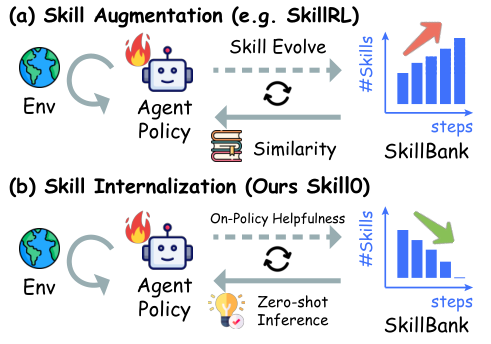
Skill∞ raises an important question about AI agents: can a system improve the reusable instructions it follows while also improving the process responsible for creating those instructions? The concept connects agent skills, execution feedback, automated optimization, and AI self improvement. An October 27, 2026, AI Weekly headline describes a meta agent capable of rewriting its own skill optimizer and outperforming human curated skills on SkillsBench.
However, a corresponding primary paper, official repository, and complete evaluation configuration could not be authenticated under the Skill∞ name. The headline establishes that the claim is circulating, but it does not independently verify the technical results. Related research into skill refinement and optimizer modification provides useful context for understanding how such a system could work.
A meta agent is an agent responsible for improving how another agent operates. A conventional task agent might analyze spreadsheets, repair software, or prepare reports, while a skill optimizer reviews execution results and revises reusable instructions to improve future performance. A meta agent adds another level by modifying the optimizer’s own procedures for diagnosing failures, generating revisions, testing candidates, and selecting improvements. However, without authenticated technical documentation, it remains uncertain whether Skill∞ modifies natural language instructions, executable code, tool definitions, selection rules, or several components together. These possibilities have different implications because editing a prompt is a narrower intervention than rewriting software responsible for conducting and evaluating optimization experiments.
The description associated with Skill∞ contains two separate claims: that its optimizer can modify itself and that the resulting skills outperform human curated alternatives. One does not automatically establish the other. An optimizer might successfully revise its procedures without improving task performance, while generated skills might achieve better results because of additional evaluation attempts, stronger models, or access to more task information.
Confirming the contribution of self modification would require comparing the system with an otherwise identical optimizer that cannot modify itself. The meaning of improvement must also be defined, since higher success on familiar tasks, stronger generalization, lower execution costs, and faster optimization are different outcomes. The available description does not establish indefinite improvement or consistent performance across every domain.
A skill optimizer revises external resources that an AI agent uses for recurring tasks. These resources may contain procedural instructions, scripts, examples, reference documents, and templates. The Agent Skills specification describes a skill as a folder centered on a SKILL.md file, optionally accompanied by supporting resources. This makes optimization a concrete process of improving reusable instructions and tools rather than an undefined increase in intelligence.
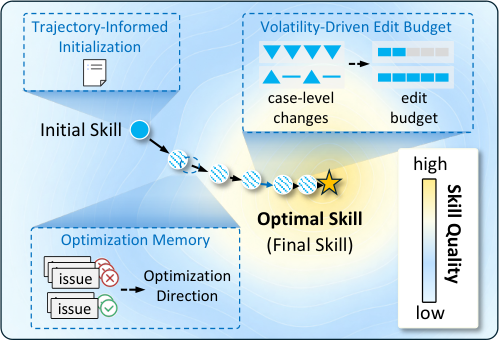
For example, a document processing skill might initially instruct an agent to extract text and save the result. If testing reveals that scanned documents produce empty outputs, an optimizer could add a check for missing text and an appropriate optical character recognition procedure. The improvement comes from connecting an observed failure to a practical correction, not simply adding more instructions. The optimizer must also determine whether a revision should be retained, rejected, or tested further, since fixing one problem can introduce failures elsewhere.
A possible Skill∞ architecture would involve two interacting optimization loops:
- Inner optimization loop: Revises task skills, tests their performance, identifies failures, and selects useful improvements.
- Outer optimization loop: Reviews the skill optimizer’s behavior and modifies how it diagnoses problems, generates revisions, or evaluates candidates.
- Execution feedback: Supplies information about task outcomes, errors, successful procedures, and the effects of earlier changes.
- Revision selection: Determines whether updated skills or optimizer procedures should replace previous versions.
- External evaluation: Measures improvements using criteria that the optimizer cannot modify to artificially increase its score.
For instance, an inner optimizer might repeatedly add instructions addressing individual failures. The outer optimizer could recognize that these additions create contradictions and change the editing procedure to detect conflicting rules before accepting another revision. Other possibilities include improving execution log summaries, allocating experiments more efficiently, preserving successful earlier versions, and requiring stronger evidence before approving changes. These are illustrative mechanisms rather than verified features of Skill∞.
Related research demonstrates that optimizer self modification is an established research direction. VERSE describes an optimizer capable of revising an executor’s surrounding software and its own prompts, skills, tools, hooks, and notes while keeping model weights fixed. Its experiments emphasize execution based verification. For such systems, evaluation criteria should remain outside the components being modified. Otherwise, an apparent improvement might result from weakening the tests rather than improving the agent. Recording modifications also helps distinguish productive revisions from incidental changes.
Skill optimization differs from conventional model training because it changes the external information and procedures available to an already trained model rather than updating its internal numerical parameters. SkillEvolver provides a documented example, identifying skill prose and code as the optimization targets while leaving model weights unchanged. A useful comparison is updating a technician’s checklist: better instructions can prevent mistakes and improve performance without changing the technician’s underlying qualifications.
This distinction also explains why training free optimization is not necessarily inexpensive. Avoiding model weight updates does not eliminate the costs of model calls, experiments, execution environments, or evaluation. A system may conduct extensive searches across different instructions while leaving the underlying neural network unchanged. Therefore, improvements from revised skills should not automatically be described as permanent new capabilities acquired by the model.
Execution feedback is essential because instructions that sound reasonable do not always work in practice. Failed runs can reveal incorrect input selection, misunderstood tool responses, missing transformations, or inadequate output validation. Effective revisions target the causes of these failures rather than adding general warnings. For example, if a data processing agent incorrectly assumes that every date uses the same format, a useful revision would require inspecting the actual format before conversion instead of hardcoding one format from a previous example.
Successful executions must also be considered because a change that fixes one failure may disrupt several previously correct cases. The evaluation should establish whether the revised skill was actually loaded and influenced the agent’s behavior. SkillEvolver discusses audits for situations in which valid skills are bypassed during execution. The objective is to preserve reusable procedural knowledge supported by observed results, with enough context to explain when each instruction applies.
Skill∞ vs Human Curated Skills: SkillsBench Performance, Generalization, and Optimization Costs
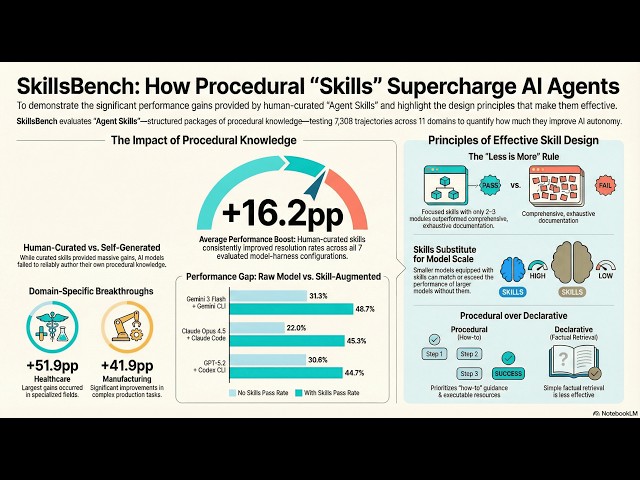
SkillsBench evaluates whether reusable skills improve an AI agent’s ability to complete tasks. Its design compares performance under different skill conditions, allowing researchers to measure the contribution of procedural instructions. Benchmark version identification is essential because different releases contain different task inventories and configurations. The original SkillsBench paper described 86 tasks across 11 domains, with its principal results using 84 evaluated tasks. SkillsBench 1.1 describes 87 tasks across eight domains. These versions should not be treated as identical evaluations.
SkillsBench 1.1 reports that curated skills increased mean task resolution from 33.9% to 50.5% across 18 model and harness configurations, an improvement of 16.6 percentage points. These findings concern the stated SkillsBench evaluation and are not verified results for Skill∞. The original benchmark also used programmatic verification to assess task outputs, reducing dependence on subjective model judgments. Nevertheless, the reliability of the results still depends on whether those checks accurately capture task requirements.
The central claim associated with Skill∞ is that its automatically optimized skills outperform instructions curated by humans. A fair comparison must keep the task solving environment consistent while changing the skills supplied to the executor. Otherwise, differences in performance cannot confidently be attributed to skill quality. Important requirements for a reliable comparison include:
- Identical execution conditions: The same model, tools, runtime limits, reasoning settings, and task inputs.
- Comparable skill availability: Generated skills and skills curated by humans should use equivalent loading and discovery mechanisms.
- Transparent preparation: Researchers should disclose whether the optimizer received repeated feedback from benchmark tasks.
- Consistent scoring: Both conditions must use the same success criteria and treatment of failures.
- Controlled computational budgets: Additional attempts, generated tokens, and optimization costs should be accounted for.
- Independent testing: Final skills should be evaluated on tasks that did not influence their development.
- Component comparisons: An optimizer that modifies itself should be tested against an otherwise matched fixed optimizer.
Preparation differences are particularly important. A skill curated by a human may contain general domain guidance, while an automated optimizer might receive repeated feedback from the exact tasks later used for evaluation. Higher performance in that setting could demonstrate successful adaptation to familiar tasks without proving better generalization. Both outcomes are useful research subjects, but they must be identified separately. The starting material also affects interpretation. Improving an existing package written by humans differs from creating a skill without it. If an automated system retains substantial guidance authored by humans, its success may demonstrate effective refinement rather than entirely independent skill creation.
Benchmark scores also require careful interpretation. A percentage might represent complete task success, partial rewards, or success after multiple attempts. Results obtained from selected tasks should not be described as performance across the entire benchmark without accounting for exclusions, missing runs, infrastructure failures, and timeouts. Repeated trials are valuable because agent execution can vary, making uncertainty estimates more informative than a single favorable result. Percentage points should also be distinguished from relative percentage improvement. For example, increasing success from 40% to 50% represents a gain of 10 percentage points or a relative improvement of 25%. These descriptions are mathematically different and should not be used interchangeably.
Automatically generated instructions can appear polished without introducing useful knowledge. They may repeat existing advice, restate task requirements, or introduce assumptions that become persistent errors. The original SkillsBench study reported a mean decline of 1.3 percentage points under its self generated skill condition. That experiment examined procedural knowledge generated before task execution and should not be treated as a universal assessment of iterative optimization driven by feedback.
Generating instructions once and optimizing them repeatedly are different processes. The first relies on information already available to the model, while the second can incorporate evidence from actual executions. Instructions written by humans may also contain expert knowledge, verified tool behavior, and known exceptions that an automated generator does not possess. However, human authorship alone does not guarantee quality because manually created instructions can be outdated, ambiguous, or poorly suited to an execution environment. The meaningful comparison concerns actual task behavior: whether the agent discovers the relevant skill, follows the procedure, produces the required output, and avoids unnecessary work. Execution under matched conditions provides stronger evidence than judging the apparent quality of the written instructions alone.
Generalization presents another major challenge. Repeated optimization can improve results on familiar tasks while introducing instructions that fail elsewhere. A skill may accumulate specific filenames, fixed values, or assumptions taken from earlier examples. Such changes can improve benchmark scores without making the skill broadly reusable.
A separate study, Do Self Evolving Skills Generalize to Held Out Tasks?, reported that among 21 skills showing improvements on training tasks, five retained all those gains on test tasks, 13 retained some, and three retained none. These findings concern the methods examined in that research rather than Skill∞, but they illustrate why performance on familiar tasks cannot establish generalization. Transfer should be evaluated using tasks that did not influence skill revisions or final candidate selection. Different tests examine different forms of generalization:
- New inputs within the same task family test whether procedures work beyond specific examples.
- New repositories or organizations test adaptability to unfamiliar conventions.
- New task domains examine broader applicability.
- Different executor models test whether optimized instructions depend on a particular model.
- Untouched evaluation tasks help identify shortcuts specific to the benchmark.
SkillNEO, another skill evolution study, explicitly states that its final evaluation uses the same task instances while also reporting reuse across stronger models. Reuse across models provides evidence about transfer between executors, but it does not independently establish performance on unseen tasks. A suitable evaluation for Skill∞ would freeze the optimizer and resulting skills before testing them on an untouched task collection. If additional adaptation occurs during evaluation, researchers should disclose what feedback is available and include its computational cost. Tests should introduce meaningful variations rather than merely changing filenames while preserving the same solution structure.
Optimization efficiency also deserves attention. No authenticated cost breakdown was available for Skill∞, preventing a reliable assessment of its resource requirements. A complete analysis should distinguish the cost of creating optimized skills from the cost of applying them during later tasks. Creation expenses include candidate generation, execution, feedback analysis, optimizer revisions, and unsuccessful experiments.
Usage expenses include loading the final skill and completing downstream work. Expensive preparation may become worthwhile when a skill is reused frequently, but the number of uses required depends on the savings achieved during execution. For illustration, a hypothetical optimization process costing $60 and saving $0.20 per subsequent task would require approximately 300 uses to recover its preparation cost, assuming other costs and success rates remain unchanged.
Token efficiency also depends on more than instruction length. A shorter skill might omit important checks and create additional debugging work. The study What Should a Skill Remember? examines the tradeoffs between preserved procedural information, quality, and cost. Useful comparisons should therefore report total execution expense, latency, task success, and cost per successful outcome. Ultimately, higher benchmark performance alone would not establish that Skill∞ is more efficient or broadly effective. The result must be considered alongside preparation effort, generalization, reliability, and the contribution of optimizer self modification.
Skill∞ Research Verification, Benchmark Overfitting, and Independent Reproduction Requirements
As of October 27, 2026, a primary paper identifier, author maintained repository, and official evaluation configuration could not be authenticated for Skill∞. This limitation does not prove that the project or its materials do not exist, but it prevents independent confirmation of the specific performance claim, implementation details, and computational requirements.
A reliable source chain should connect the project name to identifiable authors, a primary research publication, an official code repository, and the artifacts used to produce its reported results. Similarly named projects are insufficient evidence of that connection.
SkillsBench itself has identifiable public research materials. Its official repository is maintained under benchflow ai/skillsbench, while its research paper is identified as arXiv:2602.12670. The benchmark materials provide task packages, evaluation tools, and information about versioned releases. However, these resources establish the benchmark’s existence, not the authenticity of Skill∞’s reported results.
Reproducing an optimization claim requires more than installation instructions. Researchers need the initial skills, final optimized versions, optimizer configurations, model identifiers, benchmark release, task splits, computational budgets, scoring procedures, and individual execution results. Repository history is also important because a project’s current implementation may differ from the version used to produce published findings. A release tag or commit identifier helps connect results to specific software.
Benchmark overfitting remains a major concern for any system that repeatedly revises instructions according to execution feedback. An optimizer may learn shortcuts that improve familiar tasks while reducing adaptability. For example, a general report writing skill might incorrectly preserve a particular organization’s name because it appeared repeatedly in development examples. That instruction could improve one benchmark case while producing errors elsewhere.
Even when a final test collection remains hidden, repeated experimentation can cause increasingly close adaptation to development tasks. Researchers should therefore document how often feedback influenced revisions, preserve an untouched evaluation collection, and inspect optimized skills for assumptions tied to individual benchmark examples.
Independent reproduction should answer several questions:
- Does optimizer self modification outperform a fixed optimizer under the same computational budget?
- Do improvements persist when final skills are tested on unfamiliar tasks?
- Are performance gains consistent across repeated runs?
- Can another executor model benefit from the optimized skills?
- How much computation is spent on unsuccessful revisions?
- Do the final skills contain benchmark specific information that limits their portability?
- Can independent researchers reproduce both the reported scores and the explanation for those improvements?
Reproducing a numerical result and verifying its cause are different achievements. An independent team might observe similar performance gains but discover that additional feedback, improved skill loading, or more optimization attempts explain most of the difference. Establishing the contribution of self modification requires experiments that isolate that mechanism.
Unsuccessful revisions also deserve attention. A system that occasionally produces an excellent skill after numerous expensive failures has different practical value from one that improves reliably within a small resource budget. The scope of retained knowledge matters as well because instructions containing details specific to individual benchmark cases may perform poorly when reused elsewhere.
Related research into optimizer self modification and feedback driven skill refinement demonstrates that the general concept is technically plausible. However, those studies cannot independently establish the implementation or results attributed to Skill∞. Their findings provide context rather than confirmation.
The most meaningful evidence would come from authenticated primary materials, controlled experiments, transparent resource accounting, and independent reproduction. Until those materials are available, Skill∞ should be understood as a reported research claim rather than a verified demonstration that a meta agent can consistently outperform human curated skills through optimizer self modification.
The broader research question remains valuable. An AI agent that can improve reusable instructions and the process responsible for creating them could potentially become more effective without changing its underlying model weights. Whether that capability produces reliable advantages depends on the quality of execution feedback, the stability of revisions, performance on unseen tasks, and the computational resources required.
Frequently Asked Questions (FAQs)
- What is Skill∞ supposed to do?
Skill∞ is described as a meta agent that improves reusable AI agent skills while modifying the optimizer responsible for creating those skills. An October 27, 2026, headline claims that the system outperforms human curated skills on SkillsBench. However, the primary paper, official implementation, and complete evaluation settings could not be authenticated, so the reported performance remains unverified. - Does self improving agent software necessarily change model weights?
No. An AI system can improve its external instructions, scripts, tools, and workflows without modifying the numerical parameters of its underlying language model. Skill optimization focuses on improving the procedures available to an agent, while conventional model training changes the model itself. These approaches can both improve performance, but they operate on different components and require different forms of evaluation. - What is the difference between a skill and a skill optimizer?
A skill is a reusable collection of instructions, scripts, examples, or supporting resources that helps an agent complete particular tasks. A skill optimizer examines how those resources perform and revises them to improve future results. A meta optimizer goes further by changing the optimization process itself, potentially improving how failures are diagnosed, revisions are generated, or successful candidates are selected. - Has Skill∞ been independently shown to outperform human curated skills?
An independent reproduction confirming that result could not be authenticated for this article. A reliable comparison would require the original experimental materials and matching evaluation conditions, including the same benchmark version, executor model, task collection, scoring procedure, and computational budget. Without these details, the reported advantage cannot be confidently attributed to optimizer self modification. - Why does the SkillsBench version matter?
Different SkillsBench releases contain different task inventories, evaluation configurations, and reporting conditions. Consequently, scores obtained from separate versions cannot automatically be compared as though they came from the same experiment. Researchers must identify the exact benchmark release, task set, model, and scoring procedure before interpreting performance differences or claims of improvement. - Can automatically generated instructions outperform human written ones?
Yes, automatically generated instructions can potentially outperform human written guidance when testing and execution feedback help identify better procedures. However, this is not guaranteed. Human instructions may contain valuable expert knowledge, while automated optimization may benefit from repeated experimentation. A meaningful comparison must account for differences in available information, preparation effort, and testing conditions. - Does a higher score prove that a skill generalizes?
No. A higher score on familiar evaluation tasks may indicate successful adaptation to those examples without demonstrating broader usefulness. Generalization requires testing on tasks that did not influence the optimization process. Ideally, researchers should examine new inputs, unfamiliar task families, different environments, and alternative executor models to determine whether improvements remain effective beyond the original benchmark. - Are shorter skills always cheaper to use?
No. Shorter instructions may reduce the number of tokens required to load a skill, but they can also omit important procedures, checks, or explanations. Missing information may cause additional exploration, debugging, or failed attempts. Efficiency should therefore be measured through total execution cost, task success, and preparation expenses rather than instruction length alone. - What is the main risk of repeatedly revising skills from failures?
The main risk is introducing changes that solve individual problems while reducing performance on other tasks. An optimizer may preserve assumptions, filenames, or procedures specific to familiar examples and incorrectly apply them more broadly. Testing previously successful cases and evaluating untouched tasks helps determine whether a revision produces reusable improvements or merely adapts to a limited set of examples. - What evidence would make the performance claim more convincing?
The strongest evidence would include an identifiable research paper, official code repository, versioned skill artifacts, transparent computational costs, matched baselines, and independent reproduction. Experiments comparing the meta optimizer with an otherwise identical fixed optimizer would help establish whether self modification contributes to the reported gains. Testing unfamiliar tasks and repeating experiments would further demonstrate reliability and generalization.

Conclusion
Skill∞ presents an interesting possibility: an AI agent could improve both its reusable procedures and the process responsible for optimizing them. Existing research on skill evolution and optimizer self modification supports the technical plausibility of this approach, but it does not independently verify Skill∞’s reported results.
SkillsBench provides an established framework for evaluating agent skills, while related studies examine feedback driven refinement, generalization, and computational efficiency. However, the specific research paper, implementation, and performance claims associated with Skill∞ still require authenticated primary evidence. The most important questions concern which components the system modifies, what feedback it receives, how much experimentation it requires, and whether improvements extend beyond familiar tasks. Until reproducible evidence answers these questions, Skill∞’s reported advantage over human curated skills remains an unverified claim.
Sources and Citations
- AI Weekly, October 27, 2026 – Skill∞ announcement and benchmark claims
- AI Weekly reports that Skill∞ uses a meta-agent to optimize task skills and then apply the same process to rewrite the meta-skill that governs optimization itself. Its coverage reports a 60.7% pass rate across 83 SkillsBench tasks, compared with 56.4% for human-curated skills and 54.5% for SkillEvolver. AI Weekly
- Citation: AI Weekly – Skill∞ Lets a Meta-Agent Rewrite Its Own Skill Optimizer
- Wangcheng Tao, Zhanglu Yan, Han Wu and Weng-Fai Wong – Skill∞: Recursive Self-Improvement for Agent Skill Optimization
- The primary arXiv paper is arXiv:2610.35434, submitted on October 26, 2026. It describes Skill∞ as a recursively self-improving skill optimizer in which a meta-agent diagnoses execution traces, proposes candidate revisions, requests independent reviews, allocates search budget, and also improves the meta-skill defining that process. The paper reports the same 60.7% / 56.4% / 54.5% SkillsBench comparison. arXiv
- Citation: arXiv – Skill∞: Recursive Self-Improvement for Agent Skill Optimization
- Agent Skills – Official Overview
- Agent Skills documentation defines a skill as a portable folder built around a required SKILL.md file containing metadata and task instructions, with optional scripts, references, templates and other resources. It also describes progressive discovery, activation and execution of skills by compatible agents. Agent Skills
- Citation: Agent Skills – Official Overview
- Agent Skills – Official Specification
- The formal specification documents the required directory structure and SKILL.md format, including YAML frontmatter, required
nameanddescriptionfields, and optionalscripts,references, andassetsdirectories. This is the strongest source for the article’s description of skills as external procedural packages rather than model-weight updates. Agent Skills - Citation: Agent Skills – Specification
- Xiangyi Li and colleagues – SkillsBench: Benchmarking How Well Agent Skills Work Across Diverse Tasks
- The original SkillsBench paper is arXiv:2602.12670. It introduces a benchmark of 86 tasks across 11 domains, with tasks evaluated using no skills, curated skills and self-generated skills. The paper reports that curated skills raised average pass rate by 16.2 percentage points, while self-generated skills provided no average benefit in that original evaluation. arXiv
- Citation: arXiv – SkillsBench
- SkillsBench Team, June 16, 2026 – SkillsBench 1.1
- SkillsBench 1.1 updates the benchmark to 87 tasks across eight domains and reports results across 18 model-harness configurations. In the published aggregate, curated skills increase mean resolution from 33.9% to 50.5%, a gain of 16.6 percentage points. SkillsBench
- Citation: SkillsBench – SkillsBench 1.1 Release
- BenchFlow – SkillsBench GitHub Repository
- The official BenchFlow repository contains runnable SkillsBench tasks, task packages, verifiers, oracle solutions, experiment tooling and benchmark infrastructure. It describes SkillsBench as a benchmark for measuring how effectively AI agents use reusable skill packages. GitHub
- Citation: GitHub – benchflow-ai/skillsbench
- Genrui Zhang and colleagues – SkillEvolver: Skill Learning as a Meta-Skill
- arXiv:2605.10500 introduces SkillEvolver, which iteratively authors, deploys and refines skills using execution feedback while leaving underlying model weights unchanged. Its optimization targets are the skill’s prose and code. The paper reports 56.8% accuracy across 83 SkillsBench tasks in its own evaluation, versus 43.6% for curated human skills and 29.9% without skills. arXiv
- Citation: arXiv – SkillEvolver: Skill Learning as a Meta-Skill
- Zekai Wang and colleagues – VERSE: Verified Self-Evolving Optimizer for Agent Harnesses
- arXiv:2610.02616 studies optimizer self-modification with execution-based verification. VERSE can revise an executor harness as well as its own prompts, skills, tools, hooks and notes while keeping model weights fixed. The paper reports held-out gains on SWE-rebench and newer out-of-distribution tasks and emphasizes that self-evolution is most effective when paired with execution verification. arXiv
- Citation: arXiv – VERSE: Verified Self-Evolving Optimizer for Agent Harnesses
- Enze Ma and colleagues – SkillNEO: Non-Elitist Evolutionary Optimization of Agent Skills
- arXiv:2610.20926 proposes a skill-evolution method that allows lower-scoring intermediate versions to continue evolving rather than discarding them immediately. Across 86 SkillsBench tasks in eight domains, the paper reports GPT-5.4 Mini improving from 49.1% to 66.4%, with the resulting skills also helping stronger models without further editing. arXiv
- Citation: arXiv – SkillNEO
- Qinghua Xing and colleagues – What Should a Skill Remember?
- arXiv:2606.09421 studies quality-cost tradeoffs in skill rewriting rather than treating shorter instructions as automatically better. The paper reports that its learned policy reduced total cost by 7.0% and downstream agent-token cost by 6.0% in its main held-out evaluation while preserving verifier quality. arXiv
- Citation: arXiv – What Should a Skill Remember?
- Xihao Piao, Zifeng Wang and Zhen Chen – Do Self-Evolving Skills Generalize to Held-Out Tasks?
- arXiv:2609.39148 directly examines whether improvements on training tasks transfer to unseen tasks. Of 21 skills that improved during training, five retained all gains on test tasks, 13 retained some, and three retained none. The authors highlight task-specific overfitting as a major failure mode and argue that execution-based testing remains necessary. arXiv
- Citation: arXiv – Do Self-Evolving Skills Generalize to Held-Out Tasks?
Recommendations
- Vivian Kubrick Debunks Eyes Wide Shut Deleted Scenes Theory
- Battlefield 6 2026 Roadmap: More Maps, “Legendary” Battlefield 4 & Battlefield 3 Remakes, and Wake Island’s Return
- Apple TV’s Widow’s Bay is the First Breakout TV Hit of 2026: Why Everyone is Talking About the Horror Comedy
- Pitchify Launches New Service to Connect Developers and Publishers: How Pitch Direct Works
- Pokémon Pokopia Bubbly Basin DLC Release: Date, New Pokémon, and Everything You Need to Know
- Nordic Game 2026 (NG26 Spring): Dates, Venue, Passes, Speakers, Expo & Awards in Malmö
- Subnautica 2 Early Access Roadmap: Co-Op Updates, Sprinting, and More
- Virtua Fighter 6 Leak Explained
- The Future of 3D Modeling: Insights on AI Advancements
- GTA 6 is Already Outselling Everything Else: Why Pre-Orders Are Dominating Gaming



































































































