






Resident Evil Requiem (the ninth mainline Resident Evil game) delivers intense survival horror action on screen but its creation story behind the scenes is just as fascinating. In this deep dive, we explore how Capcom brought Grace Ashcroft and Leon S. Kennedy to life through cutting-edge motion capture and performance techniques.
From filming in near-total darkness with stunt actors lunging at the cast, to recording voice lines on the mocap stage, to leveraging the RE Engine for eerily realistic facial animations and hair, we’ll uncover how Resident Evil Requiem was made. We’ll also look at the actors (Angela Sant’Albano and Nick Apostolides) and their process, the use of props and sets, first-person vs. third-person animation, the return to true horror and Raccoon City in this installment, and even the bonus behind-the-scenes content Capcom offered fans. Let’s step into the mocap studio and see what happened “behind the motion capture scenes” of Resident Evil Requiem.
In This Article (17 sections)
Resident Evil Requiem Motion Capture Footage Explained
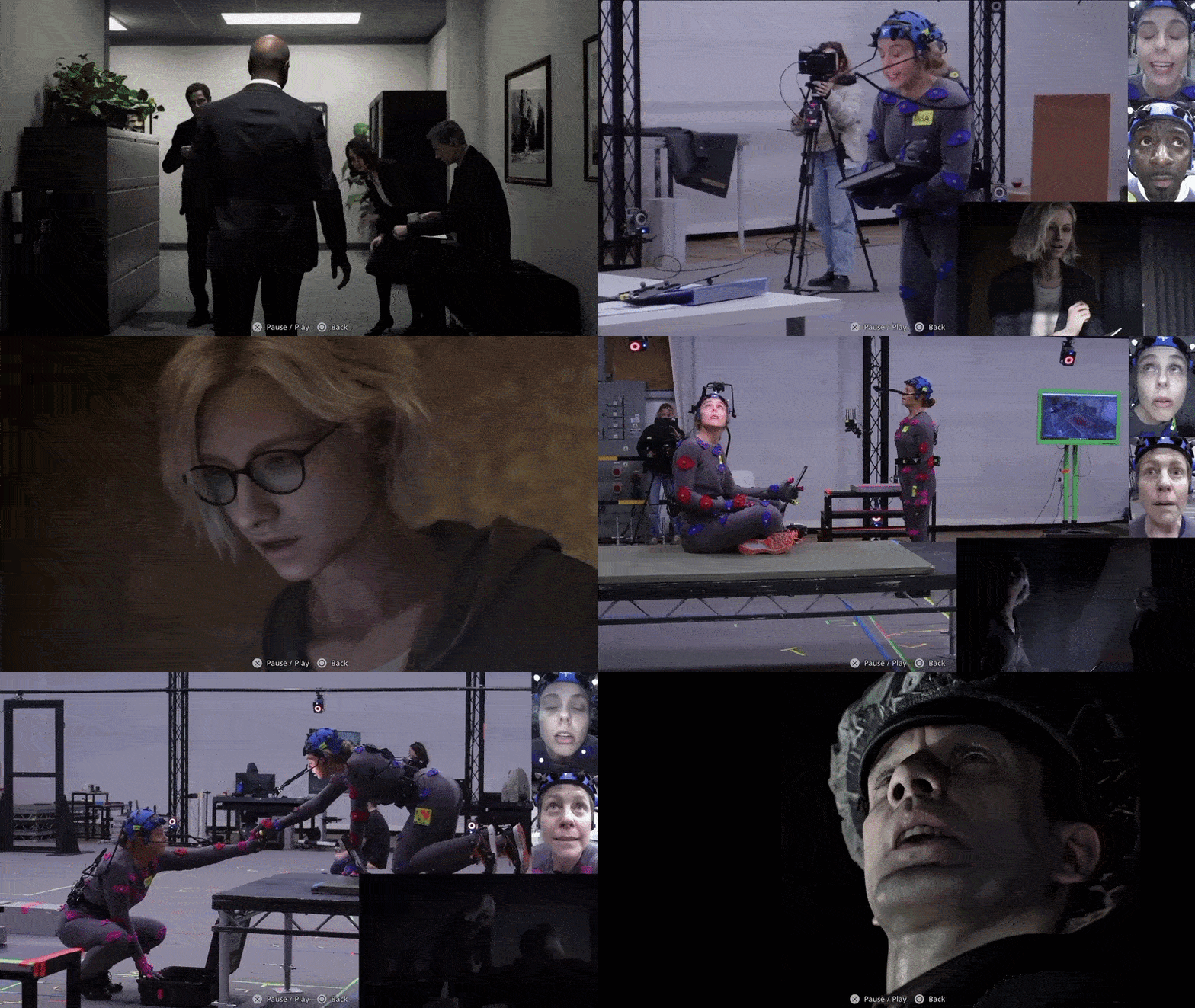
Resident Evil Requiem features unlockable behind-the-scenes motion capture footage as a reward for completion. These videos showcase actors like Angela Sant’Albano (Grace) performing in “the volume,” a specialized studio where they wear reflective suits and head-mounted cameras. This process, known as performance capture, records body movements, facial expressions, and voices simultaneously. The footage reveals how actors used imagination and foam props to create the game’s cinematic scenes, highlighting the human effort and talent behind the digital characters.
How Capcom Filmed Resident Evil Requiem in Near-Total Darkness
To ensure authentic horror reactions, Capcom had actors perform in near-total darkness. Actors like Sant’Albano relied on actual flashlights or tiny head-rig lights to navigate the studio, simulating the pitch-black environments faced by their characters. Stunt performers in mocap suits would charge at or grab the actors in the dark to induce genuine adrenaline and fear. This immersive environment allowed the cast’s natural gasps and panicked movements to be captured directly for the game.
Resident Evil Requiem Performance Capture Process
Capcom utilized a group performance capture process where multiple actors performed scenes together in real-time. This approach allowed for natural chemistry and timing between characters, such as Grace and Leon Kennedy. Performance Director Kate Saxon coached the actors to treat the capture studio like a theater stage, blending theatrical expression with cinematic subtlety. While the suits and helmet rigs were initially uncomfortable, the collaborative environment helped the actors deliver grounded, truthful performances.

How Resident Evil Requiem Recorded Voice Acting and Motion Capture Together
Unlike traditional methods, Requiem recorded dialogue simultaneously with physical movements and facial expressions. Most of the game’s audio comes from these live takes on the mocap stage, with ADR used only for minor cleanup. This method ensures that vocal inflections like shivering breaths or screams perfectly sync with the character’s physical actions. It allowed actors to remain in character and respond naturally to their co-stars during intense dramatic moments.
Angela Sant’Albano as Grace Ashcroft in Resident Evil Requiem
Angela Sant’Albano made her video game debut as Grace Ashcroft, a rookie FBI analyst. Despite being new to the franchise, she researched Resident Evil lore to capture the series’ signature tension. Sant’Albano portrayed Grace as a vulnerable “everyman” rather than a super-soldier, utilizing her theater background to express intense emotions like grief and terror. Her performance involved significant physical commitment, including crawling and screaming, to realistically depict Grace’s transformation from a petrified investigator to a survivor.
Nick Apostolides as Leon Kennedy in Resident Evil Requiem
Nick Apostolides returned as Leon S. Kennedy, portraying a more world-weary and veteran version of the character. Off-camera, Apostolides mentored Sant’Albano, mirroring the in-game relationship between Leon and Grace. He used personal mood boards to internalize Leon’s mindset and performed complex mocap action sequences, including signature roundhouse kicks and weapon handling. His performance combined high-energy combat with nuanced facial expressions to convey Leon’s emotional depth and resolve.
Resident Evil Requiem Stunt Performers and Props Behind the Scenes
The production used physical props and a team of stunt performers to enhance realism within “the volume.” Simple furniture stand-ins matched the game’s digital environments, giving actors physical objects to interact with. Stunt actors played the roles of zombies and the “Stalker” enemy, physically grappling with the lead actors to provoke authentic reactions. This choreographed approach, combined with detailed visual references for gore, ensured that every physical hit and struggle felt weighted and convincing in the final game.

Resident Evil Requiem RE Engine Facial Animation and Hair Detail
Capcom utilized the proprietary RE Engine to create photorealistic 3D character models for Grace and Leon, driven by performance capture data. This allows for subtle micro-expressions, such as lip quivers or clenched jaws, that make emotions like terror and relief highly convincing. The engine features an advanced, physically-based hair strand system where thousands of individual strands react realistically to movement, light, and environmental factors like wind, sweat, or blood. As a current-gen exclusive, the game uses ray tracing to enhance the horror atmosphere, allowing light and shadows to interact dynamically with skin textures including pores and scars and hair translucency.
PixelHair: An Alternative for Realistic Hair Creation
PixelHair is a tool developed by artist Daniel “Yelzkizi” Isaac that offers nearly 200 production-ready 3D hair assets for independent developers and artists. Compatible with Blender and Unreal Engine (including MetaHumans), it provides a faster alternative to manual grooming. The system is transitioning from particle-based hair to Blender’s Geometry Nodes for more flexible procedural styling. While Capcom uses internal proprietary tools, PixelHair allows smaller creators to achieve similar high-end results, such as hair that sways and shines realistically, in a fraction of the time.
Resident Evil Requiem First-Person vs Third-Person Animation Differences
Resident Evil Requiem allows players to toggle between first-person and third-person perspectives. Grace’s segments default to first-person to heighten horror through “embodiment,” showing details like her hands trembling when injured or afraid. Leon’s sections default to third-person to showcase his action-oriented combat, such as full-body roundhouse kicks. Because the game was built for both views, every character has a full model with consistent animations regardless of the camera choice, blending the immersion of Resident Evil 7/Village with the classic style of the series’ remakes.

Why Resident Evil Requiem Is a Return to Horror
Capcom intentionally designed Requiem to return to the slow, creeping dread of titles like Resident Evil 1, 2, and 7. The game emphasizes survival horror by making Grace a vulnerable “everyman” with limited power and resources. Features include claustrophobic environments, a persistent stalker enemy (Victor Gideon’s henchman), and a heavy reliance on darkness and atmospheric audio. To prevent player desensitization, the developers alternated Grace’s intense horror segments with Leon’s action-packed sequences, making the return to terror feel more impactful each time.
Why Resident Evil Requiem Returns to Raccoon City
Driven by fan feedback for a continuation of the series’ main storyline, Requiem returns to Raccoon City, which is now a massive, overgrown crater. This setting serves as a “tomb of Umbrella’s sins,” where Grace investigates the ARK facility and a new virus called “Elpis.” For the 30th anniversary, the return provides a personal and emotional homecoming for Leon Kennedy while linking Grace’s family history to the original outbreak. The “Requiem” theme reflects the narrative’s focus on laying souls to rest and resolving long-standing mysteries within the franchise’s iconic ground zero.
Resident Evil Requiem Bonus Content, Concept Art, and Motion Capture Extras
Capcom included extensive bonus content in Resident Evil Requiem, unlocked by completing the game or meeting specific milestones. These extras celebrate the development artistry and provide a behind-the-scenes look at the project.
- Concept Art Gallery: Features early sketches and illustrations of Grace Ashcroft, Leon Kennedy, and the antagonist Victor Gideon. It showcases character outfit iterations, monster designs, and environment art for locations like the Rhodes Hill facility and ruined Raccoon City.
- 3D Model Viewer: Allows players to rotate and inspect high-fidelity character and enemy models. This mode highlights intricate details such as tactical gear, skin textures, and gore modeling, serving as a resource for fans and cosplayers.
- Motion Capture Footage: Displays side-by-side comparisons of actors, including Angela Sant’Albano and Nick Apostolides, performing in mocap suits next to the finished in-game cinematics. These videos illustrate how the RE Engine translated raw studio performances and physical acting into digital characters.
- External and Deluxe Content: Capcom released cast interviews, a “Creators’ Message” series, and a marketing video featuring Leon’s actor in a zombie survival fitness theme. The Deluxe Edition also offers a digital art book and the game’s soundtrack.
The game’s successful launch, selling over 5 million copies in five days, highlights the high demand for this supplemental content.

Frequently Asked Questions (FAQs)
- What is Resident Evil Requiem, and is it the same as Resident Evil 9?
Resident Evil Requiem is the mainline entry commonly referred to as Resident Evil 9. Set for release in 2026, it is a sequel featuring a return to classic survival horror themes, centering on new protagonist Grace Ashcroft and series veteran Leon S. Kennedy. - Who is Grace Ashcroft in Resident Evil Requiem?
Grace is a rookie FBI intelligence analyst and the adopted daughter of Alyssa Ashcroft (from Resident Evil Outbreak). Designed as an “everyman” character, her gameplay emphasizes vulnerability, resource management, and survival rather than direct combat. - How did Capcom film the motion capture scenes in near-total darkness?
To capture authentic fear, actors performed in a pitch-black studio using only flashlights or small headlamps. Stunt performers surprised the actors with physical grabs to elicit genuine reactions, all of which were recorded using infrared motion cameras. - Did the actors wear special suits and equipment during filming?
Yes, the cast wore black mocap suits with reflective markers and head-mounted camera rigs. These rigs tracked facial expressions and lip-syncing via dots on the actors’ faces, allowing their physical performances to be mapped onto digital models. - Were the voice lines recorded separately in a studio or during the motion capture?
The game used full performance capture, recording voice and movement simultaneously on set. This ensures natural interactions between actors. ADR was only used for minor audio cleanups. - Is Resident Evil Requiem scarier than previous Resident Evil games?
Many consider it one of the scariest entries, with a focus on slow-burn suspense, near-total darkness, and a persistent stalker enemy. It aims to surpass the dread established in Resident Evil 7. - Can you play Resident Evil Requiem in first-person or third-person?
The game allows players to switch between perspectives at will. While Grace defaults to first-person and Leon to third-person, the animation system supports both modes dynamically for all characters. - How do Leon and Grace’s gameplay differ in Requiem?
Grace’s segments focus on survival horror, puzzles, and evasion. Leon’s gameplay is action-horror oriented, featuring a larger arsenal, melee moves like roundhouse kicks, and high-octane encounters, including a fight involving a chainsaw. - Why is Raccoon City in Resident Evil Requiem if it was destroyed?
The story returns to the ruins and underground remnants of the Raccoon City crater to investigate the “ARK” facility and the “Elpis” virus. This setting addresses fan requests for main storyline continuation and revisits the series’ origins for its 30th anniversary. - Does Resident Evil Requiem include behind-the-scenes or extra content for fans?
Yes, including concept art galleries, 3D model viewers, and motion capture footage. Deluxe versions include art books and soundtracks, while external content like cast interviews and marketing videos provide further depth.
Conclusion
Resident Evil Requiem merges advanced production techniques, such as filming in darkness and simultaneous voice and motion capture, with traditional survival horror elements. By utilizing the RE Engine to capture the nuanced performances of Angela Sant’Albano and Nick Apostolides, Capcom created a realistic and terrifying experience. The game bridges the gap between first-person immersion and third-person action, while returning to the legacy of Raccoon City. Ultimately, Requiem honors the franchise’s 30-year history by focusing on authentic, character-driven horror, rewarding fans with both a compelling narrative and extensive behind-the-scenes insights.

Sources and Citations
- Link: Ubisoft News – Assassin’s Creed Unity: Play Now at 60 FPS on Consoles
Citation: Ubisoft News. “Assassin’s Creed Unity – Play Now at 60 FPS on Consoles.” March 5, 2026. - Link: PureXbox – Assassin’s Creed Unity Is Getting A Free Xbox Series X|S Upgrade This Week
Citation: PureXbox. “Assassin’s Creed Unity Is Getting A Free Xbox Series X|S Upgrade This Week.” March 2026. - Link: Reddit r/PlayStationPlus Discussion on Assassin’s Creed Unity 4K60 Patch
Citation: Reddit (/r/PlayStationPlus). Community discussion regarding 4K60 patch notes and resolution improvements. March 2026. - Link: MP1st – Assassin’s Creed Unity Update 1.06 Adds 60FPS Support on Current-gen Platforms
Citation: MP1st. “Assassin’s Creed Unity Update 1.06 Adds 60FPS Support on Current-gen Platforms.” March 5, 2026. - Link: Push Square – Assassin’s Creed Unity PS5 60FPS Patch Out Now
Citation: Push Square. “Assassin’s Creed Unity PS5 60FPS Patch Out Now.” March 2026. - Link: GameSpot – The Underrated Assassin’s Creed Unity Gets A Major Improvement 12 Years After Infamous Launch
Citation: GameSpot. “The Underrated Assassin’s Creed Unity Gets A Major Improvement 12 Years After Infamous Launch.” March 5, 2026. - Link: Game Informer – Assassin’s Creed Unity 60 FPS Patch Hits PlayStation 5 And Xbox Tomorrow
Citation: Game Informer. “Assassin’s Creed Unity 60 FPS Patch Hits PlayStation 5 And Xbox Tomorrow.” March 4, 2026. - Link: Inverse – Assassin’s Creed’s Most Divisive Entry Deserves More Credit
Citation: Inverse. “Assassin’s Creed’s Most Divisive Entry Deserves More Credit.” November 2024. - Link: Backwards-Compatible.com – Assassin’s Creed Unity Compatibility Information
Citation: Backwards-Compatible.com. Assassin’s Creed Unity PS4/PS5 compatibility database entry. - Link: Nexus Mods – ACU Fixes and Plugin Loader
Citation: Nexus Mods. “ACU Fixes and Plugin Loader,” by NameTaken3125. - Link: Reddit r/Trophies – AC Unity Co-op Still Possible in 2025
Citation: Reddit (/r/Trophies). “[AC Unity] Co-op still possible in 2025!” Community discussion. - Link: Wccftech – Assassin’s Creed Unity PS5/XSX Patch Reportedly Bumps The Resolution Up to 4K
Citation: Wccftech. “Assassin’s Creed Unity PS5/XSX Patch Reportedly Bumps The Resolution Up to 4K.” March 5, 2026. - Link: Ubisoft Press Center
Citation: Ubisoft Press Materials and Media Resources. - Link: Yelzkizi – PixelHair Collection Overview
Citation: Yelzkizi. PixelHair collection overview and Unreal Engine hair asset information. - Link: Yelzkizi – View Keeper Overview
Citation: Yelzkizi. View Keeper Blender camera management add-on overview.
The above sources were referenced to ensure all information about the game’s production and features is accurate and up-to-date. By combining insights from developer interviews, journalist previews, and official media, this article provides a comprehensive look “behind the motion capture scenes” of Resident Evil Requiem. Each citation corresponds to specific details, from quotes by the actors to technical features noted by reviewers, giving readers confidence in the authenticity of these behind-the-scenes revelations. Enjoy exploring these references for an even deeper dive into Resident Evil Requiem’s creation
Recommended
- Marvel Rivals Wants Some Lesser-Known Heroes and Villains Characters: Why Deep-Cut Picks Are the Game’s Secret Weapon
- Sony Adds Nearly All of Destiny 2 to PS Plus Game Catalogue on Same Day as Final Update: What it Means for Players and Bungie’s Future
- Backrooms is the Best Horror Movie Since Weapons
- Star Trek: Starfleet Academy Season 1 Review (2026) Cast, Story, Ending, and Where It Fits in the Star Trek Timeline
- Mortal Kombat 2 Theory: Is Cole Young Dying on a Classic Stage and Being Reborn as a New Character?
- Mastering Hair Creation in Blender: A Step-by-Step Guide
- V-Ray Is Now Free For Blender Users: What the New Community Edition Means for 3D Artists
- Tomodachi Life: Living the Dream Was In Development For Almost A Decade (9 Year Timeline Explained)
- Blender Redistribute Curve Points Geometry Nodes Preset: A Comprehensive Guide
- Did Subnautica 2’s Surprise Delay Help the Game? What the 2026 Early Access Shift Means



































































































