









In This Article (9 sections)
Sonic Fans Initially Embraced Sega’s Chaos Hunt ARG Before Privacy Concerns Took Over
The announcement of Sega’s Chaos Hunt anniversary ARG created immediate excitement across the global Sonic the Hedgehog community. Alternate reality games have often been used as immersive marketing experiences, and the idea of a Sonic-themed scavenger hunt promised something more interactive than a standard promotional campaign. For many fans, it felt like a modern evolution of classic franchise marketing, combining nostalgia with digital discovery and community participation.
Early reactions focused on anticipation. Fans expected hidden codes, lore-based puzzles, collectible Chaos Emerald mechanics, and interactive challenges connected to Sonic’s long-running mythology. The concept appeared to blend physical exploration, online clue hunting, and collaborative puzzle solving in a way that matched the franchise’s themes of speed, adventure, and discovery.
The Sonic Chaos Hunt ARG was designed as a layered experience that combined online puzzles with possible real-world missions. Participants were expected to search for virtual Chaos Emerald fragments across digital platforms, promotional websites, and potentially physical locations connected to partner events. Timed clue releases, community decoding efforts, and location-based tasks were reportedly part of the structure, encouraging fans to work together to unlock passwords, reveal story fragments, and assemble all Chaos Emeralds during a global completion event.
In theory, the ARG functioned as both an anniversary celebration and an extension of Sonic storytelling. It followed a model used by other successful gaming ARG campaigns, where fan collaboration and collective intelligence drive engagement. However, the positive response changed once participants began examining the event’s terms more closely. What first appeared to be a fun community celebration soon became a debate about privacy, data usage, and whether fan interactions could be connected to AI training.

Why the Sonic 35Th Anniversary ARG Generated Hype Before the AI Clause Backlash
Excitement around the Sonic the Hedgehog 35th anniversary ARG came from the sense that fans would be able to engage with the franchise in a more direct and participatory way. Longtime players saw the event as a rare opportunity to interact with Sonic mythology outside traditional games. The Chaos Emerald hunt fit naturally with the series’ legacy of fast-paced adventure, exploration, and mystery, making the ARG format especially appealing to a community that already thrives on creativity and collaboration.
Fans expected the event to include rare digital collectibles, exclusive lore reveals, and possibly early hints about future Sonic releases. Many also viewed the ARG as a bridge between classic Sonic storytelling and modern interactive marketing. Because the Sonic fanbase has long embraced fan art, speedrunning, theories, and community-driven projects, the structure of an alternate reality game seemed well matched to the audience. Early promotional messaging emphasized unity, celebration, and mystery, which helped strengthen the positive reaction before the controversy emerged.
One of the most ambitious elements of the ARG was its reported use of real-world locations. Clues appeared to reference landmarks, city-based puzzles, and region-specific digital triggers. Fans believed that scanning QR codes at designated places or interacting with geographically anchored websites could unlock Chaos Emerald fragments. This approach blended digital gameplay with physical exploration and encouraged participation across different countries and time zones.
The same location-based design that made the ARG feel exciting also contributed to later concerns. A global, interactive scavenger hunt depends on user engagement data, movement patterns, puzzle inputs, and timed participation. Once users found references to an AI training agreement in the terms and conditions, the tone of the discussion shifted sharply. The clause reportedly stated that user interactions, puzzle inputs, and engagement behavior could be collected and used to improve machine learning models.
For many fans, that discovery changed the meaning of participation. They had expected a celebratory gaming event, but some felt their activity could be repurposed for data-driven AI development. Critics argued that the agreement was not clearly highlighted and was instead buried in lengthy legal language. This sparked accusations of poor transparency, especially because the ARG appealed to younger audiences, casual players, and longtime fans who may not have expected a data policy to become central to the experience.
Data Collection, Consent, and Trust Became the Core Issues in the Sonic ARG Debate
The backlash intensified when fans examined the ARG sign-up process and found that registration required agreement to terms involving data tracking, behavioral analysis, and interaction logging. While data collection is common across digital platforms, many participants were uncomfortable with the perceived scale and ambiguity of the policy. The concern was not only that data might be collected, but that the terms did not clearly explain how far that collection could go or how participant behavior might be used later.
Fans focused on several possible categories of data, including puzzle-solving patterns, geographic participation behavior, time-based engagement metrics, and interaction logs. Some users worried that even ordinary gameplay actions, such as clicking clues or entering puzzle answers, could become part of machine learning datasets. This created unease because the activity had been presented as entertainment, while the terms suggested a broader data function behind the experience.
The emotional response was heightened by Sonic’s family-friendly reputation. Many fans associate the franchise with trust, nostalgia, and accessible fun, so the complexity of the data agreement felt out of step with that image. The issue became less about whether companies commonly include data clauses and more about whether fans were given a clear, meaningful understanding of what participation involved.
Trust quickly became the central theme of the controversy. The language around AI training and data usage was interpreted by many as overly broad, which created uncertainty about how participant information could be used in the future. The ARG had been marketed as a playful fan experience, but the inclusion of AI-related terms changed the perception for critics, making the event feel closer to data extraction than simple recreation.
The Sonic community’s objections centered on three connected concerns: transparency, consent, and data ownership. Many argued that players were not adequately informed that participation might contribute to AI training datasets. Others questioned whether casual actions inside a game-like event should be treated as machine-learning input. This blurred line between entertainment and data collection became one of the most contentious parts of the debate, with many fans calling for explicit opt-in consent instead of broad clauses embedded in general participation agreements.

Sega’s AI Policy Raised Larger Questions About Interactive Entertainment and Fan Data
The AI data training policy associated with the ARG suggested that user interactions may be analyzed to improve automated systems, recommendation engines, or behavioral prediction models. For Sonic fans, this raised questions about how far-reaching the data usage could be. Even when companies use anonymized data, skepticism remains when the end purpose is not clearly communicated or when fans feel the original entertainment context has shifted.
The controversy reflects a broader trend in interactive media: entertainment systems are increasingly connected to machine learning infrastructure. In the context of Sonic, that shift is especially sensitive because the franchise appeals to a wide range of age groups and has a long-standing identity as a fun, accessible entertainment brand. When an event tied to such a familiar property includes AI training language, fans may interpret it through the lens of brand trust rather than standard digital policy.
A major question debated across the community was whether participants were unknowingly contributing to AI training systems. Based on interpretations of the terms, user interactions within the ARG could potentially be used as structured behavioral data. This might include how players solve puzzles, respond to clues, navigate interactive systems, and engage with timed content. Such information can be valuable for improving adaptive systems and engagement algorithms.
Critics argued that the possibility of unknown contribution weakens informed consent. Even if the data is aggregated or anonymized, uncertainty about its end use can damage confidence in the event. Supporters of the policy countered that similar data practices are common across digital entertainment platforms and may be used to improve user experiences. That disagreement helped polarize the conversation, with some fans seeing the clause as routine and others viewing it as a serious breach of expectations.
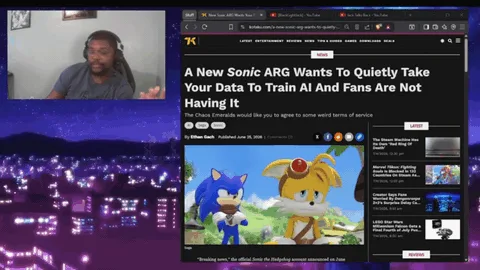
Social media reactions reflected that divide. Some users expressed disappointment and frustration, while others defended the practice as standard industry procedure. Many fans called for clearer disclosure and more transparent opt-in systems. Memes and commentary also spread quickly, with users jokingly reframing the Chaos Emerald hunt as a data collection quest. Despite the humor, privacy concerns remained at the center of the conversation, and gaming influencers added to the discussion by emphasizing the need for clearer communication when entertainment and AI development overlap.
The Sonic ARG Controversy Shows How AI Policies Can Challenge Brand Trust
Sega’s handling of AI in the Sonic ARG drew comparisons to broader controversies in gaming around digital practices, including monetization, live service design, and data transparency. However, this situation represented a newer type of concern because it connected fan participation in an anniversary event with potential machine learning development. Unlike traditional debates about pricing or ongoing game services, the issue focused on whether engagement in a celebratory campaign could become part of a data pipeline.
The controversy stood out because it combined nostalgia-driven marketing with advanced data systems. Sonic fans entered the ARG expecting mystery, teamwork, and franchise celebration. When the terms introduced AI training language, the emotional response became stronger because the experience no longer felt purely recreational to many participants. The gap between the event’s playful public messaging and the complexity of its data policy became one of the biggest sources of criticism.
The broader lesson from the backlash is that legal inclusion of data terms may not be enough to preserve trust. Fans often judge interactive events not only by what is technically permitted, but by whether the experience feels fair and clearly explained. When users believe that important information is hidden inside dense terms of service, even a well-designed campaign can face reputational damage.
For a franchise as recognizable and widely loved as Sonic the Hedgehog, transparency is especially important. The ARG concept itself had strong appeal because it matched the community’s interest in puzzles, lore, and global collaboration. The controversy shows that future events may need clearer communication, more visible consent options, and a stronger separation between entertainment messaging and AI-related data practices if companies want to maintain confidence among fans.

Frequently Asked Questions (FAQs)
- What is the Sonic Chaos Hunt ARG?
The Sonic Chaos Hunt ARG is a fan-engagement experience built around puzzle solving, digital clues, and possible real-world participation tied to Sonic anniversary celebrations. It was designed to let fans search for Chaos Emerald fragments, work together on clues, and engage with Sonic-themed storytelling beyond a traditional game format. - Why did Sonic fans get upset about the ARG?
Fans became upset after discovering that participation may involve data collection and AI training clauses in the terms of service. Many felt the event had been presented as a fun anniversary activity, while the legal language suggested that their interactions could also be used for broader data and machine learning purposes. - What is the AI training agreement in the Sonic ARG?
The AI training agreement refers to a clause indicating that user interactions within the ARG could be used to improve machine learning systems and data models. This raised concern because fans were unsure how gameplay behavior, puzzle inputs, and engagement patterns might be collected or analyzed. - Are Sonic fans’ data really being used for AI training?
The terms suggest that aggregated and anonymized data may be used for AI development, though exact implementation details remain unclear. This uncertainty is part of why the issue became controversial, since fans wanted clearer information about what data was collected and how it could be used. - What is an ARG in gaming?
An ARG, or alternate reality game, is an interactive experience that blends real-world activity with digital storytelling and puzzle solving. In gaming marketing, ARGs often encourage players to decode clues, visit websites, share discoveries, and work together as a community to unlock a larger narrative. - Why is Sega using AI in the Sonic ARG?
AI may be used to analyze engagement patterns, improve interactive systems, and enhance future marketing or gameplay experiences. The concern from fans is not only the use of AI itself, but whether that use was explained clearly enough before people agreed to participate. - Did Sega clearly inform users about data usage?
Critics argue that the AI-related terms were not prominently disclosed, which led to concerns about transparency. Many fans felt that information about data usage should have been easier to find and understand, especially for an event positioned as a celebratory fan experience. - How did the Sonic community respond online?
Reactions were mixed across social media and fan spaces. Some fans criticized the lack of clarity around AI and data usage, while others argued that similar data practices are common in digital entertainment. The debate quickly became a larger discussion about consent, privacy, and trust in gaming events. - Could this affect future Sonic games or events?
Yes, the controversy may influence how future Sonic events are structured, especially when it comes to data transparency and user consent. Fans may expect clearer explanations, more visible opt-in choices, and stronger communication around how their participation data is handled. - What lessons can game companies learn from this controversy?
Game companies can learn that clear communication is essential when interactive entertainment involves data collection or AI-related policies. Even if certain clauses are common, fans are more likely to trust an event when data practices are easy to understand, visibly disclosed, and clearly separated from the entertainment experience.

Conclusion
Sega’s Sonic Chaos Hunt began as an exciting way to celebrate Sonic the Hedgehog’s 35th anniversary, combining scavenger-hunt mechanics, community participation, and the search for scattered Chaos Emeralds. That enthusiasm changed once fans examined the registration requirements and discovered that Community’s terms allowed user data to be used for developing and improving AI models.
The controversy was therefore not simply about Sega using AI, but about whether participants were given enough visibility into how their information could be collected and used before joining the ARG. Coverage from GamesRadar, GameSpot, Kotaku, and other outlets shows that transparency and informed consent quickly became central concerns among fans. The backlash demonstrates how even a well-received interactive campaign can lose momentum when the legal and data practices behind it conflict with what participants expected from the experience.
Sources and Citations
- Sonic the Hedgehog / SEGA, June 23, 2026 – Official Chaos Hunt announcement
SEGA’s verified Sonic the Hedgehog channel officially launched the Chaos Hunt as part of Sonic’s 35th anniversary. The announcement says the Chaos Emeralds had scattered across the United States and asks fans to recover them before Dr. Eggman, establishing the ARG’s basic premise and official connection to the anniversary campaign. YouTube - Community – Terms of Service
Community’s current terms explicitly state that User Data may be used to train and enhance its proprietary AI models. They also say Community may use third-party AI providers, that data integrated with those providers may continue to be analyzed for model improvement and other business purposes, and that AI-training data may be retained in an AI model’s knowledge base. This is the strongest primary source for the AI-training controversy. community.com
Community – Terms of Service - Community – Privacy Policy, updated March 2, 2026
Community’s privacy policy explains that it collects messaging information, including message content, phone numbers, interaction data, timestamps, attached media, reactions, polls, and other information generated when users interact with Community Numbers. This supports the article’s broader discussion of interaction and engagement data, although it does not by itself prove that every category mentioned in the article was collected specifically during Chaos Hunt. community.com
Community – Privacy Policy - GamesRadar+, June 25, 2026 – Sonic fans react to AI-training agreement
GamesRadar reports that Chaos Hunt was run for SEGA through Community and that registration required users to accept Community’s terms before submitting details such as ZIP code and date of birth. It cites the terms permitting data use for developing and training AI models and documents negative fan reactions over data harvesting, transparency, and trust. GamesRadar+
GamesRadar – Sonic fans couldn’t wait for Sega’s new ARG until they spotted the AI training agreement - GameSpot, June 23, 2026 – Chaos Hunt fine print and AI terms
GameSpot reports that the 35th-anniversary Chaos Hunt required participants to agree to terms involving AI model training and third-party AI vendors. It also highlights Community’s wording that it would make reasonable efforts to prevent third parties from using personal information to develop their own models. GameSpot
GameSpot – Sonic’s New Chaos Hunt Game Includes Some Fine Print You Shouldn’t Skip - Kotaku, June 25, 2026 – fan backlash and registration requirements
Kotaku reports that joining Chaos Hunt required information including name, date of birth, ZIP code, and phone number, with users agreeing to Community’s Terms of Service and Privacy Policy. It also documents angry fan responses and notes that the ARG appeared to involve QR codes at real-world locations. Kotaku
Kotaku – A New Sonic ARG Wants Your Data To Train AI And Fans Are Not Having It - Hitmarker, June 25, 2026 – AI clause and transparency concerns
Hitmarker summarizes the controversy around Community’s AI terms, including data sharing with third-party providers and criticism that the AI-related provisions were not prominently surfaced during registration. It also covers concerns around behavioral and registration data. Hitmarker
Hitmarker – Sega’s Sonic Chaos Hunt ARG contains AI model training terms - Sonic Stadium, June 24, 2026 – Chaos Hunt and Club Chaos details
Sonic Stadium reports that Chaos Hunt was announced during Sonic’s 35th-anniversary activities and involved recovering scattered Chaos Emeralds across the United States. It describes an official Emerald Tracker, social-media sightings, prizes, and the connection to the October 9 Club Chaos event in New York City. Sonic Stadium
Sonic Stadium – Chaos Hunt ARG Contest Launches Ahead of Club Chaos - Community – Third Party Disclosures
Community identifies OpenAI among its integrated third-party services and states that, by default, data submitted through OpenAI’s API is not used by OpenAI to train its general models unless specifically submitted for fine-tuning. This is important context because Community’s own terms permitting its data use for AI training should not automatically be interpreted as proof that every third-party AI vendor trains its public models on Chaos Hunt participant data. community.com
Community – Third Party Disclosures - Community – AI Message Generator documentation
Community confirms that its platform includes AI-generated messaging tools and first-party-data features designed to collect audience insights through conversations and engagement. It also reiterates that OpenAI does not, by default, train its models on Community customer data submitted through the API. Community Help
Community – AI Message Generator
Recommendations
- Where Winds Meet, Official Imperial Palace Gameplay Trailer Explained: Release Date, Story, Combat Details & Everything We Know
- Diablo 4 3Rd Anniversary Event: Goblins, Massive XP Boost, Free Cosmetics, and Full June 2–9 Celebration Guide
- IO Interactive and Build A Rocket Boy End MindsEye Partnership as Hitman Crossover DLC Is Canceled
- All Anomalies in Animal Hospital Guide: Every Roblox Anomaly Explained
- Every Release Date from Every Event at Summer Game Fest 2026
- First Gameplay Trailer of Silent Hill: Townfall: It’s a First-Person Game and Everything We Know (2026)
- Best New Anime to Watch Right Now: Spring 2026 Picks
- Switch 2 Software Update Adds “Handheld Mode Boost” for Old Games – Performance Upgrade Explained
- We Build LEGO Winnie the Pooh: A 100th Anniversary Set Worth the Hype for Disney and LEGO Fans
- Echoes of Aincrad: Complete Guide to Growth Points (Best Stat Builds & Leveling Tips)



































































































