










In This Article (7 sections)
Sony Transfers 419 VR and AR Patents to Meta in Major XR Technology Deal
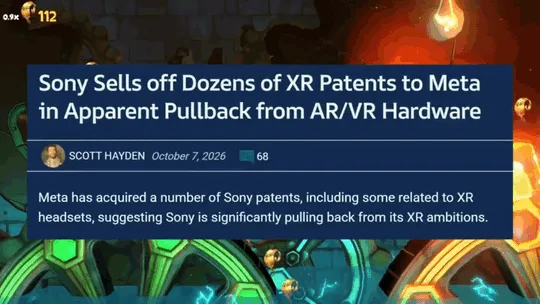
Sony has reportedly transferred a substantial portfolio of 419 extended reality (XR) patents to Meta Platforms, marking a significant development in the virtual reality and augmented reality industries. According to a report by ZDNet Korea, the transaction is based on a Confirmatory Assignment agreement signed in December 2025, with patent ownership records showing transfers throughout 2026. The portfolio covers technologies associated with virtual reality (VR), augmented reality (AR), mixed reality (MR), and head mounted display (HMD) systems.
The agreement reportedly includes 180 United States patents and 239 related international patents, covering inventions registered across several jurisdictions, including Japan, China, South Korea, and Europe. Records from the United States Patent and Trademark Office indicate that 43 American patents were assigned from Sony to Meta between June and September 2026.
These transfers occurred in several batches:
- June 2026: Two United States patents were recorded as transferred.
- July 2026: Another 20 United States patents were assigned to Meta.
- September 2026: An additional 21 United States patents changed ownership.
- Total recorded transfers: 43 United States patents across the three reported periods.
- Overall portfolio: 419 patents associated with the December 2025 agreement.
The remaining patents are covered by the broader assignment agreement, although the timing and registration status of individual transfers may differ between patent offices.
The transaction attracted attention because Sony and Meta have pursued different strategies in the XR market. Sony developed consumer gaming headsets through PlayStation VR and PlayStation VR2, while Meta has invested heavily in standalone VR headsets, smart glasses, and mixed reality technology.
Industry observers interpret the transfer as a possible indication that Sony is reducing its emphasis on consumer XR hardware while Meta continues strengthening its intellectual property portfolio.
However, the patent transfer does not automatically mean Sony has discontinued PlayStation VR2 or abandoned all XR development. The transaction was conducted through Sony Group, and Sony has not formally announced that its gaming division will permanently exit virtual reality hardware.
The patents reportedly cover technologies developed between approximately 2010 and 2022, spanning more than a decade of Sony’s research into immersive displays and related systems.
During this period, Sony developed its first PlayStation VR headset, released in 2016, and subsequently introduced PlayStation VR2 in February 2023. The company’s research also extended beyond gaming into display manufacturing, imaging systems, wearable devices, and professional mixed reality equipment.
The transferred portfolio reportedly includes inventions involving:
- Virtual reality display systems: Technologies used to present immersive digital environments through headsets.
- Augmented reality displays: Systems that combine digital information with views of the physical environment.
- Mixed reality technology: Methods for integrating virtual objects and real world surroundings.
- Head mounted display optics: Optical components and arrangements designed for wearable displays.
- Camera integration: Technologies involving cameras incorporated into headsets and other wearable equipment.
- Image processing: Methods for preparing and displaying visual information within XR systems.
- Gesture and movement tracking: Technologies that support interaction through physical movements.
- Transparent displays: Display configurations that allow users to view their surroundings while receiving digital information.
- Spatial interaction systems: Methods for connecting virtual objects with physical environments or devices.
- Signal processing: Technologies used to manage visual and sensor information within immersive hardware.
Some patents reportedly describe augmented reality methods in which virtual objects can influence physical devices, while others concern transparent headsets equipped with integrated cameras.
These inventions are relevant to several product categories, including VR gaming headsets, professional mixed reality systems, and consumer smart glasses.
The breadth of the portfolio helps explain why Meta may consider the acquisition strategically valuable. Rather than obtaining rights associated with a single device, Meta is acquiring intellectual property covering different aspects of immersive computing.
The financial terms of the transaction have not been publicly disclosed. Neither Sony nor Meta has confirmed how much was paid for the patents, and no official valuation of the portfolio has been provided.
Although industry commentators have speculated about its potential value, the available information does not establish a specific purchase price.
The transaction’s significance therefore extends beyond its undisclosed financial value. It involves the transfer of intellectual property developed through years of research into technologies that remain important to the future of immersive computing.
Sony’s decision has also been linked to its earlier approach to supplying display technology for Apple’s Vision Pro headset.
Sony was reportedly a supplier of advanced OLEDoS displays used in Apple’s mixed reality hardware. However, reports indicated that Sony declined a request to substantially expand production capacity for the headset.
Industry observers interpreted that decision as evidence that Sony was reluctant to make additional large investments in certain XR hardware components.
The subsequent patent transfer has reinforced speculation that Sony may be reallocating resources toward other businesses, including entertainment, software, licensing, and professional technology.
Nevertheless, the company continues to operate in several areas associated with imaging and immersive systems, meaning the patent transaction should be understood as a potential strategic shift rather than confirmation of a complete withdrawal.

Why Sony’s Patent Transfer Raises Questions About PlayStation VR2 and the Future of PSVR3
Sony’s reported transfer of 419 XR patents has intensified questions about the future of PlayStation VR2, particularly because the headset has received relatively limited first party software support since its introduction.
PlayStation VR2 launched in February 2023 as Sony’s second major consumer virtual reality headset. It introduced substantial improvements over the original PlayStation VR, including higher resolution OLED displays, inside out tracking, improved controllers, and advanced haptic feedback.
The headset was designed to deliver immersive gaming experiences using PlayStation 5 hardware and initially launched at a price of approximately $550.
Sony supported the platform with notable titles and virtual reality experiences, including Horizon: Call of the Mountain, Gran Turismo 7, and Resident Evil Village.
These releases demonstrated the potential of PSVR2’s hardware, particularly its improved visual quality, controller tracking, and immersive feedback features.
However, the flow of major Sony developed VR games slowed considerably after the initial launch period.
Industry publications, including PlayFront, Road to VR, and Shacknews, have highlighted the limited number of new first party VR projects announced by Sony since the headset’s release.
This reduced software investment has contributed to concerns that the company no longer considers dedicated consumer virtual reality a major priority.
The situation has been complicated by PSVR2’s commercial performance. Reports following its launch indicated that early sales were below some industry expectations, with estimates suggesting fewer than 300,000 units were sold during the first month.
The headset’s relatively high initial price, limited software selection, and dependence on PlayStation 5 hardware were frequently discussed as possible obstacles to wider adoption.
Sony subsequently reduced the headset’s price in some markets and introduced additional ways for consumers to use the hardware.
One important development was the release of an official PlayStation VR2 PC adapter, allowing compatible headsets to access supported virtual reality experiences through SteamVR.
This expanded the headset’s potential software library beyond PlayStation 5 and provided existing owners with another way to use the hardware.
Industry observers have interpreted the PC adapter in different ways. Some consider it an effort to improve the value of PSVR2 for existing customers, while others view it as evidence that Sony is relying increasingly on software developed outside its own PlayStation studios.
The patent transfer has added another consideration to these discussions.
Because the portfolio reportedly covers technologies developed during both PlayStation VR generations, some analysts believe Sony may be reducing its long term investment in proprietary consumer XR hardware.
Their concerns involve several developments:
- Limited first party software: Sony has announced relatively few major new VR games developed by its own studios since the original PSVR2 launch period.
- Commercial performance: Reports indicated that early headset sales were below expectations.
- Price reductions: Sony introduced lower prices in an effort to make the headset more accessible.
- PC compatibility: The official adapter expanded PSVR2 support beyond PlayStation consoles.
- Patent transfers: Sony has reportedly assigned hundreds of XR related patents to Meta.
- Alternative business priorities: Sony continues investing in gaming software, entertainment, imaging technology, and other business areas.
These factors have encouraged speculation that Sony may gradually reduce its involvement in dedicated consumer VR hardware.
However, Sony has not formally announced the discontinuation of PSVR2, and the patent agreement does not establish that existing headsets will stop functioning or lose compatibility with supported games.
Patent ownership and product availability are separate matters. A company can transfer intellectual property while maintaining existing products, operating under licensing arrangements, or continuing development involving other technologies.
The agreement also does not establish that Sony has transferred every patent required to manufacture a future headset.
Questions have nevertheless emerged about whether Sony will develop a PlayStation VR3.
Some industry analysts argue that the transfer makes a successor less likely because Sony is assigning a substantial collection of XR technologies to a competing hardware company.
PlayFront has interpreted the transaction as evidence that Sony’s major consumer VR ambitions may be ending.
However, no official announcement confirms that PSVR2 will be Sony’s final gaming headset. Similarly, Sony has not announced a PlayStation VR3 project or provided a timetable for a successor.
A future headset could theoretically rely on newly developed technology, retained intellectual property, licensing arrangements, or components supplied by external partners.
Consequently, the patent transfer may influence expectations surrounding PSVR3, but it does not independently prove that another PlayStation headset is impossible.
Sony also continues pursuing professional and enterprise mixed reality technologies, demonstrating that its involvement in immersive hardware extends beyond PlayStation gaming.
The company has introduced the SRH S1 professional mixed reality headset and its XYN spatial computing platform, which target creative, industrial, and professional applications.
These products focus on areas such as spatial content creation, digital design, and visualization rather than traditional consumer VR gaming.
Their existence suggests that Sony may be directing more attention toward professional immersive systems while reducing investment in consumer gaming headsets.
For existing PSVR2 owners, the most immediate question is how the reported transaction affects their current hardware.
There is no indication in the supplied reports that the patent transfer disables existing headsets or removes already released games.
Players can continue using compatible PSVR2 titles on PlayStation 5 and supported PC virtual reality applications through the appropriate adapter.
Third party and independent developers may also continue releasing compatible games, even if Sony’s own first party development remains limited.
The main uncertainty concerns future investment. Without new announcements, players cannot know whether Sony will introduce major exclusive titles, additional hardware revisions, or another dedicated headset.
The patent transfer therefore reinforces existing concerns about the platform’s long term direction without establishing a definitive end to PlayStation VR.

What Meta Gains From Sony’s XR Patents and How the Deal Could Affect Future Quest Headsets and Smart Glasses
For Meta Platforms, the reported acquisition of Sony’s XR patent portfolio represents an opportunity to strengthen its position in virtual reality, augmented reality, mixed reality, and wearable computing.
Meta has invested heavily in immersive hardware through its Quest headset lineup and related smart glasses initiatives.
Unlike Sony’s PlayStation VR systems, which primarily focus on gaming experiences connected to PlayStation hardware, Meta has pursued standalone VR headsets alongside wearable devices intended for broader everyday use.
The transferred Sony patents could support these efforts by providing intellectual property associated with display design, camera systems, optics, tracking, spatial computing, and other XR technologies.
Such patents can be valuable even when they are not incorporated directly into a new product.
Ownership may allow a company to use protected technologies, strengthen its position in negotiations, reduce certain intellectual property risks, or support the development of alternative hardware designs.
The Sony portfolio could therefore serve both commercial and defensive purposes within Meta’s broader XR strategy.
One potential application involves future Meta Quest headsets.
Meta’s Quest devices combine display systems, tracking technology, sensors, and software to create immersive virtual environments. More advanced mixed reality functions also require cameras and processing systems that allow digital content to interact with the surrounding physical world.
Patents relating to these technologies could potentially support improvements in visual quality, tracking accuracy, device design, and spatial interaction.
However, Meta has not publicly identified specific Sony patents that will be used in future Quest hardware.
The portfolio may also be relevant to Meta’s efforts to develop smaller augmented reality glasses and wearable computing devices.
Unlike conventional VR headsets, which typically cover much of the user’s field of view, AR glasses aim to combine digital information with the physical environment through more compact wearable hardware.
Developing such products presents significant engineering challenges involving displays, lenses, cameras, processing efficiency, power consumption, and physical dimensions.
Sony’s patents involving transparent displays, image processing, and head mounted optics could potentially contribute to research in these areas.
Industry analysts have suggested that Meta may use the acquired intellectual property to strengthen its development of lightweight glasses and advanced mixed reality devices.
Some reports have also discussed a possible high end Meta headset or glasses product priced around $1,300, potentially arriving in 2027.
However, neither Meta nor Sony has confirmed that this rumored device will use the transferred patents, and its final specifications, price, and release date remain uncertain.
The reported acquisition comes as Meta maintains a substantial presence in the wider XR market.
Market research cited by ZDNet Korea indicated that global shipments of AI and AR smart glasses increased by approximately 127% during the first half of 2026.
The same reporting suggested that Meta accounted for approximately 81% of global smart glasses shipments during that period.
These figures describe the smart glasses segment and should not be treated as an identical measurement of the entire virtual reality headset market.
Nevertheless, they demonstrate Meta’s strong position in a rapidly expanding category of wearable technology.
Other reports estimated that approximately 4.2 million smart glasses units shipped globally during the first half of 2026, with Meta accounting for a substantial proportion of the market.
The company’s Quest product family also maintains a leading position in standalone VR, supported by devices such as Quest 2, Quest 3, and Quest Pro.
Sony’s PSVR2 operates in a different market position because it was designed primarily as a PlayStation accessory and requires compatible hardware to access its core console gaming features.
Meta’s broader standalone ecosystem and investment in wearable devices therefore give it a different commercial strategy from Sony’s consumer VR business.
The transfer of Sony’s patents may further strengthen Meta’s technology portfolio in several areas:
- Display technology: Patents covering optical systems and immersive visual presentation could support future headset development.
- Transparent wearable displays: Relevant inventions may contribute to smaller augmented reality devices.
- Camera integration: Technologies involving headset cameras could support environmental awareness and mixed reality applications.
- Spatial computing: Patents describing the relationship between digital objects and physical surroundings may be useful for advanced XR interactions.
- Tracking systems: Movement and gesture recognition technology could support more natural controls.
- Image processing: Acquired intellectual property may provide additional methods for handling complex visual information.
- Patent protection: A larger portfolio can strengthen Meta’s position in licensing discussions and intellectual property disputes.
- Future product research: Existing inventions may help inform development of new hardware designs and wearable computing systems.
Although these applications are plausible, Meta has not announced a detailed implementation plan for the portfolio.
The deal’s commercial value also remains uncertain because the companies have not disclosed the purchase price.
Patent portfolios can contain inventions with different remaining legal terms, commercial relevance, and geographic protections. Their value depends partly on the scope of individual claims, the markets in which they apply, and whether the protected technologies are important to existing or future products.
The 419 patents reportedly cover research dating from approximately 2010 through 2022, meaning some inventions may relate to technologies that have already evolved considerably.
Even so, older patents can remain relevant when they protect important methods or designs used in newer products.
Meta’s acquisition therefore provides access to a collection of Sony technologies developed during a formative period for modern consumer VR and mixed reality hardware.
The transaction also illustrates the contrasting strategies of the two companies.
Meta continues investing in standalone immersive devices, smart glasses, and spatial computing technologies, while Sony appears to be placing less emphasis on dedicated consumer VR gaming hardware.
Industry publications have interpreted this difference as evidence of a changing competitive environment in which Meta is consolidating its XR position while Sony redirects resources toward other priorities.
For consumers, the immediate effects may be limited. Existing Meta Quest and PlayStation VR2 devices are not automatically changed by a patent ownership transfer.
The longer term consequences may emerge through future products, licensing arrangements, and investment decisions.
If Meta incorporates relevant Sony technologies into new devices, the portfolio could contribute to improvements in display design, wearable comfort, tracking systems, or mixed reality functionality.
If Sony continues reducing its consumer VR investment, third party developers and competing headset manufacturers may assume greater importance in the market.
However, neither outcome is guaranteed by the patent transaction alone.
The reported 419 patent transfer represents a significant redistribution of XR intellectual property, but the full implications will depend on how both companies use their remaining and acquired technologies.
For Sony, the agreement raises questions about future PlayStation VR hardware and the company’s broader priorities. For Meta, it provides additional intellectual property that could support its ambitions in immersive computing and smart glasses.
The most important confirmed distinction is that Sony has not officially ended PSVR2, while Meta has not revealed exactly how the acquired patents will influence its next generation products.

Frequently Asked Questions (FAQs)
- What exactly did Sony sell to Meta?
Sony reportedly transferred a portfolio of 419 extended reality patents to Meta Platforms under a Confirmatory Assignment agreement signed in December 2025. The portfolio includes 180 United States patents and 239 related international patents covering virtual reality, augmented reality, mixed reality, and head mounted display technologies. The inventions involve areas such as optics, display systems, cameras, image processing, and spatial interaction. According to the reported patent records, 43 United States patents were assigned to Meta between June and September 2026. The financial terms of the transaction have not been disclosed. - Why is Sony selling its VR patents?
Industry analysts interpret the patent transfer as a possible indication that Sony is reducing its investment in consumer XR hardware and redirecting resources toward other business priorities. The transaction follows reports of limited first party support for PlayStation VR2 and Sony’s earlier decision not to substantially expand certain XR display production activities. Selling intellectual property may allow a company to monetize research developed over many years. However, Sony has not publicly confirmed that the agreement represents a complete exit from virtual reality, and the company continues operating in professional mixed reality and related technology markets. - Does this mean PSVR2 is discontinued?
No official announcement confirms that PlayStation VR2 has been discontinued. Although the patent transfer has raised concerns about Sony’s long term commitment to consumer virtual reality, the agreement does not automatically end production, disable existing headsets, or remove compatibility with supported games. Sony has introduced PC compatibility through an official adapter, expanding the headset’s available software options. However, limited first party game announcements and broader industry reports suggest that PSVR2 may no longer be a major development priority. Its future support will depend on Sony’s decisions and continued interest from third party developers. - How many Sony patents are affected?
The reported agreement covers 419 patents worldwide, including 180 United States patents and 239 related international patents. These inventions span technologies associated with virtual reality, augmented reality, mixed reality, and wearable display systems. Patent records indicate that 43 United States patents were assigned to Meta between June and September 2026, with two transfers recorded in June, 20 in July, and 21 in September. The broader agreement includes additional patents whose ownership records may be processed through different patent offices. The figures describe the reported portfolio rather than every XR patent Sony has ever developed. - What technologies do the patents cover?
The transferred patents reportedly cover a broad range of technologies developed during Sony’s XR research between approximately 2010 and 2022. These include immersive display systems, headset optics, transparent wearable displays, integrated cameras, image processing, gesture tracking, and spatial interaction methods. Some inventions describe augmented reality systems in which virtual objects interact with physical devices, while others concern technologies used to present and process immersive visual information. The portfolio is relevant to products such as VR gaming headsets, professional mixed reality equipment, and smart glasses, making it potentially useful for Meta’s future hardware development. - Is Sony still making VR headsets?
Sony has not announced a new consumer PlayStation VR headset beyond PSVR2, but it has also not formally declared that it is permanently leaving the VR hardware market. The patent transfer and limited first party software investment have encouraged speculation that Sony is reducing its emphasis on consumer VR gaming. However, the company continues working with professional immersive technologies, including the SRH S1 mixed reality headset and XYN spatial computing platform. These activities demonstrate that Sony still has interests in XR applications outside gaming. Whether it will develop another PlayStation VR headset remains unconfirmed. - What will Meta do with these patents?
Meta could use the acquired patents to support research, strengthen intellectual property protection, and develop future virtual reality or augmented reality products. The portfolio includes technologies associated with display systems, optics, cameras, tracking, and spatial computing, all of which are relevant to Meta’s Quest headsets and smart glasses initiatives. Analysts have suggested that the patents may contribute to smaller wearable devices and more advanced mixed reality experiences. However, Meta has not identified specific patents it intends to incorporate into future products, so their precise commercial applications remain uncertain. - How does this affect the VR market?
The transaction may strengthen Meta’s position in the XR industry by expanding its intellectual property portfolio while raising questions about Sony’s future consumer VR investment. Meta already maintains a substantial presence in standalone virtual reality through its Quest devices and has a strong position in smart glasses. Market research cited in the reports estimated that Meta accounted for approximately 81% of global smart glasses shipments during the first half of 2026. However, the patent transfer does not automatically change headset sales, product availability, or market shares. Its longer term effects will depend on future hardware development and competition. - Were the patents valuable?
The portfolio may have significant strategic value because it includes hundreds of inventions developed through more than a decade of Sony’s XR research. These patents cover technologies relevant to headset displays, optical systems, cameras, image processing, and augmented reality interactions. Such intellectual property can support product development, licensing arrangements, and protection against certain patent disputes. However, neither Sony nor Meta has disclosed the transaction price, so its financial value cannot be established from the available information. The commercial importance of individual patents will depend on their legal scope, remaining protection periods, and relevance to future products. - What should PSVR2 owners do now?
Existing PlayStation VR2 owners can continue using their headsets with compatible PlayStation 5 games and supported PC virtual reality applications through Sony’s official adapter. The reported patent transfer does not automatically affect the functionality of purchased hardware or existing software. Players should monitor Sony’s announcements for information about future support, updates, and new games while continuing to explore available third party titles. Although analysts have questioned whether Sony will develop another dedicated VR headset, no official decision has been announced. Owners therefore do not need to replace their equipment solely because of the patent transaction.

Conclusion
The sale of 419 XR patents from Sony to Meta is a landmark shift in the VR/AR industry. Sony has effectively decided to step back from VR hardware, focusing instead on other core businesses. Meta, by contrast, continues to invest heavily in XR and has secured these patents to fuel its future devices. For PlayStation VR2, the implications are clear: Sony’s in-house development of VR is over, and VR2 remains the endpoint of Sony’s VR journey.
Current PSVR2 owners can still enjoy the existing experience, but should not expect major new titles or a successor headset. The VR market itself is consolidating around Meta’s vision, with Meta’s Quest and anticipated AR glasses leading the way. Sony’s patent transfer may give VR enthusiasts pause, but it also opens the door to a more unified XR patent landscape under Meta. Time will tell how Meta leverages this technology, but for now it signals the end of an era for Sony in VR.
Sources and Citation
- ZDNet Korea, October 5, 2026 : Provides the original Korean report on Sony’s agreement to transfer 419 XR patents worldwide to Meta, including 180 U.S. patents and 239 related filings in other regions. Distinguishes that broader agreement, signed in December 2025, from the 43 U.S. patent transfers recorded between June and September 2026. Covers technologies associated with virtual reality, augmented reality, mixed reality, and head mounted displays. zdnet.co.kr
Citation: Sony Transfers 419 XR Patents to Meta, Signaling a Reduction in Its Hardware Business. (ZDNet Korea). - PlayFront, October 7, 2026 : Analyzes the patent agreement and its possible implications for PlayStation VR. Discusses technologies developed between 2010 and 2022, Sony’s support for PSVR 2, and the headset’s move into PC compatibility. Its conclusions about Sony withdrawing from consumer VR are editorial interpretations rather than an official announcement that PlayStation VR is ending. PlayFront
Citation: Sony sells XR patents to Meta: The end for PlayStation VR?. (PlayFront). - Shacknews, October 7, 2026 : Reports the transfer of approximately 43 U.S. patents and the broader agreement covering 419 patents worldwide, drawing on ZDNet Korea’s findings through Road to VR’s coverage. Places the transaction in the context of PSVR 2’s pricing, adoption, and software support, while discussing its potential significance for Sony’s hardware strategy. Shacknews
Citation: Sony has sold over 40 AR/VR hardware patents to Meta in 2026. (Shacknews). - Notebookcheck News, October 5, 2026 : Covers the XR patent transfer alongside unconfirmed reports that external developers could revive dormant PlayStation franchises, including Ape Escape, Sly Cooper, and Killzone. Notes that Sony has not confirmed a formal development program. Its patent breakdown lists 119 U.S. patents, which differs from the 180 U.S. patents stated in ZDNet Korea’s updated original report. Notebookcheck
Citation: Sony may license old PlayStation games to external devs as it sells VR patents to Meta. (Notebookcheck). - DTF, October 7, 2026, Russian language coverage citing ZDNet Korea : Summarizes the recorded U.S. transfers, the worldwide patent agreement, and technologies covering XR information processing, head mounted displays, and XR glasses. The linked Korean source was published on October 5, 2026, not in September; September refers to part of the period during which patent transfers were recorded. DTF
Citation: Sony Sold Dozens of XR Technology Patents to Meta. (DTF).
Recommendations
- Nintendo net sales up 99.3% as Switch 2 shifts 17.37m units: full breakdown of Nintendo’s latest earnings report
- Tides of Annihilation Is Back and Finally Playable in 2026
- Pax Autocratica Is a Roguelite FPS Where You Build a Totalitarian Colony
- Metro 2039 Collector’s Edition Includes the Stranger Helmet Replica
- Rayman Origins Enhanced Edition Appears on Xbox Store With 4K and 60FPS Support
- Minute Cryptic Answer and Hints October 7, 2026: Solved
- ARC Raiders Generated $114.9 Million for Nexon in Q2 and Sold 800,000 More Copies
- WWE 2K Series Could Double or Triple in Size, Says Take-Two CEO: What It Means for the Franchise
- Dragon Ball Z Theme Park in France? Saudi Arabia’s $7 Billion Cergy-Pontoise Plan
- Robert Downey Jr.’s Avengers: Doomsday Father’s Day Message Links to Theory on Doctor Doom’s Backstory



































































































