







In This Article (9 sections)
Stranger than Heaven Trailer, Story, World, and Setting Details
Ryu Ga Gotoku Studio shocked audiences when it officially unveiled Stranger Than Heaven through its cinematic story overview trailer. The reveal immediately sparked discussion because the project appears to blend the grounded crime drama and emotional storytelling associated with the studio’s earlier works while introducing a darker supernatural atmosphere.
The trailer presents a mysterious world where violence, memory, guilt, and identity appear to shape the central narrative. It opens with a lonely protagonist walking through rain-soaked city streets while fragmented narration discusses destiny, regret, and the burden of survival. Throughout the footage, multiple scenes imply that the main character is trapped between realities or timelines, with the atmosphere shifting between realistic urban environments and dreamlike sequences filled with symbolic imagery. These details suggest that Stranger Than Heaven may focus heavily on psychological storytelling rather than a straightforward crime narrative.
Several scenes hint at themes of death and resurrection, as characters repeatedly reference “crossing over,” “unfinished promises,” and “the price of returning.” Fans immediately connected these lines to the game’s title, which implies movement between earthly life and something beyond it. The trailer carefully avoids confirming whether the supernatural elements are literal or symbolic, creating an intentional sense of mystery. Unlike traditional action-focused reveals, the trailer spends significant time establishing mood and emotional tension. Conversations are subdued, environments feel lonely, and character expressions communicate exhaustion and grief. This storytelling direction indicates that Stranger Than Heaven may aim for a more mature and emotionally layered experience than many recent action games.
The trailer also introduces several factions competing for influence within the city. Criminal organizations, corrupt authorities, and shadowy figures appear to play major roles in the conflict, although the narrative focus seems deeply personal. The protagonist’s journey appears tied to uncovering hidden truths connected to betrayal, trauma, and a catastrophic past event. Another notable aspect of the story overview is its deliberate ambiguity. The trailer reveals enough to establish intrigue while withholding concrete answers about the central mystery, generating intense fan speculation and positioning Stranger Than Heaven as one of the most mysterious projects currently in development.
The setting of Stranger Than Heaven appears to combine modern urban realism with surreal supernatural elements. The city shown throughout the trailer resembles a dense Japanese metropolis inspired by areas similar to Kamurocho from the Like a Dragon franchise, though the environments possess a darker and more oppressive tone. Neon lights, rain-covered alleyways, abandoned districts, underground clubs, and deteriorating apartments dominate the visual presentation. The world feels more isolated and melancholic than the vibrant entertainment districts commonly associated with Ryu Ga Gotoku Studio titles. Even crowded scenes feel emotionally distant, reinforcing the game’s themes of loneliness and existential uncertainty.
Several environmental details suggest that the city itself may play an active role in the narrative. Strange markings appear throughout certain districts, while some areas transition suddenly from realism into distorted, dreamlike landscapes. Buildings twist unnaturally, shadows behave strangely, and impossible architectural structures briefly appear in multiple shots. The trailer also hints at multiple time periods or alternate realities. Some scenes depict modern technology and contemporary fashion, while others feature older vehicles, retro signage, and environments that appear frozen in a previous decade. This has led many fans to theorize that the world may exist across fractured timelines or interconnected dimensions.
Weather appears to be another major thematic element, with constant rainfall, fog, and nighttime sequences dominating the footage. These atmospheric choices reinforce the noir-inspired tone and create a sense of unease throughout the game world. Light sources are heavily contrasted against darkness, giving many scenes a cinematic thriller aesthetic. The city’s criminal underworld also appears central to the setting, with illegal gambling operations, underground fights, and organized crime networks briefly shown throughout the trailer. However, unlike previous Ryu Ga Gotoku Studio projects that balanced crime drama with humor and absurdity, Stranger Than Heaven seems significantly more serious and psychologically intense.
The supernatural aspects of the setting remain intentionally unclear. Ghostly figures, unexplained disappearances, distorted reflections, and visions all appear throughout the trailer. Whether these events represent actual supernatural occurrences or manifestations of psychological trauma remains unknown.

Stranger than Heaven Trailer, Gameplay, and Combat Details
The Stranger Than Heaven trailer contains numerous hidden details that reveal important clues about its gameplay, story structure, and thematic direction. Nearly every sequence appears carefully designed to provoke speculation. One of the earliest scenes shows the protagonist staring at a damaged photograph that appears burned along the edges, suggesting either a traumatic memory or an attempt to erase evidence from the past.
Later shots briefly reveal the same photograph restored, implying that memory reconstruction may play a role in the narrative. Another important sequence involves a train station clock repeatedly stopping at the same time, a recurring visual motif that fans quickly noticed across multiple scenes. The stopped clock may symbolize a pivotal event that permanently altered the protagonist’s life.
The trailer also repeatedly uses mirrors and reflections. Several scenes show reflections moving independently of the characters themselves, which could indicate dual identities, alternate realities, or psychological fragmentation. In one particularly unsettling shot, the protagonist’s reflection appears bloodied while the character himself remains unharmed.
Dialogue fragments provide additional clues, especially when one mysterious character asks, “How many times have you come back?” This line has fueled theories involving resurrection loops, reincarnation, or repeated timelines. Another hidden detail that attracted attention is a recurring symbol resembling wings surrounded by broken chains. The symbol appears on walls, jewelry, documents, and tattoos throughout the trailer, leading fans to believe it may represent a secret organization or cult connected to the game’s supernatural elements.
Combat footage appears briefly throughout the trailer but is presented in fragmented bursts rather than full encounters. This editing style preserves mystery while still demonstrating the game’s brutal tone. Close-quarters combat appears highly cinematic and grounded, emphasizing physical impact and desperation. The final moments of the trailer dramatically shift tone as the protagonist stands in a flooded street while ghostly silhouettes emerge around him. A voice states, “Heaven was never meant for people like us,” before the screen fades to black. This final line encapsulates the game’s themes of guilt, redemption, and moral ambiguity.
Although Stranger Than Heaven remains heavily shrouded in mystery, several important details have already emerged from official reveals and developer commentary. The game is being developed by Ryu Ga Gotoku Studio, the team responsible for some of the most critically acclaimed narrative-driven action games in recent years. This immediately raised expectations regarding storytelling quality, character writing, and cinematic presentation. The project appears to combine action combat, investigative elements, exploration, and psychological storytelling. Unlike traditional fantasy RPGs, Stranger Than Heaven seems rooted in grounded realism despite its supernatural undertones.
The protagonist has not yet been fully identified, but the trailer portrays him as emotionally damaged and deeply connected to the central mystery. Several scenes imply that he may have survived an event that should have killed him. The game appears to feature mature themes involving loss, guilt, corruption, and identity, with a tone notably darker and more introspective than many recent Ryu Ga Gotoku Studio titles. Official footage confirms that players will explore large urban environments filled with side activities, hidden stories, and interactive locations. However, the world design appears more atmospheric and tension-driven than previous open-city games from the studio.
Gameplay in Stranger Than Heaven appears to merge multiple genres into a single cinematic experience. The trailer showcases exploration, investigation, dialogue-driven storytelling, and visceral combat sequences. Exploration seems heavily emphasized, with the protagonist moving through detailed city districts, abandoned buildings, underground locations, and surreal dreamlike environments. Environmental storytelling appears central to the experience, with clues hidden throughout the world. Investigation mechanics may also play a major role, as several scenes show the protagonist examining evidence, reviewing photographs, and reconstructing events. This suggests detective-style gameplay similar to the Judgment series but potentially more psychological in nature.
Dialogue choices may influence character relationships and story outcomes. The trailer repeatedly focuses on tense conversations where trust appears uncertain, and multiple scenes suggest branching narrative paths depending on player decisions. Traversal mechanics appear smoother and more cinematic than previous Ryu Ga Gotoku Studio titles, with the protagonist shown vaulting obstacles, navigating rooftops, and escaping collapsing environments during high-intensity sequences. The game’s pacing also appears deliberately varied, as quiet investigative moments transition into sudden bursts of violence or supernatural horror. This rhythm may help maintain tension throughout the experience.
Side content is also expected to return. While the trailer focuses heavily on the main story, background details hint at mini-games, underground activities, and optional character interactions. However, the tone suggests these activities may be more grounded and narrative-driven compared to the exaggerated humor of earlier studio titles. The user interface shown briefly during combat appears minimalist, helping maintain immersion. Health indicators and environmental interaction prompts are subtle and integrated naturally into the presentation. The trailer also hints at dynamic weather and time-of-day systems, with rainfall intensity changing throughout scenes and lighting conditions shifting dramatically across districts. These systems may directly affect gameplay encounters and environmental exploration.
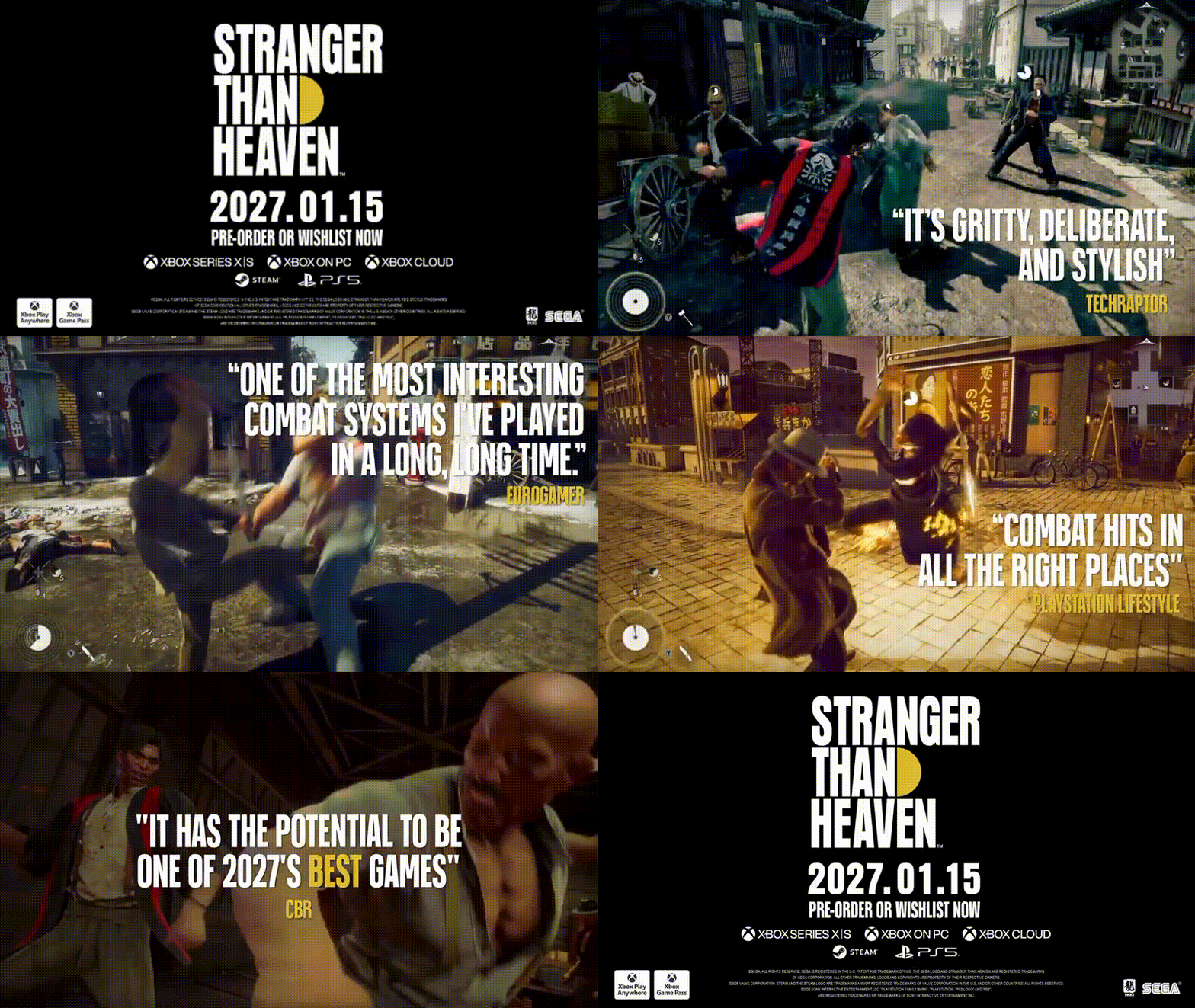
Combat in Stranger Than Heaven appears brutal, cinematic, and emotionally charged. Rather than emphasizing exaggerated martial arts spectacle, the trailer focuses on desperation, physical impact, and realism. Fights shown in the trailer are close-range and highly aggressive, with characters slamming enemies into walls, breaking furniture during struggles, and sustaining visible injuries throughout encounters. Every hit appears weighty and dangerous. Environmental interaction also seems heavily expanded, as the protagonist uses surrounding objects as improvised weapons, including pipes, chairs, bottles, and debris. Some scenes suggest players can manipulate environmental hazards during combat sequences.
Enemy AI appears more reactive, with opponents dodging attacks, coordinating movements, and adapting to player aggression. Several sequences show enemies retreating or hesitating after witnessing brutal takedowns. The trailer briefly hints at supernatural abilities integrated into combat. During one scene, the protagonist appears to slow time momentarily before counterattacking multiple enemies, while another sequence shows ghostly visual distortions during a finishing move. Stamina and endurance may also influence fights, as characters visibly tire during prolonged encounters and combat animations emphasize exhaustion rather than invulnerability.
Boss encounters appear highly cinematic. One trailer scene features a confrontation in a burning building where both characters appear severely injured before the fight even begins, reinforcing the emotional intensity surrounding combat. The game may also include multiple fighting styles or progression systems, although this has not been officially confirmed. Fans noticed stance changes and differing combat animations across scenes. Weapon combat also appears more prominent than in some previous Ryu Ga Gotoku Studio projects, with knives, handguns, and improvised melee weapons appearing throughout the trailer.
Music plays a significant role in establishing the tone, as the trailer’s soundtrack blends orchestral themes, electronic distortion, and melancholic piano melodies, reinforcing the game’s emotional and psychological focus. Another confirmed detail is the game’s cinematic presentation, with facial animation quality, lighting technology, and environmental detail representing a substantial leap forward for the studio. The project is widely believed to target modern hardware exclusively, allowing the developers to create more advanced AI systems, larger environments, and seamless cinematic transitions.

Stranger than Heaven Characters, Story Theories, Like a Dragon Connections, and Developer Insights
The characters shown in Stranger Than Heaven immediately generated widespread fan theories because of their mysterious motivations and cryptic dialogue. The protagonist appears emotionally scarred and disconnected from the world around him, with his fragmented memories and repeated references to death suggesting that he may be struggling with trauma or supernatural consequences tied to the central mystery. A female character prominently featured throughout the trailer appears deeply connected to the protagonist’s past.
Some fans believe she may be deceased, while others think she exists in another timeline or dimension. Another mysterious figure wearing dark formal clothing repeatedly appears while observing events from a distance, leading fans to theorize that this character may serve as either an antagonist or a supernatural guide.
Criminal organizations also seem heavily involved in the narrative. Several gang leaders appear during violent sequences, suggesting that organized crime remains an important component of the story despite the supernatural themes. One major theory suggests that the protagonist may already be dead and trapped between realities, an interpretation that connects directly to the game’s title and recurring references to returning from beyond.
Another theory proposes that Stranger Than Heaven involves parallel timelines shaped by player decisions, with repeated imagery involving mirrors, clocks, and alternate environments supporting this possibility. The trailer’s cryptic narration has also inspired speculation about memory manipulation, cult activity, and psychological experimentation, especially since several scenes involving hospitals and medical equipment may hint at scientific elements behind the supernatural events.
One of the biggest questions surrounding Stranger Than Heaven is whether it exists within the same universe as Like a Dragon. Officially, the developers have not confirmed a direct connection, but the similarities are difficult to ignore. The urban environments strongly resemble districts previously seen in Like a Dragon and Judgment, with fans quickly recognizing architectural styles, alleyway layouts, and entertainment district designs associated with Kamurocho-inspired settings. Combat presentation also shares DNA with the studio’s earlier games, as the cinematic camera angles, environmental interactions, and grounded brutality all feel familiar to longtime fans.
However, Stranger Than Heaven appears tonally distinct from Like a Dragon. The new project emphasizes horror, psychological tension, and supernatural ambiguity rather than balancing crime drama with comedic absurdity. Developer interviews suggest that the studio intentionally wanted to explore darker storytelling territory, which may indicate that Stranger Than Heaven functions as a spiritual successor rather than a literal continuation. Another important factor is thematic overlap. Like a Dragon frequently explores redemption, loyalty, identity, and the consequences of violence, while Stranger Than Heaven appears to continue these themes through a more surreal and emotionally intense lens.
Some fans theorize that the game may feature hidden references or cameo appearances rather than direct narrative connections, as Ryu Ga Gotoku Studio has a history of including subtle Easter eggs linking its various projects together. The possibility of crossover content also cannot be ignored, as future expansions or sequels could further establish ties to the broader Like a Dragon universe if Stranger Than Heaven succeeds commercially.
Developer interviews surrounding Stranger Than Heaven have revealed several important insights into the project’s creative direction. Members of Ryu Ga Gotoku Studio explained that the game was designed to push the studio beyond traditional crime drama storytelling. The team reportedly wanted to create an experience that blends psychological suspense, emotional storytelling, and cinematic action. Developers emphasized atmosphere as a major priority, with lighting, weather effects, ambient sound, and environmental storytelling all described as critical components of the player experience. The studio also discussed creating more emotionally vulnerable characters, explaining that rather than focusing solely on physical strength or criminal ambition, Stranger Than Heaven aims to explore grief, regret, and identity.
Combat design was another major topic during interviews. Developers explained that they wanted fights to feel dangerous and exhausting rather than overly stylized, with physical realism and emotional intensity prioritized during animation production. The narrative structure was also described as intentionally layered and mysterious, with players gradually uncovering truths through fragmented memories, exploration, and character interactions.
Technical improvements were another major focus, as developers confirmed that new rendering technology allows for more advanced lighting systems, improved facial animation, and denser environments. The team also hinted that player interpretation will play a major role in understanding the story, with some scenes intentionally leaving room for multiple interpretations rather than providing definitive answers. Finally, the developers stated that Stranger Than Heaven represents one of the studio’s most ambitious projects to date, aligning with the game’s cinematic presentation and unusually mysterious marketing strategy.
The Stranger Than Heaven trailer also contains numerous subtle clues that fans continue analyzing frame by frame. One recurring hidden detail involves birds appearing during moments tied to death or emotional trauma, potentially symbolizing souls, freedom, or spiritual transition. Another subtle clue appears in background signage, where certain signs change language or wording between scenes, suggesting timeline inconsistencies or alternate realities. Several characters also appear wearing identical watches stopped at the same time, further reinforcing theories involving a pivotal catastrophic event. A particularly interesting hidden detail involves the protagonist’s injuries, as wounds visible during early trailer scenes disappear later despite no indication of medical treatment. This has fueled speculation about regeneration or supernatural resurrection.
Audio analysis also revealed hidden whispers layered beneath portions of the soundtrack. Some fans believe these whispers contain reversed dialogue connected to the central mystery. The trailer’s color palette changes dramatically depending on emotional context, with warmer tones appearing during memory sequences and colder blue and green lighting dominating scenes involving danger or supernatural activity. Another hidden environmental detail includes recurring numbers appearing on doors, train tickets, and digital displays, which fans suspect may connect to important story events or dates. The trailer’s final shot also contains subtle visual distortion around the protagonist’s silhouette, leading some viewers to believe that the character himself may not fully exist within reality.

Stranger than Heaven Graphics, Release Date Rumors, Anticipation, and Fan Theories
Stranger Than Heaven appears to represent a major technical evolution for Ryu Ga Gotoku Studio, with the trailer demonstrating substantial improvements in lighting, animation, environmental detail, and character rendering. Character models feature more realistic facial expressions and skin rendering than those seen in previous studio projects, while subtle eye movements and facial tension help communicate character emotions and psychology. Hair rendering and clothing physics also appear notably advanced, allowing characters to react naturally to movement, wind, and rain. Animation transitions seem similarly improved, with characters moving fluidly between exploration, combat, and cinematic sequences without noticeable interruptions.
The lighting technology appears dramatically enhanced, with reflections, neon glow effects, rainfall interactions, and dynamic shadows contributing to the game’s cinematic noir atmosphere. Streets feature increased environmental density through larger crowds, detailed interiors, weather effects, and interactive elements, while advanced volumetric fog and particle systems appear to govern smoke, rain, steam, and environmental debris as they interact with surrounding light sources. Performance expectations remain high because the studio appears to be focusing on current-generation hardware, potentially allowing faster loading, improved AI processing, and larger seamless environments. Some analysts believe Ryu Ga Gotoku Studio may be using an evolved version of the Dragon Engine or an entirely new internal framework optimized for newer systems.
Although no official release date has been confirmed, speculation commonly points to a 2027 launch window for Stranger Than Heaven. The trailer’s visual polish and cinematic quality suggest that development may already be at an advanced stage, but the absence of an extensive gameplay demonstration indicates that the project could still require substantial refinement. Some industry observers have speculated that the game could launch during the second half of 2027 to avoid competing directly with other major action RPG releases expected earlier in the year.
Ryu Ga Gotoku Studio has historically maintained a relatively consistent release schedule, but Stranger Than Heaven appears considerably more ambitious than many of its previous projects. Some fans have suggested that a late 2026 launch could be possible if development progresses smoothly, although most speculation considers that less likely because of the game’s technical scope and cinematic ambitions.
Preorders will likely depend on the timing of the next major gameplay showcase. Many expect a full gameplay presentation approximately six to nine months before release, followed by collector’s edition announcements and platform-specific marketing campaigns. Another rumor suggests that the developers could release a playable demo before launch, as Ryu Ga Gotoku Studio has previously used demos to gather community feedback and generate excitement. Marketing partnerships could also influence the release schedule, with some analysts predicting an appearance at a major showcase connected to next-generation console promotion. Until the developers provide an official date, however, 2027 remains the most widely discussed release expectation among fans and industry observers.
The project has quickly become one of the most anticipated upcoming games because it combines several major strengths that are rarely found together in a single release. Ryu Ga Gotoku Studio’s reputation gives the project immediate credibility, as the developer has consistently produced acclaimed narrative-driven games featuring memorable characters and emotional storytelling. The trailer’s mysterious tone also stands out by refusing to overexplain its world, instead creating intrigue through atmosphere, symbolism, and emotional tension. Its lighting, animation quality, environmental detail, and cinematic presentation suggest a major technical leap for the studio, while its focus on emotionally complex storytelling aligns with the growing popularity of mature, narrative-driven games that explore themes beyond traditional heroism.
The apparent combination of grounded crime drama and supernatural mystery gives Stranger Than Heaven broad appeal among fans of psychological thrillers, noir stories, action games, and investigative narratives. Its darker tone further distinguishes it from many AAA releases, with the trailer emphasizing emotional dread, uncertainty, and existential themes rather than relying entirely on spectacle. Community engagement has also been substantial, as trailer analyses, theory discussions, and lore speculation continue to spread across gaming communities. The project carries the additional excitement of creative reinvention, feeling familiar enough to interest longtime Ryu Ga Gotoku Studio fans while appearing bold enough to establish an identity separate from the developer’s previous work.
Fan theories continue to evolve as viewers examine individual trailer frames and developer statements. One of the most popular theories suggests that the protagonist is trapped in a repeating cycle of death, with each failure forcing him to relive events while gradually uncovering hidden truths about the city and his past. Another proposes that multiple realities overlap throughout the game world, potentially explaining the shifting environments, changing signs, inconsistent timelines, and distorted reflections shown in the trailer. Some fans believe the apparent supernatural events could instead result from experimental technology or psychological manipulation, with the hospital imagery and fragmented memories supporting that interpretation.
Other predictions focus on possible moral choices involving trust, sacrifice, and violence, with some players expecting these decisions to create significant narrative branches. The mysterious winged symbol shown throughout the trailer has inspired theories that it represents either a cult attempting to manipulate life and death or the fractured identities of certain characters.
Several fans also predict that some supporting characters may not physically exist and could instead represent memories, guilt, or psychological projections. Speculation about multiple endings has grown for similar reasons, as branching conclusions would suit a story focused on regret, redemption, and the consequences of personal choices. Even the title may carry several meanings, with “Stranger Than Heaven” potentially referring not only to supernatural ideas but also to alienation, emotional isolation, or the perceived impossibility of redemption.

Stranger than Heaven Platforms, PC Features, and Preorder Expectations
Stranger Than Heaven is widely expected to launch on current-generation platforms, although official confirmation remains limited. Most industry analysts anticipate releases for PlayStation 5, Xbox Series X|S, and PC, while the game’s technical ambition suggests that older hardware may not be supported. Expectations for the PC version are particularly high because Ryu Ga Gotoku Studio has increasingly expanded its PC audience through successful Steam releases. Advanced graphics settings, ultrawide monitor support, and uncapped frame rates are therefore considered likely priorities. Cloud streaming support could also become available through subscription services, depending on future publishing agreements.
Preorder expectations include standard, deluxe, and collector’s editions, with fans anticipating physical items such as art books, soundtrack collections, steelbooks, and character statues. Potential digital preorder bonuses could include cosmetic content, early-access items, soundtrack downloads, or additional side missions. Demo access is another major expectation, as early preorder campaigns could offer limited gameplay previews or access to beta testing periods. Regional release plans will also be important, but simultaneous worldwide launches have become increasingly common for major Ryu Ga Gotoku Studio projects, and Stranger Than Heaven is expected to follow that approach. Collectors are particularly interested in potential premium editions because the game’s distinctive visual design and thematic symbolism are well suited to high-end physical merchandise.
Frequently Asked Questions (FAQs)
- What is Stranger Than Heaven about?
Stranger Than Heaven appears to follow a mysterious protagonist navigating a dark urban world shaped by crime, personal trauma, supernatural events, and psychological conflict. Although the full plot has not been revealed, the story seems to explore themes such as identity, death, regret, redemption, and the discovery of hidden truths connected to the protagonist’s past. - Who is developing Stranger Than Heaven?
The game is being developed by Ryu Ga Gotoku Studio, the team known for creating story-driven games with detailed urban environments, memorable characters, and dramatic narratives. The project appears to represent a darker and more mysterious direction for the studio while retaining its emphasis on cinematic storytelling. - Is Stranger Than Heaven connected to Like a Dragon?
No official connection between Stranger Than Heaven and Like a Dragon has been confirmed. Fans have compared the two because of their urban settings, crime-focused themes, cinematic presentation, and shared developer, but Stranger Than Heaven currently appears to be establishing its own characters, story, and identity. - When could Stranger Than Heaven release?
Current industry speculation points toward a 2027 release window, although the developer has not announced an official launch date. Some fans have suggested that a late 2026 release may be possible, but the scale of the project and the limited amount of gameplay shown make 2027 the more widely discussed expectation. - What genre is Stranger Than Heaven?
The game appears to combine action combat with psychological thriller storytelling, investigation, exploration, and supernatural mystery. Its trailer suggests that players may experience both grounded criminal conflicts and unexplained events involving distorted environments, visions, death, and fragmented memories. - Will Stranger Than Heaven feature open-world gameplay?
The trailer strongly suggests that players will be able to explore large and highly detailed urban environments, but a fully open-world structure has not been officially confirmed. The game may instead use connected districts or expansive areas containing side activities, hidden locations, optional encounters, and additional narrative content. - What platforms will Stranger Than Heaven release on?
The game is widely expected to launch on PlayStation 5, Xbox Series X|S, and PC, although complete platform details have not yet been officially confirmed. Its advanced visuals and technical scope also suggest that versions for older consoles may be unlikely. - Does Stranger Than Heaven have supernatural elements?
Yes. The trailer includes ghostly figures, distorted surroundings, unexplained visions, shifting imagery, and references to death and resurrection. However, it remains unclear whether these events are genuinely supernatural or connected to psychological trauma, fragmented memories, or another explanation within the story. - Why are fans so excited about Stranger Than Heaven?
Fans are excited because the game combines mysterious storytelling, a darker emotional tone, cinematic presentation, detailed environments, and advanced graphics. Interest is also being driven by Ryu Ga Gotoku Studio’s reputation for creating memorable characters and emotionally engaging narrative-driven games. - Will Stranger Than Heaven include multiple endings?
Multiple endings have not been officially confirmed, but many fans believe the game could feature branching outcomes because of its apparent focus on choice, identity, regret, and redemption. A story built around difficult decisions and hidden truths could naturally support different conclusions based on the player’s actions.

Conclusion
Stranger Than Heaven has already established itself as one of the most intriguing upcoming narrative-driven games despite revealing only limited information. Its story overview trailer successfully created mystery, emotional tension, and widespread community discussion through atmospheric storytelling and symbolic imagery.
The project appears poised to combine the cinematic strengths of Ryu Ga Gotoku Studio with darker psychological themes, advanced technical presentation, and emotionally complex storytelling. Its blend of grounded crime drama and supernatural uncertainty gives it a unique identity within the modern AAA gaming landscape.
From its brutal combat system and layered narrative structure to its haunting world design and hidden trailer clues, Stranger Than Heaven continues generating excitement because it feels unpredictable and ambitious. Whether the game ultimately connects to Like a Dragon or establishes a completely standalone universe, it already represents one of the studio’s boldest creative risks.
If the final release delivers on the atmosphere, emotional depth, and mystery established by the reveal trailer, Stranger Than Heaven could become one of the defining games of 2027.
Sources and Citations
- SEGA. Official Reveal Materials and Franchise Information.
https://www.sega.com/ - Ryu Ga Gotoku Studio. Official Developer Website and Studio Information.
https://rggstudio.sega.com/ - PlayStation. Official Ryu Ga Gotoku Studio Game and Franchise Coverage.
https://blog.playstation.com/tag/ryu-ga-gotoku-studio/ - IGN. Ryu Ga Gotoku Studio Trailer Analysis, Reveals and Gaming Industry Coverage.
https://www.ign.com/ - GameSpot. Ryu Ga Gotoku Studio News, Trailer Coverage and Industry Reporting.
https://www.gamespot.com/ - Famitsu. Ryu Ga Gotoku Studio Developer Interviews and Discussions.
https://www.famitsu.com/ - ResetEra. Ryu Ga Gotoku Studio Reveal Discussions and Community Analysis.
https://www.resetera.com/ - Digital Foundry. Technical Graphics, Performance and Game Technology Analysis.
https://www.digitalfoundry.net/
Recommendations
- Toy Story 5 Director Explains Why He Returned to Pixar After 10 Years: Everything We Know so Far
- Persona 5 Royal Temperance Confidant Guide: Sadayo Kawakami
- How to Reduce Topology in Blender: Decimate, Remesh, and Retopology Methods to Lower Polycount
- Nintendo Could Be Forced to End One of Its Biggest Anti-Consumer Practices as EU Law Demands Replaceable Batteries
- All Anomalies in Animal Hospital Guide: Every Roblox Anomaly Explained
- Schedule 1 Update V0.4.3 (Schedule I): Storage Closets Patch Notes and Changes
- Resident Evil Requiem Becomes the Best-Selling Game of 2026 in the U.S. So Far
- The Longest Journey Funcom: Story, Gameplay, Characters, Puzzles, and Legacy
- Yoshi and the Mysterious Book Review: Story Breakdown, Ending Explained, Themes & Full Analysis
- Freelance and Indie Commercial License



































































































