






In This Article (9 sections)
The Witcher 3 Build Rankings, Updated Skills and Beginner Progression
The best remastered builds in The Witcher 3 Wild Hunt combine compatible abilities, equipment, mutations, and consumables rather than spreading investments across unrelated upgrades. Although players commonly use “The Witcher 3 Remastered,” the official title remains The Witcher 3: Wild Hunt, with the term generally referring to the next-generation version introduced through update 4.0 and subsequent patches. These updates changed skill progression and rebalanced established strategies, including Euphoria, creating more opportunities to develop effective characters.
For general effectiveness, the recommended ranking is Euphoria Combat and Alchemy, Feline Combat, Griffin Signs, Ursine Quen, Metamorphosis Alchemy, and a balanced Combat and Signs hybrid. This is not a universal mathematical damage ranking, since enemy resistances, equipment quality, difficulty, progression, and player execution can change which setup performs best.
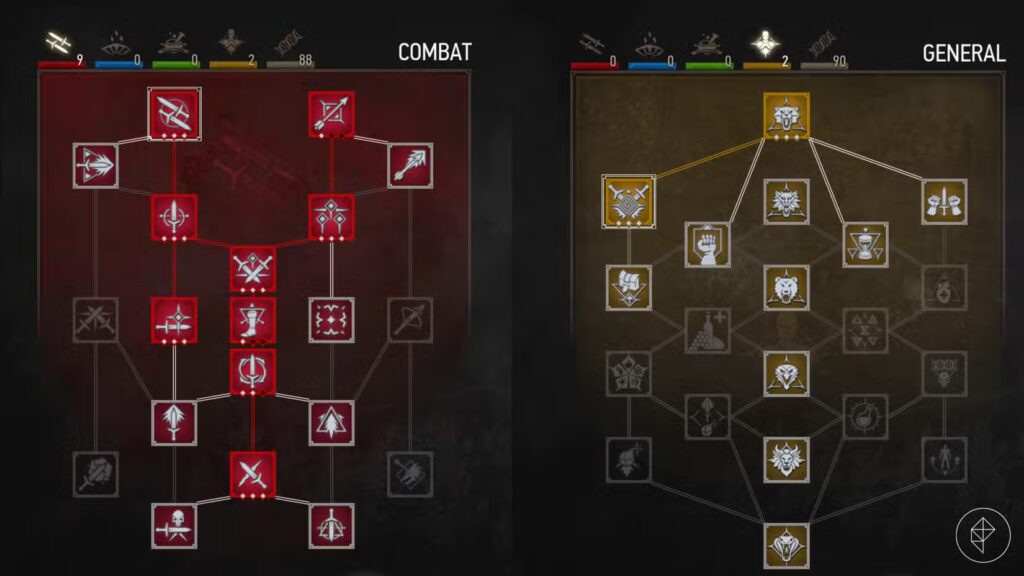
The skill system retains four categories: Combat, Signs, Alchemy, and General. Combat abilities improve sword attacks, critical damage, defensive techniques, and Adrenaline generation, while Signs develop Aard’s telekinetic control, Igni’s fire attacks, Yrden’s traps, Quen’s protection, and Axii’s manipulation. Alchemy supports potions, oils, bombs, Toxicity management, and mutagen bonuses. General abilities provide broader benefits, including Cat School Techniques, Griffin School Techniques, and Bear School Techniques, which reward matching armor classifications. Update 4.0 reduced the maximum investment in many abilities from five ranks to three and adjusted individual effects, so older recommendations may contain outdated skill levels, Toxicity limits, or damage bonuses. Fewer required points make specialization more accessible, but selecting abilities that reinforce the intended playstyle remains important.
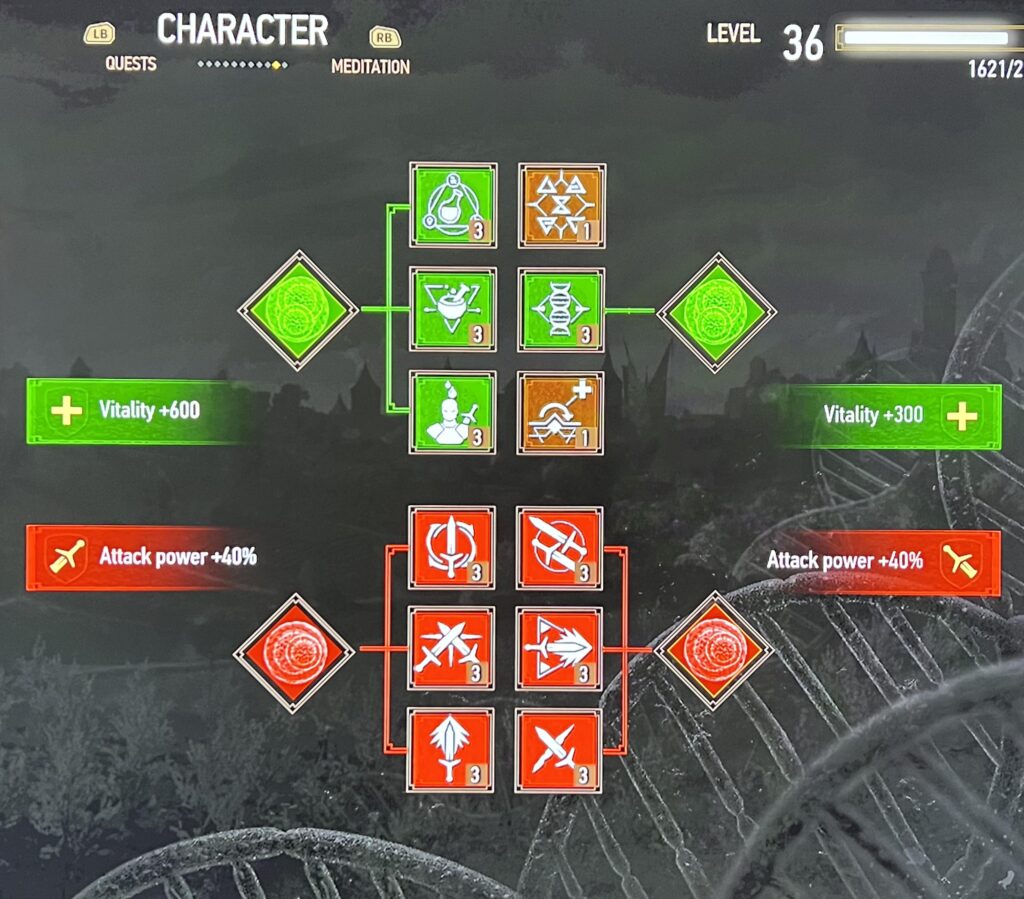
Learning a skill and activating it are separate actions. Most purchased abilities must occupy an available character slot before their benefits apply, making investments in unused skills less immediately valuable. Geralt eventually gains twelve standard ability slots, while the Blood and Wine mutation system can provide four additional slots with their own restrictions. Mutagens occupy separate positions and improve attributes such as attack power, Sign intensity, or Vitality, with matching adjacent ability colors strengthening their bonuses. Plan around the skills that can actually be equipped rather than purchasing every attractive option. This is particularly important for hybrid characters, whose Combat, Sign, and Alchemy investments compete for limited space.
For beginners, a Combat and Quen setup provides reliable performance through White Orchard and early Velen without requiring grandmaster equipment or advanced mutations. Muscle Memory improves fast attacks, while Quen protects against mistakes as players learn enemy patterns. An appropriately upgraded and equipped Delusion adds Axii utility and unlocks additional dialogue options in certain conversations and quests. Exploding Shield and Active Shield can strengthen protection later, but there is no need to purchase every Quen upgrade immediately. Gourmet offers prolonged healing from food when equipped, although its usefulness depends on difficulty and it should not replace preparation. These investments establish a foundation that can later develop into aggressive swordplay, defensive combat, or a more specialized Sign build.
Equipment and exploration matter as much as elaborate ability combinations during the opening hours. Complete nearby quests, visit Places of Power, improve Geralt’s swords, and collect Witcher School diagrams as they become available. The Viper sword diagrams in White Orchard offer useful early crafting opportunities, while Griffin gear provides a practical first Witcher armor set for players interested in Signs and survivability.
Swallow supports Vitality regeneration, Thunderbolt improves attack power, and the appropriate blade oil helps against the identified enemy type. A dependable early combat pattern is to cast Quen before engaging, attack during safe openings, avoid counterattacks, and use consumables when needed. Developing these habits makes later specialization more effective than attempting an advanced build before its necessary equipment and abilities are available.

Best Combat, Feline and Ursine Builds for Death March
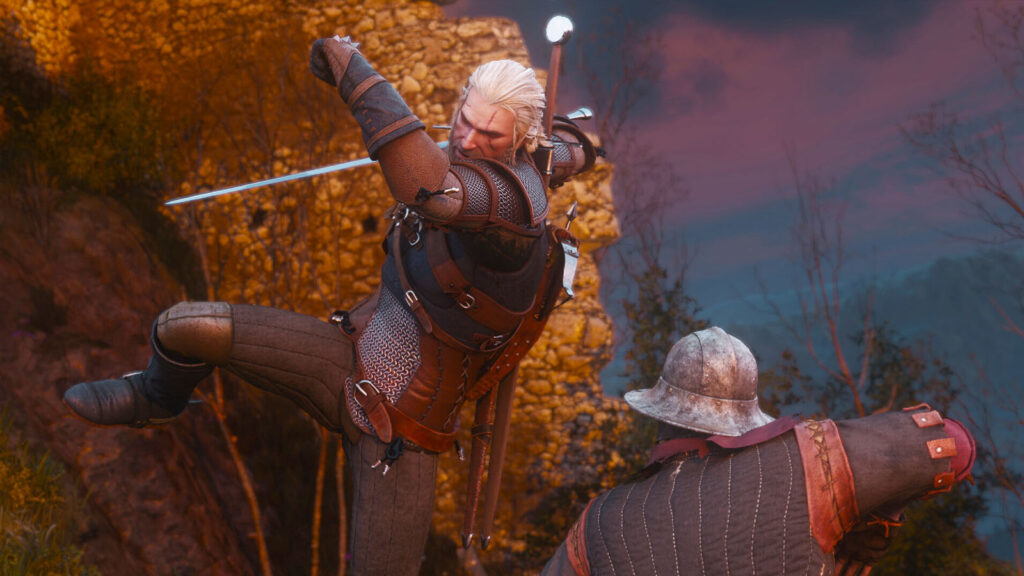
A strong sword build combines attack power, critical strikes, Adrenaline generation, and techniques suited to different openings. Muscle Memory and Precise Blows form the fast-attack foundation, while Whirl provides sustained spinning attacks against groups or vulnerable single targets. Strength Training and Crushing Blows improve strong attacks, with Rend offering concentrated damage when Geralt has sufficient Stamina and time to charge safely. Using both Whirl and Rend gives the build flexibility rather than forcing uninterrupted attacks against every opponent. Razor Focus improves Adrenaline generation, while Resolve helps preserve it when damage interrupts combat. Additional bonuses are useful only when Geralt can maintain positioning and avoid disruption, so consistent execution matters more than the largest isolated damage number.
The Feline build is the natural choice for aggressive fast attacks and critical damage. Its light armor works with Cat School Techniques, which provides fast-attack and critical-damage benefits for each matching armor piece. Muscle Memory, Precise Blows, Whirl, and Razor Focus provide the core offensive package, while strong attacks become especially useful with grandmaster equipment. The three-piece Grandmaster Feline bonus makes strong attacks increase fast-attack damage for five seconds, scaling with the number of matching pieces. The six-piece bonus improves attacks from behind and can stun opponents by consuming an Adrenaline Point. This encourages opening with a strong attack, repositioning toward the side or rear, and following with fast strikes or Whirl when uninterrupted pressure is safe.
Feline armor favors offense over maximum protection, making dodging and disengagement essential when enemies surround or repeatedly interrupt Geralt. Quen can protect against a mistake, but it should not encourage absorbing every attack. Thunderbolt supports physical damage, while Tawny Owl can help with Stamina-intensive techniques and repeated Sign use. Alchemy abilities such as Synergy provide further support without requiring the character to abandon sword specialization. Maintain the full equipment set when its bonuses are central to the strategy, or compare those benefits carefully before replacing a matching sword with an individually stronger weapon. The build performs best when its damage comes from controlled aggression rather than an attempt to attack continuously regardless of enemy behavior.
The Ursine build prioritizes resistance, Quen protection, and strong attacks. Heavy armor offers substantial protection against physical and monster damage, while Bear School Techniques increases maximum Vitality and strong-attack damage for each heavy piece. Strength Training and Crushing Blows preserve offensive power, with Resolve supporting the Adrenaline needed by other abilities. The three-piece Grandmaster Ursine bonus provides a chance to create another Quen shield when the current shield breaks, increasing with additional matching pieces, while the six-piece bonus strengthens damage from Quen-related abilities.
Exploding Shield and Active Shield support this defensive approach, and Undying can restore Vitality after otherwise fatal damage when the necessary Adrenaline is available. Heavy armor still does not eliminate threats from powerful attacks, elemental damage, or status effects, so protection must be combined with careful positioning.
Endgame mutations can reinforce either defensive consistency or demanding offensive play. Mutated Skin reduces incoming damage according to accumulated Adrenaline Points, making it suitable for characters who preserve that resource. Second Life offers another safeguard by providing temporary invulnerability and restoring health when Vitality reaches zero, subject to a cooldown. Bloodbath takes the opposite approach, increasing attack power through successive successful melee attacks but removing the accumulated bonus when Geralt takes damage. It therefore suits skilled players who can sustain offense without being hit, rather than characters planning to endure repeated attacks. Choose among these options according to whether the build needs reliable protection or rewards for precise execution.
On Death March, the highest standard difficulty, a Combat, Quen, and Alchemy combination offers a dependable balance of damage and survival. Ursine armor provides a forgiving defensive foundation, although Feline equipment remains effective for players who consistently avoid incoming attacks. Consult the Bestiary, apply the correct oil, and select suitable bombs before difficult monster encounters instead of relying entirely on equipment strength.
Short dodges preserve counterattacking opportunities, while rolls provide distance when escaping larger attacks. Avoid spending all available Stamina on offensive Signs when defensive action may soon be necessary, and refresh Quen whenever practical. Euphoria can add substantial endgame damage without abandoning protective Alchemy skills, but measured aggression and preparation remain more dependable than maximizing offense at the expense of survival.
Best Griffin, Sign and Hybrid Builds
The Griffin build makes Signs the centerpiece of combat through Sign intensity, Stamina regeneration, and battlefield control. Griffin School Techniques strengthens Sign intensity and Stamina regeneration for each medium armor piece, complementing the equipment’s magical attributes. With three Grandmaster Griffin pieces, casting a standard Sign using Stamina allows the next standard Sign cast within three seconds to consume no Stamina. The six-piece bonus expands Yrden traps and provides increased Sign intensity, improved Stamina regeneration, and damage reduction while Geralt remains inside them. This makes positioning within Yrden central to the setup rather than treating the trap as an occasional utility. Constantly retreating beyond its boundaries wastes part of the set’s defensive and offensive potential.
Igni, Aard, and Yrden work well together because they address different parts of an encounter. Yrden establishes a controlled area, Aard interrupts or destabilizes approaching enemies, and Igni applies fire damage and burning pressure. The main investments depend on which effects the build emphasizes:
- Igni:
Melt Armor reduces enemy protection, Pyromaniac improves the chance of burning, and Firestream provides a sustained alternate attack. Firestream is useful when enemies remain within range, but its Stamina requirements and the danger of being attacked during casting must be considered. - Aard:
Aard Sweep improves crowd-control coverage, while Shock Wave adds damage. These options help interrupt groups and create opportunities to reposition or cast another Sign. - Yrden:
Sustained Glyphs improves trap utility, Magic Trap adds an alternate casting mode, and Supercharged Glyphs provides damage against affected enemies. These abilities support the area-control strategy encouraged by Griffin’s grandmaster bonuses.
A practical sequence begins with placing Yrden where enemies will approach, then using Aard to disrupt attacks and Igni to maintain offensive pressure. Sword attacks provide an alternative while Stamina recovers, and Tawny Owl supports more frequent casting. This approach is effective against groups that can be slowed, burned, or knocked down, but enemy resistances prevent one Sign from solving every encounter. Geralt should remain close enough to benefit from Yrden without allowing several opponents to interrupt him simultaneously. Retaining a reliable sword option is therefore important even for a dedicated magical character. Good resource management and positioning matter as much as increasing Sign intensity.
Three mutations offer distinct endgame paths for magical builds. Conductors of Magic increases offensive Sign damage using the damage of Geralt’s drawn sword, provided the weapon qualifies, making strong equipment useful even when sword attacks are infrequent. Magic Sensibilities allows damaging Signs to inflict critical hits and suits a more general magical offense. Piercing Cold specializes in Aard by adding a chance to freeze enemies, with certain combinations of freezing and knockdown capable of defeating opponents immediately. Enemy immunities and encounter conditions still affect those results, so freezing should not be treated as universally reliable. Choose the mutation according to the build’s main damage source and control strategy rather than assuming one option improves every Sign equally.
A hybrid build combines reliable sword damage, protective magic, crowd control, and Alchemy without attempting to maximize every category. Muscle Memory, Precise Blows, and Whirl provide useful melee options, while Quen and a focused investment in Yrden or Igni cover defense and control. Acquired Tolerance and Synergy offer broadly useful Alchemy support, but ability-slot limitations require selecting skills that contribute regularly.
Griffin gear suits frequent casting, Wolven equipment supports mixed combat, and Forgotten Wolven equipment offers combinations involving Aard and Yrden. A typical encounter might begin with Quen, continue with Yrden and Igni, and shift to sword attacks while Stamina recovers. Conductors of Magic, Euphoria, or Metamorphosis can later reinforce the chosen emphasis, making a Combat, Quen, and Alchemy hybrid a dependable option for a first complete playthrough despite its lower specialization.
Best Alchemy, Euphoria and Endgame Mutation Strategies
Alchemy builds improve Geralt through coordinated potion effects, decoctions, oils, bombs, and mutagen bonuses. Acquired Tolerance increases maximum Toxicity according to known Alchemy formulas, allowing a larger collection of preparations as Geralt learns more recipes. Heightened Tolerance serves a different purpose by raising the potion overdose threshold, reaching 80% when fully upgraded in the next-generation version. Refreshment restores a percentage of maximum Vitality when potions are consumed, while Protective Coating reduces damage from enemies targeted by the oil applied to the weapon. Correct matching matters: an oil intended for another enemy category does not replace the appropriate preparation. Synergy strengthens character-panel mutagen bonuses and becomes particularly effective with greater mutagens and a compatible arrangement of equipped abilities.
Choose consumables according to the encounter and the build rather than consuming as many as possible. Thunderbolt increases attack power, Tawny Owl supports Stamina regeneration, Petri’s Philter benefits Signs, and Maribor Forest supports Adrenaline generation. Swallow restores Vitality over time, while White Raffard’s Decoction offers more immediate healing. Longer-lasting decoctions require additional Toxicity planning: Ekimmara supports healing through damage, Water Hag rewards maintaining full Vitality, Troll provides regeneration, and Ekhidna can turn Stamina-consuming actions into healing.
Check current item descriptions before relying on effects described in older guides, since patches may have changed relevant mechanics. Manticore gear complements Alchemy strategies through properties supporting Toxicity and bonuses associated with bombs and other Alchemy tools, but the strongest setup still balances damage, healing, and protection.
Euphoria remains a leading endgame choice because it converts Toxicity into both sword damage and Sign intensity. Access requires the Blood and Wine mutation system, with Toxic Blood researched before Euphoria itself can be unlocked for three ability points and three Greater green mutagens. Its supplied scaling is a 0.75% increase in sword damage and Sign intensity for each Toxicity point, so maintaining 100 Toxicity produces a 75% bonus from that calculation. Actual performance still depends on equipment, enemy defenses, and other active effects. The next-generation changes to Alchemy and Toxicity mean older setups should not be followed without considering their assumptions. Higher Toxicity also creates risk when potion thresholds and defensive preparations are poorly managed.
An effective Euphoria character combines the fast-attack foundation with Acquired Tolerance, Heightened Tolerance, Synergy, and suitable defensive support such as Protective Coating. Feline equipment reinforces physical offense, while Manticore offers an alternative for a more Alchemy-centered approach. Mixed equipment can also be useful, although abandoning matching pieces may remove a desired set bonus. Prepare selected potions and decoctions before combat, activate Quen, and use fast or strong attacks according to the available opening. Thunderbolt improves physical pressure, while Tawny Owl supports Whirl or repeated Signs when those actions are central to the build. Euphoria rewards a coherent setup rather than making every offensive ability equally valuable.
Metamorphosis provides a different advanced Alchemy strategy by activating random decoctions when Geralt applies certain critical effects. These temporary effects do not add their normal Toxicity cost, last 120 seconds, and can maintain up to three activated decoctions simultaneously. The advantage is access to several beneficial effects without paying the usual cost of drinking each preparation. Its limitation is unpredictability, since triggered decoctions are random rather than a fully controlled selection. This makes it attractive for players comfortable adapting to changing bonuses and combining Combat, Signs, and Alchemy. It also supports a broader selection of abilities in mutation-related slots than more narrowly specialized alternatives.
The mutation system is unlocked through Turn and Face the Strange in Blood and Wine. Research consumes ability points and Greater mutagens, and although several mutations can be researched, only one primary mutation effect can be active at a time. Strengthened Synapses adds ability slots after researching two, four, eight, and twelve mutations, eventually expanding the standard twelve-slot configuration by four.
Slot compatibility depends on the active mutation: Euphoria supports Alchemy abilities, Conductors of Magic accommodates Combat and Signs, and Metamorphosis and Second Life allow combinations across Combat, Signs, and Alchemy. These restrictions matter when planning a complete build, particularly when several useful abilities cannot fit into the regular slots. Research the mutation that supports the intended playstyle first, then pursue additional unlocks as resources allow.
Best Witcher Gear, Weapons, Enchantments and Respec Options
Witcher equipment can be improved through crafting tiers, generally progressing from basic to enhanced, superior, mastercrafted, and grandmaster gear, with the latter available through Blood and Wine. Individual attributes and matching-set bonuses must be evaluated separately. For most traditional schools, three matching grandmaster pieces activate the first bonus and six activate the second, with the qualifying collection generally consisting of four armor pieces and two swords. Replacing a matching weapon with a stronger alternative can therefore remove the full-set effect. Compare the resulting damage, protection, or utility rather than assuming the weapon with the highest individual statistics is automatically better. The same principle applies to mixed armor, which may improve selected attributes while sacrificing the intended school bonuses.
Aerondight is a powerful endgame silver sword obtained through There Can Be Only One in Blood and Wine. Successful attacks build charges that increase damage, while defeating enemies under the appropriate conditions can permanently improve its damage potential. This makes it attractive for long-term progression and many Combat or Euphoria setups. The Toussaint Knight’s Steel Sword is another strong offensive option when obtained with suitable attributes. Grandmaster Feline swords remain useful when preserving the complete Cat School bonus matters more than replacing an individual weapon, while Griffin swords complement a full Sign-focused set. Characters using Conductors of Magic should also consider qualifying sword damage because it contributes to magical offense, not merely melee attacks.
Hearts of Stone introduces the Runewright and enchantments through Enchanting: Start-up Costs. Severance is especially useful for sword builds because it extends the effective reach of Whirl and Rend, while Invigoration offers an alternative for characters combining healing with offensive damage. Armor glyphwords can change how equipment is classified: Levity treats equipped armor as light, Balance treats it as medium, and Heft treats it as heavy. These effects allow heavier or otherwise differently classified equipment to work with School Techniques that normally require another armor type. For example, Levity creates opportunities to combine the resistance attributes of heavier gear with Cat School Techniques. Entanglement is useful for Yrden-focused setups because it improves interactions involving the Sign’s alternate trap mode.
New Game Plus introduces legendary versions of Witcher equipment, allowing preferred schools to continue developing against stronger enemies. However, gear carried from an earlier playthrough should still be compared with newly available items rather than automatically retained or replaced. Combat characters should examine attack-related attributes and critical damage, while Sign specialists should prioritize intensity and Stamina-related benefits. Defensive builds need to weigh resistances and protective set effects, and Alchemy characters should consider Toxicity support, bombs, and consumable-related advantages. Armor rating alone does not capture every contribution an item makes to the build. The useful comparison is how the complete equipment combination supports Geralt’s active abilities and typical encounters.
A Potion of Clearance resets points invested in standard abilities without requiring a new playthrough. It normally costs 1,000 crowns and can be obtained from vendors including Keira Metz after sufficient quest-related progress, a merchant near Novigrad’s Gildorf area, and Gremist or Yolar around Gedyneith in Skellige. Additional merchants and herbalists in Toussaint provide further opportunities during Blood and Wine. Save before consuming it, then redistribute the returned points among Combat, Signs, Alchemy, and General abilities. A full reset is particularly useful when changing from Feline sword combat to Griffin Signs or moving from an early Combat setup into an Alchemy-heavy endgame build. Plan the necessary equipment, consumables, and mutation access beforehand so the new allocation can actually function.
The separate Potion of Restoration returns ability points invested in mutation research, but it does not refund the Greater mutagens consumed during that research. Changing mutation plans therefore has a different resource cost from resetting ordinary skills. Neither potion is necessary merely to rearrange abilities that Geralt has already learned; those can be removed from active slots and replaced with other available skills. This is useful when temporarily exchanging an offensive option for more protection or adjusting a Sign setup against a resistant opponent. Reserve a full respec for situations where the existing point investments no longer support the intended character. Reviewing the complete setup before spending again helps avoid repeated reset purchases and makes experimentation more productive.
Frequently Asked Questions (FAQs)
- What is the best overall build in The Witcher 3 Remastered?
Euphoria Combat and Alchemy is one of the strongest late-game options because it combines reliable sword damage with Toxicity-based bonuses to both physical offense and Sign intensity. Acquired Tolerance supports greater Toxicity capacity, Synergy strengthens mutagen bonuses, and abilities such as Muscle Memory and Whirl provide effective melee attacks. However, Euphoria requires access to Blood and Wine’s mutation system, so it is not an early-game setup. Griffin Signs or Feline fast attacks may be more suitable for players who prefer a specialized approach. - Is Euphoria still powerful after the next-generation update?
Yes. Euphoria increases sword damage and Sign intensity by 0.75% per Toxicity point, so maintaining 100 Toxicity provides a 75% bonus from the mutation’s calculation. Actual damage still depends on equipment, other abilities, and enemy defenses. The next-generation balance adjustments reduced the effectiveness of older Toxicity strategies without removing Euphoria’s usefulness. Pair it with suitable Alchemy skills and carefully chosen preparations, but avoid raising Toxicity indiscriminately. Acquired Tolerance improves capacity, while Heightened Tolerance helps manage potion overdose risk. - What is the best armor set for maximum sword damage?
Feline School armor is particularly strong for fast attacks and critical damage. Its light classification works with Cat School Techniques, while Muscle Memory, Precise Blows, and Whirl reinforce sustained melee offense. The Grandmaster Feline bonuses also reward using strong attacks before fast attacks and striking enemies from behind. However, its offensive advantages require careful positioning because repeated hits can quickly undermine the build. Players who favor strong attacks and greater protection may find Ursine equipment more effective for their preferred fighting style. - Which Witcher 3 build is best for beginners?
A Combat and Quen build offers straightforward damage and protection without requiring rare equipment or advanced mutations. Start with Muscle Memory to improve fast attacks, activate Quen before combat, and dodge counterattacks rather than trying to absorb them. Swallow, Thunderbolt, and appropriate blade oils provide useful support as equipment improves. Remember that most purchased abilities must be equipped before their benefits apply. This foundation lets beginners learn enemy patterns and resource management before committing more heavily to Combat, Signs, or Alchemy. - What is the best Sign build in The Witcher 3 Remastered?
A Griffin School build is among the strongest options because its armor and School Techniques support Sign intensity and Stamina regeneration. Develop Yrden for battlefield control, Aard for disruption, and Igni for fire damage, then use sword attacks when Stamina needs to recover. Grandmaster Griffin bonuses make fighting inside Yrden especially valuable, so avoid repeatedly abandoning its area. Conductors of Magic strengthens damaging Signs through a qualifying sword’s damage, while Piercing Cold suits an Aard-focused approach. Keep a sword option for enemies that resist particular magical effects. - Is Ursine armor better than Feline armor?
Neither set is universally better because they support different combat priorities. Ursine’s heavy armor, defensive resistances, and Adrenaline-oriented attributes suit strong attacks and Quen protection. Feline’s light armor and offensive bonuses favor fast attacks, critical damage, and avoiding hits through careful movement. Ursine can be more forgiving when positioning is imperfect, but it does not make Geralt invulnerable. Feline rewards accurate dodging and sustained pressure. Choose the set that complements the attacks, defensive habits, and abilities you actually use. - How do you unlock mutations in The Witcher 3?
Complete Turn and Face the Strange, a secondary quest in Blood and Wine, to unlock mutation research. Each mutation requires ability points and Greater mutagens, and some require earlier mutations to be researched first. Multiple mutations can be unlocked, but only one primary effect can be active at a time. Strengthened Synapses provides additional ability slots after researching two, four, eight, and twelve mutations. The types of abilities allowed in those extra slots depend on the active mutation, so plan research around the intended build. - What is the best build for Death March difficulty?
A Combat, Alchemy, and Quen build provides dependable damage while reducing the consequences of mistakes. Ursine armor adds protection, Acquired Tolerance expands potion options, and Protective Coating improves defense when the correct oil matches the enemy. Maintain Quen, consult the Bestiary, and use dodges or rolls according to the attack rather than relying entirely on armor. Experienced players can use Feline or Euphoria setups to shorten encounters, but greater damage does not replace defensive timing. A sustainable build is usually more reliable than one focused exclusively on offense. - Can you reset your skills and change builds in The Witcher 3?
Yes. A Potion of Clearance, normally costing around 1,000 crowns, refunds points spent on ordinary abilities. It is available from certain merchants, including Keira Metz after sufficient quest progress and selected vendors in Novigrad, Skellige, and Toussaint. Mutation research requires a separate Potion of Restoration, which returns invested ability points but not consumed Greater mutagens. A reset is unnecessary when simply exchanging already learned abilities between active slots. Before purchasing a potion, check whether rearranging existing skills is enough to make the desired adjustment. - What is the strongest endgame mutation in The Witcher 3?
The strongest choice depends on the build rather than one mutation outperforming every alternative. Euphoria suits Combat and Alchemy characters who maintain managed Toxicity, while Metamorphosis triggers temporary random decoction effects without their normal Toxicity cost. Conductors of Magic benefits offensive Sign builds by scaling their damage from a qualifying drawn sword. For defense, Mutated Skin reduces incoming damage according to accumulated Adrenaline Points. Consider both the primary effect and the ability types permitted in additional mutation slots when choosing a setup.
Conclusion
The best remastered builds in The Witcher 3 Wild Hunt show how compatible abilities, Witcher School equipment, mutations, and Alchemy preparations can shape Geralt’s combat effectiveness. Euphoria Combat and Alchemy remains an outstanding endgame choice for offensive power, converting Toxicity into increased sword damage and Sign intensity when supported by suitable skills and gear.
Feline builds favor aggressive swordplay through fast attacks, critical hits, precision, and mobility, while Griffin equipment strengthens magical combat centered on Igni, Aard, and Yrden. Ursine builds take a defensive approach, combining heavy armor, Quen, and protective abilities to support cautious play during demanding encounters. Alchemy specialists benefit from improved Toxicity management, stronger mutagens, and carefully selected consumables, while hybrids combine these systems to handle a wider range of situations.
The next-generation update reduced the points needed to maximize many abilities and rebalanced previously dominant strategies, encouraging players to explore more viable combinations. However, the strongest build depends on more than individual bonuses: its equipment and abilities must work together and suit the player’s combat style. Specialized characters can achieve exceptional results, but understanding enemy weaknesses, maintaining defensive protection, and managing resources remain essential at every difficulty. Experimenting with different setups helps players find the balance of damage, control, and survivability that works best for them. Mastering these systems allows Geralt to perform consistently throughout the main campaign, Hearts of Stone, Blood and Wine, and New Game Plus.
Sources and Citations
- CD Projekt Red, The Witcher Official Website : Provides official information about The Witcher games, including game overviews, announcements, trailers, development updates, and links to technical support. Serves as the primary source for news and published patch documentation for The Witcher 3: Wild Hunt. The Witcher
Citation: The Witcher Official Website. (CD Projekt Red). - CD Projekt Red, December 12, 2022 : Documents the next generation update for The Witcher 3: Wild Hunt, covering graphical enhancements, ray tracing, performance options, cross progression, additional content, and gameplay adjustments. Also explains Quick Sign Casting, combat balance changes, and fixes for several quests. The Witcher
Citation: Next-gen Update List of Changes. (CD Projekt Red). - CD Projekt Red, July 19, 2023 : Provides the official Patch 4.04 documentation, detailing subsequent gameplay fixes, quest corrections, visual improvements, and platform specific stability updates. Includes fixes for underwater health loss and blocked progression in The Final Trial, alongside radial menu improvements and updates for Nintendo Switch. The Witcher
Citation: Patch 4.04 Is Live on All Platforms, Including Nintendo Switch!. (CD Projekt Red).
Recommendations
- The Performing Right Society Has Filed a Lawsuit Against Valve Over Unlicensed Music on Steam
- Bohemia Interactive Releases Arma: Cold War Assault Source Code: What it Means for Modders and the Future of Arma
- All Character and Specialist Locations in Fortnite Chapter 7 Season 3: Complete NPC Guide
- More Than 20 Classic Warhammer PC Games Hit Steam Full List, Including Shadow of the Horned Rat, Fire Warrior, and Space Hulk
- Empulse – Official Early Access Gameplay Trailer
- Adobe Photoshop 27.10 Adds Powerful AI Editing and Light Controls
- Dead by Daylight Devs Celebrate 10 Years of Eldritch Evil and Hope for Many, Many More
- The Super Mario Galaxy Movie and Everything New to Streaming (2026 Release Guide, Digital Watch Options & Platform Updates)
- How to Fix Missing Textures/ (or Linked) Files Detected in Blender: A Complete Troubleshooting Guide
- MSI Claw 8 EX AI Plus Review: the Ultra-Premium $2000 Handheld Gaming PC You Probably Can’t Afford



































































































