









In This Article (7 sections)
Stanford AI100 2026 Report: AI Scaling Laws, Training Compute Growth, and the Cost of Frontier Models
Stanford’s 2026 AI100 report examines a central question in artificial intelligence development: whether building increasingly large models remains the most effective way to improve performance. Since 2020, the computing operations used to train frontier language models have increased by approximately five times annually. Yet research has also demonstrated that smaller models can outperform much larger systems when training resources are allocated more efficiently.
One example is DeepMind’s Chinchilla experiment, which produced a stronger model with 70 billion parameters compared with Gopher’s 280 billion parameters by using approximately the same training compute budget while processing four times as much data. The distinction illustrates why model performance depends not simply on size, but on how developers distribute available computing resources between parameters, training examples, and other improvements.
The November 2026 report, AI Goes Mainstream: The Scaling Era and the Rise of Generative AI, is the third assessment produced through Stanford’s One Hundred Year Study on Artificial Intelligence. The initiative commissions a major evaluation every five years, and the latest report was prepared by an international panel chaired by Oxford computer scientist Michael Wooldridge. It examines the period when generative AI developed from a research technology into tools used directly by millions of people.
The panel credits larger datasets and increased computing power with enabling much of that progress while questioning whether the same development strategy will remain the most effective approach. It does not declare that the scaling era has ended. Instead, it considers how future improvements might come from better training data, reasoning methods, retrieval systems, memory, and tools that allow models to perform more complicated tasks.
AI scaling laws describe relationships between the resources used to train models and their measured performance. During pretraining, a language model repeatedly predicts the next token, which may represent a word, part of a word, or punctuation. Researchers measure how much probability the model assigns to the correct continuation. Better predictions generally produce lower average loss, while evaluation on previously unseen text helps establish whether the model can generalize beyond its training material.
In 2020, Jared Kaplan and colleagues found approximate power law relationships between language model loss, parameter count, training data, and computing resources. These relationships suggested that researchers could train smaller experimental models and use their results to estimate the performance of larger systems developed using comparable methods.
Later research by Jordan Hoffmann and colleagues examined how developers should distribute a fixed training compute budget. Across more than 400 experimental models, the researchers found that compute efficient training generally required increasing parameter counts and training tokens together. Doubling model parameters called for approximately doubling the amount of training data processed. Increasing only the network’s size could leave it without enough examples to make effective use of its capacity. This finding helped explain why the 70 billion parameter Chinchilla model outperformed the substantially larger Gopher system despite using a comparable training budget.
However, better training scores do not automatically guarantee better performance on practical tasks. A model might predict most of a legal document accurately while overlooking a single exception that changes an important deadline. Average language prediction loss would reward the many correct predictions, even though the mistake could make the final answer unusable. Research by Deep Ganguli and colleagues documents the difficulty of predicting particular model behaviors from aggregate loss measurements. Evaluation methods also influence how progress appears. A system extracting three fields from a document may improve from identifying one correctly to identifying two, but if the application requires all three fields before proceeding, both outputs remain unusable.
This distinction makes task specific evaluation essential. A document assistant should be tested using examples containing amendments, conflicting dates, exceptions, and other details that require interpretation. Researchers should measure whether the system identifies the correct information rather than relying only on general language prediction scores. Evaluation should also consider differences between languages, document types, and user groups. An aggregate improvement may conceal persistent weaknesses in less common situations, especially when those cases are underrepresented in the testing material.
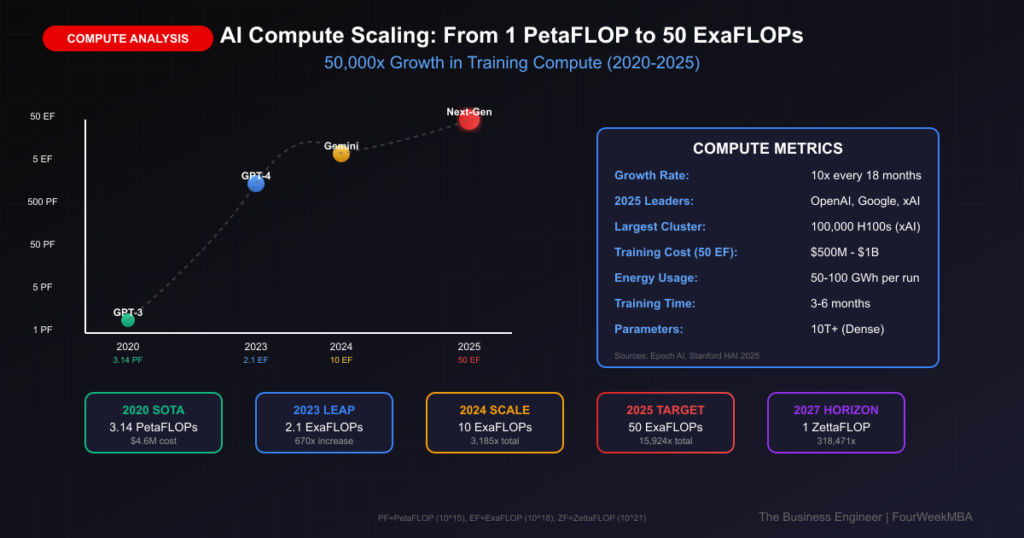
Stanford cites research from Epoch AI estimating that frontier language model training compute has grown by approximately a factor of five annually since 2020. Epoch reports a doubling time of around 5.2 months, with a 90% confidence interval placing the annual growth factor between roughly four and six. These figures describe the trend among frontier models rather than every AI system. Training compute measures arithmetic operations, commonly expressed as floating point operations, allowing comparisons between workloads completed using different hardware.
A fivefold increase in computation does not necessarily mean a fivefold increase in performance, electricity consumption, training time, or financial cost. Faster hardware may complete more calculations within the same period, while differences in system design can change the resources needed for similar results.
The scale of modern infrastructure illustrates how computing capacity and completed training workloads must be distinguished. Stanford describes a facility with computing power exceeding the equivalent of one million Nvidia H100 accelerators. An H100 equivalent provides a common reference for estimating processing capacity, but the figure does not establish the facility’s physical GPU inventory or how much of that capacity was used for any individual model. A data center’s theoretical computing resources, the operations performed during a training run, and the performance of the resulting system are separate measurements.
The financial requirements of frontier AI development extend well beyond the final training process. Developers must prepare datasets, test architectures, employ specialized engineers, and coordinate communication between thousands of accelerators. Research by Ben Cottier and colleagues estimated that accelerators and personnel each accounted for tens of millions of dollars in the development of systems such as GPT 4 and Gemini. Other expenses include networking equipment, server components, and electricity. Cost estimates vary depending on whether researchers allocate part of a computing cluster’s lifetime expense to one training run, calculate the full purchase price, or estimate the cost of renting similar resources through a cloud provider.
These expenses contribute to the concentration of frontier AI development within large technology companies. Stanford’s separate 2026 AI Index reported that industry produced more than 90% of the notable AI models it tracked in 2025. The statistic concerns a selected collection of significant models rather than all AI research. Universities and independent laboratories continue contributing training methods, evaluations, and investigations into model weaknesses. Nevertheless, the cost of repeatedly training large systems can limit their ability to conduct controlled experiments at frontier scale.
University research laboratories face particular difficulties when experiments require several comparable training runs. A team investigating poor performance in one language might need to train multiple models while changing only the language distribution. If its budget supports just one large experiment, identifying the cause of an apparent improvement becomes harder. Access to finished model weights helps researchers investigate some behaviors, but reproducing training results can also require knowledge of the original datasets, procedures, and configurations. Projects such as FineWeb have supported reproducibility by releasing data curation code and models used to test specific design choices.
Shared infrastructure provides one possible response. In September 2026, the U.S. National Science Foundation announced an operations center for the National Artificial Intelligence Research Resource, an initiative intended to broaden access to computing, data, tools, and technical expertise. Such resources could allow university laboratories to perform controlled comparisons that would otherwise exceed their available hardware budgets. Stanford’s broader concern is that continued growth in frontier training costs may increasingly determine which organizations can experiment with the largest models, making shared resources and more efficient methods particularly important.

AI Training Data Limits, Synthetic Data, Electricity Demand, and Diminishing Returns
The increasing scale of AI training has raised questions about whether developers can continue finding enough useful text to support larger datasets. Stanford examines estimates suggesting that the effective supply of publicly available human generated text may eventually constrain current approaches to model development. However, there is no verified inventory of high quality public text that frontier models have not yet processed. A widely cited 2024 study by Pablo Villalobos and colleagues estimated an effective stock of approximately 300 trillion tokens, with a 90% confidence interval ranging from roughly 100 trillion to 1,000 trillion. The calculation accounted for assumptions about quality and the usefulness of repeated training rather than counting only documents that had never been used.
The same study projected that, if the trends it examined continued, training datasets could reach the effective size of that text supply sometime between 2026 and 2032. This does not establish when every useful document will have been included in an AI model. Developers may repeatedly train on some sources while omitting entire languages, archives, or communities. The training mixtures used by many frontier systems also remain undisclosed. The estimate therefore describes a potential constraint on the existing scaling approach, not a definitive exhaustion date for human writing or the availability of useful information.
The value of additional training data also depends on its relevance and quality. A language tutoring model might benefit more from carefully corrected examples of common learner mistakes than from another enormous collection of general web pages. Similarly, a system designed to answer technical questions may gain more from reliable explanations than from repeated copies of broadly similar text. Researchers have demonstrated that additional data does not always provide additional useful information.
Katherine Lee and colleagues identified a 61 word English sentence repeated more than 60,000 times in a widely used web dataset. Removing duplicate material allowed models in their experiments to achieve comparable or better accuracy with fewer training steps while producing memorized passages approximately ten times less frequently.
The FineWeb project provides another example of improving dataset quality through selection. Researchers assembled approximately 15 trillion tokens from 96 Common Crawl snapshots, then created a smaller educational collection called FineWeb Edu containing around 1.3 trillion tokens. Models trained on this educational subset performed particularly well on knowledge and reasoning evaluations, including MMLU and the AI2 Reasoning Challenge. The findings demonstrate how carefully selected material can improve performance on particular tasks without necessarily increasing the total dataset size. However, quality depends on the intended application. A filter favoring textbook style explanations might remove informal conversations that would be useful for a dialogue system. Dataset evaluations should therefore identify the skills being measured and the types of material excluded.
Synthetic data offers another possible source of training examples when suitable human produced material is scarce. The approach is particularly useful when generated examples can be checked against reliable rules or evidence. Google DeepMind’s AlphaGeometry demonstrates this advantage. Because published solutions to difficult geometry problems are limited, researchers generated geometric diagrams and derived relationships using mathematical reasoning, producing approximately 100 million synthetic examples. Their system combined a language model with a symbolic deduction engine and solved 25 of 30 historical Olympiad geometry problems in a benchmark under competition time limits.
The reliability of synthetic data depends heavily on whether its contents can be verified. A mathematical deduction system can determine whether a geometric relationship follows from stated assumptions, making generated examples useful for training. Producing thousands of plausible descriptions of an undocumented historical event presents a different problem because the examples may repeat invented details without providing new evidence. Research by Ilia Shumailov and colleagues demonstrated another risk through experiments involving successive generations of models trained on generated data. Under the recursive conditions they tested, rare parts of the original data distribution gradually disappeared. This effect, known as model collapse, illustrates the danger of allowing synthetic material to replace the diversity and factual grounding of original examples.
Stanford therefore treats synthetic data as a potentially valuable complement to human generated and otherwise grounded information rather than a universal replacement. The most relevant questions concern what the system generates, how the examples are checked, and whether the training process preserves important variation. Synthetic examples verified by mathematical rules can address one kind of scarcity, while tasks requiring new observations of the physical or social world still need reliable evidence beyond a model’s existing outputs.
Computing infrastructure creates another constraint because larger models require access to electricity, cooling, networking, and suitable facilities. A developer may purchase accelerators before a data center has the infrastructure needed to operate them. A region can produce enough electricity over a year while lacking the local transmission capacity or transformers necessary to deliver concentrated power to a particular site. Consequently, the availability of annual electricity generation does not necessarily establish that a new AI facility can connect to the grid when needed.
The International Energy Agency’s April 2026 analysis estimated that data centers worldwide consumed approximately 485 terawatt hours of electricity in 2025. Its November World Energy Outlook 2026 projected consumption of roughly 1,000 terawatt hours by 2030 under the Stated Policies Scenario. Facilities optimized for AI were expected to account for around three quarters of the projected increase. These estimates include conventional cloud computing and other data center activities, not just the training of frontier language models. The IEA also identified longer waiting periods for transformers and some electricity generation equipment, reinforcing the importance of infrastructure availability when planning future computing projects.
Improving software efficiency can help developers perform more work using existing clusters, but it cannot independently resolve delays involving electrical connections or physical facilities. The constraint may therefore shift between computing hardware, available training data, electricity delivery, and the cost of operating infrastructure. A developer planning a larger training run must consider all these factors rather than assuming that purchasing more accelerators will immediately provide proportionally more usable computing capacity.
The concept of diminishing returns explains why continuously increasing training compute may become economically challenging even when it still improves performance. Under a power law relationship, additional computing resources can produce predictable reductions in training loss, but each comparable improvement may require progressively more absolute computation. A model can therefore continue improving while the cost of obtaining the next increment rises. Whether that improvement is valuable depends on the errors it removes.
For example, a transcription system that becomes substantially more accurate at recognizing unfamiliar names may save an archive considerable manual correction work. A similar improvement concentrated mostly on punctuation that staff already correct automatically may provide less practical value. Likewise, a small accuracy gain used across billions of requests can justify significant investment, while a larger improvement on an uncommon benchmark may offer limited commercial benefit. Stanford does not declare that further scaling has become economically unviable. Instead, it emphasizes that the relationship between additional investment, measurable improvement, and practical value is becoming increasingly important as frontier development costs rise.
Beyond Bigger AI Models: Inference Time Reasoning, Distillation, Retrieval, and Efficient Training
Stanford’s 2026 AI100 report identifies several approaches that could improve AI performance without relying exclusively on larger pretrained models. These include better allocation of training compute, additional reasoning work during inference, knowledge distillation, retrieval systems, improved data curation, memory, specialized training, and tools that extend model capabilities. The approaches address different limitations. Additional training examples may help a model learn a pattern, retrieval can provide recently updated information, and a reasoning procedure can allow a system to examine several candidate solutions before responding. Understanding which limitation matters is essential when choosing the most effective improvement.
Inference time compute refers to the processing performed after a user submits a request. Unlike pretraining, which changes the model used for future requests, additional inference work can be assigned selectively to individual problems. A system may generate several possible solutions, compare them using a verifier, or revise an initial attempt before producing its final answer. This allows developers to spend more processing resources on difficult questions while answering routine requests quickly. However, the additional expense recurs whenever a request requires the longer reasoning procedure, making expected usage volume an important part of the calculation.
Research by Charlie Snell and colleagues examined this tradeoff using mathematical reasoning problems. Under matched computing budgets, a smaller model given additional opportunities to search or revise could outperform a model with approximately 14 times as many parameters on some tasks. The result depended on problem difficulty and the amount of inference the system was expected to perform. For particularly difficult questions, investing in a stronger base model was often more effective because repeated attempts offer limited benefit when a weaker model rarely produces a promising solution.
The economic tradeoff differs between applications. A service handling occasional, complicated calculations may benefit from spending additional time checking possible answers. A product responding to millions of routine questions may gain more from improvements made once during training, since those improvements can benefit every subsequent request without requiring the same extended procedure each time. Meaningful comparisons therefore need to consider accuracy, response time, and total computing work across the expected number of requests.
The Chinchilla experiment remains an important example of efficient training because it compared models developed using approximately the same training compute budget:
- Gopher: Contained 280 billion parameters and used a comparatively smaller amount of training data.
- Chinchilla: Contained 70 billion parameters and processed approximately four times as much training data.
- Performance: Chinchilla outperformed Gopher across a broad collection of evaluations and achieved 67.5% average accuracy on MMLU.
- Efficiency: The smaller model required less computation during subsequent fine tuning and inference.
These results demonstrate that model architecture size alone is not a reliable measure of training efficiency or practical performance. Processing more useful examples can make a smaller system more capable within a fixed development budget. Lower inference requirements can also become important when the model must handle large numbers of requests after deployment.
The InstructGPT research provides another example of improving model usefulness without simply increasing its parameter count. Human evaluators preferred responses from a 1.3 billion parameter model tuned using human feedback over responses from the original 175 billion parameter GPT 3 on the researchers’ prompt distribution. This comparison evaluated how well models followed instructions and produced useful responses rather than measuring every possible dimension of capability. A large model may possess extensive knowledge while still ignoring a requested format or answering a related but incorrect question. Training with demonstrations and preference judgments can improve behavior by making desired responses clearer.
Chinchilla and InstructGPT therefore illustrate different methods of improvement. Chinchilla focused on distributing a fixed training budget more efficiently between model parameters and training examples. InstructGPT focused on improving the alignment between model behavior and user instructions. Claims that a smaller model outperforms a larger one should specify the evaluation criteria, training conditions, and tasks being compared. A result demonstrating superior instruction following does not automatically establish superiority in every area of knowledge or reasoning.
Knowledge distillation provides another route to smaller and more efficient models. In this process, a student model learns behavior from a larger teacher model or a collection of teachers. Instead of receiving only a label identifying one correct category, the student can learn from the probabilities the teacher assigns to several possible answers. Those relative probabilities may reveal similarities between categories that a simple correct or incorrect label would not communicate. Once trained, the student can reproduce some of the teacher’s behavior using a smaller architecture. However, errors consistently made by the teacher may also transfer to the student, making the quality of the original system important.
Retrieval addresses a different problem by providing relevant information when a question is asked. A university handbook assistant, for example, could retrieve the section governing the current academic year rather than relying entirely on facts learned during training. When the university updates an enrollment deadline, the document collection can be revised without rebuilding the language model. The reliability of the answer then depends on two stages: retrieving the correct document and interpreting its contents accurately. A system may still provide outdated information if it selects an older edition or misunderstands an exception in the correct passage.
Improved data curation can complement both approaches. A university assistant trained on carefully corrected examples of student questions might learn to distinguish an application deadline from an enrollment deadline. Retrieval would supply the dates currently in force, while distillation could reduce the cost of serving the resulting behavior through a smaller model. These methods can work together because they improve different parts of the system rather than competing to solve the same problem.
Stanford also identifies memory, specialized reasoning training, continual learning, and modular architectures as promising areas of development. A system with useful memory could retain relevant information between interactions, while continual learning might allow models to incorporate new experience without requiring complete retraining for every improvement. Modular systems could assign calculations to specialized solvers or document searches to retrieval components. The advantage depends on whether developers can identify the source of a problem and select a component better suited to handling it.
Learning through interaction offers another potential source of training signals. A simulated robot can attempt a movement, observe the result, and use that feedback to improve. Such experiences may provide information that written descriptions cannot fully capture. However, a simulator that models friction or other physical conditions inaccurately can reward behavior that fails when transferred to the real world. Researchers therefore need evaluations in the intended environment before assuming simulated improvements will generalize.
These approaches also create more complicated reliability challenges. When an AI assistant retrieves information, interprets a document, calls a tool, and produces an answer, an error may occur at several different stages. Evaluators need methods for identifying whether the system selected the wrong source, misunderstood correct evidence, used an inappropriate tool, or failed to recognize missing information. Stanford’s report emphasizes that the next phase of AI development must establish reliable evidence of performance as systems become capable of more complex actions.
The broader conclusion is that future AI progress may depend increasingly on using computing resources intelligently rather than simply increasing model size. Larger training runs remain one possible route to improvement, but their costs, infrastructure requirements, and data demands encourage developers to consider alternatives. Efficient training, better datasets, retrieval, reasoning procedures, distillation, memory, and specialized tools offer ways to address limitations that additional parameters alone may not resolve. Evaluating these methods requires attention to the specific task, the quality of the result, and the resources needed to achieve it.

Frequently Asked Questions (FAQs)
- Is Stanford AI100 the same publication as the Stanford AI Index?
No. Stanford AI100, formally the One Hundred Year Study on Artificial Intelligence, commissions a major assessment every five years to examine developments in AI and their broader implications. The Stanford AI Index is a separate annual publication that compiles quantitative indicators about research, investment, industry activity, and adoption. The November 2026 scaling analysis comes from AI100, while the statistic about industry’s share of notable models comes from the AI Index. - What is the difference between a parameter and a token?
A parameter is a numerical value learned by a model during training that helps determine how it processes information and generates predictions. A token is a unit of text or other input that the model processes, such as a word, part of a word, or punctuation. Parameter count describes part of the model’s architecture, while training token count indicates how much material it processed. More parameters do not automatically guarantee better performance if the model has insufficient training data. - Can two models use the same training compute and have different running costs?
Yes. Two models can consume approximately the same amount of computation during training while distributing that work differently between parameters and data. Chinchilla demonstrated this by training a smaller model on substantially more examples than Gopher. Because Chinchilla contained fewer parameters, it also required less computation for subsequent inference. That recurring difference can become financially important when a model handles millions of requests. - Can several AI developers use the same public text?
Yes. Training a model on publicly available text does not physically consume or remove that material, so multiple developers can use the same documents. The concern about data scarcity involves the amount of distinct, useful human generated information available for training, not exclusive ownership of each text. Actual access may still depend on licensing, technical availability, and the sources a developer chooses to include. - Why does finding a test question in training data matter?
If a model encountered a test question during training, its correct answer may reflect memorization rather than the ability to solve an unfamiliar problem. This makes benchmark results harder to interpret. Researchers check for overlap between training and evaluation data to determine whether measured performance reflects generalizable skills. The issue is particularly relevant when public benchmark questions appear in widely collected web datasets. - Does synthetic data always cause model collapse?
No. Model collapse was observed under particular recursive training conditions in which generated examples progressively displaced information from the original data distribution. Synthetic data can be useful when its correctness can be verified, as demonstrated by AlphaGeometry’s mathematically checked examples. The important distinction is whether generated material preserves reliable information and meaningful variation or simply reproduces a model’s existing errors and omissions. - Is a fivefold increase in training compute the same as a fivefold increase in capability?
No. The fivefold figure describes the estimated annual growth in arithmetic operations used to train frontier language models. It does not measure how much better those systems perform. Capability must be evaluated separately through defined tasks and performance measures. A substantial increase in training computation may produce modest improvements in one application and larger gains in another, depending on the model and evaluation conditions. - Why can a model with document retrieval still give an outdated answer?
Retrieval does not guarantee that a system selects the correct or most recent document. The current file may be missing from the collection, the search process may return an older edition, or the model may misunderstand an accurate passage. Testing both the retrieved source and the generated answer helps identify which stage caused the error. Maintaining an updated document collection is therefore necessary but not sufficient for reliable responses. - Does asking a reasoning model to spend longer change what it has learned?
Usually not. Additional inference time allows a model to generate, compare, or revise more candidate answers while its learned parameters remain unchanged. This can improve its response to the current question without permanently updating the underlying model. Retaining new information for later interactions requires another mechanism, such as storing memory or performing a subsequent training update. - What makes an AI scaling claim meaningful for a particular application?
A useful scaling comparison identifies the task being performed, the measure of success, and the resources required. For a document assistant, relevant measures might include the percentage of questions answered correctly using current sources, the time needed to produce a usable answer, and the computing cost per successful response. Comparing systems under consistent conditions helps establish whether additional scale provides a practical improvement rather than only a better general benchmark score.

Conclusion
Stanford AI100 identifies a central challenge in artificial intelligence development that cannot be resolved through training compute growth alone. Researchers can estimate how increasing the size of a training run may improve average language prediction, but determining whether those improvements will correct specific, consequential errors is more difficult. The availability of suitable training examples, the cost of controlled experiments, and the reliability of performance gains all influence the outcome. Frontier training compute has grown approximately fivefold annually since 2020, while estimates of the remaining supply of useful public text contain substantial uncertainty. Together, these constraints raise questions about how effectively developers can continue relying on larger models and increasingly expensive training runs.
Research into alternative approaches demonstrates the importance of improving how computing resources and training data are used. DeepMind’s Chinchilla achieved stronger results by allocating a fixed training budget more efficiently, while AlphaGeometry demonstrated how verifiable synthetic examples can support learning when suitable human generated data is limited. Experiments involving additional inference time also showed that smaller models can benefit from generating and evaluating more candidate solutions on certain tasks, although particularly difficult problems may still require stronger underlying models.
These findings suggest that future AI progress will depend increasingly on choosing the appropriate method for each limitation. Rather than measuring advancement primarily through parameter counts or training expenditure, developers will need to establish how reliably an improvement corrects important errors and what it costs to achieve that improvement in practical use.
Sources and Citations
- Stanford University, November 2026, AI Goes Mainstream: The Scaling Era and the Rise of Generative AI: Official AI100 Study Panel Report examining the evolution of artificial intelligence, constraints on traditional scaling, frontier model development, computational efficiency, training data availability, and emerging approaches to reasoning and memory.
https://ai100.stanford.edu/reports/2026-report - Stanford AI100, November 2026, Deep Dive Two: The Scaling Era: Detailed research analysis examining the limitations of conventional AI scaling, diminishing returns from increasing model size, training costs, data scarcity, algorithmic efficiency, retrieval-augmented generation, continual learning, and inference-time computation.
https://ai100.stanford.edu/reports/2026-report/deep-dives/deep-dive-two-scaling-era - Stanford AI100, November 2026, Key Takeaways: Official summary of the report’s principal findings, including the growing limitations of data and compute scaling, the shift toward reasoning and inference-time computation, specialized training, contextual memory, and AI agents.
https://ai100.stanford.edu/reports/2026-report/key-takeaways - Stanford AI100, November 2026, Full Study Panel Report: Complete research publication documenting the technological, economic, environmental, and societal developments associated with artificial intelligence between the 2021 and 2026 assessment periods.
https://ai100.stanford.edu/sites/g/files/sbiybj36086/files/media/file/ai100_report_2026.pdf - Stanford AI100, November 2026, Conclusions: Official assessment of the future of artificial intelligence, including computational constraints, limited training data availability, concentration of frontier development, infrastructure investment, and uncertainty surrounding continued capability improvements.
https://ai100.stanford.edu/reports/2026-report/conclusions - Epoch AI, Trends in Artificial Intelligence: Research database documenting historical developments in machine learning, frontier model training compute, parameter counts, dataset sizes, hardware requirements, and computational growth.
https://epoch.ai/trends - Pablo Villalobos et al., June 6, 2024, Will We Run Out of Data? Limits of LLM Scaling Based on Human-Generated Data: Primary research estimating the available supply of quality-adjusted public human-generated text and projecting when continued language model scaling could exhaust accessible training data under specified assumptions.
https://epoch.ai/publications/will-we-run-out-of-data-limits-of-llm-scaling-based-on-human-generated-data - Jared Kaplan et al., January 2020, Scaling Laws for Neural Language Models: Foundational research establishing empirical relationships between language model performance, parameter counts, dataset sizes, and training computation. Provides historical context for the emergence of large-scale AI development.
https://arxiv.org/abs/2001.08361 - Jordan Hoffmann et al., March 2022, Training Compute-Optimal Large Language Models: Google DeepMind research introducing compute-optimal training principles and demonstrating that the 70-billion-parameter Chinchilla model could outperform the substantially larger Gopher model through more effective allocation of training data and computational resources.
https://arxiv.org/abs/2203.15556 - Stanford Institute for Human-Centered Artificial Intelligence, 2026 AI Index Report: Annual research assessment covering artificial intelligence development, frontier model performance, industry participation, research investment, computational requirements, economic impacts, and technological trends.
https://hai.stanford.edu/ai-index/2026-ai-index-report - Ben Cottier et al., June 3, 2024, How Much Does It Cost to Train Frontier AI Models?: Research examining the increasing financial costs of frontier artificial intelligence development, including accelerator hardware, electricity consumption, cloud infrastructure, and research personnel expenses.
https://epoch.ai/publications/how-much-does-it-cost-to-train-frontier-ai-models - Guilherme Penedo et al., 2024, The FineWeb Datasets: Decanting the Web for the Finest Text Data at Scale: Research examining large-scale web data processing, dataset filtering, deduplication, educational content selection, and the relationship between training data quality and language model performance.
https://arxiv.org/abs/2406.17557 - Hugging Face, FineWeb Official Dataset: Open dataset documentation providing information about Common Crawl processing, text filtering, dataset construction, deduplication procedures, training applications, and data-quality evaluation.
https://huggingface.co/datasets/HuggingFaceFW/fineweb - Katherine Lee et al., 2022, Deduplicating Training Data Makes Language Models Better: Research demonstrating how removing duplicated training examples can improve language model efficiency, reduce memorization, and limit the overlap between training and evaluation datasets.
https://aclanthology.org/2022.acl-long.577/ - Google DeepMind, January 2024, AlphaGeometry: An Olympiad-Level AI System for Geometry: Official research announcement explaining how synthetic mathematical training examples, neural language models, symbolic reasoning systems, and verifiable solutions enabled substantial improvements in geometry problem solving.
https://deepmind.google/discover/blog/alphageometry-an-olympiad-level-ai-system-for-geometry/ - Trieu H. Trinh et al., Nature, January 2024, Solving Olympiad Geometry Without Human Demonstrations: Peer-reviewed AlphaGeometry research documenting synthetic training data generation, symbolic deduction, mathematical reasoning, and evaluation against challenging geometry competition problems.
https://www.nature.com/articles/s41586-023-06747-5 - Ilia Shumailov et al., Nature, July 2024, AI Models Collapse When Trained on Recursively Generated Data: Peer-reviewed research examining model collapse, degradation of learned distributions, and the risks associated with repeatedly training generative models on synthetic outputs without sufficient preservation of original data.
https://www.nature.com/articles/s41586-024-07566-y - International Energy Agency, 2026, Key Questions on Energy and AI: Energy sector assessment examining accelerating data center investment, AI computing infrastructure, electricity demand, energy supply requirements, and the implications of artificial intelligence expansion for global energy systems.
https://www.iea.org/reports/key-questions-on-energy-and-ai - International Energy Agency, 2025, Energy and AI: Comprehensive research report examining historical and projected data center electricity consumption, power generation requirements, electricity grid constraints, energy security, and opportunities for AI-driven improvements in energy efficiency.
https://www.iea.org/reports/energy-and-ai - Charlie Snell, Jaehoon Lee, Kelvin Xu, and Aviral Kumar, August 2024, Scaling LLM Test-Time Compute Optimally Can Be More Effective Than Scaling Model Parameters: Research examining adaptive inference-time computation, reasoning strategies, computational budget allocation, and circumstances under which smaller language models can achieve improved performance through additional reasoning computation.
https://arxiv.org/abs/2408.03314 - Long Ouyang et al., March 2022, Training Language Models to Follow Instructions With Human Feedback: Foundational InstructGPT research examining supervised instruction tuning, reinforcement learning from human feedback, preference alignment, and improvements in instruction-following performance without relying exclusively on larger parameter counts.
https://arxiv.org/abs/2203.02155 - Geoffrey Hinton, Oriol Vinyals, and Jeff Dean, March 2015, Distilling the Knowledge in a Neural Network: Foundational research introducing knowledge distillation as a technique for transferring learned capabilities from larger neural networks or model ensembles into smaller, more computationally efficient models.
https://arxiv.org/abs/1503.02531 - Patrick Lewis et al., May 2020, Retrieval-Augmented Generation for Knowledge-Intensive NLP Tasks: Foundational research examining the integration of pretrained language models with external information retrieval systems, enabling access to relevant knowledge without requiring all information to be encoded in model parameters.
https://arxiv.org/abs/2005.11401 - U.S. National Science Foundation, September 1, 2026, NSF Establishes Operations Center for the National Artificial Intelligence Research Resource: Official federal announcement establishing the NAIRR Operations Center to coordinate computing infrastructure, datasets, AI models, research tools, technical expertise, and training support. The initiative aims to broaden access to advanced artificial intelligence research resources.
https://www.nsf.gov/cise/updates/nsf-establishes-operations-center-national-artificial
Recommendations
- BOMBANANA! Launches on PC: Release Date, Three-Monkey Roles, and Bomb-Defusal Gameplay
- Deadhand Theater: Unreal Engine Poker Deckbuilder With 3D Practical Effects
- From Concept Art to UE5: The Complete Environment and Game Art Pipeline Explained
- Young Suns Hits Game Pass August 31, 2026: 1.0 Launch, Features, Platforms and Everything You Need to Know
- Rockstar Devs Allege GTA 6 Crunch is Built into Contracts: Pay, Union, and Overtime Claims Explained
- Higgsfield Raises $400M at $5.4B Valuation as AI Video Booms
- Everything coming to Netflix in November 2026
- Epic Games Store Debuts on IPhone Devices in Japan: How to Download, Install, and Play Fortnite on IOS
- Madden NFL 27 Apple Arcade Edition Arrives August 6: Release Date, Features, and Devices
- PlayStation is Getting Yelled at Everywhere Online After Sony’s Digital-Only Game Decision



































































































