





In This Article (15 sections)
Deadhand Theater Poker Roguelike and Practical Effects
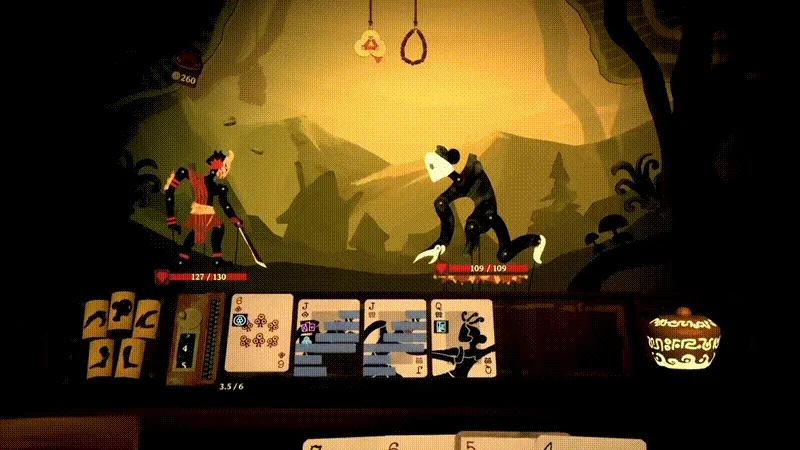
Deadhand Theater is a dark, turn based roguelike deckbuilder that combines poker based combat with a theatrical premise in which the character fighting on stage is a shadow puppet whose body can become a tactical resource. Different poker hands have different combat properties, so the value of a play depends on more than conventional hand ranking. The theatrical setting connects card play, character presentation, progression, and combat rather than functioning only as decorative scenery. Bag Track Games, an independent studio based in Jakarta, Indonesia, was co founded by designer Alwin Tantowi and developer Ronny Tantowi according to its official studio profile, establishing Deadhand Theater as an original project rather than an entry in an existing card game franchise.
The game is best understood as a survival problem built around several connected resources. Players must consider the cards available during the current encounter, the deck they are building for future battles, and the advantages attached to the puppet’s present body. This creates a recurring trade off between solving an immediate danger and preserving future capability. A powerful long term deck has little value if the current encounter ends the run, but repeatedly choosing desperate short term solutions can leave the surviving character poorly prepared for what follows. That tension gives the combat system more depth than simply describing the game as poker combined with monsters.
Deadhand Theater’s visual effects follow the same theatrical logic as its gameplay. Bag Track Games has described replacing conventional particle flashes with 3D animation, turning a production challenge into a distinctive way of presenting attacks. The puppet’s body and the surrounding stage can therefore participate directly in how combat actions are communicated.
However, these so called practical effects remain digital. The term refers to an approach that evokes physical objects and actions associated with a staged performance, not to filmed real world explosions or a complete rejection of computer generated effects. Unreal Engine’s own documentation also shows that 3D meshes and particle systems are not mutually exclusive technologies, so the technique should be understood as an artistic and production choice rather than a strict technical divide.
As of September 23, 2026, Deadhand Theater’s full Steam release remains unannounced. The available information establishes its poker driven combat, theatrical puppet concept, resource based progression, and distinctive approach to visual effects, while future release plans and additional technical details have not yet been publicly established.

Deadhand Theater Unreal Engine Visual Design and Practical Effects
Bag Track Games has shared Deadhand Theater development work within the Unreal Engine 5 community, including demonstrations of practical style impact effects and discussions of stage lighting problems. One developer post describes the challenge of creating a character shadow on the background without relying on an excessively bright frontal spotlight. That problem shows why a theatrical presentation still requires careful technical work, since lighting that improves a silhouette can also alter the appearance of the puppet or scenery.
The studio’s June 9 update also documented changes to stage lighting, backdrop positioning, and backdrop textures, showing that the visual presentation is being refined across the entire performance space rather than only through individual combat effects. The available material supports the conclusion that Unreal Engine is being used to create a deliberately stylized stage presentation, but it does not establish which engine revision the current build uses, whether particular advanced rendering features are enabled, or how much performance any individual visual change saves.
The studio has also explained why it moved away from conventional particle flashes for some effects, stating that visual effects had been challenging and that it decided to use 3D animation instead. This establishes production difficulty as the stated reason for the change without implying that particle effects are unsuitable for card games or unavailable in Unreal Engine. Epic Games documents Niagara as supporting different particle renderers, including sprites and meshes, so a mesh based appearance does not automatically prove that an effect exists outside a particle framework.
Animated Impacts and Performance Tradeoffs
In Deadhand Theater, the more important design value is how the chosen presentation fits the puppet theater setting. An impact that resembles a staged object or choreographed movement can feel more consistent with the surrounding performance than a bright, diffuse flash. The confirmed decision concerns the highlighted attack presentation, not a claim that the entire game contains no particles, shaders, or other visual effects.
The September 1, 2026, v0.3.0 patch notes provide the clearest implementation related evidence by documenting attack animations and hit impact effects for every attack type, alongside animations for poker hand combinations. At the presentation level, these effects can be understood as small animated performances in which placement, motion, timing, and recovery all contribute to communicating an attack. A solid stylized shape, for example, could communicate force through direction and timing without filling the surrounding area with luminous particles, though that remains an illustrative example rather than a description of a specific unpublished asset. Performance claims should also remain measured.
Epic’s optimization guidance identifies several possible costs in visual effects, including overdraw, draw calls, update time, and visibility calculations, so replacing one technique with another redistributes costs rather than automatically eliminating them. Without comparable measurements, the available developer material does not establish that these practical style effects are faster.
Wayang Inspired Theatrical Identity and Readability
Deadhand Theater’s shadow puppet and wayang inspired presentation gives the visual system a broader source of consistency. Bag Track Games explicitly described the project as a wayang themed turn based roguelike deckbuilder, making the theatrical framing part of the game’s stated identity rather than only an audience interpretation. Puppet movement, stage scenery, and deliberately artificial looking impacts can therefore participate in the same visual language without aiming for photographic realism.
The setting also makes bodily changes easier to communicate, since a removable puppet component can function as equipment, an ability source, and a visible alteration to the character. Sound contributes to that presentation as well. In developer replies, Bag Track Games identified improved sound effects as a priority and stated that voice acting was not currently planned. Those comments describe present development priorities rather than guarantees about the final audio package. The broader challenge is keeping the stage expressive without allowing props, lighting, or effects to obscure the character, opponent, or information needed for the next decision.
Deadhand Theater Poker Combat, Deckbuilding, and Roguelike Progression
Deadhand Theater uses poker hands to determine combat actions, but its rules extend beyond standard five card poker. The developer’s current description includes familiar combinations such as pairs, straights, and flushes while also advertising unusual possibilities such as wrapping ace to ace straights and ten of a kind. A single play can also trigger several hand categories at once, with a pair, three of a kind, and high card given as one example. These details establish that traditional poker knowledge provides only a starting vocabulary. The game’s own rules determine which combinations are valid and what effects they produce, so conventional hand rankings should not be converted into an assumed ability chart.
The developer has separately explained that poker hands have distinct effects and are not restricted to ordinary poker rules. This means that the strongest hand in conventional poker is not automatically the best response to every combat situation. The more relevant question is what total effect a particular play produces at that moment. To help players learn these relationships, the June 9 update added an in game poker hand ability guide accessible through the deck viewer during battle.
That guide is a more reliable reference for current ability behavior than assumptions based on standard scoring systems. The resulting decision space can therefore extend beyond chasing one rare combination, since a less prestigious hand may be more useful if it produces the right effect for the immediate situation.
Roguelike Deckbuilding and Route Planning
The roguelike structure connects those combat choices to longer term deck construction. The September v0.3.0 update revised the map so players could see the nodes leading toward the boss, reworked the tutorial, and changed post battle rewards to support buying new cards or removing cards from the deck. These systems separate immediate tactical decisions from the broader question of what the deck should become over the course of a run. Card removal is particularly meaningful because, under an ordinary shuffled deck model, cards that do not support a strategy can compete with more useful cards for limited draw opportunities. A smaller deck is not automatically stronger, but unnecessary additions can make preferred combinations less consistent.
The opposite problem is over specialization. A deck built around one attractive outcome may struggle when the required cards do not appear, so useful evaluation should consider both the strength of successful combinations and the quality of weaker turns between them. Visible route information adds another layer by allowing players to consider current rewards in relation to the path toward later encounters and the boss.
None of these systems prove that a particular deck or route is optimal, since that would require current card rules, encounter data, and repeated testing. What the documented updates do establish is that Deadhand Theater treats deckbuilding as an active process involving both selection and removal, while its poker system asks players to judge the usefulness of a hand by its combat effect rather than by familiar ranking alone.

Deadhand Theater Limb Sacrifice, Talismans, Sigils, and Run Modifiers
Limb sacrifice is one of Deadhand Theater’s defining systems. The official description states that sacrificing a body part activates its combat effect while removing the passive bonus associated with that part until a replacement is found or purchased. Replacement parts can restore lost capability and may also provide stronger alternatives, so the mechanic should not be described as an irreversible penalty that permanently weakens the character.
Its real cost is the period spent without that passive benefit, along with the resources or opportunities required to replace it. The system has also expanded during development, with the May 21 update adding 14 grafts and allowing players to purchase more than one graft in the Black Market. This creates a meaningful opportunity cost because the emergency effect is attached to something already helping the player, so activating it changes the puppet rather than merely consuming a separate resource.
The most useful way to evaluate limb sacrifice is to compare immediate necessity with future value. An active effect that prevents defeat may justify giving up a strong passive bonus, while sacrificing a part simply because its active effect is available may weaken the run without sufficient benefit. Replacement prospects also matter because spending that resource is a different decision when recovery appears close than when several difficult encounters may come first. This does not guarantee that a suitable replacement will always be available, but it shows how the documented replacement system can influence the timing of a sacrifice.
Talismans and Sigils
Talismans operate at another layer of progression. Bag Track Games describes them as artifacts that improve combat and help define a run through synergies, with the official website advertising 60 talismans. They can be purchased and upgraded, and the v0.3.0 notes specifically mention improvements to the Upgrade Forge’s visuals and usability.
The presence of an upgrade system is therefore confirmed, although the available material does not provide a complete formula for upgrade costs or scaling. The more useful question is not which talisman displays the largest number, but how often its benefit contributes to the deck being played. A modest effect that regularly supports a common hand may provide more value across an encounter than a larger bonus tied to a condition the deck rarely achieves. Likewise, an expensive upgrade can be worthwhile when it strengthens an already reliable strategy but inefficient when it improves something the deck cannot consistently use.
Sigils work at the card customization level. Bag Track Games describes them as marks applied to cards that can modify the effectiveness of the poker hands those cards help create. Published counts have changed during development: the current Steam description lists 40 sigils, while the studio website still displays 25, making the newer storefront description the larger advertised pool rather than proof that every playable build contains the same inventory.
The September update also mentions the Red Sigil without explaining its complete effect, so assigning it a specific bonus or trigger would go beyond the published information. Conceptually, sigils separate changing the deck’s composition from changing the behavior of cards already inside it. Adding a new card may make a desired pattern easier to produce, while modifying an existing card may increase the value of a pattern without necessarily changing how often it appears. The exact relationship depends on the current sigil rules.
Hexes and Stage Modifiers
Hexes and stage modifiers create another distinction. Hexes are described as afflictions that hinder abilities or resources, while stage modifiers alter the conditions of a level and can create either advantages or disadvantages. The current Steam listing advertises 45 hexes and 30 stage modifiers, while the studio website retains an older count of 28 stage modifiers, showing that these published totals have changed over time.
A condition attached directly to the player and one attached to the stage may require different responses because one can alter the usefulness of a particular ability while the other changes the environment in which several choices are being evaluated. Their value comes from preventing a successful plan from becoming completely automatic and forcing the player to reconsider priorities such as resource preservation, card selection, or purchasing decisions. The available summaries do not explain every hex’s duration, removal method, or interaction with body parts, so those details should come from the current build rather than assumptions based on terminology borrowed from other roguelikes.
Deadhand Theater Compared With Other Deckbuilders and Its Planned Progression
Balatro and Slay the Spire provide useful points of comparison for understanding Deadhand Theater, but only at the level of design structure rather than identical mechanics. Balatro’s official description emphasizes poker hand combinations, Jokers, and synergies used to earn enough chips to overcome blinds, making its central challenge the construction of a scoring engine capable of meeting escalating requirements. Slay the Spire instead emphasizes selecting cards, fighting enemies, choosing routes through changing layouts, and using relics to improve deck effectiveness across an ascent. Deadhand Theater combines poker combinations with direct combat instructions, while its body sacrifice system adds another resource relationship that links the puppet’s physical condition to the decisions made through the deck.
The comparison helps clarify what each game asks the player to evaluate. Balatro centers heavily on producing enough score, while Slay the Spire focuses on surviving encounters and shaping a deck across a route. Deadhand Theater’s opportunity is to connect present combat survival with future capability in a visibly physical way through the puppet’s changing body. A sacrificed limb can represent a strategic cost that another game might display as a more abstract resource. This does not establish that Deadhand Theater is deeper or better than either comparison, since that would require extensive hands on testing, but it does show why describing it only as another deckbuilder with different artwork misses an important part of its design.
Planned Replayability and Progression Systems
Longer term replayability is also part of the project’s announced direction. Different starting decks, special characters with unique powers, and progression that carries improvements between runs are listed as future features in the Steam description and should not be presented as fully implemented simply because they appear in promotional material. The September 1 development update adds further context, with Bag Track Games stating that meta progression would be added after the team became confident in the stability of the current version, alongside more suitable introductory and ending presentation.
These planned systems affect replayability in different ways. Alternative starting decks can change the initial problem a player is trying to solve, while character powers can change the relative value of familiar choices. Meta progression determines what, if anything, carries forward between attempts. Unlocking additional options is also different from granting permanent numerical advantages, since both can create a sense of progress while affecting difficulty and player expectations in different ways.
The available announcements do not provide a complete unlock structure, finalized character roster, or exact balance between new options and persistent power, so specific progression paths should not be assumed. The clearest expectation is that these systems remain part of the stated development direction, with their eventual success depending on whether they expand meaningful choices without making early runs feel incomplete or forcing repeated attempts simply to reach an intended baseline of strength.

Frequently Asked Questions (FAQs)
- Does requesting Steam Playtest access guarantee immediate entry?
Not necessarily. Steam Playtest allows developers to control how many players are admitted and when additional testers receive access. Requesting access shows interest in participating, but the developer can still admit players in batches or limit availability according to its current testing needs. Playtest registration is also separate from wishlisting the main game, so completing one does not automatically provide the benefits of the other. - What is Deadhand Theater?
Deadhand Theater is a dark, turn based roguelike deckbuilder developed by Bag Track Games. Its combat system uses poker combinations to determine attacks and other combat effects, while the theatrical setting presents the player character as a shadow puppet performing on a stage. Different hands can produce different results, so success depends on more than simply creating the highest ranking poker combination. - Why does Deadhand Theater use 3D animations instead of particle flashes?
Bag Track Games has said that producing visual effects was challenging for the team, so it chose to use 3D animation for certain impact effects instead of relying on conventional particle flashes. The decision also fits the game’s theatrical presentation because animated objects and choreographed movements can resemble elements of a stage performance. This does not mean particle effects are technically inferior or unavailable in Unreal Engine. - Are its practical effects real physical effects?
No. The practical style effects discussed by the developer are still created digitally through 3D animation. The word practical refers to the way the effects are presented, making them feel more like physical props or staged actions rather than diffuse flashes. It does not mean that Bag Track Games filmed real explosions or other live action effects, and Unreal Engine can also combine meshes with particle based systems. - Does Deadhand Theater follow ordinary poker rules?
Not completely. Familiar hands such as pairs, straights, and flushes are part of the system, but Bag Track Games has explained that the game extends beyond standard poker rules and gives different combinations their own combat effects. The game can also recognize unusual hands and multiple categories within a single play. For that reason, conventional poker rankings alone are not enough to determine which move is most useful during combat. - Is sacrificing a body part permanently irreversible?
No. Sacrificing a body part activates its combat effect but removes the passive benefit connected to that part until the player finds or purchases a replacement. The sacrifice therefore creates a temporary strategic weakness rather than an automatically permanent loss. The real decision is whether the immediate benefit of sacrificing the part is worth functioning without its passive advantage until another suitable component becomes available. - How are talismans, sigils, and grafts different?
They affect a run in different ways. Talismans are artifacts that enhance combat and can create useful synergies, while sigils are applied to cards to modify how those cards contribute to poker hand effects. Grafts are body components connected to the puppet’s passive bonuses and sacrifice mechanics. Because each system changes a different part of the character or deck, they should be considered separate forms of customization rather than interchangeable upgrades. - Is Deadhand Theater simply another Balatro?
No. Balatro is a useful comparison because both games use poker combinations, but their central systems are different. Balatro focuses on building scoring combinations strong enough to overcome blinds, while Deadhand Theater uses poker hands as direct combat instructions against enemies. Deadhand Theater also adds systems such as body part sacrifice, replacement grafts, stage conditions, and combat focused hand effects that change how those poker combinations are evaluated. - Is meta progression already confirmed as playable?
Meta progression has been announced as a planned feature, but it should not be treated as fully implemented simply because it appears in the game’s development plans. In the September update, Bag Track Games said it intended to introduce meta progression after becoming confident in the stability of the current version. The exact unlock structure, permanent benefits, and progression balance have not yet been fully detailed. - What is the Deadhand Theater release date?
The full Steam release date remains unannounced as of September 23, 2026. Development updates, patches, demos, or playtest periods should not be confused with the commercial launch of the finished game. Until Bag Track Games announces a specific release date for the main Steam version, there is no confirmed full launch day to report.

Conclusion
Deadhand Theater’s most compelling idea is the connection between its presentation and its decisions. Poker supplies the combinations, puppet combat gives those combinations a dramatic setting, and body-part sacrifice turns an emergency action into a visible loss of ongoing capability. Its developer-confirmed move toward 3D impact animation belongs within that broader identity rather than standing apart as an isolated visual trick.
The project should nevertheless be evaluated as a work in development. Its advertised content has changed, some public pages retain older counts, and several progression systems remain plans rather than established features.
The strongest basis for interest is not an unsupported promise of superior performance or a claim that it will replace established deckbuilders. It is the coherence of the proposal: make the cards, the puppet, and the stage express the same strategic problem. Whether that proposal becomes a consistently satisfying game will depend on the clarity, balance, and execution of the evolving playable build.
Sources and Citations
- Bag Track Games, Official Studio Profile : Identifies Bag Track Games as an independent studio based in Jakarta, Indonesia, cofounded by designer Alwin Tantowi and developer Ronny Tantowi. It provides the primary reference for the studio’s identity, location and team.
About Bag Track Games - Deadhand Theater, Official Website : Describes the game’s theatrical setting and poker driven combat, alongside talismans, sigils, hexes, grafts and stage modifiers. It provides an overview of the systems players use to develop strategies and adapt their approach during each run.
Deadhand Theater - Steam, Deadhand Theater Official Listing : Provides the game’s release status, advertised features, system requirements and downloadable demo. The main game’s release date remains to be announced, while its description explains poker combat, limb sacrifices and collectible upgrades.
Deadhand Theater on Steam - Deadhand Theater, Official itch.io Demo : Hosts the downloadable demo and identifies the project as still in development. The page also explains its combat and deckbuilding systems, presents screenshots and links to development logs documenting changes to the game.
Deadhand Theater by Bag Track Games - Steam Community, May 21, 2026 Development Announcement : Documents v0.2.0 additions, interface improvements and bug fixes, alongside the launch of a closed Steam playtest. Its separate future plans section discusses changes to the introduction, stage selection and lighting.
Patch v0.2.0 Is Now Live! - Bag Track Games, September 1, 2026 Development Log : Records improvements to maps, rewards, tutorials, attack animations, impact effects and lighting. Its future plans section describes the demo and meta progression as upcoming at that time, distinguishing those plans from changes already implemented.
Patch v0.3.0 Is Now Live! - Reddit, Deadhand Theater Visual Effects Discussion : The supplied developer discussion concerns animated 3D impact effects, translucency experiments and the intended visual style. The post and replies were inaccessible during verification, so those implementation details could not be independently confirmed.
“We use ‘practical’ effects instead of generic particle flashes, what do you think?” - Epic Games, Niagara and Visual Effects Documentation : Explains Niagara’s systems, emitters and modules, including mesh and sprite rendering. These references clarify visual effects terminology and engine capabilities, while the developer’s own materials provide evidence for Deadhand Theater’s specific implementation.
Niagara Overview and Creating Visual Effects - Valve, Steamworks Playtest Documentation : Explains how players request access and how developers control admissions and test availability. It also describes the separate application used for a Steam Playtest and how that application relates to the main game.
Steam Playtest - Steam, Balatro Official Listing : Describes the use of poker hands, Joker cards and deck upgrades to build scoring combinations. It provides a reference for comparisons involving card synergies, escalating challenges and different strategies across individual runs.
Balatro on Steam - Steam, Slay the Spire Official Listing : Describes the game’s roguelike deckbuilding, card combat, changing routes and collectible relics. It supports comparisons involving strategic deck construction, encounters and item effects that interact with the player’s chosen cards.
Slay the Spire on Steam
Recommended
- EVE Online Studio Goes Indie in “New Era” Rebrand: Fenris Creations, Google DeepMind AI Partnership, and What It Means for EVE Online
- Final Fantasy VII Revelation Release Date, World Map & New Gameplay
- Corsair Cove Challenges Players to Build a Pirate Empire and Defeat the Crown
- Anthropic Redeploys Fable 5 on July 1: Usage Credits, AI Safety Standards, and Everything We Know
- Echoes of Aincrad: Complete Guide to Weapons, Stats, Skills, and Best Builds
- Magic: The Gathering, Doom Prevails Commander Deck Guide (Upgrades, Combos, and Best Cards)
- All Free Mystery Gifts in Pokémon Legends: Complete List of Codes, Rewards & How to Redeem in 2026
- Corsair Cove Release Date (July 31, 2026): Everything You Need to Know About Gameplay, Demo, Platforms, and Latest Updates
- Palworld 1.0: All New Features and Major Changes
- Disney’s Hexed Trailer Has Fans Concerned TikTok Is Shaping Its Movies
- Grid Legends Server Shutdown: PlayStation and Xbox Online Services Ending September 11, 2026
- Everplay (Team17 Parent Company) Reports 10% Gross Profit Rise in 2025: Full-Year Results, Revenue, and Outlook
- Pokémon TCG 30th Anniversary: 1-in-20,000 RGB Mew Rumor
- AC Black Flag Resynced Grand Cayman Chest Guide: Every Chest Location and Loot Reward
- Meta Reportedly Cuts About 700 Jobs as Reality Labs Is Hit in Wider Restructuring
- Mortal Kombat 2 Home Release Dates Confirmed: Digital, 4K Blu-ray, and Bonus Features Revealed



































































































