








In This Article (9 sections)
Coraline Lyu’s Shell Grotto Environment Art Workflow
Coraline Lyu’s Shell Grotto explores how procedural materials can become the defining feature of an architectural environment. Her portfolio identifies England’s Shell Grotto as the main inspiration while also acknowledging artistic changes made for mood and composition. The project includes breakdowns of shell, snail shell, and ornamental wall materials, making it useful both as an environment art reference and as a study of procedural texturing. The central production challenge is not simply creating a convincing shell, but finding a way to organize individually recognizable forms across an architectural surface without losing their identity or overwhelming the larger composition.
Lyu developed the personal project over approximately two months using Maya, Substance 3D Designer, and Unreal Engine. A useful way to understand the workflow is to divide it into three connected tasks: constructing reusable surface elements, arranging those elements into coherent material patterns, and evaluating the finished materials on the architecture itself. Substance 3D Designer supports this approach through a node based, parameterized, and non destructive workflow, allowing repeated operations to be adjusted as the environment develops instead of treating every wall as a completely separate texture.
For a comparable project, an effective early milestone is a small but complete test containing one recognizable shell, one simple ornamental arrangement, and one architectural surface inside the target renderer. This provides more useful information than building a large library of shell assets before checking whether the material actually works in context. If the test fails, the problem can be traced more clearly to the shell silhouette, pattern distribution, perceived surface depth, or lighting rather than being hidden inside a large procedural graph.
That diagnostic approach is important because the project depends on several systems working together. Shape construction needs to preserve recognizable shell forms, pattern distribution needs to create deliberate ornament rather than visual noise, material layering must support depth and variation, and lighting needs to reveal the surface without flattening or overwhelming it. A complicated procedural network should therefore grow from successful visual tests rather than become a substitute for them. The most useful lesson from the Shell Grotto workflow is that procedural complexity only becomes valuable when it serves a clear architectural and compositional goal.

Shell Grotto Architecture Blockout and Procedural Shell Construction
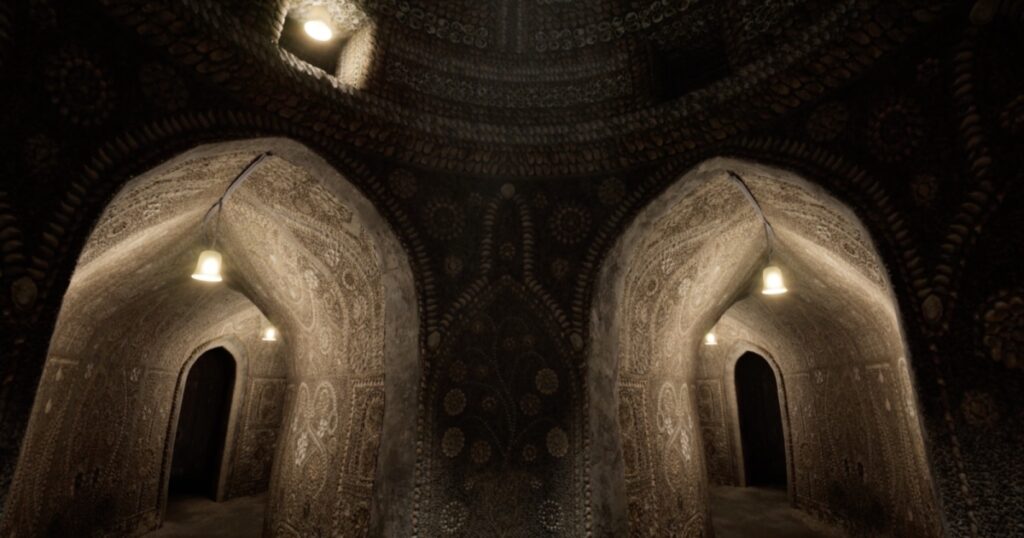
Coraline Lyu adapted the reference architecture rather than reproducing it exactly, replacing the small final room with a taller domed chamber. That documented change illustrates the difference between reference based environment art and architectural reconstruction. Existing architecture can provide visual identity, spatial cues, and ornamental language without determining every dimension of the final scene. For a similar project, reference gathering is more useful when divided into spatial information and surface information. Spatial references help define ceiling height, passage width, openings, and relationships between rooms, while surface references clarify ornament density, shell orientation, edge treatment, and how much of the underlying wall remains visible.
The blockout should test both categories together because architectural proportions directly affect how ornamental materials read. Even a temporary black and white pattern can reveal whether a wall is large enough to support a central motif or whether a doorway interrupts the intended composition. Camera placement should also be established early. A design that looks balanced in a frontal render may need significant adjustment when viewed from an angle during a walkthrough, so field of view and likely viewing positions should be checked before architectural details become expensive to change.
Lyu’s portfolio also presents separate material graph breakdowns for shells and snail shells, showing a procedural approach built around reusable shape systems rather than one finished texture. A useful generator should produce a controlled family of recognizable variations, with exposed parameters representing meaningful artistic choices instead of every possible internal control. Overall proportions, ridge detail, and color variation can remain independent so that changing shell width does not require rebuilding downstream operations and adjusting the palette does not unexpectedly alter height information. Parameter ranges should also be tested at their minimum, middle, and maximum values so the exposed controls reliably produce plausible outputs across their intended range.
Splines provide a useful basis for constructing these forms because they describe editable trajectories rather than requiring large stacks of overlapping primitives. The outer silhouette can be treated separately from the internal height structure: the silhouette establishes recognition, while the height determines whether the shell appears inflated, tapered, ridged, or recessed. Designer’s Spline Circle node offers controls for spiral turns, spiral power, dimensions, position, thickness, and height, making it a documented option for constructing spiral trajectories without implying that it reproduces Lyu’s exact graph. A practical test is to judge the silhouette first as a flat mask, then inspect the height under neutral shading before introducing ridges, damage, or material color.
Lyu used Splatter Circular Grayscale to develop shell growth detail. Because Splatter Circular organizes repeated shapes in ring based arrangements, a small ridge or narrow mark can be repeated to create larger growth patterns without requiring the input to be a complete shell. Pattern count and density should be judged at the final viewing scale rather than only in a close graph preview. Increasing detail may improve a single shell when enlarged while making the finished wall harder to read once many elements are combined. The goal is therefore not maximum density, but a pattern that reinforces the form clearly within the architectural composition.

Shell Variation, Damage, Color, and Material Response
Directional Warp and Slope Blur were used to introduce irregularity into the shells, but they solve different deformation problems. Directional Warp shifts pixels along a chosen direction using a grayscale input to control the amount, making it useful for bending or disturbing an organized pattern without removing its overall direction. Slope Blur instead follows gradients from another grayscale input and can support chipped edges, erosion, and broader weathering effects. Applying these operations in separate stages makes it easier to control which parts of the material are affected, such as the outer contour, major ridges, or fine surface breakup.
Variation should remain subordinate to recognition. If every ridge, edge, and surface receives equally strong distortion, the stable structure that identifies the shell can disappear. A more controlled approach preserves some clean forms while allowing selected areas to bend, chip, or wear. The useful target is not randomness for its own sake, but variation that looks consistent with the shell’s construction and accumulated damage. Small changes should therefore be evaluated on the complete wall before stronger deformation is introduced.
Lyu also combined grunge based damage with height derived ambient occlusion and photograph informed color. These outputs should remain related without being treated as interchangeable. Damage can influence height, color, and roughness differently, because a dark stain does not necessarily need to be recessed and a raised ridge does not automatically need to be brighter. Designer’s Gradient Map provides one way to turn grayscale information into controlled color variation, allowing palette changes to remain adjustable without destroying the underlying procedural structure.
Ambient occlusion generated from height serves another purpose by reinforcing contact and recessed areas. Designer offers height based options such as HBAO and RTAO, although the existence of those nodes does not establish which one Lyu used. For evaluation, it is useful to inspect the base color without directional lighting first so pigmentation can be separated from baked or procedural shadowing. Roughness should then be judged independently because Unreal Engine treats reflection sharpness and metallic classification as separate material properties. A shell should not be pushed toward metallic behavior simply to create brighter highlights. The stronger approach is to preserve believable material classification while using roughness, color variation, relief, and occlusion together to support the final wall surface.
Shell Grotto Ornamental Patterns, Mortar, and Wall Variations
Coraline Lyu used Scatter on Spline Grayscale to place shells along ornamental paths, allowing repeated elements to follow designed curves instead of being arranged manually one by one. Adobe documents controls for specifying either the number of shapes or the spacing between them, as well as alignment to the spline tangent so individual shells can rotate with the path.
These controls answer different compositional questions: shape amount determines how many elements belong in the design, while spacing determines the rhythm between neighboring pieces. Tight curves deserve particular attention because a sequence that reads clearly along a straight section can become crowded when shell tips converge around a bend. In those cases, reducing shell size or simplifying the curve can preserve the ornament more effectively than introducing additional randomness.
Because Scatter on Spline Grayscale works with grayscale information, its brightness controls affect height or mask values rather than full color. Color placement can be handled through a corresponding color based workflow, with pattern choices and transformations kept synchronized with the height arrangement. Adobe also provides a separate Scatter on Spline Color node for that purpose. Testing the major ornament in monochrome first is useful because the structure should remain understandable before subtle color differences are asked to separate neighboring forms.
Lyu also used Bevel and Gradient Dynamic to structure spaces between the main ornaments. Bevel can create controlled transitions around grayscale shapes, while Gradient Dynamic remaps grayscale values using a gradient sampled from another image. This makes it possible to turn broad transitions into selected bands or masks that can support secondary ornament. Gradient Dynamic does not directly create spline data, however. A reproducible workflow can convert the resulting mask into paths with Mask to Paths and then convert those paths into splines before scattering additional shells. Intermediate results should be inspected carefully because broad bands can create boundaries on both sides and narrow spaces can produce small loops that add complexity without improving the composition.
Not every empty space needs to be filled. Secondary ornament is most useful when it clarifies the main pattern rather than consuming every remaining area, and visible backing material can provide important separation between dense shell arrangements. This principle also applies to the mortar surrounding individual shells.
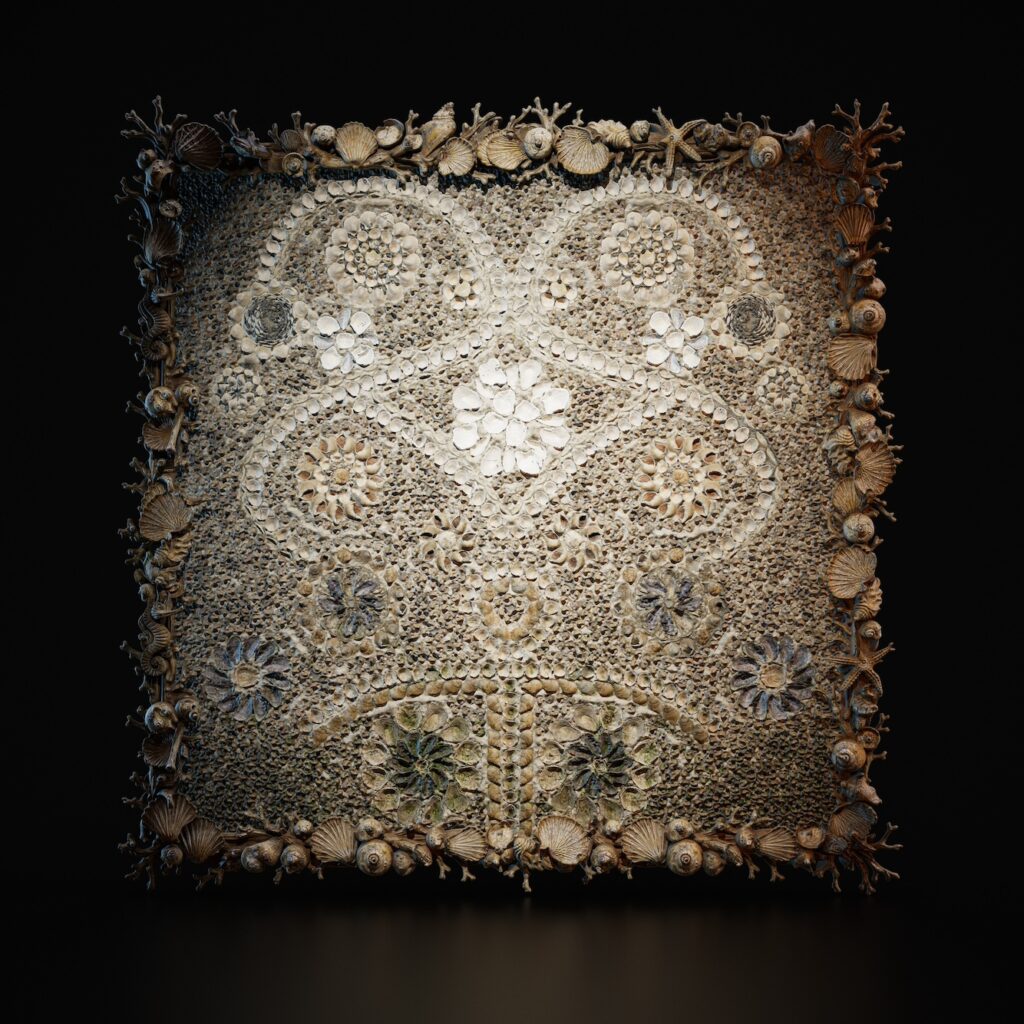
Lyu used raised mortar around shell edges to integrate the relief, making the contact zone between shell and wall a separate design problem rather than treating everything as one noisy surface. One possible method begins with the shell silhouette, expands it, subtracts the original interior, and uses the remaining border to control a narrow mortar buildup. Designer’s Bevel Smooth can support similar experiments through outward or inward expansion, gradient generation, and distance based control along the boundary.
The relative height of the shell, mortar, and backing matters more than simply adding a bright outline. Mortar intended to overlap a shell edge should become the visible upper surface in that region rather than appearing as a flat color ring. Its width and continuity should also reflect the reference, since a perfectly even border can make the result look manufactured instead of hand applied. Roughness can reinforce this separation without relying only on color, allowing shell, mortar, and backing to respond differently to light while still belonging to the same overall material.
Lyu ultimately created eight wall variants and manually composed their major motifs. This is an important distinction between procedural construction and procedural authorship. Reusable systems can handle repeated placement, variation, and material processing, while the artist still decides the dominant composition. For a comparable set, certain properties can remain stable across every material, such as approximate shell scale, mortar relationships, overall color range, and border weight, while the main arrangement changes deliberately. A different random seed may alter small irregularities without producing a meaningfully different design, so each variant should be judged by whether it changes the dominant direction, central emphasis, or balance between dense and quiet areas.
Maya to Unreal Architecture and 4K Material Export
For a Maya to Unreal workflow, the architectural mesh should establish the major spatial forms before detailed surface relief is introduced. Wall positions, doorway silhouettes, and dome curvature belong to the model itself, while procedural shell materials provide the ornamental surface treatment. Organizing the architecture according to how materials will be placed and revised can make later adjustments easier. Broad uninterrupted surfaces may support large central motifs, while borders and transitional areas can benefit from separately controlled pieces.
Epic’s FBX Static Mesh Pipeline documentation identifies pivot placement, triangulation, UV coordinates, and material assignments as important preparation concerns. Multiple UV sets are supported, and controlling triangulation in Maya can provide more predictable edge placement when that matters for shading or deformation of the surface. Before committing to detailed ornament, a simple checker or reference pattern should be tested across representative curved areas to reveal stretching near openings, mismatched scale between adjoining sections, or distortion across the dome.
The import should also be verified inside Unreal rather than assumed to be correct because the mesh appears in the scene. The Static Mesh Editor provides a place to inspect geometry, UVs, and other imported properties, making the handoff complete only when the mesh and its material placement behave as intended.
Lyu exported her wall materials as 4K texture sets. In Substance 3D Designer, bitmap export operates on the graph outputs, so each output should be named and checked according to its intended purpose. Height, normal, base color, and roughness should be inspected independently rather than assumed to be correct because the combined preview looks convincing. Adobe also distinguishes bitmap export from publishing a Substance archive, with bitmap export available through the graph’s Export Outputs as bitmaps command.
Import settings in Unreal matter just as much as export settings. Epic recommends disabling sRGB for packed mask textures because their channel values represent data and should not receive gamma correction. Texture resolution also needs to be judged in relation to the physical size of the surface. A 4096 pixel texture spread across four meters provides only half the linear texture density of the same texture spread across two meters, even though both are technically 4K.
Unreal’s texture editor also exposes mip generation and level of detail controls, while texture streaming determines which mip levels can remain resident for the current view and memory budget. Importing a 4K texture therefore does not guarantee that the highest resolution mip will always be displayed. The final material should be evaluated at its actual wall scale using the intended camera and rendering conditions rather than judged only from the source texture resolution.
Frequently Asked Questions (FAQs)
- How should artists diagnose detail that becomes blurry in Unreal Engine?
First inspect the texture’s imported mip and level of detail settings, then check whether texture streaming is loading a lower resolution mip than expected. Unreal provides tools for viewing texture properties and streaming information, which can help determine whether the blur comes from the source texture, import configuration, camera distance, or memory pressure. Increasing the original texture resolution should come after those checks rather than being the first response. - What software did Coraline Lyu use for Shell Grotto?
The documented workflow combines Maya, Substance 3D Designer, and Unreal Engine, with each application serving a different purpose. Maya handles the architectural modeling, Substance 3D Designer is used for building the procedural shell and wall materials, and Unreal Engine is used to assemble, light, and present the finished environment. The strength of the workflow comes from how those stages connect rather than from any one application alone. - Is Shell Grotto an exact recreation of the real location?
No. Lyu’s portfolio describes the project as inspired by England’s Shell Grotto rather than as a measured reconstruction. She made artistic changes to improve the mood, composition, and presentation, including altering parts of the architecture. The finished environment should therefore be understood as an interpretation that preserves the reference’s visual identity while allowing creative adjustments. - How many shell wall variations did Lyu create?
The final presentation includes eight wall variations. Their major compositions were designed manually, while procedural tools handled repeated shell placement, variation, and surface processing. This means the eight walls are not simply random outputs from one generator, but distinct ornamental designs built from a shared procedural system. - Does a procedural shell wall require every shell to be modeled separately?
Not necessarily. Substance 3D Designer can generate shell shaped height, mask, color, and material information procedurally, allowing many shells to be arranged without creating a separate mesh for each one. Exposed parameters can then produce controlled variations in shape and appearance. Individual geometry may still be useful for very close views or silhouettes, but it is not required for every shell in a material based wall. - Why are splines useful for ornamental patterns?
Splines provide editable curves that can guide the placement and orientation of repeated elements. This makes them especially useful for borders, spirals, and decorative paths that would be difficult to control with a simple rectangular grid. In Designer, image based shapes can also be converted into paths and then splines, allowing procedural masks to become guides for later ornament placement. - Does Gradient (Dynamic) directly generate splines?
No. Gradient (Dynamic) remaps grayscale image values using a gradient supplied from another input. It can help create useful bands or masks, but those results are still image data. If the artist wants spline information, the mask must first be converted into paths and then into splines through separate operations. - Can ambient occlusion be generated from a procedural height map?
Yes. Adobe provides HBAO and RTAO filters that can generate ambient occlusion from height information. This allows recessed areas and contact regions in a procedural material to produce supporting AO without manually painting it. However, the existence of those options does not prove which specific AO method Lyu used unless she identifies it directly in the project breakdown. - Are 4K textures enough for a detailed shell environment?
It depends on how much physical surface the texture covers and how closely the camera views it. A 4K texture spread across a large wall provides less detail per meter than the same resolution used on a much smaller surface. Unreal can also display lower mip levels depending on distance and memory conditions, so source resolution alone does not determine final sharpness. The material needs to be judged at its actual in game scale. - Does Nanite displacement eliminate the need for normal maps?
No. Nanite displacement can change the geometric surface, but Epic notes that the displaced geometry does not automatically produce correctly updated shading normals in every case. A corresponding normal map or another suitable normal solution may still be needed so lighting responds properly to the displaced surface. Geometry and shading information therefore remain related but separate concerns.

Conclusion
Coraline Lyu’s Shell Grotto provides a productive starting point for examining procedural ornament as an environment-design problem rather than an isolated texture exercise.
The most useful practical approach is to keep responsibilities clear. Shape construction should establish recognizable forms. Pattern placement should organize those forms. Mortar and contact regions should explain how the surface is assembled. Material channels should describe distinct properties, and lighting should make the intended hierarchy visible.
For artists developing comparable work, a small complete test is more valuable than an unfinished collection of elaborate components. Establish one convincing wall section, place it on representative architecture, and inspect it from the views that matter. Expand the system only after that relationship works.
Procedural complexity is worthwhile when it improves control, consistency, or iteration. It is less valuable when it produces detail that neither supports the composition nor survives the final presentation.
Sources and Citations
- 80 Level, Building a Procedural Shell Grotto with Substance 3D Designer and Unreal Engine : Coraline Lyu’s August 28, 2026 breakdown explains procedural shell generators, ornamental wall layouts and the Unreal Engine presentation. It covers adjustable material controls, 4K textures, Nanite displacement and testing details at their intended viewing scale. 80.lv
Read the Shell Grotto production breakdown - Coraline Lyu, Shell Grotto ArtStation Project : The artist’s original project presentation, linked from her production breakdown, contains the completed Shell Grotto environment and material studies. It provides a visual reference for the ornamental shell patterns, architectural interpretation and individual wall designs. 80.lv
View the Shell Grotto ArtStation project - Coraline Lyu, ArtStation Portfolio : Official ArtStation profile for the material and environment artist credited in the Shell Grotto breakdown. It provides a portfolio reference for attributing the project and exploring her other published artwork. 80.lv
Visit Coraline Lyu’s ArtStation portfolio - Adobe, Substance 3D Official Documentation : Adobe’s central documentation hub provides access to guides for Designer, Painter, Sampler and other Substance applications. It also organizes resources for game engine integrations, asset platforms, baking tools and production workflows. Substance
Browse Adobe Substance 3D documentation - Adobe, Substance 3D Designer User Guide : The official Designer manual explains how node graphs generate procedural textures and process existing images. It includes guidance on graph construction, exposed parameters, output resolution, publishing Substance assets and exporting texture maps. Adobe Substance 3D Designer
Read the Substance 3D Designer user guide - Adobe, Substance Materials and Exposed Parameters : Explains how Substance materials provide adjustable controls for properties such as color and surface detail. It also covers parameter presets and graph optimization, showing how one material can produce multiple appearances in compatible applications. Substance 3D Community Assets
Read about Substance materials and exposed parameters - Epic Games, Unreal Engine Nanite Virtualized Geometry Documentation : Explains how Nanite handles detailed geometry through its internal mesh format, automatic detail management and streaming. The documentation also covers displacement, supported geometry and rendering limitations, providing technical background for the project’s surface detail. Epic Developer Community
Read the Nanite Virtualized Geometry documentation - Epic Games, Unreal Engine Material Inputs Documentation : Describes material inputs including Base Color, Roughness, Normal and Ambient Occlusion. It provides technical context for understanding how texture maps control surface appearance, reflected light and the shading of detailed shell materials. Epic Developer Community
Read the Unreal Engine Material Inputs reference - Epic Games, Unreal Engine Texture Asset Editor and Properties : Documents texture settings such as compression, color space, filtering and mipmap generation. This updated reference explains the controls used to inspect imported textures and manage their appearance, resolution and resource requirements. Epic Developer Community
Read the Texture Asset Editor documentation - Epic Games, Unreal Engine Texture Streaming Documentation : Explains how texture resolution is adjusted during play to balance visual detail and available memory. It also provides guides for building streaming data, monitoring performance and configuring how textures are loaded and unloaded. Epic Developer Community
Read the Unreal Engine Texture Streaming documentation - Epic Games, Unreal Engine 5.5 Nanite Tessellation and Displacement Updates : These release notes document Nanite changes introduced in Unreal Engine 5.5, including an explicit material tessellation setting, performance improvements and displacement fixes. They provide version specific background for understanding the development of these rendering features. Epic Developer Community
Read the Unreal Engine 5.5 release notes
Recommendations
- Invincible VS Review: is the 3v3 Tag Fighter Worth Buying? Combat, Roster, Story Mode, and Rollback Netcode Breakdown
- The Studio Behind MIO: Memories in Orbit Is Closing After Creating One of 2026’s Best Metroidvanias
- Valve Steam Machine Price Confirmed from €1,039 to €1,428
- James Pond Legacy Trailer Accused of AI Art as System 3 Denies Generative AI Use
- Saving Render Settings for Multiple Cameras in Blender with The View Keeper
- Marvel Rivals PC File Size Drops by Up to 40GB With Season 9.5
- Crazy Taxi World Tour Real-Life Shops List: Pizza Hut, Five Guys & New Brands Revealed
- Company of Heroes 3: Final Stand Release Date, Gameplay, and Everything We Know
- Fallout: New Vegas Dev Obsidian’s Projects in Doubt After Xbox Layoffs
- Persona 6 Leak May Be Real as Reliable Insider Claims Reference Art Isn’t AI Fake



































































































