










In This Article (9 sections)
Xbox Playback 2026 Reveals Your Gaming History for the 25th Anniversary of Xbox
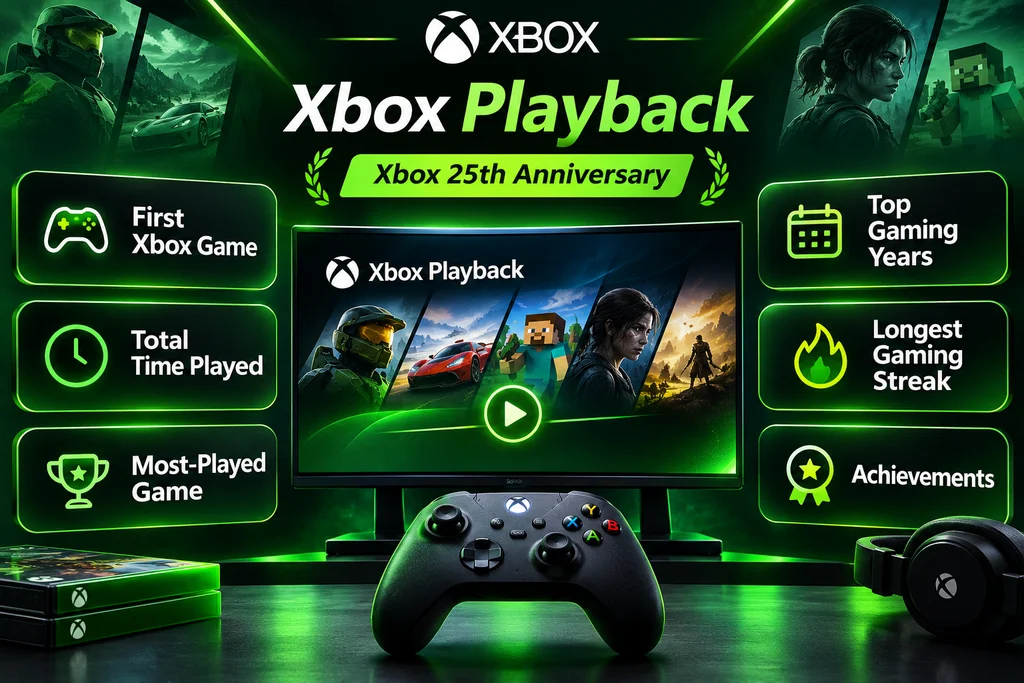
Xbox Playback is Microsoft’s personalized gaming retrospective for the 25th anniversary of Xbox. Introduced on November 12, 2026, it lets eligible players revisit the first game recorded on their profile, see which titles accumulated the most hours, and discover when they were most active. A personalized video brings together highlights such as total playtime, achievements, and the longest gaming streak. Players who want to spend more time with those records can open the Playback Archive, where the anniversary experience explores their history in greater detail.
The launch came three days before the anniversary of the original Xbox console’s North American debut on November 15, 2001. Over those 25 years, the history of Xbox has often been told through the arrival of new consoles and the games that defined them. Playback gives that history a more personal starting point. For one player, the Xbox 360 years might mean evenings spent playing Halo 3 with friends. For another, the same generation might bring back a difficult achievement or a game they continued playing long after moving on from the rest of their collection. Both players lived through the same period of Xbox history, but their anniversary videos can tell quite different stories.
That perspective depends on the Xbox profile that followed a player across devices. Someone might have earned their earliest achievements on Xbox 360, built a digital library on Xbox One, and continued playing on Xbox Series X|S or Windows PC. Xbox Live multiplayer, digital purchases, and subscription services such as Game Pass gradually changed how people found games and whom they played with. A profile used throughout those changes can show which interests lasted. A favorite franchise might appear across several generations, while a move to a new console or PC might coincide with a change in the kinds of games that occupied most of a player’s time.
Some of the most interesting results come from the difference between a memorable experience and a regular habit. A campaign finished years ago may still be the first game someone thinks of when remembering a console. Yet a racing game played with friends every weekend could have accumulated far more hours without any individual session standing out in quite the same way. The most active year can be just as surprising. A player who remembers a particular console launch vividly may discover that their busiest period came several years later, once a familiar group had settled into a regular multiplayer routine.
The amount of history available varies from one account to another. Someone who joined Xbox recently can receive a recap of their time on the platform, while a longtime player may see milestones separated by several console generations. Even an old profile can have gaps, particularly if its owner played offline or used different accounts over the years. Playback is available in 15 supported countries through December 31, 2026, giving eligible players a limited window to watch the video, explore the Archive, and keep a copy of the milestones they want to revisit.
How to Access Xbox Playback 2026, Check Eligibility, and Share Your Recap
Players can access Xbox Playback on a supported Xbox console or through the official Xbox Playback website. On console, look for the Playback option on the dashboard and select it to watch the personalized video. Its position can vary with the dashboard layout and the promotional sections on display. Microsoft also introduced Playback gradually after the November 12 announcement, so eligible players did not all see the dashboard option at the same time. The console presentation includes the main retrospective and, near the end, an opportunity to obtain a shareable recap.
The website provides another way to watch the video and is where players can open the more detailed Playback Archive. On a Windows PC, the experience runs in a compatible browser without a separate app. That makes it accessible to people who primarily play Xbox games on PC, as well as those who still use their old Microsoft account but no longer own the console where their history began. Sign in with the Microsoft account connected to the Xbox profile and complete any identity verification required by its security settings. Playback then checks the account’s activity and regional eligibility.
Choosing the right account matters, especially for players whose sign in details have changed over the years. Someone who played throughout the Xbox 360 generation using one Microsoft account may have created another when buying an Xbox One or switching to PC. In that case, the newer profile can produce a perfectly recognizable recap of recent games while leaving out an entire earlier generation. Before treating those older records as missing, check the gamertag shown after signing in. Playback builds the presentation from the selected profile, and owning both accounts does not combine their histories.
Microsoft sets a modest activity threshold for participation. An eligible profile must have all three of the following on record.
- At least one Xbox Gamerscore point
- At least one achievement
- At least one minute of qualifying gameplay
Watching Playback directly on a console also requires at least one minute of qualifying console gameplay. These requirements allow recent Xbox players to take part without having years of history behind them. A qualifying new account might have only a few games and achievements to revisit, whereas an older profile could show how the same player’s habits changed across several generations. Signing in successfully establishes which profile Microsoft should check. The activity requirements and the availability of Playback in the player’s region still determine access.
The 15 supported countries are Argentina, Australia, Brazil, Canada, Colombia, France, Germany, Hungary, Italy, Mexico, Poland, South Africa, Spain, the United Kingdom, and the United States. Xbox consoles, games, and subscriptions are available in additional markets, so access to those products alone does not establish eligibility for Playback. Nigeria, for example, is outside the announced rollout, even for players with an active Game Pass subscription and years of recorded achievements. The same regional limits apply on the website, and Microsoft has not announced an expansion beyond these 15 countries for the 2026 experience.
Once the recap is ready, console players can scan the QR code displayed near the end of the video with a compatible mobile device to get their personalized Playback card. On the website, select Share to access the card. It highlights selected statistics in a format players can send to friends or post on social platforms. Microsoft encourages participants to use #XboxPlayback when posting. Players can also review exactly what the card reveals about their profile and gaming habits, then save it privately if they would prefer to keep those details for themselves.

Xbox Playback Statistics Explained, From Your First Game to Your Longest Gaming Streak
The first recorded game gives the retrospective its starting point. Microsoft confirmed first game information as one of Playback’s featured statistics, and players can look for it in the part of the presentation covering the beginning of their Xbox history. For someone who used the same profile consistently, the result may bring back a specific release, such as Gears of War, Halo 3, or The Elder Scrolls IV: Oblivion on Xbox 360.
For someone who played long before creating that profile, it may identify the point when Microsoft began recording their activity. A person could have spent years with Halo: Combat Evolved or Project Gotham Racing on the original Xbox before leaving a trace that the anniversary service can retrieve.
Early demonstrations and reporting also described first console information, although identifying a player’s first piece of hardware presents a different problem. A profile can establish that someone used a particular console during a given period. It has less to say about the family Xbox they played on before creating their own account, or a console they owned but used entirely offline. Early coverage described instances in which a preliminary version of Playback identified the wrong first console. If the result looks unfamiliar, the earliest game, achievement, or other detail in the Archive may help explain which period of the account’s history the service picked up.
Total playtime brings qualifying activity across the available history into a single figure. For a player who stayed with one profile from Xbox 360 through Xbox One and Xbox Series X|S, those hours can span games and consoles they might otherwise remember separately. The video presents the overall figure, while the Archive may provide context about the titles, platforms, or periods that contributed to it. The total is especially interesting when years of short sessions add up to more time than expected. Its precision has limits, though. Older games and platforms tracked activity in different ways, some offline sessions may never have synchronized, and Microsoft has not published a complete explanation of every playtime calculation used in Playback.
The most played game puts those hours in context. Someone might name Halo 3 as their favorite Xbox 360 release because of its campaign or the people they played it with, then find a different title at the top of their account. Games such as Minecraft, Sea of Thieves, and Grand Theft Auto V can accumulate hours through repeated visits over several years. The same pattern applies to a sports or racing game that became a regular part of playing with friends. A short story can leave the strongest impression, while a familiar multiplayer game accounts for the largest share of recorded time. The ranking gives the player a way to recognize both experiences.
Coverage of the broader experience has also described favorite genres. Categories such as action, adventure, role playing, racing, sports, and strategy can make a pattern visible even when no single title explains it. A player might buy shooters frequently but spend more hours on a handful of lengthy role playing games. Another might find that multiplayer racing gradually took up more of their time as it became a regular activity with friends. Individual games can combine elements of several genres, and Microsoft has not published a full account of how each title is classified. The genre breakdown is most informative alongside the actual games that contributed to a player’s history.
Achievements and Gamerscore preserve a different part of that history. The achievement system became a defining feature of Xbox profiles during the Xbox 360 generation, giving players a persistent record of accomplishments across supported games. Each achievement carries a specified point value that contributes to cumulative Gamerscore. Playback highlights achievement milestones, and reporting on the Archive has described totals, early unlocks, and rare accomplishments. An old achievement can bring back the campaign a player finished or an optional challenge they went out of their way to complete. For players whose Xbox experience began before the achievement system, that first unlock marks a later chapter in a longer history.
Gamerscore also reflects the kinds of goals a player pursues. Someone who completes campaigns and explores optional objectives across a large library may build a high total. Another player could spend just as many hours mastering a small selection of games that offer relatively few achievements. The rarest achievement adds another detail by showing how uncommon an unlock is among the relevant players. Some achievements remain rare because they demand considerable skill, time, or coordination.
Others belong to an unusual game mode or an obscure activity that few people attempt. Rarity can change as more players earn the achievement, and the unlock with the lowest completion rate may be quite different from the one its owner remembers working hardest to earn.
Microsoft also confirmed the longest gaming streak as a featured statistic. It measures qualifying activity across consecutive days. A player who checked in for a short session every evening could build a longer streak than someone who spent an entire weekend on a campaign and then took several days off. That distinction gives the figure its appeal. A streak can recall a particular routine, an extended run with a multiplayer group, or a period when one game brought someone back day after day. Microsoft has not detailed every condition involved in calculating streaks or how synchronization affects every historical session.
The most active years widen the view beyond a single run of consecutive days. A player may discover that their busiest period fell during the Xbox 360 generation, when Xbox Live multiplayer became part of their weekly routine. Someone else might trace an increase to buying a new console, discovering games through Game Pass, or spending months with one multiplayer title. The year that produced the most playtime can also differ from the one that produced the most achievements. Hundreds of hours in a favorite game might add little to Gamerscore, while a year spent completing several campaigns could produce a much larger collection of unlocks.
The Xbox Playback Archive, Xbox Year in Review, and the Limits of Historical Data
Microsoft introduced the Playback Archive alongside the personalized video on November 12. Eligible players can open it through the official Playback website after signing in. The video selects a handful of milestones and moves through them in sequence, while the Archive gives players room to investigate a result that caught their attention. An unexpectedly early game, a title with more hours than they remembered, or an achievement from a long forgotten campaign can each be a starting point. The available detail depends on the profile, and entering another person’s gamertag does not provide unrestricted access to their complete retrospective.
Players familiar with Xbox Year in Review will recognize several categories, but the time period changes what those figures tell them. The 2024 Year in Review included total time played, achievements earned, favorite genres, the most active month, and the most played games during that calendar year. It also offered personalized gaming preference profiles and information about the friends a player joined most frequently. Those details could capture what made one particular year distinctive, even for someone whose Xbox history stretched back decades.
For example, a player might have spent hundreds of hours on a new release in 2024, comfortably placing it first in that year’s recap. A multiplayer game they returned to over several earlier years could still lead their full Playback history. The same distinction applies to activity patterns. The busiest month in the 2024 summary tells the player when they were especially active that year. Their longest streak might belong to an entirely different console generation, while their most active year might reflect steady play spread across many months. Reading the results together explains how a game can dominate one year yet occupy a smaller place in a much longer history.
The two experiences also have separate availability windows. Xbox Year in Review 2024 remained accessible until January 31, 2025, while the announced closing date for Xbox Playback is December 31, 2026. Microsoft introduced Playback specifically for the 25th anniversary and has not announced that it will become an annual service or replace future Year in Review experiences. Previous recaps therefore offer little guidance on how long the anniversary video, Archive, or sharing features will remain accessible beyond the confirmed window.
The records themselves are most uneven around the earliest Xbox years. The original console predates the achievement system associated with Xbox 360, and players could spend considerable time with games without building the kind of persistent profile later Xbox services supported. Offline sessions might never have synchronized, and moving to a different account could separate two otherwise well documented periods of play. Microsoft acknowledges that some historical information may be incomplete or delayed. An older title missing from the Archive is therefore a reason to consider how and where it was played before drawing conclusions about the account’s history.
Those gaps leave room for the memories that make sharing a recap worthwhile. Two friends who first played together on Xbox 360 might recognize the same multiplayer years, then discover that one spent most of their remaining hours racing while the other worked through role playing games. A first achievement or an unexpected streak can bring back a period that neither person would have thought to mention from memory alone.
Players who want to keep those discoveries can save their Playback card or capture screenshots of particular Archive entries before December 31, 2026. Achievements and Gamerscore may remain accessible through ordinary Xbox services after the anniversary ends. Microsoft has not guaranteed continued access to the personalized video or Archive, or confirmed that a future retrospective would use the same categories and calculations.

Xbox Playback Not Working: Missing Statistics, Login Problems, End Date, and 25 Years of Xbox History
Some players may encounter problems accessing Xbox Playback or notice that particular historical statistics are missing. These difficulties can arise from regional restrictions, account eligibility, incorrect authentication, initial rollout timing, or limitations in the available historical data. The first consideration is whether the service is supported in the player’s country.
Microsoft officially listed 15 countries for the 2026 experience, and users outside those markets may be unable to access their personalized retrospectives. The availability of other Xbox services in a region does not automatically mean Playback is supported there. Players should therefore check the announced eligibility conditions before assuming that a missing dashboard option indicates a technical failure. Regional availability is separate from whether the account contains enough gaming history to qualify.
Account eligibility is another important factor. Microsoft requires at least one Gamerscore point, one achievement, and one minute of qualifying gameplay associated with the relevant Xbox profile. Viewing Playback on a console additionally requires at least one minute of qualifying console gameplay. An account that has never recorded the necessary activity may not receive a personalized presentation, even when the user can sign in successfully.
Similarly, an account associated with a different gamertag may contain a much shorter history than expected. Players should verify the account being used before investigating more complicated explanations. The service generates results from the authenticated profile rather than combining every Xbox account a person may have used. These requirements help distinguish an eligibility problem from an issue involving unavailable historical records.
Incorrect Microsoft account selection is a common reason for unexpected results. A player who used one gamertag during the Xbox 360 generation and another after purchasing Xbox One may have activity divided between separate profiles. Signing in with the newer account could produce a retrospective that begins much later than the person’s actual Xbox history. This does not necessarily mean the earlier records have been deleted.
Instead, Playback may be showing the available information associated with the selected account. Checking the visible gamertag and the email address connected to the profile can help identify this issue. However, the service does not establish that separate accounts belong to the same person and automatically merge their records. Players should therefore evaluate each profile independently when investigating apparently missing historical information.
Browser-related problems may also interfere with access to the web experience. If the page fails to load, users can try refreshing it, signing out and back in, or opening the official website through an updated compatible browser. Checking whether the same Microsoft account can access other Xbox services may help determine whether the issue is specific to Playback or involves account authentication more generally.
Accounts protected by additional security measures may also require identity verification during sign-in. Users should avoid repeatedly entering their credentials on unofficial websites claiming to provide Xbox Playback access or repairs. The official Microsoft website remains the appropriate starting point for authentication. For persistent account-related problems, official Xbox Support is the safest place to seek assistance. However, ordinary troubleshooting does not guarantee that every eligibility or regional restriction can be resolved.
Missing statistics require a different interpretation because Microsoft explicitly acknowledges that historical information may be incomplete or delayed. A missing game, unexpected earliest milestone, or lower-than-expected total playtime does not automatically indicate a malfunction. Older gameplay may not have been recorded through the same account-linked systems used by modern Xbox titles.
Offline sessions, account changes, and historical data limitations can create gaps that the service cannot necessarily reconstruct. Players can compare Playback information with achievement histories or other Xbox account statistics where those records remain accessible. However, Microsoft has not published a procedure guaranteeing that every missing historical record can be restored to the anniversary experience. Unusual results should therefore be treated cautiously rather than immediately interpreted as permanent account-data loss.
The November 12 launch also involved a gradual rollout, meaning some eligible players did not immediately see Xbox Playback on their dashboards. This initial availability pattern helps explain why users might have encountered access differences on the day of announcement. However, continued problems later in the month should not automatically be attributed to the original rollout. Regional support, account eligibility, authentication, and available data remain relevant considerations.
The service’s temporary nature also means access conditions should be checked against the official anniversary availability period. Players attempting to use Playback after its confirmed closing date may encounter a different situation from someone who could not access it during the initial rollout. Understanding the timing and nature of the problem helps identify which explanation is most relevant. The official support channels remain appropriate for problems that persist despite meeting the announced requirements.
Xbox Playback is available through December 31, 2026, according to Microsoft’s official announcement. The company has not announced an extension beyond that date or specified a universal final access hour for every supported region. Players who want to explore their complete available retrospective should therefore avoid delaying until the final moments of the promotional period.
Saving screenshots or shareable cards can help preserve meaningful milestones before the anniversary experience becomes unavailable. This is especially useful for players with long histories involving multiple console generations and extensive achievement records. However, the closing of Playback should not be confused with the deletion of the wider Xbox account history. Persistent achievements, Gamerscore, and other supported records may continue to exist through the normal Xbox ecosystem.
The historical significance of Xbox Playback becomes clearer when examining how the platform developed between 2001 and 2026. The original Xbox launched in North America on November 15, 2001, introducing Microsoft’s first home gaming console. Its hardware design, integrated hard drive, and networking capabilities helped establish the foundation for services that later became central to Xbox.
Halo: Combat Evolved emerged as one of its most recognizable early releases, demonstrating the appeal of console-based first-person shooters. In 2002, Xbox Live introduced a more unified connected gaming environment built around player identities and online multiplayer services. These developments helped establish the idea that an Xbox player’s identity could extend beyond an individual game or console. However, the earliest generation did not record activity with the same level of detail associated with later achievement-enabled systems.
The Xbox 360 generation expanded this connected approach after launching in North America on November 22, 2005. Achievements and Gamerscore became prominent features, providing persistent records of accomplishments across supported titles. Online multiplayer, digital purchases, and connected communities also became increasingly important parts of the platform.
This generation represents a major historical transition because many of the statistics emphasized by modern retrospective tools depend on account-linked records. Players who began during the Xbox 360 era may therefore have more detailed achievement information than those whose earliest gaming experiences occurred on the original console. Xbox Live also made it easier for players to maintain recognizable identities across multiple games. These developments contributed to the foundation upon which Xbox Playback can present historical milestones spanning many years.
Xbox One arrived in November 2013 and continued Microsoft’s movement toward a connected gaming ecosystem. The generation emphasized digital libraries, online services, backward compatibility initiatives, and a growing relationship between hardware and account-based software access. Xbox Game Pass launched in 2017, introducing another important change in how players discovered and accessed games.
Instead of purchasing every title individually, subscribers could explore libraries of eligible games through the service. This approach could influence gaming habits by encouraging players to experiment with unfamiliar genres or franchises. Xbox Playback can reflect some of those changes through the games associated with an account and the activity accumulated during different years. However, the service does not necessarily identify every reason behind a player’s changing preferences. Historical statistics reveal patterns without independently establishing the motivations that produced them.
Xbox Series X and Xbox Series S launched in November 2020, introducing another hardware generation while continuing Microsoft’s emphasis on compatible digital libraries and account continuity. The wider Xbox ecosystem increasingly incorporated Windows PC gaming, cloud gaming, cross-platform services, and connected player profiles. By 2026, Xbox had become broader than the single-console business introduced in 2001.
Microsoft’s anniversary message described four completed console generations and a fifth generation in development. It also emphasized the contributions of franchises, developers, gaming communities, and individual players. Xbox Playback connects those developments through personal historical information rather than presenting them exclusively as technical milestones. A player’s account may reflect the transition from one console generation to another while retaining familiar achievements and long-running gaming interests.
For longtime players, this connection between platform history and personal activity can be particularly meaningful. The earliest recorded game might belong to the Xbox 360 generation, while the most-played title could be a modern release accessed through newer hardware. Achievement records may show a progression from short single-player campaigns to expansive multiplayer experiences or long-running role-playing games.
Other players might discover that they continued returning to the same franchises across several console generations. These patterns can reveal changes in time commitments, gaming preferences, and the ways players interact with Microsoft’s services. However, the information cannot explain every personal circumstance associated with those changes. It provides historical evidence of recorded activity rather than a complete account of the experiences and memories behind it.
The earliest years of Xbox also demonstrate why Playback’s historical coverage cannot be assumed to be complete. The original console launched before achievements and modern persistent account records became established across the ecosystem. Some players used their consoles offline or participated in gaming activities that were not recorded through the systems available to Microsoft today. Others later created new accounts, changed gamertags, or moved between different forms of Xbox gaming.
These circumstances can affect the first-game, first-console, playtime, and achievement statistics displayed. Consequently, Playback may provide a more detailed history of later generations than of someone’s earliest experiences. Its value lies in organizing available account information rather than perfectly reconstructing every moment since November 2001. Understanding that limitation allows users to appreciate the retrospective without treating every result as a definitive historical record.
Ultimately, Xbox Playback celebrates the platform’s 25th anniversary by transforming available gaming statistics into a personalized historical experience. Its combination of early milestones, total playtime, favorite games, achievements, gaming streaks, and detailed Archive information gives players several ways to revisit their Xbox journeys. The video presentation and sharing features also encourage community participation by making individual histories easier to explore and compare.
However, the service remains limited to eligible accounts in supported countries, and some older or disconnected activity may not appear. Its confirmed December 31, 2026, closing date also makes it important for interested players to explore and preserve their results during the availability window. As Xbox continues evolving across consoles, PCs, online services, and future hardware, Playback offers a reminder that the platform’s history is also made up of the games and accomplishments recorded by its players. The experience connects Microsoft’s technological development with personal gaming memories, illustrating how much the Xbox ecosystem has changed over a quarter-century.

Frequently Asked Questions (FAQs)
- What is Xbox Playback 2026?
Xbox Playback 2026 is a personalized look at your Xbox gaming history that Microsoft introduced on November 12, 2026, for Xbox’s 25th anniversary. A personal video highlights milestones such as your first recorded game, total hours played, most played titles, most active years, and longest gaming streak. The Playback Archive lets you explore those statistics and achievements in more detail. - How do I access my Xbox Playback history?
Visit the Xbox Playback website and sign in with the Microsoft account you use for Xbox. You can also open Playback from a supported Xbox console dashboard, though Microsoft rolled out that option gradually. To qualify, you must be in a supported country and have at least one Gamerscore point, one achievement, and one minute of qualifying gameplay. Console access also requires at least one minute of qualifying console gameplay. - Can Xbox Playback show my first Xbox console and first Xbox game?
Microsoft confirms that Playback can show the earliest Xbox game recorded on your account. Some demonstrations have also shown a player’s first console, though Microsoft has been less explicit about that detail. Check your video and Playback Archive for these milestones. If you started playing offline or used a different account, the earliest entry may be from a later point in your gaming history. - Does Xbox Playback calculate total hours played across every Xbox generation?
Playback adds up qualifying playtime recorded on your account across multiple generations, including Xbox 360, Xbox One, and Xbox Series X|S. Microsoft does not guarantee complete coverage back to the original Xbox in 2001. Older games tracked activity differently, and offline sessions may be missing, so the total can fall short of the hours you actually played. - Can I view my Xbox achievements and rarest achievement in Playback?
Yes. Your video highlights selected achievements, and the Playback Archive offers more detail. Reported highlights include Gamerscore totals and rare achievements, though whether your rarest unlock appears depends on your account history. Rarity reflects how few players unlocked an achievement. Even a relatively easy achievement can be rare if few players earned it. - Is Xbox Playback available in every country?
No. Xbox Playback is available in 15 countries: Argentina, Australia, Brazil, Canada, Colombia, France, Germany, Hungary, Italy, Mexico, Poland, South Africa, Spain, the United Kingdom, and the United States. Nigeria was outside the announced rollout, and as of November 23, 2026, Microsoft had not announced any additional countries. An Xbox Game Pass subscription does not change regional eligibility. - Why is my Xbox Playback history incomplete or incorrect?
Older games may have gaps in their records, offline sessions may be missing, and some activity can take time to appear. First, check that you signed in with the gamertag you used during the years in question. If you switched accounts between consoles, earlier activity may belong to your original profile. Compare Playback with your Xbox achievement history. A missing entry alone does not mean your data was deleted, and there is no confirmed way to restore every missing record. - How can I share my Xbox Playback recap on social media?
On console, scan the QR code near the end of your anniversary video to open your personalized sharing card. On the Xbox Playback website, select Share to get the card. You can review the milestones it displays, save a copy, or post it on social media with the #XboxPlayback hashtag. - Is Xbox Playback the same as Xbox Year in Review?
No. Xbox Year in Review covers one calendar year, including the games you played most, the hours you logged, and the achievements you earned. Xbox Playback looks across your recorded account history for Xbox’s 25th anniversary. A game you played regularly across several years could lead your Playback recap even if a different title topped your latest Year in Review. - When will Xbox Playback 2026 end, and can I save my results?
Xbox Playback is available through December 31, 2026. To keep your results, save your sharing card and take screenshots of any additional statistics you want to preserve. Microsoft has not guaranteed access to the personalized video or Playback Archive after that date. Your regular Xbox achievements and Gamerscore remain part of your account after the anniversary experience ends.

Conclusion
Xbox Playback lets players see 25 years of their Xbox play history, including their first console, first game, total hours played, favorite titles, and significant gaming achievements. Introduced on November 12, 2026, the feature transforms available historical account data into a personalized celebration of Xbox’s 25th anniversary, connecting individual gaming experiences with the platform’s development from 2001 to 2026.
The personalized video and Playback Archive provide different ways to explore those memories. Players can discover their earliest recorded Xbox milestones, identify the games they played most, examine their achievement histories, and compare their activity across different years. For longtime Xbox fans, these statistics offer an opportunity to revisit forgotten games and recognize how their interests have changed across generations of hardware and services.
Although Xbox Playback has limitations involving historical data accuracy, eligibility, and geographic availability, it represents a distinctive approach to celebrating a gaming platform’s anniversary. With access currently scheduled to end on December 31, 2026, eligible players have a limited opportunity to explore their personalized histories and preserve their favorite statistics. Ultimately, Xbox Playback demonstrates that the history of Xbox is not defined solely by consoles and games, but also by the millions of personal experiences that have shaped the platform over the past 25 years.
Sources and Citations
- Xbox Wire, November 12, 2026, “Xbox Playback is Here: Look Back at Your Xbox Story”: This is the strongest primary source. Microsoft confirms that Xbox Playback covers available history across Xbox generations and includes a player’s first Xbox game, total time played, most played game, top years, longest streak, achievements, Playback Archive, sharing tools, eligibility requirements, the 15 supported countries, and the December 31, 2026 end date. XBOX Wire
Xbox Playback is Here: Look Back at Your Xbox Story - Xbox, Official Xbox Playback Website: Microsoft’s official access page for the personalized Playback experience. It describes Playback as a celebration of 25 years of Xbox built around the player’s own gaming journey. xbox.com
Official Xbox Playback Website - Xbox Wire, November 12, 2026, “Thanks for 25 Years, Xbox Players”: Microsoft’s broader anniversary announcement confirms Xbox Playback as part of the 25th anniversary celebrations and specifically highlights first game, total playtime, most played game, top years, and longest streak. XBOX Wire
Thanks for 25 Years, Xbox Players - Xbox Wire, November 12, 2026, “25 Years of Xbox”: Microsoft’s official retrospective covers the evolution of Xbox across four completed console generations, its games and communities, and the platform’s transformation from a single console into a much broader gaming business. XBOX Wire
25 Years of Xbox - TrueAchievements, November 12, 2026, “Xbox Playback is now live”: Independent reporting confirms the launch and explains that players can access the feature through the Xbox Playback site or console dashboard. It also confirms statistics including first Xbox game, total time played, most played game, top years and longest streak, plus the 15 country restriction and December 31 deadline. TrueAchievements
TrueAchievements Xbox Playback Coverage - XboxAchievements.com, November 13, 2026, “Xbox 25th Anniversary Playback Archive Now Available”: Independent coverage of the Playback Archive confirms statistics including total time played, first Xbox game, most played game and longest streak. The report also gives real player examples and confirms access in 15 countries through December 31, 2026. XboxAchievements
XboxAchievements Playback Archive Coverage - Destructoid, November 12, 2026, “Xbox Playback rolls back the clock for 25th anniversary”: Hands on reporting provides examples of total playtime, most active years, most played titles, favorite genres, rare achievements and longest gaming streaks. It is particularly useful for supporting the article’s discussion of how individual Playback results can differ substantially between players. Destructoid
Destructoid Xbox Playback Report - Xbox Wire, December 4, 2024, “Xbox Year in Review 2024 Is Here”: Microsoft confirms that Year in Review 2024 focused on a single year and included total time played, achievements, favorite genres, top gameplay month, most played games, personalized gamer profiles and sharing. This is the best primary citation for explaining how Xbox Playback differs from the normal annual recap. XBOX Wire
Xbox Year in Review 2024 Is Here - Xbox Wire, May 13, 2021, “Celebrating 20 Years of Xbox”: Microsoft confirms that the original Xbox launched in North America on November 15, 2001. The retrospective also documents the growth of Xbox across hardware, online services, Game Pass, achievements and community features, making it a strong historical source for your 2001 to 2026 context. XBOX Wire
Celebrating 20 Years of Xbox - Xbox Wire, September 15, 2005, “Xbox Launch Dates Announced”: Microsoft’s historical announcement confirms the Xbox 360 launched in North America on November 22, 2005, followed by Europe on December 2 and Japan on December 10. XBOX Wire
Xbox 360 Launch Dates Announced
Recommendations
- Paramount Closes $111B to Warner Bros. Deal: WB Games Uncertain
- Final Fantasy X/X-2 HD Remaster Switch 2 Release Guide and New Features
- Blender DLSS (2026 Guide): Enable DLSS Ray Reconstruction for Faster Cycles Viewport Denoising
- Steam Controller Hidden Easter Egg Explained: Why It Screams When Dropped and What It Means
- ANBERNIC RG DDS: 3DS-Inspired Handheld Starts at $299.99
- Anthropic’s $660M Charity Match Bill Could Reach Billions After IPO
- Ghostly Whiskers Faces Haunted Paws Copycat Allegations on Nintendo eShop
- Chaos releases V-Ray 7.4 for Houdini
- Marvel Rivals “Daredevil’s Shadowed Start” Costume Trailer Explained: Release Date, Event Details, Skin Rewards, and Everything We Know
- Horror Romance Visual Novel This Game Is Not Real Gets Rejected By Steam For “Not Meeting Platform Criteria”



































































































