







In This Article (9 sections)
Torizon Telecom Explained: How Its Text-Based FPS Works (Travelling At Night)
Torizon Telecom is an experimental single-player 3D first-person shooter in which text is not limited to dialogue, menus, or decoration. Letters and words form the walls, floors, weapons, enemies, environmental objects, and projectiles inside its three-dimensional world. Developed by South Korean indie creator Yechan Choi under SkagoGames and Project Torizon, the game combines this unusual presentation with fast arcade shooting influenced by classic run-and-gun FPS design. Telecom itself is described as a strict and apparently infinite virtual world whose inhabitants are controlled by a governing system. The protagonist begins as one of those subjects before an unexplained anomaly disrupts that control and raises questions about their identity and whether another reality exists outside Telecom.
Unlike a traditional text adventure, Torizon Telecom does not require players to type commands or navigate through static descriptions. Players directly control the protagonist from a first-person perspective, moving through 3D stages, aiming weapons, jumping, avoiding hazards, and shooting enemies in real time. The major difference lies in how the game communicates visual information. Instead of using conventional models and textures for concrete, metal, fabric, skin, glass, and particle effects, the game constructs objects from words associated with what they represent. A wall may consist of repeated instances of the word identifying it as a wall, while a weapon can be outlined by its name or by words connected to its individual components.
This approach connects reading and seeing more closely than in a conventional shooter. Players do not always need to interpret a detailed silhouette before understanding an object because the object can identify itself through the language forming it. The typography also supports navigation, localization, narrative progression, weapon design, world-building, and user-created stages. Torizon Telecom therefore uses text as both a visual material and a functional source of information, although its combat still depends on recognizable FPS fundamentals such as aiming, movement, ammunition management, enemy pressure, hazard awareness, and repeated mastery of compact encounters.
As the protagonist advances, the world is intended to transform gradually from dense, pure text into wider character arrangements, wireframe structures, and increasingly realistic graphics. This visual development represents the attempt to escape Telecom’s synthetic reality rather than serving only as an aesthetic change.
The game’s BIC 2026 appearance also showed that the concept is supported by rapid movement, enemy groups, responsive automatic weapons, instant retries, and dangerous environmental hazards. Steam currently classifies it as an action, adventure, and indie game, with planned features including single-player play, achievements, captions, Steam Cloud, Steam Workshop integration, and a level editor. Mechanically, it is a fast shooter about surviving combat spaces, but conceptually, it is a journey through a reality where language has become architecture, identity, matter, and control.

Torizon Telecom Gameplay, Text-Based World Design, and Escape Story
The BIC 2026 build showed that Torizon Telecom emphasizes rapid forward movement and direct shooting rather than forcing players to stop constantly and analyze every word. Its compact stages place enemies in several directions and reward players for maintaining momentum, selecting suitable weapons, avoiding lethal hazards, and repeating difficult sections until routes and enemy positions become familiar. Inven Global described the demo as a classic hyper-shooter with a run-and-gun structure similar to early fast-paced FPS games. Death carried little meaningful penalty in the showcased version, making repeated attempts part of the intended rhythm instead of a major setback.
That restart system is especially useful because players must learn an unfamiliar visual vocabulary. Platforms, ammunition, mines, enemies, gaps, and environmental boundaries all share the same typographic foundation, so immediate retries allow players to understand the world through movement and combat. Landmines and suicide attackers could end an attempt suddenly, while gaps in the environment were sometimes difficult to identify during aggressive jumps. Players could fire while jumping, reposition during enemy swarms, and use movement as an important part of survival. The planned inclusion of rocket jumping suggests that vertical movement and explosive propulsion will extend the game beyond ordinary running and jumping.
Making every major object from text also gives Telecom a consistent internal logic. The typography is not an overlay placed on an otherwise conventional environment, and the protagonist is not simply viewing ordinary objects through a filter that labels them. Telecom appears to generate physical existence through language, allowing an object’s description to become the object itself. Weapons, enemies, body parts, walls, surfaces, bullets, and temporary combat effects all follow the same rule, reinforcing the idea that nothing inside the virtual nation exists outside its language-based structure.
This consistency creates useful readability opportunities, but it also presents major visual design challenges. An object can identify itself through visible words without relying entirely on complex textures, yet combat may become difficult to follow if every surface uses similar fonts, sizes, spacing, and brightness. The game therefore depends on contrast, composition, color, animation, distance, and carefully selected words to distinguish threats and routes. Even each projectile becomes a demonstration of Telecom’s rules because a shot is both an attack and a moving piece of the language from which the world is constructed.
The story develops directly from this visual system. Telecom is presented as a strict, apparently infinite virtual nation whose subjects have their thoughts, emotions, egos, and identities restricted by its governing system. The protagonist initially participates in operations and battles under the administrator’s authority until an unexplained anomaly disrupts that relationship. Their larger objective becomes escaping Telecom and reaching the real world, although neither the character nor the player can initially verify whether such a world exists.
The official synopsis also questions the protagonist’s true identity, making the escape mystery inseparable from the character’s damaged or controlled sense of self. The anomaly could represent awakening, corruption, external interference, or another form of manipulation. The BIC preview described the administrator’s communication as cold and mechanical, while unsettling death messages and later scenes gave the demo a psychological-horror atmosphere. Words do not merely describe the protagonist’s prison because they are the prison, defining every object, threat, and possible interpretation of reality. Escaping Telecom may therefore require the protagonist to break free from both physical control and the system of meanings that has shaped what they believe existence to be.
Torizon Telecom Visual Evolution, Weapons, and Language-Based Graphics
Torizon Telecom’s visual progression is designed to reflect the protagonist’s movement toward an apparent real world. The earliest sections are dominated by dense, pure text, but the characters become more widely spaced as the player advances. Wireframe structures then begin to appear before additional graphical detail gradually brings the world closer to recognizable physical reality. Instead of keeping its rendering style constant while only improving equipment or statistics, the game makes perception itself part of progression. Pure text provides names without conventional surfaces, wireframes introduce geometry without complete material detail, and more realistic graphics move closer to ordinary physical objects.
This transformation allows the game to communicate narrative progress without depending entirely on exposition. A newly visible outline or non-textual detail can show that Telecom’s control is weakening even when no character explicitly explains the change. Wider character spacing and exposed geometry may also affect how players read stages, although the developer has not confirmed that every graphical phase introduces a separate gameplay system. What has been established is that the transition is gradual, deliberate, and connected directly to the escape narrative. The player is not moving through an unchanging visual gimmick, but travelling from language toward apparent reality.
The announced and demonstrated weapon selection includes:
- Pistols
- Assault rifles
- Shotguns
- Sniper rifles
- Rocket launchers with rocket-jumping functionality
- Akimbo firearms
- A submachine gun included in the BIC 2026 demo
- A flamethrower announced in a July 2026 development update
The BIC build contained an assault rifle, shotgun, sniper rifle, and submachine gun. The assault rifle and SMG were particularly effective against large enemy groups because they offered controllable spread and sustained fire. The shotgun became less effective at longer distances, while the sniper rifle’s limited ammunition made it more situational. These differences show that the typographic presentation does not remove conventional weapon roles. Automatic weapons provide reliable crowd pressure, shotguns favor close combat, sniper rifles reward accuracy, and rocket launchers are expected to support both area damage and movement.
Each weapon can also communicate its identity through its vocabulary, letter density, orientation, and firing effects. A shotgun does not need a highly detailed conventional model when its visible words and animations clearly establish its purpose. Rocket jumping may become one of the clearest demonstrations of Telecom’s internal logic because the player will use a weapon made from text to launch a text-based explosive projectile, generating force that moves them through architecture also made from text.
Localization changes the world just as significantly as weapons and graphical progression. The official Steam page states that selecting another language changes the words used to construct the environment, rather than only translating menus and subtitles. The storefront currently lists 22 supported interface and subtitle languages, including English, Korean, Japanese, Simplified Chinese, Traditional Chinese, Arabic, Hebrew, Hindi, Greek, Ukrainian, Tamil, Thai, and several European languages.
Different writing systems contain distinct shapes, widths, densities, directions, and spacing requirements, so changing the language can alter the visual rhythm of a stage without changing its underlying layout. Localization consequently becomes a form of art variation and reinforces the story’s central idea that language determines reality. The system also creates major technical demands involving word length, right-to-left scripts, font coverage, missing characters, and readability during motion. These challenges made a dependable custom text-rendering workflow essential to the project rather than an optional technical improvement.

How Torizon Telecom Evolved from a Typing Game into a Custom Godot FPS
The name Torizon predates Torizon Telecom. Yechan Choi’s earlier project was a first-person typing game created with TypeScript and the Three.js 3D library. It began under the working title TssaulT and was intended to transform his previous shooter, Assau!t, into a typing-focused game. Players entered displayed words to attack approaching three-wheeled vehicles, following a structure compared with an “acid rain” typing exercise in which words must be entered before they reach a dangerous position. The final name combined “Text” and “Horizon.”
Several years later, Choi revisited the concept during a game jam in Jeonju and reversed the relationship between language and gameplay. Instead of requiring every action to pass through a typing field, he made text the visual material through which ordinary FPS movement and shooting occurred. The earlier game treated words as commands and targets, while Torizon Telecom treats them as physical matter. Direct aiming and movement replaced typing as the primary interaction, but Project Torizon retained its wider interest in text and the letter T.
Torizon Telecom is being developed in Godot Engine, beginning with a small first-person maze constructed from text. Godot provides the standard systems required for a 3D shooter, including input, cameras, collision, physics, animation, audio, scripting, materials, scenes, and navigation. Choi then built specialized systems to handle the unusual requirements of a world in which text must be placed consistently across stages, objects, weapons, and several languages.
His custom development utilities include:
- Map-editing tools for faster stage construction
- A localization system for language-dependent graphics
- Weapon-creation tools that reduce repeated setup
- Reinforcement-learning work connected to enemy development
- Torizon Telemap, a stage editor intended to support custom maps and font changes
Godot’s built-in TextMesh initially appeared suitable because it can create three-dimensional geometry from font glyph contours, apply materials and shaders, provide physical depth, and cast shadows. However, it also depends on vector-based dynamic fonts and can fail when glyph outlines contain problematic intersections. Choi encountered fonts that rendered incorrectly or displayed missing characters, which created a critical problem for a game where text forms nearly every visible object and language switching is a major feature.
The developer therefore replaced the built-in TextMesh workflow with a custom rendering method. Its precise architecture has not been described publicly in enough detail to identify whether it uses generated geometry, shaders, font atlases, instanced surfaces, or another specific method. What is confirmed is that the replacement was necessary and must support 3D placement, multiple fonts, many writing systems, object identification, combat readability, and the gradual transformation of the world’s graphics.
The older Torizon: Telecom build represents an intermediate stage in this development history. That version focused on escaping a dark text world through simple, speedrun-oriented shooting, while the current Steam project expands the idea through a broader arsenal, multilingual world changes, evolving graphics, a more developed control-system narrative, additional stages, Steam Workshop support, and user-created levels. Godot remains the project’s structural foundation, but the concept depends heavily on Choi’s custom rendering and production tools.
Yechan Choi’s Solo Development, Release Plans, and BIC 2026 Demo
Yechan Choi is a South Korean indie developer who works under the nickname !CyberApex and is identified publicly as the founder and owner of SkagoGames. He began creating games in 2018 and previously developed projects including Assau!t, Roots Need Control 3.0, and Super Kingcrab Simulator. Although Steam credits SkagoGames and Project Torizon as the developers, Choi describes Torizon Telecom as a solo-developed project. Its scope includes FPS combat, enemy behavior, weapons, levels, localization, custom text rendering, narrative progression, interface design, audio, testing, and exhibition-ready builds.
Choi has used specialized and reusable tools to reduce the workload involved in building such a large system alone. The map editor accelerates stage creation, the localization utility manages language-dependent graphics, and separate weapon tools reduce repeated setup. Reinforcement-learning techniques have also been used in connection with enemy development. Steam’s official AI disclosure states that AI assisted with portions of programming-code writing, but generated code was corrected directly or used as reference. The same disclosure says that fonts and other resources were not created with generative AI.
Public exhibitions have also served as part of the development process by allowing Choi to meet other creators, exchange ideas, test builds, and collect feedback. Project Torizon’s listed appearances include:
- G-STAR 2025
- Pocket Gamer Connects Summit Korea 2025
- PlayX4 2026
- Seoul Game Town 2
- Busan Indie Connect Festival 2026
Torizon Telecom does not yet have a confirmed release date. Steam currently lists a planned 2026 launch, while Choi stated in an August 11, 2026 interview that he was targeting either the end of 2026 or the first quarter of 2027. A public demo was planned for around October 2026, although the August 18 development update did not confirm a final demo date. That update stated that completing the demo remained the priority, increased the estimated development progress from about 60 percent to 65 percent, and described the project as entering a stage-focused polishing phase.
A legacy build was previously available through itch.io, and updated versions have been shown at exhibitions, but the current Steam edition is not yet available for public purchase or download. Players can wishlist it on Steam, where Windows 10 or later is listed among the preliminary requirements. Planned features include controller support, achievements, captions, Steam Cloud, Steam Workshop, and an included level editor. No final price has been announced, leaving the practical schedule as a public demo targeted around autumn 2026 followed by a full Windows PC release in late 2026 or early 2027.
The game appeared in the Rookie Division at Busan Indie Connect Festival 2026, whose offline exhibition ran from August 14 through August 16 at BEXCO in Busan. It was selected as a finalist in the Rookie Division’s action and experimental categories, but it was not announced as the winner of either award. The playable build included an assault rifle, shotgun, sniper rifle, and SMG, while enemy groups, landmines, suicide attackers, lethal falls, and short retry loops encouraged constant movement without making failure excessively punishing.
The demo initially appeared visually confusing because floors, walls, objects, and enemies were all formed from the same broad typographic medium. Reading the words and recognizing repeated arrangements gradually made the environment easier to understand, suggesting that learning its visual language will be an important part of the opening experience. The administrator’s commands, the oppressive structure of Telecom, unusual later scenes, and the protagonist’s growing awareness also placed psychological horror beneath the arcade shooting. The post-BIC update indicated that the core structure was close to completion and that development had moved more fully toward level creation and polish, although weapon balance, stage clarity, progression, and final content volume remained in development.

Frequently Asked Questions (FAQs)
- Is Torizon Telecom a typing game?
No. The current Torizon Telecom is a real-time first-person shooter played through standard movement, aiming, jumping, and firing controls. Its predecessor, Torizon, was a TypeScript typing game in which players entered displayed words to attack approaching targets. The new project retains the focus on text but turns language into the game’s graphics and physical environment instead of using it as the primary input method. - Is Torizon Telecom an ASCII game?
Torizon Telecom is often described as ASCII-inspired because its environments and objects are built from characters and words. However, it is not restricted to a traditional two-dimensional ASCII grid. Its typography is arranged inside a three-dimensional first-person world to create floors, walls, enemies, weapons, projectiles, hazards, and other environmental structures. - Who is developing Torizon Telecom?
Torizon Telecom is being developed by South Korean indie creator Yechan Choi, who also uses the nickname !CyberApex. He works under SkagoGames and Project Torizon and describes the game as a solo-developed project. Steam officially lists SkagoGames and Project Torizon as the development credits. - What engine does Torizon Telecom use?
The game uses Godot Engine as the foundation for its cameras, input, physics, collision, audio, animation, scenes, and other FPS systems. Choi built the first text-maze prototype in Godot but later created a custom rendering method after the built-in TextMesh system produced unreliable fonts and missing characters. - When will Torizon Telecom be released?
Torizon Telecom does not have an exact release date. Steam currently lists a planned 2026 release, while Choi has said that the development target is either the end of 2026 or the first quarter of 2027. Late 2026 remains the goal, but an early 2027 launch is still possible. - Will Torizon Telecom have a public demo?
Yes, a public demo has been planned for around October 2026. The August 18 development update confirmed that finishing the demo remained the current priority, although it did not provide a final public release date. Earlier and exhibition builds exist, but the current Steam demo is not yet publicly available. - Does changing the language really change the graphics?
Yes. The official Steam description states that selecting another language changes the words used to construct the environment itself, not only menus and subtitles. Steam currently lists 22 supported interface and subtitle languages, so different scripts, character shapes, spacing patterns, and text densities can give the same stage a noticeably different visual appearance. - What weapons are available in Torizon Telecom?
The announced arsenal includes pistols, assault rifles, shotguns, sniper rifles, rocket launchers with rocket-jumping functionality, and akimbo weapons. The BIC 2026 demo featured an assault rifle, shotgun, sniper rifle, and submachine gun. A flamethrower was also announced during development, with additional weapons planned beyond the current selection. - What is the story of Torizon Telecom?
The protagonist begins as a controlled subject inside Telecom, an apparently infinite virtual nation made entirely from text. After an unexplained anomaly disrupts the system’s authority, the character begins fighting to escape, discover whether a real world exists beyond Telecom, and understand their own identity. The story also questions whether the protagonist’s thoughts, emotions, and desire for freedom can be trusted after prolonged control. - Will Torizon Telecom support custom levels?
Yes. Steam lists Workshop integration and an included level editor among the planned features. Choi has also announced Torizon Telemap, a custom stage-creation system intended to let players build their own maps and change the fonts used within them. Because typography forms the environment, changing a font could alter the appearance of nearly every surface in a user-created stage.
Conclusion
Weather Factory Announces Travelling At Night, a 1940s Narrative CRPG marks a significant expansion of the Secret Histories universe. Instead of repeating the card-driven structure of Cultist Simulator or the library restoration of Book of Hours, Weather Factory is building an isometric role-playing game around a defined protagonist, a damaged postwar continent, an occult carnival, and decisions whose consequences stretch across cities and political factions.
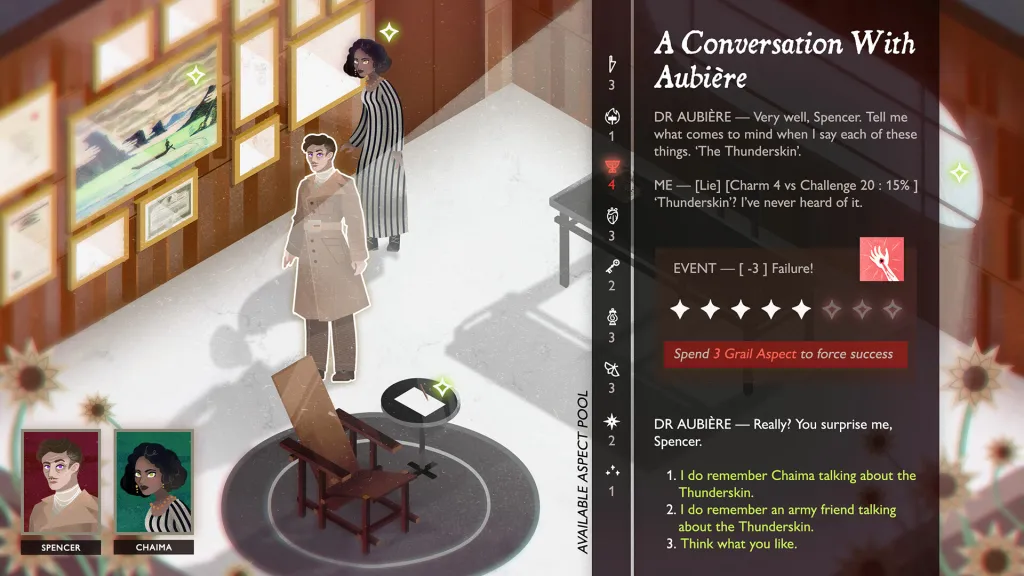
Its most distinctive quality is not simply the absence of combat. Travelling At Night is attempting to make personality, conversation, clothing, performance, memory, knowledge, and motivation carry the mechanical weight normally assigned to battles. Spencer’s Career determines his starting abilities. His Passions evolve according to behavior. Footnotes transform lore into interpretation and choice. Opportunities turn objects, Memories, and Influences into occult tools. Troubles ensure that failure creates new conditions instead of ending with a missed attack.
The alternate 1948 setting gives these systems a strong narrative foundation. The War in the World and War in the Sun have created a Europe of divided towns, altered landscapes, supernatural ruins, rival powers, and displaced people. The golden Incorporates and star-touched Ministries compete for influence, while Rosa Mundi crosses the continent in search of something capable of changing their Cold War.
The Steam demo provides the clearest evidence of how these ideas work together. Antibes offers dense conversations, character-building decisions, social consequences, outfit effects, crafting, Footnotes, and enough branching material to support repeated visits. Its early reception, including approximately 20,000 players by August 25, 2026, suggests considerable interest in Weather Factory’s move into a more recognizable CRPG format.
Important details remain unfinished. Travelling At Night has no final release date, and Weather Factory’s open-development approach means individual systems or destinations may change. Nevertheless, the confirmed design already presents a clear identity: a combat-free, choices-matter narrative RPG about a damaged man traveling through a damaged Europe, surrounded by performers, conspirators, immortals, political agents, and powers that should perhaps have remained buried.
Sources and Citations
- Weather Factory — “Travelling At Night” Announcement — December 12, 2024. The original reveal establishes Travelling At Night as a dialogue-driven, choices-matter, combat-free CRPG; identifies Spencer Hobson as the protagonist; connects him to Cultist Simulator and BOOK OF HOURS; discusses four Careers, sixteen Skills and nine Passions; confirms the original Windows/Mac/Linux, Steam and GOG plan; and explains Weather Factory’s open-development approach. (weatherfactory.biz)
- Weather Factory — Travelling At Night Official Game Page — The main official game page establishes the alternate Europe, 1948 setting, the Incorporates/Ministries Cold War, combat-free structure, Careers and Passions, sixteen-Skill character system, Memories and Signs, multiple endings and current description of the game as offering 40-plus hours of replayable narrative. (weatherfactory.biz)
- Weather Factory — Travelling At Night Streamer / Press Kit — Official press materials list the release as TBA, platforms as Windows, Mac and Linux through Steam and GOG, and describe Careers including exorcist, stage magician and physician. The press kit currently describes the game as a 20–40 hour experience, while Weather Factory’s newer main game page says “forty-plus hours.” (weatherfactory.biz)
- Steam — Travelling At Night Store Page — Confirms Weather Factory as developer and publisher, “To be announced” release status, single-player support, Windows/macOS/Linux requirements, the Secret Histories franchise connection, demo availability and Steam wishlist information. (Steam Store)
- GOG — Travelling At Night Store Page — Official GOG storefront confirming Windows, Linux and macOS support, Weather Factory as developer/publisher, the narrative CRPG format, multiple endings and the game’s current storefront availability/wishlist presence. (GOG.com)
- Weather Factory — “Travelling At Night Demo Out Now!” — August 10, 2026. Official launch announcement for the first public Steam demo. It details Antibes, the Sanitarium Aujourd’hui, more than twenty characters, occult crafting, Passions, Footnotes, six demo outfits, and the demo’s endpoint aboard the train from Antibes toward Mimata. Weather Factory’s site index confirms the post and date, while the syndicated Steam announcement preserves the detailed content. (weatherfactory.biz)
- Weather Factory — “Before the Dawn” — August 25, 2026. The key post-launch development report. Weather Factory reports roughly 30,000 demo installations, around 20,000 actual players and a 563-player concurrent peak, alongside about 1,200 support/bug reports across its games since August 10, most relating to Travelling At Night. It also discusses UI improvements, Skills and Passions progression, map work and development of more than a dozen major destinations. (weatherfactory.biz)
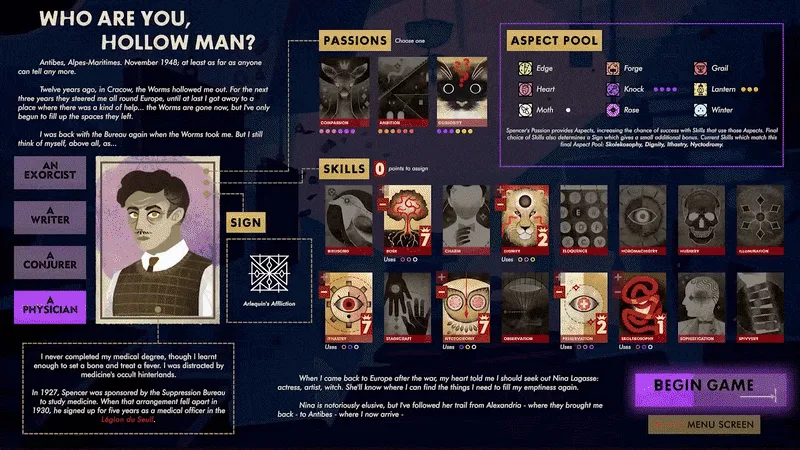
- Weather Factory — “Who Are You, Hollow Man?” — April 30, 2025. The main character-creation source. It explains how players choose Spencer’s Career, Passion and starting Skills, which then generate aspects of his portrait, backstory, Sign and starting Aspect Pool. It also explains how additional Passions can emerge through dialogue choices and play style. (weatherfactory.biz)
- Weather Factory — “Turn This Opportunity Yes” — October 10, 2025. Weather Factory’s dedicated explanation of the Opportunities system and its role in making smaller locations dense with interactive stories, lore and consequential choices. The accompanying discussion also addresses Troubles and skill progression. (weatherfactory.biz)
- Weather Factory — “It’s Not a Codex” — September 19, 2025. Alexis Kennedy’s design post explaining the philosophy behind Travelling At Night’s Footnotes system as an alternative to a conventional CRPG encyclopedia/codex, providing contextual lore without separating that lore completely from play. (weatherfactory.biz)
- Weather Factory — “The Black and White Ceremony” — June 27, 2025. The major Rosa Mundi source. It establishes the travelling occult circus as a central part of the game and explains how choosing where to pitch the circus creates branching routes, including possibilities involving Kionn, Schloss Nagelsburg, Vienna, France and Brancrug. It also introduces its performance tent and other circus facilities. (weatherfactory.biz)
- Weather Factory — “The Player and the Peacock” — February 13, 2026. The most important source for the performance system. It explains Rosa Mundi’s cast and roles, five-act plays, location-dependent performances, character/role choices, Skill-based decisions, rewards including cash, Influences, Experiences and Troubles, and Weather Factory’s intention for performances to be repeatable but variable. (weatherfactory.biz)
- Weather Factory — “Scapin’s Sickness” — March 6, 2026. Additional character and performance-design material connecting Rosa Mundi members to their commedia del Sole roles, including Torgue as Fracasse, Bronek as Cassandro and Arun Peel as Metaphraste, while also providing further material on Mimata and other characters. (weatherfactory.biz)
Recommended
- 2 Fights 2 Tight Spaces Early Access Launch Trailer Breakdown: Gameplay, Co-Op Features, New Cards, and Everything You Need to Know
- Where to Find Silver in Subnautica 2: Best Early Locations, Cave Routes, and Fast Farming Guide
- Meccha Chameleon Multiplayer Guide: How to Play, Win Matches, and Master Hider & Seeker Strategies
- Minecraft Mod Lets You Control Giant Sphere That Absorbs Blocks
- All ARC Raiders Quests (2026) – Full Mission List, Quest Chains, and Unlock Order
- Tomb Raider: Legacy of Atlantis Gets Shown Again With a New Release Date: What Changed
- Scooby-Doo: Origins — First Look at the Cast and Full Title Revealed for Netflix’s Live-Action Series
- Call of Duty: Modern Warfare 4 Reveals Kill Block, Its Dynamic Multiplayer Map
- PureRef 2.1: What’s New, Download, Pricing, and Best Reference-Board Workflow Tips



































































































