


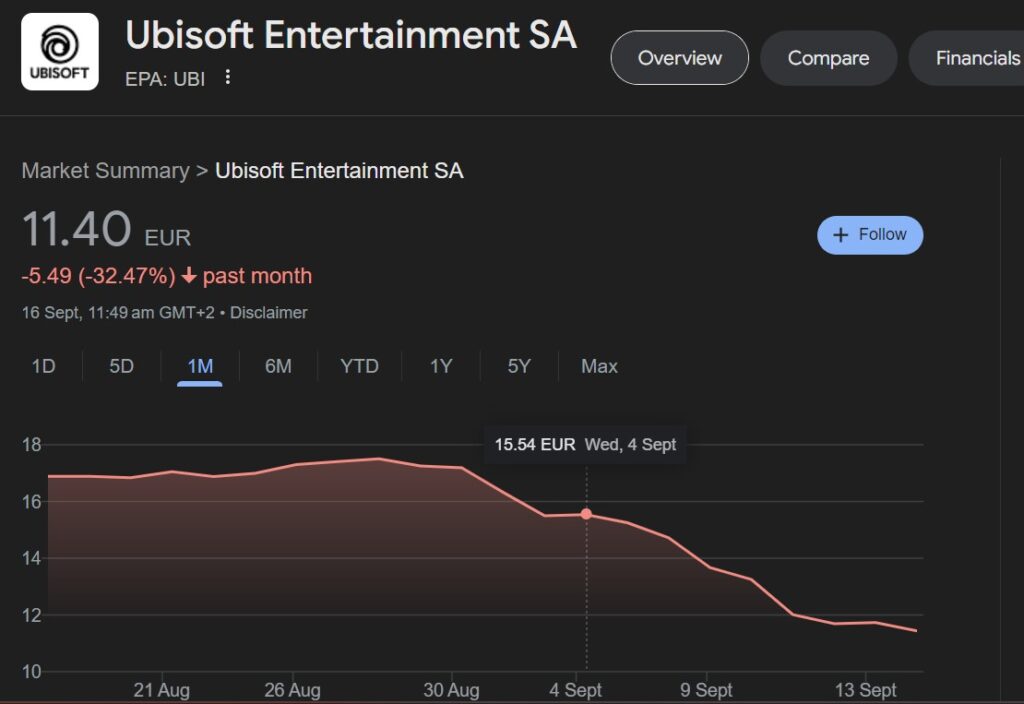
In January 2026, Ubisoft’s stock plunged over 30% on the Paris exchange, falling as much as 35% to around €4.5 per share — its lowest level in 14 years — giving the company a market cap of roughly €616 million. The drop followed a sweeping corporate reset that included major layoffs, six game cancellations (including Prince of Persia: The Sands of Time Remake), studio closures, project delays, a strict five-day return-to-office mandate, and a renewed push into player-facing generative AI. Ubisoft also sharply lowered its financial outlook, forecasting net bookings of about €1.5 billion for FY2025–26 and a non-IFRS operating loss of roughly €1.0 billion, with free cash flow between –€400 million and –€500 million. These developments significantly undermined investor confidence.
As part of its restructuring, Ubisoft reorganized into five autonomous Creative Houses, each responsible for specific genres or core franchises and operating with full development, marketing, and P&L accountability. Creative House 1, known as Vantage Studios and partly owned by Tencent, oversees Assassin’s Creed, Far Cry, and Rainbow Six. The other four houses focus respectively on first-person shooters (Ghost Recon, Splinter Cell, The Division), live-service titles (For Honor, The Crew, Skull & Bones), narrative fantasy games (Rayman, Anno, Beyond Good & Evil), and casual/family games (Just Dance, Uno). The model aims to decentralize decision-making, improve accountability, and raise game quality.
Ubisoft cancelled six projects that failed to meet new quality standards. The most prominent was Prince of Persia: The Sands of Time Remake, originally announced in 2020 and delayed multiple times. The company also scrapped four unannounced titles (three new IPs) and one mobile game. Seven additional projects were delayed, including one pushed from FY2026 into FY2027, to allow for additional development time.
The restructuring included the closure of Ubisoft Halifax and Ubisoft Stockholm, as well as layoffs and downsizing at other studios including Ubisoft Massive and RedLynx. Hundreds of roles were affected. A voluntary departure plan targeted around 200 headquarters staff. Ubisoft’s CFO noted that employees unwilling to comply with the new five-day in-office mandate could face termination, referring to this as “soft layoffs.”
Ubisoft reinstated a strict five-day on-site workweek, ending remote flexibility except for limited annual exceptions. Management argues this will improve collaboration and efficiency, but the policy has sparked backlash. Five French unions called for an international strike from February 10–12, 2026, criticizing the reorganization, layoffs, cancellations, and abrupt return-to-office mandate. They accused management of prioritizing financial goals over workers and failing to properly consult employees.
To stabilize finances, Ubisoft reaffirmed a €100 million fixed-cost savings target by March 2026 and added a further €200 million in reductions over the next two years. By March 2028, it expects fixed costs to be roughly half of 2023 levels, amounting to about €500 million in total reductions compared to recent levels. These measures include studio consolidations, project cancellations, and headcount cuts.
Financially, Ubisoft projects net debt of €150–250 million by FY26 year-end, with cash reserves between €1.25–1.35 billion. The revised outlook incorporates approximately €650 million in write-downs from cancelled projects. FY27 guidance has been withdrawn, with updates expected in May 2026.
A key component of the reset is Tencent’s €1.1–1.2 billion investment in 2025 for a 25% stake in Vantage Studios, giving Tencent partial ownership of revenue from Assassin’s Creed, Far Cry, and Rainbow Six. Ubisoft signaled openness to additional minority-stake sales to strengthen liquidity and reduce debt.
Central to Ubisoft’s long-term strategy is “player-facing generative AI,” meaning AI systems directly experienced by players rather than internal development tools. This includes AI-generated NPC dialogue, adaptive character behavior, and dynamic content creation. The Teammates prototype demonstrated AI companions in a first-person shooter that respond to natural voice commands and adapt behavior contextually. The earlier NEO NPC project showcased an AI character capable of dynamic conversation, memory retention, and context-based responses that could unlock quests.
Ubisoft plans to apply generative AI primarily in open-world and live-service games, potentially enabling dynamic side quests, adaptive NPC personalities, and more responsive gameplay. Leadership maintains AI will augment rather than replace human creativity.
However, generative AI has sparked industry backlash. Surveys show 52% of developers believe AI is harming the gaming industry. Critics cite concerns about plagiarism, generic output, and replacement of human artists. Ubisoft projects have already faced criticism over AI-generated art and content.
Looking ahead, Ubisoft will revise its three-year roadmap, potentially delaying or cancelling more projects. May 2026 is expected to bring updated financial guidance and release schedules. The company is also considering additional asset sales beyond the Tencent deal. The success of the reset will depend on delivering higher-quality games, achieving cost reductions, restoring financial stability, and rebuilding trust among investors, employees, and players.

In This Article (21 sections)
Ubisoft stock down in 2026: why Ubisoft shares dropped after the restructuring
In January 2026, Ubisoft’s stock plunged over 30% on the Paris exchange following its major company reset. Shares fell as much as 35%, hitting their lowest level in 14 years (around €4.5, a market cap of roughly €616M). Investors were spooked by the combination of game cancellations, studio closures, and a vow to double down on AI. The company simultaneously warned of a sharply lower revenue outlook. For the fiscal year ending March 2026, Ubisoft now forecasts an operating loss of about €1.0 billion (US$1.2 billion). Together with the mass restructuring, these factors undermined confidence, driving the stock to a new record low (it once traded above €100 in 2018).
Ubisoft restructuring 2026 explained: five Creative Houses and the new operating model
 Ubisoft’s new organization splits its studios and franchises into five Creative Houses, each focused on specific genres or core franchises. For example, Creative House 1 (“Vantage Studios”) – partly owned by Tencent – will manage flagship series like Assassin’s Creed, Far Cry, and Rainbow Six. The other houses cover shooters (Ghost Recon, Splinter Cell, Division), live-service titles (For Honor, The Crew, Skull & Bones, etc.), narrative fantasy games (Rayman, Anno, Beyond Good & Evil), and casual/family games (Just Dance, Uno, etc.).
Each Creative House is an end-to-end unit with its own development, marketing, and P&L responsibility. This decentralization is meant to speed decision-making and focus each team on delivering higher-quality games. (Ubisoft’s slide above illustrates the five-house structure and supporting “Creative Network” of shared resources.)

Ubisoft game cancellations 2026: which Ubisoft games were canceled and why
As part of the refocusing, Ubisoft cancelled six projects that “did not meet the new enhanced quality” criteria. The most high-profile cut was Prince of Persia: The Sands of Time Remake, which had been in development since 2020. In addition, Ubisoft axed four unannounced games (three of them original IPs) and one mobile title. Company representatives said these games required more development time or budget than the firm could justify. For instance, the PoP remake team explained that although the game “had real potential,” it wasn’t reaching Ubisoft’s quality bar and would need far more time and investment than feasible. Overall, cancelling these titles is intended to free up resources to finish fewer games at a higher standard.
Prince of Persia: The Sands of Time remake canceled — what happened
After years of delays and even changing studios, Ubisoft finally pulled the plug on the Sands of Time remake in January 2026. Originally announced in 2020, the remake missed multiple release windows. In a statement on social media, the development team said the project “had real potential” but fell short of the required quality. They noted that completing it would have taken more time and money than Ubisoft was willing to commit. Despite fan disappointment, Ubisoft emphasized that cancelling the remake does not mean abandoning the franchise entirely. In fact, it reassured fans that Prince of Persia remains an “important” IP and hinted that future projects may still come around the series.

Ubisoft delays 2026–2027: which Ubisoft games were delayed and what it means
Ubisoft also announced delays for seven additional projects to ensure they meet the new quality benchmarks. The company said these include one title originally slated for release before April 2026, which has now been pushed into the next fiscal year (before April 2027). (Ubisoft hasn’t publicly confirmed the specific games, aside from noting that it carried development on over half a dozen projects.) Management framed these delays as a positive, buying developers extra polish time. In essence, the goal is to “reallocate resources and comprehensively revise [the] roadmap over the next three years” so that remaining Ubisoft games launch at a higher level of quality.
Ubisoft layoffs and studio closures: Halifax and Stockholm shutdown details
As part of the overhaul, Ubisoft closed its Halifax (Canada) and Stockholm (Sweden) studios. Other teams were restructured or downsized as well – for example, Ubisoft Massive (Malmö) and RedLynx (Finland) had planned layoffs earlier in 2025. In total, the changes affect hundreds of positions worldwide. A voluntary departure plan for about 200 headquarters staff was offered, while many studio employees were either moved to other projects or offered redundancy. Ubisoft says these rightsizing moves will reduce overlap and costs. CFO Frederick Duguet explicitly noted that workers unable or unwilling to comply with the new five-day office policy may be let go, terming such attrition “soft layoffs”.

Ubisoft return to office mandate: five days per week on-site policy explained
Alongside these cuts, Ubisoft abruptly ended its remote-work flexibility. Effective immediately, all Ubisoft developers are required to work on-site five days a week, with only a limited number of occasional work-from-home days allowed per year. In practice, this means employees must be in the studio Monday through Friday. Ubisoft management argues that full on-site work will improve efficiency and collaboration. However, the mandate has been controversial – the company said it would create “more opportunities for onboarding” and ensure better oversight, but many staff feel it contradicts trends in work–life balance. The strict RTO policy is a key grievance cited by unions and employees in the current pushback.
Ubisoft unions strike 2026: why employees are calling for walkouts
In response to these measures, five French unions (including CFDT, CGT, CFE-CGC, Solidaires, Printemps Écolo) announced an international strike for Feb 10–12, 2026. The unions specifically called out Ubisoft’s “colossal reorganisation” – the layoffs, game cancellations, and especially the five-day RTO – as justifications for a walkout. In a joint statement, they criticized management for announcing the changes via press release rather than negotiations, and for “treating the staff like children.” The unions pledged to defend employees’ rights and protect jobs, accusing Ubisoft of prioritizing financial objectives over its workforce. (Notably, union leaders pointed to the sudden RTO policy and the way cost-cutting was imposed as primary triggers of unrest.)

Ubisoft cost-cutting plan: €200 million savings target and the longer-term reduction plan
Ubisoft has launched an aggressive cost-reduction program to stabilize its finances. The company reaffirmed its commitment to hit a €100 million fixed-cost savings goal by March 2026 (from an existing “Fit for 100M” plan) and to cut an additional €200 million in fixed costs over the following two years.
In practical terms, this €200M will come from studio consolidations, cancelled projects, and headcount reductions. By March 2028, Ubisoft expects its annual fixed costs to be roughly half what they were in 2023. Taken together, Ubisoft aims to eliminate about €500M in costs by 2028 – a figure also cited by management – counting both already-achieved savings and this new phase. These cuts are intended to preserve cash and allow reinvestment in higher-priority games and technology (like AI).
Ubisoft financial forecast 2026: net bookings guidance, operating loss, and cash flow outlook
With these changes, Ubisoft has lowered its financial targets. For FY2025-26, the company now expects net bookings around €1.5 billion (about a €330 million drop from its previous guidance). It forecasts a non-IFRS operating loss of roughly –€1.0 billion. Free cash flow is projected to be about –€400 to –€500 million for the year. By the end of FY26, Ubisoft plans to have net debt between €150–250 million and cash of €1.25–1.35 billion. (Ubisoft has withdrawn its FY27 guidance and said it will provide updates in May 2026.) These figures incorporate one-time write-downs (about €650M from the cancelled projects) and the expectation that Xbox acquisitions and other deals will be deferred under the new plan.

Tencent investment in Ubisoft: how the deal connects to Vantage Studios and key franchises
A major backdrop to Ubisoft’s reset is Tencent’s strategic investment. In 2025, Tencent poured about €1.1–1.2 billion into Ubisoft for a 25% stake in Vantage Studios (the newly formed Creative House 1). Vantage Studios now exclusively manages Ubisoft’s biggest franchises – Assassin’s Creed, Far Cry, and Rainbow Six – meaning Tencent will own one-quarter of the revenue stream from those series. Ubisoft’s management says the deal was structured to fund this major reorganization and focus on blockbuster IP, and they have made it clear they are open to selling minority stakes in other houses if needed. The Tencent infusion gives Ubisoft more liquidity (some of which will repay debt) but also shifts power to Tencent for future blockbuster titles.
What is “player-facing generative AI” in Ubisoft games?
“Player-facing” generative AI is Ubisoft’s term for AI systems that directly interact with or affect the player experience, rather than just assisting developers behind the scenes. In practice, this means AI-driven content – such as NPC dialogue, character behavior, or on-the-fly level design – that players see and respond to in-game. Ubisoft’s recent experiments (Neo NPC, Teammates, etc.) illustrate this: the AI is in the game world, taking voice commands or carrying on conversations with the player. According to Ubisoft, these AI characters use natural language and contextual awareness to create more dynamic gameplay. In short, “player-facing generative AI” refers to using generative models to make the games themselves more interactive and responsive to the player.
Ubisoft generative AI plans for open-world and live-service games
Ubisoft plans to apply its player-facing AI technology especially in its two core pillars: open-world adventures and live-service (Games-as-a-Service) titles. The new corporate strategy emphasizes “Open World Adventures” and “GaaS-native experiences,” backed by accelerated AI investments. For example, Ubisoft’s labs have already prototyped AI-driven NPCs in a shooter (the Teammates demo) and hinted at AI features for live games: its recent Rainbow Six Siege roadmap included a “Defender AI” mode with bots meant to behave like human players.
In future open-world games, generative AI could automatically generate dynamic side-quests or create NPC personalities on the fly. While specifics are still experimental, Ubisoft’s leadership has stated that AI tools will be used to make sprawling worlds and live-service experiences more engaging – although they stress these tools will complement human design rather than replace it.
Ubisoft Teammates AI companion: what it is and how it works
Image: Ubisoft’s Teammates AI demo – the player (center) commands two AI companions (Sofia on left and Pablo on right) in a prototyped FPS mission.
Ubisoft’s Teammates is a research prototype showcasing in-game generative AI companions. It’s a short first-person shooter scenario where the player is accompanied by an AI “voice assistant” (named Jaspar) and two NPC squadmates (Sofia and Pablo) with advanced AI. The player issues natural voice commands like “Take cover” or “Attack that target,” and the AI teammates carry out those instructions. In the demo, Sofia and Pablo navigate the level, use cover, and engage enemies according to player prompts.
They even exhibit distinct personalities and adapt to changing situations. For instance, Ubisoft notes that the AI NPCs can interpret a player’s tone, mood and strategy to decide how to act, yielding a fluid, context-aware response to the gamer’s input. In short, Teammates uses speech recognition, generative language models, and game AI to let players “command” their AI comrades as if talking to real squad members. (Ubisoft emphasizes this is a limited tech demo, but it illustrates how voice-driven AI could work in future games.)

Ubisoft Neo NPC project: Ubisoft’s AI NPC prototype and what it showed
The NEO NPC project (unveiled at GDC 2024) was an earlier experiment in player-facing AI. Powered by the Inworld Engine, NEO NPC featured an AI character named “Bloom” that could converse with players. The demo showed that as the player built rapport with Bloom through conversation, new dialogue options and even quests unlocked.
Bloom would adjust his answers based on the player’s tone (friendly, hostile, etc.) and could recall earlier details—such as a player’s fondness for burgers—to personalize the interaction. Essentially, the prototype demonstrated an NPC with memory and cognition: it reacted to what the player said, learned from it, and used that context to influence gameplay. Ubisoft believes NEO NPC has opened the door to more emergent storytelling, where character responses aren’t fixed but are generated on the fly based on player input.
Generative AI backlash in games: why players and developers push back
Generative AI in games has been controversial. Many players and creators worry it will dilute artistry or replace human work. In a recent industry survey, 52% of game developers said AI is harming the gaming business (up from 18% two years prior). Common complaints include that AI tends to regurgitate or plagiarize existing content – one developer bluntly called it “built on theft and plagiarism”. Fan outcry has flared whenever major franchises use AI tools; for instance, Ubisoft’s own Anno 117 and Ubisoft-related projects like Arc Raiders generated backlash for AI-generated art and music.
The uproar usually centers on fears that AI assets look generic or unfairly replace human artists. Even among Ubisoft’s leadership, there is some defensiveness: they maintain that their AI experiments (Teammates, NEO NPC) are research tools to augment creativity, not finalize game content. Nevertheless, the industry trend is clear: a vocal segment of developers and fans remain wary of generative AI in games, demanding transparency and quality assurances.

What to watch next for Ubisoft in 2026: roadmap changes, asset sales, and release timing
Looking ahead, the key questions are how Ubisoft will execute this reset. Management says it will re-examine its entire three-year roadmap, likely moving or canceling more projects to meet its higher standards. A concrete milestone is May 2026, when Ubisoft will issue updated financial guidance and presumably a clearer release schedule. Note that one unannounced game was already pushed from FY26 to FY27, so other delays or new release dates are likely. On the corporate side, Ubisoft signaled it is open to further asset sales. The CFO explicitly mentioned considering divestitures beyond the Tencent deal.
Keep an eye out for announcements of more minority-stake partnerships or spin-offs, as Ubisoft tries to shore up cash and reduce debt. Finally, watch for any year-end reports on whether these changes truly stabilize Ubisoft’s finances. The success of the reboot will ultimately be measured by whether future games actually improve in quality, whether costs stay under control, and whether the company can return to growth after this turbulent year.
Frequently Asked Questions (FAQs)
- Why did Ubisoft’s stock drop sharply after the January 2026 announcement?
The stock tumble coincided with Ubisoft’s announcement of major layoffs, six game cancellations (including the Prince of Persia remake), and an overhaul centered on AI. Investors were spooked by the sudden cut to its revenue outlook. Ubisoft warned it now expects much lower sales (net bookings around €1.5 billion) and a roughly €1 billion operating loss for FY2025-26. These factors drove the share price down to multi-year lows. - What are Ubisoft’s “Creative Houses” in the new structure?
Ubisoft created five Creative Houses – each an autonomous development and publishing group. For example, Creative House 1 (called Vantage Studios) handles big franchises like Assassin’s Creed, Far Cry, and Rainbow Six, backed by Tencent investment. The other four houses focus respectively on first-person shooters, live-service titles, fantasy/narrative games, and casual/family games. Each house will manage its own P&L and brand, in hopes of clearer focus and accountability. - Which Ubisoft games were cancelled during this restructuring?
Six projects were scrapped entirely. Notably, Prince of Persia: The Sands of Time Remake was cancelled after years of troubled development. The other five were a mix of unannounced titles (three new IPs) and a mobile game. Ubisoft said these projects “did not meet the new enhanced quality criteria” and were removed to allocate resources elsewhere. - Why was the Prince of Persia remake cancelled?
According to the development team, the remake never reached the quality Ubisoft was aiming for. They stated it “had real potential” but wasn’t polished enough – completing it would have required significantly more time and budget than the company could dedicate. Given these constraints, Ubisoft chose to cancel it rather than release an inferior product. - Which Ubisoft titles have been delayed into 2026–2027?
Ubisoft said seven titles got extra development time. One game originally planned for release before April 2026 is now slated to launch before April 2027. (Ubisoft didn’t name the specific games in its statement.) Essentially, any remaining high-profile projects have been pushed back to ensure they meet the new quality expectations. - What studio closures and layoffs has Ubisoft announced?
Two known studios have shut down: Ubisoft Halifax (in Canada) and Ubisoft Stockholm (in Sweden). In addition, teams in Abu Dhabi, RedLynx, Ubisoft Massive (Malmö) and elsewhere have been resized. Ubisoft also put in place a voluntary departure plan for around 200 HQ employees. In total, the company expects to cut hundreds of jobs through studio closures and staff reductions as part of its cost-saving strategy. - What is Ubisoft’s new return-to-office policy?
Ubisoft has reinstated a strict five-day in-office workweek. All employees are now required to work on-site Monday through Friday, with only a limited number of remote days allowed each year. This is a sharp reversal of recent flexibility, and Ubisoft says the policy will improve teamwork and oversight. (The policy change itself has been controversial among staff and was one reason cited by unions calling for a strike.) - Why are Ubisoft employees planning strikes or protests?
A: The planned strike in early February 2026 is a response to the “colossal reorganization.” French unions object to the rapid layoff announcements, project cancellations, and especially the abrupt return-to-office mandate. They argue that these changes were imposed without proper consultation and that workers are being squeezed after years of overwork. In short, staff are protesting Ubisoft’s cost-cutting and work-policy changes, which they feel violate labor rights. - What cost-cutting targets has Ubisoft set?
Ubisoft reaffirmed its previous target of €100 million in savings by March 2026 and added a new goal of cutting €200 million more over the following two years. These cuts encompass closures, layoffs, and the scrapping of projects. Overall, Ubisoft expects to reduce its fixed cost base by roughly €500 million relative to recent levels. - What is “player-facing generative AI” and how is Ubisoft using it?
This term refers to AI technology that players directly experience in-game (as opposed to tools used behind the scenes). In Ubisoft’s case, it means AI-driven characters and content that react to players. Examples include the Teammates demo and NEO NPC prototype, where NPCs use natural language and context to interact with the player. Ubisoft says it is pouring more resources into these kinds of AI experiments, aiming to eventually use generative models to make NPCs more dynamic and responsive in its open-world and live-service games.

Conclusion
Ubisoft’s January 2026 overhaul represents the most radical shift the company has undertaken in years. By slicing its business into five Creative Houses and abruptly axing projects and jobs, Ubisoft aims to stabilize finances and raise game quality. However, these changes have unsettled investors (causing a stock crash) and alarmed employees (prompting strike calls).
Generative AI is at the center of its long-term vision – Ubisoft plans to double down on player-facing AI – but the short-term challenges are immense. In the coming months, all eyes will be on Ubisoft’s updated financial guidance, its revised game roadmap, and any further asset sales or studio changes. Success will depend on whether the company can actually deliver better games faster, achieve the promised cost savings, and win back trust from both gamers and its workforce.
Sources and Citations
- Ubisoft Press Release (Jan. 21, 2026) – Major Organizational, Operational and Portfolio Reset
- (official strategy hub; Jan. 21, 2026 press release referenced in coverage)
- GameDeveloper – “Ubisoft initiates huge restructure to become more ‘gamer-centric’ company”
- PC Gamer – “Prince of Persia: The Sands of Time Remake is cancelled…”
- Creative Bloq – “Ubisoft says AI Teammates will make gaming more engaging and accessible…”
- Ubisoft News – “Ubisoft Reveals Teammates – An AI Experiment to Change the Game”
- https://news.ubisoft.com/en-us/article/3mWlITIuWuu0MoVuR6o8ps/ubisoft-reveals-teammates-an-ai-experiment-to-change-the-game (English version may redirect from regional page)
- Tom’s Hardware – “Ubisoft’s share price plummets… Developer falls below…”
- Reuters – “Ubisoft unveils sweeping restructuring, updates targets”
- TechSpot – “More than 50% of game developers say generative AI is harming the industry”
- VGC – “Ubisoft details ‘major company reset’: 6 games canned, 7 delayed, and 2 studios closed”
- Ubisoft FY2025–26 Financial Guidance / Investor Materials
- Ubisoft Financial Release – Cash Flow and Debt Figures
- Ubisoft Financial Presentation – Cancellations and Delays Information
- Ubisoft Technology Blog – Rainbow Six Siege “Defender AI” Feature
- https://www.ubisoft.com/en-us/company/careers/our-jobs/technology (Ubisoft tech blog portal; specific Defender AI article may be archived here)
- GamingOnLinux – “Ubisoft shutters studios, cancels 6 games…”
- https://www.gamingonlinux.com/ (search title: “Ubisoft shutters studios, cancels 6 games”)
- TweakTown – “Ubisoft open to selling more minority stake bids similar to $1.2 billion Tencent deal”
- TweakTown – “Ubisoft reboots business with Creative House plan, reveals future of its biggest franchises”
- https://www.tweaktown.com/ (search title: “Ubisoft reboots business with Creative House plan, reveals future of its biggest franchises”)
- Inworld AI Blog – “Game Design in Ubisoft’s NEO NPC Prototype”
Recommendations
- Ant-Man Star Evangeline Lilly Slams Disney’s Marvel Layoffs, Says Artists Are Being Replaced by AI
- Mixtape is Earning Widespread Acclaim for Its Animation, Soundtrack, and Emotionally Driven Coming-of-Age Storytelling
- Daredevil: Born Again Returns for Season 2 on Disney+
- Why Blender Gets Ignored by Studios: Key Reasons and Industry Insights
- Mortal Kombat Actor on Street Fighter Rivalry: Lewis Tan Reacts to Andrew Schulz’s Game Awards Jab
- The Academy Draws Line for Oscars: No AI Actors and No AI Scripts (New 2027 Rules Explained)
- Outward 2 Release Date Revealed: Potato PC Trailer, Huge Compatibility Range, Gameplay Details, and Everything We Know About the 2026 RPG Sequel
- New Invincible Season 4 Trailer Teases the Debut of Ultimate Viltrumite Villain Thragg
- The Most Efficient Way to Create 3D Ponytails in Blender
- The Wizard of the Kremlin: Jude Law as Vladimir Putin, Cast, Plot, Release Date, and Reviews



































































































