




In This Article (23 sections)
Star Wars tools now live in UEFN and Fortnite Creative
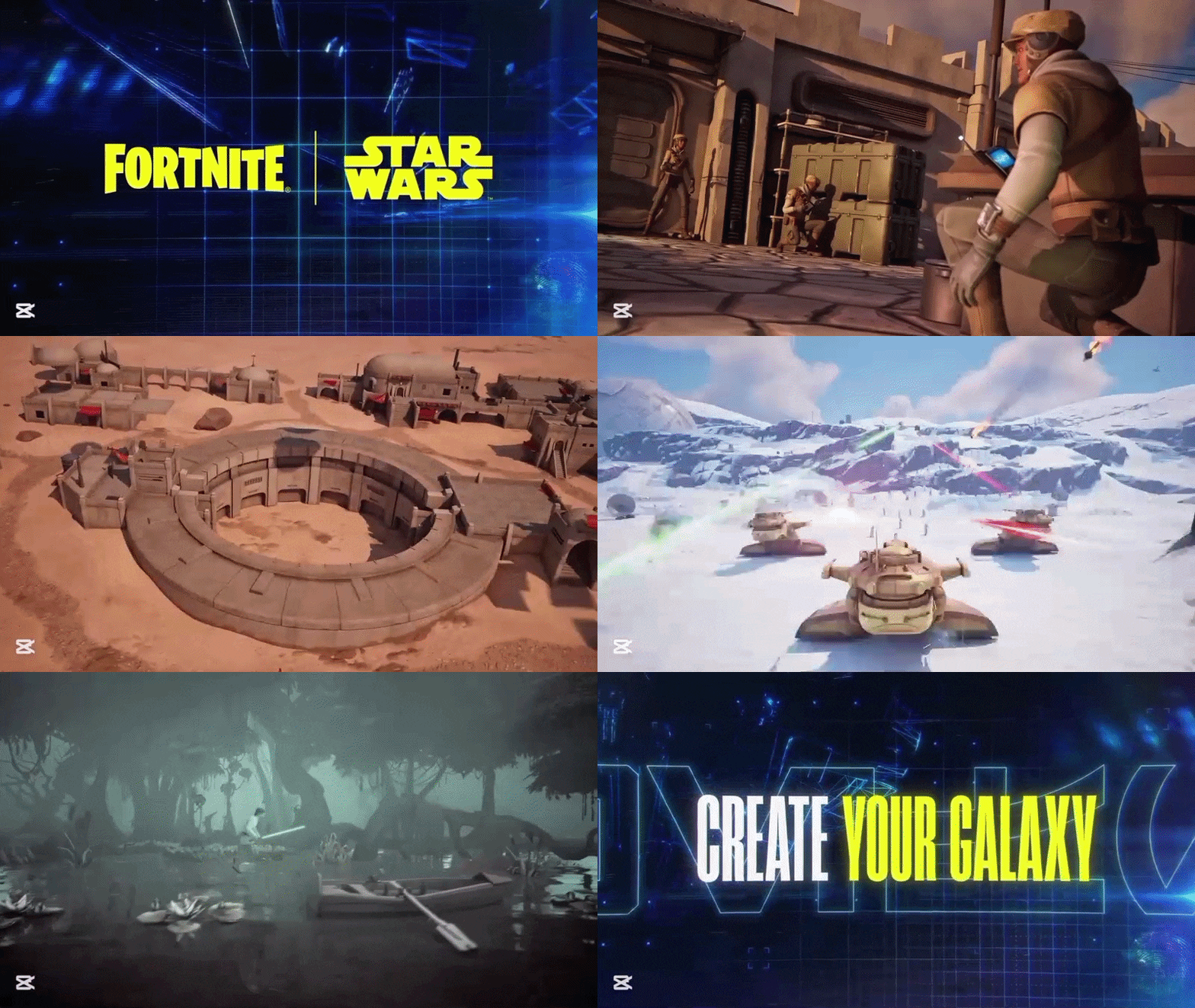
On March 19, 2026, Epic Games released a major update making official Star Wars content a permanent part of the Unreal Editor for Fortnite (UEFN) and Fortnite Creative. Resulting from a $1.5 billion partnership with Disney, this “largest IP toolset to date” allows the community to build Star Wars–themed islands and games using an expansive library of authentic assets, characters, vehicles, and weapons. While the tools are accessible to both PC and console creators, UEFN offers advanced capabilities like custom scripting and exclusive devices to reach the content’s full potential.
How to create Star Wars islands in Unreal Editor for Fortnite (UEFN)
To begin, creators can launch UEFN and start a new project using the “Star Wars” brand filter, which provides access to four themed starter terrains: Space, Hoth, Tatooine, and Nevarro. Existing UEFN projects can also be converted into Star Wars projects through the Project Settings menu.
The creation process involves several key components:
- Assets and VFX: Creators can use Star Wars Galleries for iconic structures like the Death Star or Mos Eisley Cantina and place props such as Sandcrawlers or Dejarik tables. Niagara VFX systems allow for the creation of space battles, laser effects, and hyperspace jumps.
- Environment: Starter islands include specific sky and terrain settings. Background assets like Star Destroyers can be added to enhance the atmosphere without affecting gameplay.
- Mechanics: Creators can place spawners for vehicles like X-wings and TIE Fighters, as well as NPCs such as Stormtroopers or Rebels. The new Hero device allows players to transform into iconic characters, and the Mandalorian’s Jetpack is available for flight.
- Narrative: The Conversation device enables scripted, branching dialogues with NPCs for quests, merchants, and story cutscenes.
Console creators can use Star Wars assets and two flat grid islands in the standard Fortnite Creative mode, though they lack access to advanced features like the Hero device, custom lightsaber editing, and the Conversation system.
How to publish Star Wars islands in Fortnite (Creator Portal requirements)
Publishing Star Wars islands follows the standard creative workflow with additional requirements. Creators must be enrolled in the Fortnite Developer Program and must opt-in to specific Star Wars brand license terms via the Creator Portal.
The publishing workflow requires UEFN to upload the island data. Key details include:
- No Support-A-Creator Code: Creators do not need a SAC code to publish; instead, they earn through engagement payouts.
- Monetization Restrictions: In-island transactions, such as merchandise or device paywalls, are strictly prohibited. Earnings are generated solely from player engagement time, with a portion shared with Disney.
- Submission Process: After uploading through UEFN, creators define descriptions and media in the Creator Portal, toggle the Star Wars IP Content setting, and submit the island for a compliance review.
While the tools were released on March 19, 2026, public publishing was scheduled for a later date, though creators could immediately begin building and testing via private codes. To be successful, creators must ensure their content adheres to all official brand rules and policies.
Star Wars island publishing date and Discover “Star Wars Game Collection” page
Although Star Wars development tools launched on March 19, 2026, public publishing for these islands began on May 1, 2026, to coincide with the “May the 4th” celebrations. This timeline allowed creators several weeks to refine their maps before a surge of community content. To support this launch, Epic introduced the “Star Wars Game Collection” in the Discover menu, a dedicated section for curated Star Wars islands and featured promotions like “Epic’s Picks.”
Prior to May 1, creators could build and share teasers, but maps were not visible in the general Discover menu. By the official publishing date, Epic released additional updates, including first-person weapon modes and lightsaber customization. The “Star Wars Game Collection” is intended to be a permanent, ongoing showcase within Fortnite, allowing creators to continue submitting and updating their Star Wars experiences over time.
Star Wars UEFN starter islands (Hoth, Tatooine, Nevarro, space) explained
To facilitate creation, Epic provided four distinct starter environments:
- Space: A starfield skybox featuring distant galaxies and asteroid belts, designed for starfighter dogfights.
- Hoth: A snowy, frozen tundra with mountains and blizzard effects, suitable for base defense scenarios.
- Tatooine: A desert environment with sand dunes and golden lighting, ideal for podracing or recreating Mos Eisley.
- Nevarro: A volcanic landscape with lava streams, charred ground, and dark basalt rocks.
Console creators also have access to two flat grid islands with Star Wars backdrops. These starters handle environmental visuals like sky colors and fog, allowing creators to focus immediately on gameplay. While these islands provide the atmosphere, creators must still manually adjust game physics, such as low gravity, using standard Fortnite devices.
Star Wars galleries in Fortnite Creative (Death Star, Cantina, Resistance Base)
The update includes modular “galleries” that provide the building blocks for iconic locations, accessible in both UEFN and Creative mode:
- Death Star Gallery: Contains Imperial-style wall panels, control consoles, blast doors, circular corridor lights, and the Emperor’s throne room window.
- Tatooine Cantina Gallery: Features sand-colored adobe walls, arched doorways, bar counters, and Aurebesh signage, alongside props like distillery equipment.
- Resistance Base Gallery: Includes bunker walls, tactical map screens, hangar doors, and supply crates themed after the sequel trilogy era.
The toolkit also features specialized background assets and interactive props, such as a colossal Star Destroyer skybox model, a Holochess (Dejarik) table with visible holograms, a Sabacc card table, and a large Sandcrawler vehicle. These assets are scaled to work with existing Fortnite prop galleries, allowing creators high flexibility in designing authentic or hybrid Star Wars locations without the need for custom modeling.

Star Wars UEFN templates: Team Conquest template features
Epic Games provided the Team Conquest template in UEFN to demonstrate large-scale, team-based combat scenarios for 16–50 players. Set on a Tatooine desert battlefield, the template functions as a blueprint for objective-driven modes where opposing teams compete to capture and hold control points, similar to “Conquest” modes in other shooters. It includes structured spawning systems to handle players re-spawning at forward outposts or captured bases for both Rebel and Imperial factions.
A central feature of the template is the integration of the Hero device, which allows players to transform into iconic characters like Luke Skywalker or Darth Vader with enhanced abilities. The template demonstrates how to trigger these transformations via milestones like kill streaks, power-ups, or specific pickups, while also showing how to balance their use. Additionally, the template supports vehicle and NPC integration, featuring updated X-wings and TIE Fighters with secondary fire modes, Armored Assault Tanks (AATs), and NPC troopers to simulate an ambient battlefield.
The Team Conquest template provides creators with the technical foundation for “Battlefront-style” gameplay, handling the complex logic of team mechanics, scoring, and win conditions. Creators are free to modify the template by changing the location to environments like Hoth, adjusting weapon loadouts, or tweaking victory rules. As one of the three official Star Wars templates—alongside “Lightsaber & Force” and “Narrative”—it serves as a primary educational tool for learning how to orchestrate large battles and effectively deploy the Hero device within the Fortnite ecosystem.
Star Wars UEFN templates: Narrative and roleplaying template with Conversation device
The Narrative and Roleplaying template in UEFN is designed to showcase how creators can build story-driven, RPG-like experiences using Star Wars assets and the new Conversation device. Set in an atmospheric Tatooine cantina with dim lighting and potential “Cantina Band” music, the template serves as an iconic hub for storytelling, filled with interactive NPCs such as bartenders and quest-givers.
Key features of this template include:
- Interactive NPCs and Branching Dialogue: Using the Conversation device, players can engage with NPCs through a dialogue UI. The system supports multi-step branching trees where the NPC reacts differently based on player choices, allowing for immersive role-playing.
- Gameplay Loops and RPG Mechanics: The template demonstrates full gameplay loops by integrating quest devices and trackers. Players can receive objectives—such as defeating enemies or finding droids—and return to NPCs for rewards. It also showcases functional vendor NPCs who can sell items like lightsabers in exchange for gold or unlock specific dialogue branches if the player possesses required items.
- Environmental and Cinematic Storytelling: The cantina is constructed using specific gallery pieces and mood lighting. The template illustrates how to use Cinematic Sequence devices for cutscenes and how to pose NPCs naturally using the Prop Manipulator or Verse scripts.
This framework moves Fortnite Creative beyond basic shooter mechanics into the realm of narrative adventures. It provides an invaluable technical example for setting up interactive dialogues, permitting creators to develop mini-RPGs where players roam locations like Mos Eisley, undertake bounties, and make choices—such as light side versus dark side responses—all within a Fortnite island.
Star Wars characters and NPCs available in UEFN (Luke, Vader, Leia, Mandalorian, more)
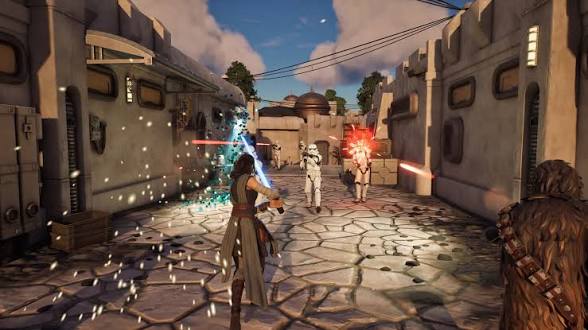
The UEFN integration provides an extensive roster of authentic Star Wars characters from multiple eras. Iconic figures include Luke Skywalker, Darth Vader, Princess Leia, Chewbacca, Boba Fett, the Mandalorian (Din Djarin), Emperor Palpatine, and Rey Skywalker. These characters are accessible as playable forms through the Hero device—granting signature gear and powers—or as interactive NPCs with potential AI behaviors for boss fights or ally support. Supporting the main cast are generic NPCs such as various Rebel Alliance troopers, Imperial Stormtroopers equipped with E-11 blasters, civilians, and Jawas. Additionally, rideable Tauntauns are included as ground mounts. These high-fidelity models replace generic placeholders, allowing creators to build immersive scenes with actual Star Wars inhabitants for combat, quests, or environmental ambiance.
Star Wars vehicles and creatures in UEFN (X-wings, TIE fighters, Tauntauns)
Epic has introduced a suite of iconic Star Wars vehicles and mounts for player use in UEFN. Flyable starfighters include the X-wing, TIE Fighter, and the Mandalorian’s N-1 Starfighter, all updated with secondary fire options and adjustable attributes like health and boost speed. On the ground, players can operate the AAT (Armored Assault Tank), a two-seater with a rotating turret and main cannon. For organic traversal, rideable Tauntauns function similarly to Fortnite’s wildlife mounts and can be used across any terrain.
While colossal assets like the Star Destroyer remain non-operable background decorations for atmospheric scale, other vehicles can be tuned via spawner devices to control parameters such as speed, damage, and fuel. These tools enable the creation of aerial dogfights, combined arms warfare, and racing experiences within Star Wars-themed maps.
Star Wars weapons in UEFN (lightsabers, blasters, turrets, bowcaster)
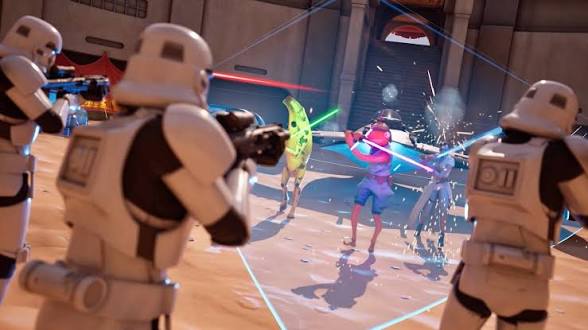
Epic has introduced over 25 Star Wars weapons to UEFN, spanning multiple categories of iconic armaments. Lightsabers are a centerpiece, featuring character-specific versions for Luke, Rey, Obi-Wan, and Darth Vader, each with distinct colors and hilts. These melee tools allow players to perform combo slashes, leap attacks, and block incoming fire. The blaster selection includes the rapid-fire E-11, heavy rifles, blaster pistols, and Chewbacca’s Wookiee Bowcaster, which fires high-damage explosive bolts. Ranged weapons now support first-person aiming (ADS) for increased immersion.
Additionally, creators can place interactive heavy weapons like the Imperial Turbolaser and the Rebel DF.9 ground turret. These mounted stations typically feature infinite ammo with an overheat mechanic, making them ideal for base defense. The update also provides Star Wars audio assets, such as the “Imperial March” and “Cantina Band” themes. While weapon stats are generally fixed to mirror their Battle Royale counterparts, creators can utilize global multipliers and the new custom item system to influence balance. The diverse arsenal, complete with authentic sound effects and models, allows for the creation of Jedi duels, blaster shootouts, and vehicle-versus-turret skirmishes.
Hero device in UEFN: how players transform into Star Wars heroes and villains
The Hero device is a brand-new tool in UEFN that enables mid-game transformations, allowing players to take on the appearance and unique abilities of iconic Star Wars characters. When triggered by events—such as interacting with the device, picking up a power-up, or completing an objective—the player’s model swaps to the chosen hero or villain. Available characters for this device include Darth Vader, The Mandalorian, Rey Skywalker, Chewbacca, Emperor Palpatine, and Leia Organa.
Beyond the cosmetic change, the device grants signature powers:
- Darth Vader: Increased health/shields, Force choke, and lightsaber throw.
- The Mandalorian: Access to his jetpack and Amban Rifle.
- Emperor Palpatine: The ability to use Force lightning.
- Rey Skywalker: Lightsaber combat and Force abilities like mind tricks or pushes.
- Chewbacca: Enhanced strength and his signature Bowcaster.
Creators can configure the Hero device to manage transformation duration, determine if the change is permanent until elimination, and limit the number of active heroes. This mechanic allows for “Battlefront-style” gameplay, where becoming a hero serves as a powerful reward that can turn the tide of a match. This technical achievement marks the first time mid-game skin swaps have been natively supported via a device in Fortnite Creative, opening up new possibilities for both competitive and narrative-driven maps.

Mandalorian Jetpack in UEFN: omnidirectional flight and combat
The Mandalorian’s Jetpack is a specialized UEFN item that enables advanced aerial mechanics, including omnidirectional flight. Unlike standard Fortnite jetpacks restricted to vertical thrust, this version allows players to move freely in 3D space—forward, backward, strafing, and hovering. A key enhancement is the ability to fire weapons simultaneously while flying, permitting full accuracy and the use of Aim Down Sights (ADS) mid-air with blasters or lightsabers.
Implemented as an equippable backpack, the jetpack features configurable fuel settings, allowing creators to choose between limited or infinite use. These mechanics support vertical combat strategies and complex 3D navigation in environments like asteroid fields or multi-story structures. This upgraded version addresses previous limitations by allowing players to act as effective flying combatants, making it a vital tool for Mandalorian-themed maps or aerial arena shooters.
Star Wars UI updates and custom fonts for Fortnite islands
Epic introduced Star Wars-themed UI updates and two custom fonts to provide an authentic aesthetic for player-made islands. The re-themed HUD includes styled health bars, shields, and inventory icons that incorporate Star Wars visual language, such as Imperial-style interfaces and Aurebesh accents. Non-HUD elements, including pop-up menus, mission notifications, and the dialogue boxes for the Conversation device, have also been re-skinned.
The update includes two specific fonts: an Aurebesh font for in-universe environmental text and a second font likely intended for titles or general UI headings. Creators can utilize these via UI Message devices, Billboard devices, or HUD widgets. These enhancements are designed to be applied when an island’s brand is set to Star Wars, ensuring a cohesive “total conversion” experience that maintains high immersion and consistent branding throughout the map’s presentation.
First-person support for Star Wars ranged weapons in UEFN
A significant update for Star Wars UEFN islands is the official first-person camera support for all Star Wars ranged weapons, including blasters and the Bowcaster. While melee weapons like lightsabers remain in third-person, ranged armaments now allow players to experience combat through the eyes of their character. This feature was integrated between March 19 and May 1, 2026, enabling the creation of authentic first-person shooter (FPS) experiences within Fortnite.
The first-person mode is specifically integrated with aiming down sights (ADS), providing a proper sight picture for weapons like the E-11 blaster. Creators can likely opt-in to this perspective to enhance immersion in interior shootouts, trench runs, or high-tension narrative maps. This official support replaces previous unofficial camera workarounds, allowing for the development of Star Wars FPS sub-genres, such as stormtrooper base raids or Death Star escapes, and attracting players who prefer traditional first-person shooter mechanics.

Custom items and inventories for lightsabers and Force powers (beta details)
The Star Wars UEFN update introduces a Custom Items and Inventory system, transitioning from an experimental feature to a beta phase. This system allows creators to move beyond fixed item parameters to create bespoke items and modify existing properties. Key features include the ability to design custom lightsabers—customizing hilts (such as Luke’s or Obi-Wan’s), colors (blue, green, red, purple), and blade styles (like an unstable blade)—using the Scene Graph tool or in-game crafting workbenches.
A significant shift is the decoupling of Force powers from lightsabers. Creators can now assign Force abilities independently, allowing for scenarios where players use Force powers without a lightsaber or vice versa. The expanded list of abilities includes traditional powers like Force Push, Pull, Lift, Throw, and Jump, as well as new additions: protective barriers, Force Heal, mind tricks, distractions, and enemy detection. The Custom Inventory UI enables RPG-like management where players can equip a limited number of powers at a workbench. As of May 1, creators are permitted to publish islands utilizing these beta features, introducing deeper personalization and progression into Fortnite experiences.
Star Wars brand rules for Fortnite creators (what you can and can’t do)
Epic and Disney have established strict Star Wars Brand Rules to ensure that user-generated content respects the franchise and follows licensing agreements. Creators must use only official Star Wars assets from Epic’s toolkit and are prohibited from importing external models or art. Modifications are limited; while system-supported changes like lightsaber colors are allowed, inappropriate re-texturing of character models or creating obscene content is forbidden.
Additional restrictions include:
- IP Isolation: Creators may not mix Star Wars assets with other IPs, such as Marvel or Naruto.
- Neutrality: Islands cannot depict real-world political or religious themes, nor can they use Star Wars symbols to represent real-world groups.
- Content Standards: Misuse of assets in an obscene, violent, or discriminatory manner is prohibited.
- Naming and Trademark: Islands cannot use existing Star Wars titles, such as “Star Wars Battlefront,” “Jedi: Fallen Order,” “Star Wars Outlaws,” or “Squadrons.” Creators must avoid implying official endorsement or canon status.
- Monetization: In-island transactions and external sales are disabled. Creators earn revenue solely through engagement payouts, from which Disney receives a portion.
Disney retains all IP rights under a limited, revocable license. Epic and Disney reserve the right to moderate and take down any islands that violate these guidelines, fail to maintain the appropriate franchise tone, or breach general Fortnite content rules.
Star Wars brand rules for Fortnite creators (what you can and can’t do)
Epic and Disney have established specific Star Wars Brand Rules to ensure that user-generated content remains respectful to the franchise and complies with licensing agreements. Creators are required to use only official, “genuine” Star Wars assets provided in Epic’s toolkit; importing external models, art, or fan-made assets is prohibited. Modifications are restricted to those permitted by the system, such as changing lightsaber colors; creators may not re-texture models inappropriately or use assets to create obscene imagery. Furthermore, Star Wars content should not be mixed with other intellectual properties in a single island.
The rules strictly forbid the depiction of real-world political or religious themes. Creators cannot use Star Wars assets to comment on real-world issues or represent real-world groups and movements. Content must avoid obscene, excessively violent (such as extreme gore), or discriminatory misuse. Additionally, island names must not infringe on existing trademarks; creators cannot use official titles like “Star Wars Battlefront,” “Jedi: Fallen Order,” “Star Wars Outlaws,” or “Squadrons.” Islands must be clearly presented as fan-made without implying they are official canon or endorsed by Disney.
Disney retains all intellectual property rights through a limited, revocable, and non-exclusive license. Creators do not own the Star Wars aspects of their islands and cannot use them outside of Fortnite. Monetization via in-island transactions, external merchandise, or NFTs is disabled, leaving engagement payouts as the only permitted revenue source. Creators are also prohibited from using Star Wars assets for real-world brand integrations or advertisements. Finally, islands must maintain a tone consistent with the franchise, avoiding extreme or disrespectful parodies. Epic and Disney reserve the right to moderate or take down any islands that violate these guidelines.
UEFN Star Wars revenue share: 20% engagement payout to Disney explained
Epic Games has implemented a revenue-sharing model for islands using Star Wars IP, where 20% of an island’s engagement payout is distributed to The Walt Disney Company as a licensing fee. This arrangement is part of Fortnite’s Creator Economy 2.0, in which 40% of net revenue is placed into a pool and distributed to creators based on player engagement time. Under this specific IP deal, creators retain 80% of their proportional earnings from the engagement pool; for example, if an island earns $1,000, $200 is sent to Disney while the creator receives $800.
This model mirrors other licensed IP integrations in Fortnite, such as those for Squid Game or The Walking Dead. Because in-island monetization and transactions are disabled for Star Wars maps, these engagement payouts represent the sole potential income for creators. While original maps offer 100% of the payout to the creator, the Star Wars brand may attract a larger volume of players, potentially offsetting the 20% royalty through higher total playtime.
The revenue share is handled automatically through the Creator Portal, and creators must accept additional terms to acknowledge this arrangement. This system effectively formalizes fan-made Star Wars content by turning creators into “micro licensees,” providing them with a legal way to earn from the IP while incentivizing Disney to allow user-generated content to flourish within the Fortnite ecosystem.

Frequently Asked Questions (FAQs)
- When Did Star Wars Content Become Available in UEFN and Fortnite Creative?
Star Wars content became available for development on March 19, 2026, with the UEFN update v40.00. Public publishing for these islands was officially enabled on May 1, 2026, to celebrate Star Wars Day. - What Is the Difference Between UEFN and Console Creative?
Creators can use both platforms, though UEFN on PC provides the full feature set. Console Creative allows for basic scene building using two flat starter islands and various galleries/props. Advanced features—such as custom lightsabers, the Hero device, the Conversation (dialogue) system, and custom scripting—require UEFN. - How Do You Start a Star Wars Island?
In UEFN, creators must start a new project and select a Star Wars starter island or template, ensuring the project’s brand is set to “Star Wars.” This provides foundations like Hoth, Tatooine, Nevarro, or Space. Creators can then use the content browser to drag and drop prefab galleries and devices, such as Death Star interiors or vehicle spawners, into their scenes. - Which Characters and Vehicles Are Available?
Available characters include iconic figures like Luke Skywalker, Darth Vader, Princess Leia, Chewbacca, Boba Fett, The Mandalorian, and Emperor Palpatine. Generic NPCs like Stormtroopers, Rebel troopers, and Jawas are also included, alongside rideable Tauntaun creatures. Operable vehicles include X-wings, TIE Fighters, N-1 starfighters, and Armored Assault Tanks (AATs), all of which can be tuned via spawner devices. - How Does the Hero Device Work?
The Hero device allows players to transform into characters like Darth Vader, Rey, or The Mandalorian mid-match. This transformation grants the player the character’s specific appearance and unique powers. Creators can design these as time-bound power-ups or limit the number of active heroes. - How Do Lightsabers and Force Powers Function?
Lightsabers function as weapons capable of blocking and deflecting shots. Through UEFN, players can use a crafting bench to customize lightsaber hilt styles and blade colors. Force powers—such as Push, Heal, Mind Trick, and Barrier—are decoupled from lightsabers, existing as separate abilities that creators can allow players to pick up or unlock. - What Are the Publishing Requirements?
To publish, creators must be enrolled in the Fortnite Developer Program and agree to Star Wars-specific terms in the Creator Portal. Islands must comply with all Star Wars brand guidelines and content rules to pass review. Once published, islands are automatically tagged and subject to a 20% revenue share with Disney. - What Content Restrictions Apply to Star Wars Islands?
Creators must adhere to strict brand rules: content must be lore-friendly, appropriate, and avoid political, religious, or offensive themes. Mixing Star Wars with other non-Epic IPs (like Marvel) is prohibited. Island titles cannot use trademarked names such as “Battlefront” or “Jedi Survivor.” - How Does Monetization and Revenue Sharing Work?
Creators earn revenue through Fortnite’s engagement payout system based on player playtime. Disney takes a 20% licensing royalty, which is automatically deducted from the engagement earnings. In-island monetization and direct microtransactions are disabled for Star Wars content. - What Types of Creative Game Modes Can Be Built?
The toolset allows for a wide range of experiences, including PvP battles (like Team Conquest), narrative adventures with interactive NPCs, recreations of movie scenes, parkour, and racing. The system supports FPS-style shooting with first-person blasters, space flight simulators, and RPG elements like Force power progression.

Conclusion
The integration of Star Wars into UEFN represents a groundbreaking fusion of an iconic franchise with a creative platform, enabling creators to build authentic games using legendary characters, weapons, and locations. Foundations like Tatooine desert or icy Hoth templates can be populated with comprehensive assets, including X-wings, Cantina props, and specialized devices like the Hero transformer and Mandalorian Jetpack. Interactivity is enhanced via the Conversation device for narrative role-play and the Custom Items & Inventory system for personalizing lightsabers and Force abilities. Authentic immersion is further supported by first-person blaster modes and Star Wars-themed UI fonts.
Creators are encouraged to explore this official sandbox while adhering to brand rules that protect the IP’s integrity, such as avoiding inappropriate content, real-world politics, and trademarked names. Published islands require a 20% revenue share with Disney. This paradigm shift creates a persistent Star Wars platform within Fortnite’s Discover page via the “Star Wars Game Collection,” empowering both seasoned and new creators to officially extend the galaxy with diverse experiences ranging from space combat to narrative missions. This collaboration heralds a new era of community-driven content for major franchises.
Sources and citations
- Fortnite Star Wars Tools for Creators
https://www.fortnite.com/news/star-wars-tools-now-live-for-fortnite-creators-create-your-galaxy-today - Publishing Star Wars Islands
https://dev.epicgames.com/documentation/en-us/fortnite/publishing-star-wars-islands-in-fortnite - Star Wars Brand Rules in Fortnite
https://dev.epicgames.com/documentation/en-us/fortnite/star-wars-brand-and-creator-rules-in-fortnite - GameSpot Fortnite Star Wars Creation Tools Coverage
https://www.gamespot.com/articles/fortnites-new-star-wars-map-making-tools-go-live-but-with-some-catches/1100-6561438/ - Creative Bloq Fortnite Star Wars Islands Analysis
https://www.creativebloq.com/3d/video-game-design/are-fortnites-star-wars-islands-an-opportunity-or-risk-for-the-franchise - 80 Level Star Wars Comes to UEFN
https://80.lv/articles/star-wars-officially-comes-to-uefn-and-fortnite-creative - UEFN Ecosystem Release Notes v40.00
https://dev.epicgames.com/documentation/en-us/uefn/40-00-fortnite-ecosystem-updates-and-release-notes - PixelHair 3D Hair Assets
https://yelzkizi.org/pixelhair-3d-hair-assets/
Recommended
- Witch Hat Atelier Premiere Review: Episode 1–2 Impressions, Animation Quality, and Crunchyroll Release Details
- Physics in Unity: Complete Guide to Rigidbodies, Colliders, Joints, FixedUpdate, and Performance
- Slay the Spire 2 Roadmap Explained: Why Mega Crit Avoids Release Dates
- Neon Odyssey Becomes the Most-Funded TTRPG Kickstarter of All Time
- Sony Fights Back Against The Scourge Of Shovelware, Wiping Over 1,000 Games From The PlayStation Store: What Was Removed and Why It Matters
- Fallout’s Co-Creator Says Some Players Are Told by Influencers What to Think, Rather than Forming Their Own Opinions (Tim Cain on Gaming Discourse)
- Wuthering Heights Review: Why Emily Brontë’s Dark Romance Still Divides Readers
- Everplay (Team17 Parent Company) Reports 10% Gross Profit Rise in 2025: Full-Year Results, Revenue, and Outlook
- The Boys Finale Homelander Scene Explained
- Dune: Awakening Is Coming to Consoles on September 22: What Console Players Need to Know



































































































