





In This Article (8 sections)
Game of Thrones War for Westeros Gameplay Teaser and Dragon Battle Explained
War for Westeros Gameplay Reveal gives players an early look at PlaySide’s premium PC real-time strategy game, where the Great Houses and the Night King command squad-based armies, heroes, cavalry, siege engines, giants, and dragons across tactical battlefields shaped by counters, formations, terrain, resources, construction, and asymmetric faction mechanics. The footage focuses on a confrontation between Lannister and Targaryen forces before a dragon attacks the advancing Lannister army, immediately demonstrating the contrast between conventional formations and the extraordinary units available to certain factions.
It also establishes the game’s larger strategic promise by showing how recognisable characters and spectacular battlefield forces are being placed within a traditional RTS structure built around army composition, positioning, readable counters, physical unit interactions, and faction-specific advantages. This framing makes the footage useful not only as spectacle, but also for judging how PlaySide translates Westeros into a coherent and replayable strategy game.
Timeline context: The teaser and pre-show passages reflect information available before Opening Night Live on August 25, 2026. The full reveal has since aired, and the post-reveal details below explain what was subsequently confirmed during gamescom and in PlaySide’s September 5 recap.
House Lannister and House Targaryen are two of the four confirmed playable factions, alongside House Stark and the Night King’s Army of the Dead. PlaySide has repeatedly indicated that faction identity will go beyond cosmetic differences, with each side built around distinctive heroes, armies, mechanics, and powerful battlefield capabilities. The teaser uses Lannister troops as a recognizable conventional force before introducing a Targaryen dragon as a dramatically different type of threat.
Dragons are formally part of the game’s combat roster rather than being limited to cinematics. PlaySide has confirmed that battles can involve infantry, cavalry, siege engines, giants, and dragons. The developer has also described powerful faction specific units as high impact trump cards, using a giant capable of physically launching enemy squads as one example. These units are intended to feel exceptional while remaining part of a broader tactical combat system.
The dragon attack should therefore be viewed as a demonstration of destructive potential rather than proof that dragons can automatically destroy conventional armies without meaningful counters. PlaySide has not yet explained how dragons are recruited, what resources they require, whether they are tied to particular heroes, how frequently they can attack, or which units can effectively counter them.
House Targaryen is naturally the faction most strongly associated with dragon warfare. Promotional material places Daenerys Targaryen beside a large dragon and ranks of Unsullied soldiers, reinforcing the combination of disciplined ground forces and overwhelming aerial power. However, the exact economy and restrictions surrounding dragons remain undisclosed, so their full strategic role cannot yet be determined.
House Lannister also remains only partially documented. Tywin Lannister has been identified as an important hero whose leadership focuses on deliberate battlefield coordination and improving the effectiveness of the Lannister war machine. The teaser gives Lannister formations considerable visibility, but a complete faction roster has not been announced, meaning players should not assume that every military unit associated with House Lannister in Game of Thrones will necessarily appear.
The distinction between the different promotional videos is important. Goodbye Kansas identifies the earlier announcement trailer as a cinematic it produced with PlaySide, whereas the August gameplay reveal introduces the playable RTS systems. A cinematic can establish the possibility of changing familiar events without explaining how those changes happen under player control.
Gameplay footage is more useful for examining formations, combat interactions, and army movement, but an edited trailer still cannot establish how an entire match develops. Neither presentation should be treated as a complete demonstration of every mechanic suggested by its imagery. PlaySide’s September 5 recap subsequently clarified that dragons require strategic investment, with opponents able to prevent that payoff. Counterplay can therefore begin before a dragon appears, although specific anti-dragon builds remain undocumented.

War for Westeros Gamescom 2026 Gameplay Reveal and RTS Combat
The full Game of Thrones: War for Westeros Gameplay Reveal Trailer is scheduled to debut on Tuesday, August 25, 2026, during gamescom Opening Night Live. The official gamescom program lists the broadcast for 8:00 p.m. CEST in Cologne, which corresponds to 2:00 p.m. ET and 11:00 a.m. PT in North America, while PlaySide has specifically confirmed that the gameplay reveal will appear during the show.
Gamescom itself runs from August 26 through August 30, with Opening Night Live serving as the major public kickoff on the evening before the show floor opens. At the time this material was researched on August 25, the broadcast had not yet taken place, so confirmed gameplay information came from the teaser, PlaySide development updates, Steam details, and earlier announcement material.
War for Westeros is described as a classic premium real time strategy game for PC, with combat built around squads, responsive formations, tactical counters, heroes, terrain, and territory control rather than requiring players to micromanage individual soldiers. Players issue orders to larger formations, while physical battlefield interactions are intended to give major units more visible impact. Cavalry can break through vulnerable formations, giants can send entire squads flying, and specialist units such as spearmen are designed to counter specific threats. This creates a system where positioning and unit selection matter alongside the spectacle of large battles.
Counterplay appears to be a major part of the design. One of PlaySide’s clearest examples involves cavalry attacking a vulnerable formation. Ordinary infantry may struggle to stop the charge, while specialised anti cavalry spearmen can shut it down. This suggests that even powerful units are intended to have appropriate responses rather than functioning as automatic victory conditions. Dragons are also part of the battlefield scale, although their exact counters and limitations have not yet been explained.
Squad-based control should not be confused with combat that plays itself. Issuing one order to a formation can reduce the need to select individual soldiers, but the player still has to decide which engagements to take, where support units belong, and when to reposition. Consider the stated cavalry-versus-spearmen example: possessing the correct counter is only part of the problem. That counter also has to be positioned where it can answer the threat. The tactical appeal therefore lies in coordinating complementary groups rather than assuming that the army with the largest visible headcount will always win.
Hero support adds another consideration to that positioning problem. A frontline commander who strengthens nearby soldiers encourages keeping the relevant parts of an army within useful reach, but concentrating every valuable unit in one place can also make the formation easier to read. The interesting decision is not automatically to spread out or stay together. It is to judge which threats demand a tighter formation and which demand flexibility. This is tactical interpretation of the described hero-and-squad structure, not confirmation of undocumented morale, cover, or formation bonuses.
Heroes are integrated directly into the RTS layer and can level up, gain abilities, and strengthen nearby forces, making their positioning and survival important to the army around them. Jon Snow and Tywin Lannister illustrate different approaches to hero design. Jon is presented as a frontline leader who rallies nearby troops, while Tywin functions more as a deliberate commander who improves the efficiency of the Lannister military machine. These differences suggest that hero selection could influence how each faction approaches combat rather than simply adding stronger individual units.
Map design is intended to reinforce these tactical systems. Ashemark is one confirmed battlefield built as a focused one versus one map with two open lanes and defensible positions, encouraging sustained pressure, holding actions, flanking manoeuvres, and counterattacks. PlaySide has also said that battlefields will range from areas inspired by Westeros to iconic locations such as King’s Landing and The Wall, with different layouts and terrain creating distinct strategic challenges. Territory control is another major system that PlaySide has already described as central to skirmish battles, suggesting that players will need to decide where to push, defend, flank, and counterattack as control of the map shifts.
The gamescom reveal is expected to clarify how these systems work together in practice. Important areas still needing more detail include territory control, hero management, faction economies, building systems, multiplayer pacing, and the practical role of extraordinary units such as dragons. Those topics remain expectations rather than confirmed contents of the trailer.
The key question is whether the footage can connect the spectacle of Game of Thrones with coherent RTS decision making through readable counters, dependable unit behaviour, meaningful territory control, resource management, and distinct faction strategies. On the information available so far, War for Westeros is positioned closer to a conventional army focused RTS than a simplified strategy adaptation, using dragons, giants, and familiar characters within a structure built around squads, counters, heroes, terrain, and tactical positioning.
That pre-broadcast position has now changed. PlaySide published its official gameplay reveal write-up on August 26, confirming a game loop involving unit training, resource acquisition, construction, and territorial expansion. These details establish that the reveal is about more than selecting armies for isolated battles: players must also develop the infrastructure that sustains those armies.
The August reveal also broadened the named playable roster. PlaySide listed Robb Stark, Jon Snow, Ghost, Grey Wind, Jaime Lannister, Tywin Lannister, Daenerys Targaryen, and the Night King. Ghost and Grey Wind are particularly notable because the developer includes the direwolves among its playable heroes, rather than presenting them only as decorative companions. The list confirms those characters, but it is not a promise that every major figure from the television series will appear or that each faction will have an identical number of heroes.
Ashemark’s two-lane structure offers a useful way to understand the decisions this approach could create. An illustrative situation would be an opponent concentrating most of an army along one route. The defending player could reinforce that position, threaten the other lane, or withdraw to a more manageable defensive line. Those are examples of the strategic questions raised by the described layout, not a prescribed winning strategy. The value of multiple routes is that a battle can become a contest over where strength is committed, rather than simply a continuous collision at one central point.
War for Westeros Economy, Base Building, and Faction Progression
Westeros.org’s August 26 hands-on preview describes workers constructing resource, recruitment, and research buildings, with Gold, Influence, and Supply serving different purposes. Gold supports spending, Influence helps obtain advanced forces, and dwellings increase the Supply capacity governing army size. A population allowance is not interchangeable with currency: having money does not necessarily mean having room to field more units. The same preview describes valuable positions beyond the starting base and hostile camps that reward Gold when defeated. Expansion therefore has an economic purpose. It introduces a tension between protecting established infrastructure and committing forces to acquire more, rather than merely increasing the territory associated with a faction’s banner.
Lannister Debt provides a concrete example of faction-specific economics. In that preview build, researched upgrades allowed spending below zero Gold, with further development extending the allowance and overspending increasing costs. This brings expenditure forward rather than granting unlimited free money. Its attraction is timing, although the preview should not be treated as a final balance guide.
A useful way to understand economic timing is to compare two hypothetical choices: buying additional soldiers for an immediate engagement or investing in infrastructure that pays off later. Neither is automatically superior. More troops might secure an important position, while a slower investment might strengthen future production. Borrowing complicates that judgment because an immediate advantage must justify the expense it creates. The decision is therefore about when resources become useful, not simply which player has accumulated the largest total.
House Stark’s progression follows a different logic. In his August 28 Inven Global interview, Ryan McMahon described an initial choice between Free Folk and Night’s Watch development. Late-game Northern Alliance research eventually combines those branches, with giants associated with the Free Folk and siege equipment with the Watch. This makes Northern unity something to develop towards, rather than an unrestricted army selection available immediately.
That kind of branching progression could make scouting particularly valuable. As an illustrative example, information about an opponent’s chosen development path could influence whether a player prioritises another counter unit, additional production, or a different direction of attack. It also creates a reason to learn a faction beyond memorising its strongest unit. Understanding what an opponent has committed to, what that commitment delays, and what becomes available later can be just as important as recognising a familiar banner. The reveal establishes the foundation for these decisions, while actual match experience will determine how frequently they matter.

War for Westeros Factions, Modes, Release Date, and Platforms
Game of Thrones: War for Westeros currently has four confirmed playable factions: House Stark, House Lannister, House Targaryen, and the Night King’s Army of the Dead. This lineup combines three major human powers with one supernatural army, giving PlaySide room to build distinct strategic identities rather than offering factions that differ only in appearance. House Stark is associated with Jon Snow, who is described as a frontline leader capable of rallying nearby soldiers. House Lannister is represented by Tywin Lannister and appears to favor a more deliberate military style built around coordination and efficient formations. House Targaryen combines disciplined ground forces with dragons, creating a faction centered on conventional armies supported by devastating high impact units.
The Night King’s Army of the Dead provides the most dramatically different military fantasy. PlaySide has confirmed that the undead are a fully playable faction rather than simply an enemy force encountered during the campaign, allowing players to command the Night King while attempting to conquer Westeros. However, the exact mechanics governing the faction remain unclear.
Recruitment, resurrection, and the possibility of turning fallen enemies into new units have not been confirmed, so those ideas should not be treated as established gameplay systems until PlaySide provides more details. McMahon subsequently confirmed in that August 28 interview that the Night King can resurrect the dead, including fallen heroes. This answers part of the preview’s uncertainty without establishing that every defeated soldier automatically becomes a recruit or revealing every restriction.
Each faction is expected to include iconic heroes who can level up, gain abilities, and strengthen nearby units. Earlier announcements also refer to signature armies and faction mechanics, suggesting that strategic differences will extend beyond unit models and visual themes. The four confirmed factions already cover very different approaches, from Northern forces and organised Lannister armies to dragon supported Targaryens and the supernatural Army of the Dead. No other playable houses have been formally announced, meaning Greyjoy, Baratheon, Martell, Arryn, and Tyrell should not currently be treated as confirmed factions.
The hero announcements also continued beyond Opening Night Live. PlaySide separately revealed Arya Stark and Gregor “The Mountain” Clegane during GameStar’s Find Your Next Game showcase. They should therefore be distinguished from the eight names highlighted in the initial gameplay announcement. Together, the announcements show why the first roster should not be mistaken for a final character list. They also create a more useful question than simply asking how many heroes exist: how differently will those characters function within their respective armies?
The interview also describes Arya temporarily assuming an enemy hero’s form and abilities after stealing their face. That could make her tactical value depend partly on the opposing lineup, although specific matchups remain undocumented. More generally, a distinctive hero should change how an army operates, rather than merely adding a stronger individual fighter.
War for Westeros supports both solo and multiplayer play. The solo campaign allows players to revisit and reimagine major conflicts and turning points from Game of Thrones rather than simply reproducing the television series, with the broader goal of letting players rewrite the fate of the realm. Multiplayer is designed around repeatable strategic competition, with earlier official material mentioning free for all battles and Steam listing single player, online PvP, and cooperative play. Important details such as player counts, matchmaking, ranked modes, campaign cooperation, and the exact implementation of cooperative play have not yet been fully explained.
PlaySide’s September 5 recap subsequently described a sandbox campaign moving between a territorial map of Westeros and RTS battles. Players decide both the victorious faction and the hero who claims the Iron Throne. The same update confirmed 1v1, 2v2, and four-player free-for-all skirmishes against players or bots, custom lobbies, and cooperative 2v2 battles against bots. Support beyond four players remains unconfirmed. These announcements resolve several questions left open in the pre-show preview, but team-based skirmish cooperation should not be mistaken for confirmation of a cooperative campaign.
For the campaign, the distinction between rewriting events and following a fixed adaptation is important. A player-led conquest promises room for outcomes to emerge from decisions rather than requiring the same sequence of battles in every run. That makes replayability a question of whether different choices produce meaningfully different situations, not simply whether another faction has a different opening cinematic. Details such as how hero progression carries between encounters, how losses affect subsequent battles, and how alliances are managed remain important to understanding the full experience. They should not be filled in by assuming that systems from another strategy game will automatically apply here.
The game is currently scheduled for early 2027 after PlaySide moved it from an earlier 2026 target. Steam lists the broader release year as 2027, but no exact launch date has been announced. PC is the only confirmed platform, with the game available to wishlist on Steam and officially described as a premium RTS built for PC. PlayStation 5, Xbox Series X|S, and Nintendo Switch 2 versions have not been announced, so any future console release remains unconfirmed.
PlaySide’s September recap also confirmed closed beta sign-ups for testing later in 2026. Registration offers a chance to participate, not guaranteed admission or proof that a public demo is playable. Steam’s published hardware information remains incomplete. Both the minimum and recommended sections specify a 64-bit processor and operating system and list broadband connectivity, but detailed processor, graphics card, memory, and storage requirements are still marked as coming soon.
Consequently, neither a recommended PC configuration nor a performance target should be inferred from the reveal trailer. The storefront does list Steam Achievements and Steam Cloud, alongside interface and subtitle support across eleven languages, with full audio listed for English. These are useful platform details, but they do not resolve the remaining questions about optimisation or launch performance.
Taken together, the teaser, gameplay announcement, hands-on accounts, and subsequent developer explanations provide a clearer foundation for judging War for Westeros. The spectacle attracts attention, but the more consequential promise is a strategy game where military strength must be developed, positioned, and supported. The remaining test is whether those choices stay understandable and rewarding when several systems demand attention at once. A dragon burning an army is an effective reveal moment; making the decisions before and after that moment equally compelling is what will determine the strength of the finished RTS.
Frequently Asked Questions (FAQs)
- What is Game of Thrones: War for Westeros?
Game of Thrones: War for Westeros is a premium real time strategy game developed and published by PlaySide for PC. Players command armies, heroes, and faction specific forces from across Westeros while managing battles built around positioning, counters, territory, and large scale engagements. The game includes both a solo campaign and multiplayer modes. - When is the War for Westeros gameplay reveal?
The full Gameplay Reveal Trailer is scheduled for August 25, 2026 during gamescom Opening Night Live. Gamescom lists the show for 8:00 p.m. CEST, with PlaySide confirming that the complete gameplay presentation will appear during the broadcast. The reveal is expected to provide a much clearer look at how the game’s RTS systems function in practice. - Has War for Westeros gameplay already been shown?
Yes, but only briefly at the time of this research. PlaySide released an official gameplay teaser on August 14 ahead of the longer gamescom presentation. The teaser showed a large battle involving Lannister and Targaryen forces and ended with a dragon attacking the Lannister army, offering an early glimpse of the game’s battlefield scale and faction differences. - Can players control dragons in War for Westeros?
Dragons are officially listed among the battlefield forces players can deploy, alongside infantry, cavalry, siege engines, and giants. However, PlaySide has not yet fully explained how dragons are recruited, controlled, limited, or countered. Their exact cost, availability, and relationship with Targaryen heroes also remain unclear. - Which factions are playable in War for Westeros?
The confirmed playable factions are House Stark, House Lannister, House Targaryen, and the Night King’s Army of the Dead. Each faction is intended to have its own heroes, armies, and distinctive mechanics, giving players different strategic approaches rather than simply changing the appearance of otherwise identical units. - Is War for Westeros single-player?
Yes. PlaySide confirms that the game includes a solo campaign where players can wage war across Westeros and revisit major conflicts and turning points from Game of Thrones. The campaign is designed around the idea of rewriting the fate of the realm rather than simply recreating the television series exactly. - Does War for Westeros have multiplayer?
Yes. PlaySide confirms multiplayer skirmishes, while Steam currently lists online PvP and co op support alongside the single player campaign. However, details such as player counts, ranked modes, matchmaking structure, and exactly how cooperative play will work have not yet been fully explained. - When will Game of Thrones: War for Westeros release?
The current official release window is early 2027. The game was originally expected in 2026, but PlaySide moved the launch window in July 2026 to allow additional development time. An exact release date has not yet been announced, so any specific day beyond the early 2027 window remains unconfirmed. - Is War for Westeros coming to PS5 or Xbox?
No console version has been officially announced. The only confirmed platform is currently PC, with the game available to wishlist through Steam. PlaySide may announce additional platforms later, but PlayStation 5 and Xbox versions should not be treated as confirmed unless the developer says otherwise. - Why was War for Westeros delayed?
PlaySide says the extra development time is intended to help the team reach the quality standard it wants for the finished game. Development updates mention continued work on responsiveness, pathing, unit behavior, physical combat interactions, maps, and tactical systems. These areas are particularly important in an RTS because problems with movement, formations, or unit reactions can directly affect how reliable and satisfying battles feel.
Conclusion
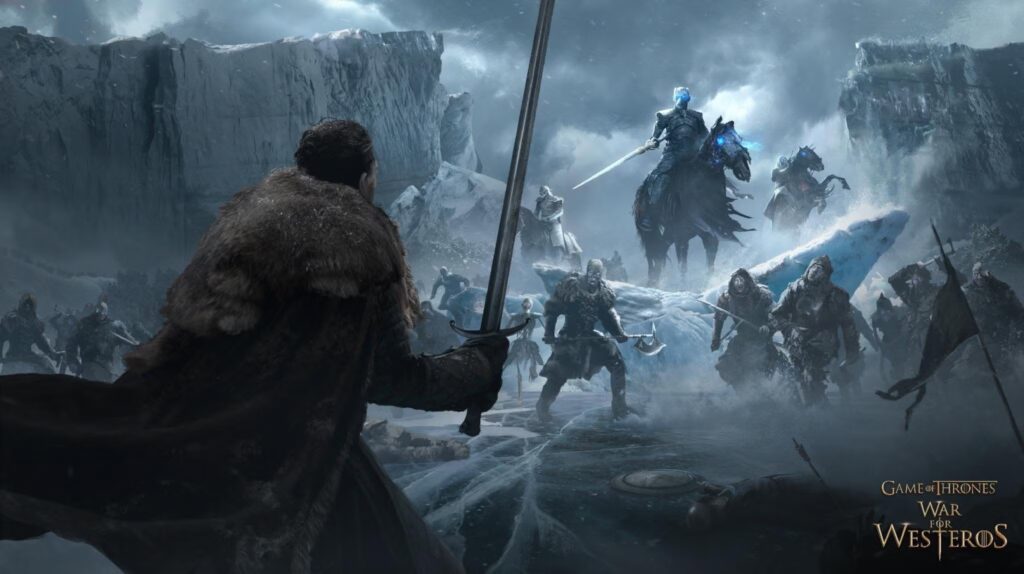
Game of Thrones: War for Westeros is finally approaching the point where players can judge, through the War for Westeros Gameplay Reveal, how PlaySide’s ambitious Game of Thrones RTS functions in motion. The brief War for Westeros Gameplay Reveal teaser establishes the visual premise: large armies clash, conventional formations meet asymmetric threats and dragons can dramatically reshape a battlefield.
Behind that spectacle in the War for Westeros Gameplay Reveal is a much more traditional strategy framework. PlaySide is building, as highlighted by the War for Westeros Gameplay Reveal, squad based army control, physical cavalry charges, tactical counters, levelling heroes, faction specific trump cards, terrain dependent maps and territory control systems.
Four factions are currently confirmed in the War for Westeros Gameplay Reveal: House Stark, House Lannister, House Targaryen and the Night King’s Army of the Dead. Players will be able, as presented in the War for Westeros Gameplay Reveal, to fight through a solo campaign or compete in multiplayer skirmishes, with the broader concept, reinforced by the War for Westeros Gameplay Reveal, centred on rewriting the fate of Westeros rather than remaining permanently locked to the television series’ events.
The biggest unanswered questions surrounding the War for Westeros Gameplay Reveal concern faction economies, dragon balance, building and resource systems, hero micromanagement, map control rules and multiplayer structure. The full War for Westeros Gameplay Reveal trailer scheduled for gamescom Opening Night Live on August 25, 2026 is positioned to provide the clearest look yet at how those pieces fit together.
War for Westeros, as discussed alongside the War for Westeros Gameplay Reveal, is no longer targeting 2026. PlaySide has pushed the PC RTS featured in the War for Westeros Gameplay Reveal to early 2027 specifically to continue improving the systems underlying its large scale battles. For an adaptation highlighted by the War for Westeros Gameplay Reveal and built around one of television’s most famous political and military conflicts, that extra development time may prove particularly important: dragons and iconic characters shown in the War for Westeros Gameplay Reveal will attract attention, but responsive armies, strong faction balance and reliable tactical mechanics will ultimately determine whether the war for the Iron Throne succeeds as an RTS.
Sources and Citations
- PlaySide Studios Official Website: Introduces the premium PC strategy game, its four playable factions and unit types, including infantry, cavalry, siege engines, giants and dragons. Covers the solo campaign, multiplayer skirmishes, iconic heroes and early 2027 release window.
Citation: Game of Thrones: War for Westeros Official Website - PlaySide Studios Development Update: Explains hero progression, squad-based commands, unit counters and the Ashemark one-versus-one battlefield. Also documents the move to early 2027, giving the team additional time to reach its intended quality standard.
Citation: Game of Thrones: War for Westeros Development Update - PlaySide Studios Gameplay Teaser Announcement: Announces that the full gameplay trailer would premiere during gamescom Opening Night Live. Provides the written announcement accompanying the August 2026 teaser, before the subsequent gameplay reveal.
Citation: Official Gameplay Reveal Teaser - Official Gameplay Teaser Video: Provides the promotional footage referenced in PlaySide’s announcement, featuring a battlefield confrontation and dragon attack. The dragon’s specific identity was not officially confirmed in the teaser.
Citation: Game of Thrones: War for Westeros Gameplay Reveal Teaser - PlaySide Studios Gameplay Reveal Announcement: Details playable heroes, resource acquisition, unit training, construction, territory capture and distinct faction mechanics. Also announces a beta, with participation information expected later in 2026, superseding the teaser’s advance notice.
Citation: Official Gameplay Reveal Trailer - Official Gameplay Reveal Video: Presents the gameplay footage accompanying PlaySide’s full reveal. Provides a visual reference for the game’s real-time battles, familiar heroes and faction-specific armies.
Citation: Game of Thrones: War for Westeros Official Gameplay Reveal Trailer - gamescom Opening Night Live Programme: Documents the August 25, 2026 presentation, with the main show scheduled for 8:00 p.m. CEST after a 7:30 p.m. pre-show. Establishes the event context for the gameplay premiere.
Citation: gamescom Opening Night Live Official Programme - Steam Official Store Listing: Identifies PlaySide as developer and publisher and lists a 2027 release, single-player, online PvP and co-op support. The co-op label does not explain whether it refers to campaign cooperation, allied skirmishes or another format.
Citation: Game of Thrones: War for Westeros on Steam - PlaySide Studios Original Announcement: Establishes the project as a classic, premium RTS built for PC. Introduces the Stark, Lannister, Targaryen and Night King factions, alongside solo conquest, free-for-all multiplayer and opportunities to rewrite Westeros’s fate.
Citation: Welcome to Westeros - PlaySide Studios Reveal Developer Diary: Introduces Game Director Ryan McMahon’s discussion of the development team’s vision, solo conquest and free-for-all multiplayer. Its original 2026 release wording was superseded by the later early 2027 announcement.
Citation: The War Begins: Reveal Dev Diary - Beebom: Reports on the gameplay reveal announcement and describes Lannister-bannered soldiers confronting Targaryen forces before a dragon attacks. Useful for secondary coverage of the teaser’s imagery, but not confirmation of the dragon’s identity.
Citation: Game of Thrones: War for Westeros Gameplay Reveal Announced for Gamescom Opening Night Live - Westeros.org: Covers the teaser, revised early 2027 release window and August 25 Opening Night Live premiere. Provides a secondary timeline reference alongside PlaySide’s announcements and gamescom’s official programme.
Citation: War for Westeros Gameplay Reveal Coming at Gamescom
Recommendations
- Chainsaw Man – The Movie: Reze Arc Finally Has a Streaming Release Date When It’s Coming to Crunchyroll
- Rockstar Game Workers Union Goes Public: What the First Rockstar Developer Union Means for GTA
- Persona 6 Xbox Games Showcase Leak: Nate the Hate Claims Major Atlus Reveal Coming in 2026
- Deep Dive Into the Behind-the-Scenes Creation of Avatar: Fire and Ash
- Directive 8020 Review: Is Supermassive’s Sci-Fi Horror Worth Playing?
- Marvel’s Wolverine Physical Edition Preorders Are Live: Amazon Links, Price, and What You Get
- Kingdom Come: Deliverance 2 AMA on Reddit Turns into a Disaster over AI Allegations (Full Breakdown)
- Crimson Desert: How to Get and Tame a Tiger Mount (Full Guide, Location, and Tips)
- Just Days Before the Oscars, Netflix Closes Deal for Maggie Kang and Chris Appelhans to Return for KPop Demon Hunters 2
- Red Dead Redemption 2 Mods (2026): Best RDR2 Mods, How to Install (LML + Script Hook), and Troubleshooting



































































































