









In This Article (8 sections)
Waterfalls Dream Developer, Release Window, Platforms, Steam Page, and Playtest Plans
Waterfalls Dream is an upcoming nature diorama builder from Mogmek, also styled MogMek, built around creating landscapes in which simulated water becomes the centerpiece of the scene. Rather than placing a decorative waterfall that simply repeats an animation, players can alter terrain and watch the water respond to those changes. The project emphasizes creativity without mandatory objectives, allowing the act of building, observing, and refining a landscape to provide its own motivation. A player might create a dramatic cascade between rocky walls, a quiet stream winding through vegetation, or several connected pools, although these are examples suggested by the premise rather than confirmed campaign objectives. The appeal comes from combining a relaxing environment with enough responsiveness to encourage continued experimentation.
Mogmek is the developer publicly associated with the project, and Steam database information lists MogMek as both developer and publisher. Development has also been documented through social posts and demonstrations under the account KingCakeTheFruity. The available material establishes the project’s public development identity but provides little basis for making claims about Mogmek’s personal biography, team size, professional history, or previous commercial projects. What the updates do show is a game evolving through technical experiments and community feedback, with the developer repeatedly discussing a calm, visually appealing experience centered on interactive water.
That distinction between experimentation and confirmed features is important. Independent developers often discuss possible ideas while determining what fits the finished game, and a public suggestion is not the same as a commitment. The strongest evidence comes from working demonstrations, current store information, and explicit announcements rather than community speculation. As of October 16, 2026, the project remains in development, so demonstrated systems can be discussed more confidently than features that have only been mentioned as possibilities.
The current release window recorded by SteamDB is Q3 2027, which corresponds to July through September 2027. This is a planned window rather than a fixed launch date, and no specific day has been announced. Platform plans have also developed over time. In an October 2 discussion, Mogmek said Windows and macOS were intended while Linux support remained conditional, but more recent Steam database information lists Windows, macOS, and Linux. The newer listing therefore reflects a broader desktop plan than the earlier statement, although final system requirements and compatibility still need to be established before launch.
A platform listing alone does not guarantee that every computer running the listed operating system will perform well. Graphics capabilities, memory, supported operating system versions, and other hardware requirements remain important. Likewise, development on a Mac does not establish support for every generation of Mac hardware, and the existing desktop plans should not be expanded into an unsupported console release. The most accurate description is that Waterfalls Dream is targeting a future desktop release with specific compatibility details still subject to development.
Waterfalls Dream also has a Steam application record under app ID 5346690, providing a more stable reference point for its planned release, developer information, and store description. Wishlisting allows players to keep track of the game, while following announcements can make development updates easier to find. Neither should be confused with purchasing the game, preordering it, or gaining access to an unfinished build. This matters for a project being developed publicly because an older social post saying a Steam page is coming soon can remain historically accurate even after the page later becomes available.
Early testing follows a similarly limited process. Mogmek has directed interested players toward a mailing list for information about playtesting, with an October 2 post inviting people interested in becoming early testers. A later update described the first playtest as upcoming alongside the Steam page. Registering interest does not guarantee an invitation, establish a fixed testing date, or provide an unrestricted public download. Actual participation depends on the instructions issued for each test.
Playtesting could be particularly valuable for a simulation-driven project because it can reveal more than whether players like the visual style. Testers may expose confusing tools, hardware compatibility issues, unexpected simulation behavior, and differences between what the developer expects people to build and what they actually attempt. Detailed feedback describing the hardware used, action performed, and result observed can therefore provide more useful information than a simple statement that performance feels slow or an effect looks wrong. Broader testing will also become increasingly important as the project moves from controlled demonstrations toward more varied player-created scenes.

Water Simulation, Real-Time Editing, Terrain Sculpting, Procedural Scenery, Weather, and Interactive Objects
The clearest gameplay direction for Waterfalls Dream is an approachable creative sandbox built around natural scenery and responsive water. Mogmek’s demonstrations establish terrain editing and water interaction as central features, while published coverage also describes placing elements such as rocks, trees, walls, and additional water within a scene. The creative loop is straightforward: establish a shape, observe how the simulation responds, and then refine the environment. Because the player decides what looks satisfying, experimentation can remain engaging without becoming a conventional challenge built around winning or resource management.
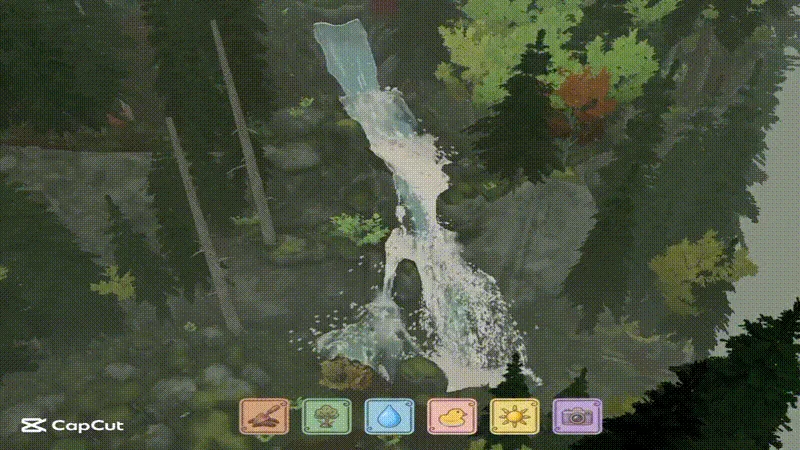
Water is the defining system. Mogmek has described the project as using a bounded PB-MPM simulation with aerated foam sharing a velocity grid, establishing that the visible waterfalls come from an actual simulation approach rather than a completely fixed animation. At a general level, particle and grid methods provide ways to represent and calculate the motion of materials, while rendering turns the result into something the player can understand visually. The public material does not justify treating Waterfalls Dream as an engineering tool or claiming that it predicts real rivers or floods accurately. Its goal is believable, responsive water behavior within a stylized creative environment.
For players, the important measure is cause and effect. Moving an obstacle, reshaping a slope, or changing the path of a stream should produce an understandable change in the flow. That relationship turns the simulation into something that can be learned through observation rather than merely admired. The bounded nature of the demonstrated system also matters because it operates within a defined simulation area rather than establishing an unlimited world. Early technical boundaries should not automatically be treated as permanent specifications for the final release.
Real-time editing strengthens this design by connecting sculpting and observation directly. Mogmek has shown environments that can be adjusted while the water remains active, allowing players to see the result of a change immediately rather than stopping the simulation, rebuilding the scene, and waiting for a separate calculation. A large rock placed beneath a waterfall might redirect the flow, divide it, hide part of the cascade, or create a stronger foreground element. The exact behavior depends on the final implementation, but the design principle is that one edit can change both the physics and the composition at the same time.
This immediacy gives players two reasons to continue adjusting a scene. One is curiosity about how the simulated water reacts, while the other is the visual desire to improve the composition. The finished experience will depend heavily on how clearly the tools communicate that connection. Even a technically accurate simulation could become frustrating if players cannot understand why a particular edit produced an unexpected result. Readable controls, consistent responses, and forgiving editing are therefore as important to the cozy experience as technical sophistication.
Terrain itself is described as voxel-based and editable in real time, with systems that help shape the resulting landscape. Voxels organize information within a three-dimensional volume, but their use does not require the finished terrain to look like visible cubes. Smooth or stylized surfaces can be generated from volumetric data, making the approach suitable for irregular cliffs, slopes, channels, and rounded natural forms. For a waterfall builder, the practical value is the ability to change the underlying landscape while remaining focused on the scene rather than requiring professional 3D modeling skills.
The balance between assistance and control will be especially important. Automatic shaping can help simple edits produce coherent terrain, but players still need enough influence over the final silhouette to achieve the composition they intend. Natural environments rarely consist of evenly repeated steps or perfectly symmetrical forms, so comfortable tools for creating uneven slopes, narrow passages, irregular edges, and rounded masses can make the environment feel more organic. The most useful sculpting system would make attractive basic results easy while still leaving room for deliberate refinement.
Procedural scenery supports the same goal. Mogmek has stated that the displayed environment is procedurally generated and has discussed combining the simulation with procedural environmental elements. Procedural generation uses rules to create variation, which can help prevent nature scenes from looking overly repetitive. Trees with different heights, orientations, and spacing can create a more convincing visual rhythm than identical objects placed at regular intervals. However, procedural variety does not replace composition because excessive foliage can obscure the waterfall or compete with the main focal point.
Water naturally provides that focal point through motion and brightness, while surrounding terrain and vegetation can frame it. Establishing the primary visual element before adding detail is a general composition principle rather than a confirmed in-game objective, but it fits the project’s creative premise. Procedural assistance is most useful when it reduces repetitive placement while preserving the player’s ability to decide where attention should be directed. The system’s value therefore depends less on generating the maximum amount of scenery than on supporting intentional arrangements.
Mogmek has also demonstrated atmospheric effects including wind, rain, and camera focus, introduced in an October 6 update as ways to make the environment feel more alive. Weather can change the mood of a composition without requiring the underlying terrain to be rebuilt. Moving vegetation can make a waterfall feel exposed or energetic, while rain can give the same scene a more enclosed or contemplative atmosphere. These demonstrations confirm environmental effects but do not establish a complete hydrological system in which rainfall fills every pool, causes erosion, or simulates an entire watershed.
Wind should be interpreted with the same caution. Seeing wind affect a development scene confirms an atmospheric feature but not every object or material that will respond to it in the finished game. Strong effects can add drama, while more restrained movement may better preserve visual clarity. For a game built partly around quiet observation, weather and presentation may become important creative choices rather than merely background decoration.
Rubber ducks provide a more playful demonstration of the simulation. Mogmek has explicitly described water interacting with rocks, trees, walls, and ducks, making those objects part of the physical behavior rather than purely static decoration. A floating object can also make subtle currents easier to read by giving players something familiar to track through the flow. The ducks therefore serve both a visual and technical purpose, communicating how the water moves while reinforcing the project’s relaxed tone.
Broader technical demonstrations have included interactions involving rigid and elastic bodies, cloth, sand, and water. These experiments show the range of Mogmek’s underlying physics work, but they should not be converted into a promise that every simulated material will receive a polished building tool in the final game. Supporting a behavior technically and exposing it as an accessible commercial feature require different levels of interface design, explanation, and testing. The rubber ducks are significant because they demonstrate that playful experimentation is already part of the project’s identity without requiring assumptions about every experimental system eventually becoming player-facing content.

Godot Development, Performance Targets, Hardware Requirements, and Open-Source Simulation Plans
Waterfalls Dream is being developed in Godot, with Mogmek also confirming development work on a Mac. That provides the basis for describing it as a Godot waterfall builder, but the engine name alone does not explain the distinctive water behavior. The simulation is the result of implementation choices made by the developer rather than a standard effect that automatically appears in any Godot project. Building the game requires integrating the simulation with terrain editing, rendering, interaction, user controls, and the rest of the creative environment.
Godot’s documentation provides useful background for understanding how demanding calculations can be handled. Compute shaders can move suitable general-purpose calculations onto the GPU, giving developers a way to perform workloads that would otherwise be expensive on the CPU. That helps explain how an engine such as Godot can support advanced simulation experiments. It does not reveal the complete Waterfalls Dream architecture, however, and the reviewed public material is not detailed enough to document every part of the project’s rendering or simulation pipeline.
Mogmek has also expressed an intention to release the water simulation as open source after further development. That statement concerns the simulation technology and remains a future intention rather than an already completed release. It should not be expanded into a claim that Waterfalls Dream itself, its artwork, or all of its development tools will be open source. Until the planned release occurs, the exact contents, license, and timing of that code remain to be seen.
Performance has featured prominently in development demonstrations, with Mogmek reporting smooth behavior in specific test scenes and expressing a goal of reaching ordinary desktop graphics hardware. These are encouraging signs but not substitutes for final benchmarks. Simulation performance can change according to scene size, number of active particles, interacting objects, rendering settings, output resolution, and the complexity of player-created arrangements. A compact demonstration designed by the developer may place a very different workload on the hardware from a densely populated scene created by a player.
For that reason, the absence of finalized system requirements remains important. Reliable launch specifications would eventually need to identify supported operating system versions, graphics hardware, memory, and any required graphics capabilities. Until those details are published and tested more broadly, identifying a specific budget GPU as sufficient would be speculative. The same applies to assumptions based on visual simplicity because stylized graphics do not necessarily mean the underlying simulation is inexpensive to compute.
Steam Deck compatibility requires particular caution. Mogmek expressed doubt in an October discussion that the handheld would be suitable hardware for the project. The appearance of Linux in newer Steam database information therefore should not be interpreted as confirmation of Steam Deck support, verification, or acceptable performance. Linux compatibility and Steam Deck compatibility are separate questions because the handheld has its own performance limits and validation requirements.
The most reasonable expectation is that optimization remains part of active development. The developer’s existing demonstrations show promising technical progress, but final performance will be better judged through broader playtesting and published system requirements closer to release. A simulation-heavy creative tool needs to remain responsive under the kinds of scenes ordinary players actually build, not just the carefully controlled examples shown during development. That makes future testing across a wider variety of hardware and creations particularly significant.
The technical work ultimately matters because of how it supports the creative experience. Players do not need to understand PB-MPM, voxel structures, GPU compute, or the engine’s internal architecture to enjoy moving a rock and seeing a waterfall react immediately. The most successful implementation would hide much of that complexity behind intuitive editing and predictable responses. In that sense, the technical achievement is valuable primarily when it makes experimentation feel effortless rather than drawing attention to the machinery underneath.
How Waterfalls Dream Compares with Tiny Glade and Why Its Relaxing Water-Focused Sandbox Stands Out
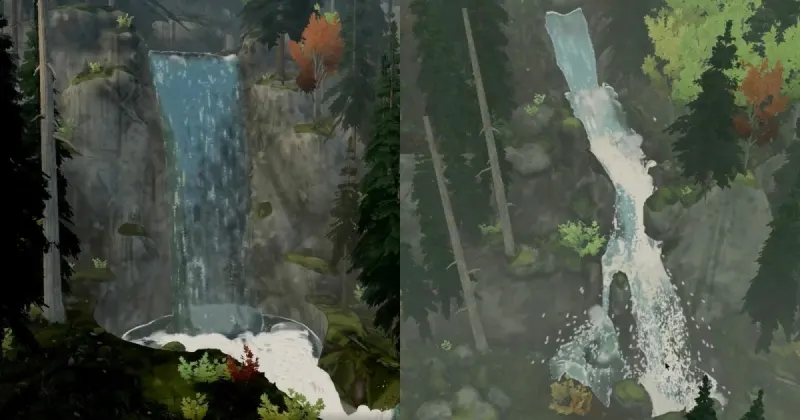
Tiny Glade provides a useful reference point for understanding Waterfalls Dream because Mogmek has explicitly mentioned it when discussing the project’s intended direction. Tiny Glade’s released Steam description centers on creating attractive architectural scenes without management pressure or combat, demonstrating how a small-scale construction game can provide satisfying creativity without conventional objectives. Waterfalls Dream appears to pursue a similarly relaxed design philosophy while shifting the primary creative material from architecture toward terrain, water, and dynamic natural scenery. The comparison is therefore most useful as a description of intent rather than a claim that the two games offer identical systems.
The major difference lies in what the player shapes and observes. Architecture creates compositions through walls, roofs, doors, openings, and silhouettes that are largely static once placed. Water adds a temporal dimension because the scene changes through movement. The player is not only deciding where a waterfall belongs but also how it falls, divides, flows around obstacles, reaches pools, and draws attention across the composition. That can make a small alteration feel significant even when the overall diorama remains compact.
This movement supports the project’s balance between relaxation and experimentation. A finished scene can be enjoyable simply to watch, yet the active simulation continually invites another small adjustment. A rock can operate simultaneously as decoration and an obstacle affecting the flow, while a cliff can provide both a visual landmark and the physical drop that produces the waterfall. Rain, wind, vegetation, floating objects, and camera presentation can then change how the same basic arrangement feels without requiring a conventional progression system.
Different players can also pursue different visual priorities without those choices becoming difficulty settings. Someone interested in calm scenery may build shallow slopes, restrained vegetation, and a gentle stream. Another player may prefer steep terrain, turbulent cascades, pronounced weather, and playful interactions with floating objects. Neither composition has to be objectively better because the sandbox is designed around expression rather than a prescribed solution. This flexibility is central to the cozy premise.
It is too early to compare Waterfalls Dream and Tiny Glade in terms of depth, value, polish, or tool quality. Tiny Glade is already a released product, while Waterfalls Dream remains in development with a Q3 2027 target and unfinished hardware requirements. The current demonstrations show a promising direction rather than a complete feature set. Any direct verdict about which game offers better construction tools or more content would therefore go beyond the evidence presently available.
What Waterfalls Dream potentially adds to the relaxing builder space is a stronger focus on systems that remain visually active after construction. A traditional diorama can reward composition through shape, lighting, and arrangement, while Waterfalls Dream adds changing flow and environmental movement to those qualities. That makes observation part of the creative loop because players can watch the simulation, notice something they want to alter, and immediately return to editing. The result is a concept in which building and appreciating the finished scene are closely connected.
The project’s future will depend on whether Mogmek can preserve that approachable feeling as the technical systems become more complete. Responsive water, voxel terrain, procedural scenery, weather, interactive objects, and real-time editing create considerable complexity beneath the surface. If those systems remain understandable and forgiving, they can support the calm experimentation that defines the concept. Waterfalls Dream’s appeal is therefore not merely that it simulates water, but that it aims to turn that simulation into an accessible creative material for players who want to shape, observe, and repeatedly refine small natural worlds.

Frequently Asked Questions (FAQs)
- What kind of game is Waterfalls Dream?
Waterfalls Dream is an upcoming creative nature diorama builder centered on shaping landscapes and watching simulated water respond to those changes. Its current direction emphasizes relaxation, experimentation, and personal expression rather than combat, resource management, or fixed victory conditions. Players can alter terrain and arrange environmental elements to influence how water moves through a scene. The appeal comes from repeatedly adjusting the landscape, observing the result, and refining the composition until it looks and behaves the way the player wants. The project is therefore best understood as a cozy creative sandbox where the water simulation is both a visual feature and part of the building process. - Who is developing Waterfalls Dream?
The developer publicly uses the name Mogmek or MogMek and has documented the project through development posts and demonstrations. Updates have appeared through social accounts, including Reddit posts under the name KingCakeTheFruity. Steam database information also identifies MogMek as both the developer and publisher of Waterfalls Dream. The available material establishes that public development identity but does not provide enough evidence to make broader claims about team size, professional background, or previous commercial projects. Most of what is currently known comes from the developer’s own technical demonstrations and progress updates. - When is Waterfalls Dream coming out?
As of October 16, 2026, Steam database information lists a Q3 2027 release window. Q3 covers July through September 2027, but no specific launch day has been announced in the reviewed material. Because the game is still actively being developed, that window should be treated as a current target rather than an unchangeable release commitment. Playtesting, optimization, feature work, or other development needs could still affect the schedule. The most reliable date will be the one eventually confirmed by Mogmek through the current Steam page or an official release announcement. - Will Waterfalls Dream support Windows, Mac and Linux?
Current Steam database information lists Windows, macOS, and Linux as planned desktop platforms. Earlier developer comments were more definite about Windows and Mac while describing Linux support as conditional at that stage, so the newer listing represents an expanded platform plan. A platform listing does not guarantee that every computer running those operating systems will meet the final technical requirements. Graphics hardware, operating system versions, memory, and other specifications will still determine practical compatibility. Players should therefore check the final Steam requirements closer to release rather than relying only on the operating system icons. - How can players get into the playtest?
Mogmek has invited interested players to join the project’s mailing list for information about early testing. An October development post specifically encouraged people interested in becoming playtesters to subscribe, while a later update described the first playtest as upcoming. Joining the mailing list should be treated as registering interest rather than receiving guaranteed access. The developer has not established that every subscriber will be invited or that the test will be an unrestricted public download. Actual access, timing, and any selection process will depend on the instructions issued for each testing round. - Does the water respond to objects?
Yes. Mogmek has demonstrated and described water interacting with environmental elements and objects, including rocks, walls, trees, and rubber ducks. These interactions are important because they make placed objects part of the simulation rather than purely decorative scenery. Moving or adding an obstacle can potentially alter how water flows, divides, or collects within the scene. Floating objects such as rubber ducks can also make currents easier to see because players can watch how they move through the water. This responsiveness is central to the game’s identity as a creative waterfall builder rather than a tool for placing fixed animated effects. - Can the terrain be edited while water is flowing?
Yes. Real-time terrain editing has been demonstrated as one of the project’s defining features. Players can modify the landscape while the water simulation remains active, allowing them to see the consequences of an edit without repeatedly stopping and restarting the scene. This supports a direct creative loop in which a player changes a slope, cliff, or obstruction and immediately observes how the flow responds. The approach makes experimentation more natural because visual design and simulation behavior can be adjusted together. However, the final range of sculpting tools, brushes, controls, and editing options has not yet been fully documented. - Does the game include rain and wind?
Yes. Mogmek showed wind and rain in an October development update as part of the evolving atmospheric presentation. These effects can make vegetation and the overall scene feel more active and can change the mood of a completed diorama without requiring the landscape itself to be rebuilt. Their appearance confirms environmental presentation features, but it does not establish a complete weather simulation system. There is currently no basis for assuming mechanics such as erosion, seasons, rainfall filling every pool, or weather-driven flooding. Those features would require separate demonstrations or announcements. - Is Waterfalls Dream confirmed for Steam Deck?
No. The available sources do not establish Steam Deck verification or confirmed support. Mogmek has previously expressed doubt about whether the handheld’s hardware would be suitable for the game’s simulation workload. A planned Linux version does not automatically mean Steam Deck compatibility because desktop Linux support and performance on Valve’s handheld are separate questions. Simulation complexity, graphics requirements, and optimization will all influence whether the game can run acceptably on that hardware. Players interested specifically in Steam Deck should therefore wait for explicit compatibility information or testing closer to release. - Is Waterfalls Dream an open source game?
No. Mogmek has discussed an intention to release the water simulation as open source after further development, but that is different from making the complete commercial game open source. The game’s art, interface, terrain tools, procedural systems, and other assets or code are not established as part of that planned release. The statement should also be treated as a future intention until the code is actually published. Once that happens, the scope and license will determine exactly what other developers are allowed to inspect, modify, or reuse.

Conclusion
Waterfalls Dream stands out by making simulated water part of the creative process rather than simple decoration. Terrain, scenery, and interactive objects shape both the appearance of each diorama and how its waterfalls move, giving players a reason to keep experimenting with otherwise peaceful scenes.
The project remains in development, so final tool depth, performance requirements, compatibility, and release timing still need confirmation. Its potential lies in combining a relaxing builder with responsive physics, creating a sandbox where players can enjoy the finished landscape while continuing to refine how it behaves.
Sources and Citations
- Mogmek, “I bet you’d love to build your own cozy waterfalls with realistic behavior!” This development post is a primary source for Waterfalls Dream’s core concept: a cozy nature-building game centered on realistic water behavior, terrain manipulation, interactive scenery, procedural elements, and the developer’s evolving platform plans.
Reddit development post - Mogmek, “A rainy day nearby your own waterfall,” October 6, 2026: Mogmek confirms that Waterfalls Dream uses real-time 3D water physics and terrain sculpting, while demonstrating camera focus, wind, rain, and a software cursor. The developer also says the Steam page and first playtest were approaching and directs interested players to a mailing list. In the comments, Mogmek explains that rain uses GPU-colliding particles and discusses the scene’s vegetation and atmospheric effects. Reddit
Reddit weather update - Mogmek, “I promised you waterfalls,” September 5, 2026: This post documents an earlier Waterfalls Dream prototype built around a simulated 3D voxel world, water physics, live editing, and procedural generation. Mogmek says the simulation was then bounded to roughly 400 × 400 × 400 voxels and explains that final scale would depend partly on GPU capability. The developer also explicitly describes the concept as something like Tiny Glade but with a major emphasis on water, waterfalls, and rivers. Reddit
Reddit simulation update - Mogmek, “Ultimate particle-based simulation physics in Godot,” September 29, 2026: Mogmek demonstrates a broader physics system supporting rigid and elastic bodies, cloth, sand, springs, and water with two-way interaction. The developer reports a test involving around 100 ducks, a waterfall, procedural vegetation, and approximately 60 fps on a Mac M5 Pro with 24 GB memory. Mogmek also states an intention to open-source the water portion of the simulation after further development, making this the strongest source for the article’s open-source claim. Reddit
Reddit physics update - Mogmek, “Would you play a game about building cozy waterfalls with realistic physics?”, August 22, 2026: This early concept post shows that the project began as an experiment with particle-based water designed to run without overwhelming an average GPU. Mogmek discusses sculpting waterfalls and riverbeds and explicitly cites Tiny Glade as an inspiration for the intended cozy building direction. The developer also acknowledges at this stage that the prototype was still far from production-ready. Reddit
Reddit concept discussion - SteamDB, Waterfalls Dream: SteamDB identifies MogMek as both developer and publisher, records app ID 5346690, and lists the game for Windows, macOS, and Linux. It currently records a Q3 2027 release window and describes the game as an expressive diorama builder with realistic water behavior, procedural helpers, relaxing sandbox play, and no mandatory objective. Because SteamDB notes that it has only partial information for the application, these details should still be treated as current database records rather than an immutable final specification. SteamDB
Waterfalls Dream on SteamDB - Godot Engine Documentation, “Using compute shaders”: Godot’s official documentation explains that compute shaders are general-purpose GPU programs useful for offloading heavy calculations from the CPU to the GPU. It also documents their use through Godot’s RenderingDevice system and notes that compute shader support depends on the renderer and underlying hardware. This is appropriate technical background for explaining how advanced simulation workloads can be handled in Godot, but it does not independently describe Waterfalls Dream’s exact implementation. Godot Engine documentation
Godot compute shader documentation - Pounce Light, Tiny Glade: The official Steam page describes Tiny Glade as a relaxing, free-form diorama builder with procedural details, no management pressure, no combat, and no fixed goals. That makes it a suitable comparison for Waterfalls Dream’s stated creative direction, although the two games focus on different primary materials and systems. Tiny Glade centers on architecture and procedural building interactions, while Waterfalls Dream emphasizes terrain and simulated water. Steam Store
Tiny Glade on Steam - 80 Level, October 13, 2026, “This Game Allows You to Create Your Own Stylized Waterfalls with Realistic Behavior”: 80 Level reports that Waterfalls Dream is a relaxing builder featuring real-time editable voxel terrain, with players able to add rocks, trees, additional water, and rubber ducks. It also covers camera controls, aperture and color adjustments, filters, slow motion, procedural generation, rigid and elastic bodies, cloth, sand, and the developer’s stated Windows and Mac plans at that time, with Linux still described as a possibility. The report also quotes Mogmek describing the goal as allowing players to recreate memorable natural scenes and water effects. 80 Level
80 Level project coverage
Recommendations
- Vivian Kubrick Debunks Eyes Wide Shut Deleted Scenes Theory
- Battlefield 6 2026 Roadmap: More Maps, “Legendary” Battlefield 4 & Battlefield 3 Remakes, and Wake Island’s Return
- Apple TV’s Widow’s Bay is the First Breakout TV Hit of 2026: Why Everyone is Talking About the Horror Comedy
- Pitchify Launches New Service to Connect Developers and Publishers: How Pitch Direct Works
- Pokémon Pokopia Bubbly Basin DLC Release: Date, New Pokémon, and Everything You Need to Know
- Nordic Game 2026 (NG26 Spring): Dates, Venue, Passes, Speakers, Expo & Awards in Malmö
- Subnautica 2 Early Access Roadmap: Co-Op Updates, Sprinting, and More
- Virtua Fighter 6 Leak Explained
- The Future of 3D Modeling: Insights on AI Advancements
- GTA 6 is Already Outselling Everything Else: Why Pre-Orders Are Dominating Gaming



































































































