






In This Article (7 sections)
What the World Humanoid Robot Games in Beijing Reveal About Robot Performance
The World Humanoid Robot Games in Beijing produced a striking contrast between robots delivering extraordinary athletic performances and still exposing the difficulties of operating reliably in the physical world. The headline achievement was Tiangong Ultra’s 8.64 second 100 meter final on August 26, 2026, while the less glamorous moments included falls, collisions and machines requiring human assistance. Together, those images offered a more revealing picture than either celebration or ridicule alone.
The central question is not simply whether a robot at the World Humanoid Robot Games can run fast, throw a punch or perform an entertaining dance, but whether the machine can complete a task repeatedly, recover when something goes wrong and operate safely beyond a carefully prepared competition setting. That distinction provides one of the most useful ways to understand the Beijing Games and their viral highlights.
The World Humanoid Robot Games are an international competition that uses sporting events and practical tasks to evaluate humanoid robots. The inaugural edition opened in Beijing on August 14, 2025, with competitions taking place from August 15 to 17. Its program combined recognizable sports with activities such as moving materials, sorting medicines and cleaning. Organizers presented these challenges as a way to test technology intended eventually for workplaces and homes.
The sporting format of the World Humanoid Robot Games makes engineering performance easier to observe because a race measures how quickly a machine completes a course, while a manipulation challenge tests whether it can handle objects successfully. However, these results answer different questions. Winning a sprint establishes a particular locomotion achievement rather than proving competence across every activity that might require legs, arms or artificial intelligence.
A useful comparison comes from structured robotics testing. The United States National Institute of Standards and Technology, or NIST, describes competitions as opportunities to compare emerging capabilities and improve testing methods. Its approach emphasizes measurable performance rather than treating an impressive demonstration as proof of a universally capable robot. That principle helps explain both the value and the limitations of Beijing’s event. Fast race times, successful practical tasks and other standout performances at the World Humanoid Robot Games demonstrate meaningful progress, while falls, collisions and the need for human intervention show that reliability, recovery and safe operation remain equally important measures of how capable these machines are outside controlled competition settings.

World Humanoid Robot Games 2026 Venues, Events, Records and Viral Highlights
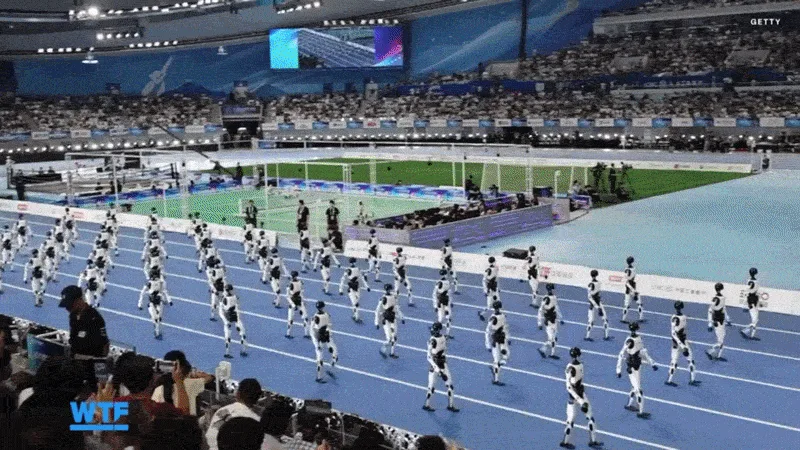
The main World Humanoid Robot Games 2026 program ran from August 22 to August 26 at Beijing’s National Speed Skating Oval, also known as the Ice Ribbon. The finalized schedule included 51 events and 1,301 competition sessions, with Beijing’s official breakdown listing 30 competitive events and 21 scenario-based events. One event could contain several rounds, divisions or scheduled contests, so the event and session totals represent different measurements.
Some practical competitions at the World Humanoid Robot Games took place before the main arena program and at separate locations, including hotel and household tasks at the Beijing Continental Grand Hotel and the Habit@ smart apartment. An emergency response competition was also reported at a fire brigade on August 16. These additional venues explain why genuine competition coverage appeared before the August 22 opening and why performances need to be judged in context: running on a marked track presents different challenges from navigating a hotel room or operating in an emergency exercise.
Participation expanded considerably from the inaugural edition. The 2026 World Humanoid Robot Games attracted 666 registered teams and 2,056 robots from 16 countries, compared with 280 teams from 16 countries the previous year. Anadolu reported that 641 registered teams were Chinese, while participating countries also included the United States, Germany, Japan and Brazil. These figures should not be treated as interchangeable categories. A team is a competition entry, a robot is an individual machine, and a manufacturer supplies a hardware platform. The World Humanoid Robot Games therefore did not feature 666 manufacturers or 2,056 independently developed robot designs.
The visible hardware field at the World Humanoid Robot Games included Tiangong, Honor and Unitree platforms, while Xinhua documented AgiBot-associated teams and High Torque robots. Results could involve several layers of contribution, as illustrated by the partnership between Shanghai University of Sport and AgiBot. A university or specialist team may use hardware developed by a manufacturer while contributing its own software, control systems or event-specific configuration. National participation, robot origin and software development consequently measure different things, and international team totals should not be interpreted as a direct indicator of manufacturing market share.
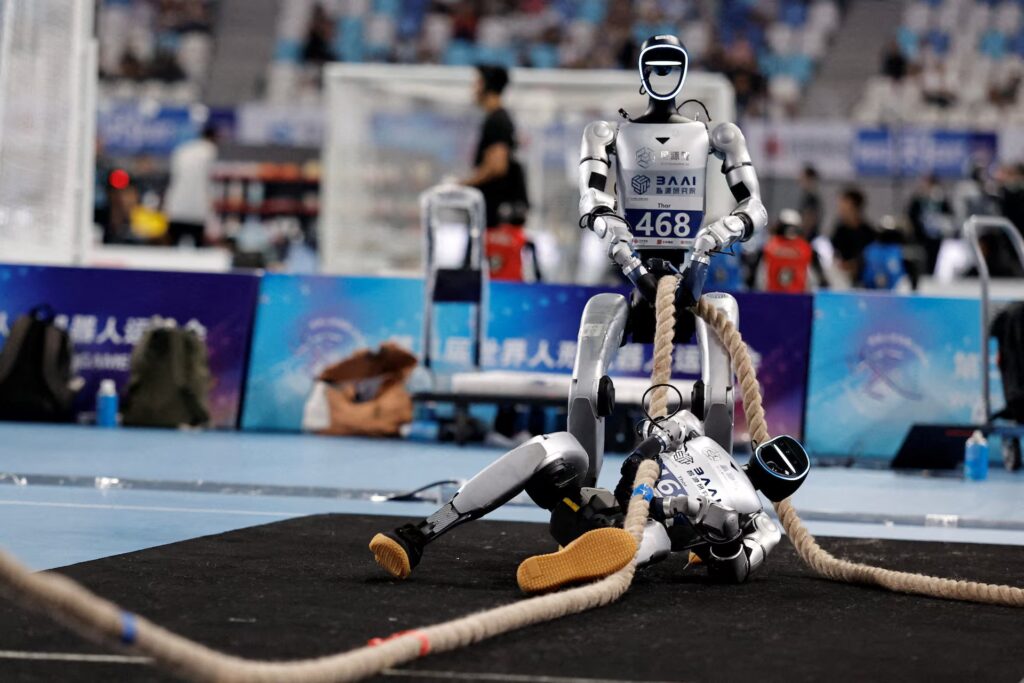
The competitive program at the World Humanoid Robot Games covered running, obstacle racing, standing long jump, gymnastics, martial arts, freestyle fighting and dancesport, while weightlifting was newly added with lightweight and heavyweight titles. Football, table tennis and tug of war broadened the schedule further, with Huawei highlighting table tennis among the additions. Jinan’s official reporting documented a lightweight tug of war victory by the Xingzhe Taishan team using Yobotics robots.
That event emphasized traction, balance and controlled force rather than speed, with the reported format placing two robots against two robots and giving teams two minutes to pull the marker across the required boundary. Football at the World Humanoid Robot Games instead introduced coordination, perception and group movement, and its opening-night seven-a-side exhibition was separate from the five-a-side final. These different formats help explain why a single overall robot ranking would be of limited value: a machine optimized for sprinting may not be the strongest platform for manipulation, coordinated football or judged performance.
Performance requirements at the World Humanoid Robot Games became more demanding as the competition expanded. Scheduled sessions increased from 487 in the inaugural edition to 1,301 in 2026, while the official 100-meter completion limit was reduced from three minutes to one minute. Longer races also received tighter limits. Beijing’s closing account reported a winning 1,500-meter time of 2 minutes 21.64 seconds, compared with 6 minutes 34.40 seconds at the previous Games. These changes show that expectations for baseline robot performance were rising alongside the number of participating teams and machines.
Tiangong Ultra delivered one of the clearest measurable improvements at the World Humanoid Robot Games. It recorded 9.39 seconds in the preliminary round, improved to 8.86 seconds in the semifinal and completed the August 26 final in 8.64 seconds. Reuters reported that Tiangong had won the inaugural event’s 100 meters in 21.50 seconds, demonstrating a substantial reduction in elapsed time. Beijing’s closing report identified the Tianjiao team as the winner of the large-size 100-meter category with the 8.64-second result, while the separate small-size category was won in 11.98 seconds.
For comparison, Usain Bolt’s recognized men’s 100-meter world record is 9.58 seconds, set in Berlin on August 16, 2009. Tiangong Ultra’s reported time at the World Humanoid Robot Games was 0.94 seconds shorter, meaning it completed the distance in approximately 9.8 percent less elapsed time.
Dividing 100 meters by 8.64 seconds produces an average speed of about 11.57 meters per second, or 41.67 kilometers per hour. That calculation represents average speed across the reported distance, not a measured peak speed. The result also does not replace Bolt’s record because the performances belong to fundamentally different competitions. The relevant comparison is that a humanoid robot covered the same distance in less elapsed time, not that a robotics result invalidated a human athletics record.
Racing also produced some of the World Humanoid Robot Games’ most widely shared incidents. Reuters photographs from August 22 showed a humanoid robot burning after a large-size 100-meter preliminary race, with staff and a firefighter extinguishing the flames. A separate Reuters report documented Tiangong Ultra’s August 25 semifinal incident. After finishing in 8.86 seconds, the robot struck a thick stopping mat beyond the finish line, collapsed and developed a small fire in its torso.
The opening-day fire, Tiangong Ultra’s semifinal crash and its 8.64-second final the following day should therefore remain separate events. The reports document fire and impact at the World Humanoid Robot Games without establishing a specific component-level cause. They do not provide a forensic finding identifying a failed battery cell, wire, motor or protection system, so describing either incident as a confirmed battery explosion would go beyond the evidence.
Other viral footage focused on movements compared with Fortnite emotes. Kotaku’s August 24 coverage described robot boxing celebrations in those terms because some actions resembled victory animations from video games. That resemblance does not establish an official Fortnite collaboration, a software connection or proof that a robot independently recognized victory and chose to taunt an opponent. Organized dancing was also an official part of the World Humanoid Robot Games, with street dance, ballroom dance and cheerleading included in the program. The 2026 edition featured 108 participating dancesport teams, compared with 29 in the inaugural edition, making it important to distinguish judged dance performances from brief celebratory clips circulating online.
Combat events at the World Humanoid Robot Games created similarly accessible highlights because viewers could immediately see whether a robot landed a strike, missed, lost balance or remained upright. Reuters documented Unitree robots competing in the 80-kilogram kickboxing quarterfinals on August 23, while Xinhua’s August 25 photographs covered a separate 58-kilogram quarterfinal between a joint Shanghai University of Sport and AgiBot team and a Shenzhen AgiBot team. Retaining the dates, weight classes and team information prevents visually similar footage from being mistaken for the same match. These events also demonstrated a broader challenge than producing a powerful punch in isolation: a competing robot had to coordinate movement, respond to contact and engage a moving opponent without losing balance.
World Humanoid Robot Games Robot Autonomy, Safety Challenges and Practical Performance
Humanoid robots operate under physical constraints that become particularly visible during running, boxing and other fast competition events at the World Humanoid Robot Games. A controller must account for how the feet contact the ground, how much friction is available and how the machine’s momentum is changing while coordinating foot placement, body position and corrective forces.
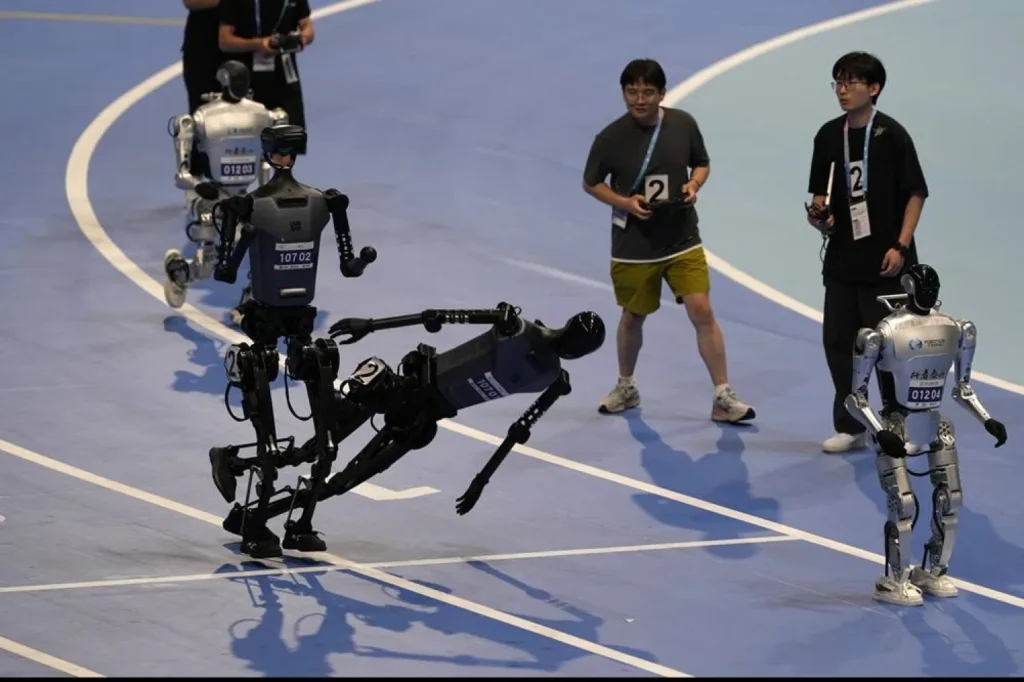
Balance therefore involves more than keeping the torso upright. Running adds another difficulty because a position that appears stable at one moment does not guarantee that the next step can be recovered safely. The robot must consider its movement, possible landing positions and remaining corrective forces, which helps explain how a machine can run convincingly before suddenly losing balance when its recovery options become too limited.
The crash pads used during sprinting at the World Humanoid Robot Games addressed a more specific problem: fast robots reaching the finish with limited space to decelerate. In a September 10 Reuters interview, Tiangong Ultra’s developer described braking as a major challenge. The robot weighed 75 kilograms, and a crash mat was positioned beyond the short stopping area. Crossing the finish line quickly and stopping under control are different objectives. Racing rewards maintaining speed through a fixed point, while deceleration requires reducing momentum without losing a manageable posture or foot-contact sequence. The same balance and friction limits that shape running performance also determine how much braking force can be applied safely.
The physics becomes increasingly demanding as speed rises. At the same mass, doubling speed quadruples kinetic energy, leaving a faster robot with disproportionately more energy to dissipate when stopping. Padding can extend the distance and time over which that energy is absorbed, but it cannot guarantee that the machine will remain upright or avoid damage. Maximum speed alone consequently does not describe a complete locomotion capability. Acceleration, lane control, finish-line behavior, recovery and controlled deceleration all matter when assessing whether a performance at the World Humanoid Robot Games can translate from a competition track to practical use.
Transferring movement from simulation to physical hardware creates another challenge. The ASAP research project demonstrated an approach that adapts human movement data to a humanoid body, trains motion tracking in simulation and uses real-world data to reduce differences between simulated and physical behavior. This provides useful background for understanding how expressive or agile movements can be created, but it does not establish that the Beijing robots at the World Humanoid Robot Games used ASAP.
Its researchers identify differences between simulated and real-world dynamics as an obstacle, meaning a controller that performs convincingly in a virtual environment may still require adaptation before behaving consistently on an actual machine. Competition footage from the World Humanoid Robot Games rarely reveals the full control history or hardware condition, so these principles should not be treated as diagnoses of every fall. Calling every incident an artificial intelligence failure would be as misleading as dismissing every one as harmless.
Robot boxing at the World Humanoid Robot Games illustrates why reproducing a movement and using it effectively are separate achievements. A machine must coordinate locomotion and upper-body actions while responding to contact and an opponent’s changing position. The RoboStriker research paper approaches this through a hierarchical autonomous boxing system, with higher-level decisions controlling fighting behavior and lower-level systems managing physical execution. It offers relevant technical background rather than evidence that RoboStriker powered a particular Beijing competitor. A powerful isolated punch demonstrates one ability, while landing that punch against a moving opponent without falling requires a much broader combination of capabilities.
The World Humanoid Robot Games did not use one universal control system, so describing every competitor as either autonomous or remotely controlled would be inaccurate. Requirements varied by event, and the official preview indicated that autonomy standards had become stricter. Hotel and household challenges provided a clear example: Global Times reported that fully autonomous performance received a weighting of 1, while teleoperated performance received 0.5. Human intervention during a run could cause the entire attempt to be classified as remotely controlled. Understanding robot independence therefore requires separating functions such as choosing a task, deciding what action to take, planning a route and stabilizing individual movements. Automation in one area does not prove that the complete activity is autonomous.
Teleoperation also does not necessarily mean a person manually controls every motor. Systems such as TWIST demonstrate how human movement can provide real-time target information while a learned controller manages balance and translates those targets into coordinated robot motion. A teleoperated machine can therefore use sophisticated autonomous control at the movement level without being autonomous at the overall task level. Connectivity introduces a further distinction. Huawei and China Unicom described communications infrastructure supporting telemetry, control signaling and coordination at the World Humanoid Robot Games, but a connected robot is not automatically being driven by a person. Communication links can support several architectures, including machine-generated coordination and information sharing.
These distinctions became especially important in the factory, restaurant, hotel and emergency response challenges at the World Humanoid Robot Games. Reuters’ August 23 reporting highlighted the contrast between spectacular athletic results and difficulties with comparatively ordinary tasks such as connecting cables. Moving quickly or powerfully does not establish an ability to manipulate objects accurately. Reaching a connector is only part of the task because the robot must position it correctly and complete the intended operation. Practical events consequently tested whether machines could combine perception, movement and manipulation to reach a required final state rather than merely demonstrate an impressive isolated action.
Restaurant challenges required sequences of actions rather than single movements. Xinhua described a robot at the World Humanoid Robot Games using tongs to pick up a snack, placing it inside a microwave, operating the appliance and then proceeding to another order. Hotel tasks included delivering luggage to assigned rooms, replenishing towels and water, and handling bedding, requiring interaction with objects and room layouts rather than travel along an unobstructed route.
Other practical competitions at the World Humanoid Robot Games included a charging service challenge in which robots had to handle charging connectors for three vehicles within 30 minutes. Beijing’s closing report also described general service robots arranging nameplates, printing documents and shredding paper. Together, these activities tested perception, manipulation, sequencing and recovery from small errors across a broader range of situations than athletics alone.
Emergency response introduced more demanding conditions. In the August 16 competition observed by Global Times, robots had to identify hazardous materials, operate different valves and extinguish a controlled fire within a 30-minute limit. Three of the 12 teams competing that day completed the entire challenge, with rain and changing outdoor lighting reported as additional difficulties. Those figures apply only to that particular group and competition day, not to the overall success rate of the World Humanoid Robot Games. The conditions also show why completing an emergency task requires more than reproducing movements demonstrated in a predictable indoor environment.
Success in a controlled competition does not establish readiness for unrestricted real-world deployment. NIST’s approach to emergency robot evaluation emphasizes repeated testing across relevant capabilities and environmental conditions. Completing a defined firefighting or service challenge at the World Humanoid Robot Games provides evidence about that task, not automatic proof that the robot can perform the same work safely and reliably without supervision in an uncontrolled setting.
This distinction captures both sides of the progress between the 2025 and 2026 World Humanoid Robot Games. The second edition delivered major improvements in measured athletic performance, broader participation, more competition sessions and stricter minimum requirements, while practical challenges continued to expose limitations in reliability, manipulation and adaptation. Some humanoid capabilities advanced dramatically, but consistent performance across varied real-world tasks remained a more demanding standard.
Frequently Asked Questions[FAQs]
- Do the Games prove humanoid robots are ready for every workplace?
No. The Games demonstrate what particular robots can achieve under defined competition conditions, but a successful demonstration does not automatically prove readiness for widespread workplace deployment. Real world use also depends on whether robots can repeat tasks reliably, recover from mistakes, operate safely around people and continue performing effectively in less controlled environments. - When and where were the World Humanoid Robot Games 2026 held?
The main World Humanoid Robot Games 2026 program ran from August 22 to August 26, 2026, at Beijing’s National Speed Skating Oval, commonly known as the Ice Ribbon. This was the primary venue for the major competitions, although some practical challenges connected to the Games were held earlier at other locations designed to better represent real service and workplace environments. - How many robots and teams participated in the 2026 Games?
The announced registration figures included 2,056 robots representing 666 teams from 16 countries. The robot and team totals measure different things, since a single team could enter or work with multiple robots. The number of teams therefore should not be treated as a count of individual manufacturers or robotics companies. - Did a robot really catch fire at the Beijing Games?
Yes. Fire incidents were documented during the Games, including one involving Tiangong Ultra after its August 25 semifinal. The robot collided with the stopping area and subsequently experienced a torso fire, showing that the high speed demonstrations also exposed practical reliability and safety challenges. - Was Fortnite an official competition at the Games?
No. Fortnite was not included as an official event at the World Humanoid Robot Games. References to Fortnite were used as a media comparison rather than as part of the actual competition schedule, so it should not be confused with the sports, combat or practical challenges officially contested in Beijing. - What was Tiangong Ultra’s fastest 100-meter time at the Games?
Tiangong Ultra completed the August 26 final in 8.64 seconds, which was its fastest recorded 100 meter performance at the Games. This result should be separated from the times recorded during earlier rounds, since the robot improved through the competition before reaching its fastest performance in the final. - Did the robot replace Usain Bolt’s world record?
No. Usain Bolt’s 9.58 second performance remains the recognized men’s 100 meter athletics world record. Tiangong Ultra completing the same distance in a faster time is an engineering achievement involving a humanoid robot, but it does not compete within the human athletics record system and therefore does not replace Bolt’s record. - Why did the sprinting robots run into crash pads?
The robots were moving at high speeds while having relatively limited space to slow down after crossing the finish line. Rapid braking and maintaining balance remained difficult for the machines, so padded stopping areas helped absorb impacts and reduce damage when robots could not stop smoothly on their own. - Were all the robots fully autonomous?
No. The level of autonomy differed between events and participating robots. In hotel and household challenges, organizers explicitly separated autonomous operation from teleoperated performance, with different scoring weights depending on how much human assistance was involved. Human intervention could therefore change how a run was categorized and evaluated. - Did robots perform useful tasks as well as sports?
Yes. The Games included practical demonstrations alongside running, combat and other athletic events. Robots performed restaurant and service tasks such as handling food with tongs and operating a microwave, while other challenges explored household and workplace activities intended to test how humanoid machines could function in more realistic environments.

Conclusion
The World Humanoid Robot Games in Beijing made humanoid robotics unusually visible. Athletic records, expressive performances and practical challenges sat alongside falls and failures, creating a public demonstration of both capability and limitation. The recorded results show that the 2026 competition was substantially more than a repeat of its inaugural edition.
The correct response is to keep the claims about the World Humanoid Robot Games proportional to the evidence. A fast sprint does not establish all-purpose intelligence. A dance does not reveal how a robot interprets victory. A fire video does not identify the failed component without further investigation.
The lasting importance of the World Humanoid Robot Games will depend on whether the demonstrated skills become repeatable and useful. Faster movement attracts attention, but safe stopping, dependable manipulation and successful operation under changing conditions are the more demanding tests. Beijing’s spectacle made that distinction impossible to ignore.
Sources and Citations
- Beijing Government Portal Event Preview: Confirms the August 22–26, 2026 schedule, National Speed Skating Oval venue, 666 registered teams and 2,056 robots. Distinguishes 51 events, comprising 30 competitive and 21 scenario-based events, from the 1,301 scheduled competition sessions.
Citation: 2nd World Humanoid Robot Games: Highlights & Ticket Info - Beijing Government Portal Final Results: The August 28 report, sourced to Guangming Daily, records the 8.64-second large-group and 11.98-second small-group 100m winning times, alongside Tianzhuo Team’s 2:21.64 in the 1,500m. Also covers practical challenges involving vehicle charging, document handling, household tasks and emergency rescue.
Citation: 2nd World Humanoid Robot Games Conclude - Xinhua Inaugural Games Report: Documents the first World Humanoid Robot Games opening in Beijing in August 2025, with 280 teams from 16 countries and regions competing in 487 events across 26 disciplines. Provides historical context that should remain separate from the expanded 2026 programme.
Citation: Inaugural World Humanoid Robot Games Opens in Beijing - MIT Underactuated Robotics: Russ Tedrake’s chapter explains contact forces, center of pressure, zero-moment-point planning, center-of-mass dynamics and whole-body momentum. Provides theoretical background for humanoid balance and locomotion, while some sections, including whole-body control and push recovery, remain unfinished and refer readers to research papers.
Citation: Underactuated Robotics, Chapter 5: Highly-articulated Legged Robots - ASAP Research Paper: Tairan He and colleagues describe training humanoid motion-tracking policies in simulation, then using real-world data to compensate for differences in physical dynamics. The RSS 2025 paper includes transfer to the Unitree G1 and evaluations of agility and whole-body coordination.
Citation: ASAP: Aligning Simulation and Real-World Physics for Learning Agile Humanoid Whole-Body Skills - ASAP Official Research Project: Presents demonstrations of jumping, kicking, dancing and other coordinated movements, alongside comparisons before and after policy refinement. Explains the training and deployment process and provides access to the associated paper, video and code.
Citation: ASAP: Official Research Project and Demonstrations - TWIST Research Paper: Yanjie Ze and colleagues present whole-body humanoid teleoperation using retargeted human motion, reinforcement learning and behavior cloning. Covers coordinated locomotion, manipulation and expressive movement, supporting discussion of human-guided control rather than autonomous high-level decision-making.
Citation: TWIST: Teleoperated Whole-Body Imitation System - RoboStriker Research Paper: Kangning Yin and colleagues describe autonomous humanoid boxing through separate strategic and physical-control layers, motion-capture training and self-play. Reports simulation results and real-world transfer, but does not establish which control systems the Games’ boxing entrants used.
Citation: RoboStriker: Hierarchical Decision-Making for Autonomous Humanoid Boxing - World Athletics Men’s 100 Metres Records: Provides the official human sprint benchmark, including Usain Bolt’s 9.58-second performance and +0.9 m/s wind reading. These details were checked through the indexed official entry because direct page retrieval failed; robot competition results belong to a separate category.
Citation: World Athletics: Men’s 100 Metres Records - World Athletics Berlin 2009 Final Results: The indexed official results identify Bolt’s 9.58-second winning performance in the men’s 100m final. Provides a race-specific companion to the records page, although the complete results page could not be retrieved directly during checking.
Citation: Berlin 2009: Men’s 100 Metres Final Results - NIST Response-Robot Testing Programme: Explains standardized methods for measuring mobility, manipulation, sensing, energy, communications, safety and operator proficiency. Supports comparisons based on statistically significant capability data and deployment requirements, rather than serving as certification of the Beijing Games’ participants.
Citation: NIST: Standard Test Methods for Response Robots - NIST Ground Robot Testing Methodology: Defines the apparatus, procedure, metric and fault condition required for repeatable testing. Explains repeated trials, failure recording and comparisons across testing locations, supporting the distinction between an impressive demonstration and reliable performance on a particular task.
Citation: NIST: Ground Robot Tests - NIST Humanoid Baseline Benchmark Proposal: Outlines a proposed framework for assessing minimum expected humanoid capabilities through locomotion, manipulation and coordinated tasks. It remains a benchmark under development, not a finalized universal standard or an existing assessment of the robots competing in Beijing.
Citation: NIST: Humanoid Robot Baseline Performance Benchmark
Recommendations
- Steam Deck LCD Replacement Battery Price Jumps to Around €180
- Ghost in the Shell’s New Adaptation is Surprising Anime Fans but Staying Close to the Manga’s Adult Tone
- Expeditions: Samurai, classic RPG set in Japan on the brink of a civil war. The Sengoku period serves as the backdrop for this tactical role-playing game in which your choices will shape the story
- Steam’s Revenue Hits $11.1 Billion: Record-Breaking Half-Year Earnings Explained
- Cape Fear Review: Plot, Cast, Ending Explained, and Full 1991 Movie Analysis
- The Critic Reboot: Creators Tease Revival as ‘It’s Never Been Closer to Actually Happening’; Latest Updates on the Cult Animated Series Return
- Target Seems to Be Raising Pokémon TCG Prices as Collectors Accuse Retailers of Scalper Pricing
- Motion Design Software Cavalry Is Now Free: How to Get It and What’s Included
- Mina the Hollower Area Guide: How to Reach Every Region (Bone Beach, Septemburg, and All Hidden Locations Explained)
- Best Black Mirror Season 7 Episodes: Ranked List, Reviews, and What to Watch First



































































































