

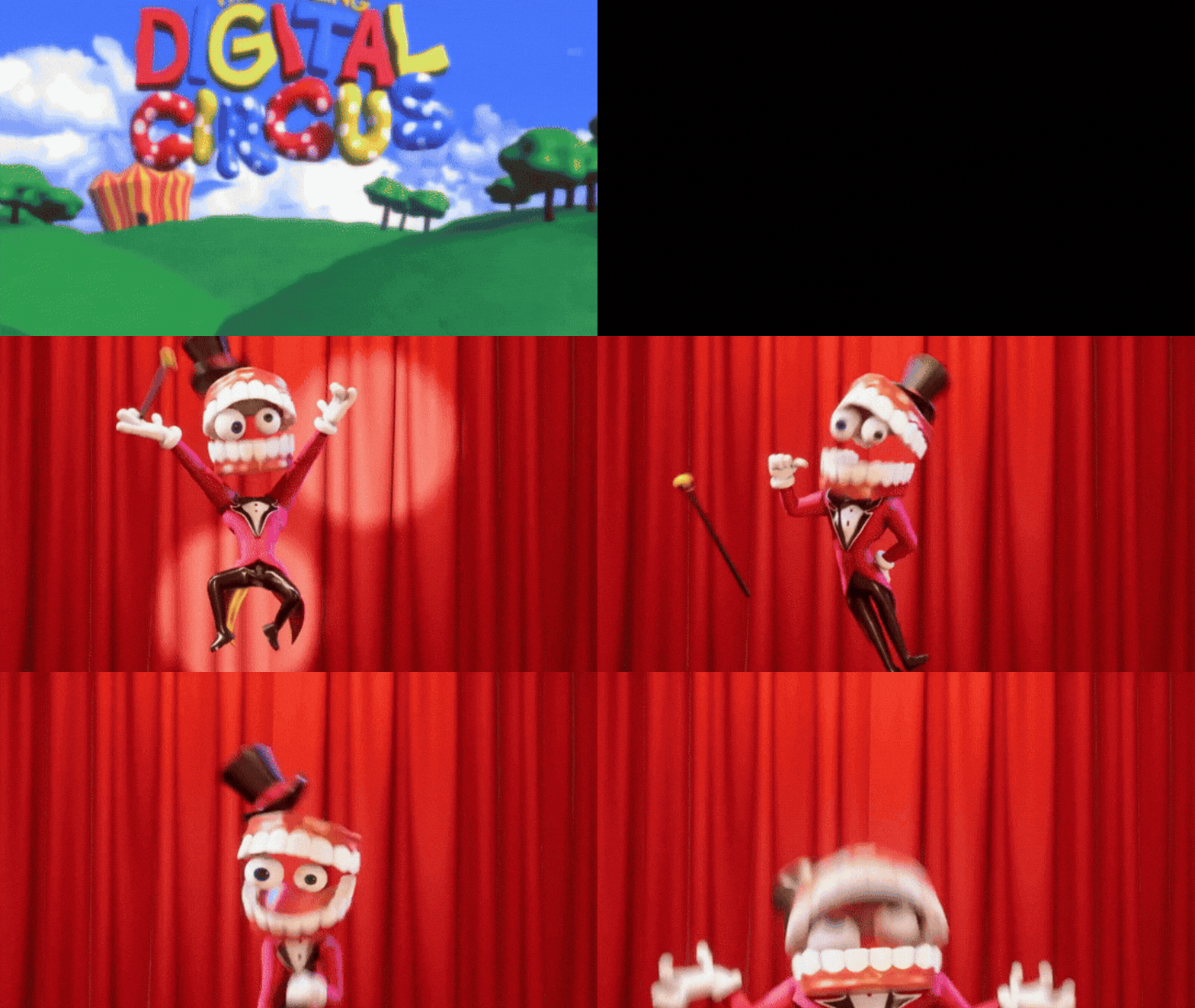
Independent animation on YouTube has shifted from “internet side project” to a creator first pipeline for original series, global fandoms, and commercially valuable IP. In April 2026, YouTube’s Culture & Trends team published its latest Animation Trends Report, Animation’s New Wave: How independent, online animators are reshaping the entertainment industry, positioning online first animated series as a core part of modern entertainment rather than an alternative lane.
The report’s headline findings focus on Gen Z animation fans’ parity between independent YouTube series and major studio series, weekly viewing habits for YouTube first animated series, and the growing normality of cross language animated viewing signals that “creator led animation” is not niche behaviour, but mainstream audience demand.

YouTube Animation Trends Report 2026 summary
YouTube’s official blog announcement (dated April 9, 2026) frames the Animation Trends Report as an examination of how independent online creators are expanding what is possible in animation outside traditional pipelines. The post calls out three “standout stats” drawn from the report’s underlying survey work in the United States (fielded April 2025).
Those featured statistics are:
- 61% of 14–24 year old animation fans in the U.S. agree they like watching animated series created by independent animators for YouTube as much as or more than series created by a major studio.
- 63% of 14–24 year old animation fans in the U.S. watch animated series created for YouTube weekly or more.
- 50% of online animation fans aged 14–49 (U.S.) agree they watch animated series in languages other than their own.
Methodologically, the blog post attributes the Gen Z fan findings to a U.S. YouTube Trends Survey conducted by Google and SmithGeiger in April 2025 (with the Gen Z animation-fan subsample reported as N=358), and the broader 14–49 animation fan language statistic reported as N=671.
Independent animators on YouTube vs traditional studio animation
The report’s framing contrasts two ecosystems: a legacy environment where major entertainment is “dominated by preexisting IP,” versus independent online animators building original characters and stories with deeply engaged fan communities.
In practical terms, “independent animators on YouTube” often operate with a different set of constraints and advantages than studio led projects:
Distribution and feedback loops tend to be more direct: visibility, audience response, and iterative creative decisions can happen in public, close to release cadence and community conversation, rather than years long closed development cycles.
Global reach is structurally easier to enable on YouTube than in many traditional release models, especially as YouTube has expanded multi language capabilities (multi language audio tracks and automatic dubbing) that reduce language as a distribution barrier.
Monetisation is increasingly multi channel and modular mixing ad revenue sharing, fan funding, and commerce rather than being dependent on a single buyer commissioning a season upfront. (This does not remove risk; it changes where and how risk is managed.)
Animation’s New Wave: what YouTube says is changing
YouTube’s report language (as quoted in industry coverage) argues that independent online animators are an exception to a market dominated by preexisting IP because they are successfully creating original characters and stories and doing so with “engaged fan communities” that help projects break through and sustain attention.
A second major theme is “reach,” described as international appeal, engagement outside official episodes, and long tail viewing where episodes keep generating views long after upload.
A concrete example discussed in coverage is Alien Stage: YouTube is cited as stating that from January September 2025, videos with “Alien Stage” in the title generated 330M+ views, with 90% of those views coming from outside Korea, and that a “Final” episode alone drew 40M views.
Why Gen Z prefers creator led animated series
The report’s survey findings indicate that Gen Z animation fans are not merely tolerant of independent animation on YouTube; many rate it as equal or better than major-studio series, and many watch YouTube first animated series weekly.
These results are consistent with a creator led media dynamic where audiences value:
Perceived closeness to creators and production: the broader YouTube ecosystem rewards transparency and ongoing context updates, behind the scenes materials, and iterative development because discovery systems respond to sustained viewer interest and satisfaction signals over time.
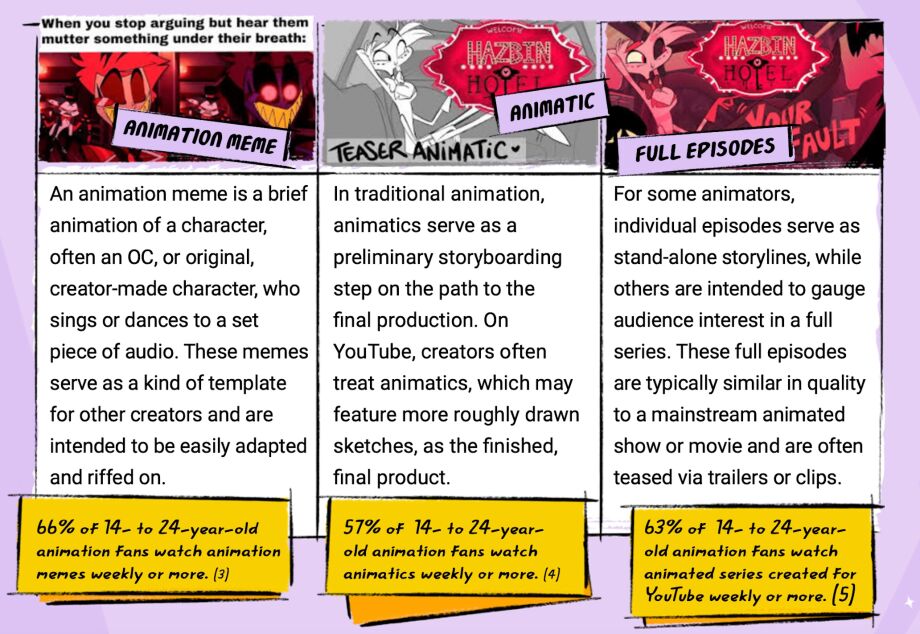
Ongoing community participation: the report coverage highlights that fanworks (memes, clips, animatics, remixes) can become part of how a series is discovered and shared, rather than being a peripheral after effect of popularity.
Global and cross cultural viewing as normal behaviour: half of surveyed animation fans aged 14–49 (online, U.S.) say they watch animated series in languages other than their own, which aligns with YouTube’s broader product investments in translation and language accessibility.
Original animated series on YouTube: what’s driving the boom
The report’s topline statistics point to two demand side drivers: (1) high weekly frequency among Gen Z animation fans for YouTube first series viewing, and (2) quality parity perceptions between independent and studio animation.
On the supply and distribution side, YouTube product changes over 2024 2026 strengthen the platform as a pipeline for animation with international ambitions:
Multi language audio makes it possible to publish one video with multiple audio tracks attached, expanding reach without maintaining multiple language channels. YouTube’s help documentation emphasises that translated titles/descriptions can support discovery in other languages, and YouTube’s own product communication reports that creators using multi language audio tracks have, on average, seen over 25% of watch time coming from non primary languages.
Automatic dubbing (distinct from manually uploaded multi language tracks) generates translated audio tracks and marks videos as “auto dubbed,” while warning of possible errors and uneven quality across languages, particularly with idioms, proper nouns, and background noise.
These features matter for animation specifically because animated storytelling is often exportable across regions when language friction is lowered; the report’s cross language viewing statistic suggests audience readiness for that global catalogue.
How indie animators build audiences without a studio
Independent animation success on YouTube tends to look less like a single launch moment and more like an ecosystem: pilots and episodes, plus surrounding formats that help discovery, retention, and community identity. This aligns with YouTube’s own description of search and discovery systems as viewer interest matching systems influenced by watch behaviour, feedback, and satisfaction surveys.

YouTube fandom culture and community building for animators
Report coverage emphasises that fanworks are not incidental: meme compilations, music videos, and fan made animations can reinforce a series’ overall traffic and awareness, especially when creators embrace the behaviour rather than resisting it.
From a community mechanics standpoint, YouTube’s recommendation systems rely heavily on signals like watch history, subscriptions, likes/dislikes, “Not interested,” and satisfaction surveys meaning an engaged fandom that repeatedly returns, interacts, and watches related content can contribute to continued visibility across personalised surfaces.
Animatics, clips, and memes: the new animation discovery funnel
The report coverage identifies that official episodes are only one route into the fandom. Fan posted remixes and meme driven clips can introduce characters and scenes to new audiences, then funnel viewers toward full episodes.
A specific tactic described in coverage is deliberate “memeability”: Glitch Productions is cited as posting a still frame altered to green screen in anticipation of meme reuse, with YouTube framing this as helping organically spread awareness early.
This discovery funnel logic is reinforced by YouTube’s own product guidance that titles, descriptions, thumbnails, playlists, and other packaging affect how content is presented and kept engaging once found particularly because discoverability and retention are linked in practice.
From pilot to franchise: how indie animation IP grows online
A key implication of the report narrative is that YouTube first animation can function as an IP proving ground: pilots build fandom, fandom supports iterative growth, and the resulting visibility can create licensing or commissioning opportunities elsewhere.
A high profile example referenced in coverage is Hazbin Hotel. Amazon Prime Video has described the series as based on a pilot released on YouTube in 2019 and states that the show was created by Vivienne Medrano, with the series produced by A24 and Bento Box Entertainment; it also characterises the pilot as quickly surpassing a major view milestone.
This model public proof of demand first, broader distribution second fits the report’s overall claim that independent animators are already influencing how entertainment evaluates and acquires new properties.

YouTube algorithm tips for animation channels
YouTube’s own explanations of discovery systems emphasise viewer satisfaction and personalisation over “tricks.” On YouTube’s creator education pages, search and discovery systems are described as being built to match videos to individual interests, using signals such as what audiences watch (and do not watch), time spent watching, likes/dislikes, “Not interested,” and satisfaction surveys.
In YouTube Help documentation, recommendations are explained as surfaces (homepage, Up Next, Shorts feed, and other pages) that rely on a large set of evolving signals, including watch and search history, subscriptions, and feedback mechanisms.
For animation channels, this implies an evidence led approach:
Packaging that accurately represents the video (titles, thumbnails, descriptions) supports the system’s attempt to put content in front of the right viewers, while reducing “mis-clicks” that can lead to poor satisfaction outcomes.
A programming strategy that connects formats Shorts previews, episode drops, compilations, and playlists can build sustained viewing sessions, which matters because recommendation systems are designed to anticipate and meet user needs across sessions, not only drive isolated clicks.
Collaboration strategies for independent animators
The report coverage describes collaboration not only as co producing episodes, but also as sourcing talent directly from the audience ecosystem.
One example cited is EPIC: The Musical: YouTube is described as noting that when Jorge Rivera Herrans posted drafts on YouTube, fans responded with animations; the creator then publicly recognised animatics and commissioned artists from that active community to produce official animatics.
This represents a collaboration model that is structurally easier online: community driven discovery identifies skilled contributors, and commissioning decisions can be made in public with immediate audience reinforcement.
Tools and workflows indie animators use to publish faster
Indie animation speed is often less about “rushing” and more about designing a workflow that can ship consistently. Common workflow accelerators include rig based animation where appropriate, reusable asset libraries, templated backgrounds, and staged pipelines (animatics → rough animation → clean-up → compositing). These practices align with the reality that YouTube systems reward consistency and clear packaging over time rather than one-off releases.
In terms of concrete tool stacks, widely used options span:
3D and hybrid pipelines using the Blender Foundation ecosystem, with Blender described on its official site as free and open-source.
End to end 2D production pipelines such as Toon Boom Harmony, positioned by Toon Boom as a full 2D animation system supporting many styles (particularly for studio style workflows adapted by smaller teams).
Compositing and motion graphics workflows using Adobe After Effects, which Adobe describes as industry standard for motion graphics and visual effects across film, TV, video, and web.
For global distribution speed specifically (not animation production speed), YouTube’s multi language audio tools and auto dubbing can reduce the time between “release” and “global accessibility,” though auto dubbing quality caveats remain material for humour heavy or dialogue dense animation.

YouTube animation monetization: ads, memberships, and merch
Independent animation is costly, so the report’s industry implication depends on whether creators can sustain production financially. YouTube monetisation is explicitly structured as a set of modules and features rather than a single revenue stream.
The YouTube Partner Program is the gateway mechanism for most platform native monetisation. YouTube’s own materials describe two stages: eligibility to apply and unlock certain features at lower thresholds, and later eligibility for ad revenue sharing at higher thresholds.
YouTube’s published guidance commonly highlights:
At 500 subscribers (with additional activity/watch requirements), creators can apply and unlock benefits that can include fan funding features and certain shopping features, depending on eligibility and region.
At 1,000 subscribers (with additional watch hour or Shorts view requirements), creators can unlock ad revenue sharing and YouTube Premium revenue sharing on eligible content.
Revenue share rates and feature level splits are documented in YouTube Help. For example, YouTube’s partner earnings overview describes a 55% net revenue share for Watch Page ads (when the relevant module is accepted), 45% for Shorts Feed allocations (when the Shorts module is accepted), and 70% of net revenues for certain fan-funding features under the Commerce Product Module.
For animation creators, three monetisation lanes tend to map onto different fan behaviours:
Ad revenue and Premium revenue, which scale with sustained viewing but carry no guarantee of payout size and can be affected by eligibility, policy compliance, and advertiser friendliness.
Channel memberships, which YouTube defines as monthly payments exchanged for members only perks; YouTube’s policies also restrict certain perk types, emphasising that this is a regulated commerce product rather than an informal subscription.
Merchandise and product promotion via YouTube Shopping, which YouTube positions as enabling creators to promote products from their own stores (including merch) across multiple surfaces and tag products in videos, Shorts, and live streams, subject to eligibility and location constraints.
The report coverage adds a further financing implication: YouTube positions fandom backed funding models such as crowdfunding and direct fan support as a meaningful part of how creator led animation can be sustained outside studio financing.
Shorts vs long form animation: what performs best on YouTube
YouTube’s own creator facing explanations frame Shorts and long form as different formats that can serve different roles. (YouTube describes Shorts as vertical videos that run 60 seconds or less in its general “getting started” guidance, while also documenting monetisation policies for eligible longer Shorts formats.)
From a performance and business perspective, “best” depends on the metric:
For discovery and sampling, Shorts are structurally designed for rapid viewing sequences in a personalised feed, and YouTube explicitly treats Shorts as a distinct recommendation surface (“the Shorts player”).
For monetisation predictability and deeper narrative, long form episodes often align with Watch Page monetisation mechanics and can support stronger session based viewing, though income still varies and is not guaranteed.
For hybrid strategies, YouTube’s own documentation clarifies that Shorts revenue sharing is based on ads viewed between videos in the Shorts Feed and uses a pooled revenue model (with creators keeping 45% of their allocated revenue), reinforcing that Shorts monetisation behaves differently than long form ads.
For animation specifically, the report coverage suggests that Shorts and clips can act as part of the discovery funnel memes, animatics, and short remixes bring viewers in, while longer episodes (or compilations) sustain fandom.

The future of the animation industry with creator first distribution
YouTube’s report framing (as cited in coverage) concludes that independent animators are not just transforming entertainment on YouTube but are already influencing the broader industry as it moves to license shows and work directly with creators effectively positioning creator led animation as a blueprint others will adopt.
Several platform level forces make creator first distribution more plausible in 2026 than it was even a few years earlier:
Discovery systems have matured into heavily personalised recommendation infrastructure, with YouTube describing systems that learn from signals like watch history, feedback, and satisfaction surveys across homepage, Up Next, and Shorts surfaces.
Monetisation has diversified into ads, fan funding, shopping, and premium revenue shares under the Partner Program framework, enabling a “portfolio” approach to sustaining production rather than reliance on a single gatekeeper.
Language accessibility tooling is now a strategic distribution layer: multi language audio enablement and automatic dubbing reduce localisation as a bottleneck, while YouTube also explicitly warns that automatic dubs may contain errors and quality may vary, which matters for story driven animation where tone and nuance are core assets.
At the same time, creator first distribution does not remove structural risks. YouTube notes constraints tied to copyright and Content ID in multiple contexts (for example, dubbing eligibility limits and monetisation policies), underscoring that rights management remains a material operational consideration for animation channels.
Frequently Asked Questions (FAQs)
- What is YouTube’s Animation Trends Report 2026 actually called?
It is presented by YouTube as the latest Animation Trends Report titled “Animation’s New Wave: How independent, online animators are reshaping the entertainment industry.” - When was the 2026 animation trends report released?
YouTube’s official blog announcement for the report is dated April 9, 2026. - What is the most important Gen Z statistic in the report?
A highlighted finding is that 61% of U.S. animation fans aged 14–24 agree they like watching animated series created by independent animators for YouTube as much as or more than series created by a major studio. - How often do Gen Z animation fans watch YouTube first animated series?
YouTube reports that 63% of U.S. animation fans aged 14–24 watch animated series created for YouTube weekly or more. - Is cross-language animation viewing actually common?
In the report’s highlighted statistics, YouTube states that 50% of U.S. online animation fans aged 14–49 agree they watch animated series in languages other than their own. - Does YouTube provide tools to help animation reach global audiences?
Yes. YouTube documents multi language audio (uploading multiple audio tracks to one video/Short) and automatic dubbing (auto generated translated audio tracks), both intended to make content more accessible across languages. - How does YouTube describe how recommendations work for viewers?
YouTube describes recommendations as personalised systems that use signals such as watch history, search history, subscriptions, likes/dislikes, “Not interested,” and satisfaction surveys across surfaces like homepage, Up Next, and the Shorts feed. - Are Shorts monetised the same way as long form animation episodes?
No. YouTube’s Shorts monetisation policies explain that Shorts ad revenue sharing comes from ads shown between videos in the Shorts Feed, uses a pooled model, and applies a 45% revenue share to the creator’s allocated revenue under the Shorts monetisation module. - What are the main YouTube monetisation pathways relevant to independent animation?
YouTube’s documentation highlights a mix of Watch Page ads (long form), Shorts Feed ads, YouTube Premium revenue sharing, fan funding (including channel memberships), and Shopping/merch features subject to eligibility, modules, and policy compliance. - What is a real world example of a YouTube pilot turning into mainstream distribution?
Amazon describes the adult animated series Hazbin Hotel as based on a popular pilot released on YouTube in 2019 and identifies its production partners, illustrating a pilot to series pathway that aligns with the report’s “creator led IP” narrative.

conclusion
YouTube’s 2026 Animation Trends Report positions independent animators as a mainstream entertainment force, supported by survey evidence that Gen Z animation fans both (1) watch YouTube first animated series weekly at high frequency and (2) rate independent YouTube series as equal or better than major studio animation.
The report’s broader implication is that “creator first animation” is increasingly defined by an ecosystem episodes plus animatics, clips, memes, and fanworks where community participation is part of the distribution engine and where global reach is amplified by multi language product features.
Sustainability depends on a blended business model: YouTube Partner Program monetisation (ads, Shorts, Premium revenue shares), fan funding (memberships and related features), and commerce (Shopping/merch) all play roles and YouTube’s own documentation emphasises that all monetisation operates under eligibility thresholds, modules, and policy constraints.
Sources and citation
- YouTube Official Blog – New YouTube report shows how online animators are reshaping the entertainment industry
https://blog.youtube/culture-and-trends/independent-animation-trends-report/ - YouTube Culture & Trends — Culture & Trends Report: Animation’s New Wave
https://www.youtube.com/trends/report/tr26-animation-trends-report/ - Tubefilter — coverage summarising and quoting the report
https://www.tubefilter.com/2026/04/09/youtube-culture-trends-original-animated-series-digital-circus-hazbin-hotel/ - YouTube Creators — How YouTube recommends videos using “the algorithm”
https://www.youtube.com/creators/top-questions/ - How YouTube Works — Recommendations
https://www.youtube.com/howyoutubeworks/recommendations/ - YouTube Help — How YouTube recommendations work
https://support.google.com/youtube/answer/16089387?hl=en - YouTube Help — Tips to optimize your video
https://support.google.com/youtube/answer/11908409?hl=en - YouTube Help — YouTube partner earnings overview
https://support.google.com/youtube/answer/72902?hl=en - YouTube Blog — YouTube Partner Program, Explained
https://blog.youtube/creator-and-artist-stories/youtube-partner-program-explained/ - YouTube Creators — How to make money on YouTube
https://www.youtube.com/creators/how-things-work/video-monetization/ - YouTube Help — Get started with channel memberships on YouTube
https://support.google.com/youtube/answer/7636690?hl=en - YouTube Help — Get started with Shopping on YouTube
https://support.google.com/youtube/answer/12257682?hl=en - YouTube Help — YouTube Shorts monetization policies
https://support.google.com/youtube/answer/12504220?hl=en - YouTube Help — Use automatic dubbing
https://support.google.com/youtube/answer/15569972?hl=en - YouTube Help — Add Multi-language features to your videos
https://support.google.com/youtube/answer/13338784?hl=en - YouTube Official Blog — Unlock a world of viewers with multi-language audio
https://blog.youtube/news-and-events/multi-language-audio/ - YouTube Official Blog — Break down language barriers with auto dubbing on YouTube
https://blog.youtube/news-and-events/auto-dubbing-on-youtube/ - TechCrunch — rollout of multi-language audio to all creators
https://techcrunch.com/2025/09/10/youtubes-multi-language-audio-feature-for-dubbing-videos-rolls-out-to-all-creators/ - About Amazon — Prime Video announcement article on Hazbin Hotel
https://www.aboutamazon.com/news/entertainment/hazbin-hotel-prime-video - Blender.org — Blender is free and open source
https://www.blender.org/ - Toon Boom — Harmony product page
https://www.toonboom.com/products/harmony - Adobe — After Effects product page
https://www.adobe.com/ng/products/aftereffects.html
Recommended
- Google Play will let you try a game before you buy it: Game Trials explained (release, supported games, and how it works)
- Helldivers 2: Comprehensive Guide to Gameplay, Features, Factions, and Strategie
- Best 10 Water Simulation Add-ons in Blender: Everything You Need to Know Before You Install
- Blender Redistribute Curve Points Geometry Nodes Preset: A Comprehensive Guide
- Psychedelic Games Secures $3.5M for Golden Tides, a Pirate-Themed “Adventure MOBA” With Open-Sea Combat and No Lanes
- The Rocketeer: Infiltrator! Explained: IDW’s New Rocketeer Comic, Release Date, Story, and Creative Team
- What Is the Purpose of the Camera View in Blender?
- Blight: Survival Blends Co-Op Medieval Combat with a Grounded Zombie Plague
- Is Arcane 3D Animated? Unveiling the Secrets Behind Its Revolutionary Style
- Smooth Obstacle Avoidance System Set Up in Unreal Engine: RVO vs Detour Crowd, NavMesh Settings, and Best Practices