












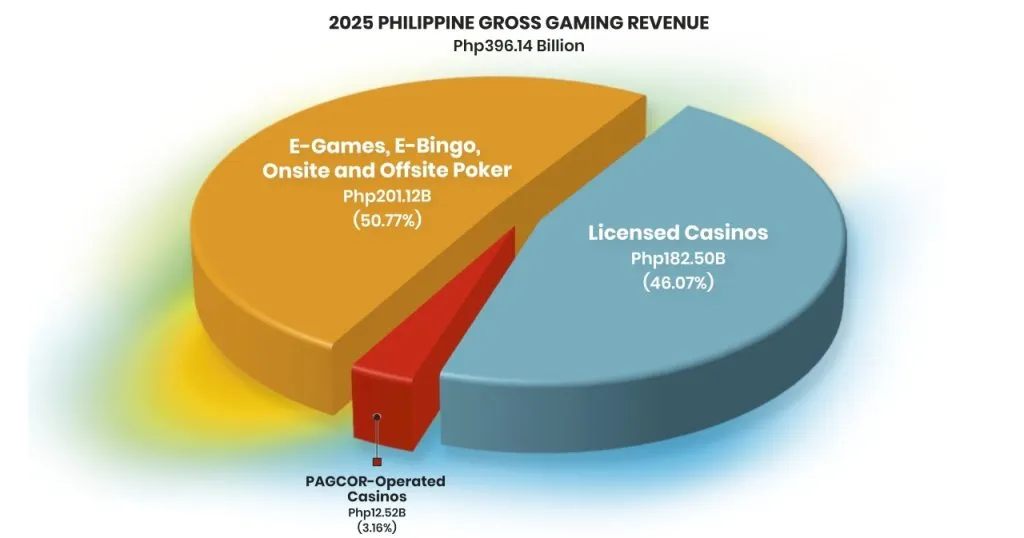
In the Philippines, the regulated gambling market changed shape in 2025. Official data from the Philippine Amusement and Gaming Corporation show total industry gross gaming revenue, or GGR, at ₱396.14 billion, with the regulator’s broad electronic-and-online gaming segment generating ₱201.12 billion, or 50.77% of the market. That official digital bucket became the industry’s largest revenue contributor, overtaking licensed casinos and, based on PAGCOR’s published 2025 table, also edging past the combined GGR of licensed casinos and PAGCOR-operated casinos by about ₱6.09 billion.
For accuracy, this article uses PAGCOR’s official industry statistics and formal press releases as the primary source base. It also distinguishes between industry-wide GGR and PAGCOR’s own corporate revenue, because those are different measures and can move in different directions. It also clarifies the 2024 comparison issue: PAGCOR’s official 2024 GGR benchmark for like-for-like domestic comparison was ₱372.33 billion, while a broader ₱410.47 billion figure used in some 2025 reporting included ₱38.14 billion from offshore gaming before that segment was removed from the 2025 base. In this article, “iGaming” is used as shorthand for the broad electronic-and-online segment PAGCOR used in its 2025 reporting.
Philippines iGaming revenue vs offline gambling revenue in 2025
Using PAGCOR’s 2025 industry table, the cleanest official comparison is between the electronic-and-online gaming segment and land-based casino revenue. The electronic-and-online bucket produced ₱201.12 billion. Licensed casinos generated ₱182.50 billion, while PAGCOR-operated casinos contributed another ₱12.52 billion, putting the combined land-based casino total at ₱195.02 billion. On that basis, iGaming-type activity finished 2025 roughly ₱6.09 billion ahead of land-based casino gambling. The important caveat is that PAGCOR’s digital bucket includes e-bingo, bingo grantees, and poker, so a broader definition of “offline gambling” can produce a different comparison.

Did online gambling surpass land-based casinos in the Philippines in 2025?
Yes, under PAGCOR’s official 2025 classification, online and electronic gaming surpassed land-based casinos in the Philippines in 2025. PAGCOR explicitly said the electronic-and-online gaming segment had overtaken licensed casinos as the largest GGR contributor after reaching ₱201.12 billion, while licensed casinos fell to ₱182.50 billion. The underlying 2025 industry table also shows that even after adding PAGCOR-operated casinos, land-based casino GGR totaled only ₱195.02 billion, leaving the official digital bucket narrowly ahead. In 2024, the situation was still the reverse, with land-based casinos ahead of e-games and e-bingo.
How much revenue did online gambling generate in the Philippines in 2025?
The most defensible official answer is ₱201.12 billion, because that is PAGCOR’s broad 2025 electronic-and-online gaming segment. Within that total, the Electronic Games line alone contributed ₱185.26 billion, Bingo Operations added ₱15.71 billion, and onsite/offsite poker contributed about ₱147.46 million combined. That means any article using the phrase “online gambling revenue in the Philippines in 2025” should ideally explain whether it is referring to the broad official segment or the narrower Electronic Games line, because the two are not identical.

PAGCOR 2025 gross gaming revenue report explained
The PAGCOR 2025 gross gaming revenue report explained in plain terms comes down to separating industry GGR from PAGCOR’s own revenue. Industry GGR was ₱396.14 billion in 2025. PAGCOR’s own corporate revenue, by contrast, was ₱106.03 billion, made up of ₱95.15 billion from gaming operations and ₱10.88 billion from interest earnings, income, and service fees. PAGCOR also reported that more than half of its gaming revenues, or ₱53.33 billion, came from electronic and online gaming activities. GGR itself is a gaming metric based on wagers less payouts, so it measures market size, not the regulator’s direct take.
Electronic gaming revenue in the Philippines in 2025
Electronic gaming revenue in the Philippines in 2025 reached ₱185.26 billion on the pure Electronic Games line in PAGCOR’s official industry table, up from ₱135.71 billion in 2024, which implies growth of roughly 36.5% year on year. The pace was strongest in the first half, with ₱47.24 billion in Q1 and ₱59.29 billion in Q2, before dropping to ₱41.95 billion in Q3 and ₱36.79 billion in Q4. That quarterly profile matters because it shows the year’s digital surge was real, but it was also front-loaded and later softened by regulatory frictions in payments.

Philippines land-based casino revenue in 2025 compared to online gaming
Philippines land-based casino revenue in 2025 compared to online gaming shows how narrow the market crossover actually was. Licensed casinos produced ₱182.50 billion, down 9.58% from 2024, while PAGCOR-operated casinos fell 20.95% to ₱12.52 billion. Together, casino floors generated ₱195.02 billion, or about 49.23% of total industry GGR, versus 50.77% for the electronic-and-online segment. Even after this crossover, casinos remained strategically important: PAGCOR said integrated resort casinos alone generated ₱93.36 billion in the first half of 2025 and paid ₱16 billion in license fees.
Why iGaming grew faster than offline gambling in the Philippines
iGaming grew faster than offline gambling in the Philippines because consumer behavior and regulatory policy moved in the same direction. PAGCOR linked the shift to more customers choosing digital and online platforms, while Q1 2025 comments from the regulator tied the trend to demand for digital, on-demand gaming experiences and wider access to mobile technology. At the same time, PAGCOR’s lower fee structure made the legal online market more commercially viable for operators. That combination of convenience, mobile access, and lower regulatory cost helped online channels grow faster than the brick-and-mortar casino floor.

What drove the Philippines online gambling boom in 2025
What drove the Philippines online gambling boom in 2025 was not a one-quarter spike but a multi-year structural build. PAGCOR said the e-games and e-bingo segment became the top revenue driver for the first time in Q1 2025 at ₱51.39 billion. By midyear, total industry GGR had already reached about ₱215 billion. The surge was also built on a steep pre-2025 base expansion: the official online/electronic bucket was only ₱58.16 billion in 2023, rose to about ₱154.5 billion in 2024, and then hit ₱201.12 billion in 2025. That progression explains why the 2025 crossover was a culmination, not a statistical fluke.
PAGCOR fee cuts and their impact on iGaming growth in the Philippines
PAGCOR fee cuts and their impact on iGaming growth in the Philippines were substantial enough that the regulator itself repeatedly cited them as a key growth driver. PAGCOR reduced e-games share rates from levels above 50% historically to 35% in April 2024, then to 30% effective January 1, 2025, while integrated resorts offering e-games received a 25% rate. PAGCOR said these changes helped the sector beat its ₱100 billion 2024 GGR target as early as September, increased licenses for on-site and online gaming offerings to 1,188 from 1,046 in 2023, and raised accredited gaming service providers to 174 from 49. In PAGCOR’s own assessment, lower fees helped move gray-market activity into the regulated system.
How the Philippines gambling industry changed after the POGO ban
How the Philippines gambling industry changed after the POGO ban is central to understanding the 2025 revenue mix. After Ferdinand Marcos Jr. announced a ban on Philippine Offshore Gaming Operators in July 2024, PAGCOR said it would wind the sector down by the end of 2024 and later described the policy as fully enforced by end-2024.
The result was a cleaner but narrower 2025 baseline. PAGCOR’s official 2024 GGR figure was ₱372.33 billion, but offshore gaming would have added ₱38.14 billion to produce a broader ₱410.47 billion total. On PAGCOR’s own corporate books, offshore gaming still contributed about ₱2.99 billion in 2024 revenue and then disappeared from the 2025 revenue mix. That left 2025 more dependent on domestic casinos and regulated digital play rather than the crime-linked offshore model that triggered the ban.
Philippines gambling revenue history and why 2025 was a turning point
Philippines gambling revenue history and why 2025 was a turning point become clear when the segment shares are lined up over time. In 2018, electronic gaming sites generated ₱28.31 billion while casinos produced ₱187.54 billion. In 2023, the official “other licensees” bucket totaled ₱58.16 billion against more than ₱227 billion from licensed and PAGCOR-operated casinos combined. In 2024, e-games and e-bingo jumped to ₱154.51 billion, but land-based casinos still led at ₱201.83 billion before PAGCOR-operated venues were added. In 2025, the balance flipped: the electronic-and-online segment reached ₱201.12 billion and the combined casino total slipped to ₱195.02 billion. That is why 2025 was a genuine structural break rather than just another growth year.

Is iGaming now the biggest gambling segment in the Philippines?
Is iGaming now the biggest gambling segment in the Philippines? The accurate answer is yes, if iGaming is used in the same broad sense PAGCOR used in its 2025 release. On that basis, the electronic-and-online segment is now the largest official segment at ₱201.12 billion and 50.77% of GGR. But if iGaming is defined more narrowly as the Electronic Games line alone, the answer is slightly more nuanced: ₱185.26 billion was still bigger than licensed-casino GGR of ₱182.50 billion, but it remained below the ₱195.02 billion combined total of licensed and PAGCOR-operated casinos. The most error-proof conclusion is that PAGCOR’s broad electronic-and-online segment is now the market leader.
What the rise of iGaming means for PAGCOR and government remittances
What the rise of iGaming means for PAGCOR and government remittances is that online-led growth now matters directly to Philippine public finance, even though the regulator’s own top line does not automatically rise in lockstep with market GGR. In 2025, PAGCOR’s contributions to nation-building reached ₱66.95 billion, with ₱45.19 billion going to the National Treasury as the 50% government share. In 2024, remittances to the Treasury were ₱46.32 billion and contributions to nation-building were ₱68.20 billion, rising to ₱76.66 billion if 50% cash dividends were included.
The implication is that digital gaming is now a central fiscal pillar, but softer land-based collections and the disappearance of offshore revenue can still pressure PAGCOR’s own annual revenue even when the industry grows.

Philippines casino industry outlook after online gambling overtook offline revenue
Philippines casino industry outlook after online gambling overtook offline revenue is not a collapse narrative. Casinos still generated almost half of 2025 GGR, and integrated resorts alone delivered ₱93.36 billion in the first half of the year, reinforcing their role in tourism, hospitality, employment, and fee generation. PAGCOR has also said the country could attract as much as $6 billion in casino investment over five years, with resort expansion expected outside Metro Manila as well. The likely result is a more specialized land-based sector focused on travel, entertainment, and destination spending, while digital platforms continue to absorb more routine mass-market gambling activity.
Philippines gambling market forecast after iGaming’s record 2025 performance
Philippines gambling market forecast after iGaming’s record 2025 performance points to continued digital leadership, but under much tighter controls than the market had expected at the start of 2025. PAGCOR’s most visible medium-term benchmark in public comments remains a ₱450 billion to ₱500 billion industry by 2027, yet its early-2025 forecast of ₱450 billion to ₱480 billion for 2025 was missed when actual GGR came in at ₱396.14 billion after payment reforms and late-year softening.
The post-2025 outlook therefore looks more disciplined than euphoric. PAGCOR has emphasized stronger KYC, identity verification, self-exclusion tools, betting limits, tighter payment-channel rules, and advertising restrictions developed with the Ad Standards Council, while also introducing a new minimum guaranteed fee for licensed online operators. Based on the 2025 actual and the 2027 benchmark, the market would still need roughly mid-single-digit to low-double-digit annual growth over the next two years to reach that range, which is plausible but no longer automatic.
Frequently Asked Questions (FAQs)
- What was the Philippines’ official gaming industry GGR in 2025?
PAGCOR reported official 2025 industry GGR of ₱396.14 billion, up 6.39% from the comparable official 2024 figure of ₱372.33 billion. - How much did the electronic and online gaming segment make in 2025?
The broad official segment generated ₱201.12 billion in 2025, while the narrower Electronic Games line alone contributed ₱185.26 billion. - Did online gambling really beat land-based casinos in 2025?
Yes, under PAGCOR’s 2025 classification. The broad electronic-and-online segment outperformed licensed casinos and also slightly exceeded the combined GGR of licensed casinos plus PAGCOR-operated casinos. - Why do some reports say 2024 GGR was about ₱410.5 billion instead of ₱372.33 billion?
Because PAGCOR later clarified that ₱372.33 billion was the official 2024 amount excluding offshore gaming, while offshore games added ₱38.14 billion and pushed the broader total to ₱410.47 billion. - Did PAGCOR’s own revenue rise in 2025?
No. PAGCOR’s own revenue fell 5.09% to ₱106.03 billion even though industry-wide GGR rose, because its corporate revenue mix was affected by softer land-based earnings and the disappearance of offshore gaming from the base. - Did the POGO ban stop the industry from growing?
No. Offshore gaming exited the picture, but official domestic-industry GGR still rose in 2025 as electronic and online gaming offset weaker casino performance. - What policy change most clearly supported iGaming growth?
PAGCOR’s fee cuts were the clearest policy accelerator, moving rates from above 50% historically to 35% in 2024 and 30% from January 2025, while license counts and service-provider accreditations also rose sharply. - What slowed online gambling later in 2025?
PAGCOR said the mandatory delinking of e-wallets and tighter payment controls caused a temporary slump in late Q3 and softer revenues afterward, even though the segment still finished the year ahead. - How much did the government receive from PAGCOR in 2025?
PAGCOR said contributions to nation-building reached ₱66.95 billion in 2025, including ₱45.19 billion remitted to the National Treasury as the 50% government share. - What is the most realistic forecast after 2025?
The most realistic forecast is continued digital-led expansion under stricter regulation. PAGCOR’s public medium-term benchmark has been ₱450 billion to ₱500 billion by 2027, but actual 2025 GGR of ₱396.14 billion shows that tighter controls and payment reforms can materially slow near-term growth.
Conclusion
The 2025 Philippine gambling story is not simply that online gaming grew. It is that online gaming became the market’s new center of gravity. On PAGCOR’s official classification, the electronic-and-online segment reached ₱201.12 billion and 50.77% of total GGR, while combined casino GGR slipped to ₱195.02 billion. That shift did not eliminate the importance of land-based casinos, which still remain vital to tourism and government funding, but it did end their automatic dominance. From here, the market will likely be defined by how effectively the state can regulate, tax, and police a digital-first industry without choking the very segment now carrying most of the growth.
Sources and Citations
- PAGCOR, “PH Gross Gaming Revenues up 6.39% to Php396.14B in 2025”
https://www.pagcor.ph/headlines/ph-gross-gaming-revenues-up-6.39percent-to-php396.14b-in-2025.html - PAGCOR, “Philippine Gaming Industry Data CY 2025”
https://www.pagcor.ph/regulatory/pdf/Industry%20Statistic/2025-Philippine-Gaming-Industry-Data.pdf - PAGCOR, “PH 2024 GGR hits all-time high of Php372.33-B”
https://www.pagcor.ph/press-releases/Ph-2024-ggr-hits%20all-time-high-of-php372.33-b.php - PAGCOR, “PAGCOR 2025 revenues fall 5% to Php106.03B as land-based earnings soften”
https://www.pagcor.ph/headlines/pagcor-2025-revenues-fall-5percent-to-php106.03B-as-land-based-earnings-soften.html - PNA, “PAGCOR records highest P112-B revenue in 2024”
https://www.pna.gov.ph/articles/1243015 - PAGCOR, “PAGCOR again slashes E-Games fees, now at 30%”
https://www.pagcor.ph/insider/2025/january-2025.pdf - Philippine News Agency, “PH gaming industry revenues up over 27% in Q1”
https://www.pna.gov.ph/articles/1249548 - PAGCOR, “Integrated Resorts’ 1H GGR hits Php93.36B”
https://www.pagcor.ph/headlines/integrated-resorts-1H-ggr-hits-php93.36B-ggr-pagcor-says.html - PAGCOR, “PAGCOR enhances responsible gaming safeguards amid digital play growth”
https://www.pagcor.ph/headlines/pagcor-enhances-responsible-gaming-safeguards-amid-digital-play-growth.html - PAGCOR, “PAGCOR, Ad Standards Council ink MOU to regulate gambling ads”
https://www.pagcor.ph/headlines/pagcor-ad-standars-council-ink-mou-to-regulate-gambling-ads.html - Reuters, “Philippines’ Marcos orders closure of offshore gaming industry”
https://www.reuters.com/world/asia-pacific/philippines-marcos-orders-closure-offshore-gaming-industry-2024-07-22/ - Reuters, “Philippines to start winding down operations of offshore gaming hubs”
https://www.reuters.com/markets/asia/philippines-start-winding-down-operations-offshore-gaming-hubs-2024-07-23/ - Reuters, “Philippine gambling revenue to hit record $6 bln this year”
https://www.reuters.com/markets/asia/philippine-gambling-revenue-hit-record-6-bln-this-year-2024-12-10/ - PAGCOR, “Industry Statistics”
https://www.pagcor.ph/regulatory/industry_statistic.php
Recommended
- Sony May Be Drastically Shifting Its PC Strategy – Report: What It Means for PlayStation PC Ports
- The Original Final Fantasy 7 Gets a New Re-release for PC on Steam: New Features, Free Upgrade, and Known Issues
- How do I simulate a GoPro-style camera in Blender?
- Minecraft Mod Lets You Control Giant Sphere That Absorbs Blocks
- The Dungeon Crawler RPG Crowdfunding Campaign Just Launched and Has Already Decimated Its Goals – Everything You Need to Know
- Windrose Dev Talks Black Flag Inspiration and Why Dropping Free-To-Play Was Best
- Sony INZONE M10S II Review: Latest 720Hz Gaming Monitor for Competitive Esports
- Official World Of Warcraft Music Video Is A Walk Down Memory Lane: “A Place to Call Home” Recaps 22 Years of Azeroth
- How to Create a Sci-Fi Metahuman in Unreal Engine 5: A Step-by-Step Guide
- The State Duma Has Proposed to Restrict Loot Box Sales in Games to Minors in Russia