



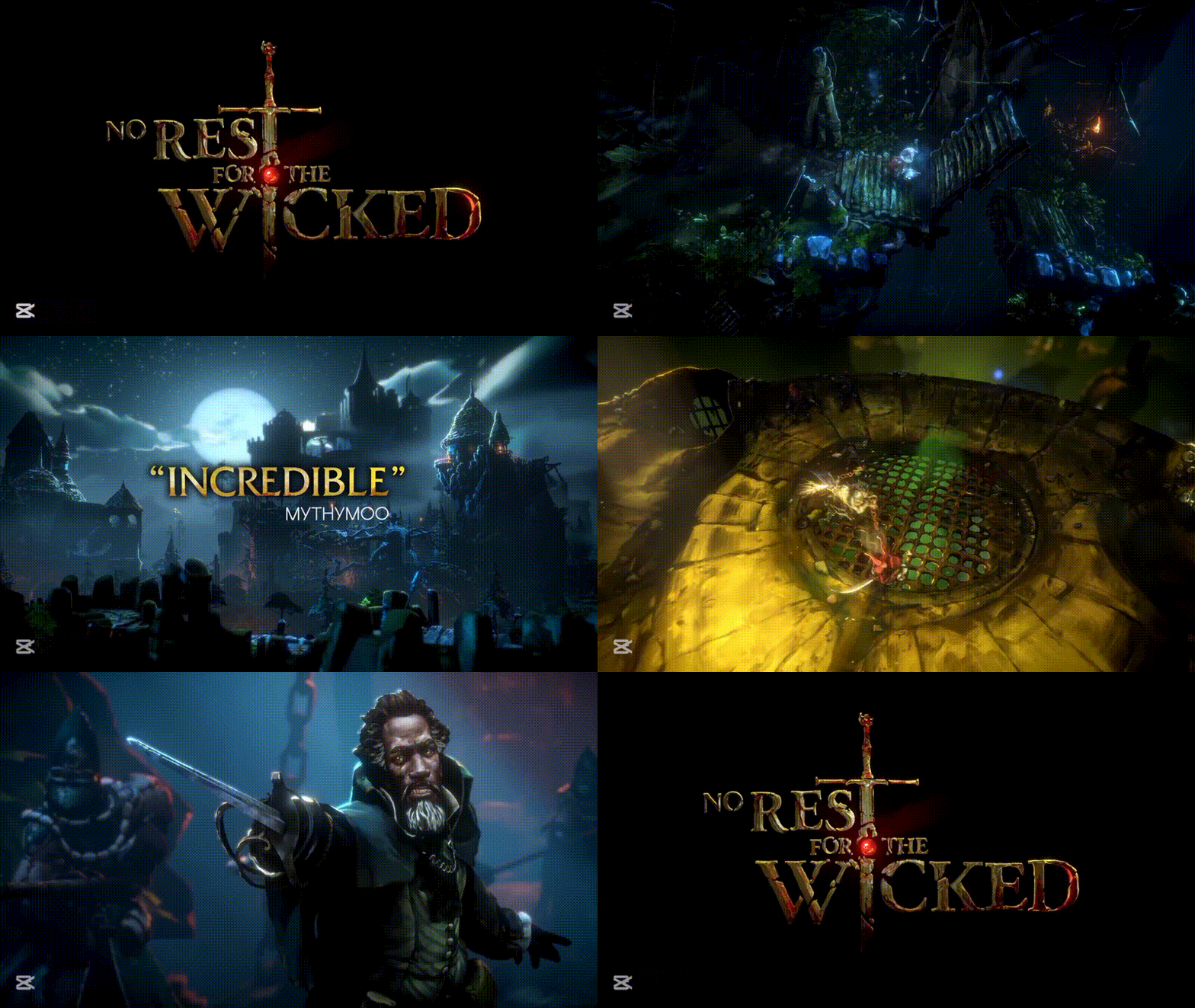
If you are searching for “Tech and Artistic Inspirations of No Rest for the Wicked from Moon Studios behind the scenes,” the strongest public record points to a very specific design philosophy: Moon Studios wanted a game that looked and felt like a painting brought to life, but with the precision, weight, and authored density of a modern action RPG.
Official materials, platform interviews, the Steam page, and a detailed April 2026 developer interview all converge on the same core ideas: painterly visuals, hand-authored assets, a heavily customized Unity-based tech stack, deliberate combat, and a world built for curation rather than procedural sameness. The game entered Steam Early Access on April 18, 2024, and Moon says it is still refining the road to 1.0 through iteration and community feedback.
What makes that notable is that the studio is not simply repeating the formula behind the Ori games. As Thomas Mahler has explained across interviews, Moon saw the Ori series as one stage of its growth and this new project as a chance to build a larger fantasy universe with human drama, deeper systems, and a more mature tone. The result is a game that borrows from action RPG history, Soulslike pacing, classical painting, and hand-built environmental storytelling, while still carrying forward Moon’s obsession with visual identity and iterative polish.
What Inspired the Art Style of No Rest for the Wicked by Moon Studios
The clearest documented answer is that Moon’s art direction began with the principle of “painting comes to life.” In the April 2026 80 Level interview, the art team said the visual target had been defined roughly a decade earlier, with Caravaggio serving as the primary reference because of his dramatic light-and-shadow contrasts and tightly controlled compositions. The team also said environment art drew from late-nineteenth-century landscape painting, while Mahler separately explained that Moon wanted its games to feel like living paintings because paintings age better than photorealistic tech showcases.
That inspiration matters because Caravaggio’s work is famous for staging figures inside concentrated darkness and then cutting through that darkness with spotlight-like illumination. The Metropolitan Museum of Art describes his later work as increasingly dark and cinematic, with faces singled out by intense light against black interiors. Moon’s own comments line up closely with that language, which helps explain why No Rest for the Wicked often reads less like neutral 3D scenery and more like a carefully lit tableau.
How Moon Studios Created a Hand-Painted World in No Rest for the Wicked
Moon’s hand-painted look is not marketing shorthand for “stylized”; it is tied to the actual asset workflow. The studio says most environment artists work in Blender, while some other artists use Maya and 3ds Max. The team also built lightweight Blender tools to automate parts of the pipeline such as interactive vegetation and collider generation. From there, concept artists and asset artists cross over heavily instead of living in separate silos, and 3DCoat became the main texture-painting tool mentioned by the team.
The crucial point is that the visual finish is camera-aware and hand-authored. Moon says enemy and character models are built around hand-painted textures, often beginning with projected concept art and then being polished in the context of the in-game camera angle. The studio also stresses that custom rendering and lighting inside Unity are what finally unify those assets into the painterly image players see on screen. In other words, the look is not coming from a single texture trick; it is coming from concept, modeling, painting, rendering, and lighting all working toward one preset visual thesis.

The Artistic Evolution from Ori to No Rest for the Wicked Explained
Moon has been unusually explicit about the transition. On Xbox Wire, Mahler said he viewed the Ori series as Moon’s “Mario,” while No Rest for the Wicked was closer to the studio making its own “Zelda,” filtered through action RPG ambitions. In a later 80 Level interview, he added that the Ori games were shaped by inspirations such as Studio Ghibli and Disney, and that they used allegory and fantasy creatures to express human emotions. Wicked, by contrast, was meant to become an epic fantasy saga with human characters, full facial animation, and more mature themes.
Even so, Wicked is not a clean break from Moon’s past. The April 2026 art interview says the pitch for Wicked was being developed in parallel with Ori and the Will of the Wisps, and that Ori’s visual style significantly influenced Wicked’s final look. What changed was the emotional palette and the medium: the studio carried forward its love of composition, texture, and atmosphere, but moved from the luminous, allegorical world of Ori and the Blind Forest into a harsher, bloodier fantasy where the painterly treatment had to work in fully 3D, isometric spaces.
How Moon Studios Achieved a Painterly Look in a 3D Isometric RPG
Moon’s answer was to reject default realism and build a stylized 3D language that still feels dense and tactile. The art team said Mahler pushed in the opposite direction from PBR-driven realism, favoring artistic expression, strong light contrast, and dramatic rim lighting. They also cited Vagrant Story as a reference point, especially for its striking rim-lit cutscene aesthetic, and said similar techniques are used extensively in Wicked.
The fixed camera is equally important. Moon’s gameplay tech lead explained that because the camera does not freely rotate, the team can predict what the player will see, optimize for that view, and light scenes for that view. The studio then polishes hand-painted textures with the game camera in mind. That combination of stylized proportions, camera-aware texture work, and custom rendering is the practical reason a 3D isometric RPG can still look convincingly painterly instead of merely “filtered.”
Behind the Scenes: The Technology Powering No Rest for the Wicked
The most recent and detailed public explanation is straightforward: Moon says it still uses Unity, but in a form that is “completely different under the hood.” In the April 2026 80 Level interview, Patrick Williams explained that the studio’s heavily modified version of Unity is internally dubbed “Moonity,” and that source-code access lets the team build its own render pipelines, timeline systems, input, audio, and other subsystems as needed. The same interview says Wicked also uses Photon Quantum for deterministic multiplayer, plus a custom chunk-based world-streaming system and a broad set of in-house developer tools.
That toolkit goes well beyond rendering. Moon described an in-game debug system that can instantly spawn enemies, players, items, and simulated lag conditions; a combat support tool called “ArmaMan” for testing attacks in real environments with audio and physics; VFX pooling to avoid performance spikes; and an in-house timeline editor used for combat, cinematics, audio, effects, and event timing. The through-line is not glamour tech for its own sake. It is faster iteration. Moon repeatedly says the faster the team can test ideas, the better the game becomes.

Why No Rest for the Wicked Uses a Custom Game Engine Instead of Unity or Unreal
This header needs an important correction for accuracy. The public evidence does not show that No Rest for the Wicked abandoned Unity for a wholly separate engine. Moon explicitly says it still uses Unity, but with deep source-level modification and multiple custom systems layered on top. Mahler has also said Unity was attractive because it is approachable, easy to learn, and easy to expand, which suited Moon’s size and working style.
So the most accurate reading is this: Wicked uses a custom Unity-based technology stack, not a stock Unity project and not a fully original engine unrelated to Unity. I also did not find a primary-source statement showing that Unreal lost a formal head-to-head bake-off. What we do have is strong evidence that Moon preferred to keep extending its existing Unity knowledge, rendering work, and proprietary tools rather than restarting its pipeline around a new engine. That nuance matters, because saying “custom engine instead of Unity” would overstate what Moon itself has documented.
How Moon Studios Blends Art and Technology in Modern ARPG Development
Moon’s pipeline shows that art and tech are not separate departments passing work along a conveyor belt. The studio says concept artists can help build textures, asset artists can feed into concepting, and technical tooling in Blender helps automate specific production tasks. Then, inside Unity, custom rendering and lighting are used to tie together all those hand-authored assets into a cohesive final image.
The same philosophy appears on the design side. Because the camera is fixed, Moon can direct composition, performance budgets, and readability toward a known angle. Because chunks can be swapped according to quest or vendor state, art direction can stay bespoke while the world still changes over time. Because the team built custom debugging and timeline tools, combat and cinematics can be iterated in context rather than in abstract test chambers. This is exactly what “blending art and technology” looks like in practice: technology is being used to protect authored quality, not to flatten it.
The Technical Challenges of Building a Dense, Living World in No Rest for the Wicked
Williams says the jump from Ori to Wicked forced almost everything to change on the technical side. Designers were moving from a 2D Metroidvania mindset into fully 3D combat spaces; level design, enemy navigation, combat, and asset production all had to be reconsidered. Some artists learned 3D workflows during the transition, which underlines how large the studio’s internal shift really was.
Multiplayer then multiplied the complexity. Moon says Photon Quantum simulates all players deterministically, which became much heavier when four people were doing different things across the map. The team specifically cited off-screen player simulation, performance pressure, cramped encounter spaces, enemy-count scaling, and camera readability as major challenges. On top of that, the world itself is stateful: chunks can change when vendors upgrade, quests advance, enemies respawn differently, or cinematics need alternate setups. Steam’s Early Access notes also show Moon continuing to optimize the game while expanding it, which is consistent with a project carrying both visual ambition and systemic density at the same time.

How Soulslike Combat Influenced the Design of No Rest for the Wicked
Moon’s public messaging has been consistent here: combat should feel weighty, precise, and skill-based. The official reveal press release described fights as animation-driven, direct, and tactile, emphasizing skill and timing over button-mashing. The Steam page uses similar language, calling the combat precision-based, weighty, and strategy-focused, with unique weapon move sets and meaningful timing.
Hands-on coverage adds texture to that claim. Game Informer wrote that the challenge and pace feel much closer to Dark Souls than to Diablo, highlighting parries, stamina management, dodge timing, and slow, dangerous fights even against ordinary enemies. GamesRadar, drawing on an Edge interview with Mahler, added that the fixed camera frees the player’s right thumb from camera control, which lets Moon give players more dramatic movement and attack options than many third-person Soulslikes normally allow. That is a subtle but important design point: Wicked borrows Soulslike tension, but then uses its isometric framing to re-stage how that tension is expressed.
Is No Rest for the Wicked Inspired by Diablo and Dark Souls? Full Breakdown
Yes, but the blend is more deliberate than the common shorthand suggests. On Xbox Wire, Mahler said the team looked back at the early-2000s ARPGs it loved and specifically described playing Diablo II “religiously.” In his 2025 80 Level interview, he argued that ARPG innovation had stagnated after Diablo II and that Moon wanted to throw its hat into the ring by questioning every part of the formula instead of copying it. That explains the Diablo side of Wicked’s DNA: isometric framing, loot, build variety, and genre-level ambition.
The Dark Souls side is clearer at the moment-to-moment level. Game Informer noted that Moon’s leads explicitly acknowledged FromSoftware as an influence, and the preview described combat built around parries, stamina, dodge rolls, and methodical boss learning. At the same time, Moon’s own staff now push back against the idea that Wicked is “purely” a Dark Souls-style game. Patrick Williams has said it also incorporates ideas from multiplayer and life-sim adjacent spaces, including town-building and housing systems, while the official site and Steam page foreground rebuilding Sacrament, crafting, fishing, home ownership, and persistent co-op. The best summary, then, is not “Diablo plus Dark Souls.” It is ARPG structure, Soulslike combat rhythm, and Moon’s own authored-world layer on top.
Why No Rest for the Wicked Features a Fully Handcrafted World Instead of Procedural Generation
Moon’s public materials repeatedly use the phrase hand-crafted world and then back it up with more specific claims: the press release emphasizes a detailed island with vertical traversal and bespoke locations; Steam says the campaign takes place in a unique hand-crafted world and that every inch of Isola Sacra, every creature, and every animation is designed by hand; and the 2026 technical interview describes world states being authored as chunks that can be swapped according to quest and progression logic.
What Moon has not publicly published, at least in the material reviewed here, is a manifesto explicitly saying “we rejected procedural generation because of X.” So the strongest accurate conclusion is an inference from the evidence: Moon appears to favor handcrafting because its goals depend on authored composition, hidden routes, quest-specific environmental states, visual polish from a fixed camera, and environmental storytelling dense enough that secrets and silhouettes matter. Procedural generation is not impossible in theory for such a game, but the documented priorities overwhelmingly favor curation over systemic randomness at the level of world construction.

The Role of Lighting and Environmental Design in No Rest for the Wicked
Lighting is not a finishing pass in Wicked; it is part of the aesthetic identity from the start. Moon’s art directors say Caravaggio’s contrast-heavy compositions were foundational, that the team prioritized dramatic lighting over realism, and that pronounced rim lighting became a recurring technique. The Steam page then extends that visual philosophy into the world itself by emphasizing shifting weather and changing light from day into dusk.
Environment design is shaped by the same logic. Business Wire’s reveal materials stress verticality, crypts, forests, mountain passes, and an island rich in secrets, while the PlayStation preview says the overhead perspective helps players notice side paths, hidden nooks, and destructible or suspicious geometry. Because the camera is fixed, Moon can light those spaces compositionally, turning traversal into a sequence of controlled visual reveals. This is why the environments do not feel like neutral combat arenas; they feel staged, almost theatrical, without losing navigational clarity.
The Creative Process Behind Character Design in No Rest for the Wicked
Moon’s art team has described a layered, iterative pipeline for enemies and characters. New boss or enemy work now begins with detailed design and lore documentation, then moves into concept art, where silhouette and texture decisions are treated as crucial because they will carry directly into the final model. The 3D model is then built around hand-painted textures, often starting from projected concept work and then being refined from the perspective of the in-game camera.
The studio also made a conscious readability choice with proportions. According to art director Mikhail Rakhmatullin, Mahler wanted stronger stylization rather than realism, with larger hands so gestures would read clearly from a distance and more pronounced facial features for distinctiveness. After modeling comes rigging, animation, combat implementation, VFX, SFX, and, for some characters, bespoke intro-cinematic setups with extra polish and dedicated lighting. So the final look of Wicked’s characters is not just an art-style preference. It is also a gameplay readability and cinematic storytelling strategy.
What Makes No Rest for the Wicked Visually Different from Other Action RPGs
The simplest answer is that Moon built a game that is painterly without becoming flat, and is detailed without becoming photorealistic. Mahler has explicitly said Moon did not want to be another studio chasing photorealism, while the art team says it also moved away from PBR-dominant realism in favor of artistic expression and dramatic lighting. The reveal press release calls the style “inimitable,” and platform previews repeatedly describe the result as frames that look like paintings come to life.
Visually, that translates into a rare combination: exaggerated silhouettes for readability, hand-painted textures, fixed-camera composition, authored vertical environments, shifting weather and lighting, and hand-designed animation across both characters and the world. Many ARPGs are strong in one or two of those areas. Wicked’s differentiation is that Moon is trying to make all of them reinforce each other at once. Its look is not just “stylized” in the generic sense; it is compositionally controlled, historically referenced, and deeply integrated with the game’s technical choices.

Behind the Scenes Insights: Moon Studios’ Approach to Artistic Innovation in Gaming
Moon’s broader philosophy explains why Wicked feels so deliberately assembled. In the recent 80 Level interview, Williams said Moon does not always begin with a fully locked design document and instead learns by building, testing, improving, and iterating until something feels right. The studio’s goal is to create tools that reduce iteration time and encourage experimentation. Steam’s Early Access page echoes that philosophy almost verbatim, saying player feedback has significantly changed the game and that exploration and iteration are critical to making the best version possible.
That philosophy extends beyond visuals into product identity. Moon has publicly framed Wicked as an authored, premium-feeling action RPG with no microtransactions, shared-world co-op, homebuilding, world-state changes, and an artistic stance that competes through craft rather than raw AAA spending. The official co-op posts are especially revealing: Moon says its goal is not simply to let players temporarily join each other’s sessions, but to create persistent realms that “remember” players and feel socially alive. Taken together, the evidence suggests that Moon’s real innovation target is not one isolated mechanic. It is the attempt to make art direction, authored world design, combat feel, and multiplayer persistence all serve the same handcrafted identity.
Frequently Asked Questions (FAQs)
- Is No Rest for the Wicked made in Unity?
Yes. Moon says it still uses Unity, but in a deeply modified form with custom render pipelines, custom timelines, and other internal systems layered on top. - Does the game use a fully original engine instead of Unity?
Not based on the best public evidence. The accurate description is a custom Unity-based stack, not a wholly separate non-Unity engine. - What is the biggest visual influence on the game?
Moon’s art directors identify Caravaggio as the main reference because of his strong lighting contrast and focused composition. - Is No Rest for the Wicked more like Diablo or Dark Souls?
Structurally it draws on ARPG traditions associated with Diablo, but moment-to-moment combat cadence, stamina use, parries, and boss-learning strongly echo Dark Souls. Moon’s own staff also say the game includes additional ideas beyond either comparison. - Why does the game look hand-painted even though it is 3D?
Because the models use hand-painted textures, the textures are polished for the in-game camera, and custom rendering plus lighting in Unity are used to unify the whole image. - Is the world procedural?
Moon’s public materials consistently describe the world as hand-crafted and designed by hand. I did not find a primary-source anti-procedural manifesto, but the available evidence strongly favors authored construction over procedural generation. - How did the Ori games influence Wicked?
Moon carried over its painterly sensibility, emotional storytelling, and visual composition, but shifted from allegorical fantasy creatures to a darker, human-centered epic fantasy. - Why is the camera fixed instead of freely rotating?
Moon says a fixed camera helps optimization, helps lighting and art direction, and allows scenes to be polished for the exact angles players will see. - How does co-op fit the game’s design philosophy?
Moon says co-op is meant to be a persistent shared realm where players shape the same world together, not merely drop into short-lived hosted sessions. - What technical problem seems hardest for Moon so far?
Public interviews point to multiplayer performance and systemic complexity: deterministic simulation across four players, off-screen world activity, encounter scaling, and living world states all increase development difficulty substantially.
Conclusion
The best-supported conclusion is that No Rest for the Wicked is not just “Ori meets Diablo” or “an isometric Dark Souls.” Moon Studios’ behind-the-scenes record shows a more ambitious and more coherent goal: build a living painting in playable form, then make every technical choice serve that vision. That is why the studio emphasizes hand-painted textures, camera-aware polish, custom rendering, authored chunks, fixed-angle lighting, animation-driven combat, and handcrafted world states over procedural convenience or off-the-shelf defaults.
For SEO purposes and for accuracy, the key takeaway is this: the tech and artistic inspirations behind No Rest for the Wicked are inseparable. Moon’s art direction depends on custom tech, and its tech choices only make sense because the studio is chasing a specific artistic result. The game’s identity comes from that fusion more than from any single inspiration, engine decision, or genre label.
Sources and Citations
- No Rest for the Wicked Official Steam store page confirms release timing Early Access details Souls like combat handcrafted world animation driven systems and community feedback direction
https://store.steampowered.com/app/1371980/No_Rest_for_the_Wicked/ - Moon Studios Official No Rest for the Wicked news posts outline reveal framing painterly art direction co op philosophy persistent shared realms and social world design
https://wicked.moonstudios.com - Xbox Wire article by Thomas Mahler explains Mario to Zelda framing Diablo II inspiration and new ARPG vision
https://news.xbox.com - PlayStation Blog preview includes Mahler commentary on fantasy universe Shakespearean themes painterly visuals and skill based progression
https://blog.playstation.com - Business Wire reveal press release details handcrafted world painterly art verticality and animation driven combat
https://www.businesswire.com - 80 Level April 2026 interview with Patrick Williams and Moon art directors covers Moonity Unity systems Photon Quantum chunk streaming stylization and internal tools
https://80.lv - 80 Level May 2025 interview with Thomas Mahler discusses Unity flexibility living painting vision Ori inspirations and epic fantasy scope
https://80.lv - Game Informer hands on preview reports combat cadence closer to Dark Souls and influence from FromSoftware
https://www.gameinformer.com - GamesRadar coverage includes Mahler comments on camera algorithm player move set philosophy and genre blending
https://www.gamesradar.com - The Metropolitan Museum of Art essay on Caravaggio provides art historical context for lighting and composition influences
https://www.metmuseum.org
Recommended
- Lego Batman: Legacy Of The Dark Knight Samurai Armor Explained
- Maya 2027 New Features EXPLAINED: Smart Bevel, Skin Tools, USD Workflows, Bifrost 3 & Arnold Updates
- Gears Of War Movie on Netflix: Everything We Know So Far
- How BALL x PIT Helped Devolver Digital Triple Its Annual Revenue From New Games (FY2025 Breakdown)
- Mastering Water Simulation in Unreal Engine: Techniques, Tools, and Best Practices
- The Future of 3D Modeling: Insights on AI Advancements
- Tales of Eternia Remastered Appears on Age Rating Website: PEGI Listing Leak, Platforms, Release Date Rumors, and What It Could Mean
- Fallout: New Vegas designer says don’t hold your breath for an Oblivion-style remaster (Bethesda “engineering knowhow” claim)
- Kingdom Come: Deliverance 2 Translator Says He Was Fired as Warhorse Plans “AI for All Translations Going Forward”
- Cascadeur 2026.1 Arrives with Rendering Engine Overhaul: Filament Rendering, Root Motion, and Unreal Live