










In This Article (8 sections)
AGMAI’s 2026 Guidelines for Releasing AI-Generated Mathematics and Defining Research Responsibility
On September 29, 2026, the Advisory Group on Mathematics and Artificial Intelligence published recommendations for releasing AI-generated mathematical research, drawing on more than 600 survey responses. Known as AGMAI, the independent group consists of François Charles, Camillo De Lellis, Timothy Gowers, Martin Hairer, Nikhil Srivastava, Ulrike Tillmann, Ravi Vakil, Edward Witten, and Melanie Matchett Wood, none of whom receive payment for this work.
The group was established after OpenAI approached some members about forming an external advisory board, but an independent organization was created instead. Its website describes a role advising OpenAI about significant mathematical results that the company says were produced by an internal model, although that description should not be interpreted as AGMAI independently certifying every mathematical claim made by the company.
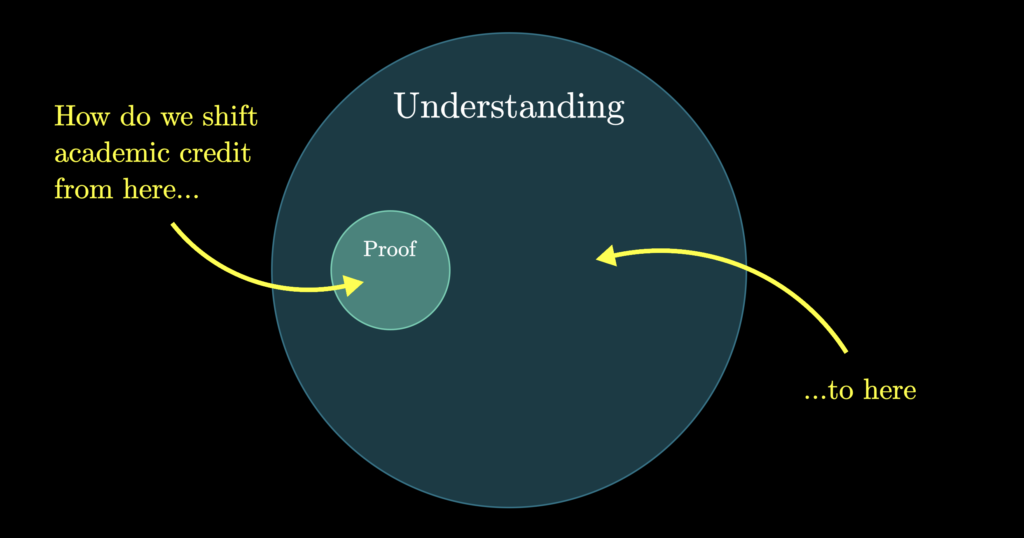
The guidelines address a broader problem than whether an AI system can produce a correct answer. Mathematical research requires distinctions between a correct conclusion, a valid proof, an understandable proof, and a genuinely novel contribution. A technically valid argument may still be difficult for researchers to interpret or extend, while an understandable proof may turn out to reproduce an earlier result or rely on assumptions that were not initially made clear. AGMAI’s framework therefore emphasizes how AI-generated work should enter the shared research record rather than treating model performance as sufficient evidence of mathematical value.
A central distinction is between work that responsible human researchers understand and output that has not yet reached that state. The support reported for this distinction was a plurality, which should not be described as unanimity or automatically as an absolute majority. More importantly, the classification concerns the current condition of the mathematics rather than whether AI participated in creating it. A researcher might use a model to suggest a crucial lemma and then independently reconstruct, verify, and explain the full argument, while another laboratory might possess a lengthy machine-generated candidate proof that its own operators cannot yet properly assess. Calling both merely “AI-assisted mathematics” hides a major difference in human accountability.
AGMAI’s recommendations are advisory rather than mandatory. The group states that it has no decision-making authority over AI companies, which remain responsible for their own publication choices. A journal, research institute, or funding body could independently adopt similar expectations, but those requirements would derive from the institution’s policy rather than AGMAI possessing regulatory authority. Likewise, saying a release follows AGMAI-style practices would not prove that a journal accepted it, referees verified it, or the mathematical community endorsed its significance.
Human responsibility remains central to work presented as understood mathematics. Researchers should be able to explain why substantial steps follow, identify where assumptions enter the argument, and respond meaningfully to objections. This does not require every exploratory calculation to have been performed manually. Models and software can suggest substitutions, test examples, simplify expressions, or help search for ideas while the responsible authors still understand the finished proof. However, asking one model whether another model’s output is correct would not itself demonstrate human understanding.
The same principle applies to authorship. The European Mathematical Society independently requires authors to take responsibility for their work and acknowledge AI tools used in content creation, while the Committee on Publication Ethics states that AI systems cannot qualify as authors because they cannot take responsibility for a submission. A human author should therefore represent meaningful accountability rather than simply the person who initiated generation. If an argument divides by a quantity that might be zero, for example, someone must recognize that possible failure and explain whether the hypotheses exclude it or whether another case must be handled separately. Fluent mathematical prose cannot substitute for that responsibility.
Peer Review, Human Understanding, Attribution and Responsible Release of Unresolved AI Proofs
AGMAI recommends that human-understood AI-assisted results enter mathematics through ordinary scholarly practices, including preprints, journal peer review, and explanatory talks. The European Mathematical Society similarly asks referees to consider correctness, significance, novelty, and clarity, which are separate judgments rather than interchangeable forms of approval. Establishing that a proof is valid does not show that the theorem is new, while establishing novelty does not guarantee that the proof is understandable or well presented.
For technically demanding work, editors could seek complementary expertise where appropriate, such as mathematical specialists who understand the surrounding subject and formalization specialists who can inspect machine-checkable artifacts. That is a possible implementation rather than a staffing requirement from AGMAI. Review confidentiality also remains important. The EMS code restricts uploading confidential manuscripts or reports to external services and requires disclosure when AI contributes to referee-report content. An AI-generated review should not be treated as independent expert judgment simply because it appears detailed or technically sophisticated.
AI-generated mathematics that humans do not yet fully understand requires a different release pathway rather than automatic suppression or automatic acceptance. AGMAI supports responsible release followed by community-led understanding. A useful release should clearly separate the proposed theorem, the available proof or artifact, the checks already completed, and unresolved questions. Saying that a formal artifact has passed particular checks while the correspondence between the formal theorem and intended informal claim remains under examination communicates a very different evidential state from saying a specialist has independently reconstructed and understood the argument.
A lengthy output may also benefit from orientation for outside researchers. If a hypothetical 200-page proof contains unfamiliar constructions, researchers need to know which portions appear central, which dependencies have already been examined, and where ambiguity remains. A visible list of unresolved issues could distinguish a disputed lemma from an unchecked dependency or missing citation, preventing progress on one problem from being mistaken for resolution of the entire proof. The public record should also be updated when an error is discovered or an uncertainty is resolved. “Not yet understood” should be treated neither as shorthand for falsehood nor as a certificate of correctness. It describes the current limit of human assessment.
Accurate attribution is equally important. AGMAI recommends tracing earlier ideas and crediting relevant sources even when a model independently rediscovers them, while the EMS publication code similarly emphasizes novelty checking and correction of missing attribution. A newly generated proof of a known theorem is not the same contribution as a new theorem, and a reformulation of an existing lemma may derive its real value from a new application rather than from the lemma itself. Mathematical announcements should make those distinctions explicit.
Contributor roles also deserve precision. One researcher may formulate the problem, another locate a crucial reference, another verify the argument, and another build a formal proof. The mathlib initiative’s metadata practices provide an example of distinguishing bibliographic authors from other contributor roles such as problem proposers or editors. Recording the actual contribution of each person is more informative than assigning identical authorship meaning to everyone involved.
Clear theorem statements and conventional exposition are fundamental because precision determines what has actually been proved. A statement such as “every continuous real-valued function is bounded” is false without an appropriate domain restriction, while restricting the function to a compact interval changes the proposition substantially. A missing assumption is therefore a mathematical defect, not merely a stylistic issue. Good exposition should separate main claims from supporting lemmas, new arguments from imported results, and examples from general reasoning, while explaining the core obstacle and central idea before burying readers in technical machinery.
Transparency, Version Tracking and Formal Verification for AI-Generated Mathematical Research
AGMAI recommends releasing mathematical work through repositories that are independent of individual laboratories, persistently citable, versioned, and preferably able to support public discussion. Version preservation matters because mathematical claims can change materially between drafts. arXiv, for example, retains earlier submitted versions and asks authors to describe changes when replacing an article. This illustrates the value of version tracking without implying that depositing a paper on arXiv constitutes peer review.
A useful AI-mathematics record could connect each manuscript version with its matching formal artifact, explanatory notes, and correction history. Without that linkage, a reader might accidentally compare a revised theorem with an obsolete proof file. Correction records should describe mathematical changes rather than merely announcing that a document was updated. Stating that a theorem’s hypotheses were restricted and the proof of a central lemma replaced gives later researchers meaningful information about whether their own work still relies on a valid version of the result. This approach also fits broader FAIR principles emphasizing persistent identification, metadata, provenance, and reusable research objects.
Transparency should extend to the AI process itself. AGMAI recommends disclosures covering models, prompts, summarized reasoning, runtime, estimated computational costs, and, where appropriate, original outputs. A reasoning summary does not require publishing an unrestricted internal transcript. It can instead provide a clearly labeled account of what the system attempted, which external tools were used, what humans changed, and where intervention occurred, without pretending to reveal internal mechanisms that are not actually observable.
Computational reporting should also use meaningful units. If 100 workers run for two hours, that represents 200 worker-hours and is not equivalent to a single worker running for two hours, even though both experiments have the same wall-clock duration. NeurIPS’s research checklist provides relevant precedent by asking about computing resources and distinguishing the reported experiments from additional computation used during development, including unsuccessful attempts. AI mathematics could similarly separate discovery costs, verification costs, formalization costs, and exposition costs rather than presenting one undifferentiated number.
Human intervention deserves comparable detail. Providing the original problem, suggesting a decisive lemma, repairing a broken proof step, and correcting typography are very different contributions. A transparent account should distinguish these without implying that either minimal or extensive human involvement automatically determines the value of the resulting mathematics. Procedural transparency should also be kept separate from reproducibility, since publishing a prompt is not sufficient for independent repetition when the model, toolchain, or computational resources are unavailable to other researchers.
Formal verification can provide especially strong evidence, but only about the claim that has actually been encoded. AGMAI recommends formalizing proofs where feasible and documenting artifacts with copyright headers, Comparator challenge files, and formalization.yaml, while clearly disclosing incomplete formalization if completing it would unacceptably delay release. Assumed standard results should also be identified rather than hidden inside the checking process.
Lean illustrates why details matter. Its sorry mechanism can fill arbitrary proof obligations and is not intended for completed proofs, while #print axioms can expose the direct and indirect axioms on which a theorem depends. Comparator addresses another issue by checking whether a submitted solution matches an independently specified challenge under defined trust assumptions, including selected theorem statements, allowed axioms, and kernel acceptance. Meanwhile, formalization.yaml records information such as provenance, process, and fidelity but is metadata rather than a proof certificate.
Even a fully checked artifact requires interpretation. Formally proving a claim for a finite collection does not establish a statement about every possible object, and adding an extra assumption may yield a valid theorem weaker than the one advertised informally. Conditional formalizations can still be valuable, but readers should know which dependencies were assumed and whether those assumptions faithfully match established results. Formal verification is therefore powerful evidence for an encoded argument, while novelty, significance, and correspondence with the intended theorem remain separate questions.

Failed Attempts, AI Marketing, Funding Human Understanding and Equitable Access to Mathematical AI
AGMAI recommends documenting problem selection and the AI workflow, especially when laboratories publish batches of apparent mathematical successes. Counting solved problems without describing the denominator can create a misleading impression of capability. Ten solved problems selected from ten attempts and ten successful results selected from a thousand trials produce the same headline number but support very different interpretations of reliability.
Even those ratios require context. Researchers should explain whether problems were randomly selected, chosen because they matched existing tools, filtered by humans, or reformulated repeatedly before success. Computational budgets should also be comparable if results are being compared. A timeout, an invalid proof, and a solution to a weaker theorem are all forms of unsuccessful attempts, but none demonstrates that the original proposition is false. Similarly, proving several consequences of one central lemma is not necessarily equivalent to solving the same number of unrelated problems. The counting rules should therefore be explained before readers draw broad conclusions about model performance.
This connects directly to AGMAI’s warning against using mathematical breakthroughs primarily as AI marketing. A valid solution to one difficult problem does not demonstrate reliable capability across mathematics as a whole, and the age or prestige of a problem does not automatically provide a controlled benchmark for general intelligence. Overstated announcements can also impose costs on researchers, who may feel pressure to publicly evaluate a result before its central arguments have been carefully checked. The EMS publication code independently cautions against announcing possible new theorems without being ready to provide supporting details promptly.
Responsible communication does not require suppressing excitement. An announcement can explain why a theorem matters while clearly distinguishing the mathematical claim, supporting evidence, and review status from broader claims about model performance. The strongest statement about progress is one that remains accurate after specialists have examined the details rather than one optimized for immediate publicity.
AGMAI also argues that laboratories generating difficult mathematics should help fund the human work required to understand it, with the amount of support reflecting the importance and complexity of the result. It proposes that independent nonprofit organizations rather than the AI laboratories or AGMAI itself should select supported projects. Potential activities include workshops, summer schools, working groups, student or postdoctoral support, and explanatory writing. Receiving this support should not be interpreted as endorsing the laboratory’s wider practices.
Different results may require different forms of investment. One team might reconstruct a difficult proof, another explain connections to established methods, while another creates teaching material that allows a larger group of researchers to engage with the ideas. For an unfamiliar proof technique, a careful exposition may be more useful than another benchmark comparison, while an ambiguous formalization may need a detailed statement audit before public presentations. The relevant measure is whether funding makes the mathematics more understandable and usable, not how many promotional events it generates. This approach is consistent with broader open-science principles emphasizing investment in infrastructure, human resources, training, and research capacity.
Finally, AGMAI raises concerns about testing advanced mathematical problems on proprietary models that the research community cannot meaningfully access. Equitable access involves more than allowing researchers to read the resulting paper. Researchers need practical opportunities to investigate, challenge, adapt, and extend the methods that produced it. Two institutions may nominally have access to the same hosted model while having dramatically different research opportunities if one can afford hundreds of experiments and the other only a few.
Possible approaches include research credits, affordable institutional access, transparent allocation procedures, and targeted support for researchers with limited infrastructure, although these are implementation possibilities rather than a single commercial arrangement prescribed by AGMAI. Equitable access should also not be confused automatically with downloadable model weights. A hosted service could provide meaningful research access without releasing weights, while downloadable software could remain practically inaccessible because of extreme hardware requirements. The more useful question is whether researchers can realistically use the system to reproduce, challenge, and extend mathematical results rather than merely observe finished outputs.

Frequently Asked Questions (FAQs)
- When were AGMAI’s AI-generated mathematics guidelines published?
AGMAI published its recommendations on September 29, 2026. The guidance addresses how AI-generated mathematical work should be released, reviewed, explained, attributed, and documented so that machine-assisted discoveries can enter the research record with appropriate scrutiny and accountability. - Can AGMAI force an AI company to follow its advice?
No. AGMAI explicitly states that it has no decision-making authority over AI companies. Its recommendations are advisory, meaning individual companies remain responsible for deciding whether and how to follow them, although journals, research institutes, or other organizations could independently adopt similar standards. - Can an AI tool take responsibility as a paper’s author?
No. COPE’s authorship position says AI tools cannot satisfy the requirement to take responsibility for submitted work. Human authors must remain accountable for the claims, arguments, corrections, and responses to criticism associated with a paper, even when AI contributed substantially to generating content. - Does posting a proof in a repository mean it passed peer review?
No. Uploading a proof to a repository or preprint server makes it publicly available, but it does not show that journal referees have examined and accepted it. Repository dissemination and formal peer review are separate stages, so readers should check the review status rather than treating public availability as evidence of validation. - Does successful formal verification establish the advertised theorem?
Only if the formally encoded statement actually matches the theorem being advertised and the underlying assumptions are acceptable. A proof assistant can verify a precisely stated formal claim, but that claim could still be weaker, differently scoped, or based on additional assumptions compared with the informal theorem described publicly. Comparator specifically treats statement matching and trust assumptions as important parts of the checking process. - Why do Lean proof placeholders matter?
Lean’s sorry mechanism allows development to continue even when a proof obligation has not yet been completed. That is useful during formalization, but a theorem containing such unresolved placeholders should not be treated as fully proved. Lean’s documentation explains that the underlying axiom used by sorry is not intended to remain in finished proofs. - Can a correct AI-generated proof lack novelty?
Yes. A proof can be completely valid while establishing a theorem or argument that was already known. That is why publication standards require checking existing literature and accurately crediting earlier work instead of assuming that an independently generated result is automatically new. - Does a failed AI attempt show that a conjecture is false?
No. Failing to find a proof does not amount to disproving a conjecture. The failure could result from an unsuitable search strategy, insufficient compute, a time limit, poor problem formulation, or limitations of the model rather than the mathematical statement being false. - Why report computation beyond the final successful run?
Because the successful run may represent only a small portion of the resources used to reach the result. Preliminary searches, failed attempts, reformulations, and checking can consume substantial computation, so including them gives a more meaningful picture of the total experimental cost. NeurIPS’s checklist reflects a similar distinction between reported experiments and additional project computation. - Is publicly available AI automatically equitably accessible?
No. A model can be publicly available while still being difficult for many researchers to use meaningfully because of cost, hardware requirements, limited credits, restricted allocations, or institutional access differences. Equitable access therefore depends on what researchers can realistically investigate, challenge, and extend, not merely whether a login page, API, or downloadable model exists.
Conclusion
The significance of this development is not that mathematics has acquired a single authority capable of approving every AI-generated proof. It is that publication practices must make the evidence behind mathematical claims easier to inspect. The decisive questions remain specific. What proposition was established? Which assumptions were used? What was independently checked? How does the contribution relate to earlier work? Can other researchers understand and build on it?
Neither enthusiasm for AI nor skepticism about it can answer those questions in place of examining the research. A valuable result should survive precise description, transparent scrutiny, and correction when necessary. The most productive standard for AI-generated mathematics is therefore not the volume of impressive announcements. It is whether those outputs become dependable, attributable, and usable additions to shared mathematical knowledge.
Sources and Citations
- AGMAI, Official Website : Official website of the Advisory Group on Mathematics and Artificial Intelligence, explaining its purpose, membership and approach to advising AI companies about mathematical research. It states that the group operates independently, accepts no payment for this work and has no decision making authority within AI companies. The website also publishes its recommendations and subsequent statements. agmai.org
Citation: Advisory Group on Mathematics and Artificial Intelligence. (AGMAI) - AGMAI, Responsible Release Guidelines, September 29, 2026 : Recommendations informed by more than 600 survey responses, distinguishing papers understood by a responsible mathematician from outputs still awaiting human understanding. They address attribution, readable proofs, research process disclosures, formalisation, versioned repositories and funding for community led interpretation. The document also advocates equitable access to models and objects to testing advanced problems on inaccessible proprietary systems. agmai.org
Citation: Responsible Release of AI Generated Mathematics. (AGMAI) - European Mathematical Society, Publication Code of Practice, March 19, 2025 : Official ethical guidance covering authors, editors, reviewers and publishers of mathematical research. It addresses originality, attribution, corrections, conflicts of interest and responsibility for correctness. The code explicitly requires authors to acknowledge AI or other automated tools used to create content and describe their use, while retaining full responsibility for the work. euromathsoc.org
Citation: EMS Code of Practice for Mathematical Publication. (European Mathematical Society) - Committee on Publication Ethics, Authorship and AI Tools, February 13, 2023 : Official position explaining that AI tools cannot qualify as authors and that human authors remain responsible for manuscript content, including material produced using AI. It also calls for transparent disclosure of how such tools were used. These points were checked against indexed COPE material because direct access to the complete page was restricted. Publication Ethics
Citation: Authorship and AI Tools. (COPE) - Lean, Official Axioms Documentation : Technical reference explaining axiom declarations, consistency and the assumptions underlying formal proofs. It documents the
#print axiomscommand, which reports direct and indirect dependencies and can reveal reliance on unfinished proofs represented bysorry. This supports careful auditing of formal verification claims rather than assuming that every accepted Lean declaration constitutes a complete proof. Lean Language
Citation: Axioms: Lean Language Reference. (Lean) - Lean, Official Theorem Prover and Programming Language Website : Official introduction to Lean’s use in writing formal proofs, specifying mathematical statements and verifying software. It explains the role of its checking kernel, extensible notation and proof automation, while providing installation instructions, learning resources and examples of research projects. This establishes the tool’s capabilities rather than certifying any particular submitted proof. Lean Language
Citation: Lean Official Website. (Lean) - Lean Community, Mathlib Library and Documentation : Official community resource introducing mathlib as a shared library of mathematics formalised in Lean. It links to library overviews, contribution guidelines, research projects and searchable documentation, helping readers locate existing definitions and theorems used by formal proofs. The direct documentation link below supplements the broader Mathlib homepage supplied. mathlib.org
Citation: Lean and Its Mathematical Library and Mathlib API Documentation. (Lean Community) - arXiv, Replacement and Versioning Guidance : Official instructions explaining how authors revise an announced paper while preserving its publication history. The guidance asks authors to describe changes, explains when replacements receive new version numbers and confirms that previous versions remain publicly available. It also identifies limited exceptions for adding journal references and DOI information, supporting transparent correction and citation practices. info.arxiv.org
Citation: Submit a New Version of a Work. (arXiv) - NeurIPS, Paper Checklist Guidelines and 2026 Submission Requirements : Official checklist covering accurate claims, limitations, theoretical assumptions, complete proofs, reproducibility, research ethics and societal impact. The 2026 Main Track Handbook confirms the checklist requirement and authors’ responsibility for their submissions. The working checklist address below replaces the unavailable year specific link and explains that justified “no” answers are not automatically grounds for rejection. NeurIPS
Citation: NeurIPS Paper Checklist Guidelines and NeurIPS 2026 Main Track Handbook. (NeurIPS) - UNESCO, Recommendation on Open Science, November 23, 2021 : Official international recommendation promoting access to scientific knowledge, transparency, reproducibility and equitable participation in research. It emphasises accountability, collaboration and opportunities for researchers regardless of geography or resources. This provides a broader policy foundation for discussions about sharing mathematical research and supporting human understanding, rather than a technical standard for checking individual proofs. UNESCO
Citation: Recommendation on Open Science. (UNESCO) - GO FAIR Foundation, FAIR Guiding Principles : Reference explaining how digital research resources can be Findable, Accessible, Interoperable and Reusable through persistent identifiers, descriptive metadata, standard protocols, clear licences and documented provenance. It explicitly allows authentication and authorisation where necessary, so FAIR does not mean that every resource must be unrestricted. The supplied address now redirects to the foundation’s page below. GO FAIR Foundation
Citation: The FAIR Guiding Principles. (GO FAIR Foundation)
Recommendations
- How do I export a camera from Blender to another software?
- The open beta for Mortal Shell II is available now on consoles
- 3D Hair Assets for Visual Storytelling and Virtual Identities: Best Practices for Interactive Media, Customization, Fashion, and Digital Twins
- Meccha Chameleon Becomes 2026’s Breakout Best-Selling Game
- Kingdom Hearts HD 1.5+2.5 ReMIX Hits #2 on US Steam Sellers After KH4 D23 Trailer
- Cat Mail Co. Beginner Guide: 9 Essential Tips for Your First Shifts
- Hyper-Realistic CGI Steam: Blender, Houdini, Cinema 4D & Unreal Engine Real-Time Simulation Guide (Free & Paid Tools)
- Kingdom Hearts IV Targets Late 2027: Voice Acting Update and 25th Anniversary Exhibition
- Cinematic From Cancelled Star Wars KOTOR Remake Leaks Online: What the Footage Shows
- Fallout: New Vegas Dev Obsidian’s Projects in Doubt After Xbox Layoffs



































































































