









In This Article (8 sections)
AMD’s 2027 Outlook: A Weaker PC Market and a Rapid Shift Toward AI Data Centers
The company expects another difficult year for the global PC market in 2027, even as its data center business becomes the main driver of growth. Management has warned that global personal computer shipments could decline by a double-digit percentage, meaning unit shipments may fall by at least 10%. No more precise percentage or verified forecast for every region was provided, but the planning assumption shows that leadership is preparing for a weak desktop and laptop market rather than assuming a quick recovery.
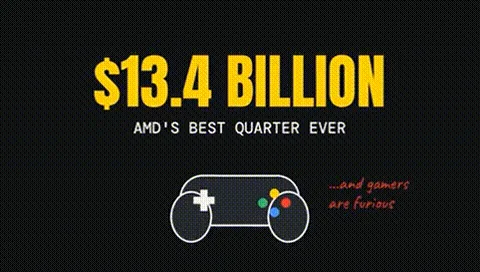
The warning came after the third-quarter 2026 earnings announcement on November 3, when the semiconductor manufacturer reported record quarterly revenue of $13.377 billion, up from $9.246 billion in the third quarter of 2025. That represented about 45% year-over-year growth and marked a new quarterly revenue record. Profitability also improved, with GAAP gross profit rising to approximately $7.21 billion from $4.78 billion a year earlier. GAAP gross margin increased from 52% to 54%, while GAAP operating income reached about $2.83 billion, up 123% from the same quarter in 2025. Net income rose to roughly $2.43 billion from $1.24 billion, and GAAP diluted earnings per share increased from $0.75 to $1.46.
On a non-GAAP basis, the company reported a gross margin of 56%, operating income of about $3.9 billion, net income of about $3.5 billion, and diluted earnings per share of $2.09. These figures show that growth was not only the result of higher shipments, but also reflected stronger earnings and a more profitable revenue mix. The strongest performance came from the Data Center segment, which generated approximately $8.55 billion in quarterly sales. The Client and Gaming segment produced about $3.72 billion, an 8% decline from the previous year, while the Embedded segment contributed approximately $1.11 billion, up 29% year over year.
Management also issued an aggressive outlook for the fourth quarter of 2026. It projected revenue of approximately $17 billion, plus or minus 3%. At the midpoint, that would imply about 66% year-over-year growth and 27% sequential growth from the third quarter. The company also expected non-GAAP gross margin of approximately 55%. These projections indicate expectations of further acceleration rather than a slowdown heading into 2027.
The contrast between weakening PC demand and fast data center growth reflects a major transformation in the business. CEO Lisa Su said rising memory prices, expensive computer components, and cautious consumer demand have created difficult conditions for traditional PCs. At the same time, cloud computing providers, enterprise technology companies, and artificial intelligence developers continue investing heavily in advanced infrastructure. The company expects overall revenue growth of more than 80% in 2027, with data center products accounting for more than 80% of total sales. That outlook suggests a shift from a business historically associated with consumer processors and gaming hardware into a major supplier of AI computing infrastructure.

Why the PC Market Is Expected to Weaken, and What It Means for Ryzen, Gaming, and Computer Prices
The forecast for a double-digit decline in PC shipments is based on several connected pressures. Memory and component prices have increased, raising the cost of producing complete computer systems. PC manufacturers must decide whether to absorb higher costs through lower profit margins or pass them on to buyers through higher retail prices. At the same time, price-sensitive consumers are becoming more reluctant to replace working computers. For many households, a new laptop or desktop is a discretionary purchase that can be delayed when economic conditions are uncertain.
Businesses are also reassessing technology investments. Enterprise customers may continue buying premium computers, but procurement decisions increasingly depend on replacement schedules, productivity needs, security requirements, and available capital. The company also reported that PC sell-through weakened toward the end of the third quarter of 2026. Sell-through refers to products purchased by final customers, making it an important indicator of real demand rather than shipments into retail and distribution channels. Management is responding by managing inventory carefully and aligning shipments more closely with customer purchases.
Rising memory prices are especially important because memory is essential in nearly every modern computer. Desktops and laptops require system memory to run applications, manage active workloads, and maintain responsive performance. They also commonly use NAND flash memory for solid-state storage. When these costs rise, the total cost of a PC can increase even if processor prices remain stable.
The broader semiconductor industry is also experiencing strong demand for memory used in AI systems. High-bandwidth memory, commonly called HBM, is critical for advanced AI accelerators because it allows large volumes of data to move quickly between memory and processing hardware. HBM is different from the conventional memory used in consumer PCs, but supplier investment priorities, production constraints, and fabrication capacity can still affect broader memory market conditions.
For PC manufacturers, higher component costs can lead to several outcomes:
- Retail prices may rise, making new computers less attractive.
- Manufacturers may reduce specifications to protect margins.
- Budget and midrange systems may offer less memory or storage than buyers expect.
- Retailers may face slower inventory turnover as customers delay purchases.
- Businesses may extend replacement cycles if existing devices remain secure and reliable.
A weaker PC market does not automatically mean computers will become cheaper. Manufacturers may offer promotions, retailers may discount unsold inventory, and competition could lower prices for selected models. However, rising component costs may offset those discounts. Budget laptops may be especially vulnerable if prices rise or specifications are reduced. Midrange systems could also face pressure because buyers often expect strong memory and storage configurations at reasonable prices. Premium systems may be better able to absorb cost increases, but they are not immune to weaker demand.
The effect on desktop systems could be more complicated because buyers often purchase components separately. A desktop processor may remain competitively priced while memory, storage, graphics hardware, or other parts become more expensive. As a result, the total cost of building a computer could increase even without a major CPU price change. For buyers considering a new system in 2027, the important factors will include total system cost, memory capacity, storage needs, upgrade options, warranty coverage, and expected useful life.
Lisa Su described the 2027 PC outlook as a practical response to market conditions, not a sign that personal computing is becoming irrelevant. Management expects the overall PC market to decline, but believes the company can outperform the broader industry. That means it could gain processor share even if total PC shipments fall. The business is focusing on enterprise systems, premium consumer devices, and desktop distribution channels where its processor technology may offer stronger competitive advantages.
Ryzen remains central to the product portfolio. The warning about weaker PC shipments does not mean the company intends to abandon consumer processors. Ryzen continues to serve laptops, desktops, gaming systems, workstations, and commercial devices. In enterprise computers, the manufacturer must compete on more than benchmark performance. Commercial buyers value security, reliability, manageability, software certification, energy efficiency, and long-term platform support. In premium consumer devices, powerful CPUs, capable integrated graphics, efficient power management, and dedicated AI processing features can appeal to professionals, creators, developers, students, and users seeking longer device lifespans. For desktop users, Ryzen processors remain relevant for gaming, content creation, software development, and demanding productivity applications.
The Gaming business showed more pressure in the third quarter of 2026. Gaming revenue fell to $773 million from approximately $1.30 billion in the same period of 2025, a decline of about 40%. Management attributed the decrease to lower semi-custom and graphics revenue. Semi-custom products include specialized chips used in gaming consoles and other customer-specific systems, where demand can vary depending on hardware lifecycles, production schedules, and consumer purchasing patterns.
The decline does not necessarily mean consumer spending on video games fell by the same amount. Radeon graphics also face competitive pressure from Nvidia GeForce products, with buyers evaluating gaming performance, pricing, power efficiency, memory capacity, driver quality, and supported features. The gaming results show how uneven the business has become, with data center products growing rapidly while consumer graphics and console-related operations face a tougher environment.
How AI Data Centers Are Driving AMD’s Growth Through EPYC, Instinct, ROCm, and Helios
The biggest change in AMD’s third-quarter 2026 results was the rapid expansion of its Data Center segment. Revenue increased from approximately $4.34 billion in the third quarter of 2025 to about $8.55 billion in the third quarter of 2026, representing 97% year-over-year growth. Data Center operating income also rose sharply to approximately $2.88 billion from about $1.07 billion a year earlier, an increase of roughly 168%. The segment accounted for about 64% of AMD’s total quarterly revenue, up from about 47% in the same quarter of 2025. This shift shows how quickly AMD’s revenue mix is changing.
The growth was driven mainly by two product families: EPYC server CPUs and Instinct AI GPUs. EPYC processors are designed for enterprise servers, cloud platforms, virtualization, high-performance computing, databases, networking services, virtual machines, and other general-purpose data center workloads. They compete in a market historically dominated by Intel Xeon processors and are positioned around core count, memory bandwidth, connectivity, performance efficiency, and workload consolidation. Cloud providers use server CPUs to run applications and infrastructure services that continue growing even outside the AI accelerator market.
Instinct GPUs serve a different but complementary role. They are designed for computationally intensive workloads such as AI training and inference. AI training involves processing large datasets to adjust the parameters of machine learning models, which requires substantial parallel processing power. Inference occurs when a trained model generates answers, predictions, recommendations, analysis, or other outputs. As AI adoption expands, inference becomes a recurring operational cost because businesses need infrastructure that can handle large numbers of requests efficiently.
Modern AI data centers often depend on CPUs and GPUs working together. EPYC processors handle general-purpose computing tasks, coordinate accelerator workloads, manage applications, and operate the wider infrastructure. Instinct GPUs accelerate the mathematical operations associated with neural networks. Even the fastest accelerator can be limited if data movement, memory management, networking, or scheduling creates bottlenecks. This is why AMD is increasingly developing integrated platforms that combine CPUs, GPUs, networking, memory, and software rather than competing only on individual chip specifications.
AMD’s broader data center strategy includes several major components:
- EPYC server CPUs for cloud, enterprise, virtualization, and general-purpose computing.
- Instinct AI accelerators for training, inference, and high-performance workloads.
- Pensando networking technology for data movement and infrastructure connectivity.
- ROCm software to support machine learning frameworks and optimization tools.
- Helios rack-scale systems for integrated AI infrastructure deployments.
Software is especially important. AMD’s ROCm platform is intended to help developers use supported machine learning frameworks and optimization tools on AMD accelerator hardware. Without reliable software compatibility, hardware performance may not translate into real-world adoption. This is one of the reasons AMD is trying to offer a more complete infrastructure stack instead of selling only individual chips.
AMD Helios is one of the company’s most significant AI infrastructure initiatives. Rather than focusing only on individual processors, Helios combines multiple technologies into an integrated rack-scale reference architecture designed for large AI workloads. The reference design includes AMD Instinct MI455X accelerators, sixth-generation EPYC Venice processors, Pensando networking technology, and ROCm software. AMD has described a configuration containing 72 Instinct MI455X GPUs. The system is designed to support demanding AI training, inference, and other computationally intensive applications.
Helios also emphasizes open industry standards. AMD developed the architecture around the Open Rack Wide design associated with the Open Compute Project, and the system uses technologies intended to support high-speed accelerator communication and efficient networking. Helios is a reference design rather than a single fixed retail product sold directly to every customer. Original equipment manufacturers and original design manufacturers can use the architecture to create complete systems, meaning commercial products may differ in configuration, deployment arrangements, and supporting infrastructure.
The MI455X accelerator is designed around AMD’s next-generation CDNA architecture and high-bandwidth memory technology. AMD’s published specifications describe substantial memory capacity and bandwidth for large AI models, although theoretical performance should not be treated as the same as measured performance across every production workload. Actual results depend on software, model architecture, numerical precision, networking, and system configuration. In October 2026, AMD confirmed that initial Helios systems had been installed and were undergoing testing at Meta. Its third-quarter earnings commentary also identified major technology companies running models or workloads on initial Helios systems.
AMD’s relationships with major technology companies support its data center growth. The company has identified Meta, Microsoft, OpenAI, Anthropic, and Oracle among the organizations involved in its expanding data center ecosystem. These relationships represent major commercial opportunities because large technology companies can deploy infrastructure at significant scale. However, announced partnerships and deployment plans should not be treated as guaranteed future revenue. Actual sales depend on hardware shipments, customer acceptance, infrastructure readiness, software performance, and contractual arrangements.
AMD’s decision to prioritize data centers reflects the financial opportunity in high-performance computing and AI infrastructure. The traditional consumer PC market remains important, but it is mature and sensitive to replacement cycles, retail pricing, and economic conditions. By contrast, AI infrastructure is attracting major investment from technology companies seeking more computing capacity. Advanced AI systems can involve thousands of processors and accelerators, sophisticated networking equipment, and extensive supporting infrastructure. These deployments can create large revenue opportunities and deeper long-term relationships with cloud and enterprise customers.

AMD’s 2027 Growth Forecast, Nvidia Competition, and What It Means for Investors and Consumers
AMD’s 2027 financial outlook is unusually ambitious. During the company’s third-quarter 2026 earnings call, Lisa Su indicated that AMD expects overall revenue growth of more than 80% in 2027. The projection reflects management’s confidence in accelerating demand for data center infrastructure, especially EPYC server processors and Instinct AI accelerators. This forecast is separate from AMD’s expected PC market decline. AMD expects PC unit shipments to contract, while total corporate revenue could still expand substantially because data center products carry much larger growth potential.
Management expects data center operations to contribute more than 80% of AMD’s total revenue in 2027. That would be a major increase from the approximately 64% share recorded in the third quarter of 2026. The company also expects strong server CPU growth and even faster expansion in data center AI products. These expectations are based on customer demand, product deployment schedules, and the anticipated expansion of AMD’s computing platforms. If AMD achieves its fourth-quarter 2026 guidance of about $17 billion in revenue, it would show continued acceleration heading into 2027.
The forecast still carries significant execution risks. Semiconductor manufacturing depends on complex global supply chains involving foundries, advanced packaging, memory suppliers, and specialized equipment. High-bandwidth memory availability is especially important for AI accelerators. Large-scale infrastructure deployments also require adequate electricity, cooling capacity, networking infrastructure, and physical data center space. Customers may delay deployments if any of these requirements are unavailable. Revenue recognition can also be uneven when large infrastructure projects move between quarters.
Competition is another major uncertainty, especially from Nvidia. Nvidia has built a powerful position in accelerated computing through its GPU architectures, CUDA software ecosystem, networking technologies, and integrated data center platforms. CUDA has extensive developer adoption and broad support across machine learning frameworks, research projects, and commercial applications. Organizations that already operate major Nvidia infrastructure may face costs and complexity when adopting another hardware platform.
AMD is trying to strengthen its position by offering competitive accelerator hardware, open software technologies, and comprehensive rack-scale infrastructure. ROCm is intended to reduce software barriers and make AMD accelerators more practical for customers seeking alternatives. AMD also emphasizes open infrastructure standards that can promote interoperability and give customers more flexibility. For large cloud providers, having multiple accelerator suppliers can be strategically valuable because depending on one supplier may create pricing pressure, availability constraints, and operational risk.
However, AMD’s strong revenue growth should not be confused with confirmed market leadership. Nvidia remains a formidable competitor, and quarterly growth rates alone do not establish comparative market share. AMD must prove that its systems can deliver competitive performance consistently across real production workloads. Helios is especially important because it shifts the competition from individual accelerators to complete AI computing systems. Nvidia has also developed integrated rack-scale architectures that combine processors, accelerators, networking, and software. The outcome will depend on performance, energy efficiency, reliability, software support, deployment complexity, and total system economics.
For AMD, success does not require displacing Nvidia everywhere. Capturing a meaningful share of the expanding AI infrastructure market could still produce substantial revenue growth, even if Nvidia retains a leading position overall. Customers may also deploy infrastructure from multiple suppliers depending on workload requirements. AMD’s opportunity is tied to its ability to provide competitive total system economics, including compute performance, memory capacity, power efficiency, networking, cooling, software compatibility, and operating cost.
For investors, AMD’s outlook presents both opportunity and risk. The third-quarter results show that AMD can generate strong revenue and earnings growth when data center demand accelerates. Record Data Center revenue, improved profitability, and the ambitious 2027 forecast support management’s growth strategy. At the same time, investors must evaluate whether this rapid expansion is sustainable. Data center demand can be influenced by the spending decisions of a relatively small number of major technology companies, which can create revenue concentration risk. Manufacturing constraints, competitive pressure, product delays, pricing changes, and economic conditions could all affect future results. Valuation also matters, since strong revenue growth does not automatically make a stock attractive at every price.
For consumers, the outlook is more complicated. A declining PC market could produce discounts in some categories, but rising component costs may offset those benefits. Laptop and desktop buyers may face higher prices or less attractive specifications, especially in budget-oriented systems. At the same time, continued competition among processor manufacturers could improve performance, energy efficiency, and features in selected devices. AMD’s focus on premium Ryzen systems and commercial computing may also support stronger products in higher-value categories.
Business customers could benefit from AMD’s continued improvements in EPYC server technology and from the availability of more AI infrastructure suppliers. Competitive alternatives can provide more flexibility when planning large technology investments. For the wider semiconductor industry, AMD’s outlook illustrates a broader structural shift. Artificial intelligence is increasingly influencing manufacturing investment, memory allocation, product development, and corporate financial priorities. The industry is no longer driven mainly by traditional demand cycles in PCs and smartphones. Large-scale AI computing has become a major source of growth, creating major opportunities along with new operational and financial risks.
AMD’s long-term success will depend on maintaining competitiveness across several markets while executing its increasingly ambitious data center strategy. The company must continue serving valuable PC, gaming, and enterprise client segments while scaling AI infrastructure products, managing supply constraints, competing with Nvidia and other rivals, and proving that its integrated platforms can perform reliably in large production environments.

Frequently Asked Questions (FAQ)
- Why does AMD expect the PC market to decline in 2027?
AMD expects global PC unit shipments to decline by a double-digit percentage in 2027 mainly because higher memory and component costs are making computers more expensive to build and buy. When laptop and desktop prices rise, many consumers and businesses delay upgrades, especially if their existing devices still meet their needs. CEO Lisa Su said AMD is managing inventory carefully, which suggests the company is preparing for weaker demand and avoiding excess supply. Even so, AMD believes it can perform better than the overall PC market by focusing on competitive Ryzen processors, premium consumer devices, enterprise PCs, and desktop systems where it still sees opportunities to gain market share. - How much revenue did AMD generate in the third quarter of 2026?
AMD reported record revenue of approximately $13.4 billion in the third quarter of 2026, a 45% increase from the same period in 2025. The company also reported GAAP net income of around $2.43 billion and diluted earnings per share of $1.46, while non-GAAP diluted earnings per share reached $2.09. These results show that AMD was not only growing revenue but also converting a significant portion of that growth into profit. The main driver was the Data Center segment, which generated about $8.55 billion in revenue as demand for AI and server products continued to rise. - How fast is AMD’s data center business growing?
AMD’s Data Center business grew very quickly in the third quarter of 2026, with revenue rising 97% year over year to approximately $8.55 billion. This means the segment nearly doubled compared with the same quarter a year earlier. Growth came from strong demand for AMD EPYC server CPUs and Instinct AI accelerators, both of which are used in cloud computing, enterprise servers, and artificial intelligence infrastructure. The segment also produced about $2.88 billion in operating income, showing that data center products are becoming a major source of both revenue and profit for AMD. - What is AMD’s expected revenue growth for 2027?
AMD management expects total revenue growth of more than 80% in 2027, with the biggest contribution coming from data center processors and artificial intelligence accelerators. The company also expects data center operations to represent more than 80% of total revenue, showing how central AI and cloud infrastructure have become to AMD’s strategy. However, these projections are forward-looking and depend on several factors, including product execution, customer demand, semiconductor supply, competitive pressure, and broader economic conditions. In other words, AMD is optimistic, but the forecast is not guaranteed. - Will AMD stop making Ryzen processors because the PC market is declining?
No. AMD has not said it will stop making Ryzen processors because of the expected decline in the PC market. Ryzen remains important to AMD’s consumer and commercial computing business, especially in laptops, desktops, and enterprise PCs. The company appears to be shifting more attention and investment toward data centers and AI, but that does not mean it is abandoning PCs. Instead, AMD is likely to focus on the parts of the PC market where it believes it can still grow, such as premium systems, business computers, and performance desktop products. - Why is artificial intelligence so important to AMD’s future?
Artificial intelligence is important to AMD because AI workloads require massive amounts of computing power for training models, running inference, and supporting AI applications. AMD sells several products that are relevant to this market, including Instinct accelerators, EPYC server CPUs, networking technologies, and ROCm software. As large technology companies, cloud providers, and enterprises build more AI infrastructure, they need more advanced chips and complete computing systems. This creates a major growth opportunity for AMD, especially if customers want alternatives to existing dominant suppliers. - What is AMD Helios, and why does it matter?
AMD Helios is a rack-scale AI infrastructure reference design that combines AMD Instinct accelerators, EPYC server processors, Pensando networking technologies, and ROCm software into a complete system architecture. Its published design includes 72 Instinct MI455X GPUs and is built around open industry standards. This matters because AMD is trying to compete not just by selling individual chips, but by offering a full AI infrastructure platform that customers and manufacturing partners can deploy more easily. By providing a more complete solution, AMD can better compete for large AI data center projects. - Can AMD compete with Nvidia in the artificial intelligence chip market?
AMD can compete with Nvidia in parts of the AI chip market, especially as it expands its Instinct GPU lineup, improves ROCm software, and promotes integrated systems such as Helios. Nvidia still has major advantages, including a mature software ecosystem, strong developer adoption, and a large base of existing AI infrastructure. However, many large customers may want a second strong supplier to reduce dependence on one company, improve pricing leverage, and increase supply availability. AMD does not need to beat Nvidia in every area to succeed; even gaining a meaningful share of the fast-growing AI market could significantly boost its business. - Will laptop and desktop prices increase in 2027?
Laptop and desktop prices could remain under pressure in 2027 if memory and component costs continue to rise. PC manufacturers may respond by increasing retail prices, reducing specifications, or limiting discounts to protect profit margins. At the same time, weaker demand could push some retailers and brands to offer promotions, especially on older models or midrange systems. This means the impact may vary depending on the product type, region, brand, and configuration. AMD’s forecast does not mean every PC will become more expensive, but it does suggest affordability could remain a challenge for buyers. - Is AMD’s data center growth enough to offset weakness in gaming and consumer PCs?
AMD’s third-quarter 2026 results suggest that data center growth was strong enough to offset weakness in some consumer-related areas. Data Center revenue rose 97% year over year, while Client and Gaming revenue declined 8%, yet total company revenue still increased 45% to a record $13.4 billion. This shows how powerful the data center segment has become for AMD’s overall performance. However, whether this continues will depend on sustained AI demand, successful product launches, manufacturing capacity, customer adoption, pricing, and competition. Data center growth is clearly helping, but AMD still needs balanced execution across its major business segments.

Conclusion
AMD forecasts another PC market decline in 2027 and a surge in its data center business, revealing how fundamentally artificial intelligence is reshaping the company’s financial performance and strategic priorities. The warning about double-digit PC shipment declines reflects growing pressure from expensive memory, higher component costs, and weakening consumer demand. These conditions are creating significant challenges for computer manufacturers, retailers, and buyers, who increasingly must balance performance requirements against affordability.
However, AMD’s third-quarter 2026 earnings demonstrate that weakness in traditional computing does not necessarily prevent strong corporate growth. Record revenue of approximately $13.4 billion, a 97% increase in Data Center sales, and substantial improvements in profitability illustrate the company’s accelerating participation in the AI infrastructure market. Its expanding portfolio of EPYC server processors, Instinct accelerators, Pensando networking products, and Helios rack-scale technology provides opportunities to serve increasingly complex computing requirements.
The company also expects revenue growth exceeding 80% in 2027, with data center products becoming an even larger part of its overall business. These projections illustrate the scale of the opportunity, but achieving them will require successful execution across manufacturing, software, supply chains, and customer deployments.
For consumers, AMD’s forecast suggests that affordability could remain a significant concern throughout 2027, particularly if memory and component costs remain elevated. For investors, the company’s accelerating AI infrastructure business offers substantial growth potential alongside risks involving competition, revenue concentration, and the sustainability of technology spending.
The most important development is AMD’s evolving identity within the semiconductor industry. While Ryzen processors and Radeon graphics products remain important, the company’s financial future is increasingly tied to the processors, accelerators, networking technologies, and integrated systems powering advanced artificial intelligence. Whether AMD achieves its ambitious 2027 outlook will depend on how successfully it converts strong customer demand into sustained revenue, earnings, and competitive market positioning.
Sources and Citations
- IG News, “AMD forecasts another decline in the PC market in 2027 and a surge in its data center business” : This appears to be the exact article matching your headline. It covers AMD’s expectation of a double-digit PC shipment decline in 2027 alongside accelerating data-center growth. The article credits VideoCardz as its source.
Citation: IG News – AMD forecasts another decline in the PC market in 2027 IG News - Reuters, “AMD forecast eases AI spending fears as data-center sales surge” : Reports AMD’s 2027 outlook, including expected revenue growth above 80%, data-center revenue growth, and a forecast for double-digit PC shipment declines.
Citation: Reuters – AMD forecast eases AI spending fears Reuters - AMD, Q3 2026 Earnings Call Transcript : The most direct source for Lisa Su’s forecasts. It records AMD’s expectation of a double-digit decline in PC shipments in 2027, server revenue doubling year over year, and data-center revenue exceeding 80% of total company revenue.
Citation: AMD Q3 2026 Earnings Call Transcript StockAnalysis.com - AMD Investor Relations, Q3 2026 Financial Results : Official company results confirming record data-center revenue of $8.5 billion, up 97% year over year, and providing the financial context behind the forecast.
Citation: AMD – Q3 2026 Financial Results Advanced Micro Devices, Inc. - MarketWatch, “AMD is now targeting 80% revenue growth for next year” : Independent coverage of Lisa Su’s 2027 growth forecast, highlighting data centers as the largest contributor.
Citation: MarketWatch – AMD targets 80% revenue growth MarketWatch - Barron’s, “AMD Earnings Show Big Tech Can’t Get Enough AI Chips” : Provides additional analysis of AMD’s data-center growth, AI-chip demand, and the contrasting weakness in PC and gaming sales.
Citation: Barron’s – AMD Earnings Show Big Tech Can’t Get Enough AI Chips
Recommendations
- Final Fantasy Resonance OST Has 120 Tracks, Releases October 28, 2026
- Kemuri Gameplay Trailer Shows Yokai Battles and Great Fashion: Combat, Co-Op, and Style
- Scavland Early Access: Soviet Survival RPG Release Date, Gameplay, Price, and PC Requirements
- Bungie Reportedly Considered “Destiny Infinity” as a Destiny 2 Relaunch Concept
- Unity-Based Tool for JRPG Game Development: RetroGig’s Retro JRPG Template for SNES/PSX-Style RPG Systems
- Hamlet: 13 Movies Based on Shakespeare’s Greatest Tragedy Ranked from Classic to Modern Adaptations
- The Director Of The Next Resident Evil Movie Has Already Beaten Requiem Twice – What It Means for the Film
- Pokémon Pokopia Underwater Update Explained: Dive Mechanics, Free Expansion, and Paid DLC Roadmap Revealed
- New Invincible Season 4 Trailer Teases the Debut of Ultimate Viltrumite Villain Thragg
- Spyder Games Files Lawsuit over Fortnite Creative “Stealing Brainrots” Copying Roblox Hit “Steal a Brainrot”



































































































