











In This Article (8 sections)
Anthropic AI Scanner: CVE-2026-119618, Discovery Timeline, and the AI Assisted Security Finding
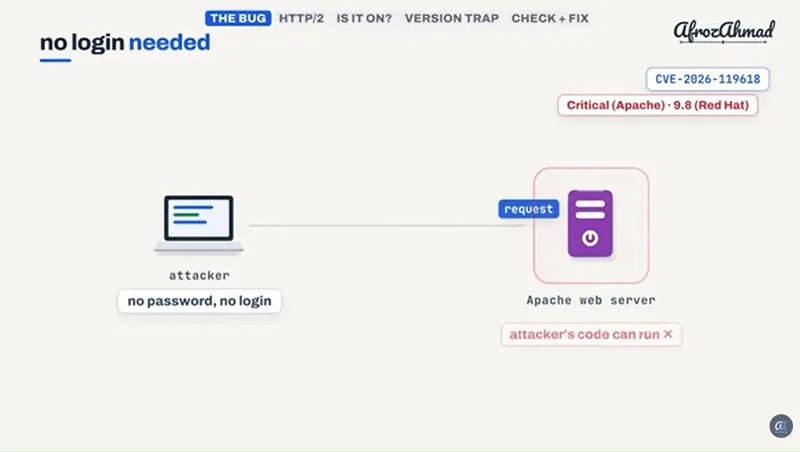
CVE-2026-119618 is a critical race condition in Apache HTTP Server’s mod_http2 component, which provides HTTP/2 support. The flaw occurs while Apache processes request headers and can cause two threads to interact unsafely with shared memory, leading to heap corruption. Because the vulnerable code runs at the web server layer before an application such as WordPress performs its own authentication or authorization checks, an attacker does not need an existing account or another user’s interaction to reach the vulnerable service. Successful exploitation could potentially lead to remote code execution with the permissions of the affected Apache worker process, although the exact consequences on a particular server depend on local file permissions, service configuration, and what the Apache process can access.
HTTP/2 makes this kind of concurrency particularly relevant because several requests can share a single connection. Apache’s module dispatches requests to worker threads and returns their results through that connection. Each request has its own processing state, while some resources belong to the longer lived connection. Safe execution depends on respecting those ownership boundaries whenever different threads update data. A race condition occurs when correctness depends on the order or timing of operations that the program has not adequately coordinated. That explains why a server can appear healthy during ordinary use while still containing a serious defect in how concurrent requests interact.
Apache credits Anthropic’s OSS Scanner with the first report of the flaw on October 26, 2026, under the identifier ANT-2026-MAPKT6MZ. That internal identifier and CVE-2026-119618 refer to the same vulnerability, with the CVE providing a common public reference for vendors, hosting providers, administrators, and security teams. Anthony Weems and Simon Scannell of Google Cloud Vulnerability Research independently reported the same flaw on November 3, eight days after Anthropic’s submission and eight days before Apache released the upstream fix. The chronology establishes which report Apache received first, but it does not show when either investigation began, how long each team spent validating the issue, or how much human review was involved in Anthropic’s scanner result.
Anthropic launched OSS Scanner on October 8, 2026, as an optional service providing eligible open source projects with periodic security scans at no cost. Its documentation describes a pipeline of agents that check candidate bugs, investigate their causes, and propose patches. Maintainers can supply a project threat model, and scanning runs in hardened sandboxes after internet access has been disabled. Enrolled projects can receive findings without the human review used in Anthropic’s separate coordinated disclosure process. This context helps explain the scanner credit: the service examines project code and reports potential defects to maintainers. Apache’s attribution identifies the reporting service, while the public record leaves the precise model and investigation workflow for this individual finding unspecified.
Apache released the upstream correction in Apache HTTP Server 2.4.71 on November 11, sixteen days after receiving the first report. The fix changes which header table is updated so that the relevant operation stays within request owned memory instead of modifying connection associated data unsafely.
The public Apache patch shows how a narrowly targeted source change can address a critical flaw. In the affected header assignment function, one line is changed so that a header update targets the request’s incoming header table. The security significance lies in the destination of the write and the ownership of its memory. A small source change can therefore address a large risk when it removes an unsafe interaction between concurrent operations. Patch size alone says little about the difficulty of finding the defect, the work needed to establish its impact, or the testing required before maintainers can safely include the change in a release.
This preserves HTTP/2 functionality while removing the unsafe memory interaction. Public research later showed heap corruption on Apache 2.4.70 and a clean result on 2.4.71, while Red Hat separately said reliable exploitation had been demonstrated on a default configuration with mod_http2 enabled. Singapore’s Cyber Security Agency warned on November 17 that active exploitation had reportedly been observed, increasing the urgency of remediation even though its alert did not identify victims or provide a count of compromised systems.
The case also provides a concrete example of what AI assisted vulnerability research can accomplish and what it cannot prove on its own. Anthropic’s scanner produced a finding that Apache credited, Google researchers independently reached the same result, maintainers identified the affected code, and vendors issued fixes. That chain gives the original report practical significance because it led to changes in software that organizations actually run.
However, the advisory does not reveal the scanner’s false positive rate, how many findings were reviewed to identify this one, how much human work went into validation and submission, or whether the same approach would outperform human researchers on another codebase. The discovery is therefore strong evidence of a successful AI assisted finding, not a general measure of scanner accuracy or researcher productivity.
Anthropic’s launch announcement provides some broader evaluation context. The company said expert reviewers examined 97 findings rated high or critical across 48 projects from an early scanner version. Of those, 85 met its coordinated disclosure standard, 11 were real issues that duplicated known problems or other findings, and one was invalid. Those figures describe the company’s selected evaluation sample; they do not establish an Apache specific accuracy rate or measure vulnerabilities the scanner missed. Anthropic also acknowledged feedback about inflated severity ratings and misunderstood threat models. For this Apache case, the strongest concrete outcome remains an accepted report followed by an independently corroborated vulnerability and a maintained upstream fix.

Affected Apache Versions, Distribution Packages, and Why Version Numbers Can Mislead
Apache lists upstream HTTP Server versions 2.4.55 through 2.4.70 as affected, with 2.4.71 serving as the first upstream release containing the correction for installations using Apache’s bundled HTTP/2 implementation. The separately distributed icing/mod_h2 project is also affected in versions 2.0.8 through 2.0.42. Those module numbers belong to a different release history from Apache HTTP Server itself, which is why an affected module version such as 2.0.42 can appear alongside an affected Apache server version such as 2.4.70. The standalone mod_h2 repository was archived on June 9, 2026, and Apache’s advisory does not list a fixed standalone release, making migration to the maintained HTTP/2 implementation distributed with Apache the safer long term path for manually installed versions.
Administrators should also distinguish the Apache executable from the module it loads. Apache supports modules compiled into the server and modules loaded separately through its configuration. Consequently, the useful inventory is the combination actually selected by the running service. As a practical example, a machine could contain a distribution supplied Apache installation alongside a manually compiled copy used by a hosting platform. Updating the distribution package would not establish that the other installation had changed. Recording the executable location, module source, service configuration, and package owner helps connect an advisory to the software responsible for a particular listener, especially where several teams maintain different parts of the same host.
Operating system packages complicate the picture because Linux distributions often backport newer module code and security fixes into older Apache package branches. Ubuntu 22.04 LTS, for example, received its fix in package 2.4.52-1ubuntu4.27, even though the leading Apache version number, 2.4.52, appears below Apache’s upstream affected starting point of 2.4.55.
That does not mean Ubuntu 22.04 was unaffected before the update because Canonical had incorporated newer HTTP/2 code into its stable package. Ubuntu 24.04 LTS provides the opposite example, with its fixed package listed as 2.4.58-1ubuntu8.19. The 2.4.58 prefix falls inside Apache’s upstream affected range, yet the full Ubuntu revision contains the fix. Administrators therefore need the complete package revision and operating system release rather than relying only on the headline Apache version.
The practical implication of these backports is that remediation decisions should follow the vendor’s security record for the installed branch. Replacing a supported distribution package with a manually assembled upstream build solely to obtain a higher displayed number can create unnecessary maintenance work. Conversely, seeing an older looking prefix should not cause an administrator to dismiss a vendor update that explicitly fixes this CVE. Security tracking should retain the operating system release, complete package revision, advisory reference, and verification date together. Those details allow a later reviewer to understand why the service was considered corrected even when a public banner continued to display an upstream version associated with vulnerable builds.
The same principle applies across other distributions. Debian lists 2.4.71-1~deb12u1 as the corrected Bookworm package and 2.4.71-1~deb13u1 for Trixie, while Red Hat may distribute mod_http2 as a separate package on Enterprise Linux 9 and 10. A server banner or the output of a public website scanner often does not contain enough information to establish whether a vendor has backported a fix.
On self managed systems, administrators should use tools such as apachectl or apache2ctl to identify the server version, loaded modules, and virtual host configuration, then compare the complete installed package revision with the relevant vendor advisory. Managed hosting customers can ask the provider which package or module contains the correction and whether it is deployed across every origin serving the site.
Installing corrected files and replacing the processes using old code are separate operational steps. Apache’s documentation explains that a graceful restart allows existing children to finish their current requests while a new generation begins serving traffic. Administrators should therefore follow the distribution’s update and restart procedure and verify that the intended processes have actually been replaced. A successful package installation, a saved configuration, or a changed version string does not independently establish that every serving worker has adopted the correction. In a busy environment, the deployment record should include the service action taken and its verification, so that an unfinished restart is not mistaken for completed remediation.
A similar distinction matters for multiple server and containerized environments. Updating an image in a registry does not protect traffic if older containers remain active, while a successful request after a rolling deployment proves only that one available instance served that request. Administrators should verify that every serving instance received the corrected code and keep the full image identifier or package revision in deployment records. That information also protects against a later rollback that could accidentally restore vulnerable code.
The same review should extend to systems that can become active later. Standby origins, disaster recovery hosts, deployment templates, and cached installation images may remain outside an immediate traffic check while still being able to reintroduce the affected module. For this vulnerability, a useful completion condition is that both current traffic and the next routine deployment will use corrected software or a documented HTTP/1.1 mitigation. Teams can retain an approved replacement image for recovery and update the templates that create new instances. This makes the response durable across scaling, failover, and maintenance instead of depending on a one time change to the machines visible during the initial investigation.
Exploitability, Real World Risk, and What the Vulnerability Means for Server Security
The race condition can corrupt heap memory because different threads can interact unsafely with data associated with the connection while processing HTTP/2 request headers. Ordinary traffic can run successfully for long periods even while the defect remains present, because the unsafe timing condition may not occur during normal requests. A single Apache worker crash also does not prove exploitation because many unrelated faults can terminate a process. For an initial assessment, the installed package and protocol configuration provide stronger evidence of exposure than repeatedly loading a website and watching for errors.
Heap corruption can affect availability even when an observer has not demonstrated arbitrary code execution on that particular build. A worker may terminate or fail to complete requests, creating errors for legitimate users. Demonstrating memory corruption establishes that unsafe behavior occurred under the tested conditions; demonstrating controlled code execution establishes a further capability. Evidence of attacks against deployed systems answers a different question again. Keeping these stages distinct helps administrators interpret research accurately without waiting for an identical exploit demonstration against every local configuration. The vendor’s affected status and the reachable protocol remain sufficient reasons to remediate, while the exact consequences depend on the build and surrounding controls.
Successful remote code execution would allow an attacker to execute instructions with the privileges of the affected Apache worker process. The immediate impact therefore depends heavily on local permissions. A web service account that can read application configuration files might expose credentials, while one with write access to published content could enable unauthorized modification. A server hosting several sites under overly broad permissions could expose material belonging to more than one application. Restricting the Apache worker to only the files and resources it needs can reduce the consequences of exploitation, although it does not remove the need to patch.
Apache’s security guidance explains that a typical server starts with elevated privileges and then uses the configured service identity to handle requests. Code execution in a worker therefore should not automatically be described as root access. The practical review should examine what that identity can read, change, or contact: application secrets, writable site directories, shared storage, and permitted internal services can all affect the consequences. Permissions that separate hosted applications and protect server configuration help contain damage. Their value is in reducing what a compromised process could do; they cannot correct the unsafe header handling or establish that an unpatched service is acceptable to leave exposed.
Exposure and compromise are separate questions. Finding a vulnerable package and an HTTP/2 enabled listener establishes that the system should be updated or mitigated. Determining whether someone actually exploited the flaw requires evidence from the affected server, including process history, logs, unexpected files, configuration changes, and other indicators of compromise. Installing the corrected package protects future request handling but does not establish what happened before the update was applied.
Where compromise is suspected, investigation should preserve available evidence while containment and patching proceed. Useful material can include Apache error logs, process termination records, unexpected child processes, unusual outbound connections, and changes to application or server files. F5 identifies segmentation faults, worker resets, and HTTP/2 connection resets as possible symptoms, but these events require correlation because normal faults can produce similar effects. A quiet application log also cannot settle the question when the affected operation occurs before application processing. Review should therefore consider host and web server evidence together. Any credential replacement should be guided by what the suspected compromised process could access and by the findings of the investigation.
Public reporting on exploitation evolved quickly after the fix. Horizon3.ai reviewed a third party demonstration showing heap corruption on Apache 2.4.70 and a clean result on 2.4.71, although that demonstration did not show code execution. Red Hat says public research demonstrated reliable exploitation on a default configured server with mod_http2 enabled, while F5 Labs said on November 16 that it had not observed major exploitation activity in its visibility. One day later, Singapore’s Cyber Security Agency said active exploitation had reportedly been observed and urged administrators to update immediately. Those statements are not necessarily contradictory because different organizations have different visibility and because exploitation activity can change over time.
Severity can also differ between software builds. Apache rates the upstream issue critical, while Red Hat classifies the impact on some Enterprise Linux 9 and 10 packages as Important because their memory allocation behavior makes successful exploitation more difficult. Both advisories nevertheless direct affected users toward security updates. The differing ratings reflect implementation specific exploitability rather than disagreement that the underlying race condition needs to be fixed.
For prioritization, exposure and potential impact should be considered together. A reachable HTTP/2 origin holding sensitive application credentials warrants prompt attention, while an isolated instance with the same package still needs a tracked correction before its access conditions change. Teams should record whether each service is patched, temporarily mitigated, unaffected according to its vendor, or still awaiting verification. These are different operational states, and combining them into a single completion percentage can hide unresolved exposure. Tracking the responsible owner and the evidence behind each decision turns a widely reported critical vulnerability into a defined set of infrastructure changes that can be reviewed and maintained.
The broader lesson is that vulnerability response extends well beyond identifying the original bug. Apache had to correct the upstream code, Linux vendors had to map that correction onto backported packages, hosting providers had to deploy updates across live infrastructure, users of the archived standalone mod_h2 project needed a migration path, and administrators had to determine whether HTTP/2 was actually enabled on the relevant connection. Anthropic’s scanner deserves credit for producing the first report Apache received, while Google’s independent discovery strengthens confidence that the flaw was reproducible. For operators, however, the decisive task remains determining exactly which running service contains the vulnerable code and making sure the corrected implementation is the one handling real traffic.

HTTP/2 Exposure, Temporary Mitigation, and What Administrators Should Check
Practical exposure depends on more than simply having Apache installed. Red Hat identifies three conditions that matter: the running server must contain affected code, HTTP/2 must be enabled for the relevant service, and a client must be able to reach that service using HTTP/2. Apache uses h2 for HTTP/2 over TLS and h2c for cleartext HTTP/2. A public HTTPS check can therefore miss an internal service using h2c, while a browser displaying HTTP/2 does not necessarily prove that the Apache origin itself is receiving HTTP/2 traffic.
Content delivery networks make this especially important. A visitor may connect to the CDN over HTTP/2 while the CDN forwards the request to Apache over HTTP/1.1, in which case the browser’s protocol display describes only the first connection. If the CDN also uses HTTP/2 to communicate with the origin, then Apache’s mod_http2 code belongs in the assessment. An origin that remains directly reachable outside the CDN needs to be checked separately as well. Virtual hosts can also define different protocol settings on the same Apache instance, so administrators should verify the effective configuration for each hostname and service rather than assuming one result applies to the whole server.
A useful way to assess the path is to write down each connection separately. In a hypothetical deployment, a browser might use HTTP/2 to an edge service, that service might use HTTP/1.1 to a reverse proxy, and the proxy might create a fresh HTTP/2 connection to Apache. The middle HTTP/1.1 connection would not remove the vulnerable processing at the final hop. Another deployment might terminate HTTP/2 entirely before Apache and send only HTTP/1.1 to the origin. These examples show why the relevant evidence is the protocol reaching the affected Apache listener, together with any alternate route that bypasses the usual front end.
An Apache listener that accepts only HTTP/1.1 does not invoke the affected HTTP/2 request handling code and is therefore not exposed to this CVE through that listener. This provides a documented temporary mitigation when an immediate package update is not possible. Red Hat and NHS England advise removing h2 and h2c from the relevant Protocols settings and restricting the service to Protocols http/1.1, while reviewing virtual hosts that may override the global protocol configuration. HTTPS can remain enabled because HTTP/1.1 still operates over TLS. The key is to verify that the running service has actually adopted the configuration rather than merely saving the file.
Applying the temporary configuration also requires care around inheritance and included files. Before activating a change, administrators should validate the Apache configuration, identify any virtual host that supplies its own protocol setting, and follow the supported service procedure. Verification should then cover the intended hostname and port as well as representative application requests. A configuration check establishes whether the server can accept the configuration; a protocol check establishes what the relevant connection actually negotiates. Neither alone substitutes for the other. Keeping these observations together helps avoid a situation in which a syntactically valid global change leaves an overriding virtual host accepting HTTP/2.
A CDN can make verification confusing because the public browser connection may continue to negotiate HTTP/2 even after the origin is restricted to HTTP/1.1. That can still represent a successful mitigation if the protected connection is the one between the CDN and Apache. Administrators should therefore verify the protocol on the same connection they intended to change. They should also record whether operation restricted to HTTP/1.1 is temporary, because restoring HTTP/2 later on an unpatched server would restore access to the vulnerable code. Testing important transactions is prudent as well because disabling HTTP/2 can affect performance characteristics and clients that explicitly require it.
Network access controls can reduce who reaches a vulnerable listener, but their placement matters. An application login page appears after the web server has already begun processing the request, so requiring a WordPress password does not address this flaw. A restriction enforced before traffic reaches Apache changes reachability and can be useful while an update is deployed. Even then, permitted clients, internal systems, and alternate origins still belong in the assessment. Similarly, the presence of a web application firewall should not be treated as confirmation that this particular memory corruption issue is blocked. Any claimed protection needs evidence that it covers the relevant HTTP/2 connection and configuration.
WordPress and other application updates do not fix this vulnerability because the flaw resides in the Apache web server before the application handles the request. Updating WordPress core, themes, and plugins can leave the Apache package and mod_http2 unchanged. A static website without WordPress can be affected by the same flaw if it runs a vulnerable HTTP/2 enabled Apache service. For shared hosting customers, the useful support questions are which server terminates HTTP/2 for the domain, which package revision contains the CVE fix, and whether every relevant origin is running it. For self managed systems, responsibility lies with whoever maintains the operating system package, web server binary, or container image.
Temporary mitigation is easier to manage when it has an owner and a clear condition for removal. The operational record should identify which listeners were restricted, when the restriction took effect, and which corrected package or image must be deployed before HTTP/2 returns. Restoring the protocol then becomes a planned change with a fresh verification step. This is especially useful when infrastructure and application teams work independently, since a later performance adjustment could otherwise undo the mitigation without revisiting the CVE. Routine checks should include important site functions, upstream connections, and service health so that the temporary protocol change remains effective throughout the patching period.

Frequently Asked Questions (FAQs)
- Who first reported CVE-2026-119618 to Apache?
Apache credits Anthropic’s OSS Scanner with the first report, which it received on October 26, 2026. Anthropic tracked the finding internally as ANT-2026-MAPKT6MZ. Google Cloud Vulnerability Research’s Anthony Weems and Simon Scannell independently reported the same flaw on November 3, eight days later. The public timeline therefore gives Anthropic priority for the first report received by Apache while also recognizing the Google researchers as independent finders. - Can an attacker reach the flaw without a WordPress or Apache account?
Yes. Red Hat says the vulnerability can be reached without authentication when a client can send HTTP/2 traffic to an affected Apache service. The vulnerable code runs at the web-server protocol layer before an application such as WordPress decides whether a visitor can sign in or access protected content. Restricting the WordPress administration area therefore does not remove exposure if the underlying Apache HTTP/2 service remains vulnerable. - Is Apache HTTP Server 2.4.70 affected?
Yes. Apache 2.4.70 is the final upstream release included in the affected range of 2.4.55 through 2.4.70. Apache HTTP Server 2.4.71 contains the upstream correction. Administrators using Linux distribution packages should still check the full package revision against their vendor’s advisory because distributions can backport security fixes without changing the leading Apache version number in the same way upstream does. - Can an Apache package starting with 2.4.52 need this update?
Yes. Ubuntu provides a clear example because it backported newer HTTP/2 module code into older stable Apache package branches. Ubuntu 22.04 LTS uses a package beginning with 2.4.52, but Canonical identifies 2.4.52-1ubuntu4.27 as the corrected revision. This means the headline version number alone is not enough to determine exposure; the operating-system release and complete package suffix must also be checked. - Does disabling HTTP/2 mean turning off HTTPS?
No. HTTPS and HTTP/2 are not the same thing. Apache can continue using encrypted TLS connections while serving HTTP/1.1 instead of HTTP/2. The temporary mitigation changes which HTTP protocol the affected listener accepts, while the website’s certificate and encrypted transport can remain enabled. - Does seeing HTTP/2 in a browser prove the Apache origin is exposed?
No. The browser may be connecting over HTTP/2 to a CDN, reverse proxy, or load balancer rather than directly to the Apache origin server. That intermediary might then communicate with Apache using HTTP/1.1. Administrators therefore need to check the protocol used on the origin connection, any independently reachable Apache listeners, and the package or module actually running there before deciding whether the origin is exposed. - Is there an official fixed release of the archived standalone modh2 project?
Apache’s advisory does not list a corrected release from the archived standalone mod_h2 repository. The repository owner archived the project in June 2026, leaving it read-only. NHS England advises users of that standalone implementation to migrate to the supported HTTP/2 module distributed with a patched Apache HTTP Server rather than waiting for an update from the archived project. - Does a server crash prove someone executed code?
No. A crash shows that something caused the server process to fail, but it does not by itself prove exploitation or remote code execution. Many software and configuration problems can cause crashes. The public demonstration reviewed by Horizon3.ai reproduced memory corruption on an affected Apache build but did not demonstrate an attacker gaining control of code execution, so additional forensic evidence would be needed to establish compromise. - Had active exploitation been reported by November 18, 2026?
Yes. Singapore’s Cyber Security Agency issued an alert on November 17 stating that active exploitation had been reported and urged administrators to apply updates immediately. The alert did not identify specific victims or provide a count of successful attacks. It therefore supports saying that active exploitation had been reported, but not estimating how widespread the activity was. - What should a managed-hosting customer ask the provider to confirm?
Ask the provider whether the Apache origin serving the domain accepts HTTP/2, which supported package or module contains the fix for CVE-2026-119618, and whether that corrected version is running across every relevant server. If the provider temporarily restricted the origin to HTTP/1.1, also ask when it plans to complete the underlying package update and safely restore HTTP/2. These questions help distinguish a real remediation from a temporary configuration workaround.

Conclusion
Anthropic’s OSS Scanner delivered the first recorded report of CVE-2026-119618, with Google researchers Anthony Weems and Simon Scannell independently reporting the same flaw eight days later. Apache then released the upstream fix in version 2.4.71 on November 11, while Singapore’s Cyber Security Agency subsequently warned that active exploitation had been reported. That sequence moved the issue from a research finding to an immediate operational concern for organizations still running affected HTTP/2 services.
For website owners and administrators, the most useful response is not simply to ask whether a site uses HTTP/2 or whether WordPress is fully updated. The key questions are which software actually terminates the connection, which Apache or mod_http2 package is running there, and whether that exact revision contains the fix.
Depending on the platform, remediation could mean upstream Apache 2.4.71, a distribution-specific package whose leading version number appears older because the fix was backported, or an updated module supplied by the operating-system vendor. Where a permanent update cannot be applied immediately, a verified HTTP/1.1-only configuration can provide a temporary mitigation while HTTPS remains enabled. Those concrete deployment details offer a far more reliable picture of risk than a browser protocol label or an application dashboard alone.
Sources and Citations
- Apache HTTP Server Project, November 11, 2026: Apache’s official 2.4 security advisory identifies CVE-2026-119618 as a critical
mod_http2race condition that can cause heap corruption and remote code execution. It lists Apache HTTP Server 2.4.55 through 2.4.70 as affected, identifies 2.4.71 as the fixed release, and credits Anthropic’s OSS Scanner with the October 26 first report, followed by Anthony Weems and Simon Scannell of Google Cloud Vulnerability Research on November 3. Apache HTTP Server
Apache HTTP Server – 2.4 Security Vulnerabilities - Red Hat Product Security, RHSB-2026-017: Red Hat’s security bulletin describes CVE-2026-119618 as an unauthenticated remote-code-execution flaw affecting servers with
mod_http2loaded andh2orh2cenabled. It documents the process-level impact, affected RHEL products, exposure conditions, and the temporary mitigation of restricting Apache toProtocols http/1.1. Red Hat Customer Portal
Red Hat – RHSB-2026-017 Apache HTTP Server RCE
Red Hat – CVE-2026-119618 Record - Ubuntu Security, November 12, 2026: Canonical’s CVE page and USN-9090-1 identify the corrected package revisions for supported Ubuntu releases. These include 2.4.52-1ubuntu4.27 for Ubuntu 22.04 LTS and 2.4.58-1ubuntu8.19 for Ubuntu 24.04 LTS. Canonical explicitly notes that newer
mod_http2code had been backported into older stable Apache branches, explaining why the leading upstream version number alone can be misleading. Ubuntu
Ubuntu – CVE-2026-119618
Ubuntu – USN-9090-1 Apache HTTP Server Vulnerabilities - Debian Security Tracker: Debian’s security advisories list 2.4.71-1~deb12u1 for Bookworm and 2.4.71-1~deb13u1 for Trixie as corrected packages for the Apache security update that includes CVE-2026-119618. This reinforces the need to check the complete distribution package revision rather than comparing only the upstream Apache version. Debian Security Tracker
Debian – DLA-4902-1 Apache Security Update
Debian – DSA-6620-1 Apache Security Update - NHS England, November 12, 2026: NHS England’s cyber alert describes CVE-2026-119618 as a critical Apache HTTP Server RCE issue, lists Apache 2.4.55–2.4.70 and standalone
icing/mod_h22.0.8–2.0.42 as affected, and recommends upgrading to Apache 2.4.71 or later. Where immediate patching is impossible, it recommends removingh2andh2cand temporarily serving HTTP/1.1 only. It also advises users of standalonemod_h2to migrate because the project has been archived. NHS England Digital
NHS England – Critical RCE Vulnerability in Apache HTTP Server - icing/mod_h2, GitHub: The original standalone HTTP/2 module repository confirms that it was archived on June 9, 2026 and is now read-only. The project owner also stated that future issues should be reported to the Apache httpd project. GitHub
GitHub – icing/mod_h2 Repository - Horizon3.ai, November 12, 2026: Horizon3.ai’s technical review describes the
assign_headers()race condition, affected releases, exploitation requirements, and mitigation. It also distinguishes a public third-party demonstration that reproduced heap corruption on Apache 2.4.70 and reported a clean result on 2.4.71 from a full remote-code-execution demonstration. Horizon3
Horizon3.ai – CVE-2026-119618 Apache HTTP/2 RCE - F5 Labs, November 16, 2026: F5 Labs summarizes the vulnerability, affected versions, race condition, public research, and recommended remediation. At the time of its November 16 publication, F5 said it had observed no major exploit activity, while noting Red Hat’s statement that reliable exploitation had been demonstrated against a default configuration. F5, Inc.
F5 Labs – CVE-2026-119618 - Cyber Security Agency of Singapore, November 17, 2026: CSA Singapore subsequently warned that CVE-2026-119618 was reportedly being actively exploited and that a proof-of-concept exploit was publicly available. The advisory urges administrators running affected Apache HTTP/2 configurations to patch immediately. Cyber Security Agency of Singapore
CSA Singapore – Active Exploitation of Apache mod_http2 Vulnerability - Apache HTTP Server Documentation: Apache’s official documentation explains how administrators can inspect the running server.
httpd -Mlists loaded static and shared modules,-Sdisplays parsed virtual-host settings, and-vreports the server version. Apache’sProtocolsdirective documentation confirms thath2enables HTTP/2 over TLS,h2cenables cleartext HTTP/2, andhttp/1.1can be configured by itself. Apache HTTP Server
Apache – httpd Command Documentation
Apache – Protocols Directive Documentation - Cloudflare, HTTP/2 to Origin: Cloudflare’s documentation makes the CDN-to-origin distinction explicit. Cloudflare can use HTTP/2 between its edge network and the origin independently of the browser-facing connection, and if the origin does not support HTTP/2, Cloudflare falls back to HTTP/1.1. This supports checking the actual Apache origin connection instead of relying only on what a browser reports. Cloudflare Docs
Cloudflare – HTTP/2 to Origin Documentation - WordPress Documentation: WordPress’s official update documentation covers updates to WordPress core, themes, plugins, and translations through the dashboard. Those updates operate at the application layer and do not update the underlying Apache HTTP Server or
mod_http2, supporting the distinction made in the article between WordPress maintenance and remediation of CVE-2026-119618. WordPress.org
WordPress – Updating WordPress
Recommended
- Where Winds Meet, Official Imperial Palace Gameplay Trailer Explained: Release Date, Story, Combat Details & Everything We Know
- Diablo 4 3Rd Anniversary Event: Goblins, Massive XP Boost, Free Cosmetics, and Full June 2–9 Celebration Guide
- IO Interactive and Build A Rocket Boy End MindsEye Partnership as Hitman Crossover DLC Is Canceled
- All Anomalies in Animal Hospital Guide: Every Roblox Anomaly Explained
- Every Release Date from Every Event at Summer Game Fest 2026
- First Gameplay Trailer of Silent Hill: Townfall: It’s a First-Person Game and Everything We Know (2026)
- Best New Anime to Watch Right Now: Spring 2026 Picks
- Switch 2 Software Update Adds “Handheld Mode Boost” for Old Games – Performance Upgrade Explained
- We Build LEGO Winnie the Pooh: A 100th Anniversary Set Worth the Hype for Disney and LEGO Fans
- Echoes of Aincrad: Complete Guide to Growth Points (Best Stat Builds & Leveling Tips)



































































































