






In This Article (7 sections)
Anthropic’s $34.9 Billion Lambda Agreement, Missed Lease Deadline, and Termination Rights
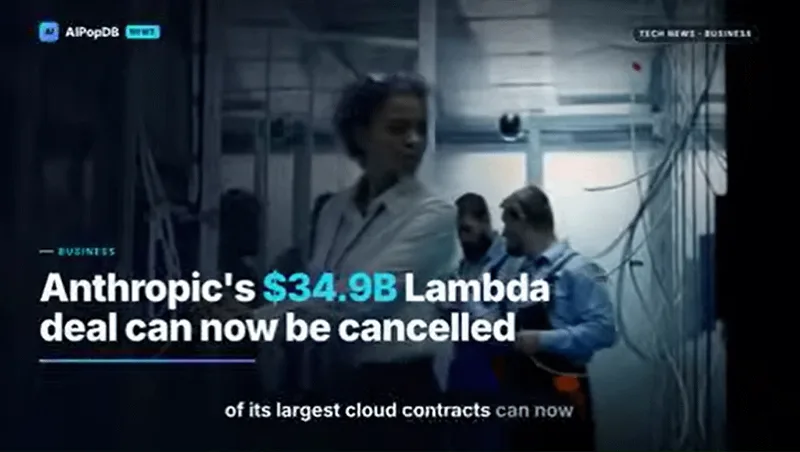
Anthropic’s $34.9 billion Lambda agreement became terminable after Lambda missed a deadline to secure the facility lease specified in their August 2026 contract. Either company could end the agreement under the provision. However, as of November 18, 2026, the date of Anthropic’s final IPO prospectus, neither company had delivered a termination notice, and Anthropic stated that it had no current intention of doing so. The prospectus, filed with the U.S. Securities and Exchange Commission on November 19, did not identify the facility or disclose the exact calendar date Lambda missed. The agreement represents approximately 84.5% of the $41.3 billion Anthropic committed to spend across its Lambda contracts, making the missed deadline significant to the companies’ broader computing infrastructure relationship.
Those contracts provide access to computing capacity powered by Nvidia graphics processing units, with fees beginning only when Lambda delivers the capacity and Anthropic accepts it. This separates three important stages: securing the facility, delivering operational computing capacity, and beginning to charge for the service. The filing confirms a failure to meet the first requirement but provides no Lambda specific figure for capacity already accepted or cash already paid.
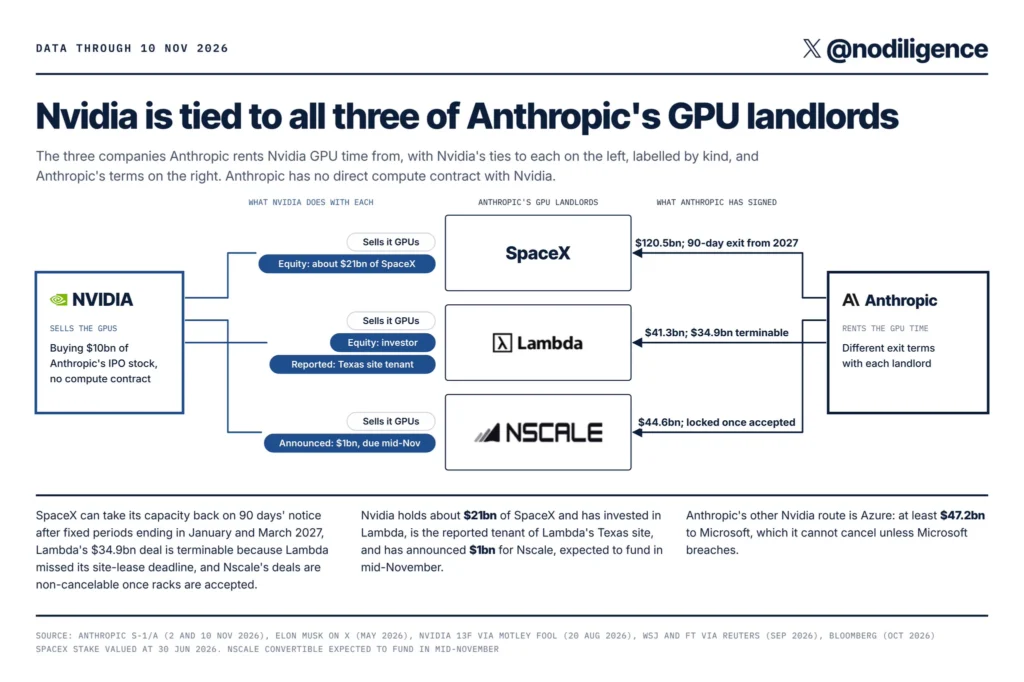
Anthropic entered the August agreement to secure access to Nvidia GPU computing services supplied by Lambda, Inc. Under the arrangement, Lambda is the infrastructure provider, Anthropic is the customer, and Nvidia supplies the underlying processor technology. The approximately $34.9 billion commitment therefore represents access to computing services rather than a direct purchase of Nvidia hardware. The disclosed value does not establish how many GPUs Lambda would deploy, which processor models would be used, or how much Anthropic would effectively pay per chip. This distinction is important because the contract’s financial value reflects a computing service commitment extending over time, not necessarily the acquisition cost of the equipment supporting it.
The status of the agreement became clearer as Anthropic updated its IPO documentation. In its October 26, 2026 registration statement, the company described the contractual consequences that would follow if Lambda failed to secure the lease before the agreed deadline. By its November 10 amendment, Anthropic disclosed that the deadline had already passed and Lambda had missed it, giving both companies the right to terminate the August agreement.
The final prospectus retained that disclosure. Consequently, the October filing described a potential contractual event, while the November filings confirmed that the event had occurred. Anthropic did not disclose the original deadline, the landlord, or the property’s location. August was the month the contract was signed, while November 10 was a date by which the missed requirement had been publicly acknowledged. Neither date identifies the actual lease deadline.
The obligation to secure a facility lease was distinct from the technical requirements involved in delivering computing capacity. Obtaining legal access to a property is not the same as installing servers, securing electricity, completing network connections, or delivering a functioning computing cluster. Anthropic disclosed that Lambda failed to satisfy the lease requirement but did not explain why.
The filing also did not identify a related failure involving GPU shipments, equipment installation, or capacity acceptance tests. Although securing the lease after the deadline might still be possible, whether such an action would eliminate the companies’ termination rights would depend on contractual provisions and subsequent decisions that were not disclosed. The missed deadline therefore created a contractual right without establishing that the infrastructure project had been abandoned.
The August agreement expressly allowed either company to terminate if Lambda missed the lease deadline. Anthropic could exercise the provision as the purchaser of computing capacity, while Lambda could invoke the same right despite being responsible for securing the premises. Once the deadline passed without the lease being secured, neither company needed the other to initiate termination under that provision. However, the existence of a termination right does not mean the agreement automatically ended. A company would still need to decide to exercise that right. Anthropic’s statement that neither party had delivered notice as of November 18 confirms that the agreement was terminable rather than already terminated.
This lease provision is particularly important because Anthropic generally characterized its Lambda commitments as noncancelable, subject to limited exceptions. Those exceptions included circumstances involving a material breach by Lambda that remained uncured, along with specific delivery milestone rights applicable to certain portions of contracted capacity. The August agreement’s lease clause had a separate trigger and applied specifically to that agreement. Anthropic could therefore disclose that the contract had become terminable without alleging an uncured material breach, reporting a failed GPU delivery, or suggesting that every agreement with Lambda could be canceled. The distinction limits the immediate contractual consequences to the agreement affected by the missed lease requirement.
Neither Anthropic nor Lambda had delivered a termination notice as of November 18, 2026. That date is important because it establishes the precise period covered by Anthropic’s statement. Although the SEC accepted the final prospectus on November 19, the absence of termination notices was confirmed only through November 18. The filing established that Lambda had missed the deadline and both parties had acquired termination rights, while also confirming that neither had exercised those rights by the prospectus date. Any claim that the agreement was subsequently canceled would require evidence of a later decision. The filing date alone does not establish what happened during the following day.
Anthropic also told investors, “we do not currently intend to terminate the agreement.” The word currently limits the statement to management’s intentions at that time. It did not amount to a guarantee that Anthropic would maintain the agreement through 2034, nor did it establish that the companies had extended the lease deadline or modified their contractual obligations. The statement concerned Anthropic’s plans, while Lambda’s future intentions remained undisclosed. Anthropic’s decision to preserve the agreement was nevertheless consistent with the economic value of maintaining access to long term computing capacity.
The company reported spending $5 billion on short term compute during the quarter ended September 30, 2026, and said comparable capacity secured through multiyear commitments was significantly less expensive. Giving up a large long term reservation could expose the company to more costly replacement capacity. However, Anthropic did not identify those pricing considerations as its specific reason for keeping the Lambda agreement or connect that quarterly expenditure directly to the lease issue.
The agreement’s continuing status therefore involved several distinct considerations. The missed deadline gave both companies the contractual ability to exit, but neither had used that ability by November 18. Anthropic expressed a preference for retaining the arrangement without making a permanent commitment to do so. Meanwhile, the absence of disclosed information about the facility, lease deadline, and subsequent negotiations prevented investors from determining whether the underlying property issue had been resolved. The central development was not a completed cancellation or a confirmed failure to deliver GPUs, but the emergence of a termination option affecting one of Anthropic’s largest disclosed computing commitments.

How Anthropic’s $41.3 Billion Lambda Commitments Support Nvidia GPU Capacity Through 2034
Anthropic’s relationship with Lambda extends beyond the August agreement. The company disclosed approximately $41.3 billion in total commitments across agreements signed in May, June, and August 2026. The August contract accounts for approximately $34.9 billion of that amount, leaving roughly $6.4 billion attributable to the May and June agreements combined.
Based on the rounded figures, the August agreement represents approximately 84.5% of the total Lambda commitment, while the earlier agreements account for the remaining 15.5%. The $34.9 billion amount is already included in the $41.3 billion total and should not be added to it again. These figures explain why the missed lease deadline received attention: more than four fifths of the disclosed contractual value was associated with the agreement affected by the termination clause.
The financial concentration does not necessarily correspond to the physical distribution of computing infrastructure. An agreement representing 84.5% of total contract value does not automatically account for 84.5% of the GPUs, data center floor space, electrical capacity, or computing resources available to Claude. Contract values depend on factors such as service duration, delivery schedules, hardware configurations, and pricing. Calculating the portion of computing capacity affected by the August agreement would require deployment dates, equipment quantities, and pricing information that Anthropic did not provide. Similarly, the approximately $6.4 billion attributed to the May and June agreements cannot be divided evenly between them without evidence. Assigning $3.2 billion to each would incorrectly assume that the earlier contracts were identical in size.
The May and June agreements serve the same general purpose as the August contract: providing Anthropic with access to computing capacity powered by Nvidia GPUs. Under the disclosed arrangements, fees begin accruing as Lambda delivers the contracted capacity and Anthropic accepts it. Anthropic discussed the three agreements together as significant infrastructure services but did not disclose individual values, separate facility locations, particular GPU models, or detailed deployment schedules for the earlier contracts. It also did not establish that the August lease termination provision applied to either earlier agreement. The available information supports the conclusion that Anthropic had already made substantial commitments to Lambda before August, while the disclosed lease failure specifically affected the later $34.9 billion agreement.
The Lambda contracts collectively extend into 2034, although Anthropic did not explain why that year was selected or identify a common expiration date for all three agreements. Their duration reflects the broader challenge of planning AI infrastructure far ahead of actual demand. Anthropic must make decisions about computing capacity before new systems are ready to support model development or serve paying customers.
Waiting until demand becomes immediate can leave the company purchasing more expensive short term computing resources while larger infrastructure projects are still being prepared. Long term agreements can provide access to capacity as it becomes available, potentially reducing dependence on short term markets. However, the 2034 horizon does not establish a uniform annual spending schedule, and dividing $41.3 billion evenly across the remaining contract years would ignore differences in delivery dates and acceptance conditions.
Anthropic uses computing infrastructure for both developing AI models and operating them after deployment. Training involves processing substantial amounts of data to adjust a model’s behavior, while inference occurs when a deployed model processes a request and generates a response.
Nvidia GPU clusters can support either activity depending on their configuration and allocation. Anthropic identified Nvidia GPUs as the hardware underlying its Lambda commitments but did not provide a breakdown of how much contracted capacity would support research, training, or customer facing inference.
By the time of its IPO, the company said it could train and serve Claude across four processor families: Nvidia GPUs, AMD GPUs, Amazon’s Trainium chips, and Google’s TPUs. Its software systems help allocate workloads according to cost and performance, providing some flexibility in infrastructure planning. Nevertheless, the ability to run workloads across different hardware platforms does not guarantee that sufficient unused capacity will be available if a planned deployment is delayed.
The conditions that determine when Anthropic begins paying Lambda are separate from the real estate requirements associated with the August agreement. Under the Lambda contracts, fees begin accruing when Lambda delivers computing capacity and Anthropic accepts it. Securing a lease addresses the provider’s right to use a physical facility, while purchasing servers or completing their installation represents additional stages in preparing the infrastructure.
Neither step independently establishes that Anthropic has accepted a usable service. A cluster could contain installed hardware while its network connections, system configuration, or operational performance were still undergoing validation. Anthropic’s disclosure identifies delivery and acceptance as the events that trigger fees but does not specify Lambda’s invoice frequency, individual payment deadlines, or total amount already billed.
The distinction between installation and acceptance is important because large computing deployments involve several stages before a customer can use them. Lambda has described testing and validation procedures before handing over large clusters, illustrating why installed equipment does not necessarily represent accepted computing capacity. For example, a provider might finish positioning servers in a data hall while still validating connections between them. Under Anthropic’s disclosed contract structure, an investor would need evidence of delivery and acceptance before treating the associated service fees as accrued. Even after fees begin accumulating, the date on which Anthropic must make a payment could differ from the date the charge is recognized. The private technical acceptance requirements for Anthropic’s Lambda deployments were not disclosed.
Anthropic also described delivery milestones for individual portions of capacity under certain Lambda agreements. These portions are referred to as tranches, and some contracts allow Anthropic to cancel its commitment for a particular tranche if Lambda misses the corresponding delivery milestone. This structure makes it possible to address a delayed portion without necessarily ending the wider commercial relationship.
For example, if one block of capacity were delivered on time while another missed its milestone, Anthropic could potentially exercise a cancellation right concerning the late block while continuing to use the capacity already received. The filing did not identify which of the May, June, or August agreements contained these provisions, how much capacity each tranche represented, or the individual delivery deadlines. The August lease provision differs because Anthropic specifically described it as making the August agreement itself terminable.
The different contractual mechanisms can be summarized as follows:
- Facility lease requirement: Lambda had to secure the property specified in the August agreement by a contractual deadline. Missing that deadline gave either company the right to terminate that agreement.
- Capacity delivery: Lambda must provide computing capacity according to the applicable contractual arrangements.
- Customer acceptance: Anthropic must accept the delivered capacity before the associated service fees begin accruing.
- Tranche milestones: Certain contracts allow cancellation of individual portions of capacity when specified delivery milestones are missed.
- Long term commitments: The agreements collectively extend into 2034, but their values do not establish how much Anthropic must pay in any particular year.
These distinctions also explain why Anthropic’s purchase commitments should not be confused with cash already spent. A purchase commitment represents spending the company has agreed to undertake under specified conditions. Fees accrued represent charges associated with capacity that has been delivered and accepted, while cash payments reflect money that has actually left the company. For the Lambda agreements, the $34.9 billion August commitment and $41.3 billion combined total do not reveal how much Lambda had already received by November 2026. Anthropic’s broader financial disclosures illustrate the difference between contractual obligations and near term payments.
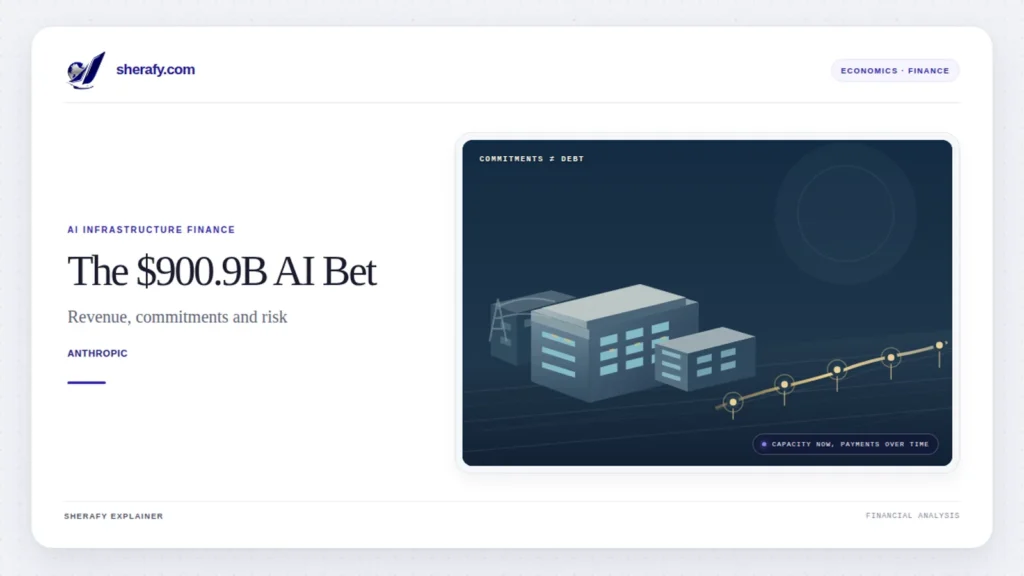
The company reported approximately $900.9 billion in purchase and lease commitments entered into as of and after September 30, 2026, while expecting roughly $70.7 billion to be paid during the following twelve months. These were company wide figures rather than Lambda specific amounts, but they demonstrate why total commitments and expected near term cash requirements measure different things.
The same distinction would matter if the August agreement were eventually terminated. Ending a $34.9 billion commitment would not automatically generate an equivalent immediate cash saving for Anthropic or a realized loss of the same amount for Lambda. The financial consequences would depend on when the original capacity was scheduled to become available, how much service had already been delivered, and whether Anthropic needed to replace the contracted resources. If replacement capacity were more expensive, the company could still face substantial future computing costs.
Likewise, Lambda’s potential lost revenue would depend on the delivery and billing schedule rather than the headline commitment alone. Without those details, the disclosed figures establish the scale of the commercial relationship but not the immediate financial consequences of exercising the termination right.
Why Lambda’s Facility Lease Matters for Claude Infrastructure and What Future Filings Could Reveal
Although Anthropic purchases cloud computing services rather than operating every associated server itself, the infrastructure supporting those services depends on physical facilities. Large GPU clusters require substantial electrical capacity, cooling systems, network connections, and space for equipment installation and maintenance. The timing of those requirements can affect the entire deployment. A provider that orders expensive computing equipment before a site is ready may have hardware that cannot immediately generate usable computing capacity.
Conversely, waiting until every property and construction requirement is finalized before ordering equipment can create delays because specialized infrastructure components often require lengthy preparation. This explains why a facility lease can become an important contractual milestone even when the customer ultimately purchases access to computing services rather than the physical property.
Lambda has illustrated these challenges in a case study concerning a separate cluster deployment. Its team arranged several megawatts of infrastructure capacity before closing on the real estate, ordered electrical equipment early, and coordinated hardware deliveries with construction progress to avoid congestion inside the data center. Network and platform engineering proceeded alongside the physical preparations. The example demonstrates how property access, power systems, hardware procurement, and technical configuration must be coordinated during large computing projects. However, it does not establish what had happened at the unidentified facility associated with Anthropic’s August agreement. The disclosed lease failure provides no reliable measure of how much construction, equipment procurement, engineering, or installation work had already been completed there.
A delay involving Lambda’s computing capacity could affect Anthropic differently depending on the workloads scheduled to use the infrastructure. If capacity intended for a model training run became unavailable, Anthropic might need to identify another suitable cluster or revise the timing of the work. If the delayed infrastructure was intended to support inference, the company might need to accommodate growing customer demand using its existing computing resources or additional short term capacity.
Its ability to distribute workloads across Nvidia GPUs, AMD GPUs, Trainium, and TPUs provides some flexibility, but available machines may already be assigned to other tasks. Reallocating those resources could require changes in scheduling, utilization, or operating costs. The practical consequences would depend on the quantity and configuration of capacity involved, when it was expected to become available, and what work Anthropic had planned to assign to it.
Importantly, Anthropic’s disclosure did not connect the missed Lambda lease deadline to a Claude outage, postponed model release, reduced usage limit, or other identified customer impact. An earlier announcement illustrates the type of evidence needed to make such a connection. On May 6, Anthropic linked several computing agreements, including one involving SpaceX, to increased usage limits.
The company doubled Claude Code’s five hour usage limits for specified paid plans and raised API rate limits for Claude Opus models. That announcement concerned different infrastructure arrangements, but it demonstrated how additional computing supply can eventually produce changes that customers experience. Establishing a similar consequence from the Lambda lease issue would require evidence identifying the affected capacity and connecting it to a specific operational or customer facing change.
Several important questions therefore remain unanswered by the November 2026 prospectus. Anthropic did not identify the facility, disclose its location, name the landlord, or provide the precise lease deadline. The filing also did not specify the number of GPUs involved, the electrical capacity of the proposed installation, or the deployment schedule associated with the August agreement.
As a result, the contract’s $34.9 billion value cannot be converted into a reliable estimate of delayed GPU capacity or megawatts. It is also impossible to determine from the disclosure alone whether the missed lease deadline would materially affect Claude’s near term computing resources. The value of the commitment establishes its financial importance, but the physical and operational consequences remain dependent on information that was not provided.
Future disclosures could clarify the agreement’s status in several ways. Anthropic might report that either company delivered a termination notice, that the companies amended the contractual deadline, or that Lambda eventually secured the facility and the parties agreed to continue. A disclosure concerning delivered and accepted computing capacity would address a different question by showing whether operational service had begun under the relevant arrangement.
Similarly, an announcement that Lambda opened a new data center would not establish that the August agreement’s facility requirement had been satisfied unless the companies specifically connected the property to that contract. The most informative update would identify the August agreement and explain what happened after November 18, rather than discussing Lambda’s infrastructure expansion in general terms.
Relevant updates could appear in Anthropic’s quarterly or annual filings, material contract amendments, or other regulatory disclosures. SEC Form 8-K Item 1.02 concerns qualifying terminations of material definitive agreements outside the ordinary course of business, although whether a particular termination requires such a filing depends on the agreement and the circumstances. The size of the $34.9 billion commitment alone does not determine which filing method would apply. A future change in Anthropic’s company wide purchase commitments would also need an explanation specifically connecting the adjustment to Lambda before it could be attributed to the August agreement. Investors would need to distinguish between a contractual amendment, a partial capacity cancellation, and the termination of the entire agreement.
The most important developments to monitor are therefore:
- Termination notices: Whether Anthropic or Lambda formally exercises the right created by the missed lease deadline.
- Lease resolution: Whether Lambda secures the originally specified facility or the companies revise the relevant contractual requirement.
- Agreement amendments: Whether the parties extend deadlines, waive conditions, or otherwise modify their obligations.
- Capacity delivery and acceptance: Whether Anthropic confirms that additional Lambda computing resources have become available for use.
- Financial disclosures: Whether subsequent filings identify changes to Lambda commitments, payment obligations, or the expected timing of infrastructure spending.
- Operational consequences: Whether Anthropic connects any future change in Claude infrastructure, model development, or customer service capacity to the Lambda arrangement.
As of the November 18 prospectus, the established facts were that Lambda had missed the lease deadline, both companies had obtained the right to terminate the August agreement, neither had issued a termination notice, and Anthropic did not currently intend to end the contract. Those facts establish a significant change in the agreement’s contractual status without confirming its cancellation or demonstrating that computing capacity had failed to reach Anthropic. The distinction matters because the August agreement accounts for most of Anthropic’s disclosed Lambda commitments, yet the filing leaves its physical deployment details and future delivery schedule unresolved. Further information would be needed to determine whether the companies ultimately preserve the agreement, modify its terms, or exercise their termination rights.

Frequently Asked Questions (FAQs)
- Is Anthropic’s $34.9 billion Lambda agreement canceled?
No cancellation had been disclosed as of November 18, 2026. Lambda’s failure to secure the required facility lease gave both companies the right to terminate the August agreement, but neither had delivered a termination notice by that date. Anthropic also stated that it did not currently intend to terminate the contract. The agreement was therefore terminable, not confirmed as canceled. - When did investors learn that Lambda had missed the deadline?
Anthropic publicly acknowledged the missed lease deadline in its November 10, 2026 registration statement amendment. Its October 26 filing had described the termination provision as a possibility if Lambda failed to meet the deadline. The November amendment confirmed that the failure had occurred, and the final prospectus dated November 18 retained that disclosure. The actual contractual deadline was not identified. - Did Lambda miss a deadline to deliver Nvidia GPUs?
The confirmed failure involved securing the facility lease specified in the August agreement, not delivering Nvidia GPUs. Anthropic separately described delivery milestones for certain portions of its Lambda contracts, but it did not identify a particular GPU shipment or computing capacity tranche that Lambda had failed to deliver. A missed property deadline does not independently establish a hardware delivery failure. - Which data center was supposed to provide the computing capacity?
Anthropic did not identify the data center associated with the August agreement’s lease requirement. Its disclosure omitted the property’s location, landlord, and exact contractual deadline. Although Lambda has other computing infrastructure projects, connecting any particular facility to this agreement would require additional information from Anthropic or Lambda. - How much had Anthropic committed to Lambda before August?
Anthropic’s disclosed figures indicate approximately $6.4 billion in commitments across agreements signed in May and June 2026. This amount is calculated by subtracting the approximately $34.9 billion August agreement from the $41.3 billion combined commitment. Because the figures are rounded, the remainder is approximate. Anthropic did not disclose how much of that amount belonged to each earlier agreement. - Did Anthropic agree to buy $34.9 billion of chips from Nvidia?
No. Anthropic contracted with Lambda to purchase access to computing capacity powered by Nvidia GPUs. Lambda is responsible for providing the computing service, while Nvidia supplies the processor technology used by the infrastructure. The $34.9 billion amount represents Anthropic’s service commitment rather than a disclosed direct hardware purchase, and the prospectus did not specify the number or individual prices of the GPUs involved. - Would signing the lease immediately start Anthropic’s capacity fees?
No. Under the Lambda agreements, fees begin accruing when Lambda delivers computing capacity and Anthropic accepts it. Securing the lease would address the facility requirement, but equipment installation, network configuration, testing, and service handover could still be necessary. The lease itself does not establish that operational computing capacity has been delivered and accepted. - Can Lambda itself choose to end the August deal?
Yes. The lease provision gives both Anthropic and Lambda the right to terminate the August agreement following the missed deadline. This means Lambda could exercise the right even though securing the lease was its responsibility. Neither company had delivered notice as of November 18, 2026. Anthropic expressed its intention to retain the agreement, but the filing did not disclose Lambda’s future plans. - How many GPUs or megawatts could a delay affect?
Anthropic did not disclose the number of GPUs or electrical capacity associated with the affected facility. Although the August agreement represents approximately 84.5% of its total Lambda contract value, that percentage does not establish an equivalent share of computing hardware or megawatts. Estimating the affected capacity would require information about the facility’s specifications, equipment deployment, and delivery schedule. - What would establish that the lease issue had been resolved?
The clearest confirmation would be a dated disclosure from Anthropic or Lambda identifying the August agreement and explaining how the lease requirement was addressed. This might involve securing the specified facility, extending the deadline, amending the agreement, or waiving the relevant condition. If the lease were obtained after the original deadline, clarification of the companies’ remaining termination rights would also be important.
Conclusion
The missed lease deadline gave Anthropic and Lambda a choice over the largest agreement in their business relationship. As of November 18, 2026, both companies had the right to terminate the $34.9 billion agreement, neither had delivered a termination notice, and Anthropic had stated that it still intended to proceed. The remaining uncertainty concerned a specific facility and contractual requirement, although the companies had not disclosed the property’s identity, the original deadline, or the associated delivery schedule.
Two developments would clarify different aspects of the situation. A termination notice or contractual amendment would establish the fate of the August agreement. Confirmation that Lambda had delivered computing capacity and Anthropic had accepted it would establish when the project began supplying usable computing resources and generating the associated service fees. For investors evaluating Anthropic’s infrastructure commitments and Claude customers interested in available computing capacity, these are separate milestones that should be monitored independently.
Sources and Citations
- Anthropic, PBC, November 18, 2026, Final IPO Prospectus, Form 424B4: Primary regulatory documentation covering the Lambda computing agreements, approximately $41.3 billion in aggregate commitments, the $34.9 billion August 2026 agreement, the missed facility lease deadline, contractual termination rights, capacity acceptance requirements, and conditions governing service payments. Pages 180 and 181 provide the principal contractual disclosures.
https://www.sec.gov/Archives/edgar/data/2130357/000162828026074944/anthropicpbc-424b4.htm - U.S. Securities and Exchange Commission, November 19, 2026, Anthropic Final Prospectus Filing Record: Official EDGAR filing record confirming the submission of Anthropic’s final Form 424B4 prospectus on November 19, 2026, including the accession number, filing acceptance time, registration information, and associated regulatory documents.
https://www.sec.gov/Archives/edgar/data/2130357/000162828026074944/0001628280-26-074944-index.html - Anthropic, November 10, 2026, Preliminary IPO Prospectus: Official preliminary prospectus detailing Anthropic’s corporate structure, financial performance, computing infrastructure commitments, contractual obligations, supplier dependencies, operational risks, and proposed public offering.
https://ipo.anthropic.com/documents/us/prospectus.pdf - Anthropic, November 10, 2026, Form S-1 Amendment No. 2, Hosted by J.P. Morgan: Preliminary regulatory documentation confirming the missed Lambda facility lease deadline, both parties’ contractual termination rights, the absence of termination notices at the prospectus date, and Anthropic’s stated intention not to terminate the agreement at that time.
https://www.jpmorgan.com/content/dam/jpm/securities/documents/deal-docs/2026/Anthropic%20PBC%20IPO%20Prelim.pdf - U.S. Securities and Exchange Commission, November 17, 2026, Anthropic Form S-1 Amendment No. 3: Official amended registration statement documenting Anthropic’s financial position, infrastructure expansion strategy, contractual commitments, computing supplier relationships, capital requirements, and risk disclosures immediately preceding its initial public offering.
https://www.sec.gov/Archives/edgar/data/2130357/000162828026074338/anthropicpbc-sx1ax3.htm - Anthropic, November 18, 2026, Issuer Free Writing Prospectus: Official SEC filing confirming the IPO pricing date, public offering price, registration effectiveness, expected trading commencement, and references to the preceding November 17 registration statement.
https://www.sec.gov/Archives/edgar/data/2130357/000162828026074937/anthropicpbc-fwppricing.htm - Anthropic, May 6, 2026, Higher Usage Limits for Claude and a Compute Deal With SpaceX: Official company announcement explaining how additional computing capacity supported increased Claude Code usage allowances, the removal of certain peak-hour restrictions, and higher Claude API rate limits. Establishes the operational relationship between infrastructure availability and customer access to AI services.
https://www.anthropic.com/news/higher-limits-spacex - Lambda, Superclusters for Frontier AI: Official technical documentation describing dedicated GPU computing infrastructure, liquid cooling, high-density deployments, networking architecture, equipment redundancy, pre-delivery testing, infrastructure monitoring, and validation procedures required to support large-scale artificial intelligence training and inference.
https://lambda.ai/superclusters - Lambda, How Lambda Built a Hyperscaler Cluster in 90 Days: Official deployment case study documenting the coordination of real estate acquisition, electrical infrastructure, construction schedules, hardware procurement, networking, automated provisioning, security requirements, and system validation. Provides practical context for the infrastructure dependencies involved in delivering large GPU clusters without establishing the circumstances of Anthropic’s specific facility lease.
https://lambda.ai/customer-stories/90-day-hyperscaler-cluster - Lambda, November 2025, Hyperscaler Cluster in 90 Days Case Study: Official downloadable technical case study examining the deployment of thousands of GPUs, equipment procurement challenges, infrastructure preparation, high-performance interconnects, automated testing, and operational readiness within a compressed deployment schedule.
https://lambda.ai/hubfs/Datasheet%20-%20Hyperscale%20Case%20Study.pdf - U.S. Securities and Exchange Commission, Form 8-K, Item 1.02, Termination of a Material Definitive Agreement: Official regulatory documentation explaining public company disclosure obligations following qualifying terminations of material agreements, applicable reporting deadlines, required contractual information, and the distinction between possessing termination rights and experiencing an actual reportable termination.
https://www.sec.gov/files/form8-k.pdf - Reuters, November 18, 2026, Anthropic Valued at $1.5 Trillion as IPO Raises Record $81 Billion: Independent financial reporting examining Anthropic’s public offering, revenue growth, infrastructure expenditure, future computing commitments, supplier-related delivery risks, and the financial pressures associated with expanding frontier AI infrastructure.
https://www.reuters.com/legal/transactional/anthropic-prices-blockbuster-ipo-83-share-source-says-2026-11-18/ - InfraCompute, November 2026, Anthropic’s Compute Commitments: Every Counterparty in the IPO Filing: Secondary financial and infrastructure analysis summarizing Anthropic’s computing commitments, including its Lambda agreements, contractual payment conditions, facility lease dependency, termination provisions, and wider infrastructure financing arrangements. References the relevant pages of Anthropic’s final IPO prospectus.
https://www.infracompute.co.uk/insights/anthropic-compute-commitments - Ars Technica, Samuel Axon, May 6, 2026, Anthropic Raises Claude Code Usage Limits, Credits New Deal With SpaceX: Independent technology reporting examining Anthropic’s increased computing capacity, rising demand for Claude services, infrastructure partnerships, previous usage restrictions, and the relationship between available computing resources and customer-facing service limits.
https://arstechnica.com/ai/2026/05/anthropic-raises-claude-code-usage-limits-credits-new-deal-with-spacex/
Recommendations
- Corsair Cove Release Date Trailer Explained: Everything We Know About Gameplay, Platforms, and 2026 Launch Details
- How to Get the Perfect Hair Roughness for a Realistic Look
- How to Build and Upgrade the Jotunn Star Wonder Weapon in BO7 Zombies (Totenreich Quest + Surtr’s Ember Upgrade Guide)
- The Legend of Zelda: Ocarina of Time Remake Pre-Orders Could Open August 4
- Just Days Before the Oscars, Netflix Closes Deal for Maggie Kang and Chris Appelhans to Return for KPop Demon Hunters 2
- Sentra raises $150M Series C to govern what AI agents can read
- Aion 2 PC Release: Everything to Know About the October 5, 2026 Launch
- Deep Rock Galactic: Rogue Core Early Access Guide, Expenite, Void Gates, and How the Roguelite Works
- Metro 2039 Takes the Post-Apocalyptic Series to Even Darker, More Claustrophobic Depths: Release Window, Trailer, and Everything We Know
- Palo Alto Networks in Talks to Acquire AI Agent Security Startup Clutch for $500M



































































































