








In This Article (18 sections)
Sentra Raises $150M Series C Led by Capital One Ventures to Expand AI Agent Data Security
Sentra announced a $150 million Series C funding round on November 4, 2026, marking a significant investment in enterprise cybersecurity as organizations increasingly introduce artificial intelligence agents capable of accessing and processing sensitive information. The financing was led by Capital One Ventures and brought Sentra’s total capital raised to more than $250 million. The investment will support the company’s efforts to strengthen enterprise data protection, develop security capabilities for AI agents, and expand its international operations. Sentra also reported more than 300% annual growth, reflecting increasing demand for technologies that help businesses control confidential information as automated systems become more deeply integrated into corporate operations.
The investment comes as businesses adopt AI assistants and autonomous agents that can interact with databases, cloud storage, company documents, and operational software with limited human supervision. Although these systems can improve productivity, they also introduce risks involving excessive access permissions, identity management, unauthorized information exposure, and regulatory compliance. Traditional cybersecurity controls were often designed around employees and applications performing relatively predictable activities. AI agents create additional complexity because they may retrieve information, connect applications, and execute multiple operations automatically. A security failure involving an agent with broad permissions could therefore expose sensitive information unrelated to its assigned responsibilities.
For example, an AI assistant designed to summarize customer support conversations might receive access to a shared storage environment containing financial records, employee information, and confidential contracts. Even when the assistant performs its original task correctly, unnecessary access increases the potential consequences of compromised credentials, configuration errors, or malicious instructions. Sentra’s approach focuses on reducing these risks before an incident occurs by identifying sensitive information and determining which users, applications, and automated identities can access it. Rather than concentrating exclusively on individual prompts or model behavior, the company emphasizes protecting enterprise information where it is stored.
Investor Participation and Existing Backers
Capital One Ventures led the financing with participation from existing investors Bessemer Venture Partners, Zeev Ventures, Standard Investments, Munich Re Ventures, and Key1 Capital. Capital One Ventures is associated with Capital One, a major American financial services company operating in an industry where customer confidentiality, access control, and regulatory compliance are essential. Its involvement reflects institutional interest in security technologies designed for increasingly automated business environments. As part of the transaction, a Capital One representative will join Sentra’s board of directors, providing the investor with a formal role in corporate governance.
However, board representation does not establish that Capital One has acquired control of Sentra or that the cybersecurity company will become an exclusive technology provider to the financial institution. The investment announcement also should not be interpreted as independent certification of Sentra’s technical effectiveness. Businesses evaluating the platform must still examine its integration capabilities, security performance, operational requirements, and suitability for their infrastructure. Nevertheless, support from an investor connected to a large regulated financial institution highlights the commercial importance of controlling what automated systems can access.
The Series C also demonstrates continued backing from Sentra’s existing institutional investors. Key1 Capital previously led the company’s $50 million Series B financing in April 2025, and participation by several earlier investors indicates continued support for its development strategy. According to Calcalist, the latest financing included a small secondary component for employees, with most of the investment going directly into the company. This distinction is important because primary financing provides capital for business operations and expansion, while secondary transactions generally involve the purchase of existing shares from shareholders.
Founding Team and Product Evolution
Sentra was founded in 2021 by Yoav Regev, Asaf Kochan, Ron Reiter, and Yair Cohen. The Israeli founded cybersecurity company operates from New York and Tel Aviv and develops software designed to discover sensitive information, identify data exposure, analyze access permissions, and support remediation. Its leadership team has experience in cybersecurity, enterprise software, and technology development. Chief executive Yoav Regev previously led the cyber center of Israel’s Unit 8200, while company president Asaf Kochan previously commanded the same military intelligence unit. Chief technology officer Ron Reiter held leadership responsibilities at Oracle’s development operations in Tel Aviv, and cofounder Yair Cohen has held senior technology and product positions at Microsoft and Datadog.
The company initially focused on data security posture management, commonly known as DSPM, before expanding into broader data access governance, data loss prevention, data hygiene, and security monitoring. This development reflects growing recognition that identifying sensitive information is only one part of enterprise security. Organizations also need to understand who can access that information, whether permissions remain appropriate, and how to respond when exposure becomes excessive. Sentra’s platform aims to connect these capabilities so security teams can assess risks across distributed infrastructure rather than relying on separate assessments of individual storage systems.
Sentra’s reported commercial performance provides additional context for the funding. The company announced more than 300% growth compared with the previous year, although it did not provide complete audited financial statements establishing the exact revenue base, customer growth calculation, or profitability associated with that figure. Calcalist reported that Sentra had approximately 100 major enterprise customers across the United States and Europe and was generating annual revenue in the tens of millions of dollars. These figures suggest meaningful commercial activity, but they do not independently establish the company’s profitability, customer retention, or future growth rate.
Valuation, Hiring, and Expansion Plans
The financing brought Sentra’s cumulative funding above $250 million, while The Wall Street Journal reported a more specific total exceeding $260 million. These figures are not necessarily contradictory because the company’s announcement used a broader threshold. Sentra did not disclose an exact valuation for the November 2026 transaction. Globes referenced PitchBook data placing its valuation at approximately $205 million during the previous financing round, while Calcalist reported that the company’s valuation had roughly tripled and remained below $1 billion. These reports provide context but do not establish a verified valuation for the Series C.
Sentra plans to use the investment to expand research, engineering, recruitment, international operations, and commercial activities. According to Calcalist, the company employed approximately 130 people at the time of the announcement, including around 65 in Tel Aviv. The company reportedly intends to double its workforce in Israel and the United States, while The Wall Street Journal described a hiring objective extending over approximately 12 to 18 months. Additional employees would support product development, enterprise customer services, sales, and expansion into new markets.
International growth is another priority. Sentra intends to strengthen its presence in North America and Europe, including additional operations in London. The company has also discussed opportunities within the United States federal market, with Calcalist reporting expectations for sales activity beginning in the second half of 2027. Entering government markets may require specialized compliance capabilities, procurement expertise, security assessments, and dedicated customer support. Sentra also plans to expand partnerships, distribution channels, marketing, and field sales operations. Possible acquisitions involving data loss prevention or identity management have been discussed as strategic options, but no particular acquisition should be treated as confirmed.
The broader importance of the investment lies in the changing requirements of enterprise cybersecurity. As financial institutions, healthcare providers, government agencies, and other organizations adopt AI agents, they must establish clearer boundaries around sensitive information. Sentra’s financing reflects investor confidence in the commercial importance of these controls, although sustainable growth will depend on the company’s ability to convert new capital into reliable technology, long term customer relationships, and effective international operations.

How Sentra Protects Enterprise Data Through AI Agent Access Governance, DSPM and Least Privilege Security
Sentra’s enterprise security platform focuses on identifying sensitive information, understanding which identities can access it, and reducing unnecessary exposure. Its approach addresses a fundamental challenge in AI adoption: an automated system may possess technically valid credentials while having access to information that its assigned task does not require. Organizations often accumulate excessive permissions as employees change departments, applications receive new integrations, and service accounts retain access after their original responsibilities change. AI agents can inherit these arrangements when they operate through established applications, shared credentials, or delegated authority.
Data Security Posture Management Fundamentals
Data security posture management forms the foundation of Sentra’s platform. DSPM helps organizations discover sensitive information throughout their infrastructure, classify that information, identify exposure risks, and prioritize corrective action. Modern enterprises commonly store data across cloud services, SaaS applications, databases, data warehouses, and private infrastructure. Over time, these environments can accumulate duplicated records, unused datasets, outdated permissions, and confidential documents stored outside established security processes. Without reliable visibility into these information assets, organizations may struggle to identify which systems contain sensitive records or which permissions create unnecessary risk.
Sentra provides continuous discovery and classification across distributed environments, including cloud infrastructure, SaaS platforms, data warehouses, and on premises systems. A business might maintain operational databases in Amazon Web Services, analytical workloads in Google Cloud, collaboration documents in Microsoft 365, and customer records across several specialized applications. Sensitive information may also appear in development environments, archived repositories, or duplicated files created without centralized oversight. Sentra’s discovery capabilities are intended to help security teams locate these records and understand their sensitivity.
Classification is important because not all information requires the same level of protection. Ordinary marketing materials create different risks from customer payment information, confidential contracts, proprietary source code, employee records, or access credentials. Sentra says its technology combines small language models with contextual analysis to identify sensitive data more accurately than approaches relying exclusively on predefined patterns. For example, a sequence resembling an identification number may not represent genuine personal information, while confidential technical documentation may contain sensitive material without matching any familiar numerical format. Contextual analysis can help distinguish these situations and support more appropriate security decisions.
Continuous discovery is also necessary because enterprise information environments change frequently. New applications are introduced, storage locations are created, employees generate documents, and permissions are modified. A security inventory that accurately describes an organization today may become incomplete as its systems evolve. Sentra’s approach therefore emphasizes ongoing visibility rather than depending entirely on periodic assessments. The platform also supports data hygiene by identifying redundant, obsolete, or high risk information that organizations may no longer need to retain. Removing unnecessary sensitive records can reduce the volume of information potentially exposed during a security incident.
Data Access Governance and Least Privilege
Sentra extends these capabilities through data access governance, which connects sensitive datasets with the identities authorized to reach them. This includes human employees, applications, service accounts, and AI agents. The objective is to help organizations determine whether access permissions remain appropriate for each identity’s responsibilities. An employee may have access to several departmental folders because of previous assignments, while an AI assistant operating through that employee’s permissions could potentially retrieve information from all of them. Even if the agent only needs one folder to complete its task, inherited permissions may provide much broader access.
Consider an enterprise deploying an AI agent to prepare weekly sales reports. The agent may legitimately require sales transactions, customer segmentation information, and approved performance metrics. However, it should not automatically receive access to employee medical records, confidential acquisition documents, or unrelated customer identity information. By identifying sensitive datasets and mapping access relationships, security teams can establish narrower authorization boundaries before deployment. These controls can reduce the consequences of accidental misuse, compromised agents, or malicious attempts to retrieve unauthorized information.
The principle underlying these controls is least privilege, which requires identities to receive only the permissions necessary to perform authorized responsibilities. Sentra applies this concept to human users and nonhuman identities, including AI agents and service accounts. Its platform is designed to identify excessive permissions, highlight risky sharing arrangements, and support remediation. Depending on the environment and available integrations, corrective measures may involve revoking unnecessary access or changing configurations that expose confidential information.
Effective least privilege also requires attention to how permissions are granted and maintained. An automated system may need temporary access to complete a particular transaction without requiring that permission indefinitely. Organizations can address this through narrowly scoped credentials, time limited authorization, and approval workflows. The National Institute of Standards and Technology’s 2026 work on AI agent identity management emphasizes bounded authorization, accountability, and reducing persistent privileges. Sentra’s capabilities are relevant to these objectives, although organizations must validate how its remediation features integrate with existing identity providers, cloud permission systems, and application controls.
AI Agent Governance and Risk Management
AI agent governance has become increasingly important because automated systems can perform many actions more rapidly than ordinary human workflows. An agent may search multiple repositories, retrieve documents, interact with APIs, generate reports, and coordinate tasks across applications. These capabilities create opportunities for productivity but also increase the potential impact of inadequate security controls. If an agent possesses unnecessarily broad permissions, a configuration error or malicious instruction could expose substantial amounts of confidential information.
Prompt injection is one example of this risk. An attacker may place instructions inside a document, webpage, or other untrusted material that an AI agent is expected to process. These instructions could attempt to redirect the agent toward retrieving confidential records or transmitting information to an unauthorized destination. Access restrictions can reduce the amount of information available to a compromised agent even when other defenses fail. However, data access governance does not replace secure application design, prompt injection protections, authentication, or runtime monitoring. It provides an additional defensive layer intended to limit the potential consequences of inappropriate behavior.
Accountability is another essential component of enterprise AI governance. Organizations need to determine which user authorized an automated system, what permissions were delegated, which resources it accessed, and whether its actions complied with internal policies. These requirements are particularly important in regulated sectors, including financial services, healthcare, insurance, and government. Such organizations may face strict obligations involving confidentiality, recordkeeping, data protection, and auditability. Canada’s Office of the Superintendent of Financial Institutions has also highlighted concerns involving shared credentials, excessive permissions, and autonomous actions, reinforcing the need for stronger controls over automated identities.
Monitoring, Containment, and Automated Remediation
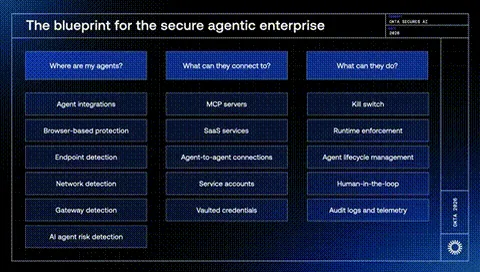
Sentra’s security approach extends beyond identifying excessive permissions before an incident. The company also emphasizes detecting unusual activity involving sensitive information and supporting containment when an AI agent behaves unexpectedly. Its capabilities can be understood through three related stages:
- Before an incident: Discover confidential information, classify sensitive datasets, identify identities with unnecessary permissions, and reduce exposure.
- During an incident: Monitor unusual access involving sensitive information, investigate suspicious activity, and support containment through permission changes or security workflows.
- After an incident: Help investigators understand which sensitive datasets an affected identity could potentially access and support remediation to reduce future exposure.
For example, an AI agent normally responsible for retrieving a limited number of customer service records might unexpectedly begin accessing large collections of financial documents. Such a change could indicate a configuration problem, compromised identity, or malicious instructions requiring investigation. Sentra’s data aware monitoring is intended to help identify unusual access involving sensitive information and support appropriate corrective measures.
However, the distinction between possible access and confirmed exposure is important. Establishing that an agent possessed permission to retrieve a database does not prove that every record was accessed or transmitted externally. Investigators may require application logs, network activity, endpoint records, and other evidence to determine what actually occurred. Similarly, no monitoring platform can guarantee detection of every unauthorized action. Effectiveness depends on telemetry, integration coverage, configuration, and the behavior being investigated.
Automated remediation also requires careful implementation. Revoking permissions may prevent further exposure, but poorly configured responses could interrupt legitimate operations. Organizations should test containment procedures, evaluate false positives, and establish appropriate escalation processes. Sentra’s platform is therefore most useful when integrated with broader cybersecurity practices involving identity management, centralized logging, secure application development, incident response, and data loss prevention.
In-Environment Analysis and Multi-Layered Governance
Sentra says its analysis operates within customers’ environments rather than requiring sensitive information to be copied into a separate vendor controlled data repository. This approach may help address concerns about data residency, confidentiality, and third party information handling. However, organizations must still examine technical implementation details and determine whether the platform meets their own security and regulatory requirements.
The company’s emphasis on protecting data where it resides distinguishes its strategy from approaches focused primarily on monitoring AI prompts or individual applications. Nevertheless, storage level protection cannot independently control every form of delegated authority or application behavior. Effective governance requires multiple coordinated security mechanisms, including identity controls, authorization checks, monitoring, and secure AI agent design.
The central objective is to ensure that AI agents can complete authorized business tasks without automatically gaining access to every information resource available within an organization. As enterprises introduce increasingly capable autonomous systems, maintaining that distinction will become essential to protecting confidential information while preserving the productivity benefits of artificial intelligence.

Sentra’s Growth, Global Expansion and the Future of Enterprise AI Agent Security
Sentra’s $150 million Series C financing reflects increasing commercial interest in cybersecurity platforms capable of protecting enterprise information as AI systems become more autonomous. The company reported more than 300% annual growth and intends to use the investment to expand its technology, workforce, customer relationships, and international operations. Its strategy is based on the argument that organizations cannot adequately secure autonomous AI systems without understanding the information those systems can access. As businesses connect AI agents to internal applications and databases, data classification, identity relationships, and access governance become increasingly important components of enterprise security.
Several factors help explain the demand for these capabilities. The first is the adoption of AI agents that operate across multiple enterprise systems. Businesses are introducing automated assistants capable of retrieving documents, processing information, and coordinating workflows, creating new questions about delegated permissions and accountability. The second factor is data fragmentation. Organizations commonly operate across several cloud providers, SaaS applications, private infrastructure environments, and specialized business platforms, making comprehensive visibility difficult. The third factor is the growing emphasis on preventing information exposure before an incident rather than relying exclusively on detection and response after a compromise.
Sentra’s expansion beyond conventional DSPM reflects these changes. The company is developing a broader platform combining sensitive data discovery, classification, access governance, data detection and response, data loss prevention, and remediation. These capabilities are intended to help organizations understand which information requires protection, identify identities with excessive access, and respond when permissions or behavior create unnecessary risk. By connecting these functions, Sentra seeks to provide security teams with a clearer understanding of the potential exposure associated with both employees and automated systems.
Enterprise Data Security Integration and Competitive Evaluation
Traditional enterprise cybersecurity environments commonly use separate technologies for different security responsibilities. Identity and access management systems control authorization, data loss prevention products monitor information transfers, cloud security platforms identify infrastructure weaknesses, and security information and event management tools collect records for investigation. Each category remains important, but organizations may struggle to combine their findings into a single understanding of which AI agents can reach sensitive datasets.
Sentra aims to address this challenge by connecting information sensitivity with access permissions. A security team may know that an AI agent possesses valid credentials without understanding the confidentiality of every dataset those credentials can retrieve. Data classification provides additional context, allowing security teams to prioritize risks based on the sensitivity of the information involved. The company also emphasizes reducing unnecessary access before depending on monitoring to identify inappropriate behavior after it occurs.
However, these capabilities are not exclusive to Sentra. Other enterprise cybersecurity companies, including Cyera and Varonis, offer technologies involving data discovery, exposure analysis, access governance, and information protection. Sentra should therefore be understood as one competitor within a broader market rather than the only provider addressing AI related data security. The most meaningful comparisons involve measurable technical and operational characteristics, including classification accuracy, integration coverage, access mapping, detection effectiveness, remediation capabilities, deployment requirements, and cost.
Independent evaluation remains important because enterprise security products operate across different infrastructure environments. A platform that integrates effectively with one organization’s cloud systems may require additional configuration or offer different coverage elsewhere. Businesses should assess whether Sentra can identify their sensitive information accurately, support appropriate permission changes, and integrate with existing security controls without disrupting authorized operations. Investment backing and reported growth do not replace these technical assessments.
Funding Plans, Expansion, and Financial Outlook
Sentra’s latest funding provides resources for addressing these requirements while expanding its commercial reach. The company intends to recruit additional engineers, develop new security capabilities, strengthen customer support, and expand sales operations. Its plans include a stronger presence in North America and Europe, additional activity in London, and potential opportunities within the United States federal market. Government customers may require specialized security assessments, compliance processes, and procurement support, making market expansion dependent on more than additional sales capacity.
The company’s reported financial performance also requires careful interpretation. More than 300% growth indicates substantial expansion according to Sentra’s disclosures, but the available information does not establish the precise revenue base or audited profitability. Calcalist’s reporting on approximately 100 major enterprise customers and annual revenue in the tens of millions of dollars suggests that the company has developed a meaningful commercial presence. Nevertheless, long term financial performance will depend on customer retention, operating costs, product competitiveness, and its ability to maintain growth as the market develops.
Its valuation remains another area where publicly available information is incomplete. Although the Series C brought cumulative funding above $250 million, Sentra did not disclose the exact ownership percentage acquired by investors or a verified valuation for the transaction. Earlier estimates and statements about substantial valuation growth cannot be used to calculate a precise November 2026 figure. Financing provides evidence of access to capital and investor interest, but it does not independently demonstrate profitability or guarantee future commercial success.
The broader cybersecurity industry is also adapting to increasingly autonomous software. Traditional approaches to enterprise security concentrated on protecting networks, securing applications, and controlling employee access. AI agents expand these requirements because software identities can independently perform tasks, retrieve information, and interact with multiple systems. Security teams must therefore understand not only which employees possess access to confidential records but also which automated identities can reach those records, how permissions were delegated, and whether they remain necessary.
Industry Adaptation and AI Agent Security Principles
This development may encourage closer integration between data security posture management, identity management, data loss prevention, and automated security response. Enterprise buyers may increasingly seek products capable of connecting information classification with permission analysis and compliance evidence. Cybersecurity vendors specializing in separate areas may also expand their offerings or improve integration with complementary technologies. Sentra’s investment strengthens its ability to participate in this market, although the competitive outcome remains uncertain.
AI agent security will continue to require multiple protective layers. Limiting access to confidential datasets can reduce the potential impact of compromised agents, but it cannot eliminate every form of misuse or system failure. Prompt injection defenses, secure application architecture, authentication, runtime monitoring, logging, and human approval for sensitive actions remain important. Organizations must also ensure that autonomous systems operate within clearly established responsibilities and that security teams can investigate their activities when necessary.
The effectiveness of enterprise AI governance ultimately depends on balancing access restrictions with legitimate business operations. Excessively broad permissions increase exposure, while overly restrictive controls can prevent automated systems from performing authorized tasks. Security platforms must help organizations identify the appropriate boundaries and maintain them as applications, employees, and operational requirements change. Continuous monitoring and carefully managed remediation can support this process, but effective implementation still requires appropriate technical integration and human oversight.
Sentra’s Series C therefore represents more than an investment in a single cybersecurity company. It reflects the growing importance of controlling enterprise information access as artificial intelligence becomes capable of carrying out increasingly complex operations. The company’s future will depend on whether it can deliver reliable protection across diverse environments while expanding its workforce, technology, and customer base. For the wider industry, the central challenge is developing security systems that allow businesses to benefit from autonomous AI without unnecessarily exposing confidential information.

Frequently Asked Questions (FAQs)
- What is Sentra’s $150 million Series C funding round?
Sentra’s $150 million Series C is a major financing round announced on November 4, 2026, and led by Capital One Ventures. The investment supports the company’s development of enterprise data security technology designed to identify sensitive information, manage access permissions, and protect confidential records from inappropriate access by employees and AI agents. The funding also provides resources for research, recruitment, international expansion, and commercial operations. Following the transaction, Sentra reported cumulative funding exceeding $250 million. - Who invested in Sentra’s $150 million funding round?
Capital One Ventures led the investment, with participation from existing backers Bessemer Venture Partners, Zeev Ventures, Standard Investments, Munich Re Ventures, and Key1 Capital. As part of the transaction, a Capital One representative will join Sentra’s board of directors. The participation of existing investors demonstrates continued financial support for the company’s expansion strategy. However, the investment does not establish that Capital One has acquired control of Sentra or that the company will become its exclusive cybersecurity provider. - What does Sentra do for AI agent security?
Sentra provides a data security platform that helps organizations discover sensitive information, classify datasets, analyze permissions, and identify unnecessary exposure. Its capabilities extend to AI agents and other automated identities that interact with enterprise systems. By connecting confidential information with the identities capable of accessing it, Sentra helps businesses establish more appropriate authorization boundaries. The platform also supports monitoring and remediation when sensitive information may be exposed through excessive permissions or suspicious activity. - How does Sentra prevent AI agents from accessing confidential information?
Sentra identifies sensitive datasets and examines which users, applications, and automated identities possess permission to access them. Its platform helps organizations detect excessive privileges, correct risky sharing arrangements, and apply least privilege principles so agents receive only the access necessary for their responsibilities. This can reduce the information available to an agent if it behaves unexpectedly or becomes compromised. However, effective protection also requires integration with identity management, application authorization, monitoring, and other security controls. - What is data security posture management in Sentra’s platform?
Data security posture management, or DSPM, involves discovering sensitive information, assessing how it is protected, identifying exposure risks, and supporting corrective action. Sentra uses DSPM to provide visibility into confidential records distributed across cloud infrastructure, SaaS applications, databases, and private systems. The platform also evaluates access relationships and identifies unnecessary exposure. This information helps security teams prioritize risks and establish stronger protection before sensitive data is accessed by employees or automated systems. - How much money has Sentra raised in total?
Following its November 2026 Series C financing, Sentra announced that its cumulative funding exceeded $250 million. The latest round contributed $150 million, following previous investments that included a $50 million Series B in April 2025. The Wall Street Journal separately reported cumulative funding above $260 million. These statements are not necessarily inconsistent because Sentra’s announcement used a rounded threshold. However, the available disclosures do not provide a complete financing breakdown sufficient to establish an exact total independently. - What is Sentra’s valuation after its Series C funding?
Sentra did not publicly disclose an exact valuation following its November 2026 Series C round. Earlier reporting referenced a valuation of approximately $205 million during its previous financing, while Calcalist indicated that the company’s valuation had increased substantially but remained below $1 billion. These figures provide context but do not establish the precise value associated with the latest transaction. Determining that figure would require additional information about the ownership percentage acquired, financing structure, and investor terms. - Why is AI agent access governance important for enterprises?
AI agent access governance is important because automated systems can retrieve, process, and act on enterprise information through multiple applications with limited human intervention. If an agent possesses excessive permissions, it may reach confidential records unrelated to its assigned responsibilities. Governance helps organizations establish appropriate access boundaries, maintain accountability, support compliance, and reduce potential exposure. It is particularly important in regulated industries where customer information, financial records, and other sensitive data require strong protection. - How does Sentra compare with other enterprise data security companies?
Sentra competes with cybersecurity companies providing sensitive data discovery, classification, exposure management, access governance, and data loss prevention. Its approach emphasizes connecting information sensitivity with the permissions held by employees, applications, and AI agents. Other vendors, including Cyera and Varonis, provide overlapping capabilities. Businesses should compare platforms according to classification accuracy, supported integrations, monitoring effectiveness, remediation features, deployment requirements, and operating costs rather than assuming one provider is universally superior. - What will Sentra do with its $150 million investment?
Sentra plans to invest in research and development, AI agent visibility, automated remediation, employee recruitment, international expansion, and commercial operations. The company intends to strengthen its presence in North America and Europe, establish additional operations in London, and pursue opportunities in the United States federal market. It also plans to expand partnerships and sales activities while developing broader enterprise data security capabilities. Its long term objective is to support organizations adopting autonomous AI by improving visibility into sensitive information and controlling unnecessary access.

Conclusion
Sentra’s $150 million Series C funding round, announced on November 4, 2026, highlights the growing importance of data security as businesses increasingly adopt autonomous AI agents. Led by Capital One Ventures, the investment brings Sentra’s total funding to more than $250 million and supports its plans for product development, recruitment, and international expansion. The company’s platform focuses on discovering sensitive information, classifying data, managing access permissions, and reducing unnecessary exposure across enterprise systems. Its reported annual growth of more than 300% suggests increasing demand for these capabilities, although detailed financial figures remain undisclosed. However, investment and commercial growth do not guarantee market leadership or complete protection against AI security threats.
Effective enterprise security still requires strong identity management, restricted permissions, secure application design, continuous monitoring, and reliable incident response. As organizations expand their use of AI agents, controlling which information automated systems can access, retrieve, modify, and share will become increasingly important. Sentra’s latest financing strengthens its position in this developing market while reflecting a broader shift toward making data access governance a fundamental component of secure enterprise AI deployment.
Sources and Citations
- Sentra, November 4, 2026: Official company announcement confirming its $150 million Series C funding led by Capital One Ventures, with participation from Bessemer Venture Partners, Zeev Ventures, Standard Investments, Munich Re Ventures, and Key1 Capital. Details the company’s reported 300% year-over-year growth, plans to expand internationally, and investment in technologies that control access to sensitive enterprise data by employees, applications, and autonomous AI agents.
https://sentra.io/news/sentra-raises-150-million-agentic-data-security - Sentra, Ron Reiter, November 4, 2026: Technical commentary from Sentra’s co-founder and CTO explaining why the company raised $150 million and how its platform evolved from cloud data security posture management into comprehensive agentic data security. Discusses sensitive data discovery, classification, data loss prevention, AI agent permissions, least-privilege enforcement, automated remediation, and the company’s plans to expand its engineering and product development capabilities.
https://sentra.io/blog/why-we-raised-150m-series-c-data-security - SiliconANGLE, Duncan Riley, November 4, 2026: Independent technology reporting examining Sentra’s $150 million financing, investor participation, cumulative funding exceeding $260 million, and enterprise AI security capabilities. Explains how Sentra identifies sensitive information, maps human and non-human identities to data access permissions, detects suspicious activity, and automatically revokes risky access. Also covers the company’s growth, leadership, and plans for geographic expansion.
https://siliconangle.com/2026/11/04/sentra-raises-150m-to-control-what-ai-agents-can-reach-in-corporate-data/ - Calcalist, Meir Orbach, November 4, 2026: Detailed reporting on Sentra’s financing, founding team, financial performance, and expansion strategy. Identifies founders Yoav Regev, Asaf Kochan, Ron Reiter, and Yair Cohen, and reports approximately 130 employees, around 100 major enterprise customers, and annual revenue in the tens of millions of dollars. Discusses estimates placing Sentra’s valuation near $1 billion, plans to double its workforce, establish a London office, and enter the US federal market in the second half of 2027.
https://www.calcalistech.com/ctechnews/article/s1jextotml - The Wall Street Journal, November 4, 2026: Reporting on Sentra’s $150 million Series C, cumulative financing exceeding $260 million, and workforce expansion plans. Examines CEO Yoav Regev’s expectations that employee numbers could double within 12 to 18 months. Explores cybersecurity risks associated with autonomous AI agents, excessive data permissions, employee-created AI applications, and the growing difficulty of governing automated access to sensitive corporate information.
https://www.wsj.com/pro/cybersecurity/ai-security-startup-sentra-raises-150-million-to-police-autonomous-agents-4ab9da29 - National Institute of Standards and Technology (NIST), October 27, 2026: Official cybersecurity guidance titled “Design Tenets for Agent Identity Management Systems,” outlining ten proposed principles for securing autonomous AI agents. Covers distinct agent identities, delegated authorization, least and zero-standing privilege, short-lived credentials, human oversight, continuous monitoring, access control, and tamper-evident audit records. Provides an independent technical framework for understanding the identity management and data governance challenges addressed by Sentra’s security platform.
https://www.nist.gov/blogs/cybersecurity-insights/design-tenets-agent-identity-management-systems
Recommendations
- How do I simulate a GoPro-style camera in Blender?
- Ghost Recon Wildlands 4K 60 FPS Update and New Last Rites Mission: Everything We Know
- What is the World Video Game Hall of Fame 2026 and Why it Matters
- Roblox Debuts 4D Creation Tool Letting Players AI‑generate Interactive In‑game Objects; “full Scene Generation” Roadmap and Community Reaction
- BioEden PC Release: September 3, 2026 Launch, Gameplay, Demo, and Console Plans
- Pokémon Go stop removed from Epstein island following outrage: why the Little Saint James “Sun Dial” PokéStop was deleted
- GTA 6 Leaker Cyberleek’s Meme Cryptocurrency Crashes
- The X-Files Creator Chris Carter Wants to Continue After Season 11
- Subnautica 2 Tadpole Pens Walkthrough: How to Find Zip’s Blackbox Keycode and Unlock the Locked Door
- Star Wars: Marvel Reveals a Forgotten Luke Skywalker vs Boba Fett Battle



































































































