










In April 2026, NASA completed Artemis II, the first crewed Artemis flight, sending four astronauts on a lunar flyby and returning them safely to Earth. The mission validated critical deep-space systems—especially crewed operations of Orion and the end-to-end launch-to-recovery chain—while also reshaping the roadmap for the next two missions: Artemis III is now a 2027 Earth-orbit demonstration, and the first lunar surface landing has shifted to Artemis IV in early 2028.
At the same time, NASA has announced a strategic pivot: pausing the lunar Gateway “in its current form” and shifting focus toward a phased plan for a permanent lunar base—one designed to support sustained surface operations, higher mission cadence, and longer-duration human presence.

Artemis II Mission Summary: What Happened During NASA’s Historic Lunar Flyby
Artemis II launched on 1 April 2026 from Kennedy Space Center, sending a crewed Orion spacecraft on a deep-space trajectory for a lunar flyby and return to Earth. The mission’s profile was a crewed flyby—not a landing—and was designed to test spacecraft performance and crew operations in the actual deep-space environment (including life support, navigation, communications, piloting, and recovery).
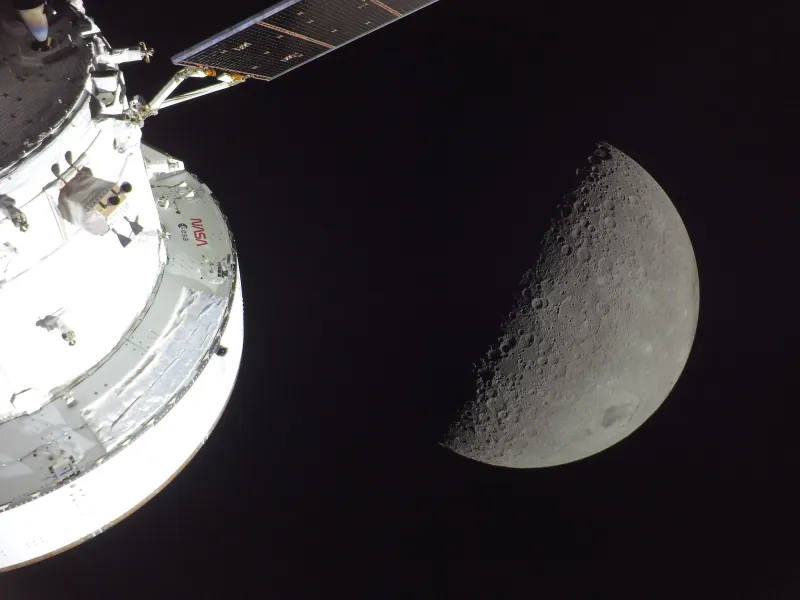
During the flyby, the crew reached a maximum distance of 252,756 miles (406,820 km) from Earth (a new human distance record) and passed within about 4,067 miles (6,545 km) above the lunar surface at closest approach. NASA also emphasised that the mission’s human observations and imagery of lunar terrain were a deliberate part of the test flight, complementing decades of robotic mapping with real-time visual interpretation by astronauts.
Artemis II officially lasted 9 days, 1 hour, and 32 minutes, with splashdown on 10 April 2026.
Why Artemis II Is NASA’s First Crewed Moon Mission Since Apollo
Artemis II is the first time humans travelled to the Moon’s vicinity and returned since the Apollo era ended with Apollo 17 in 1972. While Artemis II did not land, its significance closely parallels earlier “pathfinder” missions in the Apollo programme—testing the systems and procedures needed before committing to surface operations—except with modern requirements, modern safety standards, and a far more complex, international-commercial industrial base.
Who Were the Artemis II Astronauts and Their Historic Milestones
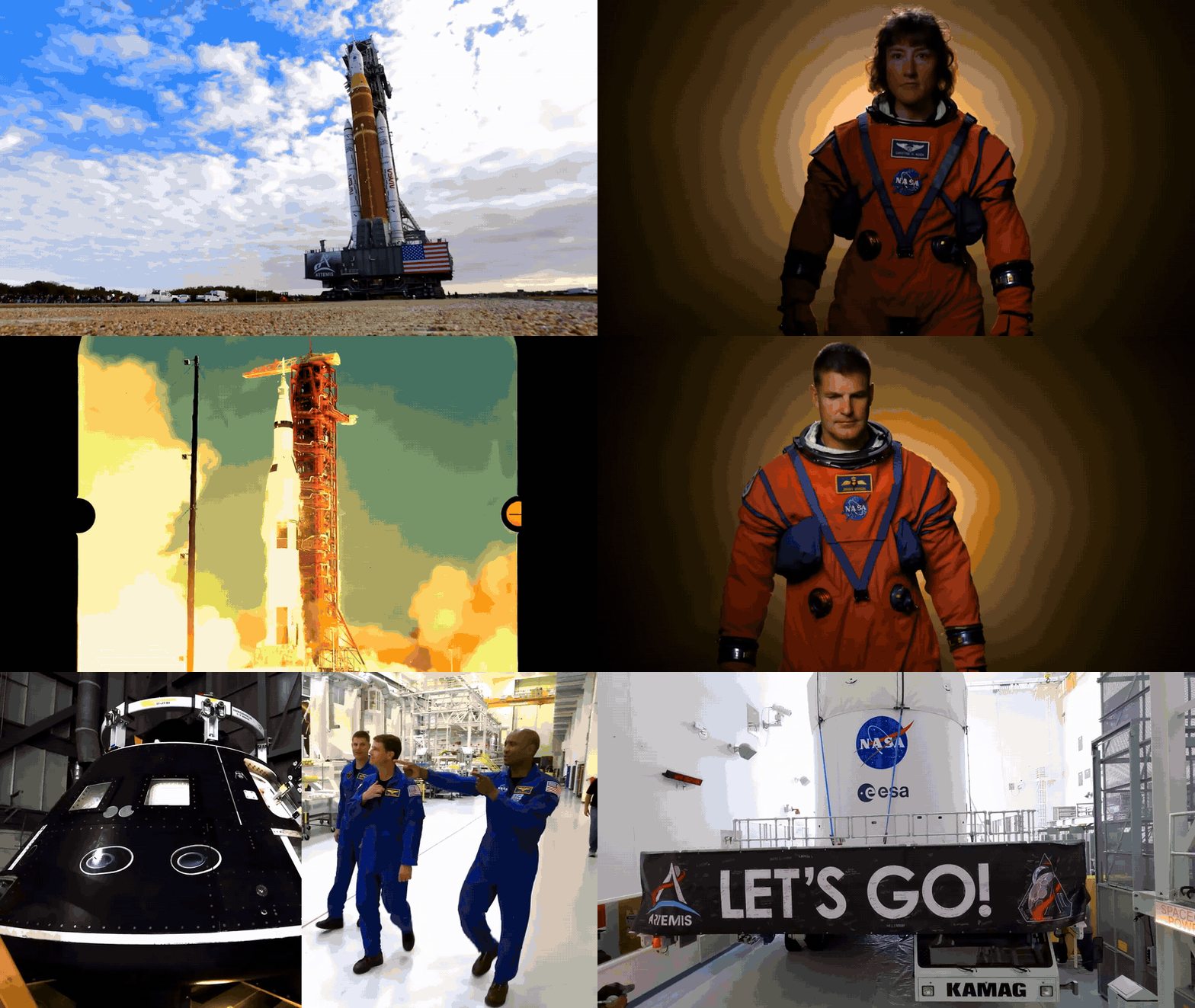
The Artemis II crew consisted of Reid Wiseman (commander), Victor Glover (pilot), Christina Hammock Koch (mission specialist), and Jeremy Hansen (mission specialist), with Canadian Space Agency participation formalised through Artemis-era international partnerships.
Multiple outlets documented the crew’s “firsts” in the modern lunar era—most notably the first Black astronaut on a lunar mission (Glover), the first woman assigned to a lunar mission (Koch), and the first non-U.S. astronaut assigned to a lunar mission in the Artemis programme (Hansen).
Artemis II Crew Return to Earth: Splashdown Details and Recovery Process
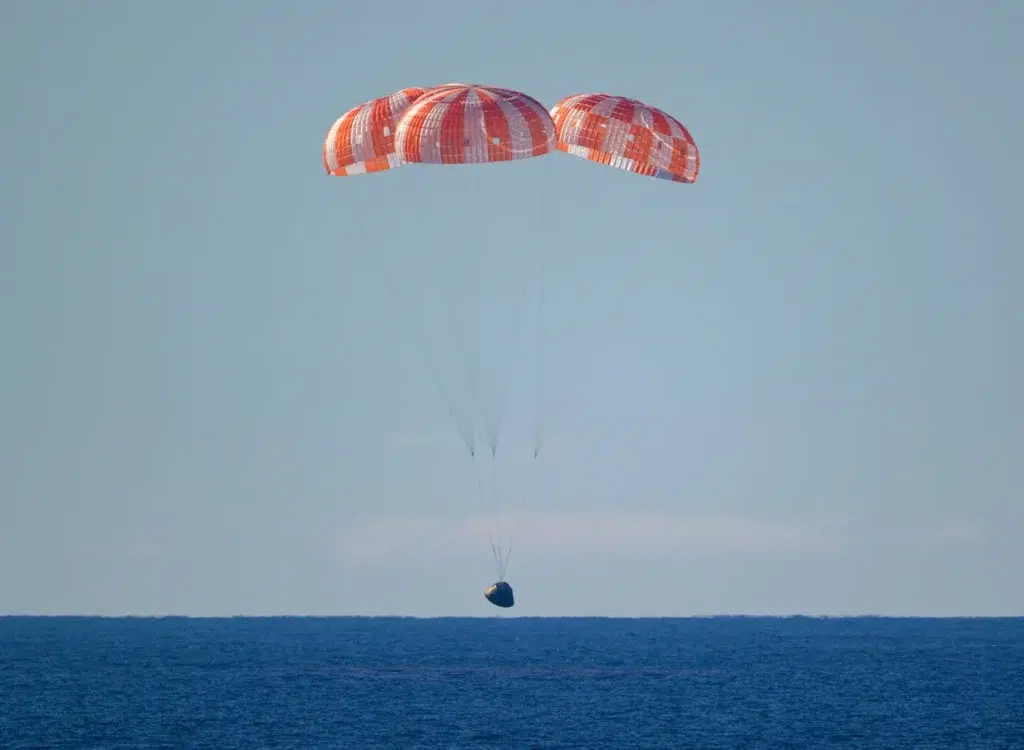
Orion splashed down in the Pacific Ocean off the coast of San Diego at approximately 5:07 p.m. PDT (8:07 p.m. Eastern) on 10 April 2026, completing the mission’s entry, descent, and landing sequence.
NASA’s recovery plan used a combined NASA–U.S. military team: astronauts were assisted out of the capsule in open water, transported by helicopter, and delivered to the USS John P. Murtha for initial post-mission medical evaluations. After initial check-outs, the crew travelled onward to Johnson Space Center and returned to Houston for reunions, debriefs, reconditioning, and postflight medical/human performance assessments.
Key Achievements of Artemis II and What NASA Learned from the Mission
Artemis II’s achievements were intentionally “systems-heavy”: the flight was a comprehensive validation of crewed deep-space operations rather than a mission built around a single scientific payload or a single destination activity.
A central objective was confirming Orion’s ability to sustain astronauts in deep space, which required validating life support system performance and related crew survival and cabin operations in-flight (including monitoring atmosphere, meal preparation, waste handling, and metabolic “loading” checks). The mission objectives also included demonstrations relevant to future proximity operations and rendezvous work—such as Orion handling qualities, proximity operations demonstrations, and communications/optical communications demonstrations—intended to reduce risk for future docking and surface mission profiles.
NASA stated that the entry, descent, and landing systems performed as designed, with the mission serving as the final, crewed test of bringing Orion back to Earth from lunar-return velocities—an especially critical requirement because Orion is the vehicle NASA identifies as capable of returning crews to Earth at those high reentry speeds.
On the research side, NASA connected Artemis II to longer-term crew health and performance goals, including the use of investigations such as AVATAR (organ-on-a-chip technologies) to study impacts of microgravity and deep-space radiation environments on human health. This type of data is a key part of building an evidence base for longer lunar stays and eventual Mars missions (where radiation exposure, isolation, and logistics constraints become even more demanding).
How Artemis II Sets the Stage for Future Moon Missions
NASA explicitly linked Artemis II’s piloting demonstrations and system evaluations to upcoming mission needs—particularly the rendezvous and docking operations expected with human-rated landers “during Artemis III and beyond.” In practical terms, Artemis II provides:
A validated baseline for crewed Orion performance (including life support and manual piloting) that future missions can build upon without simultaneously introducing “first flight” risk for the crew capsule.
A proven end-to-end recovery pipeline—splashdown, open-water procedures, helicopter transfer, shipboard medical evaluations—that becomes a repeatable operational capability as mission cadence increases.
Operational confidence to move into integration tests with lunar landers and spacesuits, which NASA has now placed at the centre of the redesigned Artemis III mission.
What Is Artemis III? NASA’s Next Step Toward Lunar Exploration
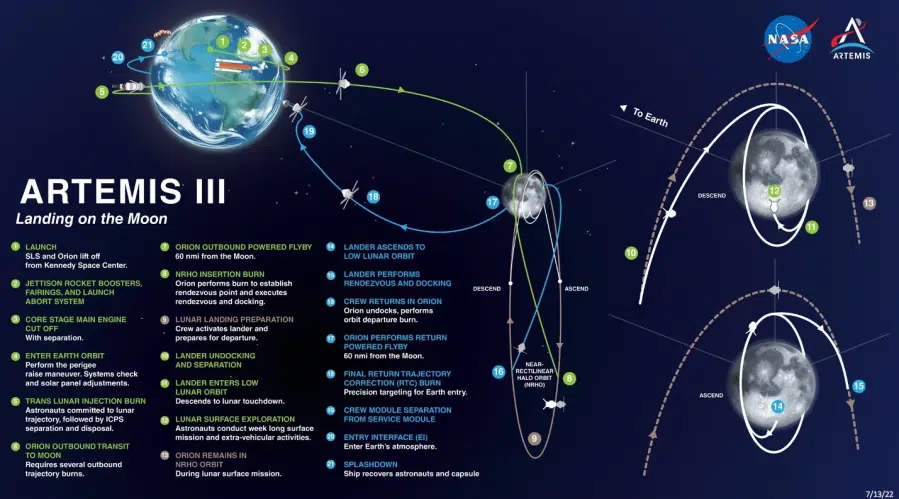
Artemis III is no longer the first lunar landing of the Artemis era. In late February 2026, NASA announced a revised architecture: Artemis III (scheduled for 2027) is now a crewed demonstration mission in low Earth orbit, focused on testing integrated operations needed for lunar landings—especially rendezvous, docking, and systems interoperability between Orion and commercial landers.
NASA described this new Artemis III as a more deliberate “build-up” step intended to prepare for an Artemis IV landing in 2028, and stated that the updated test flight is expected to include docking with one or both commercial landers and integrated checkouts of docked systems (life support, communications, propulsion), along with tests of new EVA suits.
Artemis III Launch Date, Mission Goals, and Crew Expectations
NASA lists Artemis III as launching in 2027, with a mission type defined as rendezvous and docking in low Earth orbit. The mission design is intentionally framed around closing capability gaps before a surface landing attempt—specifically testing the “integrated operations” between Orion and the commercial spacecraft that will eventually carry astronauts from lunar orbit to the surface and back.
As of April 2026, NASA indicates that details—including final mission design specifics and crew assignment—will be announced closer to the 2027 launch.

How Artemis III Will Test Lunar Landers from SpaceX and Blue Origin
Under the updated Artemis III plan, NASA intends to test rendezvous and docking with one or both commercial landers developed by SpaceX and Blue Origin—in effect, using Earth orbit as a controlled proving ground before relying on those vehicles for lunar descent/ascent in 2028.
This approach is tightly connected to the technical risk profile of human landing systems. In March 2026, NASA Office of Inspector General documented that lander development challenges were expected to delay Artemis launch dates and highlighted a central safety concern: NASA did not have a rescue capability if crews became stranded in space or on the lunar surface. The Inspector General report also described schedule pressure and “unsettled designs,” identifying large-scale cryogenic propellant transfer and related flight-test dependencies as among the most significant hurdles for crewed landing readiness.
From an engineering and operations standpoint, Artemis III’s docking-and-checkout framework is designed to demonstrate (at minimum) that Orion can safely integrate with the lander systems astronauts will depend upon—life support interfaces, communications links, and propulsion and control behaviours—before the first surface mission.
Why NASA Delayed the First Moon Landing to Artemis IV
NASA’s February 2026 architecture update added an additional mission step specifically to reduce complexity and risk: Artemis III is now a capabilities demonstration in Earth orbit, and Artemis IV is targeted as the first lunar surface landing in early 2028. NASA framed the change as a move toward a more logical, phased build-up—explicitly tying the new Artemis III mission to docking tests, integrated system checkouts, and spacesuit testing required before surface exploration.
In parallel, NASA is also refining the launch system approach for this accelerated cadence, including moving away from previously planned hardware upgrades (such as the Exploration Upper Stage and Mobile Launcher 2) that NASA said had faced delays, and instead assessing alternative options while standardising configurations to shorten time between flights.
NASA’s Plan to Land Humans on the Moon Again by 2028
NASA’s current published plan targets Artemis IV in early 2028 as the first Artemis-era lunar landing, with astronauts exploring the lunar South Pole region. NASA describes Artemis IV as a crewed surface landing mission: four astronauts launch in Orion on SLS, travel to lunar orbit, and then two descend to the surface for approximately a week of science operations near the South Pole before returning to orbit and heading home.
NASA also indicates that the landing system for Artemis IV will be commercial, with “lander readiness” determining which provider carries astronauts for the mission (a significant statement given the dual-provider lander strategy). For lunar surface EVA, NASA’s Artemis planning now explicitly points to advanced suits provided by Axiom Space for moonwalks on Artemis IV.
Timeline of Artemis Missions: From Artemis II to a Lunar Base by 2030+
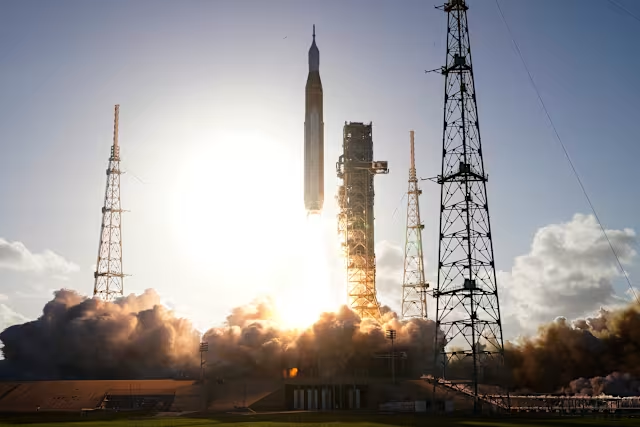
NASA’s most current, source-published sequence (as of April 2026) establishes a clear near-term chain: Artemis II (completed April 2026), Artemis III (Earth-orbit demonstration in 2027), Artemis IV (first lunar landing in early 2028), and Artemis V (another lunar surface mission targeted for late 2028).
In February 2026, NASA stated it was standardising configurations and aiming to undertake at least one surface landing every year thereafter—an explicit attempt to move from “bespoke, infrequent missions” into a repeatable cadence. In March 2026, NASA went further: it announced plans to incorporate more commercially procured and reusable hardware beyond Artemis V, initially targeting crewed lunar landings every six months, with the potential to increase cadence as capabilities mature.
The “lunar base by 2030+” concept hinges on infrastructure delivery, not just landings. NASA’s March 2026 national space policy release frames base-building as a multi-phase transition—moving from periodic expeditions to a permanent lunar base once cargo-capable landers can deliver heavier systems and logistics at scale. In parallel, NASA’s Inspector General has reported that NASA obligated $6.9 billion for human landing system development and estimated a total of $18.3 billion through fiscal year 2030, underscoring how strongly the base timeline is coupled to lander maturity, test outcomes, and long-term budgeting.
The Shift from Lunar Gateway to Building a Permanent Moon Base
On 24 March 2026, NASA stated it intends to pause Gateway “in its current form” and shift focus toward infrastructure that enables sustained surface operations—explicitly tying this decision to a phased approach for building a lunar base and achieving an enduring human presence. NASA also stated it would repurpose applicable equipment and leverage international partner commitments where possible.
This is a meaningful strategic change because Gateway was previously presented as a core staging node in the Artemis architecture. NASA’s own Gateway pages now carry editor notes indicating that NASA is updating its website to align with the latest Artemis updates and the March national policy initiatives.
How NASA Plans to Build a Sustainable Human Presence on the Moon
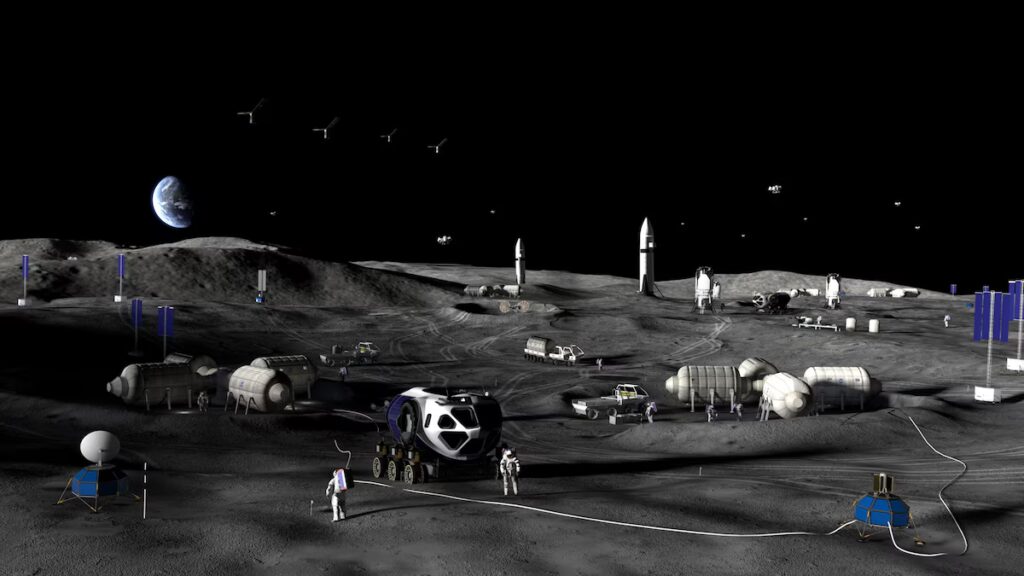
NASA’s March 2026 “Moon Base” plan is explicitly phased:
Phase One (“Build, Test, Learn”) emphasises scaling up surface activity through CLPS deliveries and the Lunar Terrain Vehicle programme, increasing the tempo of robotic and technology demonstration missions to advance mobility, power generation (including radioisotope heater units and RTGs), communications, navigation, and surface operations. NASA also outlined an accelerated CLPS cadence targeting up to 30 robotic landings starting in 2027—designed to rapidly deliver science and technology payloads (including rovers, hoppers, and drones) and expand opportunities for academia and international partners.
Phase Two (“Establish Early Infrastructure”) moves toward semi-habitable infrastructure and regular logistics, incorporating major international contributions—including a pressurised rover by JAXA.
Phase Three (“Enable Long-Duration Human Presence”) is the threshold for permanence: as cargo-capable human landing systems come online, NASA plans to deliver heavier infrastructure for a continuous human foothold, explicitly describing this as the transition from periodic expeditions to a permanent lunar base. Planned partner contributions in this phase include multi-purpose habitats from the Italian Space Agency and a lunar utility vehicle from the CSA.
Sustainability also depends on resource strategy and site selection, which is one reason NASA continues to prioritise the lunar South Pole. NASA has identified nine candidate landing regions near the South Pole for Artemis-era surface missions. These regions are scientifically and operationally attractive in large part because permanently shadowed areas are believed to contain water ice—an asset that can reduce dependence on Earth resupply. NASA describes lunar water as a “critical material” for an enduring presence, with potential uses including breathable air and rocket fuel (via processing pathways that convert water into oxygen and hydrogen).
A sustainable surface campaign also requires human mobility and EVA systems. NASA’s surface mobility framework is organised through its spacesuits-and-rovers programmes, which encompass next-generation lunar suits, unpressurised and pressurised rovers, and tools to enable work outside the spacecraft on the lunar surface. NASA has reported extensive pressurised testing and simulated lunar operations for its next-generation suit systems, reflecting the safety-critical nature of EVA as missions move from short sorties toward longer habitation.
Why the Artemis Program Is Critical for Future Human Missions to Mars
NASA positions Artemis within a broader “Moon to Mars” exploration strategy: the Moon is treated as the nearest proving ground for deep-space systems, operational cadence, surface logistics, and human health research that must work reliably before Mars missions become viable.
Several Artemis-linked capability areas are directly “Mars-relevant”:
Crew health and radiation research: Artemis II included investigations aimed at understanding how deep-space radiation and microgravity affect human tissue and performance—data needed for long-duration missions.
Surface systems and logistics: NASA’s Moon Base plan explicitly says Phase Three is where a continuous human foothold becomes possible—requiring cargo delivery, habitat-scale infrastructure, mobility, and robust power and communications systems. Those are exactly the categories of capabilities that must later scale to Mars.
“Test in Earth orbit before committing to the Moon”: NASA’s redesigned Artemis III is, in effect, a risk-reduction mission to validate integrated operations between Orion and the landers and suits required for landing missions. That sequence reflects a classical exploration principle—prove interfaces and operational modes before moving into higher-risk environments.
Cost, schedule, and safety governance: NASA’s Inspector General has emphasised that landing systems represent a high-stakes, high-cost technology area with major schedule drivers, and has raised explicit concerns about unmitigated crew safety risks—issues that become even more consequential on Mars missions where rescue is not feasible.

10 Frequently Asked Questions (FAQs)
1: Did Artemis II land on the Moon?
No. Artemis II was a crewed lunar flyby mission (a flight around the Moon and back to Earth) intended to validate deep-space systems and operations, not a lunar landing.
2: How long did Artemis II last, and what were its key distance milestones?
NASA lists Artemis II’s duration as 9 days, 1 hour, and 32 minutes. The crew travelled up to 252,756 miles from Earth and passed roughly 4,067 miles above the lunar surface at closest approach.
3: Where did the Artemis II crew splash down, and how were they recovered?
Artemis II splashed down off the coast of San Diego in the Pacific Ocean. Recovery teams used helicopters to retrieve the crew and transport them to the USS John P. Murtha for initial medical evaluations before onward travel.
4: Who flew on Artemis II?
The crew was Reid Wiseman (commander), Victor Glover (pilot), Christina Hammock Koch (mission specialist), and Jeremy Hansen (mission specialist).
5: What was the name of the Orion spacecraft used on Artemis II?
The crew named the Orion spacecraft “Integrity.”
6: What is Artemis III now expected to do?
NASA’s revised plan describes Artemis III (2027) as a crewed demonstration in low Earth orbit to test rendezvous, docking, and integrated operations between Orion and one or both commercial landers, along with other system checkouts and EVA suit testing.
7: Will Artemis III land astronauts on the Moon?
Under NASA’s February 2026 architecture update, Artemis III is designed as an Earth-orbit demonstration mission, while the first Artemis-era lunar landing is targeted for Artemis IV in early 2028.
8: Which companies are developing lunar landers for Artemis?
NASA is working with SpaceX and Blue Origin on human landing systems intended to carry astronauts from lunar orbit to the surface and back. NASA’s Inspector General notes the programme faces development challenges and safety risks that affect schedules.
9: Why is the lunar South Pole the target for Artemis landings and a future base?
NASA has identified candidate landing regions near the lunar South Pole and highlights the importance of water ice and other volatile resources—key to an enduring human presence because water can support life support and potentially be processed into propellants.
10: Is NASA building a permanent Moon base, and what happened to the Lunar Gateway plan?
NASA has announced a phased approach to building a lunar base and stated it intends to pause Gateway in its current form while shifting focus to infrastructure supporting sustained surface operations, repurposing equipment and leveraging partner commitments where possible.
conclusion
Artemis II’s safe return marks a validated re-entry point for human deep-space exploration: crewed Orion performance, operational recovery, and mission control procedures have now been proven in the lunar environment. NASA’s next steps reflect a deliberate risk-reduction strategy—moving Artemis III into Earth orbit in 2027 to test docking, lander integration, and EVA systems—before attempting the first Artemis-era lunar landing on Artemis IV in early 2028.
The longer arc is even more consequential: NASA’s March 2026 policy initiative describes a pivot away from Gateway (in its current form) and toward a phased, infrastructure-led approach that explicitly targets a permanent lunar base and an enduring human presence. If executed, Artemis becomes more than a return to the Moon—it becomes the operational and technological foundation for sustained deep-space exploration and future human missions to Mars.
sources and citation
- NASA mission overview for Artemis II (mission type, dates, official duration)
- Link NASA news release on Artemis II splashdown and mission outcomes (mission distance record, recovery narrative, key system validation statements)
- Link NASA mission blog confirming key Artemis II milestones and return-to-Houston timeline
- Link NASA “Most Pressing Artemis II Questions” (recovery plan details and mission priorities framed for the public)
- Link Artemis II mission priorities/objectives document (detailed test objectives across life support, proximity ops, emergency procedures, and communications)
- Link NASA press release updating Artemis architecture (Artemis III redesign for 2027 and preparation for Artemis IV landing in 2028)
- Link NASA mission overview for Artemis III (mission type: rendezvous and docking in low Earth orbit; launch year; integration framing)
Recommended
- The Animal Crossing Where Villagers Bully You Is Now (Unofficially) Available On PC: How It Works, Download Guide, and What’s Different
- The Ultimate Guide to the Most Popular Black Hairstyle Options
- Everwind Early Access Launch Explained: Why This Minecraft-Like Voxel Sandbox RPG With Flying Islands Is Getting Attention
- Rockstar Confirms New Data Breach After Hacker Group Threatens “Pay or Leak” — What Was Stolen and What It Means
- Dead by Daylight’s All-Kill: Comeback Adds Game’s First Urban Map — Trickster’s Delusion, Kwon Tae-young Perks, and Release Date
- VTuber Model Guide: Everything You Need to Know About Creating and Using VTuber Avatars
- Marvel’s Wolverine Preorders Still Waiting on Insomniac’s Next Gameplay Reveal as PS5 Release Approaches
- Best 10 Water Simulation Add-ons in Blender: Everything You Need to Know Before You Install