




In This Article (7 sections)
AW-0 World Action Model: How AI Combines Robot Planning, Visual Prediction, and Physical Actions
AW-0 World Action Model brings together three capabilities that robots need for complex manipulation: planning a sequence of skills, predicting how a scene will change, and generating the movements required to complete a task. Its central idea is to connect these capabilities within one model, using code to structure visual prediction and physical control. The official implementation includes separate experts for code, video, and actions, allowing the system to coordinate different forms of information during manipulation. The practical motivation is straightforward: a robot may identify the correct object but fail to grasp it, execute a stable movement while misunderstanding an instruction, or complete individual actions without knowing what should happen next. Reliable manipulation requires these abilities to work together.
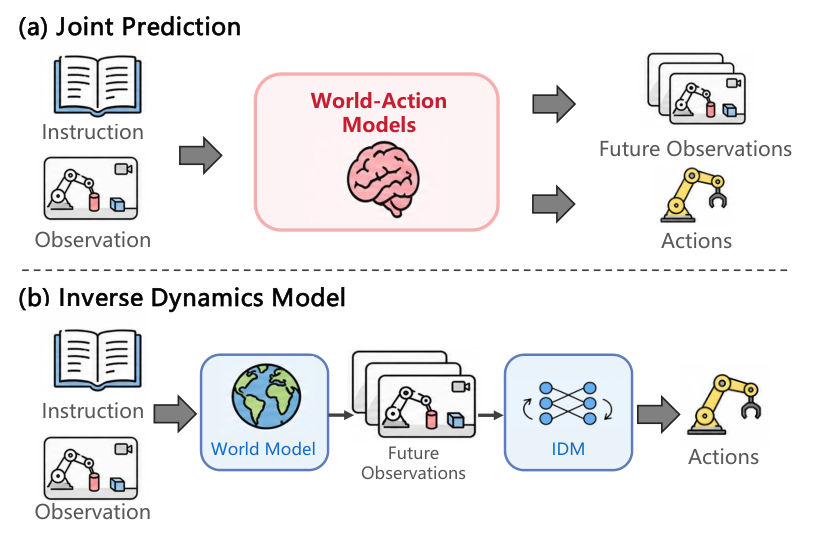
AW-0 is an agentic world action model designed for robotic manipulation. A world action model connects predictions about future observations with actions that can produce those observations. NVIDIA’s explanation of the broader approach describes learning how physical scenes change and how robots can influence those changes. The term agentic adds structured task execution, allowing the system to represent meaningful operations, their arguments, and their order rather than treating an activity as an uninterrupted sequence of motor commands.
Consider an instruction to place a fragile cup inside a container. The robot must identify the cup, locate the container opening, choose an appropriate grasp, avoid collisions, and release the object at the correct position. Planning determines what should happen, visual prediction represents the anticipated outcome, and action generation provides the movements needed to execute the plan. These capabilities are complementary, but none independently guarantees success. The model must connect its intended operations with the actual environment and respond when physical execution differs from expectations.
AW-0 was developed by researchers affiliated with UC Berkeley, NVIDIA, and the University of Pennsylvania. Its development combines pretrained model components with a robotics training and deployment framework. The released checkpoint identifies several major components:
- Cosmos-Predict2.5-2B: Serves as the video expert responsible for representing predicted visual changes.
- SDAR-1.7B: Provides the code backbone used for structured program generation.
- Qwen3-VL-2B: Functions as the vision tower for processing visual information.
- Diffusion action head: Generates robot action sequences for physical manipulation.
This architecture reflects the challenge of connecting different kinds of intelligence. A coding model can represent operations and instructions, while a visual model interprets observations and predicts future states. An action model must then produce outputs compatible with robotic hardware. The difficult engineering problem is ensuring that these representations remain consistent. An object name may help interpret an instruction, but the robot also needs a spatial target. Similarly, coordinates can specify movement without proving that the selected object satisfies the original request.
The official repository describes AW-0 as a system that jointly processes code, predicted video, and robot actions through a Mixture of Transformers (MoT) architecture. Each representation addresses a different part of the manipulation problem. Code expresses the operation and its structure, video represents a possible visual outcome, and action sequences describe numerical control targets. A sorting task illustrates the relationship: the program identifies an object and requests placement, the video expert predicts the object’s movement toward its destination, and the action system generates a feasible trajectory for the robot.
Consistency between these outputs is essential. Correctly generated code cannot compensate for selecting the wrong physical object, just as a convincing predicted video cannot compensate for a robot movement that misses its target. Training must also preserve timing between instructions, observations, and actions. AW-0’s data preparation documentation requires robot states, actions, and camera streams to share a synchronized timeline, with program labels aligned to the appropriate frames. Without that alignment, the model could associate an instruction with the wrong stage of an interaction.
Code based skill planning provides another important part of AW-0’s design. Its annotation workflow converts demonstrations into program labels by dividing episodes into subtasks, generating code against a defined application programming interface, and checking contact or gripper events against recorded behaviour. The objective is to connect meaningful operations with the physical activity demonstrated during training. Earlier Code as Policies research explored how language models can compose perception and control interfaces into robot programs, demonstrating the usefulness of familiar programming structures for representing physical tasks.
Code can express sequencing, repetition, arguments, and conditional operations more explicitly than an unstructured movement description. For example, moving several objects may involve repeating the same operation with different targets, while another task may require checking whether a prerequisite has been satisfied before proceeding. However, valid program syntax does not guarantee a physically correct plan. A function may receive the wrong object, an unsuitable destination, or an inaccurate position. Its usefulness depends on grounding program instructions in the actual scene and the robot’s capabilities.
AW-0 also predicts future visual states through its video expert, which uses Cosmos-Predict2.5-2B and a Wan2.2 variational autoencoder. A variational autoencoder provides compressed visual representations, allowing a model to work with information needed to reconstruct images rather than processing full resolution frames throughout generation. NVIDIA identifies this type of compression as a common component of world action models.
For robotic manipulation, the important question is whether the representation preserves details relevant to physical control. Object position, orientation, contact, and movement may matter more than how visually convincing a generated frame appears. A prediction showing a block inside a narrow opening may look correct even when the real object approaches at an angle that prevents insertion. Visual plausibility therefore does not guarantee physical feasibility. Predictions become most useful when they help the controller anticipate consequences and are evaluated against actual execution.
AW-0’s real robot implementation uses a unified 64 dimensional state and action representation. Its deployment documentation distinguishes end effector motion, gripper values, and dexterous hand joint values. For the YAM platform, the server converts between this representation and the robot’s joint space commands using forward and inverse kinematics. These conversions connect desired manipulator positions with the mechanical movements required to achieve them.
The model generates action chunks, meaning short movement sequences predicted together. Chunking can support coherent execution while reducing the need to generate each motor command individually. Longer chunks may improve continuity, while shorter execution intervals allow the controller to respond more frequently to new observations. If an object begins slipping, continuing an outdated movement sequence may increase the error, while observing and updating the action can provide an opportunity to correct it. The practical balance depends on inference speed, feedback frequency, and the control requirements of the hardware.
The Mixture of Transformers architecture helps coordinate these different representations. Foundational MoT research separates parameters such as attention projections, feed forward networks, and normalization according to modality while allowing information to pass between them through attention. AW-0’s checkpoint describes three experts connected through joint attention at each layer, with 28 layers per expert.
The design recognizes that program tokens, visual representations, and robot actions have different structures. Program outputs belong to a discrete vocabulary, video representations encode spatial and temporal information, and action outputs contain numerical movement values. Processing them through specialized experts can preserve these differences while joint attention allows the system to exchange relevant information.
AW-0 also uses joint denoising, with code being refined alongside video and action representations. Denoising involves progressively transforming incomplete or noisy representations into structured outputs. For continuous generative models, this commonly means refining noisy values, while discrete generation can involve recovering masked or missing tokens. The project’s simulation documentation includes controls governing when generated code tokens become available during inference.
The potential benefit is that planning information can influence video and action generation while those representations are still developing. This differs from a strictly sequential process in which one component must finish before another begins. However, simultaneous refinement does not guarantee correct coordination. The model may still produce an inaccurate interpretation, and confident predictions may still fail during execution. The relevant tradeoff involves output quality, computational cost, and responsiveness, particularly when additional refinement steps increase inference time.
AW-0 therefore represents an attempt to coordinate task meaning, predicted visual consequences, and physical actions within one learned framework. Its significance lies in whether those representations help robots perform complex manipulation more reliably, rather than merely demonstrating that several AI components can generate outputs together.
AW-0 Robot Training, Skill Reuse, Real World Benchmarks, and Performance Results
AW-0 learns from both human and robot demonstrations, using structured representations to connect observed manipulation with program labels and action sequences. Its pretraining documentation identifies two primary sources: teleoperated YAM robot demonstrations and egocentric human manipulation recordings. Both are converted into a shared action representation and paired with code annotations, allowing the system to learn relationships between instructions, visual changes, and physical movements.
The human demonstration format includes tracked wrist poses and hand configurations. Its preparation instructions distinguish hand movement in a stable coordinate system from apparent movement caused by a head mounted camera. This distinction is important because a hand may shift across the camera image when a person turns their head, even if the hand remains stationary relative to the surrounding environment. Without suitable coordinate handling, the model could mistake camera movement for physical manipulation.
Human and robotic demonstrations also differ mechanically. A human hand, a parallel gripper, and a dexterous robotic hand cannot necessarily perform identical movements because their geometry, reach, joints, and contact behaviour differ. A common representation supports learning across these sources but does not eliminate the need to account for hardware limitations. AW-0’s preparation pipeline also requires normalization statistics, instruction embeddings, synchronized observations, and aligned program labels, making training more structured than simply collecting videos.
The annotation workflow supports reusable skill libraries. Demonstrations are divided into meaningful subtasks, recurring behaviours are identified, and suitable skills are admitted into libraries that are later frozen for labeling. Candidate skills must recur across tasks and remain within the intended subtask scope. This allows common operations to be represented once and reused with different arguments instead of reconstructing every activity from elementary movement instructions.
For example, stabilizing an object while pulling another component may represent a recurring coordination pattern. The operation could potentially appear in several tasks while involving different objects, directions, or contact requirements. However, reusing a skill does not eliminate the need for adaptation. A routine suitable for a rigid container may behave differently when applied to flexible materials, and the system must recognize when its available skill is inappropriate.
AW-0’s hybrid simulation interface supports two execution approaches: generated programs can invoke available skills through defined interfaces, or the action head can produce movement sequences at a replanning point. This creates flexibility between structured operations and learned control, but it also introduces another decision about which execution method is appropriate for the current situation.
The project’s reported real world evaluation includes eight manipulation tasks:
- Fruit arrangement: Tests selecting and positioning objects in the intended locations.
- Backpack packing: Examines object placement and interaction with a container.
- Lightbulb replacement: Requires coordinated handling and accurate positioning.
- Towel folding: Introduces manipulation of flexible material.
- Tong use: Tests interaction through a tool rather than direct contact alone.
- Card handling: Examines controlled manipulation of relatively small objects.
- Scoreboard flipping: Requires changing the orientation or state of a physical display.
- Cube manipulation: Tests coordinated object handling using a single face scramble.
The evaluation uses 100 demonstrations per task and 48 rollouts per task across three training seeds. The cube task’s single face scramble is an important qualification because performance on that constrained test does not establish an ability to solve arbitrary puzzle configurations.
The hardware documentation identifies two platforms: YAM with parallel grippers and Tianji Sharpa with dexterous hands. Both use three camera views, although their hand and gripper representations differ. This allows researchers to investigate how the model handles different mechanical interfaces while maintaining a common framework for observations and actions.
The reported real world comparison shows AW-0 achieving a higher average rubric score than the evaluated alternatives:
| Model | Average Rubric Score |
|---|---|
| AW-0 | 71.1% |
| DreamZero | 46.0% |
| π₀.₅ | 43.6% |
These results represent a 27.5 percentage point improvement over π₀.₅ and a 25.1 percentage point improvement over DreamZero. The commonly referenced 25 point gain therefore corresponds more closely to the comparison with DreamZero rather than π₀.₅.
Importantly, the reported values are average rubric scores, not necessarily the percentage of attempts in which every task requirement was completed. A rubric may award partial credit for intermediate achievements. For example, a hypothetical task containing four equally weighted stages could produce a 75% average score if a robot consistently completed three stages but never finished the fourth. That illustration is not an AW-0 result; it explains why task progress and complete task success must be distinguished.
The results therefore support the conclusion that AW-0 achieved a higher average task progress score under the reported evaluation conditions. Establishing broader reliability would require additional measurements of complete task success, recovery after errors, performance on unfamiliar objects, and sustained operation across different environments.
The evaluation tasks cover several manipulation challenges, including selecting objects, coordinating hands, interacting with containers, using tools, and controlling contact with flexible or relatively small items. However, repeated testing remains limited by the chosen objects, layouts, initial conditions, and scoring rules. Multiple rollouts provide information about variability within those conditions, but they do not automatically establish generalization to every variation of the task.
AW-0 was also evaluated using the RoboTwin simulation benchmark. The reported results distinguish clean environments from randomized settings:
| Execution Method | Clean Setting | Randomized Setting |
|---|---|---|
| AW-0 | 80.8% | 20.6% |
| Hybrid execution | 63.1% | 29.2% |
RoboTwin 2.0 is a dual arm manipulation benchmark and data generation framework containing 50 tasks. Its documented variations include clutter, lighting, backgrounds, and tabletop height, allowing researchers to examine how robotic policies respond when environmental conditions change.
The results demonstrate why clean and randomized evaluations should remain separate. AW-0 achieves stronger reported performance in the clean setting, but its success rate falls considerably under randomization. Hybrid execution performs less strongly in the clean environment while achieving a higher reported result under randomized conditions.
These differences indicate that execution strategies can behave differently depending on the environment. A policy that performs well under familiar visual conditions may struggle when lighting, clutter, or background appearance changes, even when the underlying manipulation objective remains similar.
The comparison also requires attention to training conditions because the simulation configurations use different demonstration sources. When training data differs, the experiment compares complete configurations rather than isolating only the effect of changing the execution method. Attributing every performance difference solely to hybrid execution would therefore go beyond what the comparison establishes.
The official benchmark runner records configurations, random seeds, and results to support reproduction. Its current standard evaluation plan specifies 100 episodes per task and setting, meaning researchers must ensure their settings match those associated with the particular reported result they intend to reproduce.
AW-0’s broader contribution lies in connecting structured planning with visual prediction and action generation across several manipulation tasks. Its strong clean setting results and higher average real world rubric score provide evidence that the approach can improve performance under the evaluated conditions. However, the weaker randomized performance demonstrates that robustness remains a significant challenge.
The contrast between controlled and varied environments is especially important for practical robotics. Real spaces contain changing lighting, unexpected clutter, object variations, and imperfect observations. A robot that completes familiar tasks under stable conditions may require additional training, feedback, or recovery mechanisms before similar performance can be expected elsewhere.
The reported benchmarks therefore establish promising progress in coordinated robot manipulation while identifying areas where further evaluation is necessary. The next question is not simply whether the system can generate plans, videos, and actions, but whether those representations remain useful when physical conditions differ from the examples encountered during training.
AW-0 Model Availability, Deployment Requirements, Limitations, and Future Robotics Applications
AW-0’s official GitHub repository and a pretrained model checkpoint are publicly available. The repository includes documentation for data preparation, code annotation, pretraining, real world post training, and RoboTwin evaluation. These resources allow researchers to inspect the architecture, review implementation choices, and investigate portions of the training and deployment process.
However, public availability has several levels. Source code provides access to implementation details, while a pretrained checkpoint contains learned model parameters. Reproducing the reported experiments may additionally require exact datasets, preprocessing procedures, dependency versions, training configurations, external components, and matching evaluation conditions.
The installation documentation identifies a Cosmos-Predict2.5-2B initialization checkpoint for pretraining from scratch that is not distributed with the release. It also describes the external model components required by the system. The real world deployment guide includes a YAM serving pathway but states that a Tianji Sharpa serving implementation is not included.
These distinctions matter because downloading model weights is not equivalent to having a fully operational physical robot system. A laboratory must still connect observations, model inference, action conversion, hardware interfaces, and execution feedback. Differences in robotic equipment or software environments can affect whether the released model can be used directly.
The project’s release includes several important research resources:
- Official source repository: Provides implementation materials and documentation for the AW-0 framework.
- Pretrained checkpoint: Contains released model parameters for research use.
- Data preparation instructions: Describe synchronized observations, action representations, and required preprocessing.
- Code annotation workflow: Explains how demonstrations are divided into subtasks and converted into structured program labels.
- Training documentation: Covers pretraining and real world post training procedures.
- RoboTwin evaluation tools: Support simulation testing with recorded configurations and results.
- YAM deployment documentation: Describes the supported serving process for the YAM platform.
The repository uses the BSD 2 Clause license, while external components remain subject to their respective licenses. This means the released project provides substantial research materials, but dependencies and platform specific limitations must still be considered when attempting reproduction or deployment.
AW-0’s reported failure cases demonstrate why manipulation remains difficult even when the intended operation is understood. The researchers identify obstructed grasps, object instability, alignment errors, tool collisions, and lost contact. These problems involve different parts of the control process and cannot necessarily be addressed through a single improvement.
An obstructed grasp may occur when the selected approach is geometrically unsuitable, while object instability can result from poor contact or unexpected movement. Alignment errors may prevent insertion or placement even when the correct object is selected. Tool collisions introduce additional constraints, and lost contact can invalidate the movement sequence assumed by the controller.
These failures also illustrate the distinction between planning, perception, and execution. A robot may generate a logically sensible program but lack an accurate understanding of the object’s position. Conversely, perception may identify the correct target while the action system fails to maintain contact. Diagnosing these differences is important because each failure may require a different solution.
Future research could strengthen AW-0 through several approaches:
- Improved feasibility estimation: Determining whether a proposed movement is physically achievable before execution.
- Stronger contact feedback: Responding more reliably during grasps, transfers, and tool interactions.
- Better execution selection: Choosing when to invoke reusable programs and when to use learned action sequences.
- Recovery after mistakes: Revising plans when objects slip, move unexpectedly, or become obstructed.
- Longer task evaluation: Measuring whether small errors accumulate across extended manipulation sequences.
- Broader environmental testing: Examining unfamiliar objects, layouts, lighting conditions, and physical variations.
- Detailed failure analysis: Separating planning errors from perception, alignment, and motor control problems.
Program quality also requires more than successful execution of code syntax. A generated program may be valid while referring to the wrong object, selecting an unsuitable destination, or invoking a skill at an inappropriate stage. Evaluation should therefore distinguish whether a failure originates in task interpretation, symbol grounding, program selection, or physical execution.
Longer sequences create an additional challenge because early mistakes can change the conditions assumed by later operations. A robot might successfully perform several movements before an object shifts unexpectedly, making the remaining plan unsuitable. Reliable manipulation requires the ability to recognize such changes and adapt rather than continuing with outdated assumptions.
Visual prediction could contribute to that process if it helps identify differences between expected and observed outcomes. However, prediction alone is insufficient without a control mechanism capable of responding effectively. The relationship between planned operations, predicted consequences, and actual feedback remains the central engineering challenge.
AW-0’s hybrid execution design offers one possible way to investigate this relationship. Structured programs can represent reusable operations, while action generation can provide movement sequences for situations requiring learned control. The usefulness of combining these approaches depends on whether the system can select the appropriate method and recover when its initial choice proves unsuitable.
The benchmark results also suggest that improving robustness under environmental variation should remain a priority. Performance in the randomized RoboTwin setting is substantially lower than in the clean setting, indicating that changes in visual conditions and task surroundings can affect execution. Better generalization would require the model to maintain useful relationships between instructions, objects, and actions even when superficial aspects of the environment change.
Physical deployment introduces further requirements involving camera accuracy, actuator behaviour, timing, mechanical constraints, and contact stability. The model’s inference speed is only one component of overall responsiveness. A practical robot must repeatedly observe its surroundings, interpret the current situation, produce appropriate actions, convert those actions into hardware commands, and evaluate the outcome.
The value of AW-0 therefore lies in providing a research framework for coordinating these capabilities rather than demonstrating unrestricted robotic autonomy. Its combination of code, video, and action experts offers a structured way to connect task planning with predicted physical outcomes and executable movements.
The reported results show encouraging performance on selected real world manipulation tasks and controlled simulation benchmarks, particularly through its higher average rubric score compared with the evaluated alternatives. However, weaker performance under randomization and the documented failure cases demonstrate that dependable generalization remains unresolved.
Ultimately, AW-0 contributes to the broader effort to make robots capable of handling complex, multistage manipulation tasks. Its main innovation is coordinating meaningful operations, visual predictions, and physical actions within one architecture. The next stage of progress will depend on stronger robustness, clearer recovery mechanisms, broader evaluations, and evidence that the approach remains effective beyond the environments used in its initial experiments.
Frequently Asked Questions (FAQs)
- What does AW-0 combine?
AW-0 combines code based task planning, future visual prediction, and robot action generation within a single architecture. Code represents meaningful operations and their sequence, video predicts how the environment may change, and action generation produces movement commands. These components work together to help a robot understand what should happen and how to execute it. Their effectiveness depends on maintaining consistency between the intended task, the predicted visual outcome, and the robot’s actual physical behaviour. - Why use code in a robot model?
Code provides a structured way to describe robotic tasks using operations, object references, sequences, repetitions, and conditional instructions. For example, moving several objects can be represented as a repeated operation with different targets. This makes task plans easier to organize and potentially reuse across activities. However, correctly written code does not guarantee successful manipulation because the robot must still identify the right objects, determine accurate positions, and execute movements within its physical limits. - Is the reported improvement a complete task success rate?
No. AW-0’s reported real world comparison uses an average rubric score rather than a simple measurement of fully completed tasks. A rubric may award credit for intermediate progress, meaning a robot can receive points without finishing every required stage. AW-0 achieved 71.1% on this metric, compared with 43.6% for π₀.₅ and 46.0% for DreamZero. These results indicate better average task progress under the evaluated conditions but should not be interpreted as complete task success rates. - Does visual prediction guarantee that a robot can perform an action?
No. A predicted video can show a convincing outcome without accounting for every physical constraint involved in achieving it. For example, a model might predict an object entering a narrow opening even when the robot’s actual approach would cause a collision. Reliable manipulation requires suitable movement planning, accurate perception, stable contact, and successful physical execution. Visual prediction can help anticipate consequences, but real robot performance must establish whether those predictions are achievable. - Why are human demonstrations useful for robotics?
Human demonstrations show how people coordinate movements, interact with objects, and organize tasks into meaningful stages. They can provide examples of grasping, supporting, transferring, and placing objects that would otherwise be difficult for a robot to discover through exploration alone. However, human and robotic hands differ in their anatomy and mechanical capabilities. The recorded movements must therefore be represented and adapted appropriately before they can become useful robot training examples. - What is the purpose of an action chunk?
An action chunk is a short sequence of robot actions generated together rather than one movement command at a time. This can improve continuity because the controller predicts several related steps as part of the same movement. However, longer chunks may reduce responsiveness if the environment changes unexpectedly. The controller must therefore balance coherent execution with opportunities to observe the scene again and update its actions when an object moves, slips, or becomes obstructed. - Why does visual randomization matter?
Visual randomization tests whether a robotic policy can continue performing tasks when environmental conditions change. These changes may involve lighting, clutter, backgrounds, object arrangements, or tabletop height. A model that performs well in a familiar environment may struggle when its observations look different, even if the underlying task remains the same. Testing randomized conditions helps researchers measure robustness and identify whether the policy depends too heavily on visual patterns encountered during training. - What does hybrid execution mean?
Hybrid execution allows AW-0 to control a robot through more than one approach. The system can invoke generated code through available skills or use action sequences produced by its learned action head. This creates flexibility because some tasks may benefit from structured reusable operations, while others require direct movement generation. However, the system must also determine which method is appropriate for the current situation. Its effectiveness depends on both the available execution methods and the decisions governing when they are used. - Does releasing a checkpoint make the full experiment reproducible?
Not necessarily. A model checkpoint provides trained parameters, but reproducing the complete experiment may require the original training data, preprocessing steps, external model components, software dependencies, hardware interfaces, and evaluation configurations. AW-0 provides a public repository and pretrained checkpoint, but its documentation identifies certain unavailable initialization resources and platform specific deployment limitations. Researchers must therefore distinguish between running released components and reproducing every stage of the original experiments. - What should future AW-0 evaluations establish?
Future evaluations should determine whether AW-0 can maintain reliable performance with unfamiliar objects, changing environments, longer manipulation sequences, and unexpected failures. They should also examine how effectively the model recovers from lost contact, alignment errors, obstructed grasps, and unstable objects. Separating planning mistakes from perception and motor control failures would help identify which components require improvement. These experiments would provide stronger evidence about whether the system’s capabilities generalize beyond its original benchmarks.
Conclusion
AW-0 demonstrates how structured planning, visual prediction, and robot control can work together to improve complex manipulation. Its public implementation provides a foundation for further research, while its reported results highlight promising progress. However, rubric scores, complete task success, and performance under changing environmental conditions measure different capabilities and must be evaluated separately.
Future improvements will depend on stronger physical grounding, reliable execution feedback, and better coordination between reusable programs and learned movements. The ultimate goal is to develop robots that can execute plans accurately, recognize unexpected changes, and adapt their actions to complete tasks reliably.
Sources and Citations
- Agentic World Action Models, October 21, 2026: Primary AW-0 research paper. The paper introduces AW-0 as an agentic world action model that integrates code-based planning with joint video and robot-action prediction. It models code, future video, and actions as three coupled generative streams inside a Mixture-of-Transformers architecture, uses code to represent reusable skills, and evaluates the system on RoboTwin 2.0 and real bimanual manipulation tasks. arXiv
Citation: Agentic World Action Models – arXiv | AW-0 Project Page - Official AW-0 GitHub Repository: Source code, architecture, training, deployment, and evaluation. The repository identifies the project as AW-0: Agentic World Action Models and documents its code, video, and action experts, unified training framework, robot deployment pipeline, RoboTwin integration, and BSD 2-Clause licence. It also links the paper, project page, model checkpoint, installation instructions, data-processing guides, code-annotation workflow, and benchmark tools. GitHub
Citation: AW-0 Official GitHub Repository - Official AW-0 pretrained model release. The released Hugging Face checkpoint is described as the pretrained starting point for AW-0 post-training on both real robots and RoboTwin. Its model card identifies a Cosmos-Predict2.5-2B video expert, SDAR-1.7B code expert, frozen Qwen3-VL-2B vision tower, diffusion action head, and Mixture-of-Transformers coupling. Hugging Face
Citation: AW-0 Pretrained Checkpoint on Hugging Face - AW-0 implementation guides: Data preparation. The official repository’s data guide converts robot recordings into LeRobot-formatted shards, computes statistics for the shared action representation, prepares instruction embeddings, and checks dataset consistency. The main README describes the real-robot data path as three cameras, 224×320 resolution, 30 Hz data, and 64-dimensional statistics. GitHub
Citation: AW-0 Data Preparation Guide - AW-0 implementation guides: Code annotation. The code-annotation documentation explains how demonstrations are converted into per-frame program labels, including the VLM labeling pipeline, task-specific programs, alignment checking, and flat code-cache generation. The repository also includes separate annotation tools for pretraining, post-training, and RoboTwin simulation. GitHub
Citation: AW-0 Code Annotation Guide - AW-0 implementation guides: Real-world robot deployment. The real-world guide covers post-training on YAM and Tianji + Sharpa hardware and deployment of AW-0 on YAM. The repository documents a server-client setup where camera observations and robot joint states are sent to the model server, which returns robot targets for execution. GitHub
Citation: AW-0 Real-World Deployment Guide - AW-0 implementation guides: RoboTwin training and evaluation. The RoboTwin guide documents simulation data collection, AW-0 training, benchmark execution, and hybrid evaluation. The repository specifies evaluation across the benchmark’s tasks and supports a hybrid mode in which generated code can either execute through the simulator’s skill interface or defer to the learned WAM action head. GitHub
Citation: AW-0 RoboTwin Guide - RoboTwin 2.0: Official benchmark documentation. RoboTwin 2.0 is a large-scale bimanual manipulation benchmark built on SAPIEN. Its official documentation covers 50 dual-arm tasks, environmental randomization involving clutter, lighting, backgrounds, tabletop height, and other variations, as well as installation, evaluation, dataset generation, and benchmark procedures. Robot Simulation Platform
Citation: RoboTwin 2.0 Official Documentation | RoboTwin 2.0 Project Page | RoboTwin 2.0 ICML 2026 Paper - Mixture-of-Transformers: Architectural background for AW-0. The MoT paper introduces modality-specific transformer parameters while preserving global information exchange through attention. It separates components such as feed-forward layers, attention projections, and normalization according to modality, providing the architectural background for AW-0’s specialized code, video, and action experts communicating through shared attention. arXiv
Citation: Mixture-of-Transformers: A Sparse and Scalable Architecture for Multi-Modal Foundation Models | Official Mixture-of-Transformers Repository - Code as Policies: Background on using programs for robot control. This Google Robotics research demonstrates how language models can generate robot policy code from natural-language instructions. The resulting programs can call perception and control APIs, use loops and other programming structures, perform spatial reasoning, and generate waypoint or reactive robot policies. It provides direct background for AW-0’s use of structured programs and reusable robot skills. arXiv
Citation: Code as Policies: Language Model Programs for Embodied Control | Code as Policies Project Page - NVIDIA: Technical background on World Action Models. NVIDIA’s June 2026 technical overview explains world action models as robot foundation models that use pretrained video models to predict future states and actions. It describes several architectures, including joint video-action prediction and Mixture-of-Transformers designs, along with action tokens, latent action representations, and world-model-based robot control. NVIDIA Developer
Citation: Pretrained to Imagine, Fine-Tuned to Act: The Rise of World-Action Models - NVIDIA: Additional World Action Model manipulation overview. NVIDIA’s August 2026 article explains how WAMs use video world models to provide a physics prior, jointly predict action trajectories and future camera views, and support robot manipulation across changing environments. This is useful background for AW-0’s video-prediction component, but it is not documentation of AW-0 itself. NVIDIA Developer
Citation: Beyond VLAs: How World Action Models Reshape Robot Manipulation
Recommendations
- Echoes of Aincrad Crafting Guide: Recipes, Materials and Unlock Requirements
- Did Christopher Nolan’s Depiction of the Gods Pay Off in The Odyssey?
- Castlevania: Belmont’s Curse Runs at Only 30 FPS on Nintendo Switch
- EA Sports College Football 27 Preview: Defense Wins Championships
- Jurassic World Evolution 2 Complete Edition Comes to Nintendo Switch 2 on July 30, 2026
- Unity-Based Tool for JRPG Game Development: RetroGig’s Retro JRPG Template for SNES/PSX-Style RPG Systems
- Keanu Reeves & China Miéville BRZRKR: Light Draws Breath — Release Date, Story, Creative Team & Variant Covers
- CD Projekt Raises Profit Goals with Witcher 4, 5, and 6 Coming: 5 Billion PLN Target Explained
- Creepshow Official Announcement Trailer Reveals a New Anthology Horror Game Experience
- GTA 6 Leans Into Vice City’s Influencer Hustle Where Looks Matter



































































































