










In This Article (18 sections)
DNEG’s for All Mankind Season 5 VFX Breakdown: Scope, Workflow, and Production Context
DNEG’s visual effects work on For All Mankind Season 5 brings together two demanding tasks: making a growing Martian settlement feel inhabited and delivering large-scale destruction within that established world. The studio’s contribution encompasses Happy Valley’s expansion, surrounding landscapes, spacecraft activity, and major effects sequences, including the K-Station explosion. DNEG identifies Mo Sobhy as the visual effects supervisor who led its work on the season.
The fifth season premiered on Apple TV on March 27, 2026, with its ten-episode release running through May 29. Its setting gives the environmental work particular importance: Happy Valley is no longer merely a remote expeditionary outpost, but a settlement with thousands of residents and an increasingly complicated relationship with Earth. The DNEG VFX breakdown for For All Mankind Season 5 therefore offers more than a collection of Martian landscapes and spectacular explosions. It provides a useful case study in how environment design, lighting, simulation, and compositing can support the same narrative. Understanding that work also requires distinguishing documented production decisions from the broader technical principles that help explain their significance.
DNEG supplied 338 shots, according to environment supervisor Benjamin Ruiz’s Digital Media World interview. That figure represents the studio’s contribution, not the season’s total visual effects count. The published sequence highlights include the full-CG Sojourner launch, Hopper flights through sandstorms, agricultural dome destruction, the K-Station explosion, and night-time views of Happy Valley. These sit alongside the expanded colony and additional Martian environments.
Assessing Narrative Coherence and Technical Continuity
A useful way to assess this work is to separate world construction from world interaction. An establishing view asks whether the settlement has convincing dimensions and organization. A spacecraft launch asks whether an animated vehicle belongs within that settlement. A destruction sequence asks whether the same structures remain recognizable as they change state. Those questions are connected. An explosion has more dramatic value when the audience understands what is being destroyed.
Similarly, a flight through dangerous weather becomes easier to follow when the environment supplies a clear sense of direction, distance, and destination. The strongest analytical focus is therefore not simply the size of the effects. It is whether the images preserve the relationship between people, machinery, and place. That relationship provides a more useful measure of visual storytelling than spectacle alone.
DNEG migrated its environment workflow from Clarisse iFX to Houdini and RenderMan. The distinction between those software roles matters. Houdini’s documentation demonstrates procedural terrain construction and simulation capabilities, while Pixar describes RenderMan as a rendering system with physically based shading and multi-bounce global illumination. These are complementary functions rather than interchangeable descriptions of one task. At a general production level, changing a workflow while continuing an established setting creates a double objective. The new system must support future work, but it must also preserve enough of the existing appearance that the audience does not experience the transition as an unexplained redesign.
This is why software migration should be evaluated through images rather than product names. A familiar building could retain its shape while appearing different because of a change in material response or lighting. Conversely, successful continuity may make a substantial technical transition invisible. For artists studying the breakdown, the useful lesson is to distinguish creative intent from implementation. The desired settlement, atmosphere, and photographic character remain the targets. Software provides the means to reach them. The available reporting supports the broad Houdini to RenderMan workflow. It does not justify attaching an unverified version number, renderer setting, simulation preset, or compositing application to every shot in the reel.

Building Mars: Landscapes, Happy Valley, ISN Base, Space Elevator Views, and Season-to-Season Change
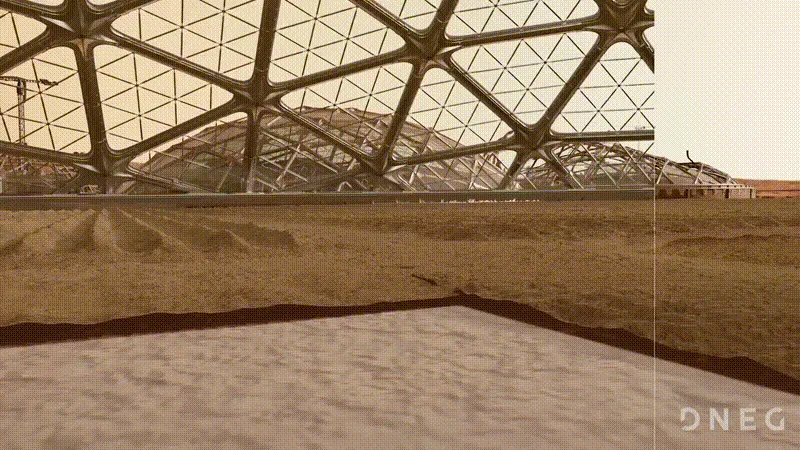
DNEG’s Martian landscapes were created with Houdini-based procedural environments supplemented by digital matte-painting refinements. For understanding the procedural side, Houdini’s documented terrain tools provide useful context. Its heightfield system represents elevation through a two-dimensional grid, with additional layers and masks controlling where modifications apply. Artists can combine terrain features while retaining the ability to revise individual operations. This explains the software’s suitability for editable landscapes, although it does not establish which particular heightfield nodes DNEG used.
A convincing Martian landscape benefits from being considered at several visual scales. The largest shapes establish the location’s identity. Intermediate formations organize the view around buildings and vehicles. Small surface features provide a reference against which a person, wheel, or landing foot can be judged. As an analytical example, a distant ridge can tolerate simplified detail when its silhouette carries the composition.
Ground beside an astronaut cannot rely on silhouette alone: its scale must remain credible next to a familiar human figure. This distinction suggests why environmental realism should not be equated with uniformly adding detail. The more useful goal is appropriate detail. A landscape needs enough information to support the camera’s position and the scene’s action, without allowing decorative complexity to overwhelm the geography.
NASA Reference Imagery and Color Interpretation
NASA mission imagery guided DNEG’s scientific references, atmosphere, and mood. That is more useful than relying on the simplified idea that Mars is uniformly orange-red. NASA’s planetary overview identifies brown, gold, and tan among the colors visible at the surface. The planet’s familiar reddish appearance is associated with oxidized iron in rocks, regolith, and dust. Reference photography also requires interpretation. NASA distinguishes raw imagery from calibrated natural-color presentations and white-balanced versions. Natural-color processing approximates how a scene might appear under Martian lighting, while white balancing can present terrain as though illuminated under more Earth-like conditions.
For an environment artist, the implication is practical: two differently colored images need not represent conflicting geological evidence. They may reflect different processing choices. A reference collection should therefore preserve information about how an image was produced, not just its visual appearance. Scientific reference is also different from literal reconstruction. An image can inform surface variation or atmospheric appearance without providing a complete model of a fictional settlement’s location.
The strongest interpretation of NASA’s role is consequently as a source of constraints and observations. It helps replace generic assumptions with specific visual evidence. It does not mean that the colony is a real NASA design, that every shot reproduces an actual landing site, or that cinematic choices disappear from the process.
Happy Valley Expansion and Procedural Roads
Happy Valley expanded two to three times, with procedurally movable roads. The narrative reason for that growth is clear in Apple’s description of the season. A colony supporting thousands of residents and further exploration needs to communicate a different level of permanence from a small research base. From a design perspective, expansion is not simply multiplication. Repeating a habitat module across a larger area might increase the apparent population, but it does not necessarily explain how the place operates. A more revealing question is whether the arrangement suggests understandable movement between living areas, workspaces, and transport infrastructure.
Consider a hypothetical revision in which a landing area moves farther from housing. The value of an editable layout is not restricted to relocating the landing surface. The approach route, adjoining terrain, and nearby structures may also need reconsideration. This is where procedural thinking becomes an organizational advantage. Instead of treating every visible feature as an isolated object, an environment can be approached as a set of relationships. For viewers, the desirable result is a settlement that appears to have developed for practical reasons. Its growth should feel connected to human activity rather than to the need to fill a wider camera frame.
ISN Base Reuse and Settlement Identity
The ISN, or Independent Spacefaring Nations, base reused Happy Valley modules in another valley. That provides an interesting environment-design problem: how can another settlement possess a distinct identity without requiring every component to be unique? One approach, considered as a general design principle, is to distinguish the arrangement rather than the underlying construction vocabulary. The same family of buildings can produce a compact outpost, a linear settlement, or a dispersed industrial site depending on spacing, orientation, and surrounding terrain.
This distinction is valuable for evaluating the ISN environment. Architectural familiarity can suggest shared technological constraints, while geography can establish separation. A settlement surrounded by enclosing slopes would communicate a different relationship to the landscape from one spread across an open plain, even before individual buildings are examined. The important storytelling test is whether the audience can recognize a change of location quickly. That does not demand an unrelated color palette or an entirely different architectural style. It demands a readable combination of silhouette, spatial organization, and context. Asset reuse should consequently be judged by the final identity of the place, not by whether components appear in more than one environment.
Elevated Views from the Space Elevator
The elevated city view originates from an unfinished space elevator. An overhead perspective changes what an environment must communicate. From street level, a foreground structure can hide much of the surrounding layout. From above, the same scene exposes relationships between structures, open ground, and routes through the settlement. For analysis, the crucial question is whether the image explains the colony without requiring a verbal description. Can the eye distinguish major destinations? Does the distribution of development suggest a center and an edge? Is there enough variation to separate functional areas without losing a common visual identity?
An elevated viewpoint also invites scrutiny of scale. If every structure has similar dimensions and spacing, the result can resemble a miniature arrangement. Introducing a readable hierarchy of large infrastructure and smaller occupied spaces offers a way to counter that impression. The unfinished elevator carries an additional interpretive value. Construction can express ambition without implying that the imagined society has completed every technological objective. The shot is therefore worth examining as both geography and storytelling. Its purpose is not merely to display more buildings. It can help establish the scale of the community and the distance between its present circumstances and future intentions.
Nighttime Lighting Controls and Dust Effects
Happy Valley’s night-time imagery was supported by asset-level light controllers, an internal atmosphere tool, and dust effects. Night-time imagery presents a different analytical problem from daylight imagery. Instead of relying on a broadly illuminated landscape, the composition must establish what is visible and why. Pixar’s RenderMan overview describes physically based lighting controls that include exposure and color temperature. Such controls offer a general foundation for distinguishing light sources and adjusting their photographic relationship, although they do not reveal the settings used for Happy Valley.
A useful way to study a colony at night is to ask which spaces the illumination makes legible. Light can suggest a route, identify an entrance, or separate an occupied area from the surrounding darkness. Giving every structure equal prominence would weaken those distinctions. Real Mars imagery offers a small but relevant comparison. NASA published a Curiosity observation in which LEDs illuminated a rock target during the Martian night.
It demonstrates localized artificial illumination on the actual surface, rather than providing a direct reference for an inhabited city. The broader artistic lesson is restraint. A night environment does not need every detail to be visible. It needs enough information to explain the action while preserving the contrast between a controlled human space and the environment beyond it.
Season Five Environmental Evolution
Season 5 also required visible evolution from earlier Mars environments. Mountains remained broadly consistent, while surrounding ground became flatter, more industrialized, and more weathered. The narrative interval is worth stating precisely: Apple’s synopsis for the Season 5 premiere places it nine years after the Goldilocks asteroid heist. That is more specific than treating the season’s time jump as an unspecified decade. The comparison suggests a useful distinction between geological continuity and human change. A settlement can evolve substantially while retaining the landscape that makes its location recognizable.
As an interpretive exercise, the most informative comparison is not necessarily between the biggest buildings. It is between the relationships around them. Does new development make the old settlement feel absorbed into a larger community? Do occupied areas appear connected rather than independently placed? Does the environment communicate accumulated use? These questions turn a season-to-season comparison into more than a search for added assets. They ask whether time has become visible. The resulting design challenge is a balance between familiarity and transformation. Too little change would undermine the narrative interval. Too much unrelated change would weaken the sense that viewers are returning to the same place. The most persuasive evolution allows both recognition and discovery.

Major VFX Sequences: K-Station Explosion, Agricultural Dome Destruction, Sojourner Launch, Hopper Flights, and Live-Action Integration
The K-Station explosion is explicitly identified among DNEG’s Season 5 effects sequences. The public material reviewed establishes the studio’s responsibility, but does not provide a reproducible account of its solver settings, fragment counts, or simulation resolution. The technical distinction between different effects tasks is nevertheless important. Houdini’s Pyro documentation describes a volumetric simulation system for phenomena such as smoke, fire, and explosions. Its sourcing tools control what enters a simulation and where that material originates. Such capabilities explain a general class of effects work; they do not prove that a particular Pyro configuration produced K-Station.
For a station-destruction image, a productive critical question is whether structural change remains readable beneath the luminous effects. A bright event can dominate attention while obscuring the very object whose destruction gives the scene meaning. The sequence can therefore be assessed in stages: the condition before the event, the initial disruption, the separation of recognizable forms, and the resulting visual state. This is an interpretive framework, not a claim about DNEG’s internal simulation order.
Timing matters as much as complexity. A destruction beat that is visually dense but difficult to understand may communicate less than a simpler event with clearly established cause and consequence. The K-Station sequence’s significance lies in that connection between spectacle and recognition. The technical achievement is not adequately described by calling it a large fireball.
Agricultural Dome Destruction and Aftermath Environments
Agricultural dome destruction also appears in DNEG’s published sequence highlights. The term “destruction” can conceal several different tasks. A building’s visible surfaces, supporting structure, and surrounding environment need not respond in the same way. SideFX’s material-fracture documentation illustrates the general principle by distinguishing fracture behavior according to material type and by treating connections between pieces as part of the setup. That documentation is useful explanatory context, not confirmation of DNEG’s exact dome materials or node choices.
A dome presents a particularly clear before-and-after design problem. Its intact outline is a recognizable shape, so the audience has a strong reference against which damage can be understood. For analysis, the most revealing question is what remains identifiable after the initial event. Does the altered structure still belong to the same location? Can the viewer understand the relationship between the damaged building and nearby spaces? DNEG also built an environment variant representing the dome’s aftermath.
That decision underlines a broader storytelling requirement: destruction should have visual consequences beyond its most dramatic moment. An aftermath environment allows subsequent images to acknowledge that the world has changed. Without that continuity, even an impressive effects shot risks feeling detached from the setting around it.
Sojourner Launch and Hopper Flight Staging
The Sojourner launch is specifically described as a full-CG sequence in coverage of DNEG’s work. “Full-CG” identifies how the image was constructed; it does not automatically explain why the result should feel convincing. The more useful question is how the spacecraft’s movement, its surroundings, and the camera’s perspective reinforce one another. As a general animation example, upward movement alone does not establish the scale of a vehicle. The distance traveled relative to nearby structures, the rate at which the craft leaves its initial surroundings, and the framing of its departure all contribute to the interpretation.
A wholly digital sequence also creates an opportunity to coordinate decisions that might otherwise be constrained by existing photography. Camera position, vehicle trajectory, and environmental visibility can be considered together. That freedom has a corresponding risk. An unrestricted camera can make an image feel less observational if it moves in ways that distract from the event. A useful viewing test is whether the shot appears motivated by a clear point of interest rather than by the ability to place the camera anywhere. The Sojourner launch is thus best studied as a complete piece of visual staging. The spacecraft model is central, but the launch becomes meaningful through its changing relationship to the world below it.
Hopper flights through sandstorms are another documented part of DNEG’s contribution. The scientific distinction between dusty conditions and a dense atmosphere is essential here. NASA explains that Mars has an atmosphere roughly one percent as dense as Earth’s. Consequently, wind speed alone does not imply the same force on equipment that comparable winds would exert on Earth. Martian dust can still interfere with machinery and reduce the sunlight available to solar-powered systems. For visual effects analysis, this suggests a more interesting approach than judging danger solely by how violently a vehicle appears to be pushed around. Reduced visibility, uncertain distance, and the loss of recognizable terrain can communicate environmental difficulty without requiring Earth-like hurricane behavior.
A flight sequence also needs to balance concealment with comprehension. If the craft remains perfectly visible, the storm may feel superficial. If it disappears completely for too long, the viewer may lose the action. The useful compositional question is therefore how much information remains available at each moment. A partial silhouette, an intermittent view of the ground, or a brief indication of the destination can preserve orientation. These are principles for reading the sequence, not evidence of specific undisclosed dust layers. They clarify why convincing storm imagery depends on controlling information, rather than simply increasing the amount of visible particulate matter.
Integrating Live Action with CGI Mars Environments
DNEG’s work also involved combining live-action footage with CGI Mars environments. Sandbox plates required matching sand ripples; CG bodies and visors accompanied retained facial performances. The underlying challenge is to make elements produced through different methods appear to share one camera and one environment. A convincing face cannot carry the entire illusion if surrounding spatial relationships disagree with it.
Foundry’s CameraTracker documentation illustrates one general part of that problem. Tracking and solving can generate an animated camera and a point cloud from photographed material, providing a basis for placing digital elements within a reconstructed scene. This explains the role of camera reconstruction in compositing; it should not be taken as confirmation that DNEG used that particular tool on these shots.
For evaluating a composite, the transition between practical and digital ground is particularly revealing. Matching the broad color of two surfaces may be insufficient if their visible patterns imply different scales. Reflections offer another useful point of scrutiny. A visor belongs to the character, but its appearance also communicates the world around that character. This makes it a meeting point between performance and environment rather than a minor finishing detail. The analytical priority is coherence. The audience should not need to identify which parts originated on set. It should be able to read the actor’s performance while accepting the surrounding space as continuous.
Where to Watch DNEG’s Official Breakdown and How to Assess the Finished Work
The official video is available on DNEG’s YouTube channel under the title “For All Mankind Season 5 | VFX Breakdown | DNEG.” Its description identifies the reel as covering large-scale environments and substantial effects simulations. Before & Afters featured the breakdown on August 22, 2026, and CG Channel published its coverage on August 24. These are publication dates for the surrounding coverage, not interchangeable confirmation of the video’s exact upload date.
For studying the work, several focused viewings are more productive than treating every transition as the same kind of reveal. One viewing can concentrate on geography: how Happy Valley expands, how routes organize the settlement, and how the surrounding Martian terrain frames the colony. Another can examine the relationship between photographed performance and the digital environment, especially where sandbox plates, CG bodies, visors, and terrain extensions have to appear continuous. A further pass can focus on what remains readable during the busiest effects moments, such as the K-Station explosion, the agricultural dome destruction, Hopper flights, and other large-scale simulations.
The reel and the series also serve different purposes. A breakdown isolates construction decisions, while an episode places the finished images within editing, performance, and narrative context. The most useful assessment considers both. The breakdown explains how much can be built; the finished sequence reveals whether those additions direct attention toward the story.

Frequently Asked Questions (FAQs)
- Who supervised DNEG’s work on For All Mankind Season 5?
DNEG identifies Mo Sobhy as the visual effects supervisor who led its contribution to For All Mankind Season 5. That credit is specific to DNEG’s role on the season and should be read within that scope. It does not automatically replace or summarize the full visual effects credit structure for the entire Apple TV production, which may involve additional supervisors, production-side decision-makers, vendors, and departments. In other words, Sobhy is the named supervisor for DNEG’s documented work, not necessarily the sole person responsible for every visual effects decision across the season. - How many shots did DNEG deliver for Season 5?
DNEG’s reported contribution was 338 shots. That figure refers to the number of shots delivered by DNEG, not the total number of visual effects shots in the entire season. This distinction matters because a large streaming production can involve multiple vendors, internal teams, and production-side visual effects work. The 338-shot figure is still substantial, especially because DNEG’s work included large environments, spacecraft sequences, storm shots, and destruction effects rather than only small invisible fixes. - Which major sequences are associated with DNEG’s breakdown?
The published highlights include the Sojourner launch, Hopper flights through sandstorms, agricultural dome destruction, K-Station’s explosion, and night scenes of Happy Valley. Environment work also forms a major part of the studio’s documented contribution, especially the expansion of the Martian settlement and surrounding landscapes. These sequences show that DNEG’s work was not limited to one type of effect. It involved world-building, spacecraft animation, atmospheric conditions, destruction simulations, lighting, and compositing, all of which had to support the same fictional Mars setting. - Was the Sojourner launch created entirely with computer graphics?
The Sojourner launch is described as a full-CG sequence in the published coverage. That means the identified launch sequence was created using computer-generated imagery rather than being built mainly from photographed physical elements. However, that label should not be overextended. It does not mean the entire season was full-CG, and it does not mean every spacecraft-related scene was created without live-action photography. Other parts of the season may combine live-action plates, digital environments, CG bodies, visors, terrain extensions, and other composited elements. - Which software was used in DNEG’s environment workflow?
The reported workflow transition was from Clarisse iFX to Houdini and RenderMan. In simple terms, this means DNEG moved its environment pipeline toward tools suited to procedural environment building and rendering. Houdini is commonly associated with procedural workflows, terrain generation, and simulations, while RenderMan is a rendering system used to produce final images with lighting, shading, and atmospheric qualities. The important point is not just the software names, but the production challenge: DNEG had to support a more expansive Mars environment while preserving continuity with the established look of the series. - Does the breakdown reveal the exact K-Station explosion settings?
No. The public material identifies the K-Station explosion as one of DNEG’s major effects sequences, but it does not disclose the complete technical setup behind it. Details such as exact fragment counts, voxel sizes, solver settings, render times, or simulation resolution would require additional production evidence from the artists or studio. It would be inaccurate to infer those specifics just from the finished images or the breakdown reel. The safer conclusion is that the sequence involved substantial effects work, but the exact internal configuration has not been publicly established in the reviewed material. - Is Mars really the same red color everywhere?
No. Mars is often described as the Red Planet, but that does not mean every part of its surface is the same shade of red. NASA describes the Martian surface as including brown, gold, and tan tones, with the planet’s overall reddish appearance linked to oxidized iron in rocks, regolith, and dust. This matters for visual effects because a convincing Mars environment should not look like a flat red filter applied to every shot. Variations in terrain color, dust, lighting, distance, and atmosphere help make the landscape feel more natural and visually readable. - Does heavy-looking dust mean Mars has a thick atmosphere?
No. Visible dust and atmospheric density are separate issues. NASA explains that Mars has an atmosphere far less dense than Earth’s, even though dust can still become airborne, reduce visibility, affect sunlight, and create problems for equipment. For visual effects, this means a sandstorm on Mars should not automatically be treated like an Earth hurricane with the same physical force. The danger can come from obscured visibility, navigation difficulty, dust accumulation, and reduced solar exposure, rather than from assuming the atmosphere behaves like Earth’s. - Where is the official breakdown, and where is the season available?
The official VFX breakdown is available on DNEG’s YouTube channel under the title “For All Mankind Season 5 | VFX Breakdown | DNEG.” For All Mankind Season 5 itself is an Apple TV release. These are separate viewing materials with different purposes. The episodes present the finished story, performances, editing, and visual effects as part of the drama, while the breakdown isolates the visual effects work to show how environments, simulations, and digital elements were constructed or integrated. - What is the most useful lesson for environment and effects artists?
A useful takeaway is that technical complexity matters most when it strengthens the audience’s understanding of the world. A larger Happy Valley should still feel organized and navigable, not just bigger. A storm should obscure the scene enough to feel dangerous while preserving enough information for viewers to follow the action. Destruction should not only look spectacular; it should leave an understandable change in the environment. For artists, the key lesson is to judge effects by their relationship to setting, scale, story, and continuity, rather than by complexity alone.

Conclusion
DNEG’s For All Mankind Season 5 work is best understood through the connection between an established world and the events that transform it. The expanded Martian environments and major effects sequences belong to the same visual problem: making an imagined society feel spatially coherent, physically vulnerable and capable of change.
The K-Station explosion naturally attracts attention, but spectacle alone is an incomplete measure of the work. Equally important questions concern orientation, continuity and consequence. Can the audience understand the place before something happens? Can it follow the event? Does the environment still make sense afterward?
For viewers, those qualities support immersion. For artists, they provide practical criteria for studying the breakdown without assuming access to unpublished production settings.
The most valuable lesson is that convincing science-fiction imagery is not simply a matter of making an unfamiliar world look impressive. It is a matter of giving that world consistent relationships; between its terrain and architecture, its people and machinery, and its ordinary conditions and extraordinary events.
Sources and Citations
- DNEG — “For All Mankind – Season 5”
Official DNEG project page - DNEG — “For All Mankind Season 5 is now streaming!”
Official DNEG streaming announcement - DNEG — “For All Mankind Season 5 | VFX Breakdown”
Official DNEG YouTube breakdown - Digital Media World — “DNEG Builds a Home on Mars in ‘For All Mankind’ Season 5”
Digital Media World interview with DNEG’s Benjamin Ruiz - Apple TV Press — “For All Mankind”
Official Season 5 page - Apple TV Press — “Apple TV reveals first look at season five of hit space drama ‘For All Mankind’”
Official January 2026 announcement - Apple TV Press — “For All Mankind – Episodes & Images”
Official episode informationNASA — “Mars: Facts”
NASA Mars facts - NASA — “The Fact and Fiction of Martian Dust Storms”
NASA dust-storm explanation - NASA — “Dust Cycle”
NASA dust-cycle science reference - NASA/JPL — “NASA’s Perseverance Captures Phobos and Earth”
NASA/JPL image-processing example - SideFX — Houdini Documentation
Official Houdini documentation - Pixar RenderMan — Learn & Documentation
Official RenderMan learning resources - Foundry — Nuke Documentation: Key Concepts
Official Nuke documentation - Foundry — Nuke Compositing Documentation
Official Nuke compositing guide
Recommendations
- Splatoon Raiders Review: a Single-Player Spin-Off that Shines
- Metaphor: ReFantazio Switch 2 Release Date & Details
- The First Berserker: Khazan Didn’t Meet Nexon’s Expectations: Reports Say Neople Team Reassigned and Downsized
- Marvel Rivals’ Cyclops Looks Like an Absolute Menace
- ’90s Eco-Fantasy FernGully: The Last Rainforest Getting Live-Action Remake Explained
- My Voice Zoo: What it Is, How the Voice Recording Game Works, Platforms, Features, and Safety Tips
- Jason Schreier Says The Last of Us Online Was a Major Naughty Dog Project, Not a Side Project
- Vivian Kubrick Debunks Eyes Wide Shut Deleted Scenes Theory
- Deer & Boy Release Date, Demo, and Story: Why This Cinematic Platformer Might Break Your Heart
- CD Projekt Red Shuts Down Witcher 4 Expansion Hopes as Multiple Projects Move Forward



































































































