










In This Article (8 sections)
Dragon Quest Smash/Grow at Tokyo Game Show 2026 and Its Global Release Status
Dragon Quest Smash/Grow returned to Square Enix’s Tokyo Game Show presence in 2026 after first being introduced as a new Dragon Quest mobile project in 2025. By the time Tokyo Game Show 2026 ran from September 17 through September 21 at Makuhari Messe, however, Smash/Grow was no longer an unreleased title. It had already entered worldwide service earlier in the year and was available on both iOS and Android. Square Enix nevertheless included it in the company’s official TGS 2026 lineup alongside console, PC, and mobile releases, showing that the publisher was continuing to promote the live game as part of its active Dragon Quest portfolio.
One distinction is especially important when describing that TGS appearance. Square Enix’s 2026 exhibition page separates the broader game lineup from its dedicated booth Activities, which identify specific playable demos, stage attractions, giveaways, and other show-floor features. Dragon Quest Smash/Grow appears in the lineup but not among the named Activities. That differs from games such as Final Fantasy Resonance, Final Fantasy VII Revelation, and Romancing SaGa 3: Destinies United, whose playable demonstrations are explicitly described. The evidence therefore supports saying that Smash/Grow returned as part of Square Enix’s TGS 2026 lineup, but not that the company confirmed a dedicated Smash/Grow show-floor demo, attendee reward, or special stage attraction.
This distinction also reflects how much the game’s status had changed since its first reveal. Square Enix originally announced Smash/Grow in September 2025 as a new mobile Dragon Quest project planned for 2026, with closed-beta recruitment beginning that month. The closed beta ran from October 14 through October 21, 2025 through Google Play on Android and TestFlight on iOS. The larger pre-release campaign continued into 2026 before the game entered worldwide service in April.
Global release coverage records April 21, 2026 as the launch date, while Square Enix’s North American communications appeared on April 20 because of regional timing. For a worldwide audience, April 21 is the clearest date to use for the global launch. By September’s Tokyo Game Show, Smash/Grow had consequently been publicly available for roughly five months. Older coverage calling it an upcoming 2026 title was accurate during the reveal and preregistration period, but no longer reflected its status by late September.
The preregistration period is also over. Full-release preregistration opened ahead of the April launch after Square Enix’s March promotional push, but users joining the game now should install it through the supported App Store or Google Play listing rather than search for a current preregistration form. The official website now presents Smash/Grow as a free iOS and Android title with optional in-app purchases.
The game remained actively supported around TGS rather than simply appearing as an old listing. Google Play shows an update dated September 19, 2026, during the event itself, with notes describing various bug fixes. The same listing also showed active limited-time promotions, including an event connected with Dragon Quest Heroes: Torneko’s Mystery Dungeon, Classic HD, and another event continuing into October. These live-service events are naturally time-sensitive, but they demonstrate that Smash/Grow was being maintained and promoted during the TGS period.
The most accurate current description is therefore not that Square Enix announced a second launch or a major TGS-exclusive expansion. Smash/Grow had already launched globally and was still receiving updates, events, and promotional visibility. Its 2026 Tokyo Game Show appearance represents continued support for an active mobile title rather than a return to prerelease status.

Dragon Quest Smash/Grow Gameplay, Combat, Blessings, and Roguelite Progression
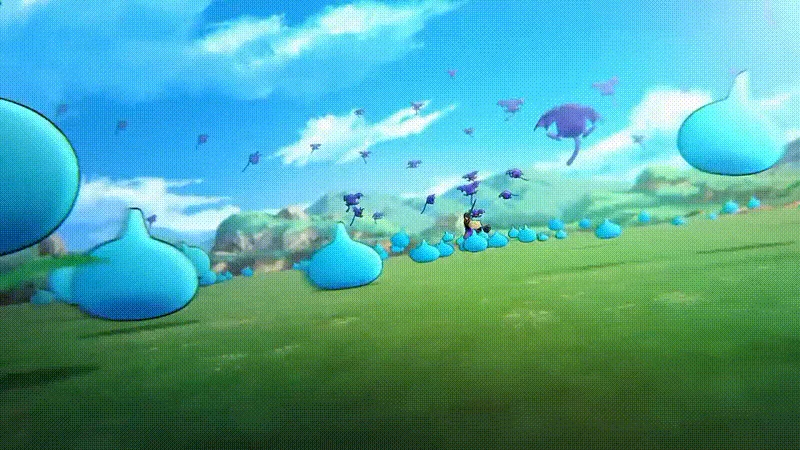
Dragon Quest Smash/Grow is officially categorized as a roguelite RPG, combining direct action combat with progression systems drawn from familiar Dragon Quest traditions. Unlike the slower command-driven battles associated with many numbered Dragon Quest games, Smash/Grow emphasizes fast movement through Rifts, large groups of enemies, powerful attacks, and repeated runs shaped by changing upgrades. Google Play describes the game as a fast-paced experience built around intuitive combat and tactical decisions that vary between attempts.
The central gameplay loop sends players into Rifts, where they fight groups of Dragon Quest monsters and collect randomly changing Blessings. These Blessings modify a character’s capabilities during the current run and reshuffle from stage to stage, which means players cannot rely on receiving the same temporary setup every time. That randomness gives the Grow side of the title much of its meaning because progression within a run is partly about adapting to the upgrades that appear rather than following one fixed build.
Blessings can be combined to create different temporary configurations, so a familiar vocation can perform differently depending on which effects become available during a particular attempt. The strongest tactical choice may therefore change from one Rift or stage to another. Square Enix’s marketing summarizes this structure as combining luck and strategy, with players expected to respond to the tools presented rather than execute the same sequence every run.
Combat centers on quickly clearing groups of monsters and using Coup de Grâce attacks as major offensive abilities. The design emphasizes action and positioning rather than fully automated encounters, with players responding to enemy groups while adapting to the Blessings and skills available in that attempt. The roguelite system therefore affects moment-to-moment combat directly rather than existing as a separate reward screen.
The game also includes more difficult activities that push the same combat foundation in different directions. Gauntlette challenges focus on large enemy swarms, while Shrines are designed around stronger boss encounters. Cooperative quests allow the player to join as many as three other participants, creating groups of up to four people. This adds a multiplayer layer to a structure that might otherwise resemble a purely solo roguelite.
Smash/Grow also retains classic Dragon Quest vocation concepts. Characters are not defined only by temporary Blessings because they can level up and develop through vocation trees. Square Enix states that players can unlock nodes within these trees to strengthen vocation abilities, producing a persistent layer of growth that remains outside individual randomized runs.
This creates two different progression systems operating together. Blessings are temporary and specific to a run, while levels and vocation-tree development provide longer-term advancement. A player can therefore become permanently stronger or more flexible while still entering a new Rift without knowing exactly which temporary enhancements will appear. That combination helps repeated sessions feel different without making every failure or completed run erase all previous progress.
The game’s monetization exists alongside these systems and should be described separately from gameplay progression. Square Enix identifies Smash/Grow as free to download and play with optional in-app purchases and explicitly states that the game contains loot boxes. Google Play likewise identifies purchases involving random items. Players should therefore distinguish between earning progress through levels, vocation trees, and Blessings and the separate commercial systems used for randomized or paid acquisition.

Dragon Quest Smash/Grow Story, Characters, Vocations, Co-Op, and Current Features
Although Smash/Grow is built around repeated action runs, it still has an original narrative framework rather than functioning only as a collection of combat stages. Mysterious dungeons called Rifts have appeared throughout the world, and the player begins an adventure aimed at restoring order. One explicitly named companion in Square Enix’s description is Roly, a mechanical ally who travels with the party as the story develops around these disruptions.
The game does not revolve entirely around one predetermined hero party in the style of a traditional numbered Dragon Quest. Instead, its systems encourage players to build and develop characters through classic vocation archetypes. That gives Smash/Grow a familiar role-playing structure despite the shift to faster action combat and roguelite stages. Vocations provide persistent progression, while Blessings temporarily reshape how those roles behave during a run.
Dragon Quest’s monster identity is also central to the design. Players frequently fight large groups of recognizable creatures rather than the smaller command-battle formations associated with many mainline entries. Stronger enemies and bosses anchor the more difficult content, while the familiar visual language of Dragon Quest monsters helps preserve the franchise’s identity even though the combat format is substantially different.
Coup de Grâce abilities, Blessings, vocation levels, and vocation trees divide character power across several overlapping systems. Coup de Grâce attacks provide major combat moments, Blessings create stage-specific builds, and permanent vocation growth provides longer-term goals. The important distinction is that a powerful Blessing combination belongs to a particular run, whereas vocation development continues to matter afterward.
The game’s current major gameplay pillars include:
- Randomly changing Blessing selections that alter each run.
- Classic Dragon Quest vocations with levels and vocation-tree nodes.
- Rifts that form the main dungeon structure.
- Story progression involving Roly and disruptions appearing across the world.
- Four-player cooperative quests.
- Gauntlette challenges built around large enemy groups.
- Shrines focused on stronger bosses.
These are established features of the live game, not systems newly unveiled at Tokyo Game Show 2026. Square Enix’s TGS page does not identify a new TGS-exclusive mechanic or mode, so current gameplay should not be repackaged as though it debuted during the show.
The multiplayer component is particularly important because up to four participants can join cooperative quests. That makes Smash/Grow structurally different from a conventional single-player Dragon Quest campaign and gives the roguelite format a cooperative dimension. A player can still work on personal character progression and vocation development while participating in content that requires coordination with others.
The overall result is a Dragon Quest game that changes the series’ familiar combat rhythm without abandoning all of its role-playing foundations. It replaces slow command selection with fast action and large enemy groups, but it retains vocations, character growth, Coup de Grâce attacks, recognizable monsters, story progression, and long-term development systems. Its identity comes from combining those traditional elements with randomized roguelite runs and cooperative mobile play.
Dragon Quest Smash/Grow IOS, Android Requirements, Live-Service Updates, and TGS 2026 Status
Dragon Quest Smash/Grow is officially available on both iOS and Android, with the same core live-service game distributed across the two mobile operating-system families. The Square Enix website identifies both platforms and presents the application as free to play with optional purchases. Players on either platform receive the same broad design built around Rifts, Blessings, vocations, story quests, cooperative content, Gauntlette challenges, and Shrine bosses rather than separate premium and free editions.
For iOS, the App Store requirements specify iOS 15.0 or later, an iPhone XS or newer, and at least 4 GB of RAM. These requirements should be checked against the current listing before installation because mobile-game support can change as updates add content or raise technical demands. The fact that a phone runs a recent iOS version does not by itself guarantee that every device configuration remains supported indefinitely.
Android requirements are more specific. Square Enix lists Android 9.0 or later, 64-bit hardware, performance in the Qualcomm Snapdragon 855 class or better, and at least 6 GB of RAM. A recent Android version alone is therefore not enough to establish compatibility because processor architecture, chipset capability, and available memory also matter.
These requirements are consistent with the game’s more demanding presentation compared with older menu-driven mobile RPGs. Large groups of enemies, direct action combat, multiplayer features, and continuing live updates all increase the technical load. Storage needs can also change as new resources and updates are downloaded, making the current store listing on the intended device more reliable than an old fixed storage figure.
The Android version’s September 19 update also demonstrates that Smash/Grow remained under active maintenance during Tokyo Game Show 2026. The listing’s bug-fix notes are modest rather than evidence of a major expansion, but they confirm continuing development. Active event banners on the same page likewise show that the game was operating as a live service with time-limited content around the show.
Square Enix’s TGS 2026 website reinforces that post-launch position. Smash/Grow appears in the official lineup with iOS and Android labels and a route to its official site, but it is absent from the booth’s dedicated Activities section. There is therefore no official basis on that page for claiming a special playable build, unique attendance reward, or dedicated Smash/Grow stage attraction.
For accurate coverage, “Dragon Quest Smash/Grow returns at Tokyo Game Show 2026” is a defensible description because the game was included in Square Enix’s lineup after its earlier reveal cycle. “New Smash/Grow TGS 2026 playable demo confirmed” is not supported by the published exhibition information. By September 2026, the more important story is that Smash/Grow had successfully moved from announcement and beta testing into global service, with Square Enix continuing to update and promote it several months after launch.

Frequently Asked Questions (FAQs)
- Was Dragon Quest Smash/Grow at Tokyo Game Show 2026?
Yes. Square Enix included Dragon Quest Smash/Grow in its official Tokyo Game Show 2026 lineup as an iOS and Android title. By that point, however, the game was already live globally, so its appearance should be understood as continued promotion of an existing mobile release rather than a new reveal or another launch announcement. - Was Dragon Quest Smash/Grow playable at TGS 2026?
Square Enix’s official TGS 2026 Activities section does not identify a dedicated Dragon Quest Smash/Grow playable demo. The game appears in the company’s wider lineup, but titles with confirmed hands-on demonstrations are listed separately in the Activities section. For that reason, Smash/Grow’s presence at the show is confirmed, while a specific Square Enix booth demo should not be presented as established. - What type of game is Dragon Quest Smash/Grow?
Square Enix classifies Dragon Quest Smash/Grow as a roguelite RPG. It replaces the slower command-based combat associated with many traditional Dragon Quest games with faster direct action against large groups of monsters. Its structure combines repeated Rift runs, random Blessings, classic vocations, character leveling, vocation-tree development, and powerful Coup de Grâce attacks, giving it both temporary run-based progression and longer-term character growth. - When was Dragon Quest Smash/Grow released?
Dragon Quest Smash/Grow entered worldwide service in April 2026, with April 21 commonly used as the global release date. Some North American Square Enix communications appeared on April 20 because of regional timing, which explains why both dates can appear in launch coverage. By Tokyo Game Show in September 2026, the game had therefore already been publicly available for roughly five months. - Is Dragon Quest Smash/Grow free to play?
Yes. Square Enix describes the base game as free to download and play on iOS and Android, with optional in-app purchases. The official information also discloses loot boxes or random-item purchases. That commercial system is separate from progression earned through ordinary gameplay, such as leveling characters, developing vocation trees, and collecting temporary Blessings during runs. - Does Dragon Quest Smash/Grow have multiplayer?
Yes. Cooperative quests allow one player to join with up to three additional participants, supporting groups of four in total. This gives Smash/Grow a multiplayer component alongside its solo progression systems, allowing players to bring developed characters into cooperative content rather than limiting the game to single-player Rift runs. - What are Blessings in Dragon Quest Smash/Grow?
Blessings are temporary, randomly selected enhancements that affect how a character develops during a particular run. They can be combined to create different tactical builds, and the available selection reshuffles between stages, so players cannot rely on receiving the same setup every time. This distinguishes Blessings from permanent progression systems such as character levels and vocation-tree upgrades. - What Android phone is required for Dragon Quest Smash/Grow?
Square Enix specifies Android 9.0 or later, a 64-bit device, performance comparable to a Qualcomm Snapdragon 855 or better, and at least 6 GB of RAM. This means operating-system version alone is not enough to establish compatibility because processor capability, architecture, and available memory also matter. Players should still check the current Google Play listing before installing because requirements can change with later updates. - What iPhone is required for Dragon Quest Smash/Grow?
The App Store requirements specify iOS 15.0 or later, an iPhone XS or newer, and at least 4 GB of RAM. Those requirements provide the current baseline for supported Apple hardware, but users should verify the live App Store listing on the intended device before downloading because compatibility can change as a live-service game receives new content and technical updates. - Is Dragon Quest Smash/Grow still being updated after release?
Yes. Google Play records an update dated September 19, 2026, during Tokyo Game Show, with the notes identifying various bug fixes. The listing also displayed active limited-time events around the same period. Together with the game’s continued inclusion in Square Enix’s TGS lineup, this shows that Smash/Grow remained under active post-launch support rather than being treated as a finished one-off mobile release.

Conclusion
Dragon Quest Smash/Grow’s return to the Square Enix Tokyo Game Show lineup in 2026 came at a very different stage of its life from its original announcement period. In 2025, it was an upcoming mobile Dragon Quest experiment preparing for closed beta testing. By September 2026, it had become an established live iOS and Android game with months of public operation, continued updates and active events.
Its central idea remains distinctive within Dragon Quest. Fast real-time action is combined with random Blessings that reshape individual runs, while permanent levels and vocation-tree progression ensure that repeated play contributes to longer-term character development. Coup de Grâce attacks, monster hordes, Rifts, Gauntlette activities, Shrines and four-player cooperative quests broaden that basic formula.
Accuracy is particularly important when discussing the TGS 2026 appearance. Square Enix unquestionably lists Dragon Quest Smash/Grow in its official show catalogue, but the game is not included in the company’s named Activities section containing confirmed demos and special booth attractions. Its presence should therefore be described as a TGS 2026 lineup return rather than an officially confirmed new playable exhibition build.
For mobile players discovering it after TGS, the essential information is straightforward: Smash/Grow is available on iOS and Android, is free to play with in-app purchases and loot boxes, supports multiple languages, features cooperative multiplayer, and remains in active post-launch service.
Sources and Citations
- Square Enix – Tokyo Game Show 2026 official exhibition site
Square Enix’s official TGS 2026 page confirms that Tokyo Game Show ran from September 17 to September 21, 2026 at Makuhari Messe. Its lineup lists DRAGON QUEST Smash/Grow for iOS and Android. The dedicated “Activities” section lists demos, photo spots and other booth attractions for selected games, but does not list a dedicated Smash/Grow activity, so its presence should be described as part of Square Enix’s lineup rather than as a confirmed playable booth demo. Square Enix Japan
Citation: Square Enix – Tokyo Game Show 2026 - Square Enix – DRAGON QUEST Smash/Grow official website / closed beta page
Square Enix’s official Smash/Grow material identifies the game as a Roguelite RPG for iOS and Android, priced free with in-app purchases. The same official page lists English, Traditional Chinese, Japanese and Korean support and states that the game includes in-game purchases and loot boxes. DRAGON QUEST Smash/Grow Official Website
Citation: DRAGON QUEST Smash/Grow Official Website
Citation: DRAGON QUEST Smash/Grow Closed Beta Information - Google Play – official DRAGON QUEST Smash/Grow application listing
Square Enix’s Google Play listing documents the core gameplay systems: randomized Blessings, multiple Vocations, dungeon-like Rifts, the mechanical companion Roly, co-op for up to four players total, the Gauntlette, and boss encounters in Shrines. It currently lists Android compatibility as Android 9.0 or later, a 64-bit device with Snapdragon 855 or better, and at least 6 GB RAM. Google Play
Citation: Google Play – DRAGON QUEST Smash/Grow - Google Play – September 2026 update and monetization disclosures
The current Google Play listing shows an update date of September 20, 2026, not September 19 in the version I could verify. Its “What’s new” field says “Various bug fixes,” the page shows active event offers, and the content disclosure says that in-game purchases include random items. Google Play
Citation: Google Play – DRAGON QUEST Smash/Grow, current listing - Apple App Store – DRAGON QUEST Smash/Grow
Apple’s official listing says the game requires iOS 15.0 or later and, in its detailed compatibility guidance, an iPhone XS or newer with at least 4 GB RAM. It also confirms Square Enix as the provider, free pricing with in-app purchases, and the same Blessing, Vocation, Rift, Roly, co-op, Gauntlette and Shrine feature set. App Store
Citation: App Store – DRAGON QUEST Smash/Grow - Square Enix – September 2025 announcement and closed beta recruitment
Square Enix’s North American press hub records the September 17, 2025 announcement for DRAGON QUEST Smash/Grow, stating that the mobile title would launch in 2026 and that closed-beta registration had begun. This is the strongest Square Enix source for the original launch window and beta recruitment. Square Enix Press
Citation: Square Enix North America Press Hub – DRAGON QUEST Smash/Grow announcement - Official closed beta dates and testing method
Square Enix’s beta page gives the planned testing period as October 14 to October 21, 2025, following applications from September 17 through October 2. It specifically states that iOS participants would use Apple TestFlight, while successful applicants would receive the beta appropriate to their selected operating system. DRAGON QUEST Smash/Grow Official Website
Citation: DRAGON QUEST Smash/Grow – Closed Beta Test Details - RPG Site – contemporary 2025 beta and announcement coverage
RPG Site’s Smash/Grow news archive records the September 2025 reveal, the start of closed-beta preregistration on iOS and Android, and later launch coverage. It is useful as a contemporary secondary record alongside Square Enix’s official material. RPG Site
Citation: RPG Site – DRAGON QUEST Smash/Grow News Archive - KLab – official April 2026 launch announcement
Co-developer KLab announced that DRAGON QUEST Smash/Grow officially launched on April 21, 2026 JST, for iOS and Android, as a free-to-play title with in-app purchases. KLab also confirmed its co-development arrangement with Square Enix. KLab株式会社(KLab Inc.)
Citation: KLab – DRAGON QUEST Smash/Grow Officially Launched - KLab – April 15, 2026 release-date announcement
KLab’s April 15 announcement set the service launch for April 21, 2026 UTC and opened pre-registration links for the App Store and Google Play. This is a useful primary source for the global launch timing communicated immediately before release. KLab株式会社(KLab Inc.)
Citation: KLab – DRAGON QUEST Smash/Grow Launch Date Announcement - RPG Site – April 20/21 regional timing clarification
RPG Site reported Square Enix’s announcement as an April 21 UTC / April 20 PDT release, explaining why some contemporary articles show April 20 while others show April 21. That is a time-zone difference in launch communication rather than evidence of separate versions releasing on different days. RPG Site
Citation: RPG Site – Dragon Quest Smash/Grow Releases April 21 UTC and April 20 PDT - Square Enix corporate reporting – launch confirmation
Square Enix’s May 2026 medium-term business-plan update lists DRAGON QUEST Smash/Grow as launched on April 21, 2026, providing additional corporate confirmation of the release date. Square Enix HD
Citation: Square Enix Holdings – May 2026 Business Plan Progress Report
Recommendations
- Echoes of Aincrad Crafting Guide: Recipes, Materials and Unlock Requirements
- Did Christopher Nolan’s Depiction of the Gods Pay Off in The Odyssey?
- Castlevania: Belmont’s Curse Runs at Only 30 FPS on Nintendo Switch
- EA Sports College Football 27 Preview: Defense Wins Championships
- Jurassic World Evolution 2 Complete Edition Comes to Nintendo Switch 2 on July 30, 2026
- Unity-Based Tool for JRPG Game Development: RetroGig’s Retro JRPG Template for SNES/PSX-Style RPG Systems
- Keanu Reeves & China Miéville BRZRKR: Light Draws Breath — Release Date, Story, Creative Team & Variant Covers
- CD Projekt Raises Profit Goals with Witcher 4, 5, and 6 Coming: 5 Billion PLN Target Explained
- Creepshow Official Announcement Trailer Reveals a New Anthology Horror Game Experience
- GTA 6 Leans Into Vice City’s Influencer Hustle Where Looks Matter



































































































