










In This Article (17 sections)
Dust: Origins Overview, Developer, and Gamescom 2026 Gameplay Reveal
Dust: Origins is Airship Syndicate’s move into science-fiction horror: an isometric action game about escaping an orbital prison station as its systems collapse and dangerous creatures break loose. The connection to Darksiders Genesis is genuine, but this is a new setting rather than another adventure in the Darksiders universe. Airship’s announcement presents a game built around survival, consequential decisions, and the possibility that an escape attempt will end badly.
As of September 17, 2026, several distinctions matter when assessing the project. An early 2027 release window has been reported, but an exact launch date remains unannounced. Its Kickstarter campaign ended, yet development continued. Meanwhile, the two PC storefronts publish different system-requirement information, making it important to distinguish confirmed features from incomplete prerelease details.
Dust: Origins is a single-player, isometric action-horror shooter. Its official website describes twin-stick combat, an explorable station, scarce resources, and several kinds of discoverable outcomes. The central objective is escape, not conquest: the player must find a way off a dying orbital prison platform. That combination suggests a different rhythm from a shooter built purely around clearing rooms as quickly as possible. When ammunition is limited, an encounter can remain costly even after every enemy has been defeated. Winning a fight and preserving enough supplies to survive the next one become separate considerations.
The isometric perspective also should not be mistaken for a promise of conventional loot-driven action-role-playing gameplay. A camera angle tells players how they view the battlefield; it does not establish the underlying progression structure, mission format, or resource economy. The most useful way to understand Dust: Origins is therefore as a survival-focused escape adventure with active shooting. The action provides the immediate challenge, while decisions about resources, exploration, and other survivors give that action context. Its potential depends on how effectively those elements reinforce one another: combat must feel satisfying without making the station’s dangers trivial, and scarcity must create meaningful decisions rather than merely slow progress.
Airship Syndicate Background and Genre Expertise
Airship Syndicate is an independent studio based in Austin, Texas, founded in 2014 by veterans of Vigil Games. Its development history includes Battle Chasers: Nightwar, Darksiders Genesis, Ruined King: A League of Legends Story, and Wayfinder. Those projects demonstrate why describing Dust: Origins only as a game from the Darksiders Genesis team is useful but incomplete. Airship’s catalogue spans turn-based role-playing games and real-time action. Its official studio page presents Battle Chasers as an exploration-driven, classic-style RPG, Ruined King as a party-based League of Legends adventure, and Wayfinder as a third-person action RPG.
Darksiders Genesis remains the most immediate comparison because of its elevated combat perspective and combination of ranged and close-range action. Released on PC on December 5, 2019, it lets a solo player switch between War and Strife and also supports two-player cooperation. However, shared developers do not guarantee identical mechanics. A powerful Horseman cutting through supernatural enemies represents a different design fantasy from an inmate trying to survive with inadequate equipment.
The interesting question is how Airship adapts its experience with readable combat and distinctive characters to a more vulnerable protagonist. The studio connection establishes relevant experience, not a verdict on the finished game. Combat responsiveness, encounter balance, and narrative execution still require assessment when playable review material becomes available.
Gamescom 2026 Reveal and Influences
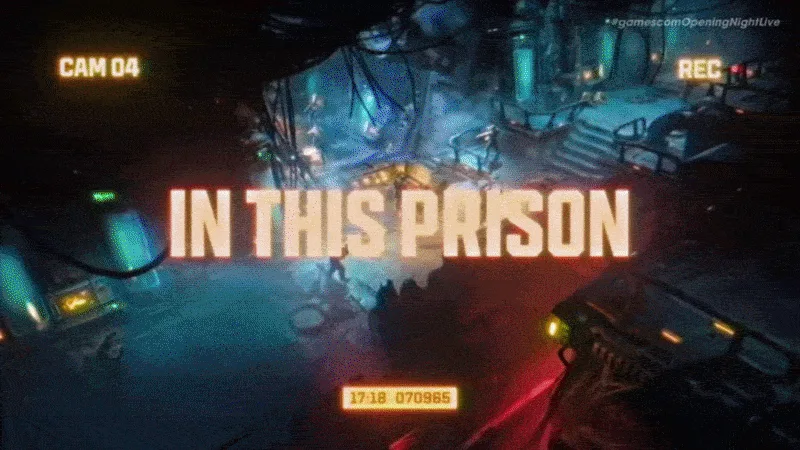
The announcement chronology needs clarification. Dust: Origins was initially announced on June 26, 2026, with a teaser. Its Gamescom Opening Night Live presentation followed on August 25, 2026. Consequently, Gamescom was a major gameplay showcase, not the first public acknowledgment that the project existed. GamingBolt’s coverage of the Gamescom trailer describes an unnamed protagonist confronting monstrous inhabitants of a space prison. It also identifies a visual connection to Darksiders Genesis while noting the move toward science-fiction art direction. That reporting supports the broad comparison without establishing that the two games share every combat system.
Airship’s accompanying announcement explicitly identifies 1980s and 1990s action science fiction as an influence, emphasizing bulky technology, gritty surroundings, and exaggerated creatures. The design implication is a setting that can look forceful and visually expressive without abandoning horror. Large silhouettes and conspicuous machinery can help communicate danger from an elevated viewpoint, where tiny environmental details may be less immediately readable than in a first-person game.
The reveal also needs to be interpreted alongside the stated survival mechanics. Promotional action does not automatically imply plentiful ammunition or consequence-free aggression. A trailer can communicate intensity while revealing relatively little about how often players must conserve supplies, reconsider a route, or retreat. For that reason, the Gamescom presentation establishes the game’s identity more clearly than its final balance. It is evidence of direction and presentation, not a substitute for examining sustained gameplay.

Dust: Origins Release Window, Platforms, Single-Player Format, and PC Requirements
The announced target is early 2027, according to Gematsu’s August 25 coverage. Airship’s official press announcement gives the broader window of 2027. Neither constitutes a confirmed calendar date, and the Steam listing still displays an unannounced release date. The Kickstarter campaign requires a separate explanation. It launched alongside the Gamescom presentation and was ended by the creator on August 28, 2026. That cancellation concerned the crowdfunding campaign, not the game itself. Kicktraq records the canceled campaign and the dated strategy update.
A developer-tagged Steam response on September 4 explained that the campaign had been intended to support polish and grassroots marketing. The developer said the team redirected its efforts toward finishing the game after receiving stronger wishlist activity than crowdfunding participation, and that other ways of involving players in playtests would be explored. This distinction prevents two misleading conclusions: that Dust: Origins still needs Kickstarter funding to proceed, or that the canceled campaign means the project has stopped.
The appropriate release-date wording remains “targeting early 2027,” rather than a specific month or day. Likewise, a statement that a date announcement is forthcoming should not be converted into an invented announcement schedule. Until Airship publishes a precise launch date, the broader window is the most defensible description.
Storefronts, Platform Caveats, and Single-Player Confirmation
Dust: Origins has product listings on both Steam and the Epic Games Store. Epic identifies Windows as the platform and lists Airship Syndicate as both developer and publisher. These are prerelease listings rather than evidence that the game is already available to play. For prospective players, storefront availability and platform availability answer different questions. Steam and Epic are distribution options for the announced PC version. Their presence does not establish a PlayStation, Xbox, or Nintendo edition, nor does it confirm native macOS or Linux support.
The reviewed announcements and store pages do not confirm those additional versions. A console release remains something that would require a separate announcement, not a conclusion that can be drawn from Airship’s previous projects. Epic also lists controller support. That is an input feature, not evidence of console development. Similarly, a Windows game supporting a controller does not by itself establish compatibility or satisfactory performance on every handheld PC. The practical conclusion is straightforward: PC players have two confirmed storefront destinations to follow. Players waiting for another platform should distinguish an unannounced version from a canceled one; the available evidence establishes neither a promise nor a rejection of future ports.
Dust: Origins is confirmed as a single-player game. Its official website states this directly, so descriptions suggesting that its player count is still unknown are outdated. The question is understandable because Airship has developed cooperative games. Darksiders Genesis supports two players, while the studio describes Wayfinder as supporting solo play and three-player online cooperation. Those features belong to those games and should not be transferred to Dust: Origins by association.
Solo Implications and PC Requirements Caveats
A solo structure has useful implications for the proposed experience. Decisions about whom to help, which supplies to retain, and how to approach danger can remain attached to one player’s priorities. There is no need to assume that the game will distribute those choices between human teammates. It also makes the distinction between companionship and cooperation important. Meeting another survivor within a story is not the same thing as inviting another person into the campaign. An NPC can influence events without functioning as a second player. Airship has additionally described Dust: Origins as a premium, self-contained single-player experience. That positioning should not be stretched into unsupported claims about offline authentication, downloadable content, or every aspect of its commercial model.
The PC system requirements currently need careful qualification because the two storefronts do not agree. Steam requires a 64-bit processor and operating system and lists Windows 11 for both minimum and recommended configurations. Its processor and graphics fields remain undetermined. Epic publishes more detailed specifications:
- Minimum requirements: Windows 10, an Intel Core i5-6400 or AMD FX-8350 processor, 16 GB of RAM, an NVIDIA GeForce GTX 970 or AMD R9 390 graphics card, and DirectX 12.
- Recommended requirements: Windows 10 or higher, an Intel Core i5-9600K or AMD Ryzen 5 3600 processor, 16 GB of RAM, an NVIDIA RTX 2060 or AMD RX 5700 graphics card, and DirectX 12.
These entries should be reported as storefront information, not silently merged into one definitive specification. In particular, Epic’s Windows 10 entry does not resolve the discrepancy with Steam’s Windows 11 requirement. The specifications also lack enough context to guarantee a particular experience. Without an associated resolution, graphics preset, and frame-rate target, “recommended” cannot automatically be translated into a promise of 1080p at 60 frames per second or any other specific result. For hardware planning, the distinction is between a published prerelease reference point and verified performance. Final requirements, optimization updates, and independent testing will be more informative than assuming that an isometric camera necessarily makes the game easy to run.

Dust: Origins Story, Combat, Equipment, and Survival Mechanics
The story begins when the player is abruptly released from cryostasis aboard Limbo-6, an orbital processing platform above the prison planet Dross. The station’s orbit is deteriorating, major systems are failing, and guards are executing inmates. The player is one of the prisoners who must escape. That geography is important. Dross is the planet below; Limbo-6 is the orbital location where the announced escape scenario takes place.
Describing the entire premise as an adventure on the planet’s surface would misrepresent the setup. Escape is also more complicated than reaching the nearest emergency exit. The official website says the station’s pods are missing, destroyed, or inaccessible. Finding a viable way off is therefore part of the central problem rather than a convenience available from the outset.
As a narrative premise, this arrangement creates several overlapping pressures. The institution that confined the protagonist is breaking down, its personnel cannot automatically be treated as protectors, and other survivors may place their own escape ahead of anyone else’s. However, the dying station should not automatically be interpreted as a confirmed global countdown mechanic. Narrative urgency and an actual timer governing the entire campaign are different design choices. The published setup establishes an unfolding catastrophe; it does not explain every rule governing the passage of time.
The announced combat emphasis is on positioning, ammunition conservation, and dealing with environmental hazards. Resources are limited, so Airship presents encounters as tactical problems rather than unrestricted shooting galleries. This creates an important distinction between immediate and cumulative difficulty. An individual enemy might be manageable, yet an inefficient encounter can still leave the player poorly prepared for what follows. Survival pressure can emerge from the combined cost of several fights, not only from a particularly powerful opponent. The isometric viewpoint can support that approach by encouraging attention to relative positions. The meaningful question becomes not simply whether a shot can land, but whether firing from that location leaves enough room to respond to another threat.
Combat Resource Tradeoffs and Loadout Foundations
Resource scarcity also gives exploration a potential double edge. Searching farther may improve the player’s position, but the search itself can expose them to costs. The tension works best when the potential reward is attractive without making every optional detour an obvious decision. These are implications of the announced design, not verified conclusions about its final balance. The available material does not yet justify a definitive combat guide, a ranking of optimal tactics, or assumptions about precisely how forgiving each difficulty setting will be. Dust: Origins’ challenge will be to make caution useful without undermining the energy of its shooting.
The Steam description confirms three loadout categories: weapons, armor, and mods. Equipment options expand deeper into the station, while the opening emphasizes vulnerability through limited supplies, including a damaged shiv and very little ammunition. This suggests progression from improvisation toward greater control. Early decisions are likely to be constrained by what can be found; later equipment access should give players more ways to express a preferred approach. However, greater choice does not necessarily mean that scarcity disappears.
In a survival-focused equipment system, the strongest-looking item is not automatically the most useful. Reliability, available supplies, and the demands of the next stretch can matter as much as offensive potential. A useful loadout is one that supports the player’s immediate situation rather than simply looking impressive in isolation. The public information does not provide a complete weapon catalogue, armor-stat breakdown, mod list, or verified class system. Consequently, specific claims about assault-rifle builds, elemental damage combinations, rarity tiers, or character classes would go beyond the disclosed material. For now, the confirmed point is customization through equipment. Whether that produces sharply differentiated builds or smaller tactical adjustments remains a question for more detailed demonstrations and the finished game.
Crafting Systems and Inventory Tradeoffs
Crafting can produce healing supplies, ammunition, permanent stat improvements, and specialist mods. Inventory capacity is restricted, although upgrades can expand it. These systems introduce different kinds of value. A consumable addresses an immediate problem, while a permanent improvement represents an investment in future survival. Inventory expansion can affect flexibility by making it possible to retain more options before the next difficult stretch. The interesting design tension is not merely whether crafting exists. It is whether the player repeatedly faces meaningful reasons to prioritize one form of preparation over another. A system becomes more engaging when immediate safety and long-term strength cannot always be pursued simultaneously without compromise.
Limited carrying space can reinforce that tension. Supplies have value only when they remain accessible at the point of need, and carrying an item has an opportunity cost when capacity is constrained. This gives inventory decisions the potential to influence exploration rather than functioning as a separate administrative chore. However, the revealed information does not establish recipe costs, resource-drop rates, exact inventory dimensions, or whether every crafting category shares ingredients. Those details will determine how restrictive the system actually feels. Until they are published or tested, claims about the best crafting priorities would be provisional. The reliable conclusion is that preparation extends beyond collecting ammunition: players must also consider how to turn found materials into survivability and useful equipment.
Limbo-6’s dangers include hostile humans and escaped alien test subjects. The station was used for bioengineering, and the developer’s overview specifically tells players to study creature behavior and exploit weaknesses rather than assume that every encounter can be approached identically. The broader announcement also places those encounters inside a collapsing installation, where failing infrastructure and environmental hazards contribute to the danger. This creates the possibility of several different kinds of pressure. Human opposition belongs to the prison’s social breakdown, while the creatures introduce biological threats that do not necessarily follow human motives. Environmental danger can complicate both without needing to function as another conventional enemy.
Alien Threats and Behavioral Variety
The instruction to observe behavior is especially significant. A well-designed enemy can become threatening through timing, movement, or the circumstances of an encounter, rather than simply through a larger health pool. Scarce ammunition makes learning those patterns potentially more valuable because mistakes can consume resources as well as health. Nevertheless, the current material does not provide a complete bestiary. Named enemy classes, a boss count, precise damage resistances, and a comprehensive catalogue of hazards have not been established in the reviewed sources. It would therefore be premature to describe particular monsters as confirmed ambush specialists, explosive enemies, or armored weak-point puzzles. The announced principle is behavioral variety; the exact implementation remains to be demonstrated.

Dust: Origins Survivor Choices, Multiple Endings, and New Game Plus
Other survivors have their own motives and may provide assistance, additional routes, items, or optional missions. The announcement also allows for a more isolated approach in which the player leaves others to their fate. That makes NPC interaction potentially relevant to both narrative and practical progress. Helping someone can be a moral decision, an investment in future assistance, or a risk taken without complete information. Those possibilities are more interesting than assuming that every optional conversation exists only to distribute rewards.
The station’s information systems also matter. Steam confirms exploration through conversations, terminal logs, collected disks, security hacking, and restricted files, including discoveries that support progression and backtracking. The design implication is that information can function as a resource. Learning how an area connects to another location may be valuable even when it does not immediately increase damage or restore health.
Revisiting somewhere familiar can acquire a purpose when new knowledge changes what is accessible. Optional content should therefore be understood as potentially consequential, but not mandatory by definition. The existence of side missions does not prove that all survivors must be helped to complete the campaign. Likewise, there is no basis yet for inventing a universal morality meter, a romance system, or exact dialogue solutions. The available evidence supports meaningful survivor interactions without revealing a complete decision tree.
Endings, Epilogues, and Dead Ends
Dust: Origins distinguishes between major endings, epilogues, and “Dead Ends.” Its official website promises multiple main conclusions, additional epilogues that can accompany them, and more than a dozen distinctive fatal outcomes. That last figure refers to Dead Ends, not a confirmed count of full campaign endings. Understanding those categories prevents an inflated description of the narrative scope. A main ending concerns the overall conclusion of an attempt. An epilogue can add information about what happened afterward. A Dead End represents a particular unsuccessful outcome rather than another successful route through the whole story.
The Steam listing confirms an Endings Collection for tracking discoveries and says that the first discovery of a unique Dead End unlocks an Extra. That creates a potentially interesting relationship between failure and completion. A fatal choice can still reveal authored content, so discovering a bad outcome need not feel entirely separate from understanding the game. However, this does not mean every ordinary death grants a new reward or that repeatedly triggering the same failure is a confirmed farming method.
The separation between endings and epilogues also allows two playthroughs to resemble one another in broad outcome while differing in their additional consequences. That is a more precise way to discuss replayable storytelling than simply counting endings. What remains unknown is the full set of requirements. No reliable ending guide can yet identify exact combinations of survivor decisions, equipment choices, and progression steps.
New Game Plus and Unlockable Replay Rewards
New Game Plus is part of the announced structure. Discovering outcomes unlocks items for later playthroughs, while additional difficulties provide another way to revisit the station. The reward categories include unusual weapons and mods, along with 3D characters that can be inspected in a model viewer. The model-viewer reference does not establish additional playable protagonists. This gives replayability two distinct foundations. One is informational: a returning player can investigate decisions, routes, or outcomes that were previously missed. The other is mechanical: newly available equipment can change the conditions under which the next attempt begins.
Those foundations can reinforce one another. A player may return because of an unresolved story question and then discover that a reward changes how they approach familiar encounters. Conversely, a new item can provide a reason to revisit the campaign and uncover narrative material along the way. However, New Game Plus should not be interpreted as confirmation that every statistic, item, currency, and inventory upgrade carries over unchanged.
The disclosed material describes unlocks and subsequent-run rewards without documenting every transfer rule. Repeated playthroughs also do not automatically make Dust: Origins a roguelike. Multiple endings and New Game Plus can operate within an authored campaign. Procedural layouts, randomized runs, and a conventional roguelike reset structure should not be assumed from replayability alone.

Frequently Asked Questions (FAQs)
- What is Dust: Origins?
Dust: Origins is an isometric, single-player action-horror game about escaping Limbo-6, a collapsing orbital prison platform above the prison planet Dross. Its announced design combines twin-stick shooting, scarce resources, exploration, and choices involving other survivors. Ammunition conservation, positioning, and preparation matter because surviving one encounter can leave fewer supplies for the next. The central objective is to find a viable escape route, while exploration and decisions can lead to different narrative outcomes. - Who is developing Dust: Origins?
Airship Syndicate, an independent studio based in Austin, Texas, is developing Dust: Origins. Founded in 2014 by veterans of Vigil Games, the studio previously made Darksiders Genesis, Battle Chasers: Nightwar, Ruined King: A League of Legends Story, and Wayfinder. Its catalogue includes both turn-based role-playing games and real-time action, providing a broader development background than the Darksiders comparison alone suggests. The Epic Games Store also lists Airship Syndicate as the game’s publisher. - When is the Dust: Origins release date?
The reported target is early 2027, while Airship’s official announcement gives the broader window of 2027. As of September 17, 2026, an exact release date had not been confirmed in the reviewed announcements, and Steam still displayed an unannounced release date. These descriptions establish an intended release period, not a particular month or day. Until Airship publishes a precise date, “targeting early 2027” is more accurate than presenting a specific launch day as confirmed. - Is Dust: Origins coming to Steam and the Epic Games Store?
Yes. Both Steam and the Epic Games Store have listings for the announced Windows PC game. These are prerelease storefront pages, so their existence does not mean the game is already available to play. They also do not confirm PlayStation, Xbox, Nintendo, native macOS, or native Linux editions. Epic lists controller support, but that is an input feature rather than evidence of a console version or guaranteed compatibility with every handheld PC. - Does Dust: Origins support multiplayer or co-op?
Dust: Origins is announced as a single-player game, and its official website identifies solo play directly. Airship also describes it as a premium, self-contained experience. Other survivors may offer assistance, optional missions, or access to additional routes, but their involvement does not mean another human player can join the campaign. Cooperative features in Darksiders Genesis and Wayfinder belong to those games. Likewise, single-player status alone does not confirm every detail of offline access or authentication requirements. - Was Dust: Origins canceled after its Kickstarter ended?
No. The Kickstarter campaign ended on August 28, 2026, but development continued. In a September 4 response, a developer explained that the campaign had been intended to support polish and grassroots marketing. After receiving stronger wishlist activity than crowdfunding participation, the team redirected its efforts toward finishing the game and said other ways of involving players in playtests would be explored. The canceled campaign therefore represented a change in approach, not the cancellation of Dust: Origins. - Is Dust: Origins a Darksiders sequel?
No. Airship presents Dust: Origins as a new science-fiction universe rather than a continuation of the Darksiders story. The connection comes from the shared developer and comparisons between its elevated combat perspective and Darksiders Genesis. However, Dust: Origins centers on a vulnerable prisoner escaping a failing station with limited supplies, rather than a powerful Horseman fighting supernatural enemies. Shared creators and visual similarities do not establish shared characters, storylines, or identical combat and progression systems. - Does Dust: Origins have multiple endings?
Yes. The announced structure includes multiple main endings, additional epilogues, and more than a dozen unique “Dead Ends.” Main endings concern the overall conclusion, epilogues provide additional consequences or information, and Dead Ends represent distinctive fatal outcomes. The dozen-plus figure therefore should not be presented as the number of full campaign endings. An Endings Collection tracks discoveries, and finding a unique Dead End for the first time unlocks an Extra. This does not mean every ordinary death produces a separate reward. - Will Dust: Origins have New Game Plus?
Yes. New Game Plus is part of the announced structure, with discovered outcomes unlocking rewards for later playthroughs and additional difficulties offering further challenges. Those rewards include unusual weapons and mods, giving players another reason to revisit familiar encounters while investigating missed routes, survivor decisions, and endings. However, the overview does not establish that every statistic, item, currency, or inventory upgrade carries over unchanged. The complete rules governing progression and equipment transfer have not yet been detailed. - What are the Dust: Origins PC requirements?
The storefronts currently provide different prerelease specifications. Epic lists 16 GB of RAM and DirectX 12 for both tiers. Its minimum requires Windows 10, an Intel Core i5-6400 or AMD FX-8350, and an NVIDIA GeForce GTX 970 or AMD R9 390. Recommended hardware includes an Intel Core i5-9600K or AMD Ryzen 5 3600 with an NVIDIA RTX 2060 or AMD RX 5700, running Windows 10 or higher. Steam instead lists Windows 11, with processor and graphics requirements undetermined. These entries should not be combined into one final specification or treated as guaranteed performance targets.

Conclusion
Dust: Origins’ appeal lies in the interaction between its systems rather than its camera angle alone. Airship Syndicate is proposing a game in which shooting, scarcity, survivor decisions, and repeat playthroughs contribute to the same central objective: finding a way out of Limbo-6. The announced features give that premise a clearer identity than simply describing it as Darksiders Genesis in space.
Its most important remaining questions concern execution. Resource pressure must remain engaging, decisions must produce satisfying consequences, and replay rewards must justify returning without making the initial campaign feel incomplete.
For now, the essential release picture is clear: the game remains in development, its crowdfunding cancellation did not cancel the project, and an early 2027 window has been reported without a precise launch date.
The strongest assessment is therefore neither premature praise nor dismissal. Dust: Origins has a defined survival-action premise and several concrete systems worth watching, while its final balance, performance, and narrative depth remain to be demonstrated.
Sources and Citations
- DUST: Origins, Official Website : Official game website introducing the escape from Limbo-6, scarce resources and decisions involving other survivors. It explains the multiple endings, secret epilogues and unlockable equipment carried into subsequent playthroughs, while providing the debut trailer, Steam wishlist links and an email signup for news and updates. DUST: Origins
Citation: DUST: Origins Official Website. (DUST: Origins) - Steam, DUST: Origins Official Store Page : Official PC listing identifying Airship Syndicate as developer and publisher, with the release date currently shown as “To be announced.” It describes combat, crafting, character interactions, branching outcomes and New Game+, while listing supported languages, Steam features and the hardware requirements that remain to be determined. Steam Store
Citation: DUST: Origins on Steam. (Steam) - Airship Syndicate, Official Studio Website : The developer’s website links directly to DUST: Origins and its Steam wishlist page, alongside information about earlier projects including Darksiders Genesis, Battle Chasers: Nightwar and Ruined King. This provides a working official studio reference in place of the supplied news address, which returned a missing page rather than an announcement. AIRSHIP SYNDICATE
Citation: Airship Syndicate Official Website. (Airship Syndicate) - Gematsu, Announcement and Release Coverage, August 25, 2026 : Reports the debut trailer, Kickstarter launch and the early 2027 release window announced for PC through Steam. It includes comments from Airship Syndicate’s founders about the game’s creative direction and funding approach, together with a feature overview covering tactical encounters, survivor interactions, branching endings and replay rewards. Gematsu
Citation: DUST: Origins Debut Trailer, Kickstarter Campaign Launched. (Gematsu) - Kicktraq, DUST: Origins Crowdfunding Campaign Record : Independent tracking page documenting the campaign’s recorded pledges, backer total, funding target and linked project updates. The record marks the campaign as cancelled by its creator, making it a reference for crowdfunding history rather than evidence that pledges remain open. Campaign cancellation should not be confused with confirmation that the game itself was cancelled. Kicktraq
Citation: DUST: Origins by Airship Syndicate: Kickstarter Campaign Tracking. (Kicktraq) - Steam Community, DUST: Origins Community Hub : Dedicated community hub linked from the official Steam listing, with sections for discussions, screenshots, artwork, videos and news. It provides a central location for following community activity and accessing the game’s news section, although comments posted by players should be distinguished from announcements or explanations published by the developer. Steam Community
Citation: DUST: Origins Steam Community Hub. (Steam Community) - GamingBolt, Gameplay Trailer Coverage, August 26, 2026 : Coverage of the Gamescom Opening Night Live trailer, focusing on the prison setting, hostile creatures and isometric action shown in the presentation. It draws comparisons with Darksiders Genesis while highlighting the move toward science fiction, and includes the trailer so readers can view the gameplay footage being discussed. GamingBolt
Citation: DUST: Origins Premiers at Gamescom 2026, Showcases Isometric Action Gameplay. (GamingBolt) - TheSixthAxis, Announcement and Feature Coverage, August 25, 2026 : Announcement report introducing the collapsing orbital prison and the player’s attempt to escape its criminals and escaped creatures. It presents the gameplay trailer and summarises ammunition scarcity, tactical positioning, survivor relationships and multiple outcomes, including how discovered endings unlock items and additional challenges for New Game+. TheSixthAxis
Citation: Twin Stick Shooter Dust Origins Has Been Announced. (TheSixthAxis) - Playasia, Trailer and Crowdfunding Coverage, August 26, 2026 : News report documenting the Gamescom trailer and crowdfunding launch, alongside the early 2027 Steam release window stated at the time. It reproduces Airship Syndicate’s gameplay overview, covering resource management, decisions involving other survivors, escaped biological experiments and rewards for discovering different endings, with the trailer included for reference. Playasia Blog
Citation: DUST: Origins Debut Trailer Released Alongside Kickstarter Campaign Launch. (Playasia Blog) - Epic Games Store, Product Page Not Verified : I could not verify a dedicated DUST: Origins product listing. The supplied address leads to the general Epic Games Store homepage, not a page for this game, so it does not establish an Epic release, purchase option, release date or supported features. Epic Games Store
Citation: Epic Games Store Homepage. (Epic Games Store)
Recommendations
- Uncharted 5? Fans Believe Cryptic Naughty Dog Dev Post Is Teasing The Game
- Disclosure Day Review: Plot Breakdown, Cast Details, Ending Explained & What Spielberg’s New UFO Movie Gets Right
- Gears of War E-Day Seems Like Nostalgia Done Right: Everything We Know About the Dark Origins of Emergence Day
- Isometric Sci-Fi Shooter
- Subnautica 2’s Messy Publisher Drama Takes Another Turn: Why Krafton Vanished From Store Listings
- Fading Echo Guide: Release Date, Water Powers, Combat, Story, and Platforms
- All Active Pokémon Champions Mystery Gift Codes and Rewards
- Sandfall Interactive Used UE5 Blueprints for All Gameplay Systems in Clair Obscur: What We Learned From GDC
- Unity Terrain Shaders in Shader Graph: Build a Terrain Lit Shader for URP & HDRP (Unity 6.3)
- Inbibo Releases Adonis 2.1 with AdonisML: New Machine Learning Tools for Maya and Houdini Character Animation



































































































