











The North American Entertainment Software Rating Board (ESRB) and Europe’s Pan-European Game Information (PEGI) are moving in opposite directions regarding how they rate games featuring loot boxes. While PEGI is preparing to mandate higher age ratings for games with “paid random items,” the ESRB will maintain its current age categories, opting instead for descriptive labels to avoid what it calls “parental confusion.”
In This Article (12 sections)
What is the ESRB and How Do ESRB Ratings Work in the United States
The ESRB is a self-regulatory body established in 1994 to assign age and content ratings to video games in the U.S. and Canada. While voluntary, most retailers and console manufacturers require these ratings.
ESRB’s Three-Part Rating System:
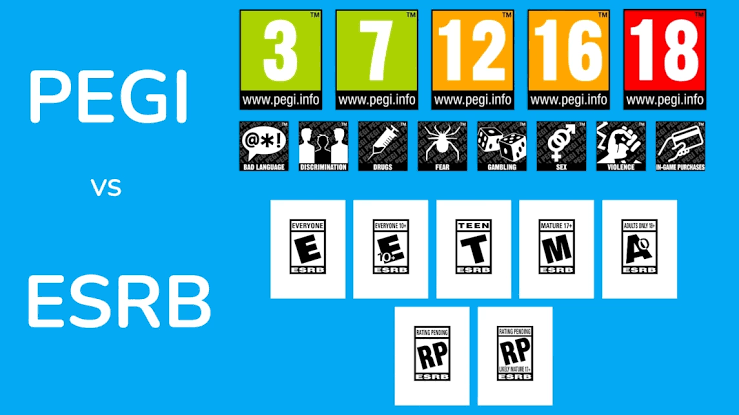
- Rating Category: Letter symbols suggesting age appropriateness: E (Everyone), E10+ (Everyone 10+), T (Teen), M (Mature 17+), and AO (Adults Only 18+).
- Content Descriptors: Phrases like “Violence” or “Strong Language” that explain why a game received its specific rating.
- Interactive Elements: Notices regarding features outside the core game, such as “Users Interact” (online chat) or “In-Game Purchases (Includes Random Items)” (loot boxes).
The ESRB focuses strictly on content (what is seen on screen) rather than context (monetization or online mechanics). It relies on the cooperation of publishers and retailers to ensure these ratings are honored at the point of sale.
What is PEGI and How PEGI Age Ratings Work in Europe
Established in 2003, PEGI is the standard rating system for 36+ European countries. Unlike the ESRB’s advisory nature, PEGI ratings are legally enforceable in several nations, meaning retailers cannot legally sell games to children below the rated age.
PEGI Age Categories and Descriptors:
- Age Ratings: Five color-coded number icons: PEGI 3, 7, 12, 16, and 18.
- Content Descriptors: Nine icons covering themes like Violence, Sex, Drugs, and Gambling.
- In-Game Purchases: Since 2018, PEGI has used a “hand with a credit card” icon to signal digital spending, often accompanied by the phrase “Includes Random Items.”
What PEGI is Changing in June 2026 for Loot Boxes and Paid Random Items
Starting June 2026, PEGI will shift from rating based on content to rating based on game mechanics and “interactive risks.”
New PEGI Rules (June 2026):
- Loot Boxes/Paid Random Items: Minimum PEGI 16 rating.
- Social Casino Games: Automatic PEGI 18 rating.
- FOMO Mechanics: Games with time-limited offers or daily deals will be at least PEGI 12 (reducible to PEGI 7 if spending limits are built-in).
- NFTs/Blockchain Trading: Automatic PEGI 18 due to financial risk.
- Engagement Tactics: “Play-by-appointment” rewards will trigger PEGI 7; systems that punish players for not logging in will trigger PEGI 12.
- Unrestricted Chat: Games with no moderation or blocking tools will be PEGI 18.
Why PEGI is Giving Games with Loot Boxes a PEGI 16 Rating
PEGI’s decision is driven by a mix of child protection concerns and political pressure:
- Gambling-Like Mechanics: PEGI views loot boxes as an adult-oriented risk because they utilize psychological triggers similar to gambling.
- Regulatory Pressure: By self-regulating, the industry hopes to avoid outright government bans, such as those seen in Belgium or Brazil.
- German Inspiration: PEGI adopted a model similar to Germany’s USK, which began factoring “pressure to spend” into age ratings in 2023.
- Transparency: A high age rating (16+) acts as a “red flag” that prompts parents to investigate monetization features they might otherwise overlook.
ESRB Response to PEGI Changes: Why the ESRB Says it “Could Be Confusing”
The ESRB has stated it has “no plans” to follow PEGI’s lead, arguing that mixing monetization with age ratings would be counterproductive.
The ESRB’s Logic:
- Content vs. Context: The ESRB believes age ratings should only reflect the maturity of the story and imagery (violence, sex). Rating a non-violent soccer game as “Teen” or “Mature” just because of loot boxes could mislead parents into thinking the game contains explicit content.
- Information Loss: If all “risk” factors are merged into one number, parents lose the ability to distinguish between a game that is “Mature” due to gore and one that is “Mature” due to a digital storefront.
- Fine-Grained Detail: The ESRB prefers to keep the age rating for content and use specific Interactive Element labels to provide “upfront notice” about spending.

ESRB “Interactive Elements” Labels Explained
Because the ESRB will not change age ratings, parents must look for these specific labels alongside the rating symbol:
- Users Interact: Indicates online communication or user-generated content.
- In-Game Purchases: Notifies that the game offers additional content for real money.
- In-Game Purchases (Includes Random Items): Specifically flags loot boxes, gacha pulls, or mystery packs.
- Online Music Not Rated: Warns that streamed music lyrics are not part of the official rating.
The ESRB maintains that these labels, combined with parent education and digital parental controls, are the most effective way to manage in-game spending without altering the fundamental meaning of age ratings.
Example – a side by side: Imagine a game like Fortnite:
- ESRB: Rated T (Teen). Descriptors: “Violence”. Interactive: “Users Interact, In-Game Purchases”. (Fortnite removed blind loot boxes in 2019 in Save the World, so now it may just say In-Game Purchases, not sure if “random” is still applicable for any mode).
- PEGI: Rated 12 (for violence) with icons for Violence and maybe a separate mention of in-game purchases (the PEGI site did note Fortnite has additional descriptors for online). Under new rules Fortnite might also get a descriptor for “pressure to purchase” if they consider the battle pass losing rewards as a factor (they said games where rewards become unavailable if you don’t meet objectives might be PEGI 12 – Fortnite’s battle pass might qualify).
- A parent seeing the ESRB label: should note it’s online (users interact) and has purchases. Seeing the PEGI label: notice the violence icon (okay cartoonish shooting) and maybe the purchases mention.
Gemini said
Detailed summaries of game ratings remain essential for parents, as age ratings alone do not convey the full context of a game’s mechanics. While PEGI is integrating monetization risks directly into its age categories, the ESRB maintains a separation between content maturity and interactive features, requiring users to review specific content notes to identify risks like loot boxes or unrestricted chat.
How Game Publishers Will Update Store Pages and Packaging Under PEGI’s New Rules
Starting June 2026, game publishers must align their physical packaging and digital metadata with PEGI’s updated criteria.
- New Submissions: All games submitted after June 2026 will be rated under the new system. Titles featuring flagged mechanics (like loot boxes) may receive higher age ratings (e.g., PEGI 16). Publishers must update all physical box art, digital storefront listings, and marketing materials to reflect these changes.
- Existing Games (Legacy Titles): Handling older games is complex. While new rules primarily target new submissions, PEGI has indicated it will review prominent legacy products, particularly live-service games like Fortnite or Genshin Impact.
- Physical Stock: Recalling existing copies is impractical, but subsequent print runs will likely require updated rating logos.
- Digital Stores: Platforms can update digital ratings server-side, potentially resulting in sudden age-rating increases for established titles on storefronts like the PlayStation Store or Steam.
- Store Policies and Compliance: Console manufacturers (Sony, Microsoft, Nintendo) require official ratings for all hosted content. Digital platforms using the IARC system will likely automate these updates as PEGI’s database evolves.
- Marketing and Partnerships: Higher age ratings may restrict where a game can be advertised (e.g., prohibiting ads during children’s television). Partnerships with family-oriented brands may also be re-evaluated if a game is no longer classified as suitable for children.
- New Descriptors: Publishers will incorporate new specific warnings for “time-limited offers” or “play-by-appointment” mechanics as the exact language for these descriptors is finalized.

FAQ: Will the ESRB Ever Adopt PEGI-Style Monetization-Based Rating Changes
The ESRB has stated it has no current plans to adopt monetization-based age ratings, maintaining that age categories should reflect narrative and visual content only.
Regional Divergence: By late 2026, a significant discrepancy will exist: a game heavily featuring loot boxes may be rated “E for Everyone” in the U.S. with a small text notice, while the same game carries a “PEGI 16” rating in Europe.ress this and other common questions, helping clarify the differences and implications of these policies for consumers.
Current Stance: The ESRB argues that baking monetization into the age rating could confuse parents. They will continue to use the “In-Game Purchases (Includes Random Items)” interactive element label to disclose loot boxes.
Potential for Future Change: While currently resistant, the ESRB may evolve if there is a significant shift in U.S. consumer sentiment or if federal legislation regarding loot boxes gains traction.
Regulatory Environment: The U.S. has seen less aggressive regulation of loot boxes compared to Europe. The Entertainment Software Association (ESA) continues to favor self-regulation over government-mandated age hikes for monetization.
Frequently Asked Questions (FAQs)
- Will the ESRB ever change its ratings because of loot boxes like PEGI did?
The ESRB currently has no plans to adjust age ratings due to in-game purchases or loot boxes, citing potential parental confusion. They will continue to rely on the “In-Game Purchases (Includes Random Items)” label. Stricter measures are unlikely unless mandated by U.S. regulators. - What exactly are loot boxes and why are they controversial?
Loot boxes are virtual crates containing random rewards purchased with real money. They are controversial due to their similarity to gambling; the randomized nature can encourage addictive behavior and overspending, particularly among minors. Critics argue these mechanics utilize psychological triggers similar to slot machines. - Why is PEGI making games with loot boxes automatically PEGI 16?
PEGI aims to protect young players and address political pressure by treating randomized monetization as an adult-oriented risk. This self-regulatory shift aligns loot boxes with simulated gambling to signal that these practices are not suitable for children and to preempt stricter government legislation. - Does the ESRB consider loot boxes to be a form of gambling?
No. The ESRB distinguishes loot boxes from actual “Simulated Gambling” (like casino mini-games), which triggers a higher age rating. Because loot boxes always provide an item and the rewards cannot be cashed out for real money, the ESRB does not classify them as gambling, though they acknowledge the similarities. - How does the ESRB let me know a game has loot boxes or in-game purchases?
Parents should look for the “In-Game Purchases” notice. For games featuring loot boxes or gacha mechanics, the specific “In-Game Purchases (Includes Random Items)” label is used on both physical packaging and digital storefronts. Detailed information is also available in the ESRB rating summaries online. - Which games will get higher ratings in Europe due to PEGI’s new rules?
Under the new criteria, various mechanics will trigger higher minimum ratings:- Loot boxes (paid random rewards): PEGI 16 (e.g., EA Sports FC, NBA 2K, Genshin Impact).
- Social casino/gambling simulations: PEGI 18.
- Timed offers/Battle Passes: Often PEGI 12.
- Daily login/“Play-by-appointment” rewards: PEGI 7 or PEGI 12.
- NFT/Crypto games: PEGI 18.
- Unrestricted communication without safety tools: PEGI 18.
- Are PEGI ratings legally enforced?
Can my under-16 child buy a PEGI 16 game? In several European countries, such as the UK, PEGI 12, 16, and 18 ratings are legally enforced, making it illegal for retailers to sell these games to underage individuals. In the U.S., ESRB ratings are a voluntary industry standard; while retailers often self-regulate M-rated (17+) sales, there are no legal penalties for selling unrated or age-inappropriate games to minors. - Have any countries banned loot boxes or taken legal action?
- Belgium: Banned loot boxes as illegal gambling in 2018.
- Brazil: Banned loot box sales to anyone under 18 effective March 2026.
- China: Limits daily purchases and mandates disclosure of reward odds.
- Netherlands: Attempted a ban, though the legal status remains complex following court appeals.
- Lawsuits: Class-action suits regarding consumer protection and gambling have occurred in the U.S. against companies like EA and Epic Games.
- How can I tell if a game has microtransactions or loot boxes before I buy it?
Consumers should check for the “In-Game Purchases” or “Includes Random Items” labels on the rating box. Digital storefronts often include an “Offers in-app purchases” notice. For more detail, the ESRB website provides rating summaries, and third-party parental guides often detail a game’s specific monetization model. - What’s the difference between a content descriptor and an interactive element on a rating?
- Content Descriptors: Describe the actual material in the game (e.g., Violence, Language, Blood) that determines the age rating.
- Interactive Elements: Detail features beyond the static content, such as online chat (“Users Interact”) or monetization (“In-Game Purchases”). While interactive elements provide vital safety and financial information, they do not currently influence the age rating assigned by the ESRB.

Conclusion
In the evolving landscape of video game ratings, parents and players now face a split reality between Europe and North America. PEGI’s landmark decision to factor monetization mechanics into age ratings represents a proactive stance to address modern gaming concerns – namely, loot boxes and other potentially exploitative designs. By contrast, the ESRB’s decision to stick to its traditional content-based ratings (augmented by warning labels) reflects a more conservative approach rooted in consistency and parental choice.
For consumers, the key takeaway is to stay informed. An E-rated game in the U.S. might carry a Teen or 16+ label in Europe not because of violence or sex, but because of how it makes money. That doesn’t necessarily mean the game suddenly contains mature content – it means rating authorities are interpreting its impact on younger audiences differently. As gaming business models have become part of the discussion, it’s crucial to read the fine print on any game your child plays: look for “In-Game Purchases (Includes Random Items)” on ESRB labels or the new PEGI notices about paid random items.
Moving forward, we may see further convergence or divergence. If PEGI’s changes prove effective and well-received, other regions (like the ESRB, or the Japanese CERO, etc.) might consider similar adjustments. Alternatively, if confusion arises (for example, European parents misinterpreting why a game is rated 16), PEGI might refine how the information is presented. The industry is at a crossroads where content and context are both king – game ratings are no longer just about pixelated blood or naughty words, but also about the digital ecosystems in which players (and often children) engage.
Ultimately, these rating systems are tools to help you make the best decisions about games. Use them. A flashy game trailer or a friendly cartoon character on the box might not tell the whole story. Check the rating, read the descriptors, and understand what they mean. Whether you’re a parent trying to shield your child from inappropriate content or predatory design, or you’re a gamer who wants to know what you’re getting into, the information is there on the label.
In summary, the ESRB and PEGI share the same goal – keeping gaming safe and fun for appropriate audiences – but they are now executing that goal a bit differently. The ESRB emphasizes content clarity and parental responsibility, while PEGI is injecting protective caution directly into the age ratings. Both approaches have merit and challenges. As a globally aware gamer or parent, you’ll benefit from understanding both. Game on, safely and smartly!

Sources
- David Carcasole, Wccftech: “The ESRB Won’t Follow PEGI in New Ratings Rules Over Loot Boxes, ‘It Could Be Confusing’” (Mar 20, 2026)
https://wccftech.com/the-esrb-wont-follow-pegi-in-new-ratings-rules-over-loot-boxes-it-could-be-confusing/ - Christopher Dring, The Game Business: “Can new age rating rules prevent a video game ban?” (Mar 19, 2026)
https://www.thegamebusiness.com/p/can-new-age-rating-rules-prevent - Chris Scullion, VideoGamesChronicle (VGC): “All games with loot boxes in them will be rated minimum PEGI 16, starting this summer” (Mar 12, 2026)
https://www.videogameschronicle.com/news/all-games-with-loot-boxes-in-them-will-be-rated-minimum-pegi-16-starting-this-summer/ - Andy Chalk, PC Gamer: “Europe’s game rating agency takes aim at in app purchases, loot boxes, with new interactive risk categories” (Mar 12, 2026)
https://www.pcgamer.com/games/europes-game-rating-agency-takes-aim-at-in-app-purchases-loot-boxes-and-unrestricted-communication-with-new-interactive-risk-categories/ - Daniel Sims, TechSpot: “Europe’s PEGI will raise age ratings for games with loot boxes and microtransactions. EA Sports FC is about to lose its PEGI 3 rating.” (Mar 13, 2026)
https://www.techspot.com/news/107164-europe-raises-age-ratings-games-loot-boxes-microtransactions.html - ESRB Blog: “Introducing a New Interactive Element: In Game Purchases (Includes Random Items)” (Apr 13, 2020)
https://www.esrb.org/blog/introducing-a-new-interactive-element-in-game-purchases-includes-random-items/ - ESRB Ratings Guide: Rating Categories, Content Descriptors, and Interactive Elements
https://www.esrb.org/ratings-guide/ - PEGI Official Site: What Do the Labels Mean?
https://pegi.info/what-do-the-labels-mean - PEGI Wikipedia Entry: Pan European Game Information
https://en.wikipedia.org/wiki/Pan_European_Game_Information - Alessio Palumbo, Wccftech: “Brazil’s President Signs Ban On Loot Boxes Aimed at U 18s Into Law, Will Go Into Effect in March 2026” (Sep 26, 2025)
https://wccftech.com/brazil-president-signs-law-to-ban-loot-boxes/ - G2A News: “ESRB vs PEGI: Navigating the World of Video Game Ratings” (Dec 20, 2022)
https://www.g2a.com/news/features/esrb-vs-pegi-navigating-the-world-of-video-game-ratings/
Recommended
- Streamers and Voice Actors Refuse to Work With Neverness to Everness Over Gen AI Concerns: Ironmouse Sponsorship Fallout, Alleged AI Assets, and Hotta Studio Response
- Unreal Engine for Beginners: A Step-by-Step Guide to Getting Started
- Big Game Pass Rumor: Possible New Tier of Xbox Game Pass Codenamed Triton
- Subnautica 2: Top 15 Things The Game Doesn’t Tell You
- Bungie Ends Its Destiny Era and Cancels All Future Content Plans
- Subnautica 2 Early Access Release on May 14, 2026: Full Details, Gameplay Features, Platforms, and Everything Survival Game Fans Need to Know
- EA Reportedly Wanted Alice: Madness Returns to Be “More Sexy,” So the Developer Put Dildos on a Snail: The Story Behind the Bizarre Creative Clash
- How to Get All the Eeveelutions in Pokopia’s Palette Town
- Blender Extremely Soft Fur/Hair Look! How to Create Fluffy Fur and Silky Hair in Cycles
- Reacher Renewed for Season 5 Before Season 4 Premieres: Release Updates, Cast, and Story Details



































































































