









In This Article (7 sections)
EU Digital Fairness Act 2026: Virtual Currency Prices, Loot Boxes, and Purchases by Minors
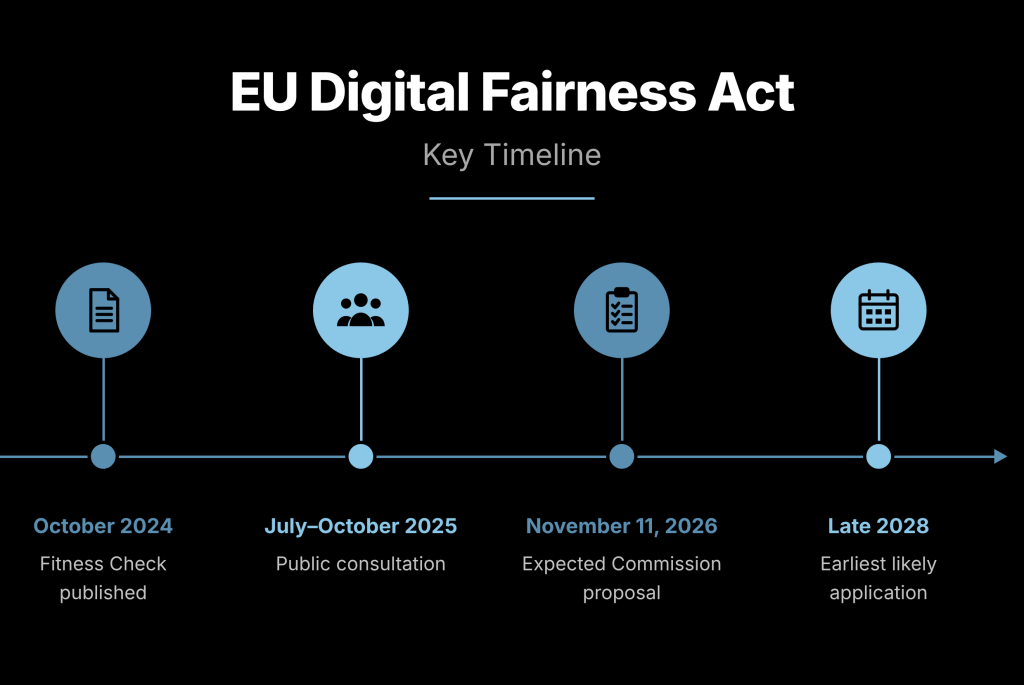
The European Commission’s proposed Digital Fairness Act, published on November 11, 2026, could significantly change how video game publishers sell virtual currency, offer random rewards, and manage purchases involving children. The draft would require clearer monetary prices for items purchased with paid virtual currency, prohibit paid loot boxes for minors, and restrict purchases presented as necessary for winning or progressing through games.
Parents could authorize teenagers to use paid virtual currency for permitted purchases, but that approval would not override the proposed restrictions on paid random rewards or exploitative progression systems. Adults would receive additional protections, including clearer information about loot box probabilities and the ability to disable paid random reward features. As of November 20, 2026, the legislation remained a proposal, requiring agreement between the European Parliament and the Council of the European Union before becoming law.
The proposal builds on existing European consumer protection concerns surrounding gaming purchases. In March 2025, the Consumer Protection Cooperation Network published principles addressing real money pricing, virtual currency systems, and practices that can force consumers to purchase more currency than they need. By September 2026, the network had opened dialogues with nine gaming companies over suspected infringements of existing consumer law. The Digital Fairness Act would introduce more explicit requirements through an EU regulation. Articles 14 to 16 address paid virtual currencies, random rewards, and purchases connected to progress or success, while Articles 20 to 23 concern subscription trials, renewals, and cancellations. A game offering premium currency, randomized rewards, and a monthly membership could therefore fall under several provisions.
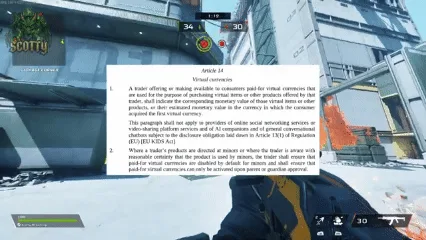
Article 14 would require publishers to display the real money value of items purchased using paid virtual currency. The value must be expressed in the currency originally used to purchase the virtual currency. For example, if a player buys 1,000 gems for €10 and a costume costs 650 gems, the game would need to display a monetary equivalent of €6.50. However, if the smallest available currency pack costs €10, a player without an existing balance might still need to spend the full €10 to purchase the costume. The difference between an item’s calculated value and the amount a customer must actually pay illustrates why consumer organizations have criticized systems that leave players with unwanted currency balances.
The requirement would also apply to transactions involving several virtual currencies. If a player purchases crystals and exchanges them for tickets, the monetary value would need to be traced back to the original currency. Where an exact value cannot be established, the Commission describes using an estimated equivalent based on standard prices without discounts or promotions. This creates complications when players combine purchased and earned currency in the same balance. A player who earned half their gems through gameplay and bought the remainder may have a different personal expenditure from the displayed standard equivalent. The German Games Industry Association has identified this mixed currency problem as an area requiring clarification.
For games directed at minors, or games whose publishers know with reasonable certainty that minors use them, paid virtual currency would have to be disabled by default. Parents or guardians would need to approve its activation. The proposed rules define minors as people under 18. A parent could therefore permit a 16 year old to use purchased gems to buy a specific cosmetic outfit at a disclosed price. However, that permission would not allow the teenager to purchase a randomized chance of receiving the same outfit. Games would need to distinguish between parental authorization to spend and the types of transactions legally available to younger players.
Article 15 would prohibit paid random rewards for minors when the relevant game is directed at them or the publisher knows with reasonable certainty that they use it. The restriction covers purchases made directly with money and transactions using purchased virtual currency. It could apply to loot boxes, randomized digital card packs, prize wheels, and similar systems.
The reward does not need to influence gameplay. A paid pack offering one randomly selected cosmetic shirt would still involve a purchase with an uncertain outcome. By contrast, a player choosing a specific shirt at a fixed price would be making a different type of transaction. A reward obtained entirely through gameplay without payment would also differ from the paid systems targeted by the proposal.
Adults would receive additional safeguards rather than a general prohibition. Publishers offering paid random rewards would need to disclose the types of rewards available and their probabilities. They would also need to provide an accessible and effective way to disable the paid random reward system. This would allow an adult player to continue enjoying a sports or racing game without being presented with paid randomized packs. Probability disclosure and disabling the feature would remain separate choices, allowing players to make informed decisions about whether they want to participate.
Article 16 would restrict purchases that minors need, or are led to believe they need, to win or progress. The proposal addresses both pay to win and pay to progress systems, including purchases made through premium currency. For example, a racing game selling cosmetic car colors would present a different issue from one selling an engine upgrade while telling struggling players that purchasing it is necessary to compete. The relevant factors would include the actual advantage, how the purchase is presented, and whether players have a realistic opportunity to succeed without paying. The draft identifies competitive systems where spending effectively determines outcomes but does not provide a numerical threshold for how much advantage becomes prohibited.
Pay to progress concerns can also arise in single player games. A campaign might allow players to earn keys through ordinary gameplay before suddenly requiring weeks of repetitive activity to obtain the next key, while offering an immediate paid alternative. The Commission identifies artificial difficulty increases and deliberately slowed progression as possible concerns. However, difficult gameplay alone would not establish a violation. The central question is whether a purchase becomes necessary, or is presented as necessary, to advance. The draft does not specify how many hours of additional gameplay make an unpaid route unreasonable, nor does it automatically classify every expansion, experience booster, or battle pass as prohibited.
The proposed protections depend partly on whether a game is directed at minors. The Commission identifies reliable age ratings, including PEGI and comparable systems, as relevant evidence. A PEGI 16 game could fall within the restrictions because it is considered suitable for some players under 18. Other factors may include advertising channels, characters, themes, influencers, animation, music, and language that appeal particularly to children.
Publishers must also consider what they know about individual users. An adult playing a family game would retain access to permitted adult purchases, while an account known to belong to a teenager would remain subject to the applicable restrictions. An 18 rating would not automatically eliminate obligations where the publisher already knows that a particular user is a minor.
How the Digital Fairness Act Would Change Gaming Subscriptions, Free Trials, and Renewals
The proposed Digital Fairness Act would also introduce consumer protections for gaming subscriptions, free trials, automatic renewals, and cancellations. These requirements would affect services such as premium gaming memberships, online game libraries, and recurring subscriptions purchased through digital storefronts. The proposal addresses several stages of the subscription relationship, including how customers agree to start paying, when they receive renewal reminders, and how easily they can cancel. Articles 20 to 23 would establish clearer responsibilities for providers while giving players more control over recurring charges.
Article 20 would require express consent before a free trial becomes a paid subscription. Providers would need to send customers a clear reminder in a form they can retain, allowing reasonable time to decide before the trial ends. The reminder would need to identify the expiration date, the price and duration of the paid contract, and how the customer can terminate the arrangement. The player would then need to expressly agree before the trial expires to continue on a paid basis. If the required reminder were missing or the player had not given express agreement, the draft states that the customer would not be bound by the paid contract.
For example, a player might activate a seven day trial of a gaming subscription, download one title, and stop using the service. Under the proposal, leaving a payment card on file and failing to cancel before the trial expires would not automatically constitute consent to begin paying. The service would need the player’s affirmative agreement. If the player accepted, the provider would have to confirm that decision in a durable form without undue delay and within one week. The draft does not impose one identical reminder period for every trial length, instead requiring notice within a reasonable time before expiration.
The proposal establishes different rules for existing paid subscriptions. Article 21 would require renewal reminders for digitally concluded subscriptions lasting six months or longer. These reminders would need to arrive between one month and 14 days before automatic renewal. They would identify the renewal date, price, duration of the next period, cancellation conditions, and access to the online termination function where applicable. For an annual membership renewing on July 1, the reminder window would run from June 1 through June 17.
Article 22 addresses subscriptions lasting less than six months, using two separate milestones. Providers would need to send at least one week’s notice before the extension that takes the accumulated subscription period to six months or before the tenth extension, whichever occurs first. A monthly membership would generally reach the six month milestone before its tenth extension, while a weekly membership could reach ten extensions much sooner. The proposed requirement therefore does not mean every monthly payment must be preceded by a separate reminder.
Missing a required renewal notice could have financial consequences. For longer contracts, customers could cancel without notice or charge between renewal and the eventual reminder, without owing payment for the period from renewal to cancellation. For shorter contracts, the protection would begin when the reminder should have been provided. A separate provision would address long contracts automatically renewed for an indefinite period, allowing customers to leave with no more than one month’s notice while paying for services received during that notice period.
Article 23 would require a prominent online cancellation function for traders that allow customers to enter contracts through an online interface. The function would also need to accommodate customers who originally subscribed through another channel. For example, a player who enrolled in a gaming membership by telephone could still be entitled to use the provider’s online cancellation process. This would reduce dependence on customer support representatives or complicated account procedures when ending a membership.
The proposed cancellation process would require the customer to identify the relevant contract, provide necessary contact information, and confirm the request. The trader would then need to issue an acknowledgment in a durable form without undue delay and within one week at the latest. That record would include the information submitted, the date and time of cancellation, and the date on which termination takes effect. For a player cancelling an annual membership several months before its scheduled expiration, this confirmation would clarify whether the cancellation was accepted and how long access would continue.
The main subscription protections can be summarized as follows:
- Free trials: Customers would need to receive a clear reminder and expressly agree before a trial becomes a paid subscription.
- Long subscriptions: Contracts lasting six months or longer would require renewal reminders between one month and 14 days before renewal.
- Short subscriptions: Contracts lasting less than six months would have reminders tied to the six month milestone or tenth extension.
- Online cancellation: Customers would receive a prominent cancellation function, even if they originally subscribed through another method.
- Cancellation confirmation: Providers would need to issue a durable acknowledgment within one week at the latest.
- Missed reminders: Customers could receive additional cancellation protections where required renewal notices were not provided.
These provisions distinguish between agreeing to begin paying after a free trial and continuing an existing paid subscription. The draft would not require a fresh agreement before every ordinary renewal. Instead, ongoing paid memberships could continue automatically, subject to applicable reminder and cancellation requirements. Similarly, uninstalling a game or deleting its application would not itself constitute the termination statement described in Article 23. Customers would still need to communicate cancellation through the appropriate process.

Gaming Industry Opposition, PEGI Ratings, KIDS Act Overlap, EU Fines, and Legislative Timeline
The German Games Industry Association, known as game, has raised concerns about how the Digital Fairness Act would affect established gaming business models and parental controls. Managing director Felix Falk argues that publishers already operate under consumer protection laws, age ratings, and family spending controls. The proposed KIDS Act would introduce additional requirements for online games used by children, while the Digital Fairness Act would regulate purchases and subscription practices. The association wants lawmakers to clarify the relationship between these measures, particularly where parental approval would permit some purchases but not others.
The financial importance of optional purchases helps explain the industry’s attention. According to the German association, in game purchases generated approximately €4.1 billion in Germany during 2025, compared with around €800 million from game sales. These figures cover the wider market for purchases inside games, including ordinary fixed price items. They do not reveal how much revenue came from loot boxes purchased by children or how much the proposed restrictions would affect publishers. Nevertheless, they demonstrate that optional spending represents a substantial part of the gaming market.
Industry groups have expressed support for measures such as smaller currency purchases, refunds for unused balances, and parental authorization before children spend money. The disagreement concerns whether parental approval should also permit access to paid randomized rewards and how broadly the proposed restrictions should apply. Consumer organizations have emphasized difficulties comparing real prices and concerns about leftover premium currency. The Commission proposes restrictions that would apply to paid random rewards for minors even where a parent has approved other spending.
The European Games Developer Federation and Video Games Europe have also questioned the uncertainty surrounding purchases connected to gameplay advantages. Competitive games frequently contain systems involving skill, time investment, and optional conveniences. The proposal identifies situations where expenditure effectively determines competitive outcomes but does not establish a precise numerical threshold for prohibited advantages. Industry representatives argue that developers need clearer distinctions before designing progression systems and monetization features around the proposed rules.
Existing age ratings would also interact with the legislation. PEGI and Germany’s USK already inform families about purchasing features, including random items. Since June 2026, newly submitted games containing paid random items have received PEGI 16 ratings, while social casino games receive PEGI 18. In October, PEGI began reassessing selected existing digital titles with paid random items and lower ratings. USK similarly distinguishes between ordinary purchases and purchases involving random outcomes.
A PEGI 16 game illustrates the interaction between classification and consumer law. The rating can indicate that the game is suitable for players aged 16 and older while warning families about paid random items. Under the proposed Digital Fairness Act, a 16 year old would still be prohibited from receiving paid loot box offers, even if a parent allowed them to play the game. The rating would help the family evaluate the game, while the publisher would need to determine which purchasing features could be offered to the individual account.
Falk has warned that treating games suitable for teenagers as directed at minors could encourage publishers to seek higher age ratings. That remains an industry prediction rather than a requirement contained in the proposal. The Digital Fairness Act would not abolish PEGI or USK or automatically assign different ratings to existing games. It would instead give age classifications an additional role in determining which consumer protections apply.
The KIDS Act, proposed on September 17, 2026, addresses different aspects of children’s experiences online. Its Article 15 covers privacy settings, communication with other users, features encouraging excessive play, parental controls, and safeguards against attempts to move children into risky contact through another service. The Digital Fairness Act focuses more directly on purchasing decisions, including virtual currencies, random rewards, and pressure to spend. The two proposals contain provisions intended to allocate certain responsibilities between them, but gaming companies may need to examine both texts when a feature involves children.
The German association has also highlighted differences in the parental roles proposed for social media and gaming. The KIDS Act would introduce parent managed social accounts with limited features for users aged 13 to under 15, with independent social accounts available from 15. Those age limits concern social media access rather than gaming purchases. A parent could therefore have a defined role in authorizing a younger teenager’s social account while remaining unable to permit that teenager to purchase a paid randomized card pack under the Digital Fairness Act.
The proposal also includes significant enforcement provisions. Article 35 identifies a Commission enforcement mechanism allowing fines of up to 6% of worldwide annual turnover for qualifying intentional or negligent infringements. The route would apply through a proposed revision of the Consumer Protection Cooperation Regulation and concern widespread cases affecting, or likely to affect, consumers in at least two thirds of EU member states representing at least two thirds of the Union’s population. The direct Commission procedure expressly excludes micro, small, and medium sized enterprises.
For a company generating €1 billion in annual worldwide turnover, the arithmetic maximum under that provision would be €60 million. However, the figure is a potential penalty ceiling rather than an automatic charge. An actual fine would require the relevant enforcement process and decision. The same ceiling could apply to certain failures involving interim measures or binding commitments. A single consumer complaint would not independently establish the geographic reach, infringement, or other conditions necessary for that enforcement route.
National enforcement would remain relevant, including for smaller studios. For specified coordinated cases, the proposal would require national penalty systems to provide maximum fines of at least 4% of annual turnover in the member state or states concerned. Where the necessary turnover information was unavailable, the available maximum would need to reach at least €2 million. These provisions establish the penalties authorities must be empowered to impose rather than minimum fines automatically charged to businesses.
Before any of these proposed requirements become binding, the European Parliament and Council must agree on a final legislative text. The procedure is identified as 2026/0356(COD) and follows the ordinary EU legislative process. Parliament examines the proposal through its committees and adopts a position, while national governments negotiate through the Council. The institutions may reach agreement during the first reading, continue into a second reading, or use conciliation if necessary.
For gaming companies, amendments could materially affect the final obligations. Lawmakers may clarify how mixed purchased and earned currency balances should be valued, what constitutes an unrealistic unpaid progression route, and how publishers should distinguish adult and teenage accounts. Industry organizations have requested changes, but the final wording will depend on negotiations between Parliament and the Council.
Article 40 proposes that the regulation would enter into force 20 days after publication in the Official Journal of the European Union and apply 12 months afterward. That period had not begun as of November 20, 2026, because the legislation had not been adopted. Existing consumer protection investigations and PEGI rating changes have their own timelines and are separate from the proposed Act.

Frequently Asked Questions (FAQs)
- Could a free-to-play game still sell skins to teenagers?
Yes. The proposed rules would still allow teenagers to purchase clearly identified cosmetic items at disclosed prices. However, if those purchases require paid virtual currency, a parent or guardian would first need to authorize activation of that currency. The same cosmetic item could not be offered through a paid random draw to a minor under the proposed loot box restrictions. - Would every game shop have to show prices in euros?
No. Article 14 would require the monetary equivalent to appear in the real currency the player originally used to acquire the paid virtual currency. A player purchasing gems with Polish złoty would therefore need to see the relevant value in złoty rather than automatically receiving a euro conversion. The purpose is to make the real cost understandable in the currency associated with the purchase. - Would players be charged twice when spending gems they already own?
No. Displaying a real money equivalent would not itself create another payment. If a player already owns 650 gems and spends them on a costume, the displayed monetary value would explain the worth of the currency being used. The German Games Industry Association has requested clearer wording to prevent players from mistaking that information for a requirement to pay again. - Would disclosing the odds let a studio sell paid packs to a 17 year old?
No. The requirement to disclose probabilities would apply to permitted paid random reward offers, but the proposal separately prohibits offering those rewards to minors in covered games. A publisher could not make a paid loot box available to a 17 year old simply by displaying the odds accurately or obtaining parental approval for general spending. - Could adults switch off paid loot boxes and keep playing?
Yes. The proposal would require publishers offering paid random rewards to provide an accessible and effective way for consumers to disable those features. An adult could therefore choose to continue playing a game without participating in paid randomized purchases. This control would be separate from the requirement to display the contents and probabilities of available rewards. - Would a difficult boss count as pay-to-progress?
Not automatically. A challenging boss encounter would not itself violate the proposed rules. The concern arises when players are required, or led to believe they are required, to purchase something to advance. A difficult boss that can reasonably be defeated through normal gameplay differs from an encounter deliberately designed to obstruct progress while encouraging a paid solution. - Would deleting a game count as cancelling the subscription?
No. Uninstalling a game would not automatically communicate a cancellation request to the subscription provider. Article 23 would require an accessible online termination process through which the customer identifies the subscription and confirms cancellation. The provider would then issue an acknowledgment recording the request and the date termination takes effect. - Would every paid renewal require fresh consent?
No. Express agreement would be required when a free trial becomes a paid subscription. Once a customer has entered an existing paid subscription, automatic renewal could continue under the proposed rules, provided the trader complies with the relevant reminder and cancellation requirements. Longer subscriptions and shorter recurring memberships would follow different notification schedules. - Would a non European publisher be outside the rules?
Not necessarily. A publisher based outside the European Union could still fall within EU consumer protection requirements when targeting consumers within the Union. The Commission’s legislative package also proposes stronger cooperation on cross border enforcement. European gaming organizations have questioned whether authorities will enforce the requirements equally against overseas publishers and companies established in Europe. - When would families begin seeing these changes in games?
There is no confirmed application date because the Digital Fairness Act remains a proposal. The European Parliament and Council must first adopt a final regulation. The Commission’s current draft proposes application 12 months after the regulation enters into force, which would occur 20 days after publication in the Official Journal. Existing PEGI classification changes and consumer protection enforcement measures operate on separate timelines.

Conclusion
The proposed EU Digital Fairness Act would require gaming companies to provide clearer answers about purchases that virtual currency balances and age ratings do not fully explain. Players would need to understand the real money value of items purchased with virtual currency, whether they are buying a specific product or paying for a random reward, and whether progression is realistically possible without additional spending. Subscription services would also face stricter requirements, including express consent before free trials become paid memberships, renewal reminders within specified periods, and cancellation procedures that provide customers with dated confirmation. Together, these measures aim to improve transparency and give consumers greater control over gaming purchases and recurring payments.
The German gaming industry’s main concerns involve the practical application of these rules, particularly when the same virtual currency can be earned through gameplay or purchased with money and when a single game serves both adults and minors. Families could benefit from clearer prices and stronger purchasing protections, while publishers would need workable methods for valuing mixed currency balances and determining which offers younger players may access. The European Parliament and Council must now consider these issues, negotiate possible amendments, and agree on a final legislative text. Until that process is completed, the November 11, 2026 Digital Fairness Act remains a European Commission proposal rather than an enforceable regulation.
Sources and Citations
- European Commission, Digital Fairness Act: Official policy information concerning consumer protection in digital markets, unfair commercial practices, manipulative interface design, virtual currencies, subscription services, and protections for vulnerable consumers.
https://commission.europa.eu/law/law-topic/consumer-protection-law/digital-fairness-act_en - European Parliament, Legislative Observatory, Procedure 2026/0356(COD): Legislative tracking reference for the proposed legislation, including procedural developments, parliamentary consideration, institutional responsibilities, and the progress of the ordinary legislative procedure.
https://oeil.secure.europarl.europa.eu/oeil/en/procedure-file?reference=2026/0356(COD) - European Commission, March 21, 2025, Key Principles on In-Game Virtual Currencies: Consumer Protection Cooperation Network guidance addressing transparent pricing, real-money equivalents, virtual currency purchases, contractual withdrawal rights, and protections for children purchasing digital gaming content.
https://commission.europa.eu/document/download/5f4d87af-2f6d-48ca-b43a-24f1d5aaf8c5_en - BEUC, September 12, 2024, Consumer Groups Launch Complaint Against Video Game Companies Over In-Game Purchases: Consumer advocacy announcement examining misleading virtual currency pricing, difficulties identifying real-world purchase costs, surplus currency balances, and potentially unfair monetization practices.
https://www.beuc.eu/press-releases/consumer-groups-launch-complaint-against-video-game-companies-over-in-game-purchases - PEGI, What Do the Labels Mean?: Official European video game classification guidance explaining age ratings, content descriptors, in-game purchases, and paid random items. Provides context for consumer information requirements and parental purchasing decisions.
https://pegi.info/what-do-the-labels-mean - European Union, Regulation (EU) 2017/2394 on Consumer Protection Cooperation: Primary legal reference establishing cooperation between national consumer protection authorities, coordinated enforcement procedures, investigation powers, and measures addressing cross-border infringements of EU consumer protection law.
https://eur-lex.europa.eu/eli/reg/2017/2394/oj - European Union, Directive (EU) 2019/2161 on Better Enforcement and Modernisation of Union Consumer Protection Rules: Official legislation addressing consumer transparency, digital commercial practices, enforcement penalties, misleading pricing, and the modernization of existing European consumer protection requirements.
https://eur-lex.europa.eu/eli/dir/2019/2161/oj - European Union, Directive 2011/83/EU on Consumer Rights: Primary legal reference covering consumer contracts, precontractual information, withdrawal rights, digital content purchases, payment obligations, and protections applicable to distance contracts.
https://eur-lex.europa.eu/eli/dir/2011/83/oj - European Union, Directive 2005/29/EC Concerning Unfair Business-to-Consumer Commercial Practices: Official legislation establishing protections against misleading commercial practices, aggressive sales techniques, deceptive purchasing arrangements, and practices affecting vulnerable consumers.
https://eur-lex.europa.eu/eli/dir/2005/29/oj - European Union, Regulation (EU) 2022/2065, Digital Services Act: Official legislation covering online platform responsibilities, protections for minors, advertising transparency, manipulative interface design, and regulatory enforcement within the European digital services market.
https://eur-lex.europa.eu/eli/reg/2022/2065/oj - European Parliament, Ordinary Legislative Procedure: Official explanation of how European Commission legislative proposals are examined, amended, negotiated, and adopted by the European Parliament and Council of the European Union. Provides context for distinguishing proposed Digital Fairness Act requirements from enacted law.
https://www.europarl.europa.eu/olp/en/ordinary-legislative-procedure/overview - Council of the European Union, Ordinary Legislative Procedure: Official institutional guidance explaining legislative readings, negotiations, provisional agreements, amendments, formal adoption, and the respective responsibilities of the European Parliament and Council.
https://www.consilium.europa.eu/en/council-eu/decision-making/ordinary-legislative-procedure/
Recommendations
- Starfield For PlayStation 5 Is Now Available to Preorder Ahead of PS5 Release
- Virtual Influencers: Exploring the Rise of Digital Personas in Modern Marketing
- Assassin’s Creed: Black Flag Resynced – Ram Ultimate Plan Location Guide
- OpenHands SDK Fixes Critical RCE in Version 1.52.0
- GTA 6 Leaker Cyberleek’s Meme Cryptocurrency Crashes
- Disclosure Day Review: Plot Breakdown, Cast Details, Ending Explained & What Spielberg’s New UFO Movie Gets Right
- How To Increase Inventory Space In Windrose (Fast Guide to Unlock More Slots & Backpacks)
- Halo: Campaign Evolved Release and Download Times Revealed by Xbox
- Wo Long: Fallen Dynasty Complete Edition is Coming to Switch 2 on September 3: Release Date, DLC, Features, and Everything We Know
- The Game Awards 2026 will stream on Disney+, and Disney teases major announcements for its own games at the show



































































































