







In This Article (8 sections)
Micron’s Reported Fab 11E Construction Pause, Location, Budget, Timeline, and ASML Equipment
Bloomberg reported on November 5, 2026, that Micron Technology had largely halted construction of Fab 11E, a planned memory chip facility in Taoyuan, Taiwan. Citing people familiar with the matter, Bloomberg said most construction activity had stopped, while limited work continued to secure the site.
The project carried a reported budget of US$3 billion to US$4.5 billion, including purchases of equipment from ASML, and had previously been expected to come online in 2028. Micron’s public response did not directly confirm or deny the construction pause, instead stating that its existing Taiwan operations were running normally and that it expected to continue negotiations with the Taoyuan union. The Taoyuan city government separately said it had received no notice that construction had been suspended.
Bloomberg linked the reported pause to Micron’s prolonged labor dispute in Taiwan and uncertainty over agreements with its workforce. People familiar with the matter said executives were concerned that an agreement reached with the Taichung union could be overturned even as negotiations continued with the separate Taoyuan union. Micron had reached an agreement with the Taichung union in October, making any uncertainty around that arrangement relevant to the company’s broader labor position. Bloomberg also reported that Micron had informed Taiwanese officials and a supplier about plans to suspend construction. Micron has not publicly explained how it weighed those labor risks when deciding what to do with Fab 11E.
The Taoyuan union disputed the suggestion that its conduct had disrupted operations. It said it had continued negotiating and questioned why a company pursuing additional memory capacity would slow an expansion for that reason. Its position concerned the union’s actions at an operating site, while Bloomberg’s reporting concerned management’s assessment of the risks surrounding a future capital project. The two accounts therefore address different decisions rather than necessarily contradicting each other. Micron has not published a detailed explanation of the construction decision or identified how long any pause could last.
Fab 11E is planned as an expansion of Micron’s manufacturing presence in Taoyuan, a city in northwestern Taiwan. Micron’s existing Fab 11 operates in Hwa-Ya Technology Park in Taoyuan’s Guishan District, where the company manufactures DRAM wafers. Reporting identifies 11E as the Taoyuan expansion, although the public materials cited here do not establish a separate street address for the new facility. The existing operation grew from Micron’s 2016 acquisition of Inotera Memories, whose DRAM wafer site became an important part of Micron’s Taiwan manufacturing network. Fab 11E was expected to support both DRAM and high-bandwidth memory.
Taoyuan and Taichung serve different roles within that network. TrendForce analysis cited by Reuters says Taoyuan focuses on front-end DRAM wafer fabrication, while Taichung produces advanced DRAM and HBM and also performs packaging and testing. Front-end fabrication creates memory dies on wafers, while packaging and testing prepare those dies for qualification and shipment. That distinction matters because several facilities can contribute to one finished HBM product. Fab 11E’s expected role would therefore fit into a wider manufacturing chain rather than operate as an isolated HBM production site.
The reported US$3 billion to US$4.5 billion project budget included construction and equipment purchases, with US$4.5 billion representing the top of the reported range. Public reporting does not disclose how much Micron has already spent or committed on the building, manufacturing tools, utilities, or other components of the expansion. Bloomberg reported that the budget included ASML equipment, but the models, quantities, delivery dates, and contract terms have not been disclosed. The reporting also referred to Micron notifying a supplier about the construction pause without publicly identifying that supplier. It therefore remains unclear whether specific tools have already been delivered, are awaiting shipment, or have had their delivery schedules changed.
ASML produces lithography systems used to print patterns on semiconductor wafers, including deep ultraviolet and extreme ultraviolet equipment. Bloomberg’s account does not specify which ASML systems were intended for Fab 11E. Micron has separately disclosed that a second cleanroom at its Tongluo site will support EUV equipment, but that statement concerns Tongluo and does not establish which equipment was planned for Fab 11E. If the installation schedule changes, Micron could potentially reschedule deliveries, hold equipment that can safely be stored, or move compatible tools to another site, depending on supplier contracts and technical requirements. Neither Micron nor ASML has publicly stated what will happen to the equipment earmarked for the Taoyuan expansion.
The reported construction pause has also placed the previously reported 2028 opening target in doubt. Micron had not issued a public update confirming that schedule or providing a replacement date as of November 11. The effect of any pause depends on its length, how much construction time can be recovered, and whether contractors and equipment suppliers remain available when work resumes. A memory fab must complete building construction, utilities, cleanroom preparation, equipment installation, calibration, process qualification, and yield improvement before meaningful commercial production can begin. An updated schedule would therefore be most useful if Micron clarified whether it referred to facility completion, initial wafer output, or customer shipments.
A relatively short interruption could leave room to recover part of the schedule if labor, construction crews, utilities, and equipment remain available at the right time. A longer pause could shift several milestones, particularly if it overlaps with planned tool installation or qualification windows. Public reporting does not provide enough construction detail to calculate the delay. As a result, 2028 remains the previously reported target rather than a newly confirmed one. Micron had also announced no restart date for Fab 11E as of November 11.

Micron’s Taiwan Worker Pay Dispute, Profit-Sharing Demands, Bonus Plan, and Union Negotiations
The dispute centers on how Micron calculates and distributes employee bonuses during a period of sharply higher profits. Workers represented by the Taoyuan and Taichung unions pressed the company for a more predictable method of sharing in its earnings. Central issues included the size of the bonus pool, the formula used to calculate it, and how much employees could verify about their individual awards. The Taoyuan union continued demanding a defined profit-sharing formula even after the Taichung union reached an agreement with Micron. Negotiations therefore involved both compensation levels and transparency about how those levels were determined.
The dispute followed a record fiscal year for Micron. For fiscal 2026, which ended September 3, the company reported US$133.19 billion in revenue, compared with US$37.38 billion a year earlier. Annual GAAP net income reached US$84.97 billion. Those figures help explain why the method used to calculate employee bonuses became especially significant. A formula based directly on operating profit can produce a very different employee pool from one based on after-tax earnings reduced by projected capital spending.
The Taoyuan union called for Micron to allocate 15% of its global operating profit to employees through a transparent profit-sharing system. That proposal concerns the overall employee bonus pool rather than specifying what every worker would receive individually. Individual payments would still depend on eligibility and how the total pool was divided. A recurring percentage formula would also allow workers to compare future payouts against published company financial results. The union’s demand therefore focuses as much on predictability and transparency as on the size of a single payment.
Micron’s announced quarterly program uses a different formula. Reuters reported that Micron would calculate the pool using profit after tax less projected capital spending for the following quarter, with fiscal 2026 serving as the baseline. The company said quarterly performance-linked payments would begin for eligible employees worldwide in fiscal 2027 and supplement its existing annual incentive plan. Micron also increased the maximum payout under the annual program, which is tied to company objectives. Because projected capital spending is deducted, a period of strong earnings could still produce a smaller bonus pool if Micron is preparing for heavy investment in manufacturing infrastructure.
Under the quarterly plan, half of an employee’s award would be paid in cash after results and the other half would be delivered in shares that vest after one year. The cash portion becomes usable once paid, while the eventual value of the share component can change with Micron’s stock price before vesting. That difference helps explain why employees wanted clearer information about how much they could expect in each form. At the November 6 negotiations, Micron agreed to develop a compensation calculator showing workers their individual amounts. The tool addressed transparency about personal awards but did not settle the Taoyuan union’s demand for a defined share of operating profit.
Micron also announced Taiwan-specific compensation changes alongside the global program. These included increasing its employer retirement contribution from 8% to 10%, adding three paid days off, raising shift allowances, and making structural salary adjustments. Reuters reported that the monthly day-shift allowance was scheduled to rise from NT$1,500 to NT$4,500 on December 1, 2026. These changes have value independently of the variable quarterly bonus. They therefore form part of the overall compensation package even though the union continued bargaining over the profit-sharing formula.
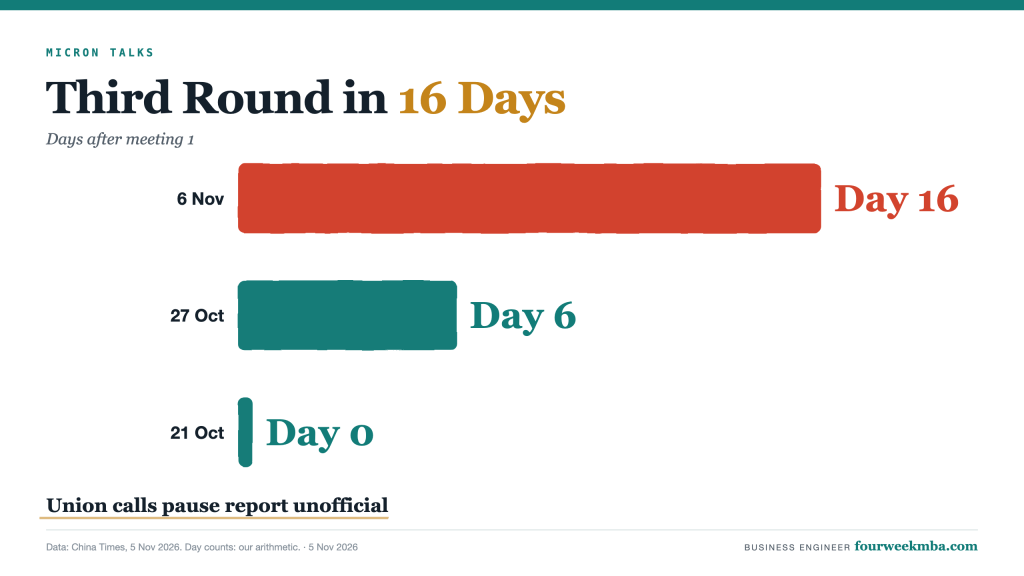
The dispute escalated in October when the Taoyuan union secured authorization to strike and held a 24-hour warning action on October 22. Taiwan’s Public Television Service reported that 11 union officers participated, while Central News Agency described the action as symbolic. The limited size of the action matters because it was separate from the later report that Fab 11E construction had been paused. The sources establish that the warning strike occurred but do not show that it shut down Micron’s entire Taoyuan manufacturing operation. Micron later said its Taiwan operations continued to run normally.
Micron and the Taichung union announced on October 21 that they had reached a labor-management agreement and would withdraw from mediation scheduled for the next day. The joint announcement said the sides had resolved multiple issues and would communicate details to employees, but it did not publish a complete public breakdown of the agreement. Taiwan’s Ministry of Economic Affairs subsequently said the deal improved employee compensation, while local reporting associated it with Micron’s new quarterly bonus arrangements. The agreement resolved negotiations with the union representing the larger share of Micron’s Taiwan workforce while leaving Taoyuan bargaining unresolved.
Central News Agency reported that Micron employs about 12,300 people in Taichung and about 3,000 in Taoyuan, with approximately 11,000 and 2,400 union members, respectively. Those figures help explain why the Taichung settlement was important even though the Fab 11E project is in Taoyuan. Some workers later questioned how the agreement had been reached. On November 3, the Central Taiwan Science Park Bureau said records from two union meetings showed that the union had authorized its board and representatives to handle negotiations and related labor actions. The bureau said it respected the October 21 agreement and pointed workers challenging it toward internal union procedures and civil litigation.
Bloomberg reported that the possibility of a challenge to the Taichung agreement was among the uncertainties concerning Micron executives. The concern therefore extended beyond the immediate terms of the Taoyuan negotiations. Micron was dealing with one union that had signed an agreement and another that was still seeking a different compensation formula. That environment created uncertainty about how stable labor arrangements across the company’s Taiwanese operations would be. Public reporting does not establish that any legal challenge had actually overturned the Taichung agreement.
Micron and the Taoyuan union met again on November 6 with assistance from the Taoyuan city government. Mayor Chang San-cheng attended to encourage a resolution, and the parties discussed compensation transparency and individual bonus calculations. The meeting ended without a comprehensive settlement, while the union also sought clarification about reports concerning Fab 11E. Its secretary-general said Micron directed questions about its official construction position to its public statements. The compensation calculator became the clearest area of progress.
By November 11, Chang said Micron had developed the system and expected to make it available to employees globally soon. The tool could help workers see their individual cash and equity awards under the quarterly program. It did not resolve the Taoyuan union’s broader demand for 15% of global operating profit. November 17 was identified as the expected date for another bargaining session. That meeting offered another opportunity to narrow differences over compensation but carried no public commitment to restart Fab 11E construction.
The Taoyuan union’s percentage proposal can also be compared with agreements at rival memory companies. Reuters reported that SK Hynix had agreed to allocate 10% of annual operating profit to a bonus pool. Samsung Electronics had agreed to special bonuses tied to 10.5% of its semiconductor division’s operating profit, subject to profitability requirements. The formulas and conditions differ, so the percentages are not directly interchangeable. Their relevance is that each gives workers an explicit benchmark against which they can assess future payouts.

Taiwan Government Response, Micron’s Existing Operations, and the Strategic Importance of Taiwan
Taiwan’s Ministry of Economic Affairs said it would work with the Ministry of Labor and local authorities to support continued dialogue between Micron and its employees. The ministry described Micron as one of Taiwan’s most important foreign investors and put the company’s cumulative investment on the island at NT$1.6 trillion. It also said it would continue supporting Micron’s long-term development in Taiwan. Questions about individual construction projects and future investment plans were referred back to the company. The national government’s response therefore emphasized continuity and mediation rather than offering a project-specific decision on Fab 11E.
The Taoyuan city government has been more directly involved in negotiations. Its labor bureau organized meetings focused on how Micron calculates bonuses, what information workers can see, and how management might respond to union demands. The city described itself as providing a neutral forum for bargaining. Mayor Chang said on November 6 that reports of a construction halt should be verified with Micron, while the city had earlier told Bloomberg that it had received no notification of a suspension. The local government therefore facilitated labor talks without publicly confirming the construction status reported by Bloomberg.
On November 11, Chang said he had asked Micron’s leadership to continue investing in Taoyuan and Taiwan. According to the mayor, Micron’s president described Taoyuan as important to the company’s global operations and said investment there would continue. That assurance concerned Micron’s broader presence rather than providing a new Fab 11E timetable. Chang’s account included no revised budget, start date, production target, or construction milestone for the project. The statement nevertheless indicated that Micron had not publicly withdrawn from Taoyuan as a manufacturing location.
Micron itself said its existing Taiwan operations were running normally and that it was confident it could maintain continuity and meet customer needs. The company described Taiwan as a critical part of its global operations, confirmed the Taichung union agreement, and said it would continue discussions with the Taoyuan union through city-arranged meetings. That statement applies to facilities already producing or supporting memory products. It does not resolve the status of a future construction project whose purpose is to add capacity later. Existing production and Fab 11E construction therefore have to be assessed separately.
A delay at a new fab can affect long-term supply plans without immediately disrupting output from existing manufacturing lines. Operating DRAM production depends on staffing, materials, and equipment at facilities already in service. Fab 11E depends on capital expenditure decisions, contractors, utilities, and equipment installation. That distinction explains how Micron can say current Taiwan operations are normal while Bloomberg reports that construction of a future facility has largely stopped. Both statements can describe different parts of the company’s Taiwan presence.
Taiwan is especially important because it accounts for about 60% of Micron’s worldwide DRAM output, according to Bloomberg reporting also cited by Central News Agency. The percentage refers to Micron’s own global DRAM production rather than Taiwan’s share of total industry output. Bloomberg separately reported that the island produces a substantial portion of Micron’s HBM without assigning a percentage to that output. The 60% figure therefore cannot be used to calculate how much of Micron’s HBM comes from Taiwan. It does, however, show why labor stability and manufacturing continuity on the island matter to the company.
The production stages also complicate any attempt to translate the percentage directly into HBM supply. HBM is a form of DRAM, but finished HBM depends on both wafer fabrication and advanced packaging and testing. A facility that produces DRAM dies and another that stacks and qualifies HBM can contribute to the same finished product. Micron has not published an estimate showing how much Fab 11E would have added to its worldwide wafer capacity. The construction pause therefore creates uncertainty around future expansion rather than establishing an immediate reduction in current output.
Micron’s Taiwan network also includes Tongluo in Miaoli County, where the company acquired a former Powerchip Semiconductor Manufacturing Corporation site. That project is part of Micron’s Taichung manufacturing network and has its own development plan. Micron completed the acquisition of the Tongluo P5 facility in March 2026 and described it as an extension of its vertically integrated Taichung campus. In June, it targeted meaningful shipments from the existing Tongluo facility in mid-2027 and said construction had begun on a second cleanroom. Tongluo therefore provides another avenue of Taiwan expansion with milestones separate from Fab 11E.

HBM Supply Risks, Micron’s Global Expansion Plans, and What Could Determine a Fab 11E Restart
A sustained delay to Fab 11E could reduce the amount of additional DRAM and HBM-related capacity Micron has available around the previously planned 2028 timeframe. HBM stacks multiple DRAM dies to move data quickly between memory and processors, which makes it important for AI accelerators. Expanding finished HBM output requires enough suitable wafer capacity, advanced packaging and testing capacity, and products that meet customer qualification requirements. A shortfall in qualified memory dies can become a bottleneck if packaging capacity is available but there are not enough dies to feed it. Fab 11E’s significance therefore depends on how much capacity it was expected to provide and when that capacity was supposed to become usable.
The nearer-term outlook depends more heavily on facilities that are already operating or have earlier scheduled expansions. Micron said its existing Taiwan operations were running normally. In its June 2026 earnings remarks, the company said it expected its Singapore facility to make a meaningful contribution to HBM packaging capacity beginning in the first half of calendar 2027. That project can increase the company’s ability to assemble and test HBM. It still requires qualified DRAM dies from Micron’s wafer manufacturing network.
Micron has not published an estimate of the HBM volume specifically attributable to Fab 11E or identified a customer whose shipments would be reduced because of the reported pause. The market impact would depend on how long construction remains slowed, how much capacity Micron can obtain from other sites, what competitors produce, and how strongly demand from AI hardware companies grows. The evidence through November 11 therefore establishes a risk to future capacity planning rather than a confirmed reduction in current HBM shipments. Current operations and future capacity expansion remain separate questions.
Fab 11E also sits within a much wider global investment program. In Taiwan, Micron completed the Tongluo P5 acquisition in March 2026 and targeted meaningful shipments from the existing facility in mid-2027. It also began constructing a second cleanroom there. Outside Taiwan, Micron’s June earnings remarks targeted initial wafer output from its first new Idaho fab in mid-2027 and from a second fab in late 2028. The company had also broken ground in January 2026 on the first fab in its planned New York manufacturing cluster.
Micron is simultaneously investing in Hiroshima, Japan, for future DRAM processes and AI memory production. Its Singapore expansion adds HBM packaging capacity, while a separate Singapore wafer fab project supports NAND rather than DRAM or HBM. These facilities operate at different stages of the semiconductor manufacturing chain and cannot automatically substitute for one another. An HBM packaging line can use suitable dies produced elsewhere after the processes and products have been qualified. A NAND fab serves a different memory market altogether.
Even among DRAM wafer fabs, one site cannot necessarily replace another on the same schedule. The contribution of a particular fab depends on the process technology it runs, when construction finishes, when tools are installed, and when yields become commercially acceptable. Micron’s broader expansion program therefore gives it additional production options but does not prove that another project could replace Fab 11E’s intended capacity by 2028. Public schedules are insufficient to establish direct substitution. The effect of a prolonged pause would have to be assessed against progress at each other site.
As of November 11, Micron had announced no restart date for Fab 11E. The expected November 17 negotiating session between the company and the Taoyuan union was the next visible labor milestone. Resolving compensation disputes could reduce the uncertainty Bloomberg identified, but it would not automatically establish when construction would resume. Micron would still need to coordinate contractors, utilities, capital spending, equipment deliveries, and any revised installation schedule. The relationship between a labor settlement and the construction timetable therefore depends on management decisions that have not been made public.
The length of the reported pause will matter to both contractors and suppliers. A quick restart could allow Micron to resume work within much of the original sequence, while a longer interruption could force the company to reschedule crews, utility work, and equipment deliveries. Bloomberg’s report that limited work continued to secure the site indicates that activity had not stopped in every respect. It does not show how quickly full construction could resume or how much schedule recovery would be possible. Micron would need to issue a project-specific update to answer those questions.
A more complete announcement would ideally clarify whether Micron still intends to complete Fab 11E, when construction will return to full activity, when tool installation is expected, and what production milestone the company is targeting. Mayor Chang’s November 11 comments indicated continued interest in Micron investing in Taoyuan and Taiwan. Micron also described Taoyuan as important to its global operations through the mayor’s account. Those statements support continued interest in the location but do not establish a new Fab 11E schedule. Until Micron provides a project-specific timetable, the restart date and the effect on the former 2028 target remain unresolved.
Frequently Asked Questions (FAQs)
- Did Micron cancel its Taiwan HBM fab?
No public cancellation had been announced as of November 11, 2026. Bloomberg reported that Micron had largely paused construction of Fab 11E in Taoyuan, with only limited work continuing to secure the site. A construction pause is different from canceling the project outright because work could resume later if Micron decides to continue on a revised schedule. Micron had not published a new restart date, completion target, or formal cancellation notice. The status of Fab 11E therefore remained uncertain rather than definitively terminated. - Is US$4.5 billion the exact cost of Fab 11E?
No. US$4.5 billion is the upper end of the reported project budget, which ranges from approximately US$3 billion to US$4.5 billion. That range includes the planned facility and equipment purchases, including equipment from ASML. Public reporting does not provide a final approved project cost or a detailed breakdown of spending by construction, utilities, and manufacturing tools. It also does not state how much Micron had already spent or contractually committed before the reported pause. The US$4.5 billion figure should therefore be treated as the top of the reported estimate rather than a confirmed final cost. - What would Fab 11E produce?
Fab 11E was expected to support DRAM and high-bandwidth memory production as part of Micron’s Taoyuan expansion. DRAM wafers provide the memory dies that can later be used in conventional memory products or in more complex products such as HBM. HBM also depends on advanced packaging, testing, and product qualification, so a wafer fab is only one part of the finished HBM manufacturing chain. Micron has not publicly disclosed how much of Fab 11E’s planned capacity would have been dedicated specifically to HBM. It also has not provided a public breakdown by memory generation, production node, or expected wafer volume. - Are Micron’s existing Taiwan fabs still operating?
Yes. Micron said its existing Taiwan operations were running normally and that it expected to continue meeting customer needs. The reported pause concerns construction of the future Fab 11E expansion rather than the shutdown of existing production facilities. That distinction matters because current DRAM and HBM-related output depends on facilities that are already operating, while Fab 11E was intended to add future capacity. A delayed expansion can affect long-term production plans without immediately reducing output from existing fabs. Micron had not reported a broad operational shutdown in Taiwan as of November 11. - What share of profits does the Taoyuan union want?
The Taoyuan union wants Micron to allocate 15% of its global operating profit to an employee profit-sharing pool. The proposal focuses on creating a transparent and predictable formula that workers can compare with Micron’s published financial results. The 15% figure applies to the total employee pool rather than guaranteeing that each worker receives 15% of anything individually. Individual payments would still depend on how Micron and the union agree to divide the pool among eligible employees. The proposal also differs from Micron’s own bonus formula, which uses profit after tax and deducts projected capital spending for the following quarter. - When do shares from Micron’s quarterly bonus vest?
Under Micron’s announced quarterly bonus plan, half of an eligible employee’s award is paid in cash after results and the other half is delivered in shares that vest after one year. The one-year vesting period means employees do not receive unrestricted ownership of the share portion immediately. Its eventual value can also change with Micron’s stock price before vesting. The quarterly program is scheduled to begin in fiscal 2027 and supplements the company’s existing annual incentive plan. The mix of cash and stock is one reason workers sought clearer information about how individual awards would be calculated. - Did the Taoyuan union hold a strike?
Yes. The Taoyuan union held a 24-hour warning strike on October 22, 2026, after securing authorization to take strike action. Taiwan’s Public Television Service reported that 11 union officers participated, while other reporting described the action as symbolic. The limited participation is important because the sources do not show that the strike shut down Micron’s entire Taoyuan manufacturing operation. Micron later said its existing Taiwan operations continued to run normally. The warning strike was therefore part of the labor dispute but should not be treated as evidence of a full production stoppage. - Did the November 6 talks settle the dispute?
No. The November 6 meeting between Micron and the Taoyuan union ended without a comprehensive settlement. The most concrete progress involved a compensation calculator intended to show employees what they could receive under Micron’s quarterly cash-and-stock bonus plan. By November 11, Mayor Chang San-cheng said Micron had developed the system and expected to make it available to employees globally. The union’s separate demand for a defined 15% share of global operating profit remained unresolved. Another bargaining session was expected on November 17. - Is the Tongluo expansion the same project as Fab 11E?
No. Fab 11E is the planned Taoyuan expansion, while Tongluo is a separate Micron facility in Miaoli County. Micron acquired the Tongluo P5 site from Powerchip Semiconductor Manufacturing Corporation and described it as an extension of its Taichung manufacturing network. The Tongluo project has its own cleanroom construction, production schedule, and investment milestones. Micron targeted meaningful shipments from the existing Tongluo facility in mid-2027 and was also constructing a second cleanroom there. Those plans are separate from the reported construction pause at Fab 11E. - Could the pause delay shipments of AI chips?
The reported pause could affect future memory capacity, but the available evidence does not show that current AI chip shipments have been delayed. HBM is used alongside AI accelerators, so a prolonged reduction in future HBM-related capacity could eventually affect how much memory Micron can supply around the period when Fab 11E was expected to contribute. However, Micron said its current Taiwan operations were running normally, and other expansions in Taiwan, Singapore, the United States, and Japan are proceeding on separate schedules. Public reporting has not identified a specific AI chip customer, shipment, or delivery that has been affected by Fab 11E. The immediate issue is therefore uncertainty around future capacity rather than a confirmed disruption to current AI hardware supply.

Conclusion
Bloomberg’s report places Micron’s planned US$3 billion to US$4.5 billion Fab 11E expansion in doubt while the company and its Taoyuan union negotiate how quarterly profits should translate into employee compensation. The parties made progress on a tool that would show workers their individual awards. The union continued to seek a transparent allocation of 15% of global operating profit, while Micron’s announced program uses after-tax earnings, deducts projected capital spending and pays half the award in shares.
As of November 11, Micron said its existing Taiwan operations were running normally, and Mayor Chang expected negotiations to resume on November 17. Bloomberg’s previously reported 2028 production target remained without a public update. A settlement could address the immediate labor uncertainty. The investment question will turn on what Micron subsequently discloses about construction, equipment installation and when Fab 11E could begin producing memory.
Sources and Citations
- Bloomberg via The Edge Malaysia, November 5, 2026, “Micron said to pause work on US$4.5 bil Taiwan plant after labour spat”: Bloomberg reports that Micron had largely halted construction of Fab 11E in Taoyuan, with limited work continuing to secure the site. The planned facility carried a reported US$3 billion to US$4.5 billion budget, including ASML equipment, and had previously been targeted to come online in 2028. Bloomberg also says Micron had informed Taiwanese officials and a supplier about the suspension plan. The Edge Malaysia
Bloomberg via The Edge Malaysia, Micron Fab 11E pause report - Focus Taiwan, November 6, 2026, “Micron says Taiwan operations normal amid reported Taoyuan project halt”: Micron told CNA that its existing Taiwan operations were continuing normally, that it expected to maintain business continuity for customers, and that talks with the Taoyuan union would continue with city-government assistance. The report also gives workforce figures of about 3,000 employees in Taoyuan and 12,300 in Taichung, with roughly 2,400 and 11,000 union members respectively. Focus Taiwan – CNA English News
Focus Taiwan, Micron Taiwan operations and union talks - Reuters, October 22, 2026, “Micron introduces quarterly employee bonus tied to profits”: Reuters reports that Micron introduced a quarterly profit-linked bonus for employees worldwide in response to Taiwanese union demands. The program supplements the annual incentive plan and is paid 50% in cash and 50% in shares. In Taiwan, Micron also raised employer retirement contributions from 8% to 10% and added three paid days off. Reuters’ reporting also covers the Taoyuan union’s push for a more explicit profit-sharing formula. Tiger Brokers
Reuters, Micron quarterly employee bonus tied to profits - Reuters, October 21, 2026, “Micron faces strike from one Taiwan union after deal with another”: Reuters confirms that Micron reached an agreement with its Taichung union, while the Taoyuan union continued toward a 24-hour strike over the lack of specific profit-sharing figures. The report also explains that Taiwan is a major Micron production base for DRAM and HBM, and that the two sites have different production roles. Reuters
Reuters, Micron Taichung union agreement and Taoyuan strike - Taiwan Public Television Service, November 6, 2026: PTS reports on the November 6 Micron-Taoyuan union talks, including discussion of a compensation calculator intended to show employees their individual bonus amounts. It also covers the earlier October 22 warning strike, which local reporting described as symbolic and limited in participation.
Taiwan PTS, Micron labor negotiations and compensation calculator - TaiSounds, November 11, 2026: TaiSounds reports that Taoyuan Mayor Chang San-cheng said Micron’s president had reaffirmed the importance of Taoyuan and continued investment there. It also says another labor-management bargaining session was expected on November 17. This was a broader investment assurance, not a new Fab 11E construction timetable. 新文易數
TaiSounds, Micron investment position and November 17 talks - Central News Agency, November 5, 2026: CNA reports that Taiwan’s Ministry of Economic Affairs would work with labor and local authorities to assist negotiations and described Micron as one of Taiwan’s most important foreign investors. The ministry put Micron’s cumulative Taiwan investment at about NT$1.6 trillion and said project-specific construction questions should be answered by Micron. 中央社 CNA
CNA, Taiwan government response to Micron Fab 11E report - Central Taiwan Science Park Bureau, November 3, 2026: The bureau’s statement says records from union meetings showed that the Taichung union had authorized its board and representatives to handle negotiations and related labor actions, supporting the legality of the October 21 agreement. It said it respected the agreement and pointed disputes over internal union authorization toward union procedures and civil remedies. search.ctsp.gov.tw
Central Taiwan Science Park Bureau, Taichung union agreement statement - Micron Technology, Fiscal Q3 2026 Prepared Remarks / investor materials, June 24, 2026: Micron’s investor materials document the company’s wider manufacturing expansion, including Tongluo in Taiwan, Idaho, New York, and Singapore, alongside aggressive investment to meet AI-driven memory demand. Micron’s Q3 results also confirm HBM4 high-volume shipments and HBM4E development for calendar 2027. Micron Investors
Micron Q3 2026 investor presentations and prepared remarks - Micron Technology, Fiscal 2026 Results, September 30, 2026: Micron reported US$133.19 billion in fiscal 2026 revenue and US$84.97 billion in GAAP net income, compared with US$37.38 billion and US$8.54 billion respectively a year earlier. CEO Sanjay Mehrotra attributed the extraordinary expansion to AI-driven demand and said Micron was increasing investment in technology, products, and manufacturing. SEC
Micron Fiscal 2026 results via SEC
Recommendations
- Where Winds Meet, Official Imperial Palace Gameplay Trailer Explained: Release Date, Story, Combat Details & Everything We Know
- Diablo 4 3Rd Anniversary Event: Goblins, Massive XP Boost, Free Cosmetics, and Full June 2–9 Celebration Guide
- IO Interactive and Build A Rocket Boy End MindsEye Partnership as Hitman Crossover DLC Is Canceled
- All Anomalies in Animal Hospital Guide: Every Roblox Anomaly Explained
- Every Release Date from Every Event at Summer Game Fest 2026
- First Gameplay Trailer of Silent Hill: Townfall: It’s a First-Person Game and Everything We Know (2026)
- Best New Anime to Watch Right Now: Spring 2026 Picks
- Switch 2 Software Update Adds “Handheld Mode Boost” for Old Games – Performance Upgrade Explained
- We Build LEGO Winnie the Pooh: A 100th Anniversary Set Worth the Hype for Disney and LEGO Fans
- Echoes of Aincrad: Complete Guide to Growth Points (Best Stat Builds & Leveling Tips)



































































































