







In This Article (16 sections)
FilmFlow AI Camera Planning: How Text Instructions and Reference Videos Control 3D Camera Movements
FilmFlow explores how filmmakers can direct virtual cameras using written instructions or reference footage. The research focuses on translating creative intentions into camera movements within existing three dimensional environments, allowing filmmakers to describe the shots they want rather than manually specifying every camera position, viewing angle and movement. For animators and filmmakers, the underlying challenge is familiar. An instruction such as “follow the character, gradually move closer, and finish on their reaction” may sound straightforward, but executing it requires decisions about camera placement, movement speed, viewing direction, framing and timing. These decisions become more complicated when characters move, foreground objects obstruct the view or several camera movements must occur simultaneously.
FilmFlow addresses this problem by connecting natural language instructions and visual references with controllable camera behavior. An effective camera planning system must identify the intended subject, determine how to present the action and evaluate whether the resulting shot communicates the filmmaker’s intentions. The research was developed by Yiming Zhang, Jiarui Guo, Haojia Wei, Yifei Liu, Yifan Yang, Hongjie Zhang, Xue Yang and Zhihang Zhong. Their affiliations include Cornell University, Shanghai Jiao Tong University, UCLA and Shanghai Artificial Intelligence Laboratory. The paper appeared on arXiv on October 22, 2026.
Virtual cinematography involves positioning and moving cameras inside digital environments. Its creative principles resemble physical filmmaking, including decisions about what the audience should see, which details should remain hidden and when important subjects should enter the frame. However, virtual cameras operate through numerical coordinates, orientation settings and software controls, creating a gap between creative descriptions and the technical instructions needed to produce a shot. FilmFlow attempts to bridge that gap through a workflow involving interpretation, camera planning, rendering, evaluation and refinement. Rather than treating camera movement as a purely geometric problem, the system considers how the resulting images communicate the requested action.
Concrete Shot Requirements and Reference Inputs
For example, consider an instruction asking the camera to follow a delivery rider through a courtyard, move closer after the rider stops and finish with a package visible. The instruction contains three distinct requirements: tracking the rider, responding to the stopping action and emphasizing the package at the end.
A camera that follows the rider smoothly but never reveals the package would fail to satisfy the complete direction. The relationship between actions also matters. “Move closer after turning” requires a different sequence from “move closer while turning.” The first separates the movements, while the second requires them to overlap. Consequently, a camera assistant must understand subjects, timing and intended visual outcomes rather than simply recognizing cinematography terms such as pan, orbit or zoom.
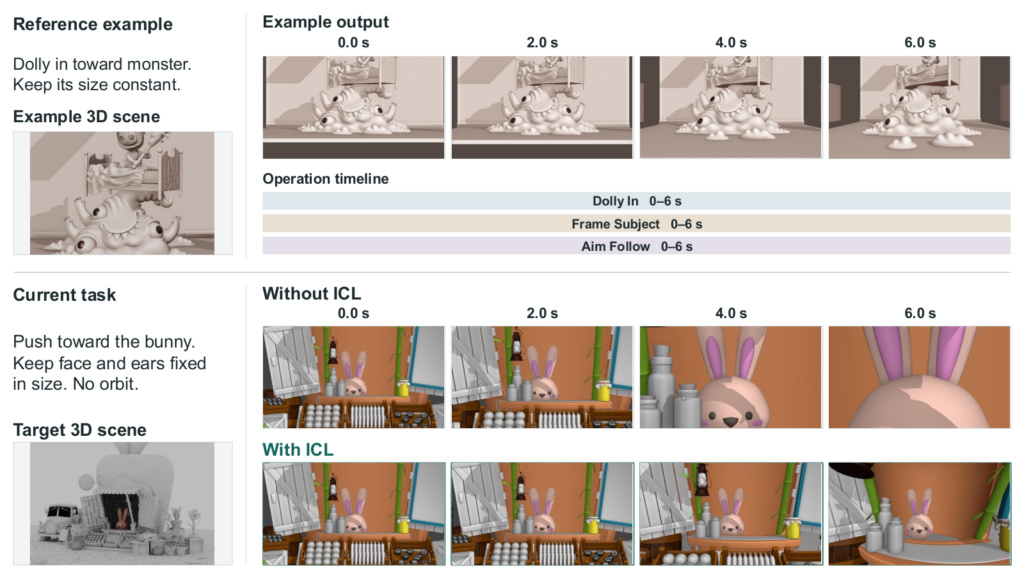
FilmFlow also supports reference video inputs, allowing camera behavior from existing footage to guide movements within another 3D scene. This approach can communicate visual intentions that are difficult to describe precisely, including the timing of a gradual approach, the progression of a reveal or the movement between two subjects. However, transferring camera behavior does not necessarily mean copying the original camera coordinates.
The research notes that estimated reference poses have unverified scale and serve as motion cues. Different environments may have substantially different dimensions, making direct coordinate reproduction unsuitable. For example, a camera movement originally filmed on a large railway platform might need considerable adjustment when transferred into a small apartment. Reusing identical travel distances could produce collisions or inappropriate framing, while preserving the transition from a wide introduction to a close reaction could maintain the intended cinematic effect. A meaningful reference transfer therefore considers:
- Movement direction: Whether the adapted camera travels in a similar direction relative to the important subjects.
- Camera progression: How the shot develops from its opening composition to its final framing.
- Timing: Whether major movements and changes in emphasis occur at appropriate moments.
- Subject relationships: Whether the camera preserves the intended attention between characters or objects.
- Scene geometry: Whether the movement remains appropriate for the dimensions and obstacles of the destination environment.
- Visual emphasis: Whether the final result communicates the purpose of the reference rather than merely reproducing similar coordinates.
Differences in costumes, lighting, scenery and other visual details do not necessarily indicate an unsuccessful transfer. The more important question is whether the adapted camera communicates a similar progression of attention while respecting the destination scene. FilmFlow works with both static and animated Blender scenes, introducing additional complexity when characters and objects move. An animated character may change direction, walk behind furniture, approach the camera or leave the original framing. A viewpoint that works at the beginning of a shot may become ineffective seconds later.
Blender Camera Controls and Timing
Blender’s camera controls determine which parts of a scene appear in the rendered image. Perspective and lens settings affect framing, with longer focal lengths producing narrower fields of view and shorter focal lengths showing more of the environment. These settings interact with animated subjects. When a character approaches a stationary camera, their apparent size increases. Maintaining a particular composition may require adjustments to camera position, viewing direction, lens settings or several controls together.
This makes virtual cinematography a problem involving time as well as space. A successful camera path must account for when characters move, stop, turn and reach important moments in their performances. Producing one attractive frame is insufficient if the camera loses the subject or misses the intended action later in the sequence. FilmFlow’s approach is therefore distinct from simply generating an attractive image. Its central objective is to translate filmmaking intentions into camera behavior that remains meaningful throughout a moving shot.

How FilmFlow’s Interpreter, Scout, Director and Critic Agents Plan and Refine Camera Shots
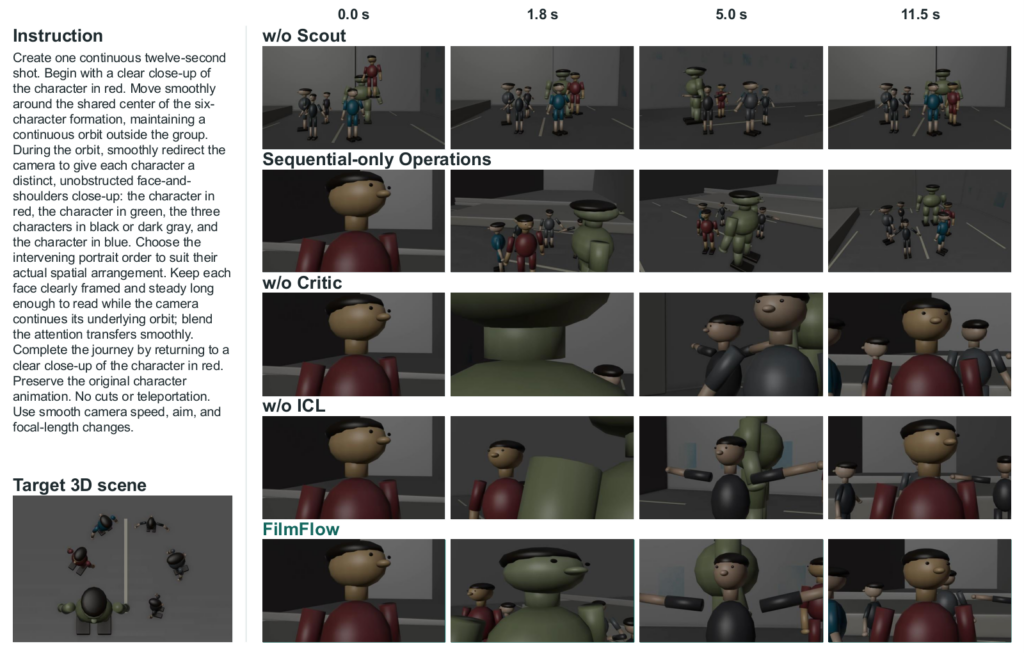
FilmFlow organizes camera planning through specialized agents that interpret instructions, establish the opening view, compose camera operations and review rendered results. The framework combines these responsibilities into an iterative process intended to connect creative direction with actual scene behavior. The system includes four principal agents:
- Interpreter Agent: Connects the filmmaker’s written instruction or reference input with the relevant subjects, objects and cinematic intentions within the scene.
- Scout Agent: Searches for a suitable opening camera viewpoint that supports the intended movement and composition.
- Director Agent: Organizes camera operations, parameters and timing into a plan, including movements that occur simultaneously.
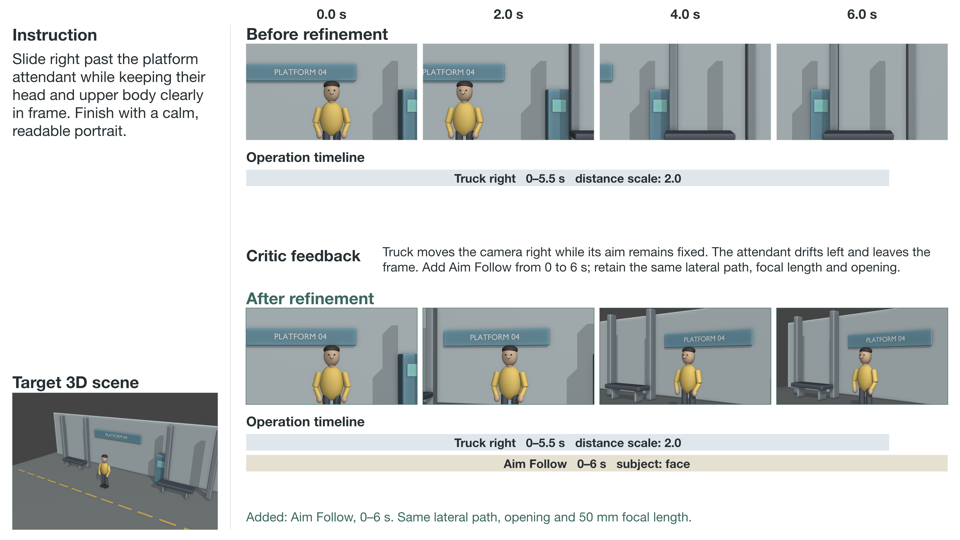
- Critic Agent: Reviews rendered results and provides feedback that can guide revisions when the shot does not adequately satisfy the requested behavior.
Interpreter Links Language to Subjects and Outcomes
The Interpreter is responsible for connecting natural language descriptions with the scene. This becomes important when instructions refer to objects using everyday descriptions rather than technical identifiers. A filmmaker might request a close view of “the woman beside the doorway” or ask the camera to reveal “the vehicle behind the crowd.” Before planning movement, the system must determine which subjects these descriptions identify. Incorrect subject identification can undermine an otherwise technically successful camera path. A smooth approach toward the wrong character would not satisfy the filmmaker’s intention, regardless of the quality of the movement.
Interpretation also requires distinguishing between a desired visual outcome and a proposed camera technique. An instruction such as “make the envelope noticeable” describes what viewers should understand, while “move closer to the envelope” specifies one possible action. Depending on the environment, changing the viewing angle or adjusting the framing might communicate the envelope more effectively than a direct approach. This distinction matters because filmmaking instructions frequently rely on context. Directors and animators may use abbreviated descriptions, emotional language or references to the surrounding action without specifying every technical detail.
Scout and Director Compose Camera Movements
Once the intended subjects and actions are identified, the Scout searches for an opening viewpoint. FilmFlow keeps the selected opening fixed during motion refinement, making its initial choice an important part of the overall plan. The opening composition determines what viewers initially understand and which movements remain practical later in the shot. Starting too close to a subject may leave little room for a gradual approach, while beginning behind an obstruction can make an immediate introduction difficult. Starting on the wrong side of an interaction may also conceal the facial expression or object that matters most.
For a planned reveal, the opening must establish a composition that initially hides the relevant detail while allowing the later movement to uncover it. Revealing the object immediately would undermine the purpose of the sequence. Lens selection also affects these decisions because different fields of view can produce substantially different framing from the same camera position. The opening should therefore support the complete movement rather than functioning only as an attractive first image.
The Director then composes camera operations into an executable plan. FilmFlow’s paper specifies a library of 22 operations, allowing movements to be organized through explicit parameters and timing, including overlapping actions. This is important because filmmakers often request combinations of movements rather than isolated camera commands. For example, moving around a sculpture while gradually approaching it produces a different visual result from completing the circular movement before moving closer.
Timing also influences the final composition. An approach might begin slowly, continue during the middle of the shot and stop before an important reaction. At the same time, a change in viewing direction could continue for longer. An explicit camera plan makes these decisions easier to inspect and revise. Filmmakers can identify whether an approach begins too early, an orbit lasts too long or the final framing arrives after the important action has already occurred.
Critic Evaluation and Scene Context
The Critic evaluates the rendered shot and provides feedback for refinement. This stage matters because a technically plausible camera plan can still produce an ineffective visual result. A camera might arrive at the intended coordinates while a foreground object blocks the subject, or a correctly timed turn might shift attention toward an irrelevant background detail. The Critic’s role concerns what the audience actually sees rather than only whether the camera executed its planned movement. Useful evaluation questions include whether the important action remains visible, whether the intended relationship between subjects is communicated and whether changes in framing occur at appropriate moments.
Feedback becomes more useful when it identifies a specific problem. For example, observing that a package leaves the frame before a character opens it provides a clearer basis for revision than simply describing the shot as unsuccessful. However, technical correctness and creative effectiveness are not identical. A smooth camera movement may fail to emphasize the intended reaction, while an abrupt movement may be appropriate for a scene involving urgency or surprise. Automated evaluation therefore remains an assessment of the shot rather than a complete replacement for artistic judgment.
Scene understanding is essential throughout this process because filmmaking instructions describe relationships between cameras, objects, characters and the audience. Moving behind a character depends on that character’s orientation, while revealing someone through a doorway depends on the doorway’s position and surrounding geometry. The same instruction can require different camera behavior in different scenes.
Keeping two speakers visible is relatively straightforward when they stand together, but becomes more difficult when one crosses the room or passes behind the other. An obstruction can also have different meanings depending on the requested shot. A foreground object might accidentally hide the subject, or it might intentionally delay a reveal. The system must interpret the creative goal rather than automatically treating every obstruction as a mistake.
FilmFlow Focus and Blender Keyframe Integration
FilmFlow differs from general text to video generation because its immediate task is planning camera movement within a supplied 3D environment. A general video generation request may involve creating characters, settings, appearances, actions and camera behavior simultaneously. FilmFlow instead concentrates on how an existing digital scene should be photographed. This distinction can be useful for animation teams that already have approved character models, prepared environments and completed performances. Their remaining challenge may be choosing and refining the camera movements that best communicate the scene.
Blender’s animation system provides a basis for representing camera properties through keyframes, which store values at particular times while interpolation determines intermediate changes when appropriate. Editable camera controls can therefore support revisions without necessarily changing the underlying character animation or environment. A filmmaker may want to preserve an existing performance while adjusting when the camera approaches, how quickly it turns or where the final composition settles. Such revisions demonstrate the potential value of separating camera planning from the creation of the scene itself. The effectiveness of this approach ultimately depends on whether FilmFlow can produce understandable camera plans, recognize unsuccessful results and allow artists to refine the outcome without excessive manual correction.
CinemaBench Results, FilmFlow Performance, Code Availability and Production Applications
FilmFlow introduces CinemaBench as a benchmark for evaluating camera planning within 3D environments. The benchmark contains 150 scenes, 750 text tasks and 60 reference clips, providing different situations in which camera behavior can be assessed. The reported evaluation uses 100 test scenes covering 500 text tasks and 40 reference tasks, while 50 development scenes supply examples. The benchmark also contains 50 human written instructions and 700 model generated instructions. These distinctions matter because a camera planning benchmark must evaluate more than whether a camera moved successfully. It needs to examine whether the movement followed the requested behavior, preserved important subjects and communicated the intended visual progression.
For example, a request to introduce a room and finish on a person reading could produce two different shots. One might execute an elaborate movement but fail to make the reader prominent, while another could use a simpler approach that clearly communicates both the environment and the character. Visual attractiveness alone would not establish which shot followed the instruction more successfully. Reference video evaluation introduces additional considerations.
Different scenes may contain unrelated objects, costumes and lighting conditions, so comparing appearance alone would provide limited information about the camera movement. A more meaningful comparison examines direction, timing, progression and the shifting emphasis between subjects. Separating development and test scenes also helps clarify the results. Performance on examples used during system development provides less evidence of generalization than performance on separate environments. In the authors’ study involving 42 participants, FilmFlow achieved the following results:
- Text instruction preference: FilmFlow ranked first in 61.0% of judgments.
- Reference instruction preference: FilmFlow ranked first in 63.2% of judgments.
- Text instruction pass rate: Human evaluators reported an 84.3% pass rate.
- Reference instruction pass rate: Human evaluators reported an 82.1% pass rate.
Benchmark Results and Interpretation
The text comparisons included LAMP, GenDoP and CinemaTraj. Reference comparisons included a zero shot vision language model, LingBot Map and VGGT Ω. These results describe different evaluation measures. A first place ranking indicates which output participants preferred among the alternatives presented, while a pass judgment concerns whether the result satisfied the requested behavior. A shot can meet its instruction without necessarily being the participant’s favorite.
The findings support the conclusion that FilmFlow performed favorably within the authors’ evaluation setup. However, they do not establish that it would outperform every competing system across all production environments, filmmaking styles or camera planning tasks. Independent reproduction would strengthen confidence in the findings, particularly if another research team could obtain similar results using the same materials and documented configurations.
Benchmark performance also does not fully explain how much effort artists would need to correct unsuccessful shots. Practical questions include which instructions fail most frequently, how the system responds to unusual scene geometry and whether revisions are easier than constructing the camera movement manually. The distinction between benchmark evaluation and production reliability is important because professional workflows require predictable behavior across many different scenes, including situations that may not be represented in the research dataset.
FilmFlow’s authors also report an average of 2.23 minutes, approximately 69,500 tokens and 6.23 model calls per task, excluding final export. All agents use GPT-6-Astra with medium reasoning effort. These figures demonstrate that camera planning involves measurable computational requirements. However, they do not directly establish the complete financial cost of using the system, which would depend on infrastructure, pricing, scene complexity and the number of revisions required. The reported execution time also excludes final export, meaning it should not be interpreted as the complete time needed to produce finished cinematic footage. Rendering, additional editing and other production tasks would still contribute to the overall workflow.
Code Availability, Licensing, and Reproducibility
As checked on October 26, 2026, FilmFlow’s official project page lists both its source code and CinemaBench as coming soon. This means the published research can be examined, but the public availability of a usable implementation and complete benchmark materials has not yet been established. A practical release would need documentation explaining installation, dependencies, input formats, scene preparation, model configuration and execution procedures. Without those details, interested users cannot reliably determine how much technical work would be required to reproduce the demonstrations. Code availability should also be distinguished from production readiness. A research repository may contain experimental scripts requiring substantial setup rather than a polished filmmaking interface.
Licensing represents another consideration. Access to source code does not automatically establish unrestricted commercial use, particularly when software dependencies, demonstration assets and benchmark materials may have separate licensing conditions. The authors also describe respecting restrictions on redistributing third party assets. Such restrictions can affect how researchers obtain scenes needed to reproduce benchmark experiments.
Instruction provenance matters as well. CinemaBench includes both human written and model generated tasks, which may differ from the informal or ambiguous directions commonly used during real production. A filmmaker might request a shot that feels “more uneasy” without explaining which camera movement should change. Another might refer to an object using a description that does not match its technical identifier. These situations raise questions about how well a system handles uncertainty beyond carefully constructed benchmark requests. For reproducibility, future releases would need to identify the evaluated model configuration, scene materials, task definitions and execution settings. Otherwise, users might run altered configurations and incorrectly assume their results directly reproduce the paper.
Production Applications and Practical Limitations
FilmFlow’s potential applications are particularly relevant to previsualization, animation and virtual production. The system could help filmmakers explore alternative ways to present an existing scene, including gradual approaches, wider introductions, subject tracking and movements that shift attention between characters. Potential applications include:
- Previsualization: Exploring camera movements before committing to final cinematic shots.
- Animation production: Developing initial camera plans for scenes containing animated characters and objects.
- Shot experimentation: Comparing alternative framing, movement and timing choices.
- Reference adaptation: Translating camera behavior from existing footage into different virtual environments.
- Camera refinement: Adjusting planned movements while preserving approved characters, settings and performances.
- Smaller production teams: Providing assistance with initial camera concepts when manual planning resources are limited.
These are potential uses based on the research capabilities rather than confirmed evidence that FilmFlow has been adopted in professional production. Practical limitations remain. Dramatic instructions can be ambiguous, attractive compositions may not communicate the intended story and continuity across neighboring shots introduces requirements beyond the success of an individual camera movement. A camera planner may produce a convincing isolated shot while failing to maintain the visual relationships established in earlier scenes. Filmmakers must also consider editing rhythm, character emphasis and the relationship between multiple shots.
Rendering costs remain separate from camera planning. Automatically selecting camera movements does not eliminate the processing required to generate finished frames. Rendering time still depends on scene geometry, lighting, materials, visual effects, resolution and quality settings. The strongest evidence of production readiness would involve more than benchmark scores. A practical system would need:
- Clear installation and operating documentation.
- Reproducible results across representative production scenes.
- Appropriate licensing for software and assets.
- Editable camera controls and reliable export procedures.
- Predictable handling of unsuccessful or ambiguous instructions.
- Efficient revision workflows that reduce manual effort.
- Demonstrated compatibility with existing animation and filmmaking processes.
FilmFlow’s research illustrates how AI systems could assist with the technical execution of cinematic intentions while leaving creative direction in the hands of filmmakers. Its reported results suggest that text instructions and reference videos can guide structured camera planning within 3D environments. However, the system’s broader production value will depend on the reliability of its outputs, the accessibility of its implementation and the amount of human refinement required after the initial plan.
Frequently Asked Questions (FAQs)
- What is a 3D camera trajectory?
A 3D camera trajectory describes how a virtual camera moves through a digital environment over time. It includes changes in position and viewing direction, while lens settings and framing also influence the final shot. Two cameras can follow the same spatial route but produce different images if they point toward different subjects or use different fields of view. In virtual cinematography, a useful trajectory must support the intended action and maintain appropriate composition throughout the sequence. - Why is moving closer different from zooming in?
Moving closer physically changes the camera’s position relative to the subject and surrounding environment, while zooming changes the lens’s field of view without necessarily moving the camera. Both techniques can make a subject appear larger, but they affect perspective and spatial relationships differently. Moving closer changes the relative appearance of nearby and distant objects, whereas zooming primarily changes framing. The appropriate choice depends on the visual effect and storytelling intention. - Why can a camera path fail when transferred to another scene?
A camera path can fail because different scenes contain different dimensions, objects, obstacles and subject positions. A movement suitable for a large courtyard might pass through walls or lose the intended subject when applied to a smaller room. Successful transfer requires adapting the movement to the new environment while preserving important visual relationships. This is why reference footage should guide timing, direction and composition rather than automatically determine identical camera coordinates. - Why does the first camera view matter so much?
The opening camera view establishes what the audience initially sees and determines which later movements remain useful. Starting too close to a subject may leave insufficient room for a gradual approach, while revealing an important object immediately could undermine a planned discovery. In FilmFlow, the Scout selects the opening viewpoint, which remains fixed during motion refinement. This makes the initial composition particularly important because it must support the entire planned shot. - What makes moving characters difficult to film automatically?
Moving characters continuously change their position, orientation, apparent size and visibility. They may turn away from the camera, move behind objects or leave the original framing. A camera position that works at the beginning of a scene may therefore become ineffective later. Automated camera planning must account for these changes over time, adjusting movement and viewing direction to preserve the intended subject and important actions. - How should reference based camera results be compared?
Reference based camera results should be compared according to the movement and visual relationships they are intended to reproduce. Important considerations include camera direction, timing, framing progression and how attention shifts between subjects. The destination scene may contain different objects, characters or environments, so identical visual appearance is not required. A successful adaptation preserves the cinematic purpose of the original movement while respecting the geometry and action of the new scene. - Does a smooth camera movement guarantee a good shot?
No. Smooth movement is only one aspect of effective cinematography. A camera can move smoothly while failing to capture an important action, emphasize the intended character or arrive at the correct composition. Some scenes may also benefit from abrupt movements that communicate urgency, surprise or instability. A successful shot depends on timing, framing, subject visibility and whether the movement supports the intended storytelling effect. - Does automated camera planning remove rendering costs?
No. Automated camera planning determines how the camera should move, but rendering the final images remains a separate computational task. Rendering requirements depend on scene complexity, lighting, materials, visual effects, resolution and output quality. FilmFlow’s reported average task time also excludes final export. Consequently, automated camera planning may reduce some manual planning work without eliminating the resources required to produce finished footage. - What does a benchmark preference score establish?
A benchmark preference score indicates how frequently participants favored a particular output over alternatives under the study’s evaluation conditions. FilmFlow ranked first in 61.0% of text judgments and 63.2% of reference judgments in the authors’ 42 person study. These scores provide comparative evidence about participant preferences, but they do not establish universal artistic quality or production reliability. Their meaning depends on the tasks, competing methods and evaluation procedures used. - What would demonstrate that an AI camera planner is ready for production?
Production readiness would require more than successful research demonstrations or favorable benchmark results. A practical AI camera planner would need reliable installation, clear documentation, appropriate licensing, editable camera controls and compatibility with existing filmmaking software. It should also handle ambiguous instructions, identify unsuccessful shots and support efficient revisions. Testing on representative production scenes would help establish whether the system reduces manual effort while maintaining the creative control filmmakers require.
Conclusion
FilmFlow addresses an important challenge in virtual filmmaking: translating creative instructions into camera movements that can be inspected, evaluated and refined. By combining natural language instructions, reference footage and automated camera planning, the framework explores how filmmakers can direct virtual cameras without manually controlling every movement and technical parameter.
The research highlights the potential to simplify camera planning while preserving the creative decisions that shape a scene. Camera position, timing, framing and visual emphasis remain essential storytelling choices, even when software assists with their execution. FilmFlow’s reported evaluation results demonstrate promising capabilities, although its current release status and benchmark scope leave questions about reproducibility and practical production reliability.
For filmmakers and animators, the most meaningful measure of FilmFlow’s success will be whether it reduces the effort required to turn creative intentions into controllable camera shots. Publicly available software, independent testing and broader production experience would help establish how consistently the framework can deliver useful results across different filmmaking environments.
Sources and Citations
- Zhang et al., FilmFlow Research Paper, October 22, 2026 : Describes FilmFlow’s Interpreter, Scout, Director and Critic agents, its library of 22 camera operations and the CinemaBench benchmark. It also reports evaluation results for generating camera trajectories from text instructions and reference videos.
FilmFlow: Agentic System for 3D Virtual Film Cinematography - FilmFlow, Official Project Page : Lists the researchers and affiliations, explains the four agent framework and presents demonstrations of camera movements generated from text and reference videos. It also introduces CinemaBench, while marking both code and benchmark releases as coming soon.
FilmFlow Official Project Page - Blender Manual, Cameras : Explains perspective and orthographic cameras, focal length, field of view and composition guides in Blender. It provides background for understanding how camera settings affect framing and the appearance of subjects within a 3D scene.
Blender Manual: Cameras - Blender Manual, Introduction to Keyframes : Explains how keyframes store property values at specific points in time and how interpolation determines the values between them. It also introduces animation curves and the controls used to shape movement in Blender.
Blender Manual: Introduction to Keyframes
Recommended
- Resident Evil Requiem Demo Is Out: How to Download on PC, PS5, Xbox, and Switch 2
- 007 First Light Development Talk Set for October 2026
- Crimson Desert Guides: Beginner Tips, Combat Basics, Best Weapons, Bosses, and Exploration Walkthroughs
- Can you zoom the camera in Blender?
- Tides of Annihilation at Xbox Gamescom Stream August 27, 2026: Gameplay Recap
- FlippedNormals Is Shutting Down: Marketplace Closing Date, Download Deadline, and What Happens to Your Purchases
- Burglin’ Gnomes Guide: High-Gnome Tasks, Crafting System, Co-Op Heists, and Survival Strategies Explained
- The First Tintin LEGO Set Celebrates the Boy Reporter’s Legendary Trip to the Moon (Set 21367)
- Assassin’s Creed TV Show: Here’s Who Will Star In And Direct (Netflix Cast & Director Update)
- This New Co-Op Dark Fantasy RPG Is Like Elden Ring Meets Arc Raiders Overview



































































































