










In This Article (10 sections)
How to Rig a Folding Chair in Blender With Bone Chains and Mechanical Pivots
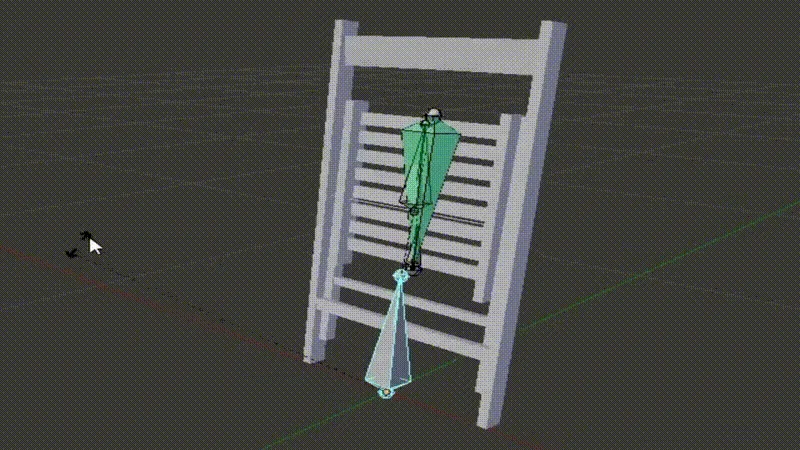
A reliable folding chair rig begins by analysing the chair as a mechanical linkage rather than immediately adding bones. Identify every rigid component, every real hinge, which parts share an axis and which points must remain connected throughout the folding motion. A typical chair may include front legs, rear supports, the seat, seat supports and cross linking members, but the exact structure depends on the model. For rigid mechanical props, pivot placement must be precise because even a small error can create visible separation or impossible movement as the chair folds. Place bone heads, bone tails, object origins or control objects directly at the real hinge centres and align their rotation axes with the physical hinge axes.
Before building the rig, apply or deliberately manage object transforms, especially scale, and choose a clear rest pose. The armature should then be constructed around real hinge to hinge distances rather than arbitrary bone lengths. Bone chains are particularly useful because connected bones preserve shared joint positions, allowing them to represent mechanical links whose endpoints must remain attached. In Edit Mode, create each bone from one meaningful pivot to the next and continue the chain through the mechanism. The physical length of each bone matters much more than in many character rigs because a solid chair bar cannot stretch to compensate for inaccurate proportions.
Rigid chair components generally do not need automatic weights. Instead, individual mesh objects can be parented directly to the bone representing that component, allowing the entire object to follow the bone without bending. This makes bone parenting well suited to hard surface mechanical pieces. A useful beginner workflow is to establish all hinge centres, create the main armature, align bones from pivot to pivot, parent each rigid object to its corresponding bone and test ordinary forward kinematic rotation before introducing IK or drivers. Solving simple relationships first makes later problems much easier to isolate.
Control Bones, IK, and Alternative Rigging Approaches
Mechanical rigs also benefit from separating technical bones from animator controls. Some bones may represent the real chair links, while others exist only as controls or IK targets and never directly move visible geometry. Blender allows non deforming bones and constraints on those bones, making it possible to keep the underlying mechanism accurate while presenting the animator with a simpler interface. This approach matches the method highlighted in Nikodem “DemNikoArt” Bredlich’s August 2026 folding chair project, which focused on understanding the mechanism, building bone chains, automating movement with IK and troubleshooting cases where the chair’s proportions did not fit the intended rigging logic.
Bone rigs are especially useful when several mechanical links depend on each other, but they are not the only possible solution. Smaller folding mechanisms can sometimes be controlled through object origins, empties, parenting, Copy Rotation, Transformation constraints and drivers. The best choice depends on dependency complexity. Armatures are useful when hierarchy and IK are central, while direct object constraints may be clearer for a very small number of independent hinges. Hybrid setups are also valid, with an armature solving the linkage while empties or custom properties provide animator friendly controls.

How to Use IK, Drivers, and Constraints to Automate Folding Chair Movement
Inverse kinematics is useful when one end of a mechanical linkage must remain connected to another moving component. Instead of rotating every parent bone manually, the animator moves an IK target and Blender calculates how the bones in the chain must rotate to reach it. For a folding chair, a chain can represent one set of linked bars while the IK target follows the component that the final pivot must remain attached to. As the main section moves, the intermediate links solve automatically and maintain the connection.
The IK constraint’s Chain Length determines how many ancestor bones participate in the solve, so it should be limited to the exact mechanical links that are supposed to move. Allowing the solver to travel too far up the hierarchy can move parts that should remain fixed, while making the chain too short can prevent the endpoint from reaching the target. A Pole Target can also control which direction a two link chain bends. This is important in mechanical rigs because a chain may have two mathematically valid solutions and can suddenly flip to the opposite configuration if the bend direction is not constrained.
For a chair that should fold largely within one plane, unnecessary degrees of freedom should be removed. Lock irrelevant axes or use rotation limits so hinges move only around their actual mechanical axis. Stretch should generally be disabled because rigid chair bars do not change length unless the real mechanism telescopes. Rotation limits can also represent real physical stops and help prevent the rig from entering impossible poses near its fully open or closed states.
Automating the Mechanism with Drivers and Controls
Automation can then reduce the mechanism to one meaningful animator control. The simplest control may be an IK target that the animator moves or rotates. A more polished setup can use a custom property such as Fold, with drivers translating that value into target movement, hinge rotation or constraint influence. The Transformation constraint can provide another option by mapping one transform range onto another, such as converting a control’s translation into a mechanical bone’s rotation. These methods can be combined, with a custom property moving the main control while IK solves the dependent geometry.
Once the mechanical relationships are correct, animation quality should come from the master control rather than from independently keyframing every technical bone. Define valid fully open and fully closed poses and animate the master target or fold property between them. Drivers allow dependent parts to respond automatically, while the Graph Editor curve on the master control determines the overall timing. Mechanical movement does not necessarily appear linear even when the main control changes steadily because linkage geometry naturally causes secondary components to accelerate and decelerate throughout the fold.
Child Of constraints can be useful when a component needs an animatable relationship rather than permanent parenting. Their influence can be keyed or blended, making them suitable for switching relationships during an animation. However, they should not replace connected bone chains when the actual mechanism depends on fixed linked pivots. The same principle applies across the rig: use IK only where a real endpoint dependency exists, use drivers where relationships can be expressed mathematically and keep rigid components rigid.
How to Fix Alignment, Proportion, and IK Problems in Folding Chair Rigs
Most folding chair rig problems become easier to diagnose when the Folding Chair Rig setup is reduced to its basic hinge geometry. Temporarily ignore decorative pieces in the Folding Chair Rig and inspect whether each bone head, bone tail, target and object pivot sits exactly on the mechanical point it represents. Orthographic views are particularly useful for a Folding Chair Rig because hinges intended to operate in one plane should remain coplanar. Small depth offsets in a Folding Chair Rig can make Blender solve a three dimensional problem when the intended mechanism is effectively two dimensional, producing twisting or unexpected chain behaviour.
Transforms in a Folding Chair Rig should be checked next. Non uniform scale combined with parent rotation in a Folding Chair Rig can introduce shear and apparent drifting, so inconsistent or unapplied scaling can make a correct hierarchy behave incorrectly. Mesh to bone parenting in a Folding Chair Rig should also be inspected if the bones remain connected but the visible geometry separates at the hinges. If an object in a Folding Chair Rig suddenly jumps when a Child Of constraint is enabled, the relationship and inverse transform should be checked rather than assuming the constraint itself is broken.
Bone lengths in a Folding Chair Rig must match the actual centre to centre distances between the physical pivots. DemNikoArt specifically identified proportion mismatch as a major issue in folding chair rigs because mechanical linkages in a Folding Chair Rig are governed by fixed lengths. If two endpoints in a Folding Chair Rig are farther apart than the combined lengths of the links connecting them, no rigid IK solution exists without stretching.
If the target in a Folding Chair Rig enters a region where more than one valid solution is possible, the chain may flip between configurations. Increasing solver iterations will not fix incompatible geometry. The correct solution is to measure the model and adjust the pivot locations, bone lengths or chair proportions so the linkage remains mathematically possible throughout the required range of motion.
Systematic Troubleshooting Best Practices and Final Rig Controls
Troubleshooting in a Folding Chair Rig should proceed from simple relationships to more complex ones. Disable constraints in the Folding Chair Rig and verify that every chair component rotates correctly around its own hinge using ordinary forward kinematics. Then restore parenting, followed by individual constraints and finally the complete IK system. If the chain in the Folding Chair Rig bends backward, inspect the pole target and rotation limits.
If it stretches, check IK Stretch and whether the target is outside the reachable range. If geometry separates in the Folding Chair Rig while the armature remains connected, inspect object parenting and pivot alignment. If a rotational limit behaves unpredictably, examine which transform space it uses because world space and local space produce different results.
The most reliable folding prop rigs, including a Folding Chair Rig, follow a few consistent principles. Place every pivot in the Folding Chair Rig exactly, align local axes with real hinge axes, keep rigid parts rigid, use bone parenting in the Folding Chair Rig instead of unnecessary deformation, restrict each hinge to the degrees of freedom it actually has, avoid stretching solid links and use pole targets where the bending direction is ambiguous.
Finally, hide the technical complexity of the Folding Chair Rig behind a simple animator control. A well built mechanical rig should allow the user to open and close the chair smoothly with one or a few controls while the internal bones, IK chains and drivers preserve the mechanical relationships automatically.

Frequently Asked Questions (FAQs)
- Is Blender 5.2 LTS suitable for mechanical rigging?
Yes. Blender 5.2 LTS includes the main tools needed for mechanical rigs, including armatures, inverse kinematics, bone constraints, object constraints, drivers and custom properties. These systems make it possible to build anything from simple hinge relationships to more advanced linked mechanisms controlled by one master parameter. Blender 5.2 LTS was released on July 14, 2026 and is scheduled to receive long term support through July 2028. - Should a folding chair use automatic weights?
Usually not if the chair is built from separate rigid pieces. Automatic weights are more useful for deforming meshes such as characters, while a mechanical chair should normally keep each component completely solid. Bone parenting allows an entire chair part to follow one specific bone without bending or stretching, which is generally better suited to legs, seats, supports and other hard surface components. - Why does my folding chair IK chain stretch?
IK can allow bones to change length when stretching is enabled, which helps some character rigs reach difficult targets but is usually undesirable for rigid mechanical parts. Chair bars and supports should remain fixed in length, so IK Stretch should be disabled or reduced. You should also confirm that the IK target never moves farther away than the combined fixed lengths of the bones can physically reach. - Why does my folding chair IK suddenly flip?
A two link IK chain can sometimes reach the same target using more than one valid bend direction. When Blender switches between those possible solutions, the linkage can suddenly flip to the opposite side. A properly placed Pole Target, sensible rotation limits and a consistent rest pose can help define which direction the mechanism should bend and keep the solution stable throughout the folding motion. - What is the most important step before creating the armature?
Identify and accurately measure the real hinge centres first. Mechanical rigs depend on fixed pivot positions and link lengths, so even a technically correct IK setup can fail if the bones do not match the geometry of the chair. Building the rig around the actual centre to centre distances between hinges gives Blender a mechanically valid structure to solve. - Can I rig a folding chair without bones?
Yes. A folding chair can be rigged using object parenting, empties, Child Of constraints, Transform constraints and drivers without creating an armature. This can work well for simpler mechanisms with only a few moving parts. Bones become more useful when the chair contains several linked components that benefit from connected chains, IK solving and a centralised rigging system. - How can one slider open and close the whole folding chair?
Create a master custom property, such as a Fold value, and use drivers to connect that property to hinge rotations, constraint influences or IK target movement. Blender’s driver system lets one source value control several dependent properties at the same time. This allows the animator to move a single slider while the rest of the chair follows automatically through the rig. - Why do my chair parts separate even though the bones remain connected?
This usually means the visible geometry does not match the rig even though the bone chain itself is working. Common causes include incorrect mesh to bone parenting, object pivots that do not sit on the same points as the bone joints, inconsistent transforms or bone lengths that do not match the actual mechanical links. Non uniform scale combined with rotation can also create shear or drifting, so object transforms should be checked carefully. - What does DemNikoArt’s folding chair tutorial teach?
The published descriptions say DemNikoArt’s tutorial focuses on analysing how a folding chair actually moves before building the rig. It covers creating bone chains, using IK to automate the mechanism and troubleshooting situations where the model’s proportions do not fit the rigging logic. The project is demonstrated in Blender 5.2 LTS and is intended to show why mechanical accuracy matters even for something that appears as simple as a folding chair. - What is the best way to make folding motion smooth?
The cleanest approach is to animate one master control instead of manually keyframing every connected hinge. IK can solve the dependent links automatically, while drivers can pass the same control value to other parts of the rig when necessary. The overall speed and easing can then be shaped through Blender’s animation curves, giving the folding motion a smoother and more coordinated result.

Conclusion
Rigging a folding chair in Blender 5.2 with a Folding Chair Rig is an excellent demonstration of why mechanical rigging is fundamentally different from ordinary character deformation. The challenge in a Folding Chair Rig is not the number of moving pieces but the geometric relationships between them. Every rigid link in a Folding Chair Rig has a fixed length, every hinge has a specific centre and axis, and every connected linkage must remain mechanically possible throughout the animation.
DemNikoArt’s 2026 folding chair tutorial for a Folding Chair Rig highlights precisely these issues, focusing on bone chains, IK automation and proportion related troubleshooting rather than treating the chair as a collection of unrelated rotating objects. The fact that such a familiar object can produce unexpected rigging problems in a Folding Chair Rig makes it a useful exercise for learning transferable mechanical rigging principles.
A dependable Blender folding chair rig starts with accurate modelling and hinge analysis for the Folding Chair Rig. Bones in a Folding Chair Rig should correspond to genuine pivot to pivot relationships, rigid components should be attached without unnecessary deformation, and IK in a Folding Chair Rig should be allowed to solve only the sections that form dependent chains. Pole targets, locked axes and rotation limits can constrain the Folding Chair Rig solver to mechanically plausible movement.
For production animation in a Folding Chair Rig, the final layer is usability. Custom properties, drivers and Transform constraints can convert the underlying technical rig in a Folding Chair Rig into a single open close control. That gives the animator a simple interface for the Folding Chair Rig while retaining the complex geometric relationships underneath.
The most important Folding Chair Rig troubleshooting principle is equally simple: when a mechanical rig such as a Folding Chair Rig behaves strangely, verify geometry before blaming the solver. Check Folding Chair Rig hinge centres, bone lengths, local axes, object scale, constraint spaces and reachable target positions. IK can automate a valid Folding Chair Rig mechanism remarkably well, but it cannot repair an impossible linkage created by incorrect proportions. That is why accurate mechanical analysis remains the foundation of smooth folding chair animation with a Folding Chair Rig in Blender 5.2 LTS.
Sources and Citations
- Blender 5.2 LTS Official Release Documentation
- Blender Foundation: Blender 5.2 LTS Official Release Page
This is the strongest official source for the release date and support period. It confirms that Blender 5.2 LTS was initially released on July 14, 2026 and will receive long-term support through July 2028. (blender.org) - Blender Developer Documentation: Blender 5.2 LTS Release Notes
The complete developer release notes provide the technical documentation for features, changes, compatibility updates, bug fixes and module-specific improvements introduced with Blender 5.2 LTS. The page also confirms maintenance through July 2028. (developer.blender.org)
- Inverse Kinematics and Armature Documentation
- Blender 5.2 LTS Manual: Inverse Kinematics
This primary source explains Blender’s IK system, including the standard and iTaSC solvers. It also documents bone-axis locks, stiffness, rotation limits and the IK Stretch setting used to control how bones respond within an IK chain. (Blender Documentation) - Blender 5.2 LTS Manual: Inverse Kinematics Constraint
This page explains how an IK constraint rotates an entire chain of bones toward a target. It documents the Target, Pole Target, Chain Length, Stretch, target-position and target-rotation controls relevant to automated folding mechanisms. (Blender Documentation) - Blender 5.2 LTS Manual: Armature Structure
The manual defines armatures, bones and bone chains. It explains that bones can be chained by linking the tip of a parent bone to the root of its child, with connected bones sharing the same joint position. (Blender Documentation)
- Parenting and Constrained Relationships
- Blender 5.2 LTS Manual: Parenting Objects
This documentation covers object parenting, bone parenting and relative parenting. It also warns that combining rotation with non-uniform parent scale can create shear or other unwanted transformation behaviour, an important consideration for rigid mechanical components. (Blender Documentation) - Blender 5.2 LTS Manual: Child Of Constraint
The Child Of constraint allows an object or bone to behave as though it were parented to another object or bone. The page documents Set Inverse and the animatable Influence value, which can be used to create temporary or switchable mechanical relationships. (Blender Documentation)
- Mechanical Controls, Drivers and Rotation Limits
- Blender 5.2 LTS Manual: Transformation Constraint
This constraint maps one object or bone’s location, rotation or scale range to another transformation range. It supports rigs in which one control drives several connected chair components. (Blender Documentation) - Blender 5.2 LTS Manual: Drivers
Blender’s driver documentation explains how one property can calculate or control another property. Drivers can therefore automate multiple rigging values from a single control, slider or transformation. (Blender Documentation) - Blender 5.2 LTS Manual: Custom Properties
Custom Properties allow artists to store their own values on Blender data blocks, including objects and bones. They are commonly used to create clear rig controls that can then be connected to drivers or constraint influence values. (Blender Documentation) - Blender 5.2 LTS Manual: Limit Rotation Constraint
This page documents how rotation can be restricted around selected axes and within specified minimum and maximum ranges. These limits are relevant when mechanical joints must rotate only as far as the real folding mechanism permits. (Blender Documentation)
- Blender 5.2 LTS Animation and Rigging Changes
- Blender Developer Documentation: Blender 5.2 LTS: Animation & Rigging
This module-specific release page documents animation and rigging changes made for Blender 5.2 LTS, including updates affecting constraints, Auto IK and rigging workflows. (developer.blender.org)
- Folding Chair Rig Tutorial and Artist Publication
- 80 Level: Tutorial: Rigging Folding Chair In Blender
Amber Rutherford’s article, published on August 17, 2026, identifies Nikodem “DemNikoArt” Bredlich as the tutorial’s creator and confirms that the project uses Blender 5.2 LTS. It summarises the tutorial’s focus on analysing the folding mechanism, building bone chains, automating movement with IK and correcting problems caused by chair proportions that do not align with the rigging logic. (80 Level) - Nikodem “DemNikoArt” Bredlich on r/blender: Folding Chair Rig
This is the artist’s own announcement of the tutorial. Bredlich describes the process as setting up bone chains, using IK to automate the chair’s movement and troubleshooting situations in which the model’s proportions conflict with the rigging system. (Reddit) - DemNikoArt on YouTube: The “Simple” Rig That’s Actually Complicated: Blender Tutorial
This is the direct folding-chair rigging tutorial linked by Bredlich in his Reddit publication and referenced by the 80 Level report. (YouTube)
Recommendations
- Until Dawn 2 Finds Horror in the Sun: Tropical Setting, Trailer Breakdown, and 2027 Release Window
- More Layoffs Affect OtherSide Entertainment, Developer Behind Thick as Thieves
- Shuhei Yoshida Says Jim Ryan Fired Him: What Happened at PlayStation
- Project Hail Mary Is Doing So Well at the Box Office That There’s Already Talk of Turning It Into a Franchise
- Saving Render Settings for Multiple Cameras in Blender with The View Keeper
- Marathon is Getting a Full PvE Mode in Season 3 this September
- EVE Frontier is Leaning into Space Survival Horror: Gameplay, Lore, and What it Means for the Hardcore Sci-Fi MMO
- Phasmophobia Developer Kinetic Games Launches Kinetic Publishing With a Quality Over Quantity Strategy
- Bridgerton and Star Wars Stars Join The Last of Us Season 3 as Lev and Yara: Cast, Characters, and What It Means
- Top Gun Back in Theaters for 40th Anniversary: Release Date, IMAX Return, and What Fans Can Expect



































































































