










In This Article (7 sections)
Google DeepMind Gemini Robotics 2.5 Release Date, Mercedes-Benz 96% Success Rate, and Apptronik Apollo 2 Factory Trials
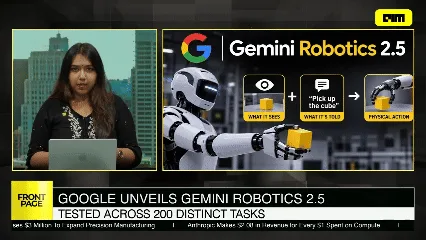
Google DeepMind introduced Gemini Robotics 2.5 on November 10, 2026, announcing improvements in robotic dexterity, task execution speed, reliability, physical reasoning, and safety. The advanced vision language action model is designed to help robots understand their surroundings, interpret instructions, and perform physical tasks. Its most prominent demonstration involved Apptronik Apollo 2 humanoid robots achieving a reported 96% success rate while handling automotive components at Mercedes-Benz production facilities in Germany and Hungary. The announcement also highlighted improvements across more than 200 physical manipulation tasks and expanded the company’s collaborations with major robotics manufacturers, including Apptronik, Agile Robots, and Boston Dynamics.
Gemini Robotics 2.5 builds on Google’s research into physical artificial intelligence, also known as embodied AI. Unlike conventional AI models that primarily generate text, images, or code, vision language action systems connect perception and language understanding with physical movement. A robot receiving instructions to arrange automotive components must identify the relevant objects, determine their positions, select appropriate grasping movements, and place them correctly. Conventional industrial automation can perform repetitive movements with exceptional precision, but changing the task may require additional programming, specialized equipment, or redesigned fixtures. Google’s approach aims to develop more adaptable robotic intelligence that can respond to different objects and working conditions.
The latest model follows Gemini Robotics 2, announced on July 30, 2026, which introduced capabilities involving whole body movement, manipulation, and cooperation between robotic systems. Gemini Robotics 2.5 concentrates on improving manipulation accuracy, completing activities more quickly, and responding more effectively to physical hazards. Google reports success rate improvements of 30% to 100% across evaluated task categories, alongside task completion speeds approximately 20% to 30% faster than earlier baselines. The company also introduced stronger safety steering during inference and continued developing supporting robotics capabilities through Gemini 4 Argon.
The Mercedes-Benz demonstration provides a practical example of these improvements. Google DeepMind and Apptronik tested Apollo 2 humanoid robots on active automotive production lines in Sindelfingen, Germany, and Kecskemét, Hungary. The robots performed component kitting, a manufacturing activity involving the selection of parts from bulk storage containers and their placement into organized trays for subsequent assembly work. In the reported demonstration, Apollo 2 identified metal automotive brackets, retrieved them from supply bins, and arranged them into sequencing containers. The task required accurate object recognition, controlled gripping, and reliable placement despite variations in how the components were positioned.
The system combined Gemini Robotics embodied reasoning with Gemini Robotics 2.5 action generation. The reasoning component maintained an understanding of the overall task and the sequence of operations, while the action model controlled the robot’s movements. This division allowed the system to interpret instructions, identify appropriate components, and adjust its actions when physical conditions differed from expectations. For example, a bracket might shift during an attempted grasp, requiring the robot to recognize the change before continuing. Similarly, an incorrectly positioned object could require another movement before the sequence was completed.
Apptronik Apollo 2 provided the physical hardware for the demonstration, combining articulated arms, perception systems, and dexterous robotic hands. Google identified the use of a SharpaWave five fingered hand with 22 degrees of freedom, allowing multiple independent movements during object manipulation. Greater movement flexibility can help a robotic hand accommodate irregular shapes and perform complex grasps, but mechanical flexibility alone does not guarantee dexterity. Effective manipulation also depends on perception, control algorithms, feedback, and the ability to recover from unexpected contact. The collaboration brings together Google DeepMind’s AI models and Apptronik’s humanoid hardware to investigate how adaptable robots might operate in environments originally designed around human workers.
The reported 96% success rate is encouraging but requires careful interpretation. Google’s public announcement did not provide a complete breakdown of trial counts, individual failure categories, exact evaluation criteria, or the amount of human assistance involved. A system maintaining 96% success would still experience approximately four unsuccessful operations per 100 attempts. Whether those failures interrupt production, can be corrected automatically, or require human intervention is critical when assessing commercial reliability. The reported result therefore demonstrates progress in a defined manufacturing task rather than proving that humanoid robots can already operate continuously without supervision.
The trials also involved a narrower activity than complete vehicle manufacturing. Picking and organizing metal brackets is different from welding vehicle structures, installing powertrains, or conducting final inspections. Testing on active production lines exposed the robots to realistic conditions involving lighting, component arrangements, equipment positioning, and surrounding activity, but it did not establish that the technology was permanently deployed throughout either Mercedes-Benz factory. Google also did not publish separate success rates for the German and Hungarian facilities, so the headline percentage should not be presented as an independently verified result for each location.
Apptronik cofounder and CEO Jeff Cardenas reported that improvements achieved during several weeks of post training transferred to factory conditions with relatively little performance degradation. This matters because adapting robotic systems to new industrial environments can require substantial data collection and engineering. Models capable of transferring learned skills more effectively could eventually reduce those costs. However, the involvement of post training also demonstrates that the robots required preparation rather than immediately performing arbitrary factory assignments without adaptation.
The partnership illustrates the potential advantages of flexible automation in manufacturing. Factories frequently handle different component variants, and conventional systems may require new programming or equipment when processes change. Humanoid robots capable of adjusting their actions could eventually support component sequencing, materials preparation, and other repetitive tasks across changing workstations. Nevertheless, commercial adoption depends on sustained uptime, maintenance requirements, integration costs, safety standards, and productivity over complete operating shifts rather than the performance achieved during isolated demonstrations.
The strongest conclusion from the Mercedes-Benz trials is that Gemini Robotics 2.5 has demonstrated useful progress in industrial materials handling under real production conditions. Its reported success rate, combined with faster manipulation and improved physical reasoning, provides a basis for further development. However, the transition from proof of concept to widespread deployment will require additional evidence about reliability, operating costs, recovery from failures, and safe cooperation with factory employees.

Gemini Robotics 2.5 Performance Benchmarks, Robot Dexterity, Vision Language Action Models, and Boston Dynamics Partnerships
Google DeepMind evaluated Gemini Robotics 2.5 across more than 200 real world manipulation tasks, including activities involving precise grasping, flexible objects, everyday tools, and coordinated movements. The company reported success rate improvements ranging from 30% to 100% relative to previous baselines, depending on the task category. These are relative improvements rather than guarantees that every task achieved a particular absolute success rate. For example, doubling a success rate from 30% to 60% represents a 100% relative increase without producing perfect performance.
Several individual tasks demonstrate the differences between the newer model and its earlier baseline:
| Robotic Task | Previous Success Rate | Gemini Robotics 2.5 Success Rate |
|---|---|---|
| Packing pastries with tongs | 5% | 100% |
| Untying ribbon bows | 0% | 70% |
| Hanging a cardigan | 0% | 62% |
| Folding pants | 0% | 40% |
These results highlight improvements in handling flexible materials, controlling tools, and coordinating movements involving objects whose shapes change during manipulation. Packing pastries with tongs requires careful positioning and control over applied force, while manipulating ribbons or clothing requires understanding how materials bend, fold, and respond to movement. Such activities are difficult for systems that depend entirely on predetermined trajectories because the physical state of an object may change during every interaction.
The variation between the benchmark results also demonstrates that Gemini Robotics 2.5 has not achieved universal reliability across manipulation tasks. Some activities improved from almost no successful attempts to high success rates, while others remained difficult. Handling deformable objects is especially challenging because the robot must respond to changes in shape, tension, orientation, and contact. A cardigan may shift under gravity while being lifted, and a ribbon can change position as the robot attempts to untie it. Successful manipulation requires the system to interpret updated observations and modify its movements accordingly.
Google also reported that tasks were completed approximately 20% to 30% faster than with previous baselines. Faster manipulation can improve productivity when an activity is repeated many times, but successful movement speed is only one part of industrial throughput. Retries, resets, perception failures, and human assistance can reduce the practical benefit. Ars Technica also reported that Gemini Robotics 2.5 was using cloud based computing during the announcement period, introducing questions about network latency and operational dependence. Industrial customers must therefore evaluate complete task cycles, communication requirements, and recovery procedures rather than relying only on successful demonstration times.
The underlying vision language action architecture connects visual perception, language understanding, and physical action generation. Perception identifies objects, positions, and environmental conditions. Language understanding connects instructions with the intended objective, while the action model generates movements that compatible robotic hardware can execute. For a task involving component placement, the system must identify the correct part, determine where it belongs, calculate an appropriate grasp, and monitor whether the operation succeeds. This approach can be more adaptable than individually programmed motion sequences, although its effectiveness depends on the quality of perception, hardware control, and training.
Google also separates detailed action generation from broader embodied reasoning. The reasoning component interprets complex instructions, determines intermediate steps, and maintains information about progress. The action model produces the physical control behavior needed to complete each step. This distinction becomes important during longer tasks involving several objects or changing conditions. A robot preparing an assembly kit must understand which components are required, which have already been collected, and whether an earlier placement needs correction. Combining planning with continuous physical action helps maintain progress toward the larger objective.
Google DeepMind’s partnership with Apptronik is central to this approach. The companies combine AI development with humanoid engineering, using Apollo 2 to investigate whole body movement, precise manipulation, and industrial component handling. Google supplies models that interpret environments and generate actions, while Apptronik provides the mechanical platform. Successful transfer from training into factory conditions is particularly valuable because data collection and adaptation can represent substantial deployment costs. Nevertheless, the demonstrated partnership still involves post training and testing, meaning it does not establish that the same model can immediately control every humanoid platform or perform every industrial task without further integration.
Boston Dynamics is another major robotics partner, following a strategic agreement announced with Google DeepMind on January 5, 2026, during CES in Las Vegas. Their collaboration focuses on combining Gemini Robotics foundation models with Boston Dynamics’ advanced robotic hardware, particularly Atlas. Boston Dynamics contributes expertise in mobility, balance, mechanical design, and physical control, while Google develops models intended to improve perception, instruction following, and adaptable manipulation. The partnership creates opportunities to investigate how advanced reasoning and vision language action systems could support industrial work.
An Atlas robot equipped with suitable Gemini Robotics capabilities could potentially interpret instructions, identify unfamiliar components, organize materials, and adjust movements within a workstation. However, these remain potential applications requiring separate validation. The Mercedes-Benz 96% success rate was achieved using Apptronik Apollo 2, not Boston Dynamics Atlas. Google’s November announcement did not publish an equivalent Gemini Robotics 2.5 benchmark for Atlas, so transferring the result between platforms would misrepresent the available evidence.
Boston Dynamics separately discussed commercial Atlas deployments involving Hyundai and Google DeepMind during 2026. Those developments support the broader direction of the partnership but do not establish that every planned deployment uses the same model configuration or achieves the same performance as Apollo 2. Differences in hardware, sensing, training, and working environments can affect results. Reliable integration requires testing the complete system rather than assuming that success on one robot automatically transfers to another.
Google’s robotics network also includes Agile Robots, expanding the range of hardware and industrial applications under investigation. These collaborations reflect an approach in which AI developers and robotics manufacturers contribute different parts of the technology. A sophisticated model requires suitable hardware to interact with the physical world, while advanced hardware needs adaptable intelligence to perform more than narrowly programmed actions. The long term potential lies in combining these capabilities across different robotic platforms without requiring an entirely separate intelligence system for every application.
The overall progression from Gemini Robotics 2 to Gemini Robotics 2.5 shows an emphasis on improved manipulation reliability, greater task variety, and faster execution. The earlier generation established broader whole body control and multi robot capabilities, while the newer model demonstrates stronger performance on detailed physical tasks. The reported results support meaningful progress, but comparisons must still account for hardware differences, training conditions, evaluation methods, and the specific baselines used for each benchmark.

Gemini 4 Argon Robotics Simulations, ASIMOV-Jailbreak Safety, Partner Availability, and Future Factory Applications
Gemini 4 Argon plays a supporting role in Google DeepMind’s robotics research, providing broader reasoning capabilities for physical understanding, simulation, and experimental analysis. Google introduced Argon’s robotics applications in October 2026, highlighting its ability to examine visual environments, reason about physical relationships, and assist researchers developing robotic systems. Unlike Gemini Robotics 2.5, which generates actions for compatible robots, Argon can support the research process used to train and evaluate those systems.
One important application involves digital twins and simulated training environments. Physical robot training can be expensive because experiments require equipment, preparation, supervision, and repeated interactions with real objects. Google reports that Gemini 4 Argon can help construct realistic digital representations of environments using observations from camera footage. Researchers can then introduce variations and generate thousands of simulated scenarios, expanding the range of situations available during development without performing every experiment physically.
Simulation is valuable because robotics systems require information about movement, contact, object properties, and physical outcomes. These experiences are more difficult to collect at scale than ordinary text data. Simulated environments can provide additional training opportunities involving different object positions, obstacles, and task conditions. However, simulation does not perfectly reproduce real world friction, sensor noise, object deformation, or equipment wear. Successful training therefore depends on whether improvements developed virtually transfer to physical machines.
Argon can also help researchers analyze unsuccessful operations. By examining recorded video and other evidence, the model may identify possible causes of a failed grasp or incorrect movement. Researchers can test proposed corrections in simulation before evaluating them on actual hardware. Google’s October announcement reported an 87% score for Argon on the Embodied Reasoning Question Answering benchmark, which examines aspects of physical and spatial reasoning. This result belongs to Argon and should not be confused with the 96% industrial kitting success rate reported for Gemini Robotics 2.5.
Safety is a central concern for intelligent robots because mistakes can produce physical consequences. An incorrect response from a conversational system may provide misleading information, while an incorrect action from an industrial robot could damage equipment or injure someone. Google DeepMind therefore introduced stronger safety steering for Gemini Robotics 2.5, designed to guide robot behavior away from hazardous situations during task execution.
Google reported improved task completion in environments containing potential hazards, including a 33% improvement around obstacles and a 43% improvement near people under its evaluation conditions. These figures indicate progress in handling difficult physical situations but do not guarantee safe operation in every industrial environment. Robots still require engineering safeguards, appropriate operating procedures, risk assessments, and monitoring systems. Safe behavior also depends on the reliability of sensors, mechanical components, control software, and communication infrastructure.
Google additionally released ASIMOV-Jailbreak, an open source benchmark designed to evaluate whether robotics oriented AI systems resist instructions that could result in unsafe physical actions. The benchmark examines adversarial requests that attempt to disguise dangerous objectives or persuade a system to perform actions with harmful consequences. This is particularly important for embodied AI because an instruction that appears ordinary in language may become dangerous depending on the surrounding environment.
For example, moving an object could be unsafe if the object contains hazardous material or if the destination creates a risk for nearby people. A robotics system must therefore consider the physical consequences of an instruction rather than interpreting its wording alone. Google reported that Gemini 4 Argon achieved 99.5% jailbreak resistance on ASIMOV-Jailbreak, compared with 82% for the previous Gemini Robotics ER 2 baseline. The 99.5% figure belongs to Argon rather than directly measuring the Gemini Robotics 2.5 action model.
Although stronger resistance to unsafe instructions is valuable, it represents only one dimension of robotic safety. A system must also perform legitimate operations without creating unacceptable hazards. Mechanical failures, unexpected human movement, communication interruptions, and incorrect environmental perception can produce risks even when the original instruction is appropriate. Consequently, benchmark resistance cannot replace physical safety engineering or sustained evaluation in realistic conditions.
Gemini Robotics 2.5 began rolling out to selected robotics partners following its November 10, 2026, announcement, rather than becoming freely available to every developer or industrial customer. Google’s research ecosystem includes Apptronik, Boston Dynamics, and Agile Robots, alongside broader trusted testing arrangements. As of November 13, the company had not announced a universal commercial release date or standard public pricing for the technology. Interested organizations therefore need to investigate the relevant partnership or early access arrangements rather than assume unrestricted API or robot availability.
Potential applications extend beyond the demonstrated automotive parts kitting. Industrial facilities frequently handle changing product configurations that require different component combinations. Adaptable robots could eventually support flexible parts sequencing, warehouse sorting, logistics handling, equipment preparation, and selected inspection activities. Laboratory environments may also benefit from robots capable of organizing materials or handling repetitive procedures. However, these possibilities require separate validation and should not be presented as confirmed commercial deployments of Gemini Robotics 2.5.
The economics of adoption will determine how widely these capabilities are used. Industrial customers must compare humanoid systems with conventional automation, specialized robots, and existing human operated processes. Relevant costs include acquiring the hardware, energy consumption, maintenance, integration, software services, and workforce training. Reliability is particularly important because a robot that performs well during a demonstration must still operate consistently through long production shifts, repeated cycles, and changing conditions. Cloud processing may introduce additional concerns involving latency, network availability, data protection, and resilience during communication failures.
The most realistic near term opportunity is therefore the expansion of carefully defined industrial pilot projects and selected automation tasks. Gemini Robotics 2.5 demonstrates progress toward robots capable of adapting to different objects and instructions, while Gemini 4 Argon supports simulation and research that could improve those capabilities further. The Mercedes-Benz trials provide encouraging evidence of industrial usefulness, but broader deployment will depend on sustained reliability, safety validation, hardware integration, and economic practicality. Together, these developments illustrate Google’s effort to build more capable physical AI systems without establishing that general purpose humanoid robots are ready to replace every existing factory process.

Frequently Asked Questions (FAQs)
- What is Gemini Robotics 2.5?
Gemini Robotics 2.5 is Google DeepMind’s advanced vision language action AI model designed to help robots interpret visual information, understand instructions, and generate physical movements. It supports manipulation tasks involving different objects and robotic hardware, including humanoid hands and industrial grippers. The November 2026 release focuses on improving dexterity, execution speed, reliability, and safety compared with earlier robotics models. - When was Gemini Robotics 2.5 released?
Google DeepMind officially announced Gemini Robotics 2.5 on November 10, 2026. It follows Gemini Robotics 2, introduced on July 30, 2026. The new model began rolling out to selected robotics partners rather than becoming immediately available through an unrestricted public release. Its announcement included industrial demonstrations, benchmark improvements, and new safety evaluation tools. - How did Gemini Robotics 2.5 achieve 96% success at Mercedes-Benz?
The reported 96% success rate came from automotive component kitting performed by Apptronik Apollo 2 humanoid robots. The robots identified metal brackets in supply bins, picked them up, and placed them into sequencing containers. Gemini Robotics embodied reasoning coordinated the workflow, while Gemini Robotics 2.5 generated the physical movements. Google has not published all trial counts or failure details, so the result represents a reported proof of concept rather than guaranteed production reliability. - Which Mercedes-Benz factories tested Gemini Robotics 2.5?
The demonstrations involved Mercedes-Benz facilities in Sindelfingen, Germany, and Kecskemét, Hungary. Apptronik Apollo 2 robots performed automotive parts picking and sequencing on active production lines. The tests demonstrated the technology under realistic factory conditions, but Google has not established that they represent permanent, factory wide commercial deployment. Separate verified success rates for each facility were also not provided. - What is the difference between Gemini Robotics 2 and Gemini Robotics 2.5?
Gemini Robotics 2 introduced broader capabilities involving whole body movement, dexterous manipulation, and cooperation between robots. Gemini Robotics 2.5 builds on those capabilities with more reliable manipulation, faster task completion, and improved safety steering. Google reports success rate improvements of 30% to 100% across evaluated categories and execution speeds approximately 20% to 30% faster than earlier baselines. Individual results vary considerably depending on the task. - Does Gemini Robotics 2.5 work with Boston Dynamics Atlas?
Google DeepMind and Boston Dynamics have a partnership focused on integrating Gemini Robotics foundation models with Atlas, the company’s humanoid platform. However, the reported Mercedes-Benz 96% success rate involved Apptronik Apollo 2 rather than Atlas. The November 2026 announcement did not provide an equivalent Gemini Robotics 2.5 benchmark for Boston Dynamics’ robot. Any Atlas deployment or performance claim therefore requires separate confirmation. - What is Gemini 4 Argon’s role in robotics?
Gemini 4 Argon supports robotics research through physical reasoning, simulation, and analysis of experimental results. It can help researchers create digital twins, generate varied simulated training environments, and investigate why robotic tasks fail. These capabilities can reduce reliance on repeated physical experiments while improving the development process. Argon is a reasoning model rather than the Gemini Robotics 2.5 action model controlling a robot’s movements. - How safe is Gemini Robotics 2.5?
Google reports stronger safety steering, including improved task completion around obstacles and nearby people. The company also introduced ASIMOV-Jailbreak, a benchmark for testing resistance to dangerous robotics instructions. Gemini 4 Argon achieved a reported 99.5% resistance score on that benchmark, but this result does not directly measure every safety property of Gemini Robotics 2.5. Physical robots still require mechanical safeguards, operational controls, supervision, and realistic safety testing. - Is Gemini Robotics 2.5 available to the public?
As of November 13, 2026, Gemini Robotics 2.5 was being distributed through selected robotics partnerships and trusted testing arrangements. Google had not announced unrestricted public access, standard commercial pricing, or a universal deployment date. Organizations interested in the technology would need to explore Google’s official robotics partnership or early access programs rather than assume the model is available for general use. - Can Gemini Robotics 2.5 replace human factory workers?
Gemini Robotics 2.5 shows potential for automating selected repetitive industrial activities, particularly component handling, sorting, and materials sequencing. However, the Mercedes-Benz demonstrations do not establish that it can replace every role performed by human factory workers. Complex assembly, quality control, maintenance, supervision, and safety management remain distinct challenges. Its near term value is more likely to involve assisting industrial teams and automating carefully defined tasks while further development improves reliability and adaptability.

Conclusion
Google DeepMind’s Gemini Robotics 2.5, announced on November 10, 2026, represents significant progress toward more adaptable artificial intelligence in industrial robotics. Its most notable demonstration involved Apptronik Apollo 2 humanoid robots achieving a reported 96% success rate while performing automotive component kitting at Mercedes-Benz facilities in Germany and Hungary. Evaluations across more than 200 physical tasks also demonstrated improvements in dexterity, manipulation accuracy, and execution speed. Alongside these advances, Gemini 4 Argon supports robotics research through simulation and digital twins, while improved safety steering and the ASIMOV-Jailbreak benchmark introduce additional methods for evaluating intelligent robotic behavior.
Despite these achievements, Gemini Robotics 2.5 remains in a transitional stage between successful demonstrations and widespread industrial adoption. The Mercedes-Benz results do not establish sustained commercial reliability, and the performance achieved by Apptronik Apollo 2 should not automatically be attributed to Boston Dynamics Atlas. Further progress will depend on dependable operation, effective failure recovery, affordable deployment, and comprehensive physical safety measures. If these challenges can be addressed, the technology could expand the role of adaptable robots in manufacturing, logistics, and other industrial environments.
Sources and Citations
- Google DeepMind, November 10, 2026 — “Gemini Robotics 2.5 Accelerates Real-World General Dexterity”: Official announcement introducing Gemini Robotics 2.5, confirming evaluations across more than 200 physical tasks, reported success-rate improvements of 30% to 100%, and task completion speeds 20% to 30% faster than previous baselines. It also confirms the Mercedes-Benz proof-of-concept in Germany and Hungary, where Apptronik Apollo 2 robots achieved a reported 96% success rate on automotive kitting, along with improved safety steering and the ASIMOV-Jailbreak benchmark. Google DeepMind
Google DeepMind – Gemini Robotics 2.5 - Google DeepMind, July 30, 2026 — “Gemini Robotics 2 Brings Whole Body Intelligence to Robots”: Official announcement for the previous generation, detailing whole-body control, fine dexterity, manipulation, adaptation across different robot types, and cooperation between robotic systems. This provides the primary comparison point for the capabilities later expanded in Gemini Robotics 2.5. Google DeepMind
Google DeepMind – Gemini Robotics 2 - Google Developers Blog, October 13, 2026 — “Gemini 4 Argon for Robotics”: Official developer documentation describing Argon as a general-purpose physical reasoning model for robotics. It covers physical and spatial reasoning, Real2Sim workflows, creation of physically calibrated digital twins from camera footage and sketches, MuJoCo simulation, robot control, and an 87% score on the Embodied Reasoning benchmark. Google Developers Blog
Google Developers Blog – Gemini 4 Argon for Robotics - Boston Dynamics, January 5, 2026 — “Boston Dynamics & Google DeepMind Form New AI Partnership”: Official announcement confirming the strategic partnership between Boston Dynamics and Google DeepMind to combine Gemini Robotics foundation models with the new Atlas humanoid. The collaboration focuses on enabling Atlas to perform a wider range of industrial tasks, beginning with manufacturing and automotive applications. Boston Dynamics
Boston Dynamics – Google DeepMind AI Partnership - Boston Dynamics, January 5, 2026 — “Boston Dynamics Unveils New Atlas Robot to Revolutionize Industry”: Official Atlas launch announcement confirming that the production version entered manufacturing in 2026 and that initial fleets were scheduled for deployment with Hyundai and Google DeepMind. It also states that Atlas would be trained with AI foundation models for industrial tasks, starting in automotive manufacturing. Boston Dynamics
Boston Dynamics – New Atlas Industrial Humanoid - Hyundai Motor Group, January 5–6, 2026 — “AI Robotics Strategy at CES 2026”: Hyundai’s official CES announcement confirms its wider industrial robotics strategy, Boston Dynamics’ production-ready Atlas, and the Google DeepMind partnership. It specifically describes plans to combine Boston Dynamics hardware with Gemini Robotics foundation models and scale humanoid robots safely across manufacturing environments. Hyundai
Hyundai – AI Robotics Strategy at CES 2026 - Ars Technica, Ryan Whitwam, November 10, 2026 — “DeepMind Reveals Gemini Robotics 2.5 and Open Safety Benchmark ASIMOV-Jailbreak”: Independent reporting on the Gemini Robotics 2.5 launch, Mercedes-Benz factory work, safety improvements, partner rollout, and the system’s computational architecture. Ars also notes that Gemini Robotics 2.5 was not generally available at launch and had instead been distributed to partners including Agile Robots, Apptronik, and Boston Dynamics. Ars Technica
Ars Technica – Gemini Robotics 2.5 and ASIMOV-Jailbreak - TechTimes, Terrence Hill, November 11, 2026 — “Gemini Robotics 2.5 Reports 96% Success Sorting Mercedes Car Parts but Publishes No Trial Count”: Independent analysis focusing on the reported 96% Mercedes-Benz result and the limitations of interpreting that figure without published trial counts, success definitions, or human-intervention rates. The article is useful for contextualizing the difference between a strong proof-of-concept result and demonstrated factory-scale reliability. Tech Times
TechTimes – Gemini Robotics 2.5 Mercedes-Benz Analysis - Google DeepMind, November 10, 2026 — ASIMOV-Jailbreak and Gemini 4 Argon Safety Results: The same official Gemini Robotics 2.5 announcement states that Gemini 4 Argon achieved a 99.5% jailbreak-resistance score on Google DeepMind’s ASIMOV-Jailbreak benchmark, compared with 82% for Gemini Robotics ER 2. This figure belongs to Argon’s agentic robotics safety evaluation and should not be confused with the separate 96% Apollo 2 factory-kitting result. Google DeepMind
Google DeepMind – Gemini Robotics 2.5 Safety Results
Recommendations
- Where Winds Meet, Official Imperial Palace Gameplay Trailer Explained: Release Date, Story, Combat Details & Everything We Know
- Diablo 4 3Rd Anniversary Event: Goblins, Massive XP Boost, Free Cosmetics, and Full June 2–9 Celebration Guide
- IO Interactive and Build A Rocket Boy End MindsEye Partnership as Hitman Crossover DLC Is Canceled
- All Anomalies in Animal Hospital Guide: Every Roblox Anomaly Explained
- Every Release Date from Every Event at Summer Game Fest 2026
- First Gameplay Trailer of Silent Hill: Townfall: It’s a First-Person Game and Everything We Know (2026)
- Best New Anime to Watch Right Now: Spring 2026 Picks
- Switch 2 Software Update Adds “Handheld Mode Boost” for Old Games – Performance Upgrade Explained
- We Build LEGO Winnie the Pooh: A 100th Anniversary Set Worth the Hype for Disney and LEGO Fans
- Echoes of Aincrad: Complete Guide to Growth Points (Best Stat Builds & Leveling Tips)



































































































