





In This Article (20 sections)
What is Google Project Genie and what does it do
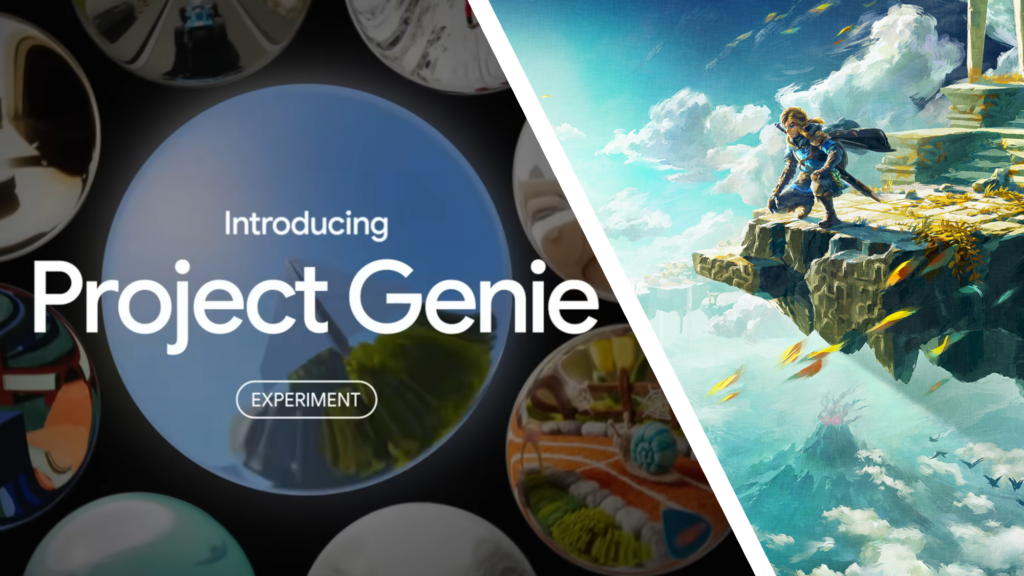
Google Project Genie is an experimental prototype from Google DeepMind that transforms text descriptions or images into playable 3D worlds. It utilizes the Genie 3 world model, the Nano Banana Pro image-generation model, and Gemini AI to create interactive environments on the fly. The system simulates physics and allows users to move through dynamic scenes in real time. While intended for entertainment and creativity, Google also views world models like Genie as a step toward training AI agents in realistic simulations.
How to access Project Genie with Google AI Ultra in the US
Access is currently restricted to Google AI Ultra subscribers in the United States who are 18 or older. This top-tier plan costs $249.99 per month and provides access through Google Labs. Because the tool is cloud-based and runs on dedicated Google AI chips, users do not need high-end local hardware, only a modern web browser and a stable internet connection. The rollout for U.S. individual accounts began on January 29, 2026.
Project Genie vs Genie 3 world model differences explained
Genie 3 is the underlying research engine, a world model capable of generating interactive environments at 20–24 FPS in 720p resolution with temporal consistency. Project Genie is the consumer-facing application built around that engine. The application includes a user interface, additional AI models for “world sketching,” and specific constraints such as a 60-second session limit and safety filters that are not inherent to the raw research model.

How Project Genie generates playable worlds from text prompts and images
The process begins with a “World Sketch,” where users provide environment and character prompts and select a movement mode and perspective. The Nano Banana Pro model then generates a static preview image. Once the user approves the preview, the Genie 3 model transforms it into a 3D environment. During exploration, the AI continuously predicts and renders the path ahead. Sessions are currently capped at 60 seconds due to high computational costs and the eventual degradation of model consistency.
Project Genie prompt tips for environments and playable characters
For the best results, prompts should be descriptive and specific regarding lighting, scale, and terrain. Using artistic keywords like “claymation” or “watercolor” often produces more coherent visuals than attempting photorealism. Character prompts should define the perspective and movement style to help the AI generate appropriate interactions. Users are encouraged to iterate using the image preview and to avoid copyrighted terms to prevent prompt rejection.
Project Genie gameplay controls and real-time exploration details
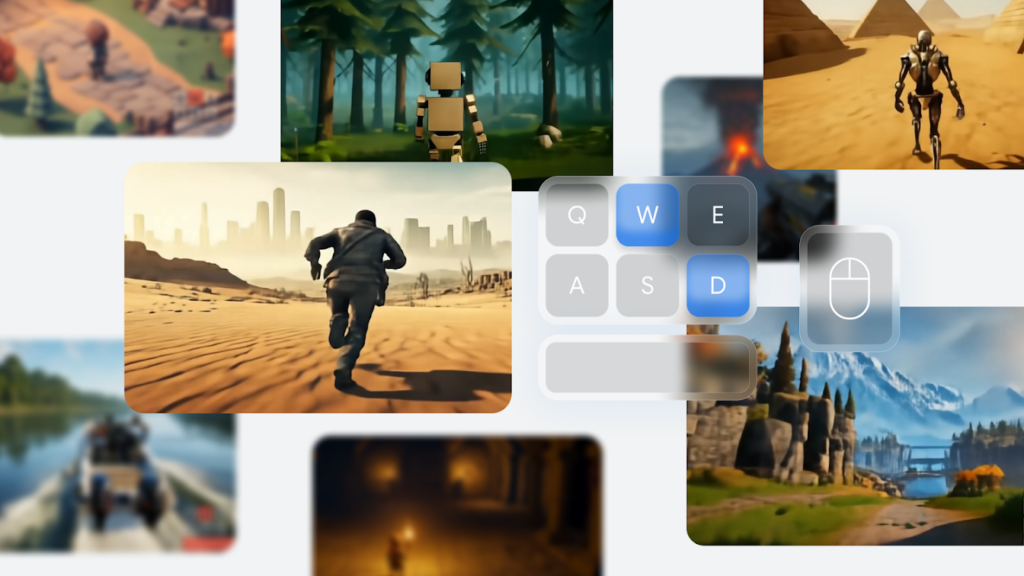
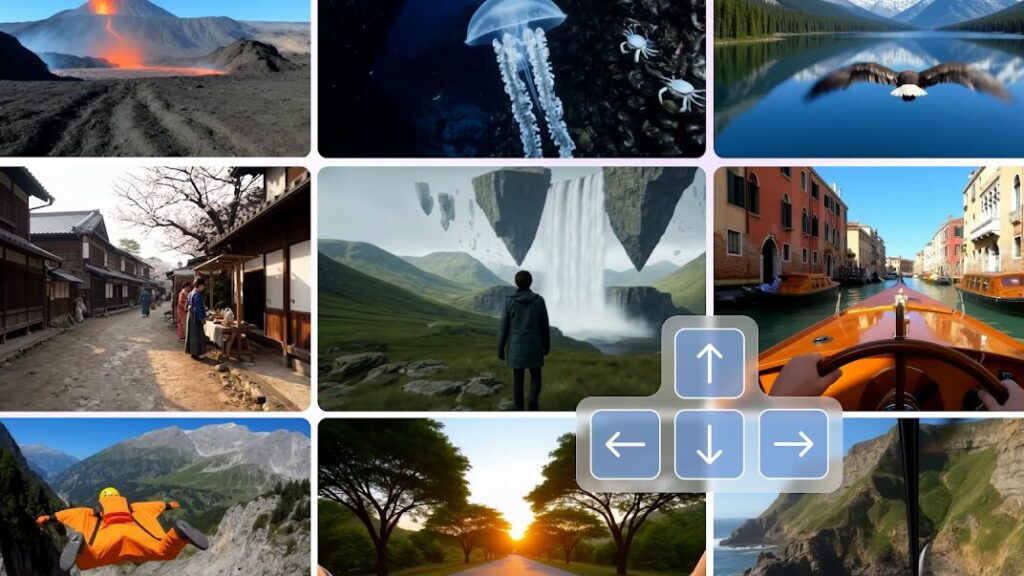
Navigation follows standard PC gaming conventions: WASD keys for movement, the spacebar for jumping or ascending, and arrow keys or the mouse for camera control. The world generates dynamically based on the user’s position, maintaining relative consistency if the user doubles back. While the model understands basic physics, inconsistencies like walking through walls can occur. Currently, interaction is limited to movement; users cannot pick up objects or trigger complex game logic. Sessions can be recorded and downloaded as video clips.
How to remix and share Project Genie worlds using the Project Genie gallery
The Project Genie gallery contains curated and random worlds that users can explore or “remix.” Remixing allows a user to take an existing prompt and modify it to create a new variant. While interactive worlds cannot be saved or shared directly for multiplayer use, users can download 60-second recordings of their sessions to share elsewhere. This creates a collaborative environment where users learn from each other’s prompting techniques.

Project Genie limitations like time limits, consistency, and latency
Current limitations include a 60-second session cap, 720p resolution, and noticeable control latency. The model often struggles with photorealism and precise prompt adherence, sometimes producing distorted geometry or nonsensical text. Environments are relatively static without complex NPC AI or evolving narratives. Additionally, the tool is strictly single-player and lacks persistent world states.
Can Project Genie create worlds with copyrighted characters and IP
Google has implemented strict guardrails to prevent the generation of copyrighted intellectual property. Following a 2025 cease-and-desist from Disney, the filters have become particularly sensitive, often blocking prompts that even indirectly reference popular franchises. While the model may have the technical capacity to recognize IP from its training data, safety policies ensure that recognizable characters or trademarked settings are sanitized or refused.
Project Genie copyright takedowns and IP enforcement concerns
The emergence of Project Genie has caused concern among traditional game publishers, leading to stock price fluctuations for companies like Roblox and Unity. There is ongoing legal debate regarding whether AI models trained on copyrighted data infringe on the rights of creators. Google manages this by moderating the public gallery and enforcing strict content policies to avoid the distribution of unauthorized derivative works.
Google Project Genie safety and responsibility guidelines for generated worlds
Google follows specific safety principles by filtering out NSFW content, graphic violence, hate speech, and the likenesses of real people. The tool is gated by age and subscription status to ensure responsible use. As an experimental prototype, Project Genie includes transparency labels and is being rolled out gradually to gather user feedback while monitoring for potential misuse. Users are expected to follow terms of service that prohibit the creation of harmful or illegal content.
What Project Genie means for game development and rapid prototyping
Project Genie is generating significant interest in game development by potentially accelerating environment design through AI. It enables rapid prototyping, allowing designers to transform a paragraph description into a playable 3D mock-up in minutes. This immediate visualization of ideas like “foggy swamps” or “desert temples” helps iterate on mood and scale, potentially shortening development cycles and reducing costs.
The technology is seen as an augmentation for designers and artists rather than a replacement. It can generate base worlds for reference or import into engines like Unity for final polishing. This democratizes creation, empowering indie or solo creators to build high-quality assets and levels, though it may also increase market saturation with AI content.
Beyond visuals, Project Genie hints at new genres where worlds are “dreamed” in real-time, creating unique, unpredictable playthroughs. It is also a tool for training AI agents in varied simulated environments safely. While there are fears of job displacement, industry experts suggest roles will shift toward creative curation. Integration with engines like Unity and Unreal could further streamline workflows, reducing the 5–7 year development time of big-budget games by 20–30%. This shift is considered a major paradigm change, similar to the move to 3D graphics.
Project Genie vs Roblox real-time dreaming world models comparison
Google’s Project Genie and Roblox’s “real-time dreaming” both aim for AI-generated worlds but differ in execution. Roblox’s concept allows for mid-session, natural language modifications—such as adding a tsunami or a boat while playing—whereas Genie currently generates a world once per session.
Genie is currently a prototype available to AI Ultra subscribers, while Roblox’s version is in the research and internal demo phase. Geographically, Roblox targets its existing community to streamline creation within its platform, using its “Cube” and “4D” models to generate functional code and interactive objects. Genie focuses more on holistic simulation and artistic 720p video streaming.
While Roblox positions AI as a collaborative assistant for millions of creators, Genie operates as a more autonomous generation tool for standalone use. Both share the vision of lowering barriers to 3D creation through natural language but face similar challenges regarding output control, performance, and content filtering.
World models and why Google DeepMind is investing in interactive simulations
Project Genie is part of DeepMind’s broader research into “world models,” which are AI systems that simulate environment dynamics and predict how actions affect a scene. These models are considered essential for achieving Artificial General Intelligence (AGI) because they allow AI to learn from interaction rather than just static data.
Genie 3 represents an advancement from previous versions, offering real-time interactivity, better memory, and improved consistency. Google, along with competitors like Meta (Habitat), World Labs (Marble), and Runway, is investing in this tech for robotics, autonomous vehicles, education, and science. These simulations provide a safe, cheap environment to train agents and ensure AI safety by testing behaviors before real-world deployment.
Best use cases for Project Genie in education, storytelling, and concepting
Project Genie has diverse applications beyond gaming:
- Education: Teachers can create virtual field trips to historical sites like ancient Rome or environments like the surface of Mars, allowing students to explore actively.
- Storytelling: Writers can visualize fictional settings or create dynamic storyboards. It can also act as a visual aid for tabletop RPGs.
- Concepting: Artists can brainstorm skylines or explore moods. It can generate environments around reference photos.
- Pre-visualization: Filmmakers can test camera angles and blocking using simple prompts.
- Therapy/Training: It can generate personalized environments for meditation or specialized training scenarios like warehouse fires.
- Creative Play: Users can engage in improv storytelling or remix community worlds.
A comparison is made to “Pixelhair” (a library by Yelzkizi for Blender/Unreal), noting that while handcrafted libraries provide high-quality static assets, AI provides dynamic generation for rapid concepting.
How to remix and share Project Genie worlds using the Project Genie gallery
Project Genie includes a Gallery where users can explore curated worlds and view the specific prompts used to create them. Key features include:
- Remixing: Users can take existing prompts and modify them (e.g., changing a surfboard to a dolphin) to generate new interpretations.
- Randomizer: A tool for discovering unexpected world combinations.
- Downloading: Users can save 60-second MP4 videos of their interactive sessions.
- Community Sharing: Prompts and screenshots can be shared on platforms like Reddit or Discord.
- Etiquette: Users are encouraged to credit original creators when remixing and to be transparent about the use of AI.
This collaborative cycle allows the community to discover the full potential of the technology through iterative improvement.
Frequently Asked Question(FAQS)
1. Who can access Project Genie, and how much does it cost?
Project Genie is currently available only to Google AI Ultra subscribers in the U.S. (18+). Google AI Ultra is a premium Google One subscription plan costing approximately $249.99 per month, though new users may receive a 50% discount for the first three months. Ultra subscribers can access it via Google Labs at no extra charge. It is currently limited to personal accounts and is not yet available for business accounts or users outside the U.S.
2. Do I need any special hardware or software to use Project Genie?
No special hardware like gaming PCs or VR headsets is required. It runs as a web-based app in modern browsers via Google Labs. Processing occurs on Google’s cloud servers using dedicated AI chips. A stable, high-speed internet connection is recommended for streaming the 3D video. A keyboard (using WASD keys) is necessary for controls, making desktops or laptops the ideal devices.
3. Do I need to know how to code or do 3D modeling to use Project Genie?
No. The tool uses natural language prompts in English (or other supported languages). Users type descriptions of the world and characters, and the AI generates the interactive environment. It is designed for both developers, who may use it for prototyping, and non-developers using it for creative fun.
4. How long can I explore a generated world? Can I extend the time limit?
Sessions are currently limited to a maximum of 60 seconds of real-time exploration. This limit is fixed and cannot be extended in the current prototype due to high computational costs and the potential for model inconsistency over longer durations. Users must re-generate a world to continue exploring.
5. Can I save or revisit a world I liked?
You cannot save the interactive state of a world to return to it later. However, you can save a 60-second video recording of your session. To revisit a similar world, you must reuse the exact text prompts. While the re-generated world may have procedural variations, the theme will remain consistent with the prompt.
6. What kind of content is off-limits or filtered in Project Genie?
Google enforces strict safety filters. The AI will not generate:
- Nudity or sexually explicit content.
- Extreme violence or realistic gore.
- Hate symbols, hate speech, or extremist propaganda.
- Copyrighted characters or trademarked IP (e.g., Disney or Marvel).
- Likenesses of real people.
7. Can I use famous characters or real places in my prompts at all?
Names of famous fictional characters are generally blocked or result in generic outputs. Likenesses of real people are also restricted. Real-world public locations and landmarks are usually acceptable, though AI approximations may vary in accuracy. Fictional locations that are protected IP (like Hogwarts) may be filtered, so using generic descriptions is recommended to achieve a similar vibe.
8. Will AI tools like Project Genie replace human game developers and artists?
Experts view these tools as assistive rather than replacements. While Genie can automate environment generation and speed up prototyping, human designers are still required for complex design, narrative, balancing, and artistic polish. Roles may evolve toward curating and refining AI outputs, but human creativity and technical oversight remains essential.
9. When will Project Genie be available in my country / to more users?
Google plans to expand access “in due course,” likely starting with other English-speaking regions. Expansion depends on the availability of the Google AI Ultra subscription in those territories and compliance with local regulations. There is currently no specific timeline for a wider or free release.
10. What improvements or new features can we expect for Project Genie in the future?
Anticipated enhancements include:
- Real-time events that change the world during exploration.
- Longer session durations and improved consistency.
- Higher visual fidelity, such as 1080p resolution and better photorealism.
- Improved character physics and more responsive controls.
- Potential multi-user support and advanced integration with other Google AI tools like Gemini.
- Enhanced editing tools for creators to lock or tweak specific elements.

Conclusion
Project Genie is a Google DeepMind tool that generates interactive 3D worlds from text or image prompts via the Genie 3 model. Currently limited to U.S. Google AI Ultra subscribers, it allows users to navigate AI-generated environments for up to 60 seconds. While a significant shift toward “playable” AI media, it remains a prototype with limitations in resolution, session length, and character control.
Google maintains strict safety and copyright guardrails to prevent the infringement of intellectual property and the generation of inappropriate content. The tool’s emergence has impacted the gaming industry, with platforms like Unity and Roblox acknowledging the shift toward AI-assisted creation. Beyond gaming, Project Genie has potential applications in education, concept art, and training AI agents for AGI development. Ultimately, it represents a step toward democratizing world-building and human-AI co-creativity.
Sources and citation
- Reuters – “Videogame stocks slide on Google’s AI model that turns prompts into playable worlds” (Zaheer Kachwala, Jan. 30, 2026)
- Google DeepMind Blog – “Project Genie: Experimenting with infinite, interactive worlds” (Diego Rivas, Elliott Breece, Suz Chambers, Jan. 29, 2026)
- 9to5Google – “Google rolling out ‘Project Genie’ to generate playable worlds” (Abner Li, Jan. 29, 2026)
- TechCrunch – “I built marshmallow castles in Google’s new AI-world generator” (Rebecca Bellan, Jan. 29, 2026)
- The Verge – “Roblox calls its take on AI world models ‘real-time dreaming’” (Jay Peters, Feb. 4, 2026)
- The FPS Review – “Google’s Project Genie AI May Be an Avalanche in the Making for Game Publishers” (Peter Brosdahl, Feb. 3, 2026)
- Google DeepMind Blog – “Genie 3: A new frontier for world models” (Jack Parker-Holder & Shlomi Fruchter, Aug. 5, 2025)
- Labellerr – “Genie 3 by Google DeepMind Is Not a Video Generator, It’s a World Model”
- Reddit Discussion – r/GeminiAI thread discussing Project Genie and Google AI Ultra pricing
- Tom’s Guide – “Google AI Ultra: Everything in the $250/month subscription”
Recommendations
- Big Game Pass Rumor: Possible New Tier of Xbox Game Pass Codenamed Triton
- Modders Can’t Be Stopped: Play the Entirety of Morrowind Inside Fallout 4’s Pip-Boy (and Fallout 1 Is Next)
- Marvel Rivals Devil Dinosaur Move Set Breakdown and Tips: Abilities, Combos, and Pro Gameplay Guide
- Developers With Foreign Legal Entities May Be Allowed to Include Games in the Russian Software Registry: Requirements, VAT Benefits, and What Changes in 2026
- ‘One Fateful, Horrifying Night’: Here’s the First Trailer for the Resident Evil Movie — Feedback, Reactions, and Everything We Know (2026)
- Scientists Make Breakthrough That Allows Lab-Grown Brain Cells To Play A Sort Of Video Game (UC Santa Cruz Cart-Pole Results Explained)
- Best New Anime to Watch Right Now (2026): Trending Series, Hidden Gems, and Must-Watch Releases
- Absolute Batman Drops Three of Its Biggest Twists Yet as the Dark Knight’s World Crumbles
- Deep Dive Into the Behind-the-Scenes Creation of Avatar: Fire and Ash
- Devil May Cry Season 3 Reportedly Greenlit at Netflix: Release Rumors, Production Details, and What it Means for the Anime Future



































































































