











In This Article (8 sections)
Grok Build Exposure: Claroc’s Investigation, Public Apps, and Sensitive Data Findings
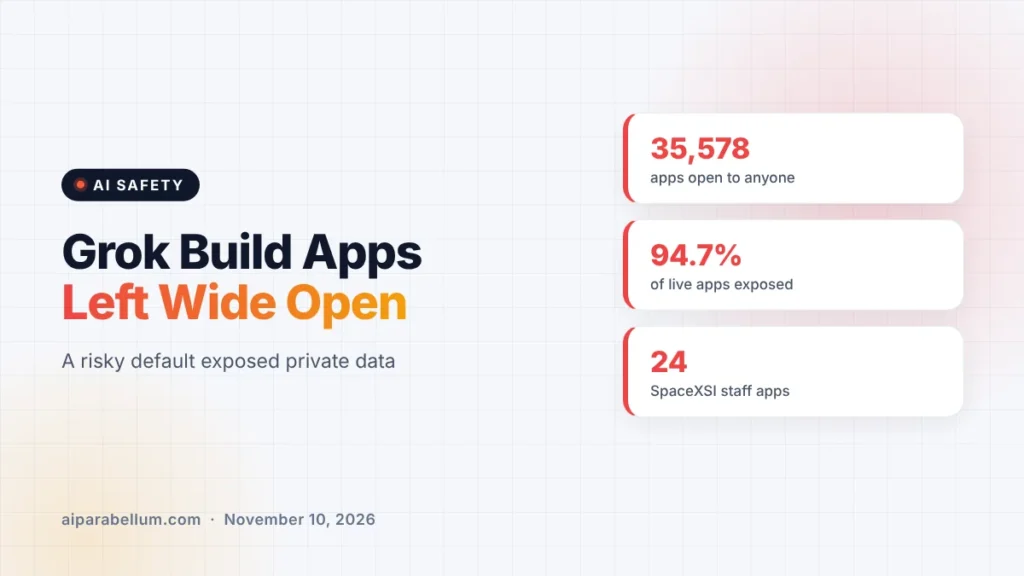
The Grok Build privacy exposure came into focus on November 8, 2026, when researchers from security firm Claroc accessed a published application intended to guide a new member of SpaceXSI’s enterprise sales team through their first month. The onboarding plan identified colleagues the employee should meet, internal chat channels, and systems needed for the role. Although the document carried a confidentiality label, the researchers could open it without an invitation or identity verification. It was one of 35,578 published Grok apps that Claroc found accessible without sign-in.
Most were ordinary games, calculators, or landing pages, but a smaller group exposed information intended for identifiable private audiences. Examples included a SpaceXSI sales map covering 594 strategic accounts, an X advertising proposal for a federal agency, employee directories, customer information, and an intensive-care briefing concerning one patient. Claroc established that outside researchers could read these materials, although the available evidence does not identify everyone else who may have accessed them.
Claroc investigated applications created through the builder integrated into Grok chat. The feature allows creators to describe software in ordinary language, generate a working application within the conversation, and publish it as a website accessible outside the original chat. SpaceXSI promoted this capability for projects ranging from games and calculators to dashboards connected to business information. Once published, an application receives a web address that can be opened independently of the conversation in which it was developed. This publishing mechanism made the sales onboarding plan and other applications accessible to Claroc’s researchers. The investigation focused on what those published websites returned to visitors who had not signed in or received invitations.
The researchers loaded the first page of each identified application while signed out and examined saved copies offline. This approach provided a consistent way to determine whether a website disclosed information to an unauthenticated visitor. In some cases, a single page was enough to reveal employee records, internal planning material, or customer information. Other data might have required navigation to additional screens or passed through separate access controls that the initial test did not examine.
The findings therefore describe what was accessible during the researchers’ checks rather than every possible function or record within each application. Claroc also created two applications containing fictional records to investigate whether unauthorized visitors could change or delete information. Those experiments were limited to applications and data controlled by the researchers, keeping the demonstrated ability to modify records separate from the exposure of real organizations’ information.
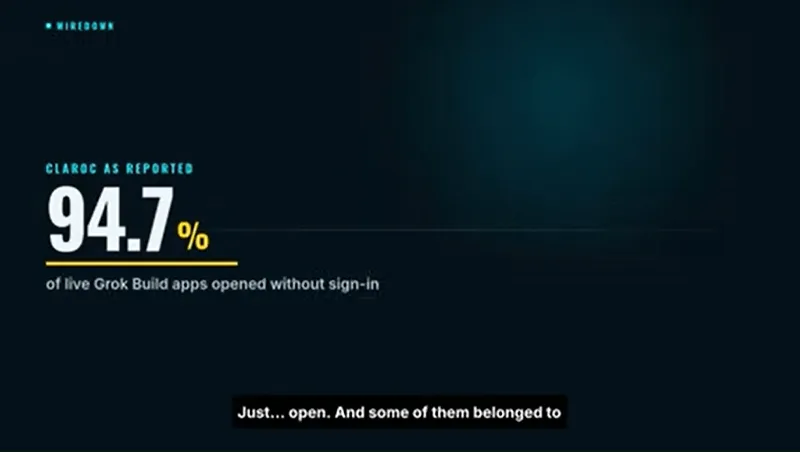
Claroc attempted to access 43,551 application addresses and identified 37,571 that were live during its checks. Of those live applications, 35,578 opened without sign-in, representing approximately 94.7%. The remaining 1,993, or about 5.3%, returned an HTTP 401 response indicating that the signed-out request was rejected. The widely reported 94.7% figure therefore uses live applications rather than every attempted address as its denominator. Each application contributed one entry regardless of whether it contained a harmless game or a sensitive record involving thousands of people. Several applications could also belong to one organization, while multiple records within a single application could concern the same individual. The result measures website accessibility, not the number of affected employees, customers, organizations, or unique creators.
The scope of the investigation places further limits on the findings. Claroc examined application addresses it could identify and reach during the relevant period. Unpublished drafts were not included, and applications removed before the researchers reached them could no longer reveal their earlier contents. The percentage consequently describes a substantial population of published applications at a particular time rather than every application ever created with Grok. It also does not establish that the majority of accessible apps represented inappropriate disclosures.
Public accessibility is useful for many of the purposes the builder was designed to support, including social games, promotional pages, and calculators intended for general audiences. The privacy concern arises when a publicly accessible application contains information that should be restricted to employees, customers, or other authorized users.
Claroc distinguished open applications from those containing apparently private information through a separate assessment of their contents. The firm estimated that approximately one in ten accessible applications contained internal business information or personal data, equivalent to roughly 3,500 apps. It judged around 2% to contain material serious enough for a high or critical severity rating. The Cloud Security Alliance interpreted Claroc’s estimate of 650 to 800 applications as the size of that narrower group and explicitly stated that it had not independently verified the totals.
These categories overlap, meaning the more serious exposures are part of the broader group rather than additional applications that should be counted separately. The estimates also involve more judgment than the accessibility figures because determining whether information is sensitive requires understanding its context and intended audience.
Claroc used an AI model to flag apparently private material, manually reviewed flagged applications, and compared the automated judgments against a random sample examined by people. That process explains why the sensitivity estimates were expressed as approximate totals rather than exact counts. The researchers also associated exposed internal information with 30 organizations beyond SpaceXSI and X. Twenty-six of those organizations had more than 1,000 employees, and six were Fortune 500 companies. These figures demonstrate that identifiable examples involved large employers as well as smaller organizations. However, they do not establish how many additional businesses were represented in applications whose ownership could not be determined.
The distinction between public content and private information is particularly important for applications whose interfaces appear ordinary. A landing page announcing an event may appropriately display its date, venue, and public contact details. An event application containing a searchable hospital employee directory raises a different privacy concern, even if its title suggests the same general purpose. A dashboard built with fictional figures may be suitable for public demonstration, while one populated with customer names, commercial margins, or internal performance targets may not be. The interface itself does not determine whether publication is appropriate. What matters is the information it displays, the audience authorized to receive it, and the actions a visitor can perform.

SpaceXSI and X Business Records, Employee Information, and Other Exposed Applications
One of the most detailed examples was a SpaceXSI enterprise sales map containing 594 strategic accounts across six territory groupings. Claroc’s redacted image showed a North Central territory dashboard with account priorities, territory scores, and a summary identifying 154 entries as “hot pipeline.” The researchers concealed account names and cities while retaining enough of the interface to demonstrate its commercial purpose. The exposed material was significant because an internal sales map can reveal how a company evaluates prospective customers rather than simply identifying organizations that may already be publicly known.
A potential buyer’s name is one piece of information, while the seller’s decision to classify that buyer as a priority opportunity is another. Displaying hundreds of accounts together also reveals how the sales organization divides its attention across territories and assesses potential opportunities.
The numbers in the sales map require careful interpretation. An account can enter a pipeline before negotiations produce a signed agreement, and a priority score reflects an internal assessment rather than a confirmed purchase. The 594 accounts therefore should not be treated as 594 paying customers or completed deals. Likewise, the 154 hot-pipeline entries demonstrate a sales classification without establishing the contracts or revenue that followed. The dashboard provides evidence about SpaceXSI’s enterprise sales strategy, including account organization and prioritization. It does not reveal the eventual outcome of every opportunity. This distinction is also necessary when interpreting the advertising proposals and spending targets found in other published applications.
Claroc identified eight X advertiser-facing materials, including proposals, media plans, and presentation decks. One prominent example was an advertising proposal prepared for an unnamed U.S. federal agency. Its budget section recommended a mixture of placements associated with UFC, college football, and ongoing video advertising. Another part of the presentation described options for a larger advertising budget. Claroc redacted financial amounts and details identifying the recipient, preserving evidence of the proposed media strategy without publicly exposing those particulars.
The document showed how X presented advertising opportunities to a prospective customer, but it did not establish that the agency approved the plan, purchased placements, or made payments. The available evidence also does not support identifying the agency through speculation about the proposal’s contents.
Other exposed X applications represented different stages of advertising operations. Claroc identified four account boards displaying campaign spending, including one that tracked progress toward a $1.6 million sales goal. It separately counted seven campaign reports involving advertisers in Brazil, Japan, Korea, and Thailand. Two copies of an internal brand-safety playbook were also among the identified materials. The $1.6 million figure belonged to an account board’s sales target and should not be attributed to the federal agency proposal. These examples show how different applications could expose proposed spending, campaign monitoring, and internal advertising procedures. They also demonstrate why examining an individual page’s purpose is necessary before interpreting a financial figure as an actual commercial transaction.
Employee information appeared in several applications unrelated to the SpaceXSI and X sales examples. A hospital group’s staff event application contained a searchable directory covering more than 3,500 employees. A trucking company’s recruitment list included legal names and personal email addresses for more than 1,000 people. Such information can reveal more than the purpose of an event or recruitment exercise because a searchable directory may allow outsiders to identify employees and contact details that were intended for a narrower audience.
The consequences depend on the fields involved and how those records were originally meant to be used. The number of entries is useful for understanding the scale of potential exposure, but it does not establish how many people actually accessed or misused the information. Each application must be assessed according to the records it made available.
An intensive-care briefing concerning a single patient illustrated why record counts alone can be misleading. The application contained information about laboratory findings, imaging, and ventilator status. Although the briefing concerned one individual rather than thousands of records, it contained highly personal medical information. Its potential sensitivity came from the nature of the information rather than the number of people represented. This example demonstrates why an application with one detailed private record can warrant more serious attention than a much larger collection of ordinary public information. It also reinforces the need to evaluate application contents rather than treating every accessible website as equally consequential.
Other examples involved customer and commercial records. Ars Technica reported a homebuilder’s sales sheet containing information about approximately 583 prospective buyers, including budget and financing notes. A vehicle-transport quoting application contained around 4,000 orders with prices and margins. For prospective homebuyers, the sensitive information could include a salesperson’s assessment of their financing circumstances or purchasing budget. For the transport company, the records could reveal customer transactions and the margins the business expected to earn. These exposures consequently involved both personal information and commercially meaningful data. They differed from public marketing pages because the records appeared to document operational relationships and internal assessments rather than information prepared for unrestricted distribution.
A contractor’s timesheet application introduced another form of exposure by including readable passwords in code delivered to visitors’ browsers. Claroc identified 18 accounts with exposed credentials, including administrator credentials, and stated that its researchers did not use those passwords. Nevertheless, a copied password could remain usable after the application displaying it was removed. This creates a different remediation requirement from an ordinary roster disclosure. Restricting or unpublishing the page would prevent subsequent visitors from retrieving the credentials through that address, but it would not invalidate passwords already obtained. Replacing the exposed credentials and examining their usage would therefore address risks that removing the application alone could not resolve.
Together, the examples show several distinct categories of sensitive information rather than one uniform type of exposure. Internal sales dashboards revealed commercial priorities, advertising materials disclosed proposed campaigns and spending targets, and employee lists exposed identifiable personnel information. Customer records contained transaction details, budgets, financing notes, prices, and margins, while the medical briefing involved intimate information about one patient.
The timesheet demonstrated the additional risk created by credentials embedded in material sent to browsers. These differences matter because each category requires its own assessment of who should have had access, what information was available, and which corrective steps are appropriate. The common problem was that published applications delivered information to visitors outside their intended audience without consistently enforcing the necessary restrictions.
Grok Build Publishing Settings, Link-Based Access, and SpaceXSI’s Response
Claroc’s testing examined how Grok Build handled publication and audience selection. In the paid account used by the researchers, creating an application in chat did not automatically publish it. The creator had to proceed through a publishing process that included selecting an audience for the resulting website. The available choices were “Anyone with the link,” “Invited users,” and “Only you,” with the first option already selected during Claroc’s test. The researchers accepted that suggested audience for their two fictional applications. Their finding therefore concerned the access setting presented when publishing from that account, rather than a claim that every draft became publicly accessible immediately after creation.
The researchers also examined whether changing those settings affected access. When they switched their fictional contact-list application to owner-only access, an outside visitor received a rejection from both the page and the function supplying its data. When they unpublished their other test application, its address stopped serving the application within seconds. These observations showed that narrower controls and unpublishing could prevent the access demonstrated during their experiments.
However, the researchers’ experience did not establish that every account had the same initial audience setting. Optimus Labs reported a different result on November 12, finding that an application published using the default settings on its own account did not become accessible to everyone holding the link. Its researchers could not determine whether the difference resulted from account configuration or a change in the product over time.
The meaning of “Anyone with the link” is important because it does not restrict access to the people who originally received the address. A sales manager might send a dashboard link to three colleagues, but a link-based permission does not necessarily limit the website to those three readers. Someone receiving a forwarded copy could obtain the same access if the application did not enforce additional controls.
A public welcome page can still protect its underlying records through separate authentication and authorization requirements. However, Claroc’s fictional four-person sales application demonstrated that having a login screen was not enough. An uninvited account could sign in and access the test customer list because the generated application did not correctly enforce the intended team boundary. The demonstration involved only fictional data controlled by the researchers.
Authentication and authorization address different questions. Authentication establishes the identity associated with a visitor, while authorization determines whether that person can view or modify a particular record. A public page introducing a service, an invited customer viewing their own information, and an employee editing an entire customer database require different permissions. A valid login should not automatically provide unrestricted access to every function. In a generated application, the relevant checks need to apply to the specific data and action being requested. Claroc’s test demonstrated why a creator should not assume that an application is private merely because it displays a sign-in option.
An unlisted application address can also become discoverable without appearing on the creator’s public profile or in website navigation. Links can be forwarded, included in shared documents, or handled by services involved in opening websites. Each published Grok application had its own hostname, meaning ordinary internet infrastructure could record the corresponding address when someone visited it. The domain name system, or DNS, helps browsers locate websites, and some services retain observations of the names being requested.
Such records can make an application address discoverable even when the creator has not promoted it publicly. However, a hostname lookup does not establish who read the page or what information appeared on their screen. That distinction is why Claroc’s saved copies of accessible pages provided stronger evidence of disclosure than address discovery alone.
SpaceXSI’s response introduced an important disagreement about the audience settings shown during publication. A Cursor representative told Ars Technica that applications began privately and that creators had to choose to share them before they became public. The described process required selecting an address, reviewing access, accepting a legal notice, and confirming publication. SpaceXSI also said employee accounts started with owner-only access, meaning employees would have needed to widen the audience before making applications available by link.
Claroc agreed that drafts created in chat were not automatically published. The disputed question was which audience setting was selected when users proceeded through the publishing process. Claroc’s paid account, the employee-account settings described by SpaceXSI, and Optimus Labs’ later test therefore represent different observations or claims that cannot automatically be treated as identical.
The public reporting does not establish which publishing settings appeared to each employee responsible for the exposed staff applications. It also does not identify whether individual creators actively changed an owner-only selection or accepted a suggested public audience. The distinction matters because the presence of an accessible page establishes its effective availability, not necessarily the sequence of choices that produced it. Product naming also became part of the public response.
Grok’s public account disputed the terminology used in some coverage, saying the findings concerned the app builder on the Grok website. SpaceXSI’s August announcement had described the in-chat feature as Grok Build on web and mobile. Claroc’s findings concerned websites published through that chat-based feature, while the separately named terminal coding tool was outside the investigation.
Claroc initially notified SpaceXSI on November 8 about two staff applications: the enterprise sales onboarding plan and the federal advertising proposal. On November 9, it reported another 22, bringing the identified SpaceXSI and X staff applications to 24. Ars Technica reported that the applications were still exposing information on Monday evening and that removals began within hours of the publication emailing questions.
By the time the November 10 article appeared, all 24 addresses returned an “app not found” message. This confirmed that fresh visitors could no longer retrieve the applications through those reported addresses. It did not establish whether earlier visitors had retained copies of the information or what had happened to the source records used to build the applications. Those questions remained separate from the successful removal of the published pages.
The response involving other organizations followed a different timeline. At publication, Claroc said applications belonging to other users remained accessible and that the firm had begun contacting identifiable organizations directly. It had emailed three organizations by that stage. Ars Technica later described one specific response involving a cruise company that reportedly engaged its security team after receiving Claroc’s findings. The available reporting did not establish the eventual status of every third-party application identified during the investigation. It also did not confirm how many remained accessible as of November 23, 2026. The removal of the 24 SpaceXSI and X staff applications therefore should not be interpreted as evidence that every exposed application across the broader dataset had been secured.
How Grok Build Creators and Businesses Can Review Exposure, Secure Apps, and Investigate Access
Creators concerned about published Grok applications can begin by reviewing the audience setting associated with each deployed website. The selected audience should match the people who genuinely need access to the information and functions provided. For an individual working draft, “Only you” is the appropriate restricted option identified in Claroc’s test. For an internal team application, “Invited users” can provide a narrower audience where that setting is available. An application that is no longer needed can be unpublished rather than left accessible indefinitely. These changes must be made to the deployed application itself because conversation-sharing settings govern a different object. A private chat does not automatically establish that a website published from it is restricted.
After changing an application’s audience, the creator should verify the result from both authorized and unauthorized perspectives. Opening an owned application’s address in a signed-out browser can reveal whether internal material remains visible without authentication. For an invited team, a designated test account outside the invitation list can help establish whether simply signing in grants unintended access. An authorized colleague should also confirm that the narrower settings still permit legitimate work. These tests examine the practical behavior of the deployed application rather than relying solely on what the publishing panel displays. Claroc’s fictional applications demonstrated that changing access settings could block outside visitors, but creators still need to confirm the controls on their own deployments.
Access reviews should also be repeated when an application’s purpose or information changes. A calculator created using sample prices may initially be suitable for public sharing. If it later connects to actual customer quotes, names, or commercial margins, the original audience may no longer be appropriate. An event page might similarly become more sensitive after someone adds a searchable employee directory. The fact that an application already works can make these changes easy to overlook. Reviewing permissions when real data first enters the system helps identify the point at which a harmless prototype becomes a potential disclosure. The same principle applies when an application gains new functions that allow users to modify records rather than simply view information.
Businesses investigating a possible exposure should identify the person who published the application, the owner of the underlying information, and the period during which real records were available. Those responsibilities may belong to different teams. A sales employee may understand the application’s publishing settings, while sales operations can establish whether displayed figures were fictional, historical, or current. Combining that knowledge helps determine when a demonstration became a potential disclosure of private business information. If an application is still providing unauthorized access, restricting or unpublishing it promptly addresses the immediate availability of the material. Preserving relevant settings and available logs can also support the subsequent investigation.
The next step is to establish what information the application actually sent to visitors. An internal table might have been copied directly into the published app, or a connector might have retrieved changing information from another service. These designs affect both the potential duration of exposure and which records may have been involved.
A static copy can continue showing information that has since changed in the original system, while a connected application may expose more recent records as they are retrieved. Investigators should also check whether browser-delivered code or downloadable content contained credentials. If passwords or API keys were exposed, replacing them and examining their usage is necessary because removing the application cannot invalidate copies already obtained. These are separate remediation tasks from changing the website’s audience setting.
Claroc’s investigation established that outside researchers accessed sensitive information through published applications. The researchers described retrieving first pages, saving copies, and producing redacted images of the material they examined. The SpaceXSI sales map image preserved account counters and priority indicators, while the federal advertising proposal image showed the structure of a recommended media package. Those details demonstrate that the applications delivered intelligible internal business information to visitors who were not part of the intended audience.
Claroc also said it did not use exposed credentials or submit forms through third-party applications. Its experiments involving unauthorized changes and deletions were confined to fictional records in applications the researchers owned. The public evidence therefore establishes disclosure to the researchers without establishing that they altered real organizations’ records.
The larger unanswered question concerns whether other parties accessed or misused the exposed information. Reporting reviewed through November 23, 2026, did not establish that criminal groups obtained the records, competitors examined the sales pipeline, or anyone used the exposed passwords. The absence of that evidence does not eliminate the demonstrated exposure, but it limits what can responsibly be claimed about its consequences. Hosting logs might show requests made while an application was accessible, while application records could reveal whether a particular account viewed or changed information.
Where visitors were anonymous, even a successful request might not identify the individual responsible. Investigators therefore need to distinguish between an application being reachable, a request being recorded, information being delivered, and a confirmed harmful action. Each represents a different level of evidence.
Organizations communicating the results of an investigation should preserve these distinctions. They may know that a customer list was accessible for several days without knowing who viewed it. They may have records of successful requests without enough information to attribute them to specific people. They may also establish that credentials were exposed without finding evidence that anyone used them.
Documenting those facts separately gives staff, customers, and business partners a more accurate understanding of what occurred. It also helps internal teams select appropriate corrective actions without exaggerating or minimizing the findings. The Grok Build investigation ultimately illustrates why publishing controls, application-level permissions, and independent verification must work together, particularly when tools originally built for experimentation begin handling real operational information.

Frequently Asked Questions (FAQs)
- Did creating an app in a Grok conversation automatically put it online?
No, creating an application inside a Grok conversation did not automatically make it publicly accessible. Claroc and SpaceXSI agreed that users had to complete a publishing process before their applications became available as websites. Their disagreement concerned the audience setting presented during that process. Claroc found that “Anyone with the link” was already selected in its paid test account, while SpaceXSI said employee accounts started with owner-only access. This distinction matters because someone who created an experimental application but never published it would not have exposed it through the public website mechanism examined in the investigation. - Were 35,578 people affected by the Grok Build exposure?
No, the figure of 35,578 refers to published applications that Claroc could open without signing in, not the number of people affected. Individual applications contained very different kinds and amounts of information. Some were harmless games or calculators, while others included employee directories, customer records, or sensitive information about a single patient. One hospital-related application, for example, contained a searchable roster of more than 3,500 employees. Claroc did not provide a deduplicated count of individuals represented across the exposed applications. Consequently, the number of affected people cannot be determined directly from the application count. - Why do reports mention both 3,500 apps and 650 to 800 apps?
The figures describe different levels of potentially sensitive information identified during Claroc’s investigation. Approximately 3,500 applications represented the broader estimate of publicly accessible apps containing some personal information or internal business data. The smaller range of 650 to 800 referred to applications estimated to contain material serious enough for a high or critical severity rating, as interpreted by the Cloud Security Alliance. Those more serious cases were a subset of the broader group rather than additional applications. Both estimates involved automated classification, human review, and judgment about the sensitivity of the material. They should therefore be treated as approximations rather than exact counts of confirmed security incidents. - Were all 594 organizations on the SpaceXSI map paying customers?
The available evidence does not establish that all 594 organizations were paying SpaceXSI customers. Claroc identified a territory dashboard containing 594 strategic accounts distributed across six groupings. The interface included account priorities, territory scores, and a summary marking 154 entries as “hot pipeline.” These labels describe how the sales team organized and evaluated potential business opportunities. An organization can appear in a sales pipeline before signing a contract or generating revenue. Since Claroc redacted account names and the published image did not establish individual contract status, the map should be understood as evidence of sales planning rather than a verified customer list. - Was the $1.6 million figure the price of the federal advertising proposal?
No, the $1.6 million figure belonged to a separate X advertiser account board that tracked progress toward a sales goal. Claroc identified several advertising-related applications, including account boards, campaign reports, and presentation materials. The federal agency proposal was a different document describing a recommended advertising mix involving UFC, college football, and ongoing video placements. It also contained options for a larger advertising budget, but Claroc redacted the financial amounts and details identifying the agency. The public evidence therefore does not establish the proposal’s actual price or whether the agency purchased any advertising. Connecting the separate $1.6 million target to the federal proposal would incorrectly combine information from different applications. - Could someone change records in every app that opened?
No, Claroc did not establish that every publicly accessible application allowed unauthorized visitors to modify records. Its large-scale investigation focused on whether the first page of each application could be opened without signing in and what information that page delivered. The researchers separately tested editing and deletion behavior using two applications containing fictional records that they created and controlled. Those experiments demonstrated weaknesses in the tested applications, including insufficient enforcement of intended access boundaries. However, they did not establish that the same permissions existed in every application belonging to other users. Access to view information and permission to change database records are separate security questions that require different tests. - Did a restrictive Grok setting work when researchers selected it?
Yes, Claroc observed effective access restrictions when it changed its fictional contact-list application to the “Only you” setting. After that change, an outside visitor was denied access to the published page. The function responsible for supplying the application’s data also rejected the unauthorized request. This demonstrated that the restrictive setting could protect both the interface and its underlying information in the researchers’ test. Claroc also found that unpublishing another test application stopped its address from serving the application within seconds. These results provide useful reference points for owners, although they should still verify the behavior of their own applications after changing permissions. - Did SpaceXSI remove all the apps in Claroc’s report?
The documented removal covered 24 applications created by SpaceXSI and X staff, not every exposed application identified in Claroc’s wider investigation. Claroc initially reported two staff applications on November 8 and notified SpaceXSI about another 22 the following day. Ars Technica reported that removals began after it contacted the company with questions. By the time its November 10 article appeared, all 24 staff application addresses returned an “app not found” message. Other organizations’ applications were still accessible during the initial reporting, and Claroc had begun contacting identifiable owners. The available evidence does not establish that every third-party application was subsequently removed or secured. - Why did Claroc withhold the affected app addresses?
Claroc withheld the application addresses because publishing them could have directed additional visitors toward information that was still exposed. Some applications contained employee records, customer details, internal business material, and other sensitive information that did not belong in a public directory of vulnerable sites. Instead of distributing the addresses openly, the researchers documented examples using descriptions and redacted screenshots. Claroc also offered to share the complete address list privately with SpaceXSI and began notifying identifiable organizations about their own applications. This approach allowed the firm to demonstrate the problem without making it easier for unrelated visitors to locate the affected records. Withholding the addresses did not eliminate the existing exposure, but it reduced the risk of increasing access through the public report itself. - What should an owner do if a Grok app exposed a password?
The owner should first restrict or unpublish the affected application to prevent additional visitors from retrieving the exposed credential. The password should then be replaced because removing the page cannot invalidate copies that someone may already have obtained. Available account activity should be reviewed for unexpected sign-ins or other suspicious use during the period of exposure. The owner should also remove the credential from application code, configuration, or any other information delivered to visitors’ browsers. If the application still requires access to a protected service, that access should be handled without exposing the credential to visitors. These steps address both the original disclosure and the continuing risk that an earlier visitor retained a usable copy.

Conclusion
The Grok Build investigation highlights a critical distinction between information labeled confidential and information actually protected by access controls. Claroc’s discovery of an internal onboarding plan accessible to an uninvited visitor demonstrated how a published application could expose information far beyond its intended audience. Although most of the 35,578 publicly accessible apps were ordinary games, calculators, and landing pages, the exposure of sales strategies, advertising proposals, employee records, and sensitive personal information revealed the consequences of inadequate access restrictions.
The subsequent removal of 24 SpaceXSI and X staff applications addressed their continued availability, but it did not establish whether other visitors had accessed or retained copies of the information. For businesses using AI-generated applications, the essential safeguard is to verify who can access each deployed app, what records it makes available, and whether its permissions match the intended audience. When exposure occurs, preserving available evidence, restricting access, and reviewing affected information are necessary to understand and contain the risk. Ultimately, the investigation demonstrates that an application’s privacy depends not on its title, confidentiality label, or intended purpose, but on the access controls that actually govern what visitors can see and do.
Sources and Citations
- Claroc Research, November 10, 2026: The original investigation documents the app counts, redacted sales materials, controlled tests and disclosure timeline.
https://blog.claroc.io/ghostshares-grok-build-apps/ - SpaceXSI, August 19, 2026: The product announcement describes publishing from Grok chat, choosing an audience and connecting apps to business data.
https://x.ai/news/grok-build-for-everyone - Ars Technica, November 10, 2026: Dan Goodin reports the company response, the removal of the 24 staff apps and further examples of exposed records.
https://arstechnica.com/security/2026/11/grok-build-coding-agent-leaks-oodles-of-confidential-info-some-belonging-to-spacexsi/ - Cloud Security Alliance, November 11, 2026: The research note distinguishes the two sensitivity estimates and explains how organizations can review their own deployments.
https://labs.cloudsecurityalliance.org/research/csa-research-note-grok-build-apps-exposed-by-default-2026111/ - The Hacker News, November 11, 2026: Coverage describes the in-chat builder, the publishing choices and the scope of Claroc’s tests.
https://thehackernews.com/2026/11/over-35000-grok-built-apps-exposed.html - The Verge, November 11, 2026: The report records Grok’s response concerning product naming and the warnings presented during publication.
https://www.theverge.com/tech/1031600/spacexsis-grok-build-reportedly-leaked-private-info-from-thousands-of-users-including-its-own-business - Optimus Labs, November 12, 2026: A separate publishing test documents a different default outcome in the researchers’ own account.
https://optimuslabs.io/research/briefings/grok-build-share-link-dns-exposure - The Next Web, November 12, 2026: Reporting covers the categories of exposed apps, the federal advertising pitch and the staff-app takedown.
https://thenextweb.com/news/grok-build-apps-exposed-claroc-spacexsi - OWASP, Authorization Cheat Sheet: Guidance explains how to check whether an identified user has permission to view a record or perform an action.
https://cheatsheetseries.owasp.org/cheatsheets/Authorization_Cheat_Sheet.html - OWASP, Logging Cheat Sheet: Guidance describes the event details needed to investigate access, changes and other application activity.
https://cheatsheetseries.owasp.org/cheatsheets/Logging_Cheat_Sheet.html - US Federal Trade Commission, Data Breach Response Guide for Business: The guide covers containment, evidence preservation and assessing the information involved in a disclosure.
https://www.ftc.gov/business-guidance/resources/data-breach-response-guide-business
Recommendations
- Palworld: Where To Find Ancient Civilization Core Fast
- Suika Game Is Coming Soon to Steam With Its Addictive Watermelon Puzzle Gameplay
- PlayStation Remains Silent on Social Media After Physical Games Announcement Sparks Backlash
- PlayStation Portal Guide (2026): Remote Play Setup, Cloud Streaming, Public Wi‑Fi, and Lag Fixes
- Arc Raiders: where to find Laser Levels (Oct 15)
- MLB The Show 26 on PlayStation Plus Essential: September 2026 PS5 Claim Guide
- Warhorse Studios Co-Founder Slams RPGs as Games for Teenagers
- Anime Story 2 Roblox Guide: Ultimate Beginner to Advanced Progression Guide (2026)
- Former Supercell staff open Helsinki studio Silent But Deadly, backed by Sisu Game Ventures, to make PC games
- Playkot modernized 15-year-old SuperCity from Flash to HTML5 without a full rewrite, keeping Adobe Animate in the pipeline



































































































