












In This Article (7 sections)
Hideo Kojima Praises Whalefall: His Reaction, Squid Comment and the Movie’s Story
Hideo Kojima’s praise for Whalefall has brought the underwater survival thriller to the attention of gaming audiences. The Metal Gear and Death Stranding creator responded positively to the film’s family drama, ecological themes and visual effects while making a memorable observation about its disturbing squid imagery. His reaction highlights the unusual combination behind Brian Duffield’s film, which blends a desperate survival story with grief, memory and humanity’s relationship with nature. Starring Austin Abrams and Josh Brolin, Whalefall adapts Daniel Kraus’s novel about a diver swallowed by a sperm whale. Its theatrical release has also generated discussion about Abrams’ demanding horror performances, the elaborate construction of the whale interiors and whether the emotional storytelling strengthens or interrupts the survival suspense.
In a post dated October 18, 2026, Kojima described Whalefall as a literary film, praising its exploration of the relationship between a father and son, its ecological perspective and its visual effects. He also revealed that he had previously received Kraus’s novel but had not yet read it, meaning his assessment concerned the film rather than a comparison with its literary source. This distinction matters because an adaptation can succeed as cinema without reproducing every aspect of the original book.
Kojima’s response also shifts attention beyond the film’s extraordinary premise. A person trapped inside a whale might initially suggest a conventional creature feature, but his emphasis on literary qualities encourages viewers to consider how the physical predicament reflects the protagonist’s emotional struggles. His endorsement remains a personal assessment rather than a universal judgment, leaving room for viewers who respond differently to the combination of survival horror and family drama.
Kojima’s comments suggest that the film impressed him because its themes extend beyond immediate danger. He connected its ecological perspective to a literary sensibility reminiscent of John Steinbeck and reflected on his longstanding fascination with whales, including their appearance in his games. One way to understand this reaction is through the contrast between scale and vulnerability. A whale can appear majestic from a distance, yet the same creature becomes an overwhelming physical environment when the story moves inside its body. This change in perspective emphasizes how little control the human protagonist possesses.
Jay’s struggle takes place within an animal far larger than himself, while his memories force him to confront another powerful presence in his life: his father. The setting consequently functions as a physical obstacle, a source of spectacle and a possible metaphor for unresolved family expectations.
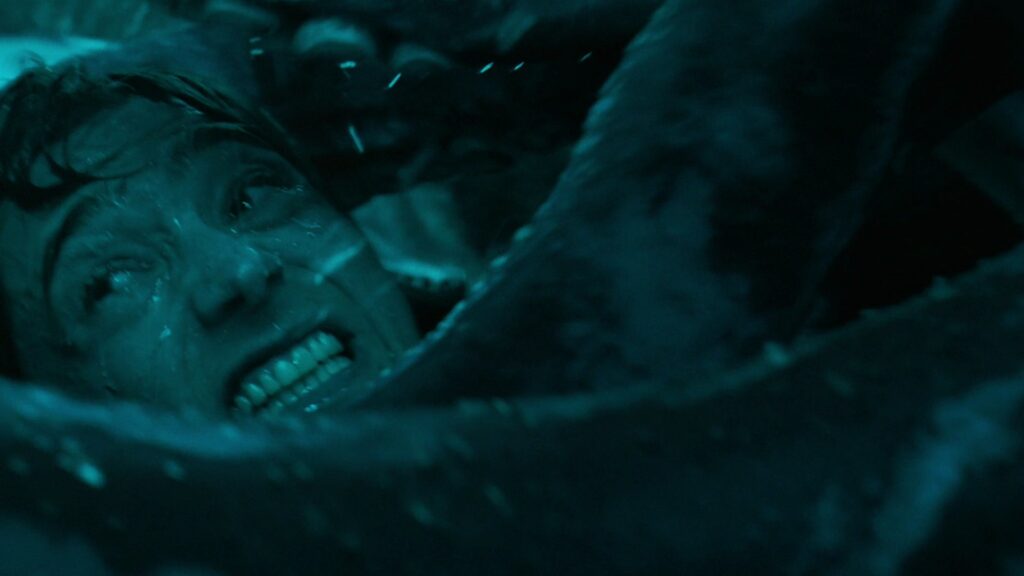
The most widely repeated part of Kojima’s response was his humorous observation that he did not expect to eat squid for a while. The remark gave an otherwise thoughtful reaction a memorable ending and connected directly to one of the film’s most unsettling elements. Dread Central’s review describes a disturbing sequence in which a squid’s limbs are difficult to distinguish from the surrounding organic environment before the creature attacks.
The scene combines confinement with the discovery that the enclosed space contains another living threat. Unlike a conventional monster encounter, Jay cannot simply retreat across an open room or escape through a familiar doorway. His limited surroundings make every movement potentially dangerous, especially when he cannot clearly identify what is touching him. Kojima’s joke captures the lingering disgust such imagery can produce, rather than offering a literal recommendation about seafood.
Whalefall follows Jay Gardiner, a young diver searching the ocean off California’s central coast for the remains of his deceased father. During the dive, he encounters a sperm whale pursuing a giant squid and is swallowed. Trapped inside the animal with a diminishing air supply, Jay must find a way to survive an environment filled with unfamiliar dangers.
The premise immediately establishes several pressures because he has limited time, restricted visibility and surroundings that cannot be navigated through ordinary experience. His diving equipment provides temporary protection, but the remaining air also gives the situation a measurable deadline. Every decision becomes important because hesitation can waste precious time, while rushing into an unknown section of the whale can expose him to additional danger.
The emotional circumstances make the story different from an accidental diving disaster. Jay enters the water carrying unresolved feelings about his father, whose remains he hopes to recover. His search represents an attempt to retrieve something tangible from a painful relationship that ended without satisfactory resolution. Once he is swallowed, the film develops two connected questions. The immediate concern is whether Jay can escape using his equipment, knowledge and remaining air. The deeper concern is whether he can confront his memories and continue living without allowing the past to determine his future. His physical struggle therefore unfolds alongside an emotional journey in which survival requires attention to the present while repeatedly revisiting experiences he cannot change.
The film’s setting also makes its survival premise unusually restrictive. Jay cannot rely on familiar landmarks, established escape routes or a clear understanding of the surrounding anatomy. He must interpret an environment that can obstruct movement, conceal threats and cause injury. The tension comes partly from the conflict between urgency and caution because acting too quickly may create another problem, while waiting allows his air supply to diminish. This creates a survival dilemma in which even small decisions carry consequences. Although biological research informed the production, the story remains fictional and should not be understood as a realistic demonstration of how someone could survive being swallowed by a sperm whale.
Kojima’s endorsement has attracted particular attention because his audience associates him with cinematic storytelling, unusual environments and ambitious creative concepts. His comments provide gaming audiences with an accessible introduction to Whalefall, encouraging interest in the performances, source novel and technical production. The film’s emphasis on navigation, limited resources and decisions under pressure also invites comparisons with interactive survival experiences, although those similarities do not establish any planned video game adaptation. The available reporting demonstrates that Kojima’s reaction generated discussion, but it does not establish how many additional cinema tickets were sold because of his recommendation.
Ultimately, Kojima’s response highlights the qualities that distinguish Whalefall from a straightforward underwater creature thriller. Its extraordinary premise provides the immediate attraction, while the family drama and ecological perspective give the story additional meaning. The disturbing squid sequence demonstrates its physical intensity, but the relationship between Jay and his father gives the survival ordeal a more personal foundation. These elements explain why the film can provoke both visceral reactions and discussions about grief, memory and the natural world.

Whalefall Cast, Austin Abrams’ Performance, Josh Brolin’s Character and Daniel Kraus’s Adaptation
Austin Abrams leads Whalefall as Jay Gardiner, portraying a vulnerable protagonist whose physical ordeal is inseparable from his emotional condition. DiscussingFilm’s review emphasizes the seriousness of his performance and his ability to make the character engaging despite the increasingly extreme circumstances.
A survival role involving prolonged isolation places substantial demands on an actor because dialogue cannot always communicate what the character is thinking. Breathing, hesitation, movement, facial expressions and reactions to the environment become essential storytelling tools. Abrams must also make repeated setbacks feel distinct, since pain, exhaustion, disgust and panic can overlap without producing the same emotional response. The film depends on audiences recognizing when Jay is reacting instinctively, when he is beginning to understand his situation and when he has developed a possible solution.
Abrams’ performance is particularly important because Jay does not appear naturally equipped to overpower his surroundings. His survival depends on persistence, resourcefulness and the ability to make decisions under pressure rather than physical dominance. This vulnerability makes small accomplishments dramatically significant. Recovering an object, successfully moving through a dangerous section or understanding part of the environment can feel important because the film has established how difficult even basic actions have become. His reactions also help audiences understand the surrounding space. When the environment is unfamiliar and visually disturbing, Jay’s physical responses provide essential information about danger, pain and the consequences of his decisions.
Josh Brolin plays Mitt Gardiner, Jay’s father and a central figure in the memories shaping the story. Published reviews describe Mitt as an experienced diver whose harsh treatment of his son left lasting emotional damage. Although his death brings Jay back toward a relationship from which he had attempted to distance himself, Mitt remains influential through the knowledge and experiences he passed down. His importance extends beyond providing the reason for the dive because some of the lessons associated with him become relevant to Jay’s survival. This creates a complicated emotional conflict in which the son must draw on useful knowledge from someone who also caused him significant pain.
The relationship between Jay and Mitt depends on maintaining that complexity. Recognizing the value of a parent’s lessons does not automatically justify cruelty, just as remembering moments of affection does not erase mistreatment. A convincing father and son story must allow these realities to coexist rather than presenting reconciliation as a simple resolution to past suffering. Brolin’s imposing presence gives the relationship an immediate visual dimension, particularly in scenes where the contrast between the characters communicates a history of pressure and emotional distance. The story ultimately asks Jay to determine which parts of his father’s influence he wants to retain without allowing that influence to define the entirety of his life.
The emotional storyline is closely connected to the film’s physical setting. Jay is trapped inside something enormous and difficult to understand while carrying memories that also feel larger than himself. His struggle can therefore be interpreted as an attempt to recover control over his life, even when the environment and experiences surrounding him remain beyond his control. Fangoria’s review emphasizes this relationship between physical danger and emotional conflict, presenting the survival ordeal as a confrontation with a bond left unresolved by Mitt’s death. The strongest interpretation of the story does not require Jay to excuse every painful memory. Instead, survival becomes an opportunity to distinguish valuable lessons from harmful experiences and decide how he will move forward.
Brian Duffield directs Whalefall and shares screenplay credit with Daniel Kraus, the author of the original novel. Duffield’s principal challenge is sustaining a feature film within an exceptionally restrictive environment while preserving a substantial emotional narrative. Once Jay has been swallowed, the story cannot depend indefinitely on the initial surprise. Each subsequent sequence must introduce a new danger, discovery, failed attempt or change in Jay’s physical condition. The whale’s interior must remain threatening while becoming sufficiently understandable for viewers to follow the protagonist’s decisions. This balance is essential because an environment that feels completely random can make survival seem arbitrary, while one that becomes too predictable may lose its capacity to generate suspense.
Duffield must also manage the relationship between immediate action and remembered experience. Flashbacks can explain Jay’s emotional reactions and the influence of his father, but they temporarily move the audience away from the danger inside the whale. This creates one of the film’s most important storytelling challenges. The memories need to deepen the survival narrative without repeatedly undermining its momentum. Some reviewers believe the family drama gives the ordeal emotional significance, while others argue that interruptions weaken the suspense. These disagreements concern the film’s central structure rather than a minor subplot because the relationship between past and present is fundamental to its approach.
Daniel Kraus’s Whalefall novel was published in 2023, combining a tightly constrained survival situation with a fractured father and son relationship. Kraus participated directly in the film adaptation as Duffield’s fellow screenwriter, establishing a creative connection between the original book and its cinematic interpretation. The publisher’s reading material identifies diminishing tank pressure, changes in time and Jay’s evolving understanding of his father as important structural elements. It also places the novel within a broader tradition of maritime literature and stories concerned with isolation, mortality and renewal.
Adapting that material for cinema presents challenges because prose can explore a character’s thoughts while simultaneously describing physical actions. A film must communicate much of that internal experience through performances, editing, imagery and sound. The adaptation therefore needs to make the mechanics of Jay’s predicament understandable while preserving the emotional significance of his memories. Kraus’s involvement supports continuity between the source material and screenplay, but it does not make the two experiences identical. Readers can move through the novel at their own pace and access extended interior narration, while cinema determines precisely when audiences receive information and how events are presented.
The movie also places Abrams alongside several established performers. The official 20th Century Studios cast listing identifies the following actors:
- Austin Abrams as Jay Gardiner: The young diver whose search for his father’s remains becomes a desperate struggle for survival inside a sperm whale.
- Josh Brolin as Mitt Gardiner: Jay’s deceased father, whose memories, harsh treatment and diving knowledge remain central to the story.
- Elisabeth Shue: Listed among the film’s supporting cast.
- John Ortiz: Also appears in the official cast listing.
- Jane Levy: Included among the film’s supporting performers.
- Emily Rudd: Another confirmed cast member identified by the studio.
Abrams’ role in Whalefall also follows his involvement in the 2026 Resident Evil movie, placing him at the center of two physically demanding survival stories. Sony’s official synopsis identifies his Resident Evil character as Bryan, a medical courier caught in a rapidly escalating nightmare. Although both films emphasize vulnerability and survival, their dramatic circumstances differ. Resident Evil places its protagonist within an unfolding outbreak, while Whalefall concentrates danger inside an enclosed biological environment and connects that danger directly to family memories. In an Entertainment Weekly interview, Abrams discussed the physical demands of his recent projects and his collaboration with Resident Evil director Zach Cregger following Weapons.
The comparison between these roles demonstrates how horror performances depend on more than appearing frightened. A convincing protagonist must communicate how fear changes behavior, whether through hesitation, sudden movement, improvised decisions or emotional exhaustion. Running, freezing, making mistakes and recovering from setbacks can each reveal something about a character. Abrams’ recent performances place these responses at the center of the viewing experience, with his effectiveness depending on making extreme distress believable while preserving a recognizable individual beneath the circumstances.
The combination of Abrams and Brolin gives Whalefall its central dramatic relationship, while Duffield and Kraus provide the narrative structure connecting survival horror with family conflict. The performances must make the emotional history compelling enough to justify the film’s repeated movement between past and present, while the screenplay must ensure that the physical ordeal remains understandable and suspenseful. This relationship between character development and immediate danger is essential to the film’s identity and explains why reactions to its emotional storytelling have been so closely connected to assessments of its survival sequences.

Whalefall Practical Effects, Claustrophobic Horror, Reviews and Release Details
Whalefall creates much of its tension by placing Jay inside an unfamiliar environment that can injure him, restrict movement and conceal additional threats. Unlike a conventional escape thriller set inside a building, the film offers few recognizable geographical features. There are no ordinary corridors, windows, stairs or doors to provide a clear sense of direction. A space that appears passable may prove dangerous, and moving forward does not necessarily mean approaching safety. Time Out’s review describes digestive fluids, constricting interiors and an increasingly disturbing progression toward body horror, emphasizing the stress created by Jay’s attempts to navigate the whale while his air supply diminishes.
The limited oxygen supply gives the film a persistent source of suspense because every delay carries consequences. Jay must decide when to move, when to conserve energy and how to respond to unfamiliar biological obstacles. Acting too quickly can cause injury or create another trap, while excessive hesitation reduces his chances of escaping.
The environment also contains threats beyond the whale’s anatomy, including the giant squid associated with the original encounter. Dread Central’s description of the disturbing squid sequence highlights how the film uses organic textures and limited visibility to make the creature difficult to distinguish from its surroundings before it attacks. This creates horror through uncertainty because Jay cannot always identify what he is touching or what may be moving nearby.
The whale itself is not presented simply as a malicious monster. Interview coverage with Brolin and Abrams emphasizes that the animal behaves according to its nature rather than deliberately targeting Jay. This distinction changes the kind of horror the film explores. The surrounding environment does not need to possess hostile intentions to become deadly. Its scale, movement and biological processes are dangerous because Jay is trapped somewhere he was never meant to survive. That sense of indifference reinforces the ecological themes Kojima recognized, presenting humanity as vulnerable within a natural world that operates independently of human needs.
The production combines physical sets and rigs with digital visual effects to recreate the whale’s interior. Reporting on production designer Ramsey Avery’s work describes biological research, full scale constructed environments and collaboration among production design, cinematography and visual effects teams. This approach provides Abrams with tangible surroundings against which he can push, struggle and react. Physical surfaces create resistance, allowing movements and collisions to communicate weight and confinement. Digital effects complement these practical elements by extending the environment, connecting separate constructed sections and creating anatomical features or movements that would be difficult to reproduce entirely through physical methods.
The most important production challenge is making these techniques function as parts of the same environment. Practical sets and digital extensions must share convincing lighting, textures, movement and spatial relationships. If those elements appear disconnected, the illusion of confinement can weaken. When they work together, the audience can better understand the pressure surrounding Jay and the physical consequences of his movements. The effectiveness of the sequence therefore depends less on whether an element is practical or digital and more on whether the combined image supports the story.
The principal elements contributing to Whalefall’s survival horror include:
- Limited oxygen: Jay’s remaining air creates a measurable deadline that makes hesitation and unsuccessful decisions increasingly dangerous.
- Restricted movement: The whale’s internal environment prevents ordinary navigation and limits opportunities for retreat.
- Organic surroundings: Digestive fluids, constricting surfaces and unfamiliar anatomy introduce physical dangers beyond simple confinement.
- Additional creatures: The giant squid sequence adds another threat within an environment that is already difficult to understand.
- Practical sets: Constructed interiors and rigs provide physical resistance that helps the performers communicate struggle and confinement.
- Digital effects: Computer generated imagery extends the physical environments and creates anatomical details that cannot easily be constructed.
- Emotional flashbacks: Memories of Jay’s father connect the immediate survival challenge with unresolved grief and family conflict.
- Environmental indifference: The whale’s behavior emphasizes the danger of being trapped within a natural system rather than confronting an intentionally hostile creature.
The combination of these elements gives Whalefall a distinctive identity within survival horror. Its physical premise provides immediate suspense, while the emotional memories explain why Jay’s continued survival matters beyond escaping the whale. However, balancing these elements has become one of the main subjects of critical disagreement. Some reviewers admire the film’s willingness to treat its family drama sincerely, while others believe the flashbacks reduce the momentum of the survival sequences.
Critical reception has generally reflected this divide between appreciation for the film’s unusual setting and differing reactions to its emotional structure. Positive reviews have emphasized Abrams’ performance, the physical intensity of the whale interior and the adaptation’s commitment to exploring grief and regret. Slashfilm’s Jeremy Mathai offered an enthusiastic assessment, highlighting the combination of a compelling premise and an existential examination of the protagonist’s emotional struggles. His response reflects the view that the film’s family narrative gives its physical ordeal additional meaning rather than distracting from the central suspense.
Dread Central’s Matt Konopka offered a more qualified assessment. Although he responded positively to Abrams and the emotional material, he argued that pacing interruptions and some computer generated imagery weakened the experience. Rotten Tomatoes’ published critical consensus similarly distinguishes the strength of the visceral survival sequences from reservations about the repeated flashbacks. These responses show that the same storytelling decisions can produce admiration and frustration depending on whether viewers prioritize continuous suspense or emotionally driven drama.
The disagreement is useful for understanding what audiences should expect. Someone looking primarily for uninterrupted survival tension may react differently from a viewer interested in a story that repeatedly connects immediate danger with painful memories. The film does not treat its family drama as a minor addition to an otherwise conventional creature feature. Instead, the emotional relationship between Jay and Mitt shapes the meaning of the entire ordeal. Kojima’s enthusiastic response belongs within this broader range of critical opinions, providing a distinctive perspective without eliminating the differing assessments of other reviewers.
Whalefall opened theatrically in the United States on October 16, 2026. The official 20th Century Studios page lists a runtime of one hour and 46 minutes, equivalent to 106 minutes, and a PG-13 rating. As of October 20, 2026, the verified viewing option established by the reviewed sources is theatrical exhibition, with Rotten Tomatoes also listing the film as playing in cinemas. A confirmed subscription streaming premiere or digital rental release date was not established by those sources. Availability may differ between countries, theaters and distribution arrangements, so the United States opening date should not be interpreted as proof that the film is showing in every territory.
The theatrical experience may be particularly suitable for a movie built around confinement and restricted visibility. A large cinema screen can make Jay’s surroundings feel overwhelming, while the sound system can emphasize pressure, movement and activity beyond the visible frame. The film’s use of constructed sets and digital environments also benefits from presentation that communicates the scale and texture of the whale interior. However, theatrical viewing is not essential to understanding the story, and eventual home release options may provide another opportunity to experience its performances and emotional narrative once their availability is confirmed.
Kojima’s public reaction has added another dimension to the film’s reception by connecting it with audiences who follow his gaming work. His emphasis on the father and son relationship, ecological themes and visual effects encourages viewers to consider Whalefall as more than an unusually graphic survival premise. His humorous squid comment also demonstrates how a brief observation can attract attention to a larger discussion about a movie’s emotional and sensory effects. Although the commercial influence of his recommendation has not been measured in the available reporting, the response illustrates how commentary from a prominent game creator can introduce a film to audiences outside traditional movie coverage.
The relationship between Whalefall and gaming audiences also reflects the film’s focus on limited resources, environmental navigation and decisions made under pressure. These elements can resemble challenges found in interactive survival experiences, even though the film remains a separate cinematic work. The comparison is useful for discussing why Kojima might appreciate its structure, but it does not establish a planned adaptation or direct creative connection between the movie and his games.
Ultimately, Whalefall combines claustrophobic survival horror with a substantial story about grief, memory and the complicated influence of a parent. Its visual effects and physical environments create a disturbing setting, while Austin Abrams and Josh Brolin provide the emotional relationship that gives the ordeal its deeper significance. The film’s reception demonstrates that its combination of physical danger and family drama can be both its greatest attraction and a source of criticism. Kojima’s praise highlights the literary and ecological dimensions of that approach, while his memorable reaction to the squid imagery captures the immediate discomfort that makes the film’s survival sequences difficult to forget.
Frequently Asked Questions (FAQs)
- What did Hideo Kojima say about Whalefall?
Hideo Kojima praised Whalefall for its literary qualities, ecological perspective, emotional father and son relationship and visual effects. In his October 18, 2026, comments, he also reflected on his fascination with whales and humorously suggested that the film’s disturbing imagery had temporarily reduced his appetite for squid. His reaction concerned the movie itself, since he acknowledged that he had not yet read Daniel Kraus’s original novel. - Who stars in Whalefall?
Austin Abrams and Josh Brolin lead the cast, portraying Jay Gardiner and his father, Mitt Gardiner. The official 20th Century Studios listing also includes Elisabeth Shue, John Ortiz, Jane Levy and Emily Rudd. Abrams carries much of the immediate survival story through his performance inside the whale, while Brolin plays an important role in the memories that explain Jay’s emotional struggles and complicated relationship with his father. - Who does Austin Abrams play?
Austin Abrams plays Jay Gardiner, a young diver searching the ocean off California’s central coast for the remains of his deceased father. During the dive, he encounters a sperm whale pursuing a giant squid and is swallowed. With limited oxygen and dangerous surroundings, Jay must find a way to survive while confronting memories of his father and the unresolved emotional difficulties connected to their relationship. - Is Whalefall based on a book?
Yes. Whalefall adapts Daniel Kraus’s 2023 novel of the same name, which combines an extraordinary underwater survival predicament with a complicated father and son relationship. Kraus also worked on the film’s screenplay alongside director Brian Duffield, providing a direct creative connection to the source material. However, the movie uses cinematic storytelling techniques that differ from the novel’s prose and internal narration. - Is Whalefall a true story?
No. Whalefall is a fictional survival thriller adapted from Daniel Kraus’s novel. Although the production incorporated biological research to help create convincing environments and anatomical imagery, that research does not establish that Jay’s experience actually occurred or that the complete scenario would be realistically survivable. The film uses its extraordinary premise to explore danger, grief, memory and the relationship between humans and nature. - Does the film use practical effects?
Yes. Whalefall combines constructed whale interiors, physical rigs and other practical production elements with digital visual effects. The physical environments give Austin Abrams surfaces against which he can struggle and react, helping communicate confinement and physical resistance. Computer generated imagery extends those environments and creates additional anatomical details. The combination allows the movie to depict an unusual setting while supporting the actor’s performance. - Is Whalefall horror or drama?
Whalefall combines survival horror, disturbing bodily imagery and emotional family drama. Its immediate suspense comes from Jay’s struggle to escape a sperm whale with limited oxygen, while its dramatic storyline examines his unresolved relationship with his father. Both elements are central to the film, although critics disagree about their balance. Some believe the emotional material strengthens the survival story, while others feel it interrupts the tension. - When was Whalefall released?
Whalefall opened in United States theaters on October 16, 2026. The official 20th Century Studios listing gives the movie a runtime of 106 minutes, or one hour and 46 minutes, and a PG-13 rating. The film’s theatrical availability may vary by country and cinema, so the United States opening date does not necessarily establish the release schedule for every international market. - Is Whalefall available to stream?
As of October 20, 2026, the sources reviewed confirm theatrical availability but do not establish an official subscription streaming premiere or digital rental date. The film is listed as playing in cinemas, while its eventual availability through streaming or digital platforms remains unconfirmed in the reviewed information. Viewers should distinguish verified release announcements from speculative dates or unofficial listings. - Is Austin Abrams also in Resident Evil?
Yes. Austin Abrams stars as Bryan in the 2026 Resident Evil film, where his character is a medical courier caught in a rapidly escalating nightmare. The role shares some similarities with his performance in Whalefall because both place a vulnerable protagonist in physically demanding survival situations. However, Resident Evil focuses on an unfolding outbreak, while Whalefall combines confinement inside a whale with a personal story about grief and family conflict.

Conclusion
Hideo Kojima’s praise has brought Whalefall greater attention, particularly among gaming audiences. The film combines an unusual survival premise, Austin Abrams’ demanding performance and an emotional story about grief and family relationships. While its flashbacks and reconciliation themes have divided critics, they also give Jay’s struggle a deeper meaning. Beyond escaping the whale, his journey becomes a fight to overcome the past and reclaim his future.
Sources and Citations
- Hideo Kojima, October 18, 2026 : Shares his reaction to Whalefall, praising its literary storytelling, exploration of humans and whales within an ecosystem, father and son relationship, and visual effects. He also connects its whale imagery to recurring themes in his games. Citation: Hideo Kojima’s Whalefall reaction. (X) omelete.com.br
- 20th Century Studios, official film page : Confirms the October 16, 2026 release date, 106 minute runtime, PG-13 rating, cast and production credits. It also provides the official synopsis and identifies Brian Duffield and Daniel Kraus as the screenwriters. Citation: Whalefall: Official Movie Page. (20th Century Studios) 20th Century Studios
- Simon & Schuster, official publisher page : Provides background on Daniel Kraus’s source novel, including its central survival premise, the protagonist’s search for his father’s remains and the limited oxygen supply that drives the story. Citation: Whalefall by Daniel Kraus. (Simon & Schuster) Simon & Schuster
- Sony Pictures, official Resident Evil synopsis : Confirms that Austin Abrams plays Bryan, a medical courier caught in a dangerous overnight struggle for survival. The page also lists the cast, filmmakers and September 18, 2026 theatrical release date. Citation: Resident Evil: Official Synopsis and Cast. (Sony Pictures) Sony Pictures
- Entertainment Weekly, September 17 and October 13, 2026 : Interviews Austin Abrams about the physical demands of Resident Evil and Whalefall. Separate production coverage explains how designer Ramsey Avery and the filmmaking team researched whale anatomy and constructed the practical interior sets. Citation: Austin Abrams on filming Resident Evil and Whalefall and How Whalefall’s whale interior was created. (Entertainment Weekly) ew.com
- Slashfilm, DiscussingFilm and Fangoria, October 14, 2026 : Offer critical perspectives on Austin Abrams’ performance, the adaptation’s survival sequences and its treatment of grief and family trauma. Their reviews assess how successfully the film combines physical danger with emotional storytelling. Citation: Slashfilm’s Whalefall review, DiscussingFilm’s Whalefall review and Fangoria’s Whalefall review. slashfilm.com
- Dread Central, Time Out and Rotten Tomatoes : Dread Central and Time Out examine the film’s claustrophobia, underwater horror, performances and pacing. Rotten Tomatoes collects broader critical reactions, including praise for the visual effects and differing opinions about the emotional material. Citation: Dread Central’s Whalefall review, Time Out’s Whalefall review and Whalefall reviews and reception on Rotten Tomatoes. A (Mostly) Suffocating Deep Sea Nightmare
Recommended
- Bungie Confirms Marathon Season 2 Details — Nightfall Update Brings PvE Modes, New Zone, and Major Gameplay Changes
- Italian Exotics Dealership Location in Forza Horizon 6
- Nintendo Exploring a Switch 2 OLED but is Worried About Price: Report
- Gears of War: E-Day Launch Guide for Xbox Series and PC
- Why GTA 6 Won’t Be on PC at Launch (November 19, 2026): Take-Two CEO Strauss Zelnick Explains
- VHOLUME Launches August 21, 2026: Parkour Gameplay, Multiplayer and Steam Details
- 007 First Light Gameplay on Steam Machine: Performance, Features, and SteamOS Experience
- Justin Drake Crypto Bunker Mode Warning: AI-Accelerated Math Threatens ECDSA Vitalik Buterin Backs It
- Nvidia’s “Zero Water” AI Factory Design Gains Momentum: How Liquid Cooling Is Reshaping AI Infrastructure



































































































