





In This Article (8 sections)
House of the Dragon Season 3 Premiere, Battle of the Gullet Overview, Adaptation Changes, and Production Insights
House of the Dragon season 3 premiered on June 21, 2026, on HBO and HBO Max as an eight-episode season, with new episodes scheduled weekly through August 9. Warner Bros. Discovery’s official press release confirmed the release date, episode count, and weekly rollout format, while pre-release interviews made it clear that the season would open directly with the long-anticipated Battle of the Gullet rather than delaying it to a later point in the season.
This decision is significant because the Battle of the Gullet has consistently been described by showrunner Ryan Condal and the cast as the moment when House of the Dragon transitions from political tension and sporadic conflict into full-scale war. Condal referred to the sequence as “arguably the craziest episode of television ever made,” and also described it as creating “the reality before the Gullet and the reality after the Gullet.” In narrative terms, the battle is not simply a large action set piece but the structural turning point of the season, reshaping the trajectory of the conflict moving forward.
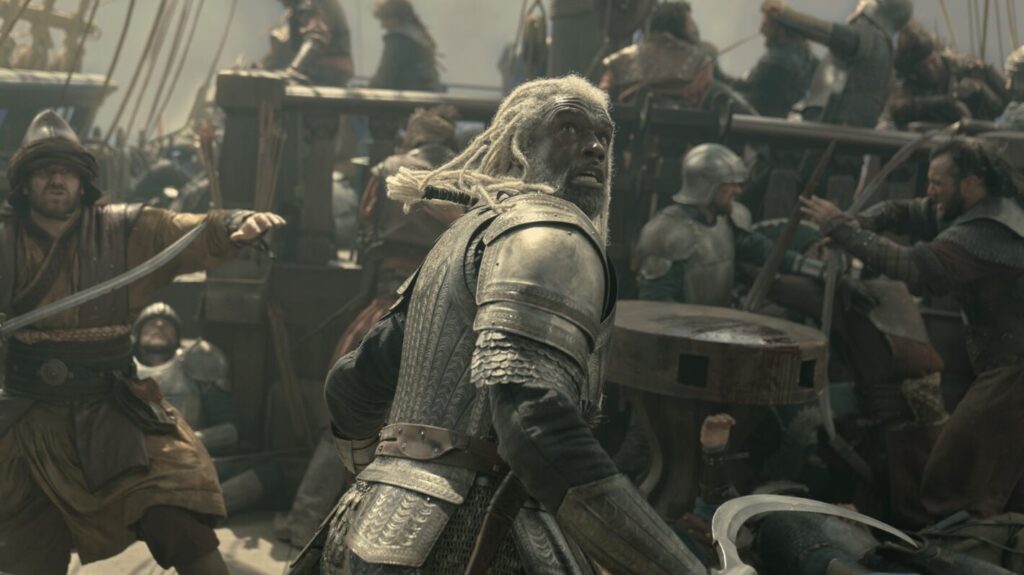
The first major battle of House of the Dragon season 3 is the Battle of the Gullet, a large-scale sea-and-dragon engagement taking place in the narrow shipping lane between Dragonstone and Driftmark. This location is strategically critical within the story, as Rhaenyra’s faction—supported by Corlys Velaryon and the Velaryon fleet—uses control of maritime routes to pressure King’s Landing and restrict enemy movement. Reports from Entertainment Weekly describe the Gullet as a vital trade and naval passage under Rhaenyra’s control, while TV Insider has characterized the adaptation as the deadliest naval battle in Westeros history.
What sets this battle apart from earlier conflicts in the series is its combination of scale, environment, and combat complexity. While season 2’s Rook’s Rest focused heavily on dragon-versus-dragon warfare, the Battle of the Gullet expands the battlefield into a multi-layered engagement involving entire fleets, ship boarding actions, aerial dragon combat, fire spreading across water and vessels, and underwater chaos. The production demands were equally extreme.
TV Insider reported that filming required the use of a wet tank, a dry tank, an underwater tank, four separate boat sets, and approximately 3 million liters of water to stage the sequence. Ryan Condal has described the battle as a foundational moment that could not be treated as off-screen lore, comparing its importance to a set piece like Helm’s Deep, which needed full on-screen depiction rather than being summarized through exposition.
In George R. R. Martin’s Fire & Blood, the Battle of the Gullet is portrayed as a sprawling and devastating conflict with multiple interwoven events and consequences. The book version includes the Gay Abandon subplot, in which Aegon the Younger and Viserys II are evacuated by Jacaerys, followed by the attack on their escort, Stormcloud’s fatal flight to raise the alarm, and Viserys’s eventual capture.
It also features the arrival of the dragonseeds Addam, Hugh, Ulf, and Nettles, alongside major destruction in the aftermath, including the burning of Spicetown and High Tide. Summaries from A Wiki of Ice and Fire and Business Insider’s breakdown of the source material also highlight key outcomes such as the deaths of Jacaerys and Vermax, the capture of Viserys, and the enormous losses suffered by the Velaryon fleet.
The television adaptation makes several notable changes to this structure, reshaping both character involvement and narrative focus. According to Entertainment Weekly’s post-premiere coverage, the series assigns Sheepstealer’s Gullet-related role to Rhaena instead of Nettles, altering a key character trajectory from the source material. Additionally, People reports that the show kills Sharako Lohar during the season 3 premiere, despite the character surviving the battle in the book.
Earlier narrative adjustments also affect how the story unfolds, as Business Insider’s season 2 coverage notes that Rhaenyra’s younger sons are already placed into a different protective storyline before season 3 begins, which removes the need for the Gay Abandon sequence to play out exactly as it does in Fire & Blood. These changes are not minor adjustments but deliberate restructuring choices that shift which characters directly experience the battle and how its emotional and narrative consequences are distributed.
Ryan Condal has explained these changes primarily through the lens of production necessity and narrative clarity. In his TV Insider interview, he noted that the Battle of the Gullet required roughly two years of research and development before filming, with about one year dedicated specifically to planning, designing, and building the infrastructure needed to execute it. He emphasized that the episode’s production demands were comparable to making a large-scale feature film, explaining that while some wide shots and dragons rely on visual effects, much of the ships, water interaction, and physical action were built practically on set.
Condal has also framed the adaptation decisions as a matter of faithfully translating a complex, multi-front, and highly chaotic event from Fire & Blood into a coherent television episode. Speaking at SXSW London and in subsequent interviews, he stressed that the Gullet had been a long-term priority for the production team and that its scale required unprecedented construction and coordination. From his perspective, the changes are not arbitrary deviations from the source material but necessary adaptations to ensure that one of the most logistically complicated events in the Dance of the Dragons can be fully realized on screen in a way that remains understandable and dramatically impactful.

Why House of the Dragon Changed the Battle of the Gullet, How It Plays Out in the Season 3 Premiere, and Book vs Show Differences
The most direct reason for moving the Battle of the Gullet is that Condal believed the sequence needed more time, more space, and more resources than season 2 could provide. In August 2024, he explained that the event was being held for early season 3 because the team wanted the time and room to do it “at a level that is going to excite and satisfy the fans in the way that is deserved.” He also acknowledged that the reduced episode count and the need to rebalance the remaining major events in relation to the series’ endpoint were part of the calculation.
By June 2026, he refined that explanation further. GamesRadar reported Condal saying there were logistical challenges tied to resources and to doing justice to “the biggest naval battle ever waged in the history of Westeros.” He also linked the decision to a deliberate shift in seasonal rhythm: instead of the usual slow build followed by a late-season explosion, season 3 would “come out so heavy and unexpectedly,” immediately altering the storytelling tone. A reasonable inference from the premiere itself is that character reassignments—especially giving Rhaena the Sheepstealer material associated with Nettles in the book—also serve the show’s broader streamlining strategy around already established characters.
The season 3 premiere itself reflects this restructuring in its pacing and structure. It does not begin with uninterrupted combat. Instead, the first half is devoted to tying off season 2 threads and positioning the characters who will be destroyed or transformed by the Gullet. As Esquire’s recap notes, the episode spends time on Aegon II’s escape, Rhaena’s dragon plot, Alicent’s crisis, Criston’s state of mind, and the arrival of new figures such as Ormund Hightower before the battle takes over the final section. This structure makes the battle feel less like a detached set piece and more like the violent convergence of earlier decisions.
Once the battle begins, the series focuses heavily on Corlys Velaryon’s naval command, the Triarchy assault, the vulnerability of dragonriders at sea, and the inability of inexperienced riders to fully control a battlefield shaped by wind, water, fire, and panic. Esquire highlights Alyn’s underwater confrontation with Sharako and Jace’s death as the emotional core of the sequence. Entertainment Weekly’s post-premiere breakdown further explains the mechanics of Jace’s fall: Rhaena arrives on Sheepstealer, loses control of the wild dragon, and the resulting chaos contributes to Vermax being harpooned into the sea, after which Jace is killed by arrows following his survival of the initial plunge.
In contrast, the book version of the Battle of the Gullet is more dispersed and overtly historical. It presents the event as a long, multi-sided catastrophe with contradictory accounts, large-scale losses, multiple dragonriders, and wide geopolitical consequences. The show version, however, concentrates attention on a smaller set of recurring characters and a more immediate emotional throughline, especially Corlys, Alyn, Jace, Baela, and Rhaena. In adaptation terms, the series trades some of the book’s breadth for sharper, character-centered causality.
Several key differences are already visible. Nettles is absent, with Rhaena instead occupying the Sheepstealer-related narrative role. The book’s “Gay Abandon” material is not staged as the defining ignition point of the on-screen battle. Sharako Lohar survives in Fire & Blood but dies in the episode. The book features Addam, Hugh, Ulf, and Nettles joining Jace in the air, while the show foregrounds a different configuration of riders and chaos. Even where the endpoint remains the same—especially Jace’s death and the destruction of Vermax—the path leading there has been significantly reimagined.
Season 3, the Battle of the Gullet, and the Turning Point of the Dance of the Dragons
Season 3 changes the Dance of the Dragons by removing the last lingering illusion that the conflict might still be contained. In Condal’s words, the season “starts moving at speed and never stops,” and he has repeatedly presented the Gullet as the moment when the abyss stops being theoretical. Entertainment Weekly’s cover story captures this through his idea that there is a reality before the Gullet and a reality after it, a way of saying the political war becomes irreversible mass slaughter.
This shift affects both tone and structure. Mitchell told Entertainment Weekly that season 3 is “all-out war,” while Condal suggested the series is now playing for keeps, making it clear that no one and nothing is safe from this point forward. Structurally, this also fits the penultimate-season design: HBO positioned season 3 as an eight-episode run leading toward its finale in August 2026, with the show already renewed for season 4. In that sense, season 3 becomes the stretch where the story stops positioning pieces and starts breaking them permanently.
The production timeline reinforces the scale of what the season is doing. HBO renewed the series for season 3 in 2024, production began in the United Kingdom on March 31, 2025, and Warner Bros. Discovery announced on April 27, 2026 that the season would debut June 21 as an eight-episode run. By late May and early June 2026, Condal was describing years of planning and an episode constructed at feature-film scale, emphasizing how deliberately the season’s major set pieces were engineered.
The in-story timeline aligns tightly with this build-up. Season 2 established Jacaerys as one of Rhaenyra’s most active strategists, showed Tyland forging the Triarchy alliance, depicted Rhaenyra sending her younger children away for safety, and ended with the Triarchy fleet moving toward the Gullet. Season 3 then immediately pays this off in episode 1 by staging the battle, making it feel both abrupt in release order and inevitable in narrative logic.
Jacaerys Velaryon is not just another casualty of the Gullet. He has already emerged as one of Team Black’s most capable young leaders. Business Insider’s season 2 recap notes that he secured Stark support in the North and proposed the dragonseed strategy that expanded Rhaenyra’s military options, meaning his death is not only a personal tragedy but a major strategic loss.
The premiere frames his end as the collision between youthful initiative and wartime chaos: he locks Rhaenyra in her room, flies out with Baela, and ultimately dies after Vermax is harpooned into the sea amid confusion created by Sheepstealer. Harry Collett described Jace’s actions as those of a frightened but determined boy trying to prove himself, while Emma D’Arcy called his death an “unquantifiable loss” that deepens Rhaenyra’s grief into something more politically hardened.
Opening the season with the Gullet is, according to Condal, a deliberate structural disruption. Rather than following the typical Game of Thrones pacing of gradually building toward catastrophe, season 3 begins with immediate escalation, forcing viewers to adjust to a faster, more destructive rhythm. As he told GamesRadar, the intention was to put audiences “back on their heels in a good way,” using the battle to establish the season’s tone rather than exhaust its momentum.
There is also a practical dramatic reason for this choice. Because season 2 ended so close to open conflict, delaying the Gullet further would have made that finale feel increasingly transitional in hindsight. Critics noted this when reacting to the premiere, with Esquire describing the battle as the payoff viewers had been waiting two years to see while still acknowledging its impact. In that sense, placing the Gullet at the start of season 3 is not just structural experimentation but a way to restore narrative momentum immediately while delivering the long-awaited escalation the story had been building toward.

House of the Dragon Season 3: Battle of the Gullet, Adaptation Changes, Reception, and Impact on Rhaenyra’s War
Taken together, Ryan Condal’s interviews about House of the Dragon season 3 form a consistent explanation for why the Battle of the Gullet was positioned as the premiere event and how it was designed for television. First, the battle was delayed because the production required more time, resources, and infrastructure to stage it at the necessary scale.
Second, it was placed at the opening of season 3 to signal that the Dance of the Dragons had entered a more relentless and irreversible phase. Third, the adaptation needed to be both cinematic and grounded, ensuring that viewers feel the physical weight of ships, water, fire, and bodies rather than experiencing the battle as an abstract CGI sequence. Taken together, these decisions reflect an intent to reshape how the story “reads” on screen compared to the source material in Fire & Blood.
Condal’s comparisons reinforce this emphasis on scale and consequence. He repeatedly frames the production as operating on a level comparable to a franchise film, describing season 3 as the largest the show has ever produced “by a huge margin.” He also emphasizes a clear structural divide in the story: there is a reality before the Gullet and a reality after it.
In his framing, the sequence is not just another battle but a defining threshold for the series, one that fundamentally changes its tone and narrative grammar. Whether or not every adaptation choice is universally accepted, the intention expressed in these interviews is consistent: the premiere is meant to mark a decisive escalation in the depiction of the Dance of the Dragons, a fictional civil war often referred to within the story as a turning point in Targaryen history, the Dance of the Dragons.
Early reactions to season 3 suggest that the Battle of the Gullet achieved strong results in terms of spectacle and momentum, though not without debate over adaptation fidelity. Initial critical roundups, including Rotten Tomatoes summaries, describe the season as richer in dragon action while still anchored by strong performances, and the overall season score reflects very high critical reception. Outlets such as Esquire praised the premiere as a return to form, suggesting that the battle may quickly win back viewers who were uncertain after earlier developments.
At the same time, audience and critic responses also reveal ongoing frustration among some viewers regarding deviations from source material and the structural decision to place material that some expected at the end of season 2 into the season 3 premiere instead. Some commentary, including analysis in Time, argues that the battle does not deliver straightforward catharsis. Broader discussion threads collecting reactions show a split dynamic: appreciation for scale, pacing, and execution on one hand, and criticism of adaptation choices on the other. The overall reception can therefore be summarized as admiration for the episode as television, paired with continued debate over how faithfully it aligns with its literary counterpart in Fire & Blood.
The story differences in season 3 extend beyond the mechanics of the battle itself and reflect a broader structural shift in how House of the Dragon is adapting the Dance. Earlier changes in season 2 already repositioned characters such as Rhaenyra’s younger sons, expanded Rhaena’s arc, and developed the Triarchy invasion setup in ways that altered the foundation for the Gullet. As a result, the battle could no longer unfold exactly as described by Maester Gyldayn in Fire & Blood.
These changes make the Battle of the Gullet a lens through which the rest of season 3’s adaptation strategy becomes visible. The series preserves major outcomes that are essential to the civil war—most notably the death of Jacaerys Velaryon and the significant weakening of Rhaenyra’s faction—but often reshapes the route by which those outcomes occur, including adjustments in character participation and survival. Reporting on specific character fates, such as Sharako Lohar’s death and Rhaena’s storyline developments involving Sheepstealer, illustrates this pattern. The adaptation model remains consistent: maintain the historical consequences of the war while reorganizing the narrative and character dynamics to better fit the structure of television storytelling.
For Rhaenyra, the Battle of the Gullet functions as both a military and psychological catastrophe. Within the traditional narrative of Fire & Blood, the battle is already framed as a devastating conflict where even victory feels indistinguishable from loss. The television adaptation intensifies this by centering the emotional weight of Jacaerys Velaryon’s death. Emma D’Arcy has described this moment as one that pushes Rhaenyra into grief-driven clarity, hardening her worldview and making her approach to the war more absolute and less flexible.
This emotional transformation is further reinforced by Condal’s commentary, which suggests that season 3 is interested in examining how idealized or “chosen one” style narratives break down under the realism of the House of the Dragon universe. Combined with D’Arcy’s remarks about grief, fanaticism, and moral narrowing, the implication is that the Gullet does not simply escalate Rhaenyra’s anger but fundamentally reshapes her governing philosophy. Hardness ceases to be a temporary response to trauma and instead becomes the defining structure of her identity and decision-making as the Dance of the Dragons continues.
Everything essential about the Battle of the Gullet in season 3 can therefore be understood through five core points. It serves as the premiere event of the season. It was delayed from the end of season 2 due to production demands and the need for greater scale. It adapts one of the most destructive battles in Fire & Blood while significantly reshaping character involvement and sequence structure. It results in the death of Jacaerys Velaryon, a turning point in Rhaenyra’s war effort. And it marks a structural shift in House of the Dragon from a buildup phase into a period where the narrative fully operates inside the collapse of the Dance of the Dragons rather than preparing for it.
Ultimately, Ryan Condal’s changes to the Battle of the Gullet in House of the Dragon season 3 reflect a clear production philosophy: prioritize scale, clarity, and immediate narrative momentum, even when that requires significant departures from Fire & Blood. Whether these changes are seen as necessary adaptation or controversial revision remains a point of ongoing debate, but the episode itself establishes an unmistakable threshold. The Battle of the Gullet now functions as a defining turning point in the television portrayal of the Dance of the Dragons, fundamentally reshaping both the war’s trajectory and Rhaenyra’s arc moving forward.

Frequently Asked Questions
- What is the first major battle in House of the Dragon season 3?
The first major battle is the Battle of the Gullet, which opens season 3 and centers on the naval choke point between Dragonstone and Driftmark. HBO’s official season 3 release materials and multiple interviews confirmed that the premiere would begin with this battle. It is positioned as a large-scale naval and dragon conflict that immediately escalates the war’s intensity, setting a much more aggressive tone than earlier episodes in the series. - Why was the Battle of the Gullet moved from season 2 to season 3?
Ryan Condal said the move happened because of logistical and resource challenges, and because he wanted enough time and production scale to do justice to the biggest naval battle in Westerosi history. He also said opening season 3 with it changed the rhythm of the show in a deliberate way. In practical terms, the delay allowed the production team to build more complex sets, water staging, and dragon sequences without compressing them into a tighter schedule. - Did Ryan Condal really compare the episode to a major movie?
Yes. In his TV Insider interview, Ryan Condal said the effort required for the episode was equivalent to making a large franchise film, especially because much of the battle was built and filmed practically. The comparison reflects the scale of production, particularly the combination of extensive physical sets, water tanks, and layered visual effects work that went into the episode. - How is the show version different from Fire & Blood?
Major changes include Rhaena taking on Sheepstealer material associated with Nettles in the book, the show’s altered handling of the Gay Abandon-related material, and Sharako Lohar dying in the premiere even though the character survives the battle in the book. These changes reflect the show’s broader approach of reshaping certain character arcs for tighter narrative focus compared to Fire & Blood. The adaptation also shifts emotional weight onto existing characters rather than introducing or maintaining some book-exclusive roles. - Does Jacaerys Velaryon die in the Battle of the Gullet in the show?
Yes. The season 3 premiere ends with Jace’s death after Vermax is pulled into the sea and Jace is finished by enemy arrows. Coverage from outlets like Entertainment Weekly and People highlighted the moment as one of the episode’s most significant turning points, marking a major loss for the Black faction early in the season. - Why is Jace’s death so important to the story?
Jace had become one of Rhaenyra’s key younger strategists, and his death devastates both her family and her war effort. Emma D’Arcy noted that the loss pushes Rhaenyra into a colder, more hardened mindset as the conflict escalates. Narratively, it removes one of her most promising heirs and forces a shift toward more desperate and less restrained decision-making. - Was the Battle of the Gullet mostly CGI?
No. While dragons and wide battlefield extensions rely heavily on visual effects, the production emphasized practical filmmaking. Much of the water environment, ship decks, and physical combat staging were built using tanks and large-scale sets, allowing actors to perform within real environments. CGI was then layered in to expand scale rather than replace the physical groundwork. - How many episodes are in House of the Dragon season 3?
Season 3 consists of eight episodes, according to Warner Bros. Discovery’s official press release. The season runs weekly from June 21 to August 9, 2026. This shorter episode count continues the show’s approach of focusing on higher-budget, more cinematic installments rather than longer traditional TV seasons. - How have critics and fans reacted to the battle changes?
Early critical reaction has been strongly positive regarding the scale, pacing, and spectacle of the Battle of the Gullet. However, fan discussions and some critics continue to debate the differences from the source material, particularly changes involving character fates and merged storylines. Overall, the consensus leans toward praise for execution, even where adaptation choices remain controversial. - What does the Battle of the Gullet mean for the rest of season 3?
House of the Dragon showrunner Ryan Condal has described it as a turning point that divides the season into “before the Gullet” and “after the Gullet.” The premiere is designed to signal that the conflict has fully escalated into its most irreversible phase. From this point forward, the war becomes more brutal, politically unstable, and emotionally consequential for the remaining characters.
conclusion
The Battle of the Gullet is the most revealing adaptation test House of the Dragon has faced so far. Ryan Condal did not simply move a popular book event forward in the calendar. He re-engineered it into a season-opening statement about the show’s priorities: practical scale over easy efficiency, emotional centrality over historical sprawl, and narrative acceleration over the old slow-burn formula. The result is a premiere designed to feel like both payoff and warning. It pays off two seasons of preparation, and it warns the audience that the Dance of the Dragons has now crossed into the stage where losses are strategic, dynastic, and existential all at once.
For readers comparing book and show, the fairest conclusion is not that the series has abandoned Fire & Blood, but that it is translating its history through a more compressed and character-forward lens. The major facts that matter most to the war remain, especially the battle’s enormity and Jace’s death. What changes is the route, the emphasis, and the distribution of tragedy. That is why the season 3 premiere already feels so important. It is not just the first major battle of the season. It is the episode that defines what the television version of the Dance of the Dragons now is.
Sources and Citations
- Warner Bros. Discovery / HBO, official Season 3 premiere announcement: Published April 27, 2026. Confirms that House of the Dragon Season 3 premiered June 21, 2026 at 9:00 p.m. ET/PT on HBO and HBO Max, with eight episodes airing weekly through the August 9 finale. It also confirms Ryan Condal as co-creator, showrunner and executive producer, with George R.R. Martin credited as co-creator and executive producer. Warner Bros. Discovery Press
Citation: Season Three of the HBO Original Drama Series HOUSE OF THE DRAGON Debuts June 21 - Warner Bros. Discovery / HBO, official Season 3 trailer release: Published May 29, 2026. Reconfirms the June 21 premiere, eight-episode structure and HBO/HBO Max availability while supplying the official Season 3 trailer and cast list. This is a useful first-party source for the show’s official release context. Warner Bros. Discovery Press
Citation: HBO Releases Official Trailer for Season Three of HOUSE OF THE DRAGON - TV Insider, Ryan Condal interview on the Battle of the Gullet: Written by Kelli Boyle, published June 1, 2026. Condal describes the Gullet episode as the production equivalent of making a major franchise movie and explains that more than three years of planning went into it. The interview is especially useful for the scale of the battle, the creative importance of Corlys and Sharako, and the decision to balance intimate character perspectives with spectacle. TV Insider
Citation: Inside House of the Dragon’s Devastating Battle of the Gullet - GamesRadar+, Condal on moving the Gullet from Season 2 to Season 3: The interview records Condal saying that logistical and resource challenges contributed to the battle being moved, while also arguing that the episode ultimately worked better as the Season 3 opener. He stresses that the move did not alter the larger planned story arc. This is the strongest source for distinguishing production-driven scheduling from claims that the story was fundamentally rewritten because of the delay. GamesRadar+
Citation: House of the Dragon Showrunner on Season 3 and the Battle of the Gullet - GamesRadar+, Condal on characters omitted or reassigned from the book battle: Post-premiere coverage addresses major differences between the television version and Fire & Blood, including the omission of Aegon the Younger and Viserys from the Gullet sequence. Condal describes some of those changes as things the adaptation had to dispense with, making this particularly useful when explaining why the show does not reproduce the book event beat for beat. GamesRadar+
Citation: House of the Dragon Season 3 Showrunner Explains Missing Battle of the Gullet Characters - Entertainment Weekly, Season 3 Battle of the Gullet preview and production methods: EW’s pre-premiere reporting describes the episode’s unusually large-scale production, including dry and wet sets, water cannons, mechanical gimbals and rocking rigs used for dragon-flight sequences. Condal characterizes it as one of the most ambitious pieces of television the production had attempted. This supports discussion of the practical-production methods behind the battle rather than treating it as entirely CGI. EW.com
Citation: House of the Dragon Stars Preview the Battle of the Gullet - Entertainment Weekly, early Season 3 critical response: Published June 16, 2026. Summarizes early reviews based on the first four episodes, noting generally strong reception for the premiere’s battle spectacle, character work and escalation of the Dance of the Dragons. This is useful for critic-response context rather than for confirming plot mechanics. EW.com
Citation: House of the Dragon Season 3 Reviews: What Critics Are Saying - People, post-premiere coverage of Jace’s death and other battle changes: Published June 22, 2026. Confirms that Jacaerys dies during the Battle of the Gullet, alongside Jason Lannister and Sharako Lohar. It also notes that Sharako’s death differs from Fire & Blood, where the character survives the battle. Emma D’Arcy discusses how Jace’s death changes Rhaenyra emotionally, making this a strong source for the premiere’s immediate character consequences. People.com
Citation: House of the Dragon Season 3 Premiere Kills Off Beloved Character - Esquire, Season 3 premiere recap: Written by Josh Rosenberg, published June 21, 2026. Describes the television version of the Battle of the Gullet, including Jace flying into battle, Vermax going down and Jace ultimately being killed by arrows after initially surviving the fall into the sea. It also discusses the naval fighting, dragon attacks and Alyn’s confrontation with Sharako. This is useful for establishing what the adaptation actually depicts on screen. Esquire
Citation: The House of the Dragon Season 3 Premiere Absolutely Rocks - Rotten Tomatoes, early and current Season 3 reception: Rotten Tomatoes’ June 15 roundup described the initial review wave as highly positive, while the current season page lists a 91% Tomatometer from 173 reviews and a 65% Popcornmeter from more than 1,000 ratings. These figures are useful for critic-versus-audience reception context, but the audience score is dynamic and may continue changing. Rotten Tomatoes Editorial
Citation: House of the Dragon Season 3 First Reviews
Citation: House of the Dragon Season 3 on Rotten Tomatoes - Business Insider, Fire & Blood version of the Battle of the Gullet: Published June 19, 2026. Provides a concise book-side account: the Triarchy encounters the Gay Abandon, Aegon the Younger escapes on Stormcloud, Viserys is captured, Jace leads the counterattack with the dragonseeds, and Jace and Vermax die during the battle. It also describes the attack on Driftmark and the destruction associated with the conflict. This is one of the most useful secondary sources for directly comparing the novel’s chronology with the TV adaptation. Business Insider
Citation: The Battle of the Gullet Is One of the Bloodiest Sea Battles in Game of Thrones History - Business Insider, earlier overview of upcoming Fire & Blood battles: Its 2024 guide also summarizes the book version of the Gullet, including the Triarchy attack, the dragonseed participation, the deaths of Jacaerys and Vermax, and the subsequent destruction at Driftmark. It is useful historical context for showing what readers expected before Season 3 aired. Business Insider
Citation: House of the Dragon Teased the Battle of the Gullet: Here Are the Major Battles From Fire & Blood - A Wiki of Ice and Fire, Gay Abandon and Viserys’s capture: The book-based reference explains that the Gay Abandon was intercepted by the Triarchy, that Aegon escaped on Stormcloud and that Viserys remained behind and was captured, ultimately reaching Sharako Lohar. It cites Fire & Blood directly and is useful for the specific plot thread that the television adaptation removes from the Gullet sequence. A Wiki of Ice and Fire
Citation: Gay Abandon – A Wiki of Ice and Fire - A Wiki of Ice and Fire, dragonseed participation: Its Dance of the Dragons and Sowing of the Seeds entries document that Jacaerys flew against the Triarchy with the newly claimed dragons and dragonriders, including Hugh Hammer, Ulf White, Addam of Hull and Nettles in the book chronology. This supports discussion of which dragonseeds participate in the literary battle and which are changed or omitted on television. A Wiki of Ice and Fire
Citation: Dance of the Dragons – Battle of the Gullet - A Wiki of Ice and Fire, Jace and Vermax’s deaths: The Vermax entry states that Vermax flew too low during the battle, possibly after being struck in the eye or caught by a grapnel, crashed into a burning galley and threw Jacaerys into the sea. Jace was then killed by Myrish crossbow quarrels. This is the clearest accessible book-reference source for comparing the literary death with the television version. A Wiki of Ice and Fire
Citation: Vermax – A Wiki of Ice and Fire - A Wiki of Ice and Fire, Velaryon fleet and Driftmark devastation: The House Velaryon and fleet entries record that the Velaryons lost roughly one-third of their fleet, while High Tide and Spicetown were sacked and burned, with Spicetown never rebuilt. These references support the scale of the book battle’s material devastation and make clear that its consequences extend beyond Jace’s death alone. A Wiki of Ice and Fire
Citation: House Velaryon – A Wiki of Ice and Fire
Recommendations
- Echoes of Aincrad Crafting Guide: Recipes, Materials and Unlock Requirements
- Did Christopher Nolan’s Depiction of the Gods Pay Off in The Odyssey?
- Castlevania: Belmont’s Curse Runs at Only 30 FPS on Nintendo Switch
- EA Sports College Football 27 Preview: Defense Wins Championships
- Jurassic World Evolution 2 Complete Edition Comes to Nintendo Switch 2 on July 30, 2026
- Unity-Based Tool for JRPG Game Development: RetroGig’s Retro JRPG Template for SNES/PSX-Style RPG Systems
- Keanu Reeves & China Miéville BRZRKR: Light Draws Breath — Release Date, Story, Creative Team & Variant Covers
- CD Projekt Raises Profit Goals with Witcher 4, 5, and 6 Coming: 5 Billion PLN Target Explained
- Creepshow Official Announcement Trailer Reveals a New Anthology Horror Game Experience
- GTA 6 Leans Into Vice City’s Influencer Hustle Where Looks Matter



































































































