







In This Article (7 sections)
IBM Granite 4.1 LLMON Reduces Prompt Injection Success Rates With Structured AI Instructions
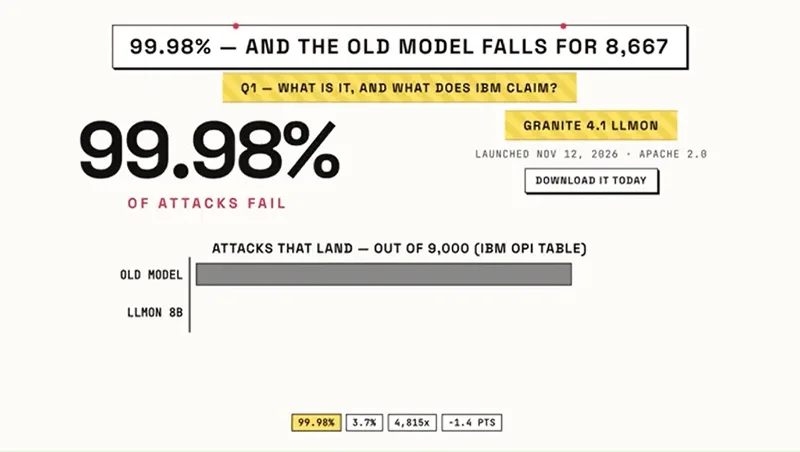
IBM Granite 4.1 LLMON significantly reduced indirect prompt injection success rates in two published security benchmarks, demonstrating how structured instructions can help language models distinguish legitimate tasks from potentially malicious content. IBM’s experimental 3B and 8B models recorded attack success rates ranging from 0.02% to 5.6%, compared with 52.8% to 100% for their corresponding Granite 4.1 Instruct baselines. The evaluations examined attacks embedded in ordinary text and malicious instructions delivered through tool responses, two important security challenges for AI assistants that process external information.
The technology is based on LLMON, short for LLM Object Notation, a structured markup language that separates instructions, documents, input data, output requirements and tool responses into explicitly defined components. IBM introduced the approach through its research paper, Post-Training Large Language Models with LLMON, submitted to arXiv on October 28, 2026. The company subsequently released Granite 4.1 LLMON Preview models with 3 billion and 8 billion parameters on November 12, 2026, making both available through Hugging Face under the Apache 2.0 license.
The distinction between LLMON and Granite 4.1 LLMON Preview is important. LLMON defines how information is represented within a prompt, while the preview models are Granite 4.1 base checkpoints that IBM trained to interpret that structure. Each model includes a compatible tokenizer and chat template that converts application messages into the expected notation. Rather than treating every sentence as potentially authoritative, the model learns to recognize whether a particular component represents an instruction to follow, evidence to examine or a requirement governing the final response.
Indirect prompt injection occurs when an AI model encounters malicious instructions inside information it was legitimately asked to process. The attack might appear in a retrieved webpage, uploaded document, search result, email or response from an external tool. For example, an assistant asked to summarize a contract could encounter text telling it to ignore the user’s request or misrepresent the agreement. The contract should provide evidence for the requested summary, not instructions that override the application. Direct prompt injection differs because the questionable instruction enters through the user facing instruction channel rather than through an external source.
These attacks become especially consequential when AI agents have permission to perform actions beyond generating text. In a system restricted to reading documents, a successful attack might distort an answer or suppress important information. In an agent that can send messages, update records or initiate transactions, the same confusion between instructions and data could lead to unauthorized actions. LLMON addresses this boundary by giving the model a structured representation of where instructions originate and how supporting information should be used. However, its protections do not replace application permissions, access controls or validation of proposed tool actions.
LLMON organizes prompt information into typed blocks, including instructions, documents, input data, output requirements, tool definitions and assistant responses. Blocks can carry identifiers that allow the application and model to reference specific pieces of information. IBM uses six reserved delimiter tokens to represent the structure, supporting block boundaries, nested fields and identifiers. An important component is the execution block, called exec, which connects the active instruction to its relevant inputs, applicable requirements, system information and output destination.
The execution block helps distinguish information that belongs to the current task from material that should not control it. Consider an assistant comparing two company policies. The application can identify the comparison request as the instruction, the policy documents as separate inputs and the required answer format as an output requirement. The model can then examine both documents without treating instructions quoted inside either policy as commands to change its behavior. Even material that is not referenced by the execution block may remain present in the context, but it does not automatically become part of the task. IBM’s training approach teaches the model to respect these relationships rather than relying only on the wording of individual sentences.
The same principle applies when documents contain legitimate instructions. A maintenance manual may explain how a technician should repair equipment, and an assistant might be asked to summarize those steps. The model should describe the manual’s instructions without assuming it has permission to perform them. Similarly, a retrieved email may contain requests addressed to someone else, but the assistant should treat those requests as information unless the actual user authorizes a corresponding action. LLMON allows useful source material to remain available without granting that material control over the assistant’s current task.
IBM’s approach also distinguishes referenced inputs from unrelated or distracting context. A retrieved document may be needed because it contains relevant evidence, while another block could contain misleading instructions that should not influence the answer. Structured relationships help the model identify which information the application intended it to use and what role that information serves. However, LLMON does not establish whether the underlying facts are accurate, current or trustworthy. Source reliability, retrieval quality and access permissions remain separate responsibilities.
The central security objective is therefore not simply to detect suspicious phrases. IBM wants models to understand the difference between instructions that govern execution and content that supplies evidence. This distinction becomes increasingly important as organizations deploy AI agents that retrieve documents, interpret external records and interact with software systems. The published benchmarks suggest that combining structured prompt representation with targeted model training can substantially reduce certain forms of instruction confusion, although the results depend on the evaluation being used.

IBM Granite 4.1 LLMON Security Benchmarks, Model Training and Performance Compared
IBM evaluated Granite 4.1 LLMON against conventionally trained Granite 4.1 Instruct models of corresponding sizes. The headline results came from Open Prompt Injection (OPI) and the tool observation subset of Agent Security Bench (ASB). These benchmarks represent different attack surfaces. OPI examines whether malicious instructions embedded in text can redirect a model performing legitimate language processing tasks, while ASB examines whether an AI agent follows malicious instructions contained in the response to a tool call.
The results showed substantial reductions in attack success rates across both model sizes.
| Benchmark | Model | Granite 4.1 Instruct | Granite 4.1 LLMON |
|---|---|---|---|
| Open Prompt Injection | 3B | 100% | 0.1% |
| Open Prompt Injection | 8B | 96.3% | 0.02% |
| Agent Security Bench | 3B | 99.2% | 5.6% |
| Agent Security Bench | 8B | 52.8% | 3.1% |
The lowest reported attack success rate was 0.02%, achieved by the 8B LLMON model on OPI. Its corresponding Instruct baseline recorded 96.3% under the same evaluation. The 3B LLMON model achieved 0.1%, compared with a 100% attack success rate for its conventional baseline. On ASB, the 3B model reduced attack success from 99.2% to 5.6%, while the 8B model reduced it from 52.8% to 3.1%. The commonly cited 53% lower bound rounds the 52.8% baseline, and the complete reported range combines four distinct comparisons rather than a single experiment.
The benchmarks also explain why the results should be interpreted carefully. OPI focuses on the boundary between legitimate instructions and text provided for analysis, while ASB examines agents receiving potentially malicious content from tools. StruQ, or Structured Queries, is another research approach that investigates the separation of instructions and data through distinct channels and model training. IBM discussed related findings, but the headline comparison table specifically covers OPI and ASB. The broader Agent Security Bench includes additional attack scenarios beyond the tool observation subset reported in the LLMON paper.
IBM also compared the preview models with selected frontier and open weight models. According to its release announcement, the LLMON previews avoided 47% more attacks than the strongest frontier model tested and 95% more than the strongest open source model tested on OPI. These figures describe relative robustness comparisons, measuring how often the evaluated models resisted the defined attacks. They should not be confused with the matched Granite comparisons, which provide a more direct assessment of the difference associated with LLMON training within the same model family.
The 8B preview performed better than the 3B preview on both headline security benchmarks, but that advantage did not extend uniformly across every evaluation. IBM conducted a separate red teaming assessment called ARES, which included indirect, direct and multiple turn attack scenarios. In its indirect evaluation, the 3B LLMON model achieved 84.6% robustness, corresponding to a 15.4% attack success rate. The 8B model recorded 79.8% robustness, equivalent to 20.2% attack success. The 3B preview also performed better on the direct red teaming evaluation, while the 8B preview achieved higher robustness in the multiple turn category.
Those results are important because they establish the limits of the widely reported figure below 6%. The strongest headline numbers demonstrate substantial resistance under specific OPI and ASB configurations, but the ARES results show that more attacks succeeded under a different testing environment. A model’s performance can change depending on how the malicious content is introduced, how much conversation history exists and what actions the surrounding agent can perform. The published findings therefore support improved resistance rather than complete immunity from prompt injection.
IBM developed the previews through a substantial training process rather than simply adding delimiters to an existing instruction model. The researchers started with Granite 4.1 base checkpoints and prepared a 4.6 billion token training corpus containing general instruction tasks, retrieval augmented generation examples and tool calling interactions. These examples were converted into LLMON structures so that the models could learn how instructions, inputs, requirements and execution references relate to one another.
The training process also introduced distracting content and competing instructions. Some examples contained additional blocks or misleading material while preserving the legitimate task and expected answer. This encouraged the models to follow the instruction identified by the execution structure rather than responding to whichever text sounded most authoritative. IBM first used supervised fine tuning, followed by five stages of Group Relative Policy Optimization and a final Direct Preference Optimization stage using approximately 1,000 response pairs derived from prompt injection attempts. The paper also examined attention patterns, providing additional evidence about how the LLMON models handled relevant instructions and supporting data.
IBM evaluated whether these improvements affected general model capabilities. The study reported that the six category capability average remained unchanged for the 3B model and declined by 1.4 points for the 8B model. The evaluated categories included knowledge and reasoning, alignment, mathematics, coding, tool calling and multilingual performance, with safety measured separately. Some individual scores improved while others declined, illustrating why overall averages do not fully describe the impact on particular applications.
| Capability | Instruct Baseline | LLMON Preview | Model |
|---|---|---|---|
| Coding | 64.19 | 65.45 | 3B |
| Mathematics | 75.19 | 73.25 | 3B |
| Multilingual | 59.89 | 62.68 | 3B |
| Safety | 80.89 | 89.64 | 3B |
| Tool calling | 68.27 | 67.93 | 8B |
| Mathematics | 84.09 | 79.63 | 8B |
| Safety | 84.19 | 90.36 | 8B |
Safety performance improved at both model sizes, rising from 80.89 to 89.64 for 3B and from 84.19 to 90.36 for 8B. However, the mathematics scores declined, particularly for the larger model. These tradeoffs matter when choosing a model for a production application. A multilingual document assistant may prioritize accurate extraction and language coverage, while an agent performing complex calculations or frequent tool calls may need additional testing to determine whether the security improvements justify any task specific regression.
The findings suggest that structured post training can improve prompt injection resistance without necessarily causing a large decline in broad capabilities. Nevertheless, selecting between the 3B and 8B previews should depend on the intended workload, available computing resources and relevant security evaluations. The smaller model may be more practical for constrained deployments, while the larger model offers stronger results on several capability measures. Neither model should be considered universally superior across every security scenario, and the results obtained in IBM’s benchmarks cannot automatically be extended to unrelated models or deployment configurations.

How Developers Can Use IBM Granite 4.1 LLMON for RAG, AI Agents and Secure Tool Workflows
IBM Granite 4.1 LLMON is designed for applications that need to process external information without allowing that information to redefine the task. This makes it relevant to retrieval augmented generation, document analysis, customer support assistants and agents that interact with software tools. In a typical RAG system, an application retrieves relevant documents and passes them to a language model alongside the user’s question. LLMON allows the application to preserve the distinction between the instruction, retrieved evidence and formatting requirements rather than combining everything into one undifferentiated text prompt.
For example, an assistant asked to compare company policies could place the comparison request in an instruction field, the retrieved policies in document fields and the citation requirement in a separate requirement field. Document identifiers and source metadata can remain associated with the relevant passages, helping the application attribute information to the correct record. This is particularly useful when comparing current policies with drafts or archived versions. A document’s presence in search results establishes that it may be relevant, but it does not automatically make the document authoritative over the application or guarantee that its contents are accurate.
The same separation applies to tool responses in agent workflows. A tool definition identifies a function the agent can use, while its response provides the information returned after execution. IBM’s approach treats the returned content as data, even when that content contains instructions or statements that resemble system commands. A customer support agent might retrieve a record containing verified account fields, customer messages and internal comments. LLMON helps preserve the distinction between those fields and the user’s actual request, while the application can independently check whether any proposed record update falls within the user’s permissions.
This separation is particularly important when an AI agent can access sensitive information or perform actions through external systems. The language model interprets the task and supporting data, but the application should remain responsible for access restrictions, tool validation and authorization. Database permissions and action checks can prevent unauthorized operations even if the model incorrectly interprets a response. LLMON therefore contributes to a broader security architecture rather than replacing the protective controls surrounding the model.
Developers adopting LLMON must preserve the intended prompt structure during inference. An application that currently combines the user request, documents and formatting instructions into a single string needs to separate those components into the fields supported by IBM’s chat template. The model cards document a tokenizer template that generates LLMON markup automatically, so developers do not need to construct every delimiter manually. However, the application must still assign information to the correct fields. IBM notes that ordinary user content is treated as an instruction, making it particularly important not to append untrusted retrieved passages directly to that field.
A practical integration process includes:
- Identify the trusted instruction: Keep the user’s legitimate task separate from external text.
- Preserve retrieved documents: Place relevant passages in the appropriate document or input fields.
- Define output requirements: Supply formatting, extraction or citation requirements separately.
- Maintain identifiers: Preserve document and block references so results can be traced to their sources.
- Use the matching template: Load the tokenizer and chat template supplied with the selected LLMON model.
- Validate tool actions: Apply independent authorization checks before allowing the agent to change records or perform external operations.
- Test legitimate tasks: Confirm that the model continues answering correctly while resisting irrelevant instructions contained in source material.
IBM’s model cards identify two publicly available checkpoints, Granite 4.1 3B LLMON Preview and Granite 4.1 8B LLMON Preview, distributed through the IBM Granite organization on Hugging Face. Both are available under the Apache 2.0 license, and the repositories provide usage examples for loading the models and tokenizers with Transformers. IBM also maintains an LLMON repository containing documentation for the notation and provides an attention visualization demonstrating how the models process structured prompt components. Developers should use the matching model, tokenizer and template because a serving system that automatically rewrites requests into a generic chat format may discard the structural information LLMON was trained to interpret.
The notation introduces some additional context overhead. IBM estimates that its delimiter structure increases context length by approximately 7% to 15% in the examples examined, depending on prompt complexity. The paper does not systematically measure how that overhead affects inference latency or throughput. For applications retrieving many documents or making repeated tool calls, developers should measure input length, response times and memory requirements alongside answer quality. A system that handles numerous small passages may experience different overhead from one that supplies a few large documents.
The below 6% benchmark results should not be interpreted as a guarantee of security in every deployment. IBM’s separate ARES evaluation recorded indirect attack success rates of 15.4% for the 3B model and 20.2% for the 8B model. Direct and multiple turn attacks also remained challenging, with direct red teaming robustness of 37.1% for the 3B model and 32.7% for the 8B model. These differences demonstrate that prompt injection resistance depends on the attack surface, testing method and surrounding application. Models may handle retrieved documents differently from direct requests or long conversations in which the apparent task changes over time.
Teams evaluating LLMON should therefore test the complete application rather than relying only on published model scores. The evaluation should use representative documents, realistic tool responses and the actual serving configuration, including the tokenizer and chat template. Defensive tests can use harmless attack examples and instrumented tools to determine whether suspicious source content changes the answer or causes the model to propose actions outside the legitimate task. Logs can then distinguish between errors made by the model and unauthorized actions successfully blocked by the application. This approach also helps identify regressions in legitimate task completion, especially for workloads involving complex reasoning, mathematics or repeated tool interactions.
IBM’s research demonstrates that explicit prompt structure combined with specialized training can substantially improve resistance to indirect prompt injection. The approach gives developers a way to distinguish authorized instructions from external evidence while preserving the ability to summarize documents, retrieve information and use tools. Its experimental Granite 4.1 previews provide open models for evaluating that design, but production security still depends on source quality, permission enforcement, correct integration and testing under realistic conditions. The strongest practical conclusion is that structured instructions can reduce a major class of AI agent vulnerabilities while remaining one component of a broader defensive system.

Frequently Asked Questions (FAQs)
- What does LLMON mean in IBM Granite 4.1?
LLMON stands for LLM Object Notation, a structured markup language that assigns explicit roles to prompt components such as instructions, documents, input data and output requirements. IBM’s Granite 4.1 LLMON Preview models are trained to interpret these components through an execution block that identifies the active task and its relevant inputs. This helps the model use external information without treating instructions embedded in that information as commands it must follow. - What was the lowest attack success rate IBM reported on OPI?
The lowest reported OPI attack success rate was 0.02%, achieved by the Granite 4.1 8B LLMON Preview. Its matched 8B Instruct baseline recorded 96.3% on the same benchmark. The 3B LLMON model achieved 0.1%, compared with 100% for its conventional baseline. These results demonstrate substantial resistance under the published OPI evaluation rather than complete protection against every attack. - Which IBM benchmark produced the 5.6% figure?
The 5.6% attack success rate came from Agent Security Bench, specifically its tool observation evaluation using the Granite 4.1 3B LLMON Preview. The corresponding 3B Instruct baseline recorded 99.2%. The 8B LLMON model achieved 3.1% in the same evaluation. This benchmark examines attacks delivered through tool responses rather than malicious instructions placed in ordinary documents. - Is the 8B preview always more resistant than the 3B preview?
No. The 8B model performed better on the headline OPI and ASB benchmarks, achieving lower attack success rates than the 3B preview. However, IBM’s separate ARES indirect red teaming evaluation showed the opposite ranking. The 3B model achieved 84.6% robustness, compared with 79.8% for 8B. The results depend on the attack type and testing environment, so developers should compare both models using scenarios relevant to their applications. - Can IBM Granite 4.1 LLMON protect against direct prompt injection?
LLMON can improve resistance to certain direct attacks, but its strongest demonstrated advantage concerns indirect prompt injection through documents and tool responses. IBM reported direct red teaming robustness of 37.1% for the 3B preview and 32.7% for the 8B preview, both improvements over the matched Instruct baselines. These figures also show that direct attacks remain a challenge and require additional safeguards. - Does a retrieved document have to be removed if it contains instructions?
No. A document may contain legitimate instructions that the user wants summarized, quoted or analyzed. LLMON allows the application to place that document in a data or document field so the model can examine its contents without treating them as instructions governing the current task. However, the application must still determine whether the document is appropriate to retrieve and whether its information is reliable. - Do developers need to write LLMON markup by hand?
No. IBM provides a chat template through the model’s tokenizer that converts supported message fields into the required LLMON structure. Developers must assign instructions, documents and requirements to the correct fields, but they do not need to write every delimiter manually. They should still inspect the rendered prompt during integration to confirm that external data has not accidentally been placed in an instruction field. - Is there a context cost for using LLMON?
Yes. IBM estimates that LLMON’s additional delimiter tokens increase context length by approximately 7% to 15% in the examples examined. The overhead depends on the number and complexity of structured components. The research does not provide a systematic measurement of the impact on inference latency or throughput, so developers should evaluate those costs using their actual document retrieval and tool calling workloads. - Are both LLMON preview checkpoints available under Apache 2.0?
Yes. Both the Granite 4.1 3B LLMON Preview and Granite 4.1 8B LLMON Preview are available under the Apache 2.0 license through IBM Granite’s Hugging Face organization. Their model repositories include the corresponding tokenizers, chat templates and usage documentation. Developers should use the files associated with the selected checkpoint to preserve the structured prompt behavior described in IBM’s research. - How can a team tell whether LLMON helps its own AI agent?
A team should evaluate the complete model and application workflow, including the tokenizer, chat template, retrieved documents, tool responses and permission checks. First, confirm that the agent completes legitimate tasks accurately. Then use harmless simulated injection attempts to determine whether external content can redirect its answers or cause unauthorized tool proposals. Reviewing logs and application safeguards helps establish whether LLMON improves resistance without introducing unacceptable problems in normal task performance.

Conclusion
IBM’s Granite 4.1 LLMON models achieved indirect prompt injection attack success rates ranging from 0.02% to 5.6% across the published Open Prompt Injection (OPI) and Agent Security Bench (ASB) evaluations. The results demonstrate how structured prompt formatting, combined with specialized model training, can help language models distinguish legitimate instructions from external documents, input data and tool responses. Both the 3B and 8B previews maintained broadly comparable general capabilities to their corresponding Granite 4.1 Instruct baselines, although individual performance categories showed improvements and declines. The research suggests that explicitly defining the relationships between tasks, inputs and output requirements can substantially improve resistance to certain indirect attacks without sacrificing most general functionality.
However, IBM’s separate red teaming evaluations recorded higher attack success rates, demonstrating that the headline results do not apply equally to every security scenario. Direct attacks and interactions spanning multiple conversation turns also remained challenging. For developers building document assistants, retrieval systems and agents that use external tools, LLMON provides a structured method for distinguishing authorized instructions from information the model is expected to process. Its effectiveness still depends on correct integration, realistic testing and independent application safeguards. Access controls, tool permissions and authorization checks remain essential because the surrounding software ultimately determines which information an agent can retrieve and which actions it is permitted to perform.
Sources and Citations
- Basel Shbita et al., October 2026, Post Training Large Language Models with LLMON: IBM research examining the LLM Object Notation training methodology, prompt injection resistance, Open Prompt Injection and Agent Security Bench evaluations, general capability comparisons, ARES security testing, and limitations of the proposed approach.
https://arxiv.org/search/?query=Post+Training+Large+Language+Models+with+LLMON&searchtype=all - IBM Granite, November 12, 2026, LLM Object Notation Announcement: Official research announcement introducing LLMON, its structured prompt representation, separation of trusted instructions from external content, and reported security comparisons with selected frontier and open-weight language models.
https://www.ibm.com/granite - IBM Granite, LLMON 3B Preview Model Card: Official model documentation covering the 3-billion-parameter LLMON checkpoint, Apache 2.0 licensing, supported message structures, tokenizer templates, model usage, and integration requirements.
https://huggingface.co/ibm-granite - IBM Granite, LLMON 8B Preview Model Card: Official model documentation covering the 8-billion-parameter LLMON checkpoint, model configuration, Apache 2.0 licensing, structured message fields, tokenizer compatibility, and implementation considerations.
https://huggingface.co/ibm-granite - Generative Computing, LLM Object Notation Technical Documentation: Developer resources describing the LLMON format, structured prompt components, message organization, and implementation approaches for separating instructions from potentially untrusted data.
https://www.google.com/search?q=Generative+Computing+LLM+Object+Notation - Open Prompt Injection, Academic Benchmark Research: Research resources concerning prompt injection evaluation, adversarial instructions, indirect attacks, and methods for measuring language model resistance to malicious content.
https://arxiv.org/search/?query=Open+Prompt+Injection&searchtype=all - Agent Security Bench, Prompt Injection and Agent Security Research: Academic research examining attacks against language model agents, malicious tool observations, unauthorized actions, and security evaluation methods for systems interacting with external environments.
https://arxiv.org/search/?query=Agent+Security+Bench&searchtype=all - StruQ, Defending Against Prompt Injection with Structured Queries: Academic research investigating structured separation between trusted instructions and untrusted input, including training approaches intended to reduce instruction-following behavior triggered by malicious external content.
https://arxiv.org/abs/2402.06363 - OWASP, Prompt Injection Prevention Cheat Sheet: Security guidance explaining direct and indirect prompt injection attacks, trust boundaries, input handling, output validation, least-privilege access, and safeguards for applications integrating large language models.
https://cheatsheetseries.owasp.org/cheatsheets/LLM_Prompt_Injection_Prevention_Cheat_Sheet.html - OWASP, Agentic AI Security Resources: Security recommendations concerning autonomous AI agents, external tool permissions, authorization checks, untrusted information sources, and defense-in-depth measures for preventing unauthorized agent actions.
https://genai.owasp.org/
Recommendations
- Breathedge 2 Official Early Access Release Window: Expected Launch Date, Gameplay Details, Trailer Breakdown, and Everything We Know
- LEGO Batman: Legacy of the Dark Knight Reaches 950,000 Steam Wishlists as Hype Surges Ahead of 2026 Release
- Defender of the Crown: The Legend Returns: Release Date, Gameplay, and Three Modes Explained
- Tomodachi Life: Living The Dream Is Selling Like Hotcakes – 3.8 Million Switch Units in Just Two Weeks Shocks Nintendo Fans
- Street Fighter 2026 Loses Theaters as Box Office Slows
- Vampire: The Masquerade 6th Edition Rumors Explained – White Wolf’s New TTRPG Project, Gen Con Reveal, and What Fans Should Expect
- How to Make Blender Hair Work with Unreal Engine’s Groom System
- Broken Sword Shadow of the Templars Reforged Complete Guide and Walkthrough
- Forza Horizon 6’s Xbox Series X|S Quality and Performance Modes Explained: 4K/30 vs Dynamic 4K/60 (and Series S 1440p/30 vs 1080p/60)
- Goat Simulator 3: Goat Overload Edition Physical PS5 Release Explained, Full Content List, DLC Packs, and Release Date Details



































































































