







In This Article (8 sections)
Why Square Enix Added a Kingdom Hearts Loremaster to the Kingdom Hearts 4 Team
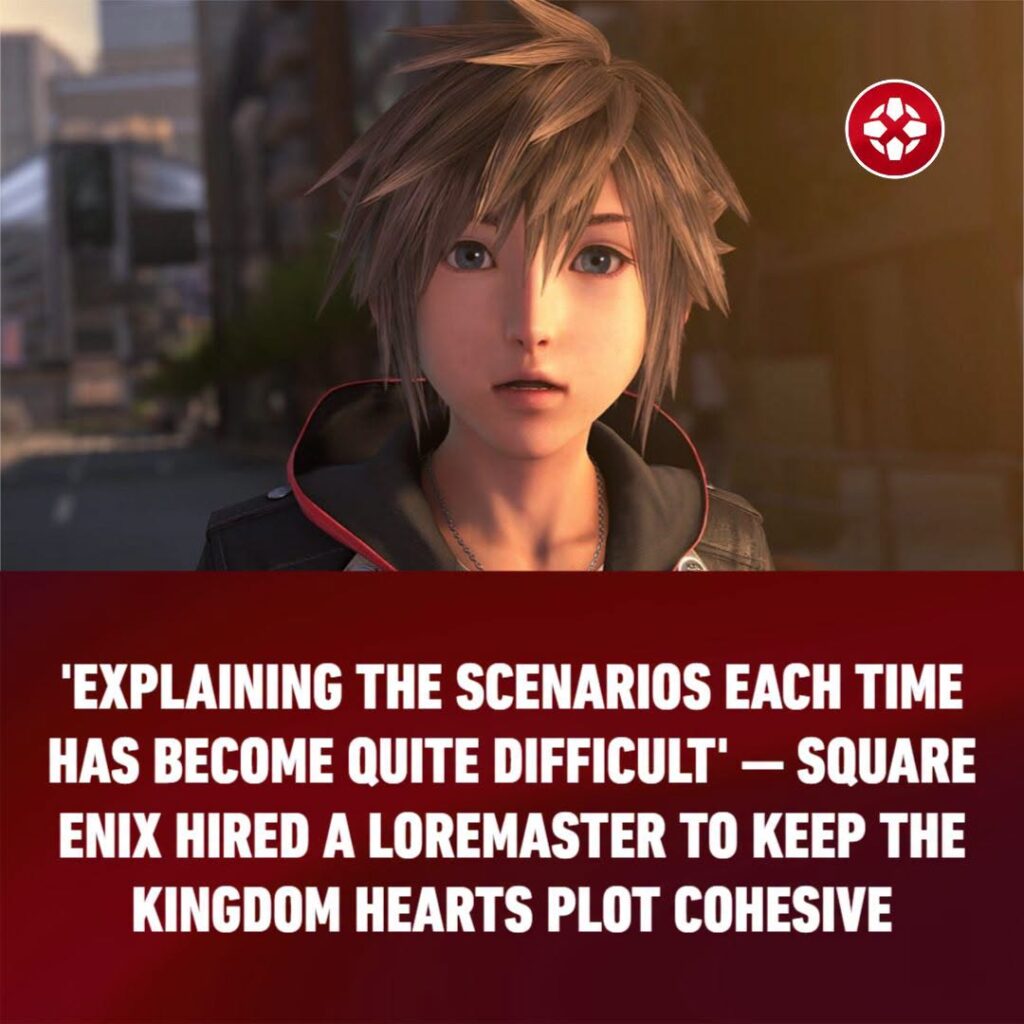
Reports that Square Enix hired a Kingdom Hearts loremaster brought attention to an important development responsibility: checking story continuity while also helping Disney understand the franchise’s increasingly interconnected mythology. The role described in coverage is fundamentally a proofreading and continuity position rather than a conventional writing assignment.
Its responsibilities go beyond correcting spelling or polishing sentences because the specialist must organize established information, compare new material with earlier settings, and help explain complicated relationships and events clearly enough for collaborators to work with them. One important distinction is that the appointment did not happen after the interview that publicized it. Tetsuya Nomura described an existing member of the χ-series staff joining the Kingdom Hearts 4 team during early development, while Famitsu published the interview on August 27, 2026. The staffing decision and the date when the public learned about it are therefore separate events.
The immediate purpose of the role was to support story consistency while making accumulated lore easier to communicate. Reporting on Nomura’s comments describes a specialist who already understood the franchise’s historical material and could organize it clearly for Disney. Those responsibilities solve related but distinct problems.
A development team may need to determine whether a new scene contradicts something established years earlier, while an external production partner may need a concise explanation of why that earlier event matters, which characters were involved, and how a proposed new scene fits with it. Neither responsibility requires replacing the original storyteller. Both require a dependable way to separate confirmed information from assumptions and interpretations, which makes detailed franchise knowledge useful only when it can be retrieved, checked, communicated, and applied to the script under development.
Famitsu’s interview with Nomura and Kingdom Hearts 4 co-director Tai Yasue makes the assignment more specific. Nomura described the specialist’s internal responsibility as comparing the new scenario with previous settings and identifying discrepancies. That is different from simply hiring someone who “understands Kingdom Hearts.” Familiarity with the fiction is the qualification, while continuity review is the job. The existence of this process does not reveal how many inconsistencies have been discovered, whether particular scenes were rewritten, or whether every apparent contradiction from earlier games has been resolved. What the interview establishes is that someone on the team is explicitly responsible for comparing the new game’s narrative with information already established across the franchise.
The individual is identified through his work rather than by name. Reporting describes him as an experienced member of the χ-series staff who had already organized Kingdom Hearts setting information and helped explain it to Disney. That makes it inappropriate to attach the role to a particular writer, translator, producer, or prominent fan theorist without evidence. It also matters when interpreting the word “hired.”
An employee formally joining a specific project is not necessarily a newly recruited employee joining Square Enix from outside the company. Internal transfer, expanded responsibilities, and external recruitment are different arrangements. The more useful question is therefore not whether this person is the franchise’s most knowledgeable fan, but whether he can turn detailed knowledge into reliable editorial work by locating the relevant evidence, explaining conflicts precisely, and recognizing when an unanswered point requires clarification rather than correction.
Nomura placed the appointment at the beginning of Kingdom Hearts 4 development after Disney requested compiled reference material, but he did not provide a specific appointment date. That chronology prevents the role from being framed as a recent emergency response to criticism about the series’ complexity.
An interview can reveal a practice that has already existed for months or years, and the available account indicates that continuity support was introduced early enough to participate in development rather than merely checking a nearly finished script after the fact. It would still be an inference to claim exactly how early the reviewer became involved in particular drafts, approvals, or revisions. The supported conclusion is simply that the public disclosure came later than the staffing decision itself.
Nomura also distinguished 校正, meaning proofreading, from 構成, meaning composition or structure. Although both can be pronounced kōsei, they refer to different responsibilities. A writer decides what happens, develops motivations, and shapes how the audience experiences a scene. A continuity reviewer tests whether those decisions remain compatible with information already established. If a proposed exchange assumes that two characters previously met, the reviewer may flag the issue, but the writer still decides whether to revise the dialogue, establish an earlier meeting, or change the scene’s purpose.
Identifying the continuity problem and choosing the creative solution are related contributions, but they are not the same job. Nomura’s earlier comments about bringing in writers who had not previously worked on Kingdom Hearts reinforce that distinction: new perspectives can help expose unclear explanations, while experienced continuity reviewers can protect established information without becoming the sole authors of the franchise.
How the Kingdom Hearts Proofreader Checks Lore, Χ-Series Continuity, and Story Inconsistencies
Nomura described a review process involving detailed questions directed to him and comparison between the Kingdom Hearts 4 scenario and previously established settings. The specialist therefore does more than independently interpret material available in the released games. In a separate Young Jump interview, Nomura explained that he keeps private notes concerning future developments and undisclosed history while giving staff the explanations they need.
That creates an important editorial challenge because a continuity reviewer must distinguish between an actual contradiction and information that has intentionally not yet been revealed. A character making an inaccurate statement, for example, is not automatically a writing error if the character is mistaken, withholding information, or speaking from limited knowledge. Likewise, a later revelation can change the audience’s understanding of an earlier scene without necessarily invalidating it. The real question is whether the earlier evidence remains compatible with the new explanation.
The specialist’s χ-series background is particularly relevant because Nomura’s account connects Kingdom Hearts 4 closely with material from that branch of the franchise. The χ storyline developed through related projects rather than existing as one isolated side story, and Nomura discussed this evolving structure as early as a 2016 Famitsu interview covering the browser game’s concluding scenario and its divergence from Unchained χ.
Reviewing a continuation therefore requires more than recognizing names. The reviewer must know which information belongs to which title or era, what was explicitly established at the time, what later material clarified, and what remains only implied. An implication, a character’s belief, and a confirmed revelation are not interchangeable forms of evidence. Even a seemingly simple callback may require checking who possessed an object, who recognized it, when its importance became known, and whether all characters in the new scene could realistically know the same information.
The Kingdom Hearts 4 interview provides concrete connections to this older material. It discusses Vali from the Union χ Dark Road material and Sigurd from Union χ, while also placing the Dandelions in Kingdom Hearts 4 and describing them as cooperating with Quadratum’s government, with Sora among the Keyblade wielders involved. These details make the need for continuity review easier to understand because a numbered sequel can introduce a new immediate situation while simultaneously drawing on characters, organizations, and events established elsewhere.
Recognizing that connection does not provide the complete explanation, however. A returning name does not reveal a character’s full motive, and the appearance of an organization does not automatically disclose every part of its history or how all previous associations apply to the new setting. The important distinction is between continuity and dependency: Kingdom Hearts 4 can continue earlier material without requiring players to know every historical detail before understanding the opening situation.
The wider Kingdom Hearts timeline makes this work more demanding because release order and fictional chronology are not the same. Birth by Sleep occurs before the original Kingdom Hearts, while 358/2 Days released after Kingdom Hearts II but explores earlier events. Collections called 1.5 and 2.5 can also be mistaken for ordinary sequel numbering even though they package older material.
On top of that, the franchise uses altered memories, time travel, multiple versions of characters, hidden identities, and deliberately withheld information. A continuity reviewer may therefore need to track not only when an event happened, but when it became known and whose understanding a particular scene reflects. Nomura’s January 2020 PlayStation Blog interview illustrates this distinction by highlighting Xigbar as a meaningful long-term payoff while declining to explain hidden identities because doing so would spoil later revelations.
This is why unanswered questions and inconsistencies should not be treated as the same thing. A mystery deliberately withholds information, while an inconsistency introduces claims that the story cannot reconcile. A complicated narrative can remain internally coherent, just as a simple narrative can contain errors. The proofreader’s job is therefore not merely to make Kingdom Hearts less complicated. It is to preserve the relationships, chronology, character knowledge, and narrative rules that allow complicated material to remain meaningful when later revelations arrive.
Why Disney Needed Kingdom Hearts Lore Documentation and How KH4 Can Remain Accessible to New Players
Disney’s request centered on organized reference material that could make Kingdom Hearts scenarios and settings easier to understand during collaboration. The available account does not show Disney asking Square Enix to replace the story or simplify the franchise from the ground up. Instead, it describes a need for someone capable of compiling existing information and explaining it clearly. That makes practical sense because a collaborator should not need to reconstruct the franchise’s entire history every time a new scene or character relationship is discussed. Good reference material can separate the background required for an immediate production decision from additional historical information that may be interesting but unnecessary at that moment.
The reported use of diagrams is one of the clearest examples of how that work may function. Visual documentation can expose relationships that lengthy prose makes difficult to follow. A relationship chart can distinguish an alliance from a family connection, a timeline can separate the order in which events happened from the order in which audiences discovered them, and a knowledge map can show what the player knows compared with what an individual character knows.
Those examples illustrate the potential value of diagrams rather than confirming the exact form of Square Enix’s internal documents. The reports do not establish which software is used, how often diagrams are updated, who approves them, or whether they resemble something suitable for public release. Internal production material could include unrevealed plot points, provisional decisions, or explanations that would spoil later mysteries, so documentation designed for collaborators would not automatically function as a player-facing guide.
Disney’s wider collaboration with Square Enix adds relevant context. In August 2026, Disney announced an original Kingdom Hearts anime series for Disney Channel and Disney+, developed with Nomura and Square Enix and described as a new story expanding the universe. Disney’s broader games strategy has also emphasized original interactive stories developed with external partners.
Those developments help explain why organized franchise knowledge could become increasingly useful, but they do not establish that the Kingdom Hearts 4 proofreader joined specifically because of the anime, that he is writing its scripts, or that the precise continuity relationship between the television project and the games has been disclosed. The stronger conclusion is simply that clear lore documentation gives collaborators a firmer basis for discussing new creative material.
Accessibility for new players presents another related but separate challenge. Nomura said Kingdom Hearts 4 would explain relevant returning characters within the game, including for people who had not played the smartphone titles. Previous knowledge can add recognition and context, but it is not intended to be the only route to understanding their immediate roles. Nomura had discussed a similar problem years earlier when talking about Kingdom Hearts III, describing the need to balance a concise opening with enough situational explanation while leaving deeper historical background in previous titles. The basic design challenge is to provide necessary context without bringing the adventure to a halt.
A character introduction does not need to begin with a complete biography. It can first establish what the person wants, how they relate to Sora or another central character, and why their current action matters. Earlier history can become more meaningful once the player has a reason to care about it. Returning fans may immediately connect a familiar name to previous events, but newcomers cannot rely on those associations, so the scene itself still needs to establish goals, relationships, and stakes. This is another area where writing and continuity review make different contributions. The writer decides how to introduce the information dramatically, while the proofreader checks that a simplified explanation remains accurate and does not contradict the deeper history.
That distinction also explains why the presence of a loremaster does not guarantee that Kingdom Hearts 4 will suddenly become simple. Consistency and clarity are different standards. A scene can be perfectly consistent with franchise history while still introducing too many unfamiliar concepts at once, just as an easy-to-follow scene can accidentally contradict an earlier event. Nomura’s 2020 comments acknowledged both his interest in fan interpretation and the possibility that some theories make the material more complicated than what is actually presented. A continuity specialist can support clearer storytelling by helping ensure that explanations are accurate and focused, but whether those explanations work for players still depends on how they are written, positioned, performed, and connected to the action.

What the Loremaster Role Reveals About Kingdom Hearts 4’S Script and Nomura’s Story Development Process
The Kingdom Hearts 4 script adds another reason why organized continuity work matters. Nomura described it as just under twice the size of the Kingdom Hearts III script, while GamesRadar+ reported that the volume complicated voice-recording arrangements and that Nomura still had additional material he would have liked to include. That comparison concerns the amount of written material rather than a guaranteed doubling of gameplay length. Dialogue can occur while the player is moving, conversations vary in performance time, and exploration or combat can occupy substantial portions of a game without creating a proportional increase in script pages. The same figure does not establish twice as many worlds, twice as many major characters, or twice as many unresolved mysteries.
From an editorial perspective, however, a larger script creates more relationships that may need to be checked. Something established early in the game can affect the meaning of a later conversation, while an explanation written to help newcomers can accidentally oversimplify an older rule. Returning χ-series characters may need to be introduced in ways that are accessible without contradicting details known to long-time players. These are reasonable review demands created by a large interconnected script, not evidence that Kingdom Hearts 4 currently suffers from particular continuity problems.
Nomura’s comments about the proofreader become more revealing when placed beside his earlier descriptions of how he writes Kingdom Hearts. Reporting on his 2024 Young Jump interview explains that he had a broad narrative direction in mind early but had not predetermined every intricate detail from the beginning. He also said he was already thinking about Kingdom Hearts IV while developing Kingdom Hearts III.
The interview further describes staff members asking questions and making corrections, while Nomura sometimes relies on colleagues or reviews older footage to refresh his memory about previous material. Taken together, these comments suggest a development process that combines long-term direction, revision, personal creative intent, and collaborative checking rather than either rigidly preplanning every detail from the first game or inventing everything without an established direction.
A dedicated continuity specialist fits naturally within that kind of process. Long-running storytelling can preserve important goals while still allowing local decisions to evolve, and new ideas can be introduced without abandoning established meaning if someone is responsible for identifying where those ideas create conflicts. This does not reduce Nomura’s role as the person shaping the story, nor does it turn the proofreader into the franchise’s new narrative authority. Instead, it separates two complementary responsibilities: deciding where the story should go and checking what the story must remain compatible with as it gets there.
The broader significance of the Kingdom Hearts loremaster is therefore less sensational than the nickname implies. Square Enix has assigned someone with detailed χ-series experience to organize information, answer continuity questions, compare Kingdom Hearts 4 material with established settings, and help communicate the franchise’s history to Disney.
That role can support both consistency and accessibility, especially as returning characters and older storylines feed into a substantially larger script. It does not guarantee that every mystery will disappear, that the finished game will be simple, or that every disputed point in the franchise has already been resolved. What it shows is that maintaining the internal logic of a large fictional universe and creating its next chapter are being treated as separate but closely connected development responsibilities.

Frequently Asked Questions (FAQs)
- Did Square Enix hire a Kingdom Hearts loremaster?
Reporting describes a dedicated proofreading and continuity-checking assignment on Kingdom Hearts 4 rather than a newly created story-writing position formally titled “loremaster.” The specialist’s work includes comparing new material with established series information and helping organize explanations for Disney, so the term “loremaster” is a useful shorthand for the role rather than the official name of a separate narrative job. - Who is the Kingdom Hearts proofreader?
The account identifies him as an experienced member of the χ-series staff who already had detailed knowledge of Kingdom Hearts settings and had helped organize information for Disney. However, the reporting does not publicly name him. That means attaching the role to a specific developer, writer, translator, or other known staff member without additional evidence would go beyond what has actually been disclosed. - When did the proofreader join the Kingdom Hearts 4 team?
Nomura said the specialist joined at the beginning of Kingdom Hearts 4’s development, but he did not provide a precise date. This means the appointment should not be treated as something that happened when the interview became public. The interview revealed an existing development practice rather than announcing that Square Enix had only just created the role. - Why did Disney request Kingdom Hearts lore documentation?
The purpose was to make the franchise’s scenario, settings, and interconnected background easier to explain during collaboration. Organized reference material could help Disney understand why certain characters, events, or relationships matter without reconstructing the entire series history each time a new idea is discussed. The reported request concerned clearer documentation and communication, not an announced demand to replace or rewrite the Kingdom Hearts narrative. - Is the proofreader the new Kingdom Hearts 4 story writer?
No. Nomura specifically distinguished proofreading from composition or story structure, meaning the proofreader’s responsibility is to check consistency rather than decide the overall direction of the narrative. A continuity reviewer can identify that a scene conflicts with previously established information, but the writer still decides how the scene, dialogue, or plot should be changed to resolve the issue. - How does the proofreader check Kingdom Hearts continuity?
Nomura described the specialist as comparing the current Kingdom Hearts 4 scenario with previous settings and asking him detailed questions when clarification is needed. That process helps distinguish actual contradictions from intentional mysteries, character misunderstandings, or information that has not yet been revealed publicly. The available comments do not describe a complete technical workflow, database, software system, or formal approval process beyond those responsibilities. - Why is Kingdom Hearts Union χ relevant to Kingdom Hearts 4?
The interview connects Kingdom Hearts 4 directly with characters and organizations associated with the χ storyline, including Sigurd and the Dandelions. That makes experience with Union χ and related material especially useful for someone checking continuity because the new game is drawing on story elements established outside the numbered titles. Those connections confirm that earlier material matters, but they do not reveal every character motive, relationship, or future plot development. - Will Kingdom Hearts 4 require knowledge of every previous game?
Nomura has described Kingdom Hearts 4 as being designed so that new players can understand relevant characters and situations without having played every earlier title, including the smartphone games. That does not mean the previous continuity has become unimportant. Returning players may recognize deeper connections immediately, while newcomers are expected to receive enough information within Kingdom Hearts 4 to understand the immediate roles, motivations, and stakes. - Is the Kingdom Hearts 4 script twice as long as Kingdom Hearts III’s?
Nomura described the script as just under twice the volume of Kingdom Hearts III’s, which indicates substantially more written material. However, script size is not the same thing as total gameplay length. Dialogue can occur during gameplay, scenes vary in delivery time, and exploration or combat can add hours without requiring proportionally more written dialogue, so the comparison should not be turned into a promise that the finished game will take twice as long to complete. - Will a loremaster make Kingdom Hearts easier to understand?
It could help, but continuity and accessibility are different problems. A proofreader can make sure that new explanations remain consistent with established events, characters, and rules, but a perfectly consistent scene can still be difficult to follow if it introduces too much information at once. How understandable Kingdom Hearts 4 ultimately feels will also depend on pacing, dialogue, character introductions, scene structure, and whether important context is provided at the moment players actually need it.

Conclusion
The Kingdom Hearts loremaster story is best understood as an account of continuity work and communication support. The reported specialist organizes established information, helps explain it to Disney, and contributes a focused understanding of the franchise’s earlier material.
Its significance is not that one employee can make a complex fictional universe simple. It is that different narrative problems need different solutions. An accurate reference document cannot replace an effective scene. A compelling new idea still needs to fit the story’s established foundations. An explanation written for a production partner may require a different form before it becomes useful to players.
The most promising interpretation is therefore measured: a clearly defined review role can support ambitious storytelling without taking over authorship. Whether Kingdom Hearts 4 successfully turns that support into an accessible, coherent adventure remains a question for the game’s actual presentation.
Sources and Citations
- Famitsu, Takahiro Sugihara, interview with Tetsuya Nomura and Tai Yasue: Published August 27, 2026. This is the primary source for the continuity-management role. Nomura explains that an existing χ-series staff member, who had organized earlier Kingdom Hearts settings and explained them to Disney, formally joined the Kingdom Hearts IV team as a proofreader during its early development. His work includes checking new scenarios against established information and preparing explanations with diagrams. Nomura explicitly distinguishes proofreading from story composition. The interview does not name the employee or establish August 2026 as his appointment date. famitsu.com
Citation: Kingdom Hearts IV: Famitsu Interview with Tetsuya Nomura and Tai Yasue, in Japanese - KHInsider, English translation of the August Famitsu interview: Published August 27, 2026, posted by Arielle. Provides an English rendering of the discussion about the proofreader, Disney’s requests for organized reference material, and the distinction between continuity checking and composing the story. It also translates the comments about KH4’s connections to the χ titles, explanations for players unfamiliar with those games, and the script’s increased volume. This is a translation of the same interview, not a separate staffing announcement. Khinsider
Citation: Famitsu Interview with Nomura & Yasue Discusses KH4 Development and Story Details - 80 Level, Amber Rutherford: Published August 31, 2026. Summarizes Nomura’s Famitsu comments under the headline’s “loremaster” terminology, explaining continuity checks, diagrams, and communication with Disney. The article reproduces a passage explicitly labeled as machine-translated, including the employee’s earlier work on the χ series. Its broader headline should therefore be read alongside the original explanation: the documented role is a proofreader joining KH4, rather than a newly identified lead writer or replacement for Nomura. 80 Level
Citation: Square Enix Hired Loremaster to Keep Track of Kingdom Hearts’ Story - Blognone, mk, Thai-language coverage: Published August 30, 2026. Describes the staff member’s role in compiling understandable reference documents, explaining the story to Disney, and checking that new material does not contradict earlier entries. It explicitly distinguishes the proofreader description from the “loremaster” label and notes that Nomura did not identify the employee by name. Blognone credits Famitsu via IGN, making its reporting another account of the same interview rather than independent confirmation of a separate appointment. Blognone
Citation: Nomura Says Kingdom Hearts’ Story Has Become Complex Enough to Need a Loremaster, in Thai - GamesRadar+, George Young, script-length coverage: Published August 27, 2026. Reports Nomura’s comparison of Kingdom Hearts IV’s script with KH3’s, describing the newer script as almost twice as large. The article also covers his comments about material he wanted to include and the demands of recording. This supports a comparison of written script volume, not a claim that KH4 will take twice as long to finish, contain twice as many worlds, or provide a particular campaign length. GamesRadar+
Citation: Kingdom Hearts 4’s Script Is Almost Twice as Big as KH3’s - Weekly Young Jump, original Tetsuya Nomura interview: The 2024 interview’s third page contains the relevant Kingdom Hearts discussion. Nomura describes keeping private notes about important characters and future developments, communicating necessary explanations to colleagues, encouraging questions, and consulting staff and videos about past events. He says that broad directions were considered early, while details could be adjusted when necessary. This supports a combination of advance planning, collaboration, and improvisation, not the stronger claim that every later plot detail was fixed when the first game was made. 週刊ヤングジャンプ公式サイト|集英社
Citation: Young Jump 45th Anniversary Interview with Tetsuya Nomura: Kingdom Hearts Section, in Japanese - Automaton, Carlos “Zoto” Zotomayor, reporting on the Young Jump interview: Published September 19, 2024. Explains Nomura’s writing process, including long-range ideas, selective sharing of unrevealed information, and relying on colleagues to recall earlier events. It also discusses his use of gameplay and analysis videos. This is useful English-language context for the earlier interview, but it predates the August 2026 proofreader coverage and should not be presented as another announcement of that role. Automaton Media
Citation: Tetsuya Nomura’s Writing Process for Kingdom Hearts Might Explain Both Its Cohesion and Convolution - PlayStation Blog, Rachel Mascetti, Square Enix interview with Nomura: Published January 22, 2020. Discusses Kingdom Hearts III and Re Mind, including the long buildup behind Xigbar’s role, deliberately withheld character information, and Nomura’s response to fan interpretation. It provides direct historical context for distinguishing intentional mysteries and delayed revelations from continuity mistakes. The interview concerns the creative choices surrounding KH3 and its expansion, rather than documenting the later KH4 staffing arrangement. PlayStation.Blog
Citation: Tetsuya Nomura Looks Back on Kingdom Hearts III, Ahead to Re Mind - The Walt Disney Company, official television-series announcement: Published August 14, 2026. Confirms that Kingdom Hearts, a working title, was greenlit as an original anime series for Disney Channel and Disney+, developed with Tetsuya Nomura and Square Enix’s creative team. Disney describes a new story expanding the Kingdom Hearts universe. The announcement establishes the television project and collaboration, but does not specify its exact position within the games’ chronology or identify a particular game as the season’s adaptation. The Walt Disney Company
Citation: Kingdom Hearts Greenlit for First-Ever Original TV Series on Disney Channel and Disney+ - The Walt Disney Company, official D23 games-strategy overview: Published August 16, 2026. Places Kingdom Hearts within Disney’s wider approach to games and digital entertainment, emphasizing original experiences, development partnerships, and additional ways for audiences to engage with its stories. This supports the broader business context for coordination across games and other media. It does not, by itself, establish shared continuity between unrelated Disney projects or additional responsibilities for the Kingdom Hearts proofreader. The Walt Disney Company
Citation: Disney Games’ Vision for the Future of Digital Entertainment: D23 Overview - Epic Games Store, Jess Reyes, series guide: Published August 1, 2023. Explains the collection names, recommends an order for experiencing the series, and discusses how prequels and connecting stories relate to the numbered games. Its treatment of Birth by Sleep illustrates why recommended play order is not necessarily strict in-universe chronology. This is a contributor’s newcomer guide hosted by Epic, rather than a developer-authored chronology document or evidence about KH4’s internal continuity-management process. Epic Games Store
Citation: Here’s the Order You Should Play All the Kingdom Hearts Games - KHInsider, English translation of Famitsu’s June 2016 interview: Published June 17, 2016, posted by Sign, with translation credited to goldpanner. Nomura explains how Dream Drop Distance and 0.2 function as preparation for KH3, and why introductory material was separated out to avoid slowing the new game’s opening. He also discusses helping first-time players understand the immediate situation while providing fuller context through earlier material. This supports the historical discussion of newcomer explanations and pacing, not a guarantee that every future installment requires no prior knowledge. Khinsider
Citation: Famitsu Interviews Nomura on Kingdom Hearts 3, HD 2.8 FCP, and Unchained X
Recommendations
- Echoes of Aincrad Crafting Guide: Recipes, Materials and Unlock Requirements
- Did Christopher Nolan’s Depiction of the Gods Pay Off in The Odyssey?
- Castlevania: Belmont’s Curse Runs at Only 30 FPS on Nintendo Switch
- EA Sports College Football 27 Preview: Defense Wins Championships
- Jurassic World Evolution 2 Complete Edition Comes to Nintendo Switch 2 on July 30, 2026
- Unity-Based Tool for JRPG Game Development: RetroGig’s Retro JRPG Template for SNES/PSX-Style RPG Systems
- Keanu Reeves & China Miéville BRZRKR: Light Draws Breath — Release Date, Story, Creative Team & Variant Covers
- CD Projekt Raises Profit Goals with Witcher 4, 5, and 6 Coming: 5 Billion PLN Target Explained
- Creepshow Official Announcement Trailer Reveals a New Anthology Horror Game Experience
- GTA 6 Leans Into Vice City’s Influencer Hustle Where Looks Matter



































































































