






The main story in Playground Games’ Fable reboot is expected to take approximately 15–20 hours, with another 15–20 hours of side content and open-world exploration. Beyond those estimates, its life simulation systems let players spend additional time building relationships, buying property and managing businesses. The game is scheduled to launch on February 23, 2027, for Xbox Series X|S, PC and PlayStation 5. These details are confirmed in the official Fable FAQ rather than being based solely on speculation or leaks.
The distinction between story length and total playtime is central to understanding this version of Albion. Fable is not presenting its campaign as an enormous mandatory commitment. Instead, its developers describe a more compact adventure surrounded by activities that players can pursue for their own enjoyment. As of September 22, 2026, these remain pre-release estimates and announced features, not independently measured completion times from the finished game.
In This Article (9 sections)
Fable Release Date: February 23, 2027 Launch Details.
Fable’s standard release date is February 23, 2027. Xbox confirmed the date during its June 2026 showcase coverage, alongside updated information about the game and its launch arrangements. Players purchasing an eligible Premium Edition can begin early access on February 18, 2027, giving them up to five days before the standard launch.
Older information describing an autumn 2026 release window is now outdated. Microsoft announced the move to February 2027 in May 2026, explaining that its crowded holiday schedule influenced the decision to give Fable a separate release window. That explanation should not be replaced with unsupported claims that the delay necessarily resulted from a particular technical failure or unfinished gameplay system.
The distinction between February 18 and February 23 matters when comparing editions. February 23 is the general release date; February 18 is the beginning of the announced premium early-access period. The Premium Edition also includes additional digital content and the post-launch Fable: Order of the Hero expansion. Early access therefore represents an edition benefit, not a different release date for the standard game.
For planning purposes, the February 2027 launch is the confirmed schedule, while the premium access period is a separate purchasing consideration.
Fable Platforms, Main Story Length, Side Content, and Total Playtime
Fable is coming to Xbox Series X|S, PC, and PS5, with all three platforms scheduled for release on February 23, 2027. Sony’s official game page lists the PS5 version for that date and identifies the game as a single player experience, so the PlayStation release is not simply an unconfirmed possibility or a vague future port. On PC, the announced options include Xbox’s PC ecosystem and Steam. Xbox’s launch announcement confirms those PC versions alongside the console releases, meaning it would be inaccurate to describe the reboot as an Xbox console exclusive.
Platform availability should be separated from performance expectations. In September 2026 reporting from a Gamescom question and answer session, Playground Games confirmed a 60 frames per second performance mode for Xbox Series X. That is a stated feature of the Series X version rather than evidence that every supported console will use identical graphics modes or deliver the same measured performance. The same caution applies to PC, where hardware, settings, and the final build will influence the experience. Choosing a platform therefore involves more than selecting a storefront, since existing hardware, subscription access, and the benefits attached to a particular digital purchase can also matter.
Playground Games estimates that the main story will take approximately 15 to 20 hours. Associate game director Will Kennedy discussed that range during Gamescom 2026, and the official Fable FAQ now repeats the same approximate campaign length. That makes the estimate developer supplied information rather than a prediction based on trailers or comparisons with earlier entries. Even so, it should not be treated as an exact timer. A player moving directly from one main objective to another may finish sooner than someone who pauses to explore, experiments with combat, or spends time interacting with the world.
For players mainly interested in the narrative, the useful takeaway is that the campaign is being presented as a relatively focused experience rather than an enormous mandatory commitment. However, the main quest is only one part of Albion. Playground separately estimates another 15 to 20 hours for side activities and open world exploration. That wording is important because it describes one combined additional estimate, not 15 to 20 hours of side quests plus another separate 15 to 20 hours of exploration.
Adding the two announced ranges produces a straightforward planning estimate of roughly 30 to 40 hours for the main story and the described optional content together. That figure is an arithmetic interpretation of Playground’s estimates rather than an independently verified completionist benchmark. Optional content also serves a different purpose from the main story, giving players opportunities to interrupt the central adventure, explore Albion more thoroughly, and become more familiar with its characters and locations. The eventual quality or variety of those activities cannot be established from their duration alone.
The meaning of “finishing Fable” therefore depends on the player’s goal. Reaching the conclusion of the principal narrative is one endpoint. Completing side stories and exploring more of Albion is another. Remaining in the world to develop relationships, manage property, or pursue personal goals can extend the experience further. Playground’s published estimates distinguish those activities instead of combining them into one fixed duration. The announced Fable: Order of the Hero expansion is also separate because it is planned for release after the base game and should not be added to current launch playtime estimates.
Fable Life Sim Features, Living Population, and Long Term Replayability
Playground’s description of Fable’s life systems as “limitless” refers to the potential for continued interaction rather than a promise of infinitely many handcrafted quests, an endlessly expanding world, or unlimited new story chapters. Associate game director Craig Littler reinforced the idea that players can continue playing according to their own interests after the main narrative reaches a defined endpoint. The distinction is between authored objectives that can be completed and ongoing systems built around relationships, ownership, businesses, and other player directed activities.
A useful way to understand that difference is to compare a finished quest with a personal life goal. Solving a particular narrative problem has a clear conclusion. Deciding which relationships to maintain, what type of household to build, which properties to own, or how to manage a business can continue generating personal goals without requiring a completely new campaign. The value of those systems depends on how long players continue finding them engaging rather than on a fixed completion timer.
There is substantial dialogue supporting this life simulation structure. Playground has said that Fable contains more than 150,000 dialogue lines, with much of that material connected to the life systems. That suggests considerable conversational breadth, but it should not be treated as a direct measure of campaign length or as proof that every interaction will always be completely unique. The more sensible interpretation is that the developers have created a large amount of dialogue to support repeated interactions with Albion’s inhabitants.
The Living Population itself contains more than 1,000 handcrafted non player characters. Playground has described choosing their characteristics individually rather than relying entirely on random generation because automatically combined appearances, jobs, and personality traits could produce characters that did not make convincing sense together. These inhabitants also follow routines, including going to work, spending leisure time, and returning home to sleep. Developer interviews explain that players can follow individuals throughout their day, with homes and beds forming part of the practical requirements behind that simulation.
The important feature is therefore persistence and continuity rather than crowd size alone. A town populated by recognizable individuals with jobs, routines, homes, and recurring behavior offers a different role playing experience from one filled mainly with anonymous background characters. Players may begin to recognize where someone works, where they spend time, or how that person fits into the wider settlement, helping Albion feel more familiar over time.
“Handcrafted” should still be interpreted carefully. It means the developers deliberately constructed these people as coherent individuals rather than randomly combining traits without oversight. It does not automatically mean every NPC has a completely unique visual asset library, an entirely separate storyline, or an unlimited amount of exclusive dialogue. The eventual success of the system will depend on how naturally those individual lives interact with the player’s actions and whether the population continues to feel meaningful after many hours of play.


Fable Romance, Family, Property, Jobs, Reputation, and Life in Albion
Romance, marriage, and children are confirmed parts of the Fable reboot, forming one part of its broader life simulation. Playground says every adult NPC can potentially enter a romantic relationship with the player, although that does not mean every adult will automatically be interested. Their feelings depend on the protagonist’s actions and reputation. Gameplay reporting describes interactions such as flirting, giving gifts, and going on dates, with relationships able to develop into partnerships, marriage, and living together. Separation is also possible, which makes romance an ongoing social system rather than a single dialogue choice that permanently completes a character’s involvement.
Family members are also intended to maintain their own routines instead of simply waiting at home for the hero. Ralph Fulton explained that spouses and children continue with their lives while the protagonist is away. Multiple marriages can create complications as well. Playground has given the example of someone discovering a secret relationship and using that knowledge for blackmail, with the player’s response affecting the relationships involved. These systems allow the protagonist to develop an identity outside adventuring through attachments, obligations, and personal complications. However, the confirmed inclusion of children should not be expanded into assumptions about playable descendants, inherited protagonists, or a full generational system, because those features have not been established by the family announcement.
Property ownership is another major part of Playground’s version of Albion. Fulton has described players being able to enter houses, purchase them, live in them, and operate rental property. Owning a home and acting as a landlord support different kinds of role playing, especially because the economic systems connect housing with employment. An NPC can be both the tenant of a house the player owns and an employee of a business controlled by the player. Playground has explained that if the player sets that employee’s wages too low for them to afford their rent, the person may move out, leaving the player without that tenant.
Eviction can also have social consequences. PC Gamer’s gameplay overview describes displaced tenants potentially becoming homeless and blaming the protagonist, showing that property ownership is not presented only as a passive way to increase income. This creates a distinction between simply possessing buildings and managing the people affected by that ownership. A player trying to maintain a generous public image may therefore approach housing differently from someone role playing as an aggressive landlord, although the exact financial results of different rent settings will need to be judged in the finished game rather than assumed in advance.
Fable also gives players ways to earn money outside the main adventure. Xbox explicitly lists blacksmithing alongside becoming wealthy through property ownership. Business ownership extends this further, with Fulton discussing investable businesses such as bakeries, pubs, bookshops, barbers, tailors, and tattoo parlors. Employees and their traits can affect how successfully a business operates, making hiring decisions relevant rather than purely cosmetic.
Wages introduce tradeoffs instead of providing an obvious optimal choice. Fulton explained that paying more can improve an employee’s feelings and may help their effectiveness, but those higher costs can still reduce overall profits. Lower wages can damage how employees view the owner and may also reduce performance. The system therefore does not establish that maximum generosity or minimum pay is always financially superior. A personally worked trade, an owned business, and a rental portfolio consequently represent different relationships with Albion’s economy, giving players room to decide whether their hero is primarily a worker, employer, landlord, or some combination of the three.
The reputation system connects these economic and social choices to the wider population. Rather than using a simple universal good versus evil score, NPCs judge the protagonist through their own perspectives, meaning the same action can produce different responses from different people. Reputation also operates locally, so one settlement does not necessarily react in exactly the same way as another. Playground has described witnesses as part of this process, with observed actions contributing to reputation and affecting relationships and everyday interactions. That does not mean every unwitnessed crime is automatically consequence free, but it does establish that social knowledge and observation matter.
The Living Population system can track up to six active reputations within a settlement, allowing the player’s public identity to contain several characteristics instead of one moral label. Consequences can also affect the population itself. Playground has explained that a settlement emptied through violence remains empty for a period before gradually being repopulated, which is different from instantly restoring the exact people who were killed. Reputation therefore works more like an ongoing relationship with particular communities than a single score to maximize, forcing players to decide whose approval matters and whether their public identity matches the character they are trying to play.
Fable Exploration and Combat: Ignoring the Main Story and Using Style Weaving
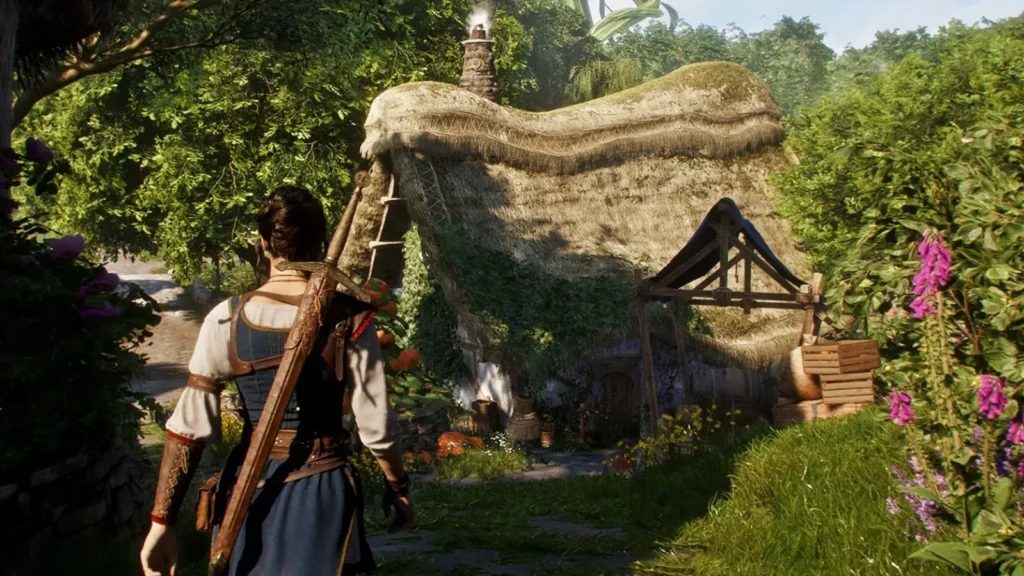
Playground has explicitly designed Fable so players can leave the main objective waiting while they explore Albion. Ralph Fulton says that after the player leaves the starting village, they can travel broadly rather than being forced along a tightly prescribed route. The story still provides a strong personal reason to begin the journey. The protagonist first appears as a child before a time jump establishes them as an adult in Briar Hill, where a mysterious stranger turns the village’s inhabitants, including the hero’s grandmother, to stone. Finding that stranger and trying to reverse what happened provides the central motivation.
Crucially, Fulton describes that situation as having no ticking deadline. He gives the example of travelling to another settlement, finding work, and getting married while the main story waits. This allows the narrative to remain emotionally meaningful without requiring every activity to serve immediate story progression. Broad freedom should still be separated from the idea that every quest, item, or interaction is available from the opening hours, since the absence of a central timer does not define every progression rule. What Playground has confirmed is that taking an interest in ordinary life is an intended way to play rather than a failure to follow the adventure correctly.
Combat follows a similar philosophy of flexibility. Fable combines melee weapons, ranged attacks, and magic through a system Playground calls “style weaving.” The goal is to let players move smoothly between those approaches rather than treating them as disconnected combat modes. Associate game director Will Kennedy has described a desire for combat that remains approachable while still meeting modern expectations for depth and variety. Players can choose their melee and ranged equipment and have four spell slots, giving them room to create a preferred combination of tools while continuing to improve weapons and abilities over time.
Humor also remains part of the combat presentation. Reported magical possibilities include turning enemies into chickens, preserving the series’ less serious approach to heroic fantasy. The design suggests that adaptability is more important than committing permanently to one attack type, since a varied loadout can provide different answers to distance, groups of enemies, or changing battlefield conditions. How well those options remain balanced throughout the campaign will require hands on evaluation of the finished game, but the confirmed direction is clear: melee, ranged attacks, and magic are intended to function as parts of one connected action system rather than three isolated play styles.

Frequently Asked Questions[FAQs]
- When is the Fable reboot coming out?
Fable is scheduled to launch on February 23, 2027. Players with eligible Premium Edition access can begin playing on February 18, providing up to five days of early access before the standard release. The February 18 date should therefore be understood as a Premium Edition benefit rather than the general launch date for everyone. - How many hours is Fable’s main story?
Playground Games estimates that the main story will take approximately 15 to 20 hours to complete. That figure applies specifically to the principal narrative rather than every activity available in Albion. Individual completion times can still vary depending on play style, exploration, combat, and how often players pause the main quest to engage with other systems. - Is Fable approximately 30–40 hours long overall?
Combining Playground’s estimated 15 to 20 hour main story with another 15 to 20 hours of side content and exploration produces a rough total of 30 to 40 hours. However, this should not be treated as a confirmed 100 percent completion time. Activities involving relationships, property, businesses, and other life simulation systems can extend a playthrough considerably beyond those quest focused estimates. - Is the Fable reboot coming to PS5?
Yes. PlayStation’s official Fable page confirms that the reboot is coming to PS5 and lists February 23, 2027 as the release date. The PlayStation version is therefore an officially announced launch platform rather than a rumored port that might arrive later. Fable is also planned for Xbox Series X|S and PC. - Will Fable be available through Game Pass at launch?
Yes. Fable is confirmed for day one Game Pass access, with Xbox’s product information identifying Ultimate and PC Game Pass. This allows eligible subscribers to access the base game at launch through the supported service. Premium Edition benefits, including early access and additional content, still require the relevant edition or upgrade and are not automatically included with ordinary base game access. - Does buying Fable on Steam include the Xbox version?
No. Purchasing Fable on Steam does not automatically provide an Xbox console copy through Xbox Play Anywhere. The Play Anywhere program applies to eligible digital versions purchased through the Xbox or Windows Store and used with the appropriate Microsoft account. Steam is a separate storefront, so its purchase should not be assumed to include the same shared ownership benefits. - Does “limitless” replayability mean infinite story quests?
No. Playground’s use of “limitless” refers to the ability to continue interacting with Fable’s life simulation systems after the main story has a defined ending. Players can continue managing relationships, property, businesses, and other personal goals for as long as those activities remain interesting to them. It does not mean the game contains infinitely generated handcrafted quests, endless new dialogue, or a story that expands forever. - Can players marry and have children in Fable?
Yes. Dating, marriage, living together, and having children are all confirmed relationship features in the reboot. Gameplay coverage also describes activities such as flirting, giving gifts, and going on dates, while relationships can change over time rather than remaining permanently fixed. This makes family life part of the wider social simulation instead of simply selecting one companion through a single dialogue choice. - Can players buy houses in the Fable reboot?
Yes. Playground has confirmed that players can enter houses, purchase them, and use them as homes. Property ownership also extends into rental systems, allowing players to act as landlords and collect rent from tenants. These mechanics connect with the broader economy and social simulation, giving players additional goals outside combat and the main storyline. - Is this game a direct sequel called Fable 4?
No. The official title is simply Fable, and Playground Games describes it as a reboot rather than a direct continuation of the original trilogy. The informal name “Fable 4” is sometimes used by fans because it is the next major entry in the series, but that is not its official title. The reboot is intended to preserve the franchise’s tone, humor, world building, and life simulation ideas without directly continuing the previous games’ storyline.
Conclusion
Playground Games’ Fable reboot combines a defined adventure with a more open-ended vision of life in Albion. The confirmed plan is a February 23, 2027 launch, an approximately 15–20-hour main story and another 15–20 hours of side content, with relationships, property and business management providing additional reasons to remain in the world.
The central distinction is between finishing the plot and finishing a personal experience. A player interested mainly in the narrative can judge the game by its campaign, while someone drawn to the life simulation can pursue a different kind of satisfaction.
Its success will depend less on whether the hour count sounds impressive and more on whether those two approaches support each other. The promise is not simply a longer Fable, but an Albion where becoming a hero and deciding how to live are parts of the same adventure.
Sources and Citations
- Xbox Wire, official June release announcement: Published June 7, 2026. The Fable section of Xbox’s showcase recap confirms the February 23, 2027 launch, with Premium Edition early access beginning February 18. It also identifies Xbox Series X|S, Xbox on PC, cloud, Game Pass and Xbox Play Anywhere support. This is a dated first-party reference for the release schedule, rather than the earlier autumn 2026 window. (XBOX Wire)
Citation: Xbox Games Showcase 2026 Recap: Fable Release Announcement - PlayStation, official Fable product page: Confirms the PS5 release on February 23, 2027, single-player support and Microsoft Corporation as publisher. The US page lists the Standard Edition at $69.99 and Premium Edition at $99.99. Premium contents include up to five days of early access, the cosmetic content pack, digital artbook and soundtrack, and the post-launch Order of the Hero expansion. (PlayStation)
Citation: Fable, Official PlayStation Product Page - Official Fable website, edition contents and pre-order rewards: Published June 7, 2026. Provides the detailed edition breakdown, including the Chicken Suit and in-game gifts offered with pre-orders, the Premium Edition’s Splendid Armour and Bastard Armour, and the post-launch expansion. It also explains the Premium Upgrade and lists the Collector’s Edition’s Jack of Blades statuette, hardcover artbook, SteelBook and Guild Seal lapel pin. This supplements the shorter storefront descriptions. (Fable)
Citation: Pre-order Fable Premium Edition and Play 5 Days Early - Microsoft, Xbox Play Anywhere ownership documentation: Explains that eligible digital games purchased through the Xbox Store, Windows Store or participating retailers’ digital codes can be played across supported Xbox consoles and Windows devices without another purchase. Saves, add-ons and achievements carry across the supported ecosystem. It explicitly excludes disc purchases. This supports distinguishing Xbox Play Anywhere ownership from separate Steam or PlayStation purchases; it is not a universal cross-store entitlement. (xbox.com)
Citation: Xbox Play Anywhere: Official Features and Frequently Asked Questions - Xbox Wire, January Developer_Direct interview with Ralph Fulton: Written by Joe Skrebels, published January 22, 2026. The interview explains the reboot’s new version of Albion, character customization, open-world exploration and style-weaving combat, which combines melee, ranged attacks and magic. It also describes reputation as a response to witnessed actions and individual villagers’ opinions, alongside the persistent population of more than 1,000 NPCs. Its original autumn 2026 release window is historical, superseded by the June announcement. (XBOX Wire)
Citation: Fable: Answering the Big Questions After That Long-Awaited Developer_Direct Deep-Dive - Playground Games, official Living Population explanation: Written by Dan Greer, Lead Game Designer, published through Xbox Wire on June 10, 2026. This is the strongest first-party source for the 1,000-plus individually designed, fully voiced inhabitants, their personalities, homes, jobs and routines. It explains how relationships, reputation and NPC memory interact with property ownership and employment. Players can control rents and wages, while villagers may refuse employment or leave housing they can no longer afford. (XBOX Wire)
Citation: Fable: How We Built the Living Population - GamesRadar+, interview on inhabitants, property and everyday life: Written by Heather Wald, published January 22, 2026. In this direct interview, Fulton discusses entering buildings, buying houses and living in them, as well as NPC routines, fully voiced conversations, relationships, marriage, divorce, children, hiring and firing. It supports the connection between explorable interiors, property ownership and persistent inhabitants, rather than treating those features as unrelated activities. (GamesRadar+)
Citation: How Fable’s Open World Lets You Meddle in the Lives of Over 1,000 NPCs - GamesRadar+, detailed business-management interview: Written by Griff Griffin, published September 5, 2026. Fulton discusses investing in businesses, selecting employees according to their traits, adjusting wages and the resulting effects on productivity and reputation. The interview also explains why Playground abandoned randomized NPC generation in favor of individually selected characteristics. Its full text was checked through GamesRadar’s Yahoo syndication, while the link below points to the original article. These are developer-described systems, not verified final-game optimization results. (Yahoo Tech)
Citation: Getting Down to Business With Fable’s Game Director - PC Gamer, reporting on the Gamescom campaign-length estimates: Written by Rick Lane, published August 31, 2026. Reports associate game director Will Kennedy’s estimate of approximately 15–20 hours for the main quest, with a similar amount of side-quest and open-world content. The article attributes the comments to a Gamescom Q&A reported by Polygon and distinguishes that structured content from the potentially much longer time players could spend with the life-simulation systems. These are pre-release developer estimates, not measured completion statistics. (PC Gamer)
Citation: Fable’s Story Will Be 15–20 Hours Long, According to Its Game Director - TechRadar, additional Gamescom reporting on campaign and optional content: Written by Demi Williams, with contributions from Rob Dwiar, published September 10, 2026. Reports Kennedy’s explanation that the main story takes approximately 15–20 hours depending on playstyle, with another estimated 15–20 hours of optional exploration and side content. It also records his description of the life systems as open-ended. This corroborates the stated scope without establishing a guaranteed 30–40-hour completion time for every player. (TechRadar)
Citation: Playground Games Explains Fable’s Story Length, Side Content and Open-Ended Life Systems
Recommendations
- Echoes of Aincrad Crafting Guide: Recipes, Materials and Unlock Requirements
- Did Christopher Nolan’s Depiction of the Gods Pay Off in The Odyssey?
- Castlevania: Belmont’s Curse Runs at Only 30 FPS on Nintendo Switch
- EA Sports College Football 27 Preview: Defense Wins Championships
- Jurassic World Evolution 2 Complete Edition Comes to Nintendo Switch 2 on July 30, 2026
- Unity-Based Tool for JRPG Game Development: RetroGig’s Retro JRPG Template for SNES/PSX-Style RPG Systems
- Keanu Reeves & China Miéville BRZRKR: Light Draws Breath — Release Date, Story, Creative Team & Variant Covers
- CD Projekt Raises Profit Goals with Witcher 4, 5, and 6 Coming: 5 Billion PLN Target Explained
- Creepshow Official Announcement Trailer Reveals a New Anthology Horror Game Experience
- GTA 6 Leans Into Vice City’s Influencer Hustle Where Looks Matter



































































































