








In This Article (21 sections)
KPop Demon Hunters behind the scenes
Released on Netflix in June 2025, KPop Demon Hunters is a Sony Pictures Animation film blending K-pop glamour with supernatural action. The film became a massive hit, earning critical acclaim and Oscar nominations. Directed by Maggie Kang and Chris Appelhans, the production focused on authenticity, cultural research, and innovative technology. The project used a unique animation style and a soundtrack featuring real K-pop producers to bring Kang’s “love letter to K-pop” to life.

How KPop Demon Hunters was made
Creator Maggie Kang first pitched the idea of “K-pop stars who secretly fight demons” in 2018. Sony Pictures Animation bought the concept within a week, and development officially began in 2021. Kang teamed up with co-director Chris Appelhans and writers Hannah McMechan and Danya Jimenez to flesh out a story rooted in Korean mythology and shamanism. The filmmakers aimed for a balance of action, comedy, and heart, inspired by Bong Joon-ho’s genre-blending style. Music was integrated from the start, with K-pop artist EJAE providing early demos and the singing voice for the lead, Rumi. Netflix funded the estimated $100 million budget and handled distribution, which included a limited theatrical run for awards eligibility.
KPop Demon Hunters animation process
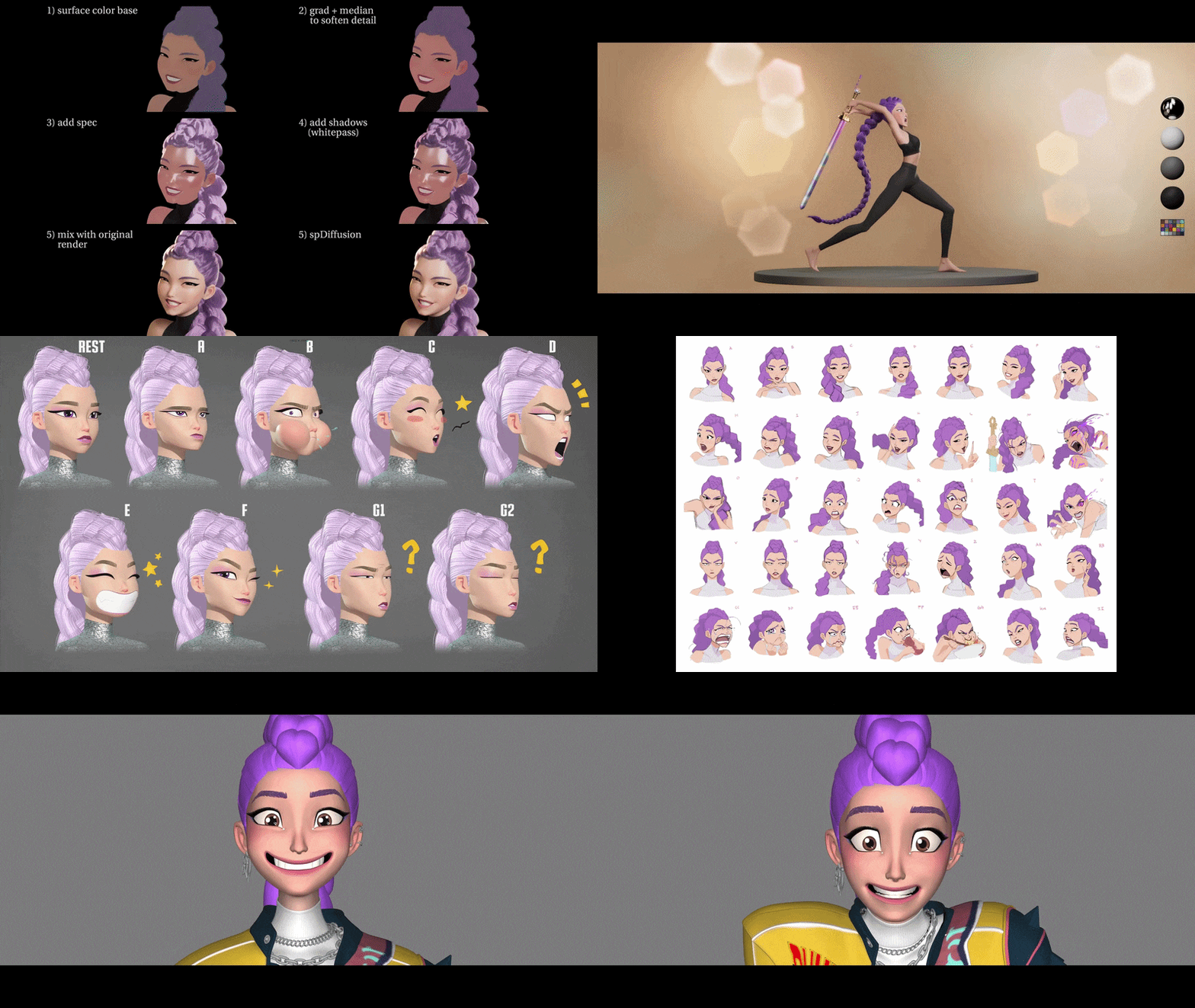
Sony Pictures Imageworks led the animation, pursuing a 3D CGI style influenced by 2D anime aesthetics. The animation style was flexible, shifting proportions and line details to match the tone from glamorous performances to “chibi”-style comedy. Action scenes incorporated “dance-fighting” and glitter effects to make battles feel like stage performances. The “Meet Ugly” battle between HUNTR/X and the Saja Boys served as a proof of concept for the film’s tone. Authenticity was a priority, with animators crafting specific mouth shapes and eye expressions to reflect Korean mannerisms. The process utilized Unreal Engine 5 for real-time previews, allowing for a workflow that was 20–25% faster than traditional methods.
KPop Demon Hunters directors Maggie Kang and Chris Appelhans
The film was led by Maggie Kang, a seasoned story artist making her directorial debut, and Chris Appelhans, who previously directed Wish Dragon. Kang provided a personal perspective as a Korean-Canadian, ensuring cultural authenticity and the inclusion of Korean lyrics. Appelhans focused on the power of music and balancing the “larger-than-life” elements with human flaws. The two worked as a cohesive unit, sharing duties on writing and storyboarding. They collaborated with producer Michelle L.M. Wong and a talented art team to ensure a unified vision that resonated globally.

Sony Pictures Animation KPop Demon Hunters production
As a Sony Pictures Animation (SPA) project distributed by Netflix, the film was part of an initiative to champion original stories. The production team included producer Michelle L.M. Wong and animation director Josh Beveridge. SPA supported Kang’s vision for a distinct 3D anime aesthetic over the hybrid style used in Spider-Verse. The success of the film on Netflix led to a successful limited theatrical sing-along release that grossed approximately $19 million. The strategic production and release earned the film a Grammy and an Oscar nomination for “Golden,” the first K-pop song recognized in the Best Original Song category.
KPop Demon Hunters Imageworks Unreal Engine workflow
Sony Pictures Imageworks integrated Unreal Engine 5 into their pipeline to handle complex concert lighting and fast-paced action. This allowed for real-time visualization of atmospheric scenes, such as the bathhouse fight, which included volumetric fog and reflections. Engineers optimized a USD-based pipeline to move assets between Maya and Unreal in minutes. The team used Unreal’s “Foliage Mode” to scatter thousands of randomized crowd members in stadium scenes and utilized “Control Rig” for real-time character animation. Lighting data from Unreal was exported to Katana for final rendering, ensuring that the musical timing of the lighting remained consistent. This workflow set a new standard for speed and creative flexibility at Imageworks.

KPop Demon Hunters visual development and art style
The visual development of KPop Demon Hunters, led by Helen Mingjue Chen and Ami Thompson, fuses Korean heritage with modern K-pop aesthetics. Director Maggie Kang integrated Korean mythology and shamanism, specifically the concept of mudang (shaman women), into the character designs and energy effects. The film uses a bold color palette to differentiate worlds: the human world features pastel pop sweetness, while the demon realm and Seoul’s nightlife utilize high-contrast neons like hot pink and electric blue.
Character designs for the idol groups HUNTR/X and the Saja Boys were inspired by real acts like Blackpink, 2NE1, BTS, and Stray Kids. The trio Rumi, Mira, and Zoey feature wardrobes ranging from high-fashion streetwear to modernized hanbok. The Saja Boys undergo a visual evolution from “saccharine” idols to demonic figures inspired by the jeoseung saja (Grim Reapers), wearing black traditional hanbok and gat hats. The art style also incorporates 2D flourishes and traditional minhwa folk art, seen in side characters like Derpy the tiger and Sussie the magpie. The film’s flexible art style allows it to shift between K-drama romance, wacky caricatures, and epic anime action.
How colors tell the story in KPop Demon Hunters
Color serves as a narrative device, primarily through the evolution of the “Honmoon” protective force. Initially, the goal is a “Golden Honmoon,” symbolizing perfection and a singular ideal. This is reflected in the girls’ gold costumes and light sticks during early performances. However, the film subverts this as the characters learn to embrace imperfection. By the climax, the power transforms into a “Rainbow Honmoon,” a prismatic shield representing the strength of diversity and unity.
This shift is mirrored in Rumi’s arc: her golden outfit is literally shredded, signifying her move away from the “untouchable idol” facade. Additionally, individual characters are assigned signature colors gold-white for Rumi, greenish-blue for Mira, and purple-pink for Zoey which eventually merge into the rainbow. Conversely, the Saja Boys transition from sugary pop colors to hollow darkness and red highlights to signal their demonic nature. Green and purple are consistently associated with demonic mischief, while the final rainbow aurora over Seoul signifies global harmony.

KPop Demon Hunters music production and soundtrack
The film’s music was overseen by executive music producer Ian Eisendrath and featured production by The Black Label (Teddy Park, 24, and IDO). The soundtrack blends authentic K-pop DNA with narrative-driven songwriting by a mix of East and West talent, including Mark Sonnenblick, Danny Chung, and Jenna Andrews. Every song was written from scratch to advance the plot; for example, “Takedown” was engineered to sound catchy yet “hollow” to reflect the Saja Boys’ nature.
The production process was highly iterative, with some songs, like “Golden,” undergoing five to six versions to ensure lyrics matched the characters’ vulnerabilities. The film used a “double-casting” approach for the voices: Rumi’s singing was provided by EJAE, while Audrey Nuna and Rei Ami sang for Mira and Zoey. The soundtrack became a massive success, certified Platinum by the RIAA and breaking records by placing four songs in the Billboard Hot 100’s Top 10 simultaneously.
How the song Golden was made for KPop Demon Hunters
“Golden” was developed from a seven-page memo outlining its narrative requirements: it had to introduce each girl’s struggle, reveal Rumi’s half-demon secret, and include a challenging high note that serves as a pivotal plot point. The song was a collaboration between The Black Label and various Western songwriters, with EJAE providing the initial melody hook. Maggie Kang insisted on including Korean lyrics for authenticity.
The track functions as both a pop hit and a cinematic resolution, with its technical musical climax the “high note” synced with Rumi’s moment of self-confidence. “Golden” became a global phenomenon, winning a Golden Globe and a Grammy for Best Song Written for Visual Media (a first for a K-pop song). It amassed nearly 4 billion streams and topped the Billboard Global 200 for eight weeks, while its central message of empowerment became a popular social media motto.

KPop Demon Hunters voice cast and singing cast
The film uses a dual-cast approach to maximize both acting and vocal performances. For the main trio, HUNTR/X: Rumi is voiced by Arden Cho, who balances leadership with vulnerability, while her singing voice is provided by the soulful vocals of EJAE. Mira is voiced by May Hong, giving the character a dry-witted edge, with R&B artist Audrey Nuna providing her singing voice. Zoey is voiced by Ji-young Yoo for youthful energy, with Rei Ami performing her pop-heavy singing parts. EJAE, Audrey Nuna, and Rei Ami also promoted the music as a real-world trio.
Jinu, the Saja Boys’ leader, is voiced by Ahn Hyo-seop, who brings a charming duality to the role. Jinu’s singing is credited to several artists, including former K-pop idol Kevin Woo and R&B singer Andrew Choi. The villainous demon king Gwi-Ma is voiced by Lee Byung-hun, providing the character with menacing authority. Other cast members include Yunjin Kim as the mentor Celine, and comedic relief from Liza Koshy, Joel Kim Booster, and Ken Jeong. Additionally, Daniel Dae Kim appears in the ensemble, and Broadway legend Lea Salonga performs an original song. The casting prioritized actors of Korean heritage for cultural authenticity, ensuring natural pronunciation and nuanced performances.
KPop Demon Hunters choreography and performance animation
The film’s choreography was a collaboration with top South Korean dance experts. Jo Nain of Jam Republic choreographed the centerpiece “Golden,” focusing on expansive movements that translate well to animation. Leejung Lee of The Black Label contributed sharp, trendy routines for “How It’s Done” and “Soda Pop.” To give the Saja Boys a distinct edge, Ha Seong-jin of K-Tigers integrated Taekwondo martial arts into their choreography for “Your Idol.”
The animation team utilized video references from these choreographers, artistically interpreting the moves to add character-specific flourishes, such as stylish poses or hair flips during combat. The action scenes were treated with a rhythmic, dance-like quality, blurring the line between fighting and performing. The Unreal Engine workflow allowed for dynamic “dance cam” angles and tracking shots typical of real K-pop broadcasts. This synergy resulted in concert sequences so authentic that they sparked viral real-world dance challenges.

KPop Demon Hunters Seoul locations and cultural references
KPop Demon Hunters is a “love letter to Seoul,” featuring landmarks like Namsan Tower and the Naksan section of the Seoul City Wall. The film captures everyday Korean life, showing the characters enjoying street foods like tteokbokki and visiting a traditional jjimjilbang (bathhouse). Cultural authenticity is maintained through the use of Hangul on city signage and the inclusion of traditional elements like norigae pendants on modern idol costumes.
The story’s supernatural lore is deeply rooted in Korean folklore and shamanism. The Saja Boys’ transformation evokes the jeoseung saja (Grim Reaper), complete with black hanbok and gat hats. Side characters Derpy the tiger and Sussie the magpie are homages to traditional minhwa folk art. The concept of the “Honmoon” barrier draws from the rituals of mudang (shamans) who use song and dance to ward off evil. The film also acknowledges K-pop history, with nods to pioneers like the Kim Sisters and S.E.S.
KPop Demon Hunters HUNTR/X and Saja Boys character design
The visual design of HUNTR/X was inspired by haute couture designers and real-world girl groups like Blackpink. Rumi’s design features sharp tailoring and purple-tinted hair, while Mira (inspired by model Ellis Ahn) exudes a “girl-crush” persona with streetwear-luxe styling. Zoey’s design is more playful and youthful. Each girl follows a “visual journey,” transitioning from early pop looks to battle-worn gold and eventually colorful “rainbow” aesthetics. Their facial features were specifically designed to reflect authentic Korean mannerisms and shapes.
The Saja Boys were designed as polar opposites to the heroines. Their leader, Jinu, was modeled after the “flower boy” archetype of idol Cha Eun-woo. The group undergoes three visual stages: a “saccharine” bubblegum pop look, a brief transitional phase, and a dark “Reaper” look featuring traditional black funeral attire. Their lion-themed branding contrasts with HUNTR/X’s more modern, vibrant aesthetic. Even side characters, like the blue-furred tiger Derpy, were designed using minhwa art styles to blend traditional mythology with magical, animated charm.

KPop Demon Hunters camera work lighting and action scenes
KPop Demon Hunters utilizes dynamic cinematography and lighting to blend the visual languages of K-pop music videos, K-dramas, and high-octane anime. Performance scenes feature rapid “concert-cam” cuts, transitioning between wide group choreography and “fan-cam” style close-ups. The film also parodies K-drama tropes, specifically using manipulated slow-motion and lens flares for the “Meet Ugly” scene.
The adoption of Unreal Engine 5 allowed for real-time volumetric camera work in action sequences, such as tracking shots through steam in the bathhouse battle. Lighting was synchronized to the music, with full concert rigs featuring strobes and spotlights exported to the final render. Action scenes, influenced by the K-Tigers taekwondo team, were staged like rhythmic dance routines. While the production used professional pipelines, independent creators can achieve similar camera management efficiency using tools like The View Keeper in Blender.
KPop Demon Hunters behind the scenes facts
- Pitched in a Week: Maggie Kang’s 2018 pitch was bought by Sony within seven days.
- The Villain’s Casting Twist: Gwi-Ma was originally a comedic role intended for JYP before being recast as a serious villain voiced by Lee Byung-hun.
- From Songwriter to Singer: Demo songwriter EJAE became the official singing voice for Rumi.
- Lead Actress Audition Quirk: Arden Cho originally auditioned for the mentor Celine before being cast as the lead, Rumi.
- Life Imitates Art: HUNTR/X and Saja Boys became the highest-charting fictional groups ever, rivaling real stars like BTS.
- Tiger and Magpie Easter Egg: Side characters Derpy and Sussie are based on the traditional “Hojak-do” folk painting motif.
- Hair Technology: Advanced physics simulations were used for hair; similar real-time results can now be achieved by independent artists using tools like PixelHair.
- Sing-Along First: The film was the first Netflix title to hit #1 at the US box office via its sing-along theatrical release.
- Record-Setting Views: The film surpassed Squid Game as Netflix’s most-watched title with over 500 million views by late 2025.
- Award History: “Golden” became the first K-pop style song to win a Grammy for Best Song Written for Visual Media.
- Cultural Impact: Korean scholars noted the “half-demon” plot as a progressive allegory for biracial or LGBTQ+ identity.

KPop Demon Hunters awards soundtrack success and fan impact
The film achieved a rare trifecta of commercial success, critical acclaim, and industry awards. It earned an Oscar nomination for Best Animated Feature, while “Golden” won a Golden Globe and a Grammy. Technical awards included wins from the Visual Effects Society for real-time technology.
The soundtrack made history by placing four songs in the Billboard Hot 100’s Top 10 simultaneously. “Golden” spent eight weeks at #1 on the Billboard Global 200 and achieved a “perfect all-kill” in South Korea. The film sparked a massive global fandom, leading to viral TikTok challenges, sold-out merchandise, and high-profile crossovers with real K-pop groups like TWICE. It also bridged the gap for K-pop skeptics, serving as a family-friendly entry point into the genre.
Frequently Asked Questions (FAQs)
- What is KPop Demon Hunters about?
It is an animated feature about a K-pop girl group (HUNTR/X) who secretly hunt demons in Seoul while balancing their idol careers and personal identities. - Is HUNTR/X a real K-pop group?
No, it is a fictional group, though its music and promotional cycle were designed to mimic real K-pop industry standards. - Who are the voice actors and singers in the movie?
The film uses a dual cast: Arden Cho, May Hong, and Ji-young Yoo provide speaking voices, while EJAE, Audrey Nuna, and Rei Ami provide singing voices. Ahn Hyo-seop and Lee Byung-hun lead the male cast. - How was the K-pop style music created for the film?
A hybrid team of Hollywood producers and K-pop hitmakers from THEBLACKLABEL collaborated to write and produce authentic songs that also served the film’s narrative. - Did the animators use motion capture for the dance scenes?
No, they used video reference from top choreographers but primarily animated the performances by hand to allow for stylistic exaggeration. - What technology was used to achieve the film’s unique animation?
A hybrid pipeline of Autodesk Maya and Unreal Engine 5 was used, utilizing USD (Universal Scene Description) for real-time layout and lighting. - Will there be a sequel to KPop Demon Hunters?
No official announcement has been made, but the directors have expressed interest in expanding the “demon-hunting pop universe” due to the film’s success. - Is the movie family-friendly and suitable for kids?
Yes, it is rated PG and contains fantasy action without gore, focusing on positive themes like teamwork and self-acceptance. - What are some of the Korean cultural references in the film?
References include Seoul landmarks (Namsan Tower), traditional folk art (minhwa), mythology (Jeoseung Saja), and K-drama tropes. - How does KPop Demon Hunters compare to other animated films, like Disney or Pixar movies?
It matches the quality of major studios but distinguishes itself through its K-pop genre focus and the use of real-time game engine technology in the production pipeline.

Conclusion
KPop Demon Hunters is a landmark in animation, successfully merging Korean pop culture with global cinematic storytelling. Through technical innovation, such as the Unreal Engine workflow, and a deep commitment to cultural authenticity, the film has set a new standard for animated musicals. It remains a powerful example of how embracing hybridity and diverse perspectives can create a “Golden” experience that resonates across the globe.
Sources and Citations
- Cartoon Brew – The Directors Of ‘KPop Demon Hunters’ Discuss The Unexpected Challenges Of Making An Animated K-Pop Film
Citation: Interview with the directors discussing how music, pacing, and storytelling were integrated while developing the animated K-pop feature. - The Hollywood Reporter – ‘KPop Demon Hunters’ Directors on Oscars, Film’s Sequel and Their Journey
Citation: Coverage discussing the film’s Oscar campaign, sequel possibilities, and the directors’ creative journey. - Creative Bloq – KPop Demon Hunters finally gets the art book it deserves (and it’s free to read online!)
Citation: Article detailing the official art book, design breakdowns, visual development process, and cultural research behind the film. - Creative Bloq – How KPop Demon Hunters’ animation process was transformed by Unreal Engine 5
Citation: Technical feature explaining the studio’s Unreal Engine 5 animation pipeline and production workflow innovations. - Netflix Tudum – KPop Demon Hunters ‘Golden’: The Real Story of the Grammy-Winning Smash Hit
Citation: Behind-the-scenes feature covering the creation of the song “Golden,” Grammy recognition, and streaming/chart records. - ArtStation – The View Keeper Camera Management Addon by Yelzkizi
Citation: Product page describing The View Keeper, a camera management workflow tool comparable to cinematic organization techniques used in animation production. - The Korea Times – Mixing K-pop and Demonology – KPop Demon Hunters charms global audiences
Citation: Analysis of the film’s Korean cultural inspirations including hanbok-inspired designs, fandom culture, and global audience reception. - Wikipedia – KPop Demon Hunters
Citation: Community-maintained overview covering cast members, soundtrack credits, awards, chart achievements, and production information for KPop Demon Hunters. - Smithsonian Magazine – ‘Golden’ From ‘KPop Demon Hunters’ Just Won K-Pop’s Very First Grammy
Citation: Feature discussing the Grammy win for “Golden” and the broader cultural significance of the soundtrack’s success. - Netflix Media Center – Netflix Announces Most-Watched Titles – KPop Demon Hunters Now #1 All-Time
Citation: Official Netflix Media Center announcement detailing viewership milestones, streaming records, and platform performance for KPop Demon Hunters.
Recommended
- What is a Stylized Grass Shader in Unity and How it Works
- Roblox introduces mandatory age-gated account tiers: Roblox Kids vs Roblox Select and what changes in 2026
- Reviews Praise New Steam Controller Performance but Debate Its $99 Price Tag in 2026
- Stupendium Softworks: Industry Veteran Alex Oxspring and YouTube Musician the Stupendium Launch New UK Indie Game Studio
- Wolverine’s Latest Defeat Has Major Consequences for the Iconic X-Man (Wolverine #19 Breakdown)
- How to Retarget Mixamo Animations to Metahuman in Unreal Engine Using the IK Retargeter
- Devil May Cry Showrunner Says Season 2 Is Like The Dark Knight Leap From Batman Begins
- A Quiet Place: Part III Cast Update: Jack O’Connell Joins as Emily Blunt and Cillian Murphy Return
- The Creators of Will Publish Third-Party Games: Explained
- Final Fantasy 14 Is Taking Its Next Giant Step With the Evercold Expansion: Release Date, New Jobs, Weekly Progression, and the Big Gameplay Overhaul



































































































