








In This Article (7 sections)
Lanterns Antaan and Atrocitus Theory Explained Through the Manhunters
The theory that Lanterns was secretly introducing the classic Green Lantern villain Atrocitus gained significant support from Episode 2 because of the similarities between Antaan’s history and Atrocitus’s comic book origin. Both are survivors of devastation associated with the Manhunters, and both allow the suffering caused by that destruction to develop into a campaign of vengeance. However, later developments substantially weaken the idea that they are literally the same character. Episode 5 kills Antaan without identifying him as Atrocitus or giving him a Red Lantern ring, making the similarities more convincing as a thematic connection than as proof of a hidden identity.
Episode 2 expands John Stewart’s investigation when his trip to Coast City to retrieve a charging lantern brings him into contact with Antaan and his alien associates. Following a confrontation on the road, John is abducted and learns that Antaan’s group is hunting a Manhunter hidden in Rushville. Antaan claims that this being infiltrated his homeworld and orchestrated the destruction of his people. Although a previous Green Lantern supposedly intervened, the situation was not properly resolved and the Manhunter remained a threat.
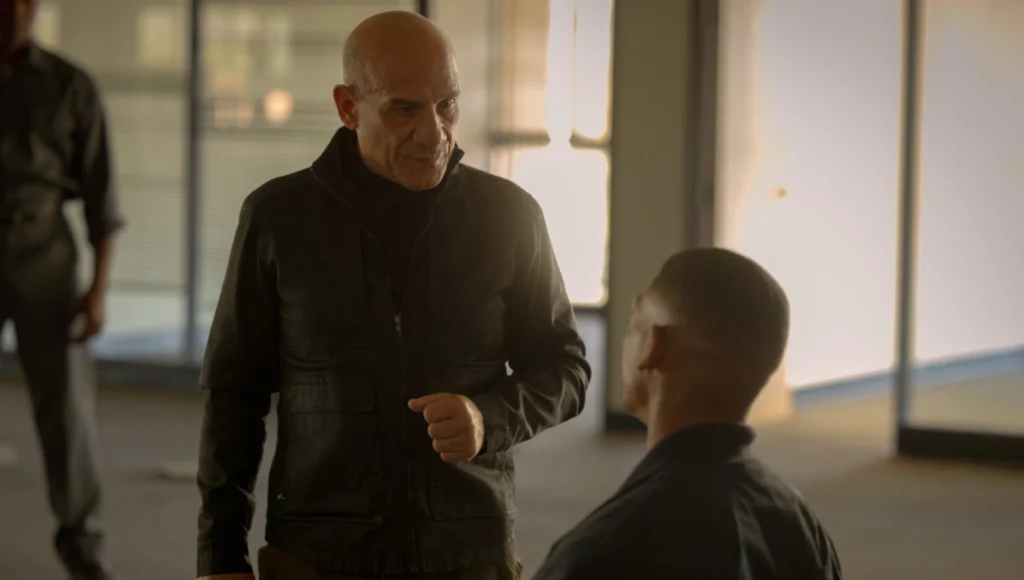
Antaan, played by Paul Ben Victor, leads the extraterrestrial group connected with the aliens encountered around Rushville, including Waylon Sanders. Their human appearances are disguises rather than their natural forms. Antaan’s motivation initially creates sympathy because his pursuit is rooted in devastating personal loss, but his methods quickly complicate that response. He gives John 48 hours to identify the Manhunter and threatens mass violence against Rushville if he fails. His desire for justice has therefore developed into a willingness to harm people who played no role in the original tragedy.
This background made the Atrocitus comparison particularly persuasive. The theory had already circulated following early casting coverage describing Antaan as a vengeance driven alien, but Episode 2 introduced the much more specific connection to the Manhunters. Antaan being an alien using a human disguise also allowed viewers to imagine that his true appearance could eventually resemble the familiar red skinned comic character. However, a disguise only removed one possible objection to the theory. It did not establish what identity existed beneath it.
In Green Lantern comics, Atrocitus was originally known as Atros and comes from Ryut in Sector 666. The Manhunters devastated the sector, leaving five survivors who became the Five Inversions. Atrocitus loses his family during the catastrophe, and his grief becomes inseparable from his hatred of the machines and the institutions connected with them. He eventually harnesses the red energy of rage through blood rituals and becomes the founder of the Red Lantern Corps.
Sector 666 is the wider region affected by the massacre rather than the name of Atrocitus’s home planet. Ryut exists within that sector. The destruction also should not be reduced entirely to an accidental programming failure. Later comic history establishes that Krona deliberately altered the Manhunters’ programming as part of an attempt to demonstrate the weaknesses of emotionless law enforcement. This complicates responsibility without eliminating Atrocitus’s wider resentment toward the Guardians and the system they created.
Atrocitus’s hatred consequently operates at two levels. The Manhunters are the immediate agents responsible for destroying his family and people, while the Guardians represent the authority responsible for creating and controlling those agents. His anger is directed not only toward a destructive weapon but toward an institution he believes failed to provide meaningful justice afterward. Antaan occupies similar emotional territory because his grievance concerns both a Manhunter and the failure of supposedly protective forces to prevent or properly resolve the consequences.
The parallels are substantial but not identical. Antaan’s story emphasizes infiltration and personal deception by an individual Manhunter, while Atrocitus’s comic history involves devastation across an entire sector. Lanterns also never establishes that Antaan comes from Ryut, belongs to the Five Inversions or experienced the precise events associated with Sector 666. These differences made it more accurate even after Episode 2 to describe Antaan as potentially inspired by Atrocitus rather than treating his secret identity as established.
The Manhunters themselves deepen the connection between the television story and Green Lantern mythology. They are artificial peacekeepers created by the Guardians of the Universe before the Green Lantern Corps, meaning the Guardians originally attempted to impose order through manufactured beings before relying on living ring bearers. Their failure becomes part of the history inherited by later Lanterns. They should not be confused with Martian Manhunter, J’onn J’onzz, whose similar name does not make him part of the Guardians’ robotic peacekeeping force.
For John Stewart, the discovery creates a larger institutional problem. Destroying one hidden Manhunter might resolve the immediate threat, but it does not answer who created the machines, what the Guardians knew or why victims such as Antaan were left pursuing justice independently. John must therefore recognize that Antaan may be telling the truth about an extraordinary injustice while still rejecting his willingness to threaten innocent people.

Lanterns Multiplayer Conflict, Sinestro and the Red Lantern Connections
Antaan’s immediate goal in Episode 2 is to force John Stewart to identify the Manhunter hiding in Rushville. John is useful because his investigation and relationship with Hal Jordan provide access that Antaan’s group does not possess. The arrangement is coercive rather than cooperative, with Antaan using the threat against Rushville to force John into helping him. This creates a moral problem in which John must respond to Antaan’s legitimate grievance without becoming an instrument of his retaliation.
John ultimately tells Hal about the Manhunter, preventing Antaan from completely controlling the investigation through secrecy. Hal then leaves Earth and visits the imprisoned Sinestro, played by Ulrich Thomsen. Their history gives the meeting additional weight because Sinestro was once Hal’s mentor before becoming his enemy, while Hal played a role in his eventual imprisonment.
Sinestro does not limit the conversation to useful information. He turns attention toward John Stewart and Hal’s anxieties about eventually being replaced, using his knowledge of Hal to apply psychological pressure. The creative approach to Sinestro has been compared with the Hannibal Lecter model of an imprisoned antagonist who remains capable of manipulating someone from confinement. His comments about John therefore should not be treated as objective proof that John is secretly dangerous or evil.
Sinestro’s open appearance also changes how the Antaan theory can be considered. Lanterns has already demonstrated that it can introduce an established Green Lantern antagonist under his familiar identity. The presence of one recognizable villain does not establish that every unfamiliar alien character must secretly be another famous comic figure.
The Red Lantern Corps nevertheless provides important context for understanding why Antaan seemed like a plausible Atrocitus adaptation. Red Lantern power is associated with rage rather than the willpower connected with Green Lantern rings. In foundational portrayals, red rings alter the wearer’s normal circulation and effectively replace the heart’s life sustaining function. Blood becomes a corrosive burning substance that can be expelled as a weapon, while the rings also provide abilities including flight, protection and energy projection.
Atrocitus should not be reduced to an uncontrollable berserker. He has demonstrated strategic intelligence and the ability to organize larger plans, while later stories develop greater control over red light constructs. Antaan’s ability to calmly organize an operation therefore was never strong evidence against the theory. The more important missing element was actual Red Lantern power. Being furious, traumatized or willing to commit violence does not automatically make someone a Red Lantern.
Episode 2’s strongest possible Atrocitus references were consequently narrative rather than visual. Manhunter violence, a destroyed home and vengeance against a supposedly protective system create a much stronger connection than the presence of red objects or an unfamiliar character name. Creator commentary also stopped short of confirming the identity. When an interviewer described Antaan as analogous to Atrocitus, Chris Mundy discussed the challenge of making planetary vengeance emotionally personal. He did not explicitly state that Antaan was secretly Atrocitus.
This distinction matters because adaptations can redistribute elements from established characters. Antaan can draw on themes strongly associated with Atrocitus without eventually receiving the same name, powers or destiny. An Easter egg or narrative parallel can enrich a character without functioning as a promise of a later transformation.
The same principle applies to the wider DCU. Lanterns could still provide foundations for future Red Lantern stories because it has introduced the relationship between peacekeepers, their failed predecessors and the survivors harmed by those failures. The series’ grounded presentation does not prevent later stories from exploring more overtly cosmic material. A future project could introduce Atrocitus independently, explore other survivors of Manhunter atrocities or eventually introduce another emotion powered Corps.
Such possibilities are not confirmed production plans. Atrocitus would also require a dramatic purpose beyond simply introducing another powerful villain. His comic history challenges the Guardians’ claim to moral authority by asking what happens to people harmed by a system that continues presenting itself as protective. That theme can continue through Lanterns even if Antaan himself is no longer available to carry it.
How Lanterns Episode 5 Changed the Antaan Is Atrocitus Theory
The strongest evidence against the straightforward Antaan is Atrocitus theory arrives in Episode 5, “Lights Out.” Rather than revealing a Red Lantern transformation, the episode brings Antaan’s immediate storyline to a violent conclusion. Hal deliberately directs him toward Will Macon by falsely identifying Macon as the hidden Manhunter. Antaan kills Macon and removes his heart to determine whether Hal’s claim is true. When the heart fails to crystallize, Antaan realizes that he has been deceived.
Antaan then turns against Hal and activates an explosive device integrated into his skeleton. Hal responds by creating a whirlwind construct that carries Antaan into the air before the explosion occurs. The sequence presents Antaan’s apparent death without a red ring appearing, without the name Atrocitus being revealed and without any transformation into the future leader of the Red Lantern Corps.
Episode 5 also develops the personal nature of Antaan’s grievance. His history with the Manhunter involved an intimate relationship, making the earlier references to betrayal by someone he loved more concrete. His trauma therefore develops around a personal deception in addition to the destruction associated with his people. This creates another distinction from simply recreating Atrocitus’s comic origin without modification.
The investigation also establishes Zoe Macon as the Manhunter at the center of the mystery. Her identity remains separate from Antaan’s role as the survivor seeking vengeance. The storyline therefore resolves significant parts of the Episode 2 setup without turning Antaan into the comic book villain many viewers suspected.
Before Episode 5, the theory had several meaningful supporting points. Antaan was a vengeance driven alien, survived devastation connected with a Manhunter, distrusted supposedly protective forces and was willing to pursue increasingly extreme methods. His human appearance was also a disguise, leaving open the possibility of a more recognizable alien form. None of those details was insignificant.
What the theory lacked were the more distinctive markers of Atrocitus’s identity. Antaan was never confirmed as Atros or Atrocitus, never identified as coming from Ryut, never connected with the Five Inversions and never shown obtaining or creating Red Lantern power. Before his death, these omissions could reasonably be explained as information the series was deliberately saving. Once his storyline reached an apparent conclusion without supplying them, their absence became considerably more important.
The most useful distinction is therefore between an Atrocitus like character and Atrocitus using another name. Antaan clearly shares important thematic characteristics with the comic villain. His story explores how Manhunter violence can turn a survivor’s understandable grief into destructive vengeance, which is central to Atrocitus’s history. The series can use that parallel without requiring both characters to be the same individual.
Episode 5 does not establish that Atrocitus can never appear elsewhere in the DCU. A later story could still introduce him independently or develop the Red Lantern Corps through another storyline. Likewise, fiction always leaves the theoretical possibility that a character believed dead could return. However, a hypothetical resurrection is not evidence that Antaan survived or will eventually become Atrocitus.
As the story stands through Episode 5, Antaan’s similarities to Atrocitus remain meaningful, but the direct secret identity theory has lost its strongest forward looking assumption. The available events support interpreting him as a character who incorporates recognizable elements of Atrocitus’s themes more strongly than they support treating him as the confirmed future leader of the Red Lantern Corps.

Frequently Asked Questions (FAQs)
- Is Antaan confirmed to be Atrocitus in Lanterns?
No. Through Episode 5, Lanterns never explicitly identifies Antaan as Atrocitus or establishes that the two characters are secretly the same person. Antaan’s history contains strong similarities to Atrocitus, particularly his suffering because of the Manhunters and his desire for vengeance. However, his apparent death occurs without the name Atrocitus, a Red Lantern ring or another direct identity reveal. - Who plays Antaan in Lanterns?
Paul Ben Victor portrays Antaan in Lanterns. His casting was reported in April 2025, when the character was described as an alien motivated by vengeance against those responsible for his suffering. That description initially encouraged speculation about Atrocitus, but Episode 2 strengthened the comparison considerably by revealing that Antaan’s personal tragedy was directly connected with a Manhunter. - Why did viewers connect Antaan with Atrocitus?
The strongest connection comes from their histories with the Manhunters. Antaan describes losing his people because of a Manhunter and becomes consumed by vengeance, while Atrocitus’s comic origin similarly develops from the devastation caused by the Manhunters. Both characters transform understandable grief into increasingly destructive retaliation, making the comparison much more specific than simply describing both as angry aliens. - Is Antaan the Manhunter hiding in Rushville?
No. Antaan is actually hunting the Manhunter rather than secretly being the creature himself. Zoe Macon, played by Poorna Jagannathan, is revealed as the concealed Manhunter at the center of the investigation. Antaan’s actions are driven by his determination to find and destroy this target because of what happened to his people and the personal betrayal connected with his past. - What is Sector 666 in Green Lantern comics?
Sector 666 is the region of space devastated by the Manhunters in the history that eventually creates Atrocitus. His home planet, Ryut, is located within this sector, and Atrocitus becomes one of five survivors who form the Five Inversions. Later comics establish that Krona deliberately altered the Manhunters’ programming, meaning the catastrophe should not be described simply as an accidental mechanical failure. - What powers a Red Lantern ring?
Red Lantern rings draw their power from rage, distinguishing them from Green Lantern rings and their connection with willpower. The red rings also have a particularly invasive relationship with their wearers, interfering with normal bodily functions and effectively taking over the heart’s role in sustaining life. They can produce destructive corrosive plasma alongside abilities such as flight, protection and energy projection. - Does Antaan receive a Red Lantern ring in Episode 5?
No. Episode 5 does not show Antaan receiving a Red Lantern ring or undergoing any transformation into Atrocitus. His final confrontation instead revolves around the explosive device incorporated into his body. The absence of a red ring during the apparent conclusion of his storyline significantly weakens the earlier expectation that his pursuit of vengeance was leading directly toward the Red Lantern Corps. - Why does Hal Jordan visit Sinestro at the end of Episode 2?
Hal visits the imprisoned Sinestro because he needs information that could help with the Manhunter investigation. Their complicated history makes Sinestro potentially useful but also dangerous. During their conversation, Sinestro turns attention toward John Stewart and attempts to exploit Hal’s fears about eventually being replaced. His statements are intended to unsettle Hal and should not automatically be treated as reliable predictions about John’s future. - How does Antaan die in Lanterns Episode 5?
Antaan discovers that Hal deliberately misled him by falsely identifying Will Macon as the Manhunter. After realizing the deception, Antaan turns against Hal and activates the explosive device built into his skeleton. Hal responds with a whirlwind construct that carries Antaan into the air before the device detonates. The episode presents the resulting explosion as Antaan’s death rather than the beginning of a Red Lantern transformation. - Does Antaan’s death rule out Atrocitus appearing later?
No. Antaan’s death substantially weakens the specific theory that he will eventually reveal himself as Atrocitus, but it does not prevent the DCU from introducing Atrocitus as a different character later. The Manhunters and their victims already provide themes that could support a future Red Lantern storyline. Any actual Atrocitus appearance, however, would need new evidence rather than relying entirely on Antaan’s Episode 2 similarities.
Conclusion
The Lanterns Episode 2 hidden villain theory was persuasive because it recognized a specific connection to Green Lantern mythology. Antaan’s suffering, the Manhunters’ role, and his transformation of grief into vengeance made Atrocitus a reasonable comparison rather than an arbitrary guess.
Episode 5 nevertheless changes the answer. Antaan’s death arrives without the identity reveal or Red Lantern intervention that would have confirmed the theory.
The distinction is not between noticing a resemblance and making a mistake. It is between identifying a meaningful comic book parallel and treating that parallel as a promise.
As of September 16, 2026, Antaan is best understood as an Atrocitus like figure whose literal identification as Atrocitus remains unconfirmed and is strongly undermined by his Episode 5 fate. The theory helps explain the character’s themes, but it should no longer be presented as the established direction of his story.
Sources and Citation
- DC. Atrocitus Official Character Profile. Origins, Guardians and Red Lantern Corps.
https://www.dc.com/characters/atrocitus - DC. Manhunters Explained. Green Lantern’s Robotic Enforcers and Their Difference From Martian Manhunter. September 2026.
https://www.dc.com/blog/2026/09/ - TheWrap. Lanterns Episode 2. Chris Mundy Interview and Atrocitus Comparison.
https://www.thewrap.com/lanterns-chris-mundy-interview/ - Entertainment Weekly. Lanterns Creators Explain the Manhunters and Their Role in the Series.
https://ew.com/tv/lanterns/ - Entertainment Weekly. Lanterns Creators on Sinestro and the Series’ Green Lantern Mythology.
https://ew.com/tv/lanterns/ - TechRadar. Lanterns Episode 5 Coverage and Manhunter Developments.
https://www.techradar.com/streaming/hbo-max/lanterns - Forbes. Lanterns Episode 5 Recap and Analysis.
https://www.forbes.com/sites/entertainment/ - Comic Book Club. Lanterns Episode 5 Recap and Comic Book Connections.
https://comicbookclublive.com/ - DCU Guide. Atrocitus. Comic Book Appearances and Publication History.
https://dcuguide.com/w/Atrocitus - DCU Guide. Red Lantern Corps. Power Rings, Abilities and Comic Continuity.
https://dcuguide.com/w/Red_Lantern_Corps
Recommendations
- The Boys vs DC vs Marvel Comparison: Characters, Counterparts, Inspirations and Key Differences Explained
- How to Auto Retopology in Blender: A Step-by-Step Guide for Clean 3D Meshes
- How to Beat the Mock Moon Boss in Mina the Hollower: Best Strategy, Attacks, and Phase Guide
- Gamescom Dev 2026: Dates, Speakers, Tracks, Networking, and What Game Developers Need to Know
- Lanterns Villain Theory
- Stranger Things Creators Admit Steve Fake-Out Death Was “F**king with the Audience”: Duffer Brothers Reveal Why They Keep Teasing Steve Harrington’s Death
- Atlus Offers a First Look at Persona 6 and Fans Have Questions
- Star Wars Zero Company Best Hawks Specializations: Medic, Sharpshooter, Gunslinger and Scoundrel
- GTA 6 Fans Spot Tommy Vercetti Easter Egg over a Year After Trailer 2’S Release: Hidden Vice City Reference Explained
- Once Human Gravity Abyss Season 4 Release Date Trailer and Everything We Know



































































































