








In This Article (19 sections)
Lux Aeterna’s Brian Cox Emergence VFX Breakdown and the Story Behind the Opening Sequence
Lux Aeterna’s Brian Cox Emergence VFX breakdown offers a detailed look at the production behind a live science show exploring how nature produces extraordinary complexity from fundamental physical rules. The sequence begins with something small enough to land on a sleeve, a snowflake, before expanding into the larger scientific questions that define Brian Cox’s latest tour. For visual effects artists, the project brings together historical environments, scientific ideas, digital reconstruction, and the demands of live presentation. Its significance extends beyond the finished imagery because it demonstrates how captured geometry, photographic information, simulation, and artistic composition can contribute to a shared narrative.
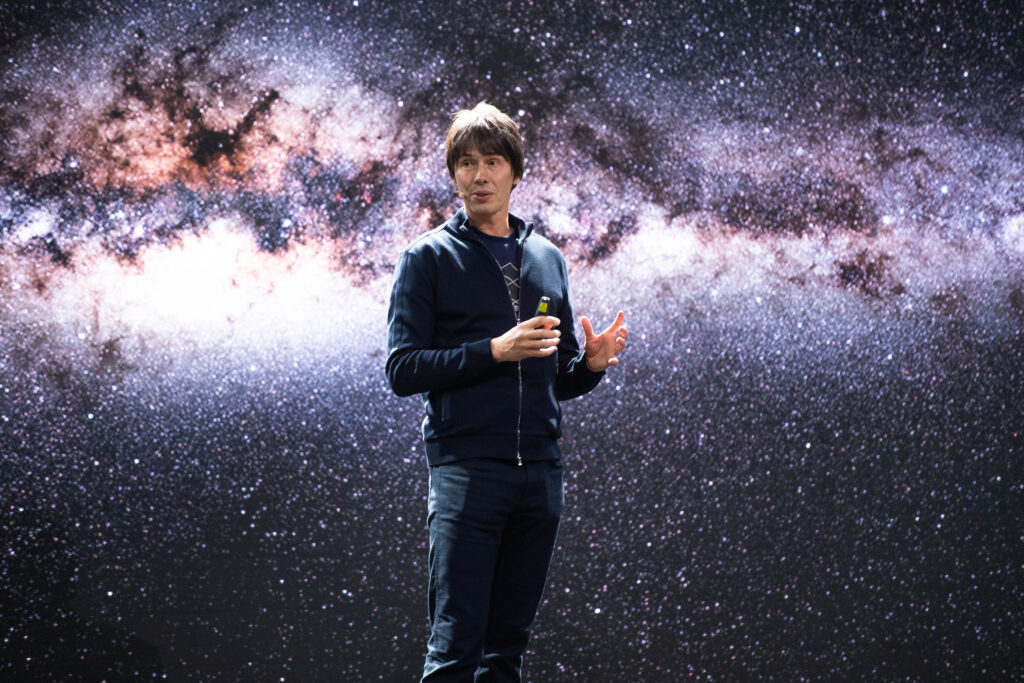
Lux Aeterna produced the opening sequence for Emergence, with CG Channel’s October 28, 2026 report describing a two minute animation recreating Prague’s Charles Bridge during a snowstorm. The published production information identifies lidar scanning, photogrammetry, Houdini particle simulation, digital matte painting, and NASA Earth observation data among the techniques and resources used. These elements contribute to an environment that serves a particular storytelling purpose rather than functioning as a purely decorative historical recreation. The architecture establishes a recognisable setting, the snowfall creates atmosphere and movement, and the scientific subject gives viewers a reason to examine the familiar environment more closely.
The breakdown is featured in CG Channel’s article titled “See Lux Aeterna’s VFX breakdown for Brian Cox’s 2026 world tour,” which also includes a separate project reference for the opening sequence. Viewers should distinguish the production breakdown from a promotional trailer or a recording of the live performance. A trailer introduces the overall experience, a performance recording documents its presentation, and a breakdown demonstrates how particular images were constructed. Watching the sequence first for its story and then examining the stages of production can reveal how geometry, surface detail, lighting, and movement contribute to the final result.
What the Opening Sequence Establishes
An opening sequence has a different responsibility from an isolated visual effects shot because it establishes the atmosphere and expectations for the performance that follows. In Emergence, the central creative opportunity comes from making an ordinary natural phenomenon feel worthy of deeper investigation. Detailed architecture, convincing snowfall, and controlled composition become most valuable when they guide the audience toward the scientific question being introduced. The relationship between the large historical setting and the small snowflake creates a deliberate contrast in scale, allowing the sequence to move from an everyday observation toward broader questions about nature.
The official tour description begins with Johannes Kepler noticing a snowflake while crossing Charles Bridge during the winter of 1610. His curiosity about its six cornered form introduces the show’s wider interest in how simple underlying laws can produce complex natural structures. This provides an accessible starting point because audiences do not need advanced scientific knowledge to recognise snow or understand the impulse to examine an unusual shape. The familiar experience creates curiosity before more demanding scientific concepts are introduced.
Charles Bridge is important because it connects the scientific question to a specific historical setting. In the tour’s account, the bridge is associated with Kepler’s observation, making Prague part of the narrative rather than an interchangeable backdrop. A generic winter landscape might communicate cold weather, but it would lose the connection between a place, a person, and an important moment of scientific curiosity. Placing the observation within a recognisable human environment also makes the history of science more tangible. Scientific discoveries can appear detached from ordinary experience when presented only as completed explanations, while the opening restores the moment of uncertainty that comes before understanding.
From Historical Text to Modern Snowflake Design
Kepler’s investigation appeared in his 1611 publication commonly known in English as The Six-Cornered Snowflake. The University of Oklahoma’s History of Science Collections identifies the work as an important example of his interest in crystal growth, geometry, and packing, extending beyond his better known astronomical studies. The distinction between the dates matters because the Emergence tour places the observation in the winter of 1610, while the published treatise dates to 1611. These represent different stages of the historical account rather than conflicting publication dates.
Modern scientific explanations connect the characteristic symmetry of snow crystals to the arrangement of water molecules within ice. Temperature and humidity influence how crystals grow, producing different structures such as plates, columns, and branching forms. Although sixfold symmetry is associated with the underlying crystal structure, not every falling snowflake resembles a perfectly formed decorative star. Some snowflakes are irregular, while others consist of multiple crystals joined together. This variation makes the subject especially valuable for visual storytelling because it demonstrates how consistent physical principles can produce many different visible outcomes.
For visual effects artists, the scientific background provides a useful reference for designing natural phenomena. Understanding why snow crystals share certain structural characteristics can help determine which visual features should remain consistent and where variation belongs. Repeating one idealised snowflake throughout a scene may communicate less about the natural phenomenon than a collection of forms that reflect its underlying diversity. The broader lesson is that scientific understanding can support artistic decisions without requiring every image to become a literal scientific diagram.
The opening sequence also demonstrates the importance of guiding attention through composition. The historical environment needs enough detail to establish a convincing world, but the scientific subject must remain central to the experience. Architectural features, snowfall, lighting, and camera movement should support the transition from the broad setting to the smaller object that introduces the main question. A technically impressive environment is most effective when its complexity does not compete with the story being communicated.
Lux Aeterna’s Prior Work and Credits
Lux Aeterna’s previous work with Brian Cox provides useful context for the collaboration. The studio contributed to Horizons: A 21st Century Space Odyssey, with its official project page describing visual effects sequences and real time Unreal Engine content. That earlier production also involved RenderStream and Disguise within its technical setup. These details establish the studio’s experience with live scientific presentation, although the software and infrastructure used for Horizons should not automatically be assumed to apply to Emergence.
The studio also contributed more than 400 visual effects shots across five episodes of the BBC series Solar System. Its official account describes environments and events including Martian dust storms, Titan’s methane seas and lakes, atmospheric systems, and asteroid impacts, with scientific data helping inform the imagery. These projects demonstrate experience translating subjects that are difficult or impossible to film directly into visuals that audiences can understand. However, television sequences, live interactive environments, and opening animations have different production requirements, so each project must be assessed according to its own creative and technical demands.
The published Emergence production credits name Timmy Willmott and Tav Flett as VFX supervisors, Clive Llewellyn as VFX artist, and Albert Testani as senior VFX producer. These credits identify contributors without providing a detailed breakdown of individual responsibilities. They should therefore not be interpreted as proof that a particular artist created a specific simulation, environment asset, or compositing element. A short public credit list may also differ from the complete production crew, especially when a live performance involves additional teams responsible for staging, technical infrastructure, and touring operations.
For artists studying the breakdown, accurate attribution is an important part of understanding professional visual effects production. A finished sequence depends on creative supervision, technical execution, coordination, and collaboration rather than one isolated software technique. The same principle applies when preparing a portfolio breakdown. Clearly identifying personal contributions, explaining the work completed, and distinguishing individual responsibilities from the wider team’s achievements makes the technical presentation more informative and gives collaborators appropriate recognition.
How Lux Aeterna Used Lidar, Photogrammetry, Houdini, Matte Painting, and NASA Data
The technical foundation of Lux Aeterna’s Emergence opening combines several methods that address different aspects of environment creation. Lidar contributes spatial measurements, photogrammetry reconstructs information from photographs, Houdini provides particle simulation capabilities, digital matte painting supports environmental construction and extension, and NASA Earth observation material offers scientific reference information. These methods are complementary rather than interchangeable because each provides a different type of information. The challenge is bringing them together into an environment whose geometry, appearance, movement, and composition feel consistent.
Lidar scanning provides three dimensional spatial measurements by emitting pulses of light and measuring their return. The resulting measurements form a point cloud containing coordinates that describe captured surfaces. For a historical architectural reconstruction, this information can provide a stronger starting point for proportions, distances, and spatial relationships than relying entirely on visual estimation. A structure such as Charles Bridge contains architectural features whose placement and scale contribute to its recognisable appearance, making measured geometry useful when establishing the digital environment.
However, a point cloud is not equivalent to a completed visual effects scene. Captured data still requires decisions about modelling, surface treatment, lighting, camera movement, and the level of detail needed in different parts of the composition. A foreground stone parapet that appears close to the camera may require greater attention than distant architecture partially obscured by snowfall. The amount of work devoted to each feature should depend on its visual importance rather than the availability of captured measurements alone.
Historical reconstruction introduces another consideration because modern scans describe structures as they exist at the time of capture. Recreating an earlier period requires separate historical research and artistic interpretation. Contemporary spatial data can provide a strong geometric foundation, but it does not automatically establish how every surface, object, or surrounding area appeared centuries ago. This distinction is especially relevant to a sequence associated with Prague in 1610 because measured accuracy and historical accuracy are related but separate production concerns.
The published production information identifies lidar as one of the techniques used for Emergence but does not disclose the scanner model, capture density, survey configuration, or detailed process used to convert the measurements into production assets. The practical lesson for artists is to use captured data deliberately. A scan can reduce uncertainty about spatial relationships, while the intended camera and composition determine how that information should be developed into a convincing image.
Photogrammetry Reconstruction and Source Image Quality
Photogrammetry complements spatial capture by reconstructing three dimensional information from photographs. Structure from Motion workflows examine relationships between overlapping images to estimate camera positions and derive representations such as point clouds and meshes. The US Geological Survey documents this approach as a method of obtaining three dimensional information from photographic material. For environment work, photogrammetry can help artists develop visual information that supports the geometry and surface characteristics of a digital scene.
The quality of photogrammetry depends heavily on the source photographs. Agisoft’s capture guidance explains that reliable reconstruction requires distinguishable surface features, while transparent, reflective, and largely untextured surfaces can create difficulties for image matching. This means collecting a large number of photographs is not necessarily the same as collecting useful photographic information. Coverage, image quality, and the ability to identify corresponding features across multiple views all influence the reconstruction process.
Photographic material must also be evaluated against the lighting and atmosphere intended for the finished sequence. A surface captured under one lighting condition may require additional adjustments before it fits a snowy historical environment. Photogrammetry can provide valuable information about appearance, but the final image still needs consistent materials, lighting, and artistic treatment. The purpose is to produce a coherent environment rather than a collection of individually detailed assets that do not belong together visually.
For artists examining a workflow that combines lidar and photogrammetry, the useful distinction is between measured spatial information and photographic reconstruction. Both can contribute to a digital environment, but they use different capture methods and have different practical limitations. Their combined value lies in supporting the intended camera and final composition. No particular photogrammetry application has been identified in the published Emergence production summary, so attributing the work to a specific application would go beyond the documented information.
Houdini Particle Simulation and Wind Controls
Houdini particle simulation provides another important component of the opening sequence, particularly in recreating the snowstorm surrounding Charles Bridge. Particle systems allow artists to control large numbers of moving elements without animating each one individually. Instead, particles can be assigned attributes and behaviours that influence their movement, appearance, and persistence over time.
SideFX’s Houdini documentation identifies several particle properties that can support this type of work:
- Velocity: Controls particle movement and helps establish direction and speed.
- Mass: Influences how particles respond to relevant simulation forces.
- Drag: Affects movement by influencing how particles respond to surrounding conditions.
- Age: Tracks how long a particle has existed within the simulation.
- Lifespan: Determines how long a particle remains active before being removed.
- Wind: Provides directional movement and can influence particle behaviour through drag and ambient wind velocity.
Houdini’s POP Wind documentation explains that the operator draws particles toward an ambient wind velocity through drag, with controls for wind direction, speed, and air resistance. These are documented software capabilities rather than confirmation of the exact nodes or settings used in Emergence. The available production coverage identifies Houdini particle simulation but does not disclose a complete node network, simulation configuration, or downloadable project.
Designing Convincing Snowfall Depth and Motion
Creating convincing digital snowfall involves more than distributing white particles across an image. The weather must appear to occupy the same space as the environment, with differences in scale, motion, and visibility helping establish depth. In a comparable scene, nearby flakes might appear larger and move prominently across the frame, while smaller distant elements could contribute to the impression of weather extending through the environment. These are general artistic principles rather than a confirmed description of Lux Aeterna’s particle layering.
Particle density is another important consideration. Too few particles may fail to communicate the intensity of a snowstorm, while excessive density can obscure the architecture and distract from the narrative subject. A useful simulation should establish atmosphere without removing the visual information the audience needs to understand the scene. Testing density, movement, and variation separately can help artists identify which adjustments improve the result and which introduce unnecessary complexity.
Motion blur also contributes to the appearance of moving snowfall. SideFX explains that motion blur represents movement occurring during a camera’s exposure, while velocity based blur can be useful for particle simulations where points appear and disappear over time. The appropriate amount of blur depends on the intended photographic treatment and how much movement should remain readable. Excessive streaking may obscure important environmental details, while uniformly sharp particles can produce a different impression of motion.
Reviewing snowfall only through individual still frames can also be misleading. A paused frame may reveal defects in particular particles, but it cannot fully communicate the rhythm of the weather as it moves through the shot. For a scene intended to appear on a large presentation screen, artists should evaluate the storm in motion and consider how the result reads at the intended viewing size. The objective is a consistent impression of wind, depth, and visibility that supports the opening’s focus.
Digital Matte Painting and Camera Movement
Digital matte painting provides another method for constructing or extending environments. It allows artists to combine carefully assembled imagery with three dimensional assets, using different techniques according to the requirements of the camera. Foundry’s documentation describes a common workflow in which painted imagery is projected onto scenic geometry, while also identifying limitations that can appear when the camera moves away from the original projection viewpoint.
Camera movement is particularly important in this approach because a projection that looks convincing from one position may reveal stretching or missing information from another. Additional projections, geometry, or image adjustments may be required to support more extensive movement. The intended camera therefore helps determine whether a particular area should be built as detailed three dimensional geometry, represented through matte painting, or developed using a combination of methods.
For a comparable historical environment, digital matte painting could support distant architecture or environmental details that do not require unrestricted camera movement. This is a possible application of the technique rather than a documented assignment of individual Emergence elements. The broader lesson is that modelling every object in full detail is not automatically the best production choice. A convincing result depends on compatible perspective, scale, lighting, and movement across the entire composition.
The published breakdown identifies digital matte painting among the techniques used but does not specify the painting or compositing applications involved. Its inclusion demonstrates that the opening relied on more than captured geometry and simulation, but the exact distribution of work between different methods remains undocumented.
NASA Earth Observation Data as Reference
NASA Earth observation data adds another dimension to the production because it introduces scientific reference material into the visual development process. Earth observation resources can provide information about geography, surface appearance, seasonal variation, and large scale environmental patterns. However, the Emergence production report does not identify the specific NASA mission, instrument, or dataset used.
NASA’s Blue Marble: Next Generation provides an example of the type of reference information available to artists. The resource contains monthly global surface composites for 2004 at a source resolution of 500 metres per pixel, illustrating changes such as seasonal vegetation and snow cover. NASA also documents limitations involving cloud contamination and certain coastal transitions. Blue Marble is an explanatory example of Earth observation imagery rather than a confirmed resource used on Emergence.
Understanding what scientific data represents is essential before incorporating it into visual effects work. A monthly composite is not equivalent to a single photograph of the entire planet captured at one moment. Resolution, processing methods, date, and coverage influence what the material can credibly show. Artists working with comparable resources should examine those characteristics before using the data to guide environmental details or large scale imagery.
Scientific reference material can strengthen the credibility of visual effects, but it still needs to be translated into a cinematic presentation. The goal is not simply to reproduce information without interpretation. Instead, artists must determine how the material contributes to the scene’s purpose while respecting its limitations. A visually compelling result depends on combining factual reference with thoughtful decisions about composition, movement, lighting, and the intended audience.
Integrating Techniques for a Cohesive Visual Purpose
The relationship between these techniques illustrates a broader production principle. Lidar measures spatial relationships, photogrammetry reconstructs information from images, Houdini simulates moving elements, matte painting helps construct and extend visual environments, and scientific data provides reference material. None of these automatically produces a complete sequence. Their effectiveness depends on how they are organised around the camera and the narrative idea.
A practical workflow for studying similar projects would begin with defining the intended shot and identifying which information sources are most useful. Captured geometry could establish proportions, photographs could support surface development, and simulations could introduce environmental movement. The scene would then require lighting, compositional refinement, and evaluation at the intended viewing scale. Each technique should solve a particular problem rather than being included simply because it is available.
The main lesson from Lux Aeterna’s production is therefore not that every sophisticated visual effects sequence requires the same combination of software and data sources. It is that different tools can contribute complementary strengths when they are selected according to the needs of the image. A technically complex environment becomes more effective when its individual components support a consistent visual purpose.

Brian Cox Emergence Live LED Presentation, Production Credits, and Lessons for VFX Artists
Presenting cinematic visual effects during a live science show introduces challenges that differ from those encountered in conventional film or television production. The audience shares a physical venue with the speaker, lighting, stage elements, and display infrastructure. Viewers may also be seated at considerably different distances from the screen, which affects how they perceive detail, movement, and composition. A sequence that looks effective on a workstation may require different visual priorities when displayed across a large stage.
The 2026 Emergence tour uses large LED display technology to support its visual presentation. ROE Visual confirmed that its Carbon5 and Vanish6 ST LED products supported the tour across Australia and New Zealand, working with Creative Technology in that region. This establishes part of the production’s regional display infrastructure, although those specifications should not automatically be applied to every international venue.
For artists preparing comparable material, the scale of presentation should influence how imagery is composed and reviewed. Fine environmental details that appear impressive when viewed closely may contribute relatively little from a distant audience seat. Conversely, large high contrast features can attract more attention than expected when expanded across a stage screen. Important subjects should remain readable throughout the venue, while movement and transitions need enough visual clarity for viewers to follow the intended idea.
Physical screen dimensions alone do not establish the resolution of the delivered media. Pixel layout, playback systems, processing requirements, and venue configuration must be considered separately. This is particularly relevant when discussing live production because the appearance of a screen does not reveal every technical requirement involved in preparing and displaying content.
Live LED Presentation and Audience Viewing Considerations
The cinematic quality of a live sequence also depends on its relationship with the surrounding performance. Visual effects are not experienced in isolation when a presenter, music, lighting, and staging contribute to the same event. The opening must establish a clear atmosphere while preparing the audience for the scientific discussion that follows. In Emergence, the historical snowstorm and Kepler’s observation create a transition from an accessible natural phenomenon toward the wider theme of complexity emerging from fundamental rules.
The audience’s attention must be managed carefully throughout that transition. A detailed historical environment can establish credibility and atmosphere, but excessive movement or visual density may compete with the scientific subject. The sequence benefits when the setting feels substantial enough to support the story without overwhelming the snowflake that introduces the central question. This balance between environmental detail and narrative focus is important for both live presentation and conventional visual effects storytelling.
The production credits provide some insight into the team behind the sequence. Timmy Willmott and Tav Flett are credited as VFX supervisors, Clive Llewellyn as VFX artist, and Albert Testani as senior VFX producer. Their inclusion identifies contributors to the production but does not provide a complete account of how individual tasks were assigned. Specific responsibilities for scanning, simulation, environment creation, or compositing should not be attributed to particular people without additional documentation.
The wider collaboration with Brian Cox also demonstrates Lux Aeterna’s experience in translating scientific ideas into visual presentation. The studio’s earlier Horizons work combined visual effects with real time Unreal Engine content, while its contributions to the BBC’s Solar System involved hundreds of shots depicting planetary environments and events informed by scientific references. These projects share an interest in making difficult or inaccessible subjects visually understandable, although their technical requirements differ.
Core Lessons in Visual Communication and Evaluation
For visual effects artists, the Emergence breakdown provides several practical lessons that can be applied to independent projects, portfolio work, and professional production:
- Begin with a clear narrative purpose: Establish what the audience should understand or notice before selecting techniques or building assets.
- Use reference material according to its strengths: Spatial measurements, photographs, and scientific information provide different forms of evidence that should not be treated as interchangeable.
- Plan around the intended camera: The viewpoint and movement determine which areas require detailed geometry, additional surface information, or alternative reconstruction methods.
- Evaluate simulations in motion: Particle density, wind behaviour, and motion blur should be judged through the complete sequence rather than isolated frames alone.
- Maintain visual consistency: Geometry, materials, lighting, movement, and atmosphere should contribute to the same environment.
- Consider the final viewing conditions: Images intended for large LED screens may require different compositional priorities from material viewed on a workstation.
- Separate documented facts from technical interpretation: A public breakdown can identify important production methods without revealing every application, setting, or workflow decision.
- Credit contributions accurately: Portfolio descriptions and technical discussions should distinguish personal responsibilities from the work completed by collaborators.
One of the most important lessons is the relationship between technical detail and visual communication. More geometry does not automatically improve a scene whose composition is unclear, and a denser particle simulation does not necessarily create a more convincing atmosphere. The effectiveness of a visual element depends on whether it contributes to the intended image. This is particularly relevant to the Emergence opening because its scientific subject requires the audience to move from observing a familiar environment toward considering the structure of a snowflake.
Artists developing comparable exercises can begin by defining a single visual question and building a short sequence around it. The camera should be chosen according to the subject, while captured data and procedural techniques should support that decision. Reviewing the scene as a complete sequence helps identify whether the environment, movement, and composition communicate the intended idea. Individual elements can then be isolated for technical refinement without losing sight of the larger purpose.
A second lesson concerns the relationship between information and interpretation. Lidar can provide measurements, photographs can record appearance, and scientific data can establish factual constraints, but none of these independently determines the final artistic result. The production still requires decisions about what to emphasise, how to guide attention, and how much detail the audience needs. Understanding the limitations of each source helps prevent technical information from being treated as more complete than it actually is.
The breakdown also highlights the importance of evaluating visual effects according to their final presentation. A snowstorm that works in a single still image may become distracting when animated, while architectural details that appear valuable during asset creation may contribute little when viewed from a distant seat. The intended audience and viewing conditions should influence production decisions from the beginning rather than being considered only after the scene is completed.
Cautionary Lessons and Final Takeaway
Another useful principle is to avoid assuming that techniques from earlier projects were automatically reused. Lux Aeterna’s documented Unreal Engine work on Horizons does not establish that the Emergence opening was rendered in Unreal Engine. Likewise, the published identification of Houdini particle simulation does not reveal the exact node network or parameter values used. Professional breakdowns can provide valuable insight while leaving substantial technical details undisclosed.
The same caution applies to scientific references. NASA Earth observation data was identified among the resources used, but the specific dataset has not been publicly established in the available coverage. Artists can study comparable NASA resources to understand their potential applications without presenting those examples as confirmed production assets. This distinction makes technical analysis more accurate and prevents general workflow knowledge from being mistaken for direct evidence.
Ultimately, Lux Aeterna’s Emergence opening demonstrates how visual effects can connect historical storytelling, scientific curiosity, and cinematic production. Its recreation of Charles Bridge gives the audience a recognisable setting, the snowstorm establishes atmosphere, and Kepler’s observation introduces the scientific question at the heart of the performance. The combination of scanning, photographic reconstruction, simulation, matte painting, and scientific reference shows how different techniques can contribute to one coherent visual experience.
For artists, the most valuable takeaway is the importance of making technical choices serve a clear creative purpose. A compelling sequence does not depend solely on the sophistication of its software or the amount of data involved. It depends on how effectively those resources are developed into images that communicate scale, atmosphere, movement, and meaning. Emergence provides an example of that relationship, demonstrating how a small natural object can become the starting point for a much larger visual and scientific story.

Frequently Asked Questions (FAQs)
- What part of Emergence does the Lux Aeterna breakdown cover?
The Lux Aeterna breakdown focuses on the opening sequence created for Brian Cox’s Emergence tour. The approximately two minute animation recreates Prague’s Charles Bridge during a snowstorm and introduces the scientific question surrounding Johannes Kepler’s observation of a snowflake. The published production coverage identifies techniques including lidar, photogrammetry, Houdini particle simulation, digital matte painting, and NASA Earth observation data. However, the breakdown should not be interpreted as a complete technical account of every visual used throughout the live performance. It specifically provides insight into the opening animation and selected aspects of its production. - Why does the show begin with a snowflake?
The snowflake introduces the central scientific question explored in Emergence: how simple physical rules can produce complex and highly organised natural structures. According to the official tour description, Johannes Kepler noticed a snowflake while crossing Prague’s Charles Bridge during the winter of 1610 and became interested in its six cornered form. This familiar observation provides an accessible starting point before the show moves toward broader scientific ideas. The snowflake is particularly suitable because its recognisable symmetry demonstrates how underlying natural patterns can produce intricate structures without requiring the audience to begin with advanced scientific knowledge. - Did Kepler publish his snowflake study in 1610 or 1611?
Johannes Kepler’s snowflake study was published in 1611, although the Emergence tour places the observation that inspired it during the winter of 1610. The publication, commonly known in English as The Six-Cornered Snowflake, examined questions involving geometry, crystal growth, and the arrangement of natural structures. The two dates refer to different stages of the historical account rather than conflicting publication information. The observation introduces the story, while the 1611 treatise represents Kepler’s written investigation into the phenomenon. - Are all snowflakes perfect six pointed stars?
No. Although the familiar six pointed snowflake shape reflects the sixfold symmetry associated with ordinary ice crystals, snowflakes can develop many different appearances. Temperature, humidity, and growth conditions influence whether crystals form plates, columns, branching structures, or other shapes. Some snowflakes are irregular, while others consist of multiple crystals joined together. The shared underlying arrangement of water molecules helps explain their characteristic symmetry, but it does not guarantee that every falling snowflake will resemble a perfectly formed decorative star. This distinction is important when creating realistic digital snowfall because natural variation contributes to a more convincing result. - What is the difference between lidar and photogrammetry?
Lidar and photogrammetry are both useful for creating three dimensional representations, but they collect spatial information differently. Lidar emits pulses of light and measures their return to determine distances, producing point clouds that describe captured surfaces. Photogrammetry examines relationships between overlapping photographs to estimate camera positions and reconstruct spatial information. Lidar can provide measured geometric data, while photogrammetry uses photographic information to derive spatial relationships and support surface reconstruction. Both techniques have practical limitations, and neither automatically produces a finished visual effects environment. Artists must still develop geometry, materials, lighting, and other elements for the intended scene. - Does a lidar scan produce a finished VFX environment?
No. A lidar scan provides spatial measurements that can serve as a foundation for digital reconstruction, but additional production work is required to create a finished environment. The captured point cloud may need to be processed into usable geometry, while materials, surface appearance, lighting, and camera requirements must be addressed separately. Historical reconstruction introduces further challenges because contemporary measurements do not automatically establish how a location appeared centuries earlier. For a scene such as Prague’s Charles Bridge in 1610, scan information can support architectural proportions, but historical research and artistic interpretation remain necessary to develop the intended visual result. - Has the exact NASA dataset been identified?
No. The published Emergence production summary identifies NASA Earth observation data among the resources used but does not specify the exact mission, instrument, or dataset. NASA provides several types of imagery and scientific information that can support environmental visualisation. Blue Marble: Next Generation is one example, offering monthly global surface composites that illustrate seasonal changes in vegetation and snow cover. However, its use on Emergence has not been confirmed. Without further production information, it would be inaccurate to identify a particular NASA dataset as the one used by Lux Aeterna. - Was Emergence’s opening rendered in Unreal Engine?
The available production information does not establish whether Unreal Engine was used to render the Emergence opening sequence. Lux Aeterna previously documented real time Unreal Engine work on Brian Cox’s Horizons production, which also involved RenderStream and Disguise. However, those details belong to an earlier collaboration and should not automatically be applied to Emergence. The published breakdown identifies lidar, photogrammetry, Houdini particle simulation, digital matte painting, and NASA Earth observation data, but it does not provide a complete rendering pipeline or confirm the final rendering application. - Is the breakdown a complete Houdini tutorial?
No. The Emergence material is a production breakdown rather than a complete instructional tutorial for recreating the project in Houdini. It identifies particle simulation as one of the techniques involved, but the public information does not include a full node network, exact simulation settings, or downloadable project files. Artists interested in reproducing similar snowfall effects can use SideFX’s official documentation to study particle attributes, velocity, drag, lifespan, wind behaviour, and motion blur. The breakdown is most useful for understanding how simulation contributes to the finished sequence rather than providing every technical step required to reproduce it. - What is the most useful way to study the breakdown?
The most useful approach is to watch the breakdown first for its overall visual story, then examine how individual production stages contribute to the finished sequence. Pay attention to the relationship between captured geometry, photographic information, environmental detail, particle movement, lighting, and composition. Consider what each element contributes to the audience’s understanding rather than focusing only on the software involved. Artists can then select one technique, such as environment reconstruction or snowfall simulation, and practise it through a smaller exercise with a clearly defined camera and subject. This approach turns the breakdown into a practical study of visual communication while avoiding assumptions about technical details that have not been publicly disclosed.

Conclusion
Lux Aeterna’s Emergence VFX breakdown demonstrates how historical storytelling, scientific research, and visual effects techniques can work together to communicate a complex idea. By combining lidar, photogrammetry, Houdini particle simulation, digital matte painting, and scientific data, the opening transforms Kepler’s snowflake observation into a compelling visual experience. For artists, the project highlights the importance of understanding reference materials, recognising technical limitations, and selecting methods that support the intended composition. Its central lesson is that sophisticated visual effects are most effective when technical complexity serves storytelling, visual clarity, and audience understanding.
Sources and Citations
- CG Channel, October 28, 2026: Jim Thacker’s report is the main source for the Emergence opening-sequence breakdown. It confirms that Lux Aeterna created a roughly two-minute animation recreating Prague’s Charles Bridge during a snowstorm for Brian Cox’s 2026 world tour. It specifically identifies Lidar scanning, photogrammetry, Houdini particle simulation, digital matte painting, and NASA Earth observation data, and credits Timmy Willmott, Tav Flett, Clive Llewellyn, and Albert Testani. CG Channel
See Lux Aeterna’s VFX breakdown for Brian Cox’s 2026 world tour - Professor Brian Cox Live: The official Emergence tour page explains the show’s central premise and the historical snowflake story. It says that in the winter of 1610, Johannes Kepler was crossing Prague’s Charles Bridge when a snowflake landed on his arm, prompting his question about why snowflakes are six-cornered. The page also describes Emergence as an exploration of how complex structures arise from simpler physical laws. Professor Brian Cox Live
Professor Brian Cox: Emergence World Tour - Lux Aeterna — Horizons: A 21st Century Space Odyssey: Lux Aeterna’s official case study documents its earlier live collaboration with Brian Cox. The studio says it created VFX sequences and real-time Unreal Engine content for the Horizons tour, using RenderStream and Disguise in the stage-production pipeline. This provides useful historical context, but those specific tools should not automatically be attributed to Emergence. Lux Aeterna VFX
Brian Cox World Tour — Horizons - Lux Aeterna — Solar System: The official studio case study states that Lux Aeterna created more than 400 VFX shots across five episodes of the BBC’s Solar System. The work included Martian dust storms, Titan’s methane seas and lakes, asteroid impacts, atmospheric systems, and other scientifically informed planetary imagery. Lux Aeterna VFX
Solar System — Lux Aeterna VFX - ROE Visual, July 3, 2026: ROE Visual confirms that its Carbon5 and Vanish6 ST LED products powered the Australia and New Zealand leg of Professor Brian Cox’s Emergence World Tour 2026, working with Creative Technology. This supports the article’s discussion of the large-format live presentation environment. ROE Visual
ROE Visual Powers Professor Brian Cox’s Emergence Tour - University of Oklahoma History of Science Collections: The university’s Kepler collection documents his 1611 publication Strena, seu de Nive Sexangula, commonly translated as The Six-Cornered Snowflake. It explains that the work examined crystal growth, geometry, and packing, helping distinguish the 1610 observation described by the tour from the 1611 publication date. OU History of Science Collections
Kepler and the Snowflake - NOAA / NESDIS, August 27, 2025: NOAA explains that ordinary ice has a six-sided crystal structure, which produces characteristic snowflake symmetry. It also describes how small changes in temperature and atmospheric moisture influence whether crystals develop facets, branches, and other forms. NOAA Satellite Service
How Do Snowflakes Form? - UCAR Center for Science Education: UCAR explains that snowflakes form below freezing and that temperature influences whether ice crystals develop as plates, columns, prisms, or more elaborate structures. It also notes that some snowflakes consist of a single crystal while others can contain many crystals fused together, and that natural snowflakes may be symmetrical or irregular. Center for Science Education
Snowflakes — UCAR Center for Science Education - U.S. Geological Survey, July 31, 2026: The USGS technical report explains Structure from Motion photogrammetry and how overlapping photographs can be converted into 3D point clouds, digital elevation models, orthomosaics, and meshes. It provides authoritative background for the article’s explanation of photogrammetry as a reconstruction technique rather than a finished VFX environment by itself. USGS Publications
Creating 3D Point Clouds Through Structure from Motion Photogrammetry - Agisoft Metashape: Agisoft’s official image-capture guidance explains that photogrammetry depends on suitable photographic coverage, sharp imagery, overlapping views, and recognizable surface texture. It warns that reflective, glossy, plain, or poorly textured surfaces can cause reconstruction difficulties and stresses the importance of minimizing areas seen by only one camera. Helpdesk Portal
Agisoft General Image Capture Tips - SideFX — Houdini POP Wind: SideFX documents how Houdini’s POP Wind system affects particles by pulling them toward an ambient wind velocity through drag. Wind direction, speed, and air resistance can be adjusted to control particle movement, making the documentation useful technical context for understanding snowfall simulations. The documentation does not establish the exact node settings used by Lux Aeterna. SideFX
Houdini POP Wind Documentation - SideFX — Houdini Motion Blur: SideFX explains transform, deformation, and velocity-based motion blur. Velocity blur is particularly relevant to particle systems because it can handle points being created and removed during a simulation, providing technical context for how moving snowfall may be rendered. SideFX
Houdini Motion Blur Documentation - Foundry — Nuke Project3D: Foundry’s official documentation explains how Project3D projects a 2D image through a camera onto three-dimensional geometry. Its projection-camera documentation shows how this workflow can combine photographic or painted imagery with 3D scene geometry, supporting the article’s general explanation of digital matte-painting and camera-projection techniques. Foundry Learn
Nuke Project3D Documentation - NASA Earth Observatory — Blue Marble: Next Generation: NASA’s Blue Marble project provides a useful example of Earth-observation imagery available to VFX artists. The dataset contains monthly global surface composites for 2004 at 500 metres per pixel, showing seasonal vegetation and snow-cover changes while also documenting limitations such as residual cloud contamination. The available Emergence coverage confirms use of NASA Earth-observation data, but it does not establish that Blue Marble itself was the exact dataset Lux Aeterna used. earthobservatory.nasa.gov
Blue Marble: Next Generation
Recommendations
- Echoes of Aincrad Crafting Guide: Recipes, Materials and Unlock Requirements
- Did Christopher Nolan’s Depiction of the Gods Pay Off in The Odyssey?
- Castlevania: Belmont’s Curse Runs at Only 30 FPS on Nintendo Switch
- EA Sports College Football 27 Preview: Defense Wins Championships
- Jurassic World Evolution 2 Complete Edition Comes to Nintendo Switch 2 on July 30, 2026
- Unity-Based Tool for JRPG Game Development: RetroGig’s Retro JRPG Template for SNES/PSX-Style RPG Systems
- Keanu Reeves & China Miéville BRZRKR: Light Draws Breath — Release Date, Story, Creative Team & Variant Covers
- CD Projekt Raises Profit Goals with Witcher 4, 5, and 6 Coming: 5 Billion PLN Target Explained
- Creepshow Official Announcement Trailer Reveals a New Anthology Horror Game Experience
- GTA 6 Leans Into Vice City’s Influencer Hustle Where Looks Matter



































































































