









In This Article (8 sections)
What the 404 Media Report Reveals About Copilot Image Review
Microsoft Copilot privacy concerns intensified in late September 2026 after 404 Media reported that contractors evaluating image-editing requests could see user prompts, uploaded photographs and AI-generated edits. According to the investigation, summarised by TNW, reviewers received the original instruction, the source image and two edited versions before assessing which output better fulfilled the request.
Their work involved checking whether Copilot followed instructions, preserved elements that should remain unchanged, avoided distortions and produced an acceptable visual result. Unlike a simple text-to-image task, this process could expose photographs of users, relatives, friends, private locations or sensitive situations.
Reviewing the original material helps evaluators determine whether an edit was performed correctly, but it also introduces human access into an interaction consumers may assume is entirely automated. The investigation concerns selected material routed into evaluation assignments, not evidence that contractors can freely browse every account, conversation or uploaded file.
The report’s most striking allegation is that identifying features, including faces, were not automatically obscured before photographs reached reviewers. Removing those details could make some assessments harder, particularly where evaluators need to check whether a portrait preserves identity, facial structure, lighting or unrelated objects. However, that technical explanation does not resolve whether users received sufficiently clear notice that another person might view their photograph.
The investigation described sexualised editing requests, intimate or voyeuristic imagery and material associated with harmful body-image themes. An otherwise ordinary image can become more sensitive when combined with instructions revealing what someone wants changed and the alternatives the system produces. “Uncensored” in this context means that selected material was reportedly visible within an evaluation workflow without automatic face-blurring, not that Microsoft published the photographs publicly. The appropriate conclusion is therefore limited but significant: some consumer image-editing content reportedly exposed original prompts and recognisable photographs to human evaluators.
TNW reported that Prolific was among the companies involved in recruiting reviewers and that it did not respond to 404 Media’s request for comment before publication. The assignments were described primarily as quality assessments rather than moderation tasks focused on identifying inappropriate user behaviour. Reviewers were reportedly asked to judge whether Copilot successfully performed an edit even when the underlying request was sexual or disturbing.
Using contractors is not inherently evidence of a privacy violation, but it raises questions about confidentiality, access permissions, activity logging and the amount of identifying information workers receive. It also creates an occupational-safety issue when people expecting ordinary evaluation work encounter explicit material. Appropriate warnings, task filtering, psychological safeguards and escalation systems are therefore relevant alongside user-data protections. Microsoft’s response, as relayed by TNW, was that customer information is used in accordance with applicable terms, including purposes connected with product improvement and enforcement of its code of conduct.
Microsoft Copilot’s Privacy Policies and Consumer vs Enterprise Protections
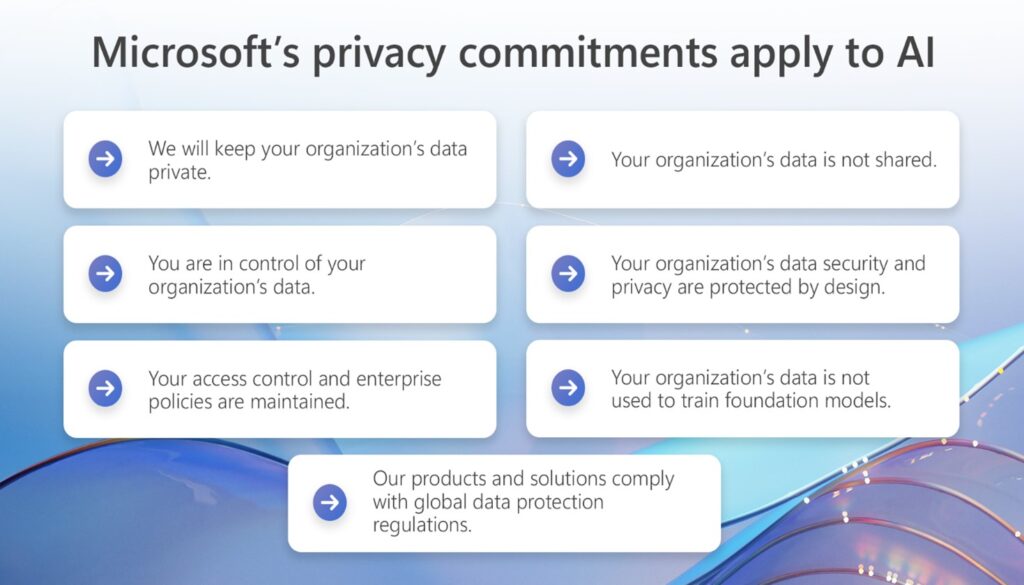
Microsoft’s documentation distinguishes the updated personal Copilot application available from 18 August 2026 from earlier versions and organisational products. When accessed through a personal Microsoft account, the updated application is governed by the Microsoft Services Agreement, Copilot Terms of Use and Microsoft Privacy Statement. Its activity-history documentation says prompts, responses and file contents are not used to train foundation models. Microsoft also says optional customer feedback may improve Copilot without being used to train its underlying foundation models.
These commitments concern a particular use of information, not every possible form of processing or access. Human evaluation can involve comparing outputs, measuring quality, identifying failures or checking policy compliance without using the exact material to update a foundation model’s weights. The 404 Media report should therefore not be paraphrased as proof that all personal photographs train Copilot or that Microsoft’s no-training statement necessarily contradicts the reported review workflow.
Documentation for the older personal Copilot experience described a different set of training controls. Signed-in consumers could choose whether future conversation activity was used for model training, but opting out did not prevent every other product, system, advertising, safety, security or compliance use. Microsoft now labels that material as applying to the earlier application and directs users of the post-August 2026 version towards newer privacy information.
The older FAQ also stated that conversations were not made public to other users and described uploaded files as being retained for a limited period under the applicable policy. It warned against providing sensitive or confidential information that users did not want handled for the purposes described in Microsoft’s privacy materials. Those statements help explain the distinction between restricted processing and public disclosure, but they should not be carried over indiscriminately to the redesigned application. Account type, application version and the feature being used all matter when identifying the applicable rules.
Enterprise Copilot operates under a different contractual and administrative framework. Microsoft describes enterprise data protection as governed by its Data Protection Addendum and Product Terms, with the company acting as a data processor for protected organisational information. Prompts and responses receive protections comparable to other Microsoft 365 customer data, including encryption at rest and in transit and tenant isolation. The enterprise framework also integrates organisational identity, permissions, sensitivity labels, retention controls and auditing. Microsoft says protected prompts, responses and Microsoft Graph data accessed by Copilot are not used to train foundation models.
Copilot Chat documentation explains that organisational prompts and responses are processed within the Microsoft 365 service boundary and may be retained for auditing and eDiscovery. Work or school interactions can also be logged for examination through authorised administrative search and audit tools. Enterprise protection therefore provides additional governance without making activity invisible to an employer’s authorised administrators.
Feature-specific policies add another important distinction. Microsoft’s older consumer documentation recognised that processing features involving faces or hands could require biometric consent and advised users not to share photographs of others without permission in those contexts. Its descriptions of Copilot Vision said certain screenshots and camera images were processed to answer requests and were not retained after the session ended, while textual transcripts could be retained separately. Those statements concerned a particular feature within documentation now marked as applying to an older experience.
They should not automatically be treated as the retention rules for ordinary photographs uploaded for image editing. Consumer chat, Vision, Microsoft 365 files, enterprise chat and image editing are not interchangeable privacy environments. The reported contractor workflow concerns selected image-editing material, so it does not establish that every Copilot feature uses the same review process.
Copilot vs ChatGPT and Gemini: Training Controls, Human Review and Retention
The consumer privacy policies described for Copilot, ChatGPT and Gemini differ in several important ways as of October 2026. Microsoft says the updated personal Copilot application does not use prompts, responses or file contents to train foundation models. OpenAI provides personal ChatGPT users with an “Improve the model for everyone” setting and says turning it off prevents new conversations from being used for model training.
OpenAI separately states that model-improvement data sharing is enabled by default for personal Free, Plus and Pro workspaces, subject to the user’s ability to opt out. Its business-product commitments differ, with data from ChatGPT Business, ChatGPT Enterprise and several other organisational products not used to train models by default. These distinctions show why a provider’s consumer policy should not be assumed to match its business offering. They also concern training specifically, rather than establishing identical rules for retention, authorised access or other processing.
Google is more explicit about human review in its consumer Gemini privacy materials. The Gemini Apps Privacy Hub states that some chats are reviewed by people and that selected conversations, together with associated data, may be retained for up to three years. That retention can continue even after a user deletes the corresponding Gemini Apps activity. Google also allows users to adjust automatic deletion settings, but the disclosed treatment of human-reviewed material makes the scope of those controls important.
This does not mean every Gemini conversation is reviewed or that every item is retained for the maximum period. It demonstrates why users need to distinguish ordinary activity history from material retained through a separate evaluation process. Across all three providers, training settings, human-review disclosures, retention periods and enterprise protections answer different privacy questions, making a blanket claim that all AI assistants handle information in the same way inaccurate.

Copilot Privacy Risks, Available Controls and the Implications for User Trust
A photograph can reveal considerably more than the person uploading it intends to disclose. Faces, homes, documents, licence plates, medical details and other people may appear alongside the object the user actually wants edited. A prompt can add sensitive context involving appearance, sexuality, health, religion or relationships, while generated alternatives reveal how the system interpreted that request. Group photographs introduce a further concern because some pictured individuals may never have agreed to provide their images to an AI service.
Encryption reduces particular risks of unauthorised access, but it does not guarantee that information remains unseen by authorised personnel whose review tools can display it. Similarly, contractor involvement does not establish that safeguards are absent, but it makes permissions, screen capture, data export, device security, logging and confidentiality important questions. The reported investigation therefore changes the practical assumption users should make: consumer AI editing should not be treated as guaranteed machine-only processing simply because the interface appears private and automated.
Microsoft’s updated consumer Copilot application offers controls over memory, history and several forms of personalisation. Those settings can reduce particular uses of information, but each has a defined purpose. Disabling saved memories does not automatically delete memories already stored, and removing a visible conversation should not be assumed to disable every safety, compliance or evaluation process. Likewise, preventing foundation-model training is different from preventing all authorised human access. These distinctions matter because users may otherwise activate one setting and believe it provides a broader protection than Microsoft describes. The available controls should be understood separately:
- Saved memories:
Copilot’s Personalisation settings allow users to manage memories, delete individual entries or erase all saved memories. Turning the feature off prevents new memories from being saved but does not automatically remove existing ones. - Chat and activity history:
Individual conversations can be deleted within Copilot, while the Microsoft privacy dashboard provides controls for broader Copilot activity history. These functions address history and retention rather than serving as a universal prohibition on every other processing purpose. - Shared experiences:
Users can disable the feature that connects personalisation signals across Copilot and services such as Bing, Edge and MSN. This controls that cross-service experience rather than all data handling within each product. - Web search:
Search can be disabled separately from memory and other personalisation features. Its independent control reflects that these functions do not operate as one combined privacy setting. - Personalised advertising:
Advertising personalisation can be switched off through Copilot or Microsoft’s wider privacy dashboard. That choice should not be mistaken for a restriction on unrelated quality, security or compliance activity.
Settings are most useful when combined with data minimisation. Cropping unnecessary areas and removing identifying details where practical can reduce what enters the service in the first place. Highly intimate photographs, government identification, medical imagery, confidential business documents and images of other people deserve particular caution. Convenience alone is not a reason to upload material when the same task can be completed without exposing it.
Users also need to consider the relevant account and feature policies rather than assume an enterprise assurance or Vision-specific retention rule applies to a personal image-editing request. Where content is exceptionally sensitive, avoiding an unnecessary upload remains the lowest-risk approach. None of these precautions means Copilot photographs are public; they address the separate possibility that selected material may be processed or viewed within authorised service operations.
The broader significance of the 404 Media investigation is the gap between how an AI interaction feels and how its data may subsequently be handled. Human evaluation can improve quality and safety, but consumers may not expect a personal photograph and its accompanying instruction to appear in an external reviewer’s assignment. Broad contractual language does not necessarily make that possibility understandable at the moment of upload.
Microsoft’s no-foundation-model-training commitment remains important, yet it does not answer questions about reviewer access, identifying details, evaluation-data retention or available user choices. Google’s explicit human-review disclosure, OpenAI’s consumer training controls and Microsoft’s enterprise governance each address different parts of that problem. Durable trust depends on explaining those boundaries clearly while minimising unnecessary exposure and protecting both users and reviewers. The central issue is not simply whether humans participate in AI evaluation, but whether people understand when that access can occur, what it reveals and how it is controlled.

Frequently Asked Questions (FAQs)
- Does Microsoft Copilot let human contractors read user prompts?
According to 404 Media’s September 2026 investigation, contractors could read the original prompts attached to selected Copilot image-editing requests. Those instructions helped them assess whether the generated edits fulfilled the user’s request. This could expose personal context in the wording, not just information visible in the photograph. The reported access concerned material assigned through an evaluation workflow. It does not establish that contractors can search all Copilot accounts or read every prompt submitted to the service. - Can Microsoft Copilot contractors see user photos?
404 Media reported that reviewers assessing selected image-editing requests could see the original uploaded photographs. They were also shown the accompanying instructions and generated alternatives to compare the results with the source material. This allowed them to check whether Copilot changed the requested elements while preserving other details. It also meant that personal information visible in the original photograph could be exposed during review. The finding concerns access within evaluation assignments, not evidence that Microsoft made those photographs publicly available. - Were faces blurred before contractors saw the photos?
According to the report, faces in the relevant evaluation material were not consistently obscured. Reviewers could therefore see recognisable people rather than only anonymised versions of uploaded photographs. Unblurred details may help someone assess whether an edit preserved identity or facial structure, but that does not resolve questions about user notice and privacy. The accompanying prompt could also reveal sensitive context about the person pictured. These findings apply to the reported workflow and should not be generalised to every Copilot image-processing feature. - Does every Microsoft Copilot conversation get reviewed by a human?
The 404 Media report does not establish that every conversation or image receives human review. It describes selected content being routed into evaluation assignments rather than universal manual monitoring. It also does not demonstrate that contractors can freely open an account and examine its complete history. Copilot includes different consumer and organisational experiences, so the findings should not be applied indiscriminately across all products. Selected review is therefore neither proof that everything is inspected nor a guarantee that a particular upload will remain unseen by authorised reviewers. - Does Microsoft use personal Copilot prompts to train foundation models?
Microsoft says prompts, responses and file contents in the updated personal Copilot application available from 18 August 2026 are not used to train foundation models. That commitment should be read alongside the documentation for that specific application version. Older personal Copilot versions used different controls, including an option governing whether future conversation activity could support model training. Those older instructions should not be substituted for the updated policy. The no-training commitment also does not, by itself, establish that content cannot undergo human evaluation or other authorised service processing. - Is human review the same as AI model training?
No, human evaluation and foundation-model training are different activities. Reviewers can compare edited images, score instruction-following or identify quality and safety problems without the underlying material necessarily being used to update the model. Their assessments can help determine how well a product performs even when the submitted content is excluded from foundation-model training. Microsoft’s no-training commitment can therefore coexist with human evaluation of selected interactions. Users still need separate information about reviewer access, confidentiality and retention because a training restriction does not answer those questions. - Is Microsoft 365 Copilot for businesses more private than consumer Copilot?
Microsoft 365 Copilot provides a stronger contractual and administrative governance framework, but “more private” depends on whose access is being considered. Microsoft describes enterprise protections that include commercial contractual commitments, encryption, tenant isolation and organisational access controls. Protected prompts and responses are not used to train foundation models. However, authorised administrators may be able to search or audit logged interactions under their organisation’s policies. Enterprise protection therefore supports business confidentiality without guaranteeing that an employee’s Copilot activity is invisible to their employer. - How does Gemini compare with Copilot regarding human review?
Google’s Gemini Apps Privacy Hub explicitly states that some conversations are reviewed by people. It also says reviewed chats and associated information may be retained for up to three years, including after the corresponding activity is deleted. This does not mean every Gemini chat is reviewed or retained for that entire period. The Copilot controversy discussed here arose from 404 Media’s investigation into selected image-editing assignments rather than an equivalent disclosure highlighted in Microsoft’s current consumer overview. Comparing the services therefore requires examining review, retention and deletion rules separately from model-training policies. - Can ChatGPT users prevent new chats from being used for model training?
Yes, OpenAI says personal ChatGPT users can turn off “Improve the model for everyone.” After that setting is disabled, new conversations are not used to train OpenAI’s models. The stated protection concerns model-training use and should not be interpreted as a complete explanation of every retention or processing practice. OpenAI separately says its business products do not use customer data for model training by default. Users should therefore distinguish the controls available in personal workspaces from the default protections attached to organisational products. - What is the safest way to use Copilot for private photos?
The lowest-risk approach is to avoid uploading sensitive material that is unnecessary for the task. Crop unrelated areas and remove identifying details where practical, especially when photographs contain documents, private locations or other people. Use the available controls for chat history, saved memories and personalisation according to what each setting actually governs. Turning memory off, for example, does not automatically erase memories already stored. These controls can reduce particular data uses, but they should not be treated as a universal guarantee against authorised human review of selected content.
Conclusion
404 Media’s September 2026 investigation reported that contractors evaluating selected Copilot image-editing requests could see original prompts, uploaded photographs and generated edits, including unblurred faces and sensitive or sexual material. It did not establish that every upload receives human review or that contractors can freely browse users’ accounts. Microsoft says its updated consumer Copilot application, available from 18 August 2026, does not use prompts, responses or file contents to train foundation models, while enterprise Copilot carries a similar commitment alongside additional contractual protections.
However, excluding content from model training does not necessarily prevent separate processing for quality evaluation, safety, compliance or abuse prevention. The central privacy questions therefore concern who may view submitted material, under what circumstances, for which purposes and with what safeguards and retention limits. Google’s disclosure of human review for some Gemini conversations and OpenAI’s separate consumer training controls and business protections further illustrate why these practices should not be treated as interchangeable.
Maintaining trust requires AI providers to explain the entire data lifecycle rather than focus exclusively on whether information trains a model. For users, the practical lesson is that an apparently automated conversation is not necessarily a sealed private space, so sharing sensitive prompts or photographs requires consideration of the specific product, account type, available controls and possibility of authorised human access.
Sources and Citations
- 404 Media. Humans Are Reading Copilot Prompts And They’re Horrified.
https://www.404media.co/humans-reading-copilot-prompts-images/ - TNW. Copilot Users’ Photos Reach Human Reviewers Uncensored, 404 Media Reports.
https://thenextweb.com/news/microsoft-copilot-human-reviewers-photos-prompts-404-media - Microsoft Support. Microsoft Copilot for Individuals: Your Data, Privacy, and Responsible AI.
https://support.microsoft.com/en-us/privacy/microsoft-copilot/overview - Microsoft Support. Microsoft Copilot for Individuals: Your Activity History.
https://support.microsoft.com/en-us/privacy/microsoft-copilot/activity-history - Microsoft Support. Microsoft Copilot for Individuals: Your Privacy Controls and Choices.
https://support.microsoft.com/en-us/privacy/microsoft-copilot/privacy-controls - Microsoft Learn. Enterprise Data Protection in Microsoft Copilot and Microsoft Copilot Chat.
https://learn.microsoft.com/microsoft-365/copilot/enterprise-data-protection - Microsoft Support. Data Protection When Using Microsoft Copilot Chat for Work or School.
https://support.microsoft.com/en-us/privacy/data-protection-when-using-microsoft-365-copilot-chat-for-work-or-school - Microsoft Learn. Microsoft Copilot Chat Privacy and Protections.
https://learn.microsoft.com/en-us/bing-chat-enterprise/privacy-and-protections - OpenAI Help Center. Data Controls in ChatGPT.
https://help.openai.com/en/articles/7730893 - OpenAI. Enterprise Privacy at OpenAI.
https://openai.com/enterprise-privacy/ - Google Gemini Apps Help. Gemini Apps Privacy Hub.
https://support.google.com/gemini/answer/13594961?hl=en
Recommendations
- Pokémon Go Nickit Community Day Guide: Bonuses, Shiny Nickit, and Icy Wind Thievul
- Stranger than Heaven: Official Cities Overview Trailer Breakdown, All Cities Explained, Release Date, Story Details, and Everything We Know
- Warframe Tau Trailer Breakdown: Fornax, Brysko, New Gameplay, and TennoCon 2026 Reveals
- Steam’s Revenue Hits $11.1 Billion: Record-Breaking Half-Year Earnings Explained
- Why Spider-Man Movies Would Never Dare Show a Marvel Hero Like Spider-Noir: The Dark Truth Behind Marvel’s Grittiest Web-Slinger
- NBA 2K27 Editions Detailed Ahead of September 4 Release
- Take-Two CEO Strauss Zelnick Mocks Elon Musk’s “AI Could Make GTA 6” Claim — “Job Number One for AI to Take”
- Marathon Open Beta Announced: Everything We Know About the Server Slam Dates, How to Join, Rewards, and Launch Details
- Switch 2 Just Got One Of The Most Nostalgic Pokemon Spin-Offs – Pokémon Pokopia Explained, Gameplay, Release Date, and Why Fans Love It
- Nicolas Cage superhero detective in Spider-Noir: Release Date, Trailer, Cast, and Story (2026)



































































































