










In This Article (8 sections)
Microsoft Nscale Deal: Microsoft’s Texas Decision and the Capacity Behind the Nscale Deal
Microsoft declined an option to expand its Texas agreement with British AI cloud provider Nscale, leaving the original contract for an approximately 240 MW campus in place. Reuters reported on November 5, 2026, that the decision had been made several months earlier, before Nscale filed for an initial public offering in September.
The Financial Times first reported the decision on November 5, with Reuters and Bloomberg publishing their accounts that day. The precise date of Microsoft’s internal decision was not disclosed. The declined capacity was an optional addition to the existing commitment, so the announcement did not establish a cancellation of Microsoft’s original Texas deployment. Nscale consequently needs other customers for the available opportunity, subject to the relevant property’s power and development status.
An expansion option gives a customer a way to consider additional supply as its requirements develop. For Microsoft, the commercial decision would involve matching a future delivery window with the workloads it expects to support, the hardware available then, and the proposed cost and terms of that additional capacity. For Nscale, a customer exercising the option could simplify planning by establishing a buyer for a substantial further development. An unexercised option offers less certainty when arranging construction and equipment purchases. The public reporting does not disclose the option’s detailed conditions, so it cannot establish whether Microsoft paid to reserve the opportunity or incurred any charge by declining it.
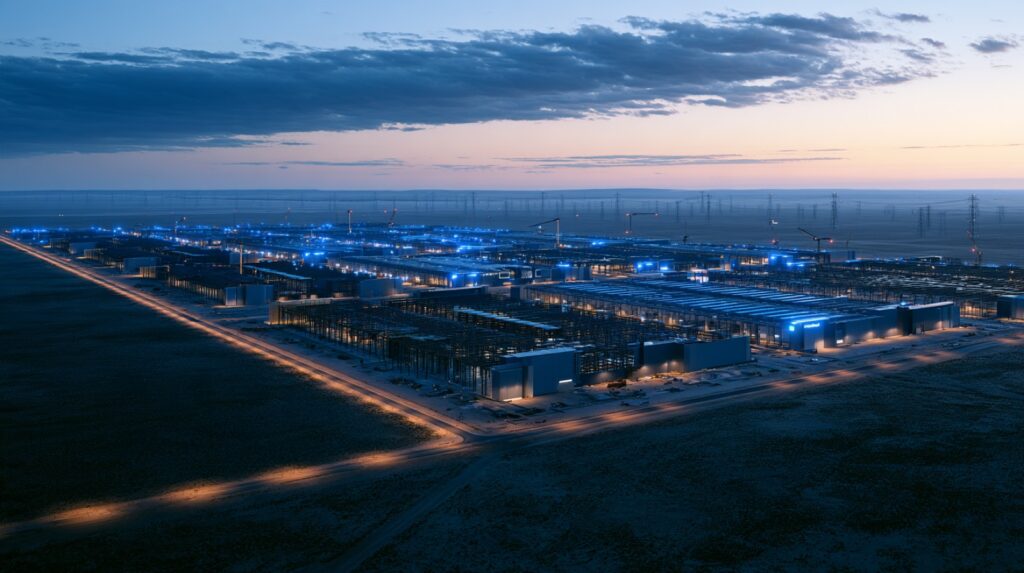
The original deployment is associated with Ionic Digital’s Cedarvale property near Barstow in Ward County, West Texas. Ionic disclosed an arrangement lasting 126 months under which Nscale would lease roughly 50 acres and obtain access to 234 MW of power. Ionic supplies land and electrical access to Nscale, while Nscale supplies computing infrastructure and services to Microsoft. These relationships carry different obligations and should be assessed separately. Nscale also owns another property in Ward County, which the Financial Times identified as the location of the declined expansion option and Figure’s planned deployment. A reference to Barstow can therefore concern either property, and a lease, approval, or construction milestone at one does not establish progress at the other.
Nscale’s October 2025 announcement described the original Microsoft campus as approximately 240 MW, supporting about 104,000 Nvidia GB300 GPUs through phased delivery beginning in the third quarter of 2026. The 240 MW figure expresses the approximate campus scale, while Ionic’s 234 MW figure describes power access under the initial lease. The Texas GPUs were part of a broader plan for approximately 200,000 Nvidia GPUs across the United States and Europe, including a separate deployment at Sines, Portugal.
Megawatts measure power, while GPU counts identify accelerators, with the relationship depending on hardware generation, rack configuration, networking, cooling, and other electrical demands. A phased delivery announcement establishes an intended schedule and deployment size. It does not show how much equipment has been commissioned or is serving customers. Neither the announcement nor the later reporting specified how many of the approximately 104,000 Texas GPUs had entered production by November 9.
Nvidia’s GB300 NVL72 platform illustrates the infrastructure behind these GPU totals. Its design combines 72 Blackwell Ultra GPUs and 36 Grace CPUs in a rack with liquid cooling and connections that allow the accelerators to work together. A large deployment also needs networking between racks, storage, and software to coordinate workloads. This explains why adding electrical capacity alone cannot produce a matching increase in usable computing performance. The complete system must be installed, integrated, and tested. It also means that a megawatt estimate for one hardware configuration cannot automatically be applied to a future deployment using a different generation of accelerators.
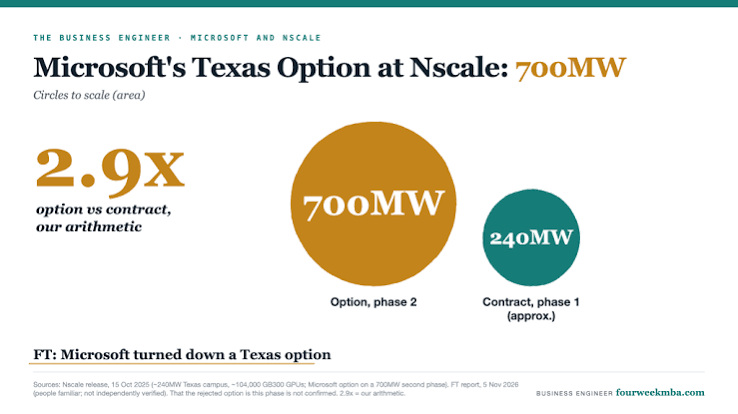
Early coverage referred to a 700 MW expansion, but Nscale told the Financial Times that the option Microsoft declined was closer to 500 MW at its own Ward County property. Adding that rounded figure to the approximately 240 MW base produces an estimated combined footprint of 740 MW across the relevant sites. That would have been just over three times the original campus size.
Separately, Ionic’s prospectus identifies 700 MW as the fully expanded target for its property, which would represent about 466 MW above the initial 234 MW lease capacity. Nscale’s October 2025 release had also described the leased campus as potentially scaling to 700 MW. The company’s later clarification provides the more direct account of the declined option, while Ionic’s filing defines its own property’s expansion target. These figures describe different commitments and development possibilities and should not be added together as available operating capacity.
Nscale’s public announcement now explicitly acknowledges the earlier reporting problem. A correction dated November 5, 2026, removed the statement that Microsoft held an option on a second phase of 700 MW beginning in late 2027. That correction matters when comparing the original announcement with subsequent coverage. Using the later rounded estimate of 500 MW, the additional opportunity alone represented roughly 208% of the 240 MW base, while the combined footprint would have been about 3.08 times as large. Those calculations describe potential electrical scale across the relevant properties; they do not establish a corresponding multiple of contract revenue, GPU capacity, or profitability.
The decision also has a narrower meaning than a general retreat from AI infrastructure. A cloud customer can retain one deployment while declining another because their delivery dates, locations, or commercial conditions differ. Microsoft’s continuing base agreement demonstrates that the Texas relationship survived the decision. Its other announced Nscale projects must be assessed on their own terms. The available evidence therefore supports a conclusion about one expansion opportunity, while leaving Microsoft’s overall capacity requirements unresolved. Establishing a wider spending change would require information about its complete procurement plans, including commitments to other providers and facilities it develops itself.

Power Connection Delays and the Outlook for Texas Data Center Approvals
Bloomberg, citing a person familiar with the matter, reported that Microsoft decided against the expansion while it awaited regulatory approval for an electrical connection. That account identifies the reported power issue without establishing the relative importance of every commercial consideration. For an AI customer, connection approval and the date a facility can reliably draw its full electrical load are separate milestones.
Uncertainty around either can disrupt server installations, network testing, and the scheduling of customer workloads. A suitable property and hardware procurement plan therefore do not guarantee a dependable computing service delivery date. Reuters also reported that Microsoft withdrew from a separate agreement to anchor Nscale’s Loughton project in Essex, England, after expected power delivery moved into the 2030s. That timetable concerned Loughton, while the Texas account referred to a pending connection approval and left the original Microsoft contract intact.
A delayed connection can create a difficult procurement tradeoff. Ordering servers early may protect a delivery slot, but equipment arriving before the facility is ready can require storage and tie up capital. Waiting for greater certainty can move hardware delivery later, even after power becomes available. Construction crews and specialist installation teams also need workable schedules, particularly when their tasks depend on one another. These are potential consequences of a mismatch between equipment and electricity delivery, rather than disclosed losses on this particular expansion. They help explain why a customer may attach substantial value to a dependable commissioning date when comparing otherwise attractive sites.
Ionic’s prospectus describes a separate obligation for Nscale to lease an additional 89 MW at the Cedarvale property when that power becomes available. Ionic said this increase depended on regulatory approval and projected energization in the second half of 2027. The increment belongs to the Ionic lease and is distinct from the approximately 500 MW option at Nscale’s own property. A lease establishes commercial access to power once available, while interconnection work addresses whether the electrical infrastructure can support the load. Construction and commissioning then determine when installed servers can serve customers. The forecast therefore describes a conditional future milestone rather than confirmation that the additional power is already available.
Ionic provided a more recent account of its expansion in its November 4 results announcement. The company said its request for an additional 466 MW at Ward County had received provisional classification under the Electric Reliability Council of Texas’s Batch Zero Baseload Pathway (b). Ionic described that pathway as applying to projects already initially energized, and continued to expect additional energization in late 2027 with final classification expected in December 2026.
The 466 MW includes the 89 MW already committed to Nscale and would bring the property from 234 MW to 700 MW. The update shows progress in a particular approval process, with regulatory and utility infrastructure conditions still attached. It concerns Ionic’s route toward its 700 MW property target and does not establish approval for the separate Nscale property associated with Microsoft’s declined option.
Texas Governor Elect Gina Hinojosa proposed a moratorium on new data center approvals while lawmakers develop protections for residents. The Texas Tribune reported that her proposal followed outgoing Governor Greg Abbott’s actions to pause grid connections and environmental permitting during an audit. Hinojosa has called for more local input and raised concerns about electricity costs, water supplies, and transparency. If implemented, her proposal could extend uncertainty for developments still requiring new approvals. Its effects would depend on the eventual wording and implementation of the pause. Microsoft’s reported decision occurred months before the September IPO filing and before Hinojosa’s November election, so her proposal should not be presented as its cause.
For any proposed pause, the treatment of existing developments would be central to its practical effect. A policy could affect an application for a new site differently from work under an existing approval or a request to expand an established connection. Developers would also need to understand whether separate electricity, environmental, and construction permissions are covered. Local concerns about water and electricity costs introduce further questions about project design and responsibility for infrastructure spending. Until the applicable rules are settled, a single statewide description cannot reliably predict each campus’s delivery date. The relevant assessment remains tied to the permissions and physical work outstanding for each phase.
Developers coordinate equipment purchases, contractor schedules, financing, and customer delivery commitments around expected construction and energization dates. Delayed approvals can force those arrangements to be rescheduled. An operating facility, a permitted development, and an expansion awaiting a new electrical connection may face different consequences. Even within Ward County, separate phases can occupy different stages of the approval process. For Barstow, the practical question is which approvals each property and phase still needs, with the proposed pause adding uncertainty to future development rather than establishing one outcome for every project.
Phased energization can help a developer start serving customers before an entire campus is complete, provided the available section has everything required to operate. However, the value of an early phase depends on the workload. Independent computing jobs may fit within smaller groups of available servers, while a large training run may require a much larger connected cluster to be ready together. Customer acceptance therefore adds another practical milestone after electricity reaches the site. The operator must demonstrate that the delivered systems meet the agreed requirements. For Nscale, matching those acceptance milestones with power and equipment availability is part of converting a development schedule into service delivery.
Nscale’s Microsoft Contracts, IPO Finances, and the Expansion’s Potential Value
The Financial Times reported that the declined expansion could have been worth tens of billions of dollars to Nscale. The Australian Financial Review also covered the opportunity worth billions of dollars. Neither report disclosed an exact price, payment schedule, or detailed contract terms. A large headline value can reflect computing services delivered over many years, with actual earnings dependent on the agreement and successful delivery. Accelerator purchases, construction financing, power connections, and operating expenses must also be considered when assessing profitability. The reported opportunity should therefore be distinguished from the values of Nscale’s signed customer agreements and its landlord’s lease.
Nscale’s registration statement disclosed Microsoft statements of work signed between September 2025 and April 2026 that provided for payments of up to approximately $43.8 billion through December 2033. These agreements cover GPU infrastructure, colocation space, and cloud services. Payments depend on delivery and service availability requirements, and the total excludes optional extensions. GPU service terms run for five to six years from acceptance of each tranche, with Microsoft able to elect an extension of six months. Because deployment is phased, individual tranches can begin their service periods at different times. This figure describes the broader existing Microsoft relationship and is not the disclosed price of the declined Texas option.
Phased acceptance also creates a financing challenge because spending and customer service periods do not necessarily begin together. A developer may need to fund construction, equipment deposits, installation, and testing before the associated capacity is accepted. Once service begins, the project still has operating costs and financing obligations to meet. The commercial value of a large agreement therefore depends partly on the timing of those cash flows. A delay could extend the period during which capital is committed without the expected service income. The public figures do not disclose a complete Texas payment calendar, so they cannot show precisely how that timing affects Nscale’s funding needs.
Nscale separately reported $103.4 billion in active and contracted total contract value across its customer portfolio as of August 31, 2026. Its definition includes signed commitments while excluding unexercised capacity, optional renewals, and optional extensions. Reuters reported that Microsoft’s Texas decision did not affect the roughly $103 billion total disclosed in the IPO filing. Contract value measures commitments over multiple years, while reported revenue reflects services accounted for within a particular period. Ionic’s filing disclosed another distinct figure, approximately $1.95 billion in fixed payments under its original property lease to Nscale. That amount concerns the landlord’s agreement and should not be confused with Microsoft’s computing commitments or the potential expansion value.
The registration statement provides another measure of how much contracted business had yet to enter service: Nscale reported approximately $2.6 billion of active total contract value within its $103.4 billion active and contracted total as of August 31. Active commitments therefore represented only about 2.5% of the combined figure at that date. This calculation compares contract values rather than physical completion or recognized revenue, but it shows how heavily the disclosed portfolio depended on services scheduled to begin later. Nscale also described a business model based primarily on contracts requiring payment for committed capacity, subject to the relevant delivery conditions. Such arrangements can improve revenue visibility once the promised infrastructure is available.
SEC records show that Nscale filed its Form S-1 on September 18, 2026. The company said it had applied to list ordinary shares on the New York Stock Exchange under the ticker NSCL, with the number of shares and price range still unspecified at filing. The Financial Times reported a target valuation of about $35 billion, which represented an ambition for the proposed offering. For the six months ended June 30, 2026, Nscale reported revenue of $140.6 million and a net loss of about $1 billion. The filing also disclosed substantial equipment and construction commitments. These figures highlight the gap between the scale of signed future business and the infrastructure and services that still need to be delivered.
There was already financing attached to Nscale’s US deployment plans before the November reporting. On August 31, the company announced approximately $3 billion in aggregate loan commitments across Ward County and Madison, North Carolina, including up to $1.85 billion for Ward County and up to $1.2 billion for Madison. Nscale said the facilities would primarily fund GPU infrastructure and associated networking, storage, and cooling equipment. These were borrowing commitments for identified projects, with funds available through delayed draw facilities. They should not be read as evidence that every contemplated Texas expansion was fully funded. The announcement nevertheless adds a concrete financing milestone to the broader picture of Nscale’s existing US buildout.
Nscale said its largest customer represented 52% of revenue in the first half of 2026. Microsoft’s declined option removes one potential route to further growth with an existing major customer without reducing the disclosed total contract value. Replacing that opportunity requires other customers and progress on the associated power, construction, and financing milestones. Agreements such as Figure’s can broaden the future customer mix, but their effect depends on when they produce operating capacity and revenue. The relevant distinction is between capacity a customer could have reserved and signed business Nscale can deliver under agreed conditions.
For the proposed IPO, the significance lies in expectations for growth beyond the signed portfolio. An option excluded from reported contract value can still influence how investors imagine a company’s future expansion, especially when it involves a major existing customer. Losing that potential business can require a different growth plan even when the disclosed total remains unchanged. New customers could help, but their payment capacity, delivery requirements, and contract duration would influence the quality of that replacement business. The reported $35 billion target also describes a proposed company valuation, rather than cash already available to fund construction or the amount the offering would necessarily raise.

New Texas Customers, Figure’s Barstow Plans, and the West Virginia Comparison
Reuters reported that Nscale was discussing the remaining Texas capacity with several major customers. The Financial Times also reported undisclosed signed deals and further customer talks at Nscale’s own Ward County property. Figure is a named customer there, while the identities and potential deployment sizes of other prospective buyers remain private. Possible customer categories include AI laboratories needing large training clusters, cloud providers seeking additional GPU supply, and enterprises with sustained AI workloads. These categories describe potential uses and do not identify confirmed buyers. Customer discussions and signed commitments also represent different stages of commercial progress.
Suitability depends on power availability, the GPU systems Nscale can supply, delivery timing, and the amount of contiguous capacity a customer needs. A large cluster can support training one model across many accelerators, while smaller deployments can accommodate independent workloads with different schedules.
Replacing one prospective large customer with several buyers would involve more than dividing the available megawatts. Each buyer could require a different installation sequence, network arrangement, security configuration, or level of operational support. Some may want dedicated infrastructure for a defined period, while others may need capacity to increase gradually. Those differences can influence how Nscale divides its buildings and schedules equipment purchases. A broader customer base could reduce dependence on any one buyer, but it would also require coordination across more service commitments. The strongest commercial outcome would combine suitable demand with delivery terms that the property and its infrastructure can support.
At Ionic’s property, Nscale holds a right of first refusal on additional power. Ionic’s filing also describes the possibility of supplying expanded capacity to other cloud, AI, or enterprise customers, or using it for its own cryptocurrency mining, subject to the applicable agreement. Those rights concern the Ionic property and do not define access to Nscale’s separate development. A prospective customer’s options therefore depend on both the site supplying the power and the commercial rights already attached to it.
Nscale announced its multiyear Figure partnership on September 3, 2026, with an initial compute commitment of $3.5 billion. It described an intention to expand the relationship beyond $6 billion and the potential to deploy up to 100,000 Nvidia GPUs using the Vera Rubin platform. The first Barstow deployments were targeted for the second half of 2027. Nscale would also become a Figure shareholder and its preferred compute provider, supporting development of Figure’s Helix models and humanoid robots.
The initial commitment, intended spending growth, maximum potential GPU count, and delivery target describe different elements of the agreement. The Financial Times located Figure on part of the property owned by Nscale associated with Microsoft’s declined option. No initial megawatt allocation was disclosed, so the agreement identifies a customer for part of the site without establishing how much of the optional capacity has been replaced or remains available.
Figure’s intended use also helps explain why robotics companies can become substantial customers for remote AI computing. The partnership announcement described training Figure’s models through Nscale’s cloud, validating them in Nvidia Isaac Sim, and deploying them on Nvidia hardware inside robots. These are different stages of development: centralized training and simulation can improve a model before that model is used in a physical machine. The Barstow commitment therefore concerns infrastructure supporting Figure’s development program. It does not mean that every robot would require a continuous allocation of the announced data center GPUs, or that the full potential deployment would enter service at the same time.
Nscale’s planned shareholding gives the Figure relationship an additional financial dimension. As a supplier, it would earn revenue from computing services; as a shareholder, it would also have exposure to Figure’s equity value. Those interests could encourage a sustained partnership, but they represent separate economic outcomes. The announcement did not disclose the investment amount or ownership percentage. Likewise, the intention to expand spending beyond $6 billion describes a possible further stage. Evaluating the agreement requires attention to the initial commitment and the conditions under which additional capacity would be ordered.
Nscale’s separate West Virginia proposal involves a different scale, GPU generation, and form of commercial commitment. In March 2026, it announced a letter of intent with Microsoft for 1.35 GW of AI computing capacity at Monarch Compute Campus. The proposal envisioned Nvidia Vera Rubin NVL72 systems and a collaboration involving Nvidia and Caterpillar. That differs from the approximately 240 MW Texas deployment planned around GB300 GPUs under the existing Microsoft agreement. A letter of intent should be distinguished from the Texas base commitment and the optional expansion Microsoft declined. The Ward County decision does not establish the status of individual deployments at Monarch, which depend on their own terms and milestones.
Nscale’s September filing also disclosed four Anthropic agreements signed on August 25, 2026, for services at Monarch. They provided for potential aggregate payments of up to about $44.6 billion, conditional on specified delivery and service availability requirements. The filing described an obligation to use best efforts to obtain qualifying financing for the necessary equipment and infrastructure. The Financial Times reported construction and permitting challenges at the campus. These Anthropic service agreements are separate from Microsoft’s publicly announced letter of intent. Comparing Texas and West Virginia therefore requires attention to the customer, contractual stage, financing obligations, and delivery conditions attached to each deployment.
The next useful evidence will be progress that connects these announcements to delivery: firm commitments from additional Texas customers, completed power milestones, installed systems, and customer acceptance of successive deployments. Those developments would show how quickly Nscale can convert the available opportunity into services and revenue. Microsoft’s original Texas agreement remains in place, while Nscale is pursuing other customers for capacity at its separate Ward County property. The outcome will depend on whether Nscale can assemble suitable customers, financing, and dependable delivery dates for that capacity.
Frequently Asked Questions (FAQs)
- Did Microsoft cancel its Texas data center deal with Nscale?
No, Reuters reported that Microsoft’s original Texas contract with Nscale remained in place. Microsoft declined an option to take additional capacity beyond that existing commitment. The original deployment is associated with Ionic Digital’s Cedarvale property, while the declined option concerned a separate property owned by Nscale. Nscale can seek other customers for that additional capacity, subject to the site’s power and development status. Keeping the original contract intact does not, by itself, confirm that all planned equipment has been installed or entered operation. - How many GPUs did Nscale plan to supply Microsoft in Texas?
Nscale announced approximately 104,000 Nvidia GB300 GPUs for the original Texas campus. Delivery was planned in phases beginning in the third quarter of 2026. A phased schedule allows portions of the deployment to become available over time. The Texas allocation formed part of a broader plan to supply approximately 200,000 Nvidia GPUs across the United States and Europe. As of November 9, the available announcements and reporting did not establish how many Texas GPUs had been commissioned or entered production. - Why are both 234 MW and 240 MW used for the original project?
Ionic Digital disclosed 234 MW of power access under its initial property lease with Nscale. Nscale used approximately 240 MW to describe the overall scale of the announced Microsoft campus. The figures concern the same original development but come from disclosures describing different commercial arrangements. They should not be added together when calculating the project’s capacity. Neither figure alone confirms that all the power is available for use or that the entire GPU deployment is operating. - Was Microsoft’s declined expansion option 500 MW or 700 MW?
Nscale told the Financial Times that the declined option was closer to 500 MW and applied to its own Ward County property. Earlier reporting had referred to a 700 MW expansion. Ionic Digital separately identifies 700 MW as the fully expanded target for its Cedarvale property, which is a different site. Compared with Ionic’s initial 234 MW lease capacity, that target would represent approximately 466 MW of additional power there. The approximately 500 MW option and Ionic’s 700 MW property target therefore describe different development possibilities. - Did the Texas decision reduce Nscale’s $103.4 billion total contract value?
Reuters reported that the decision did not affect Nscale’s disclosed $103.4 billion total contract value as of August 31, 2026. That company-wide figure covers active and contracted business across its customer portfolio. Nscale’s methodology excludes unexercised capacity, optional renewals, and optional extensions. Microsoft’s declined expansion option was therefore outside the signed commitments included in that total. The decision affected potential future business without removing the original Texas contract from the existing relationship. - How much are Nscale’s existing Microsoft agreements worth?
Nscale disclosed potential payments of up to approximately $43.8 billion through December 2033. The relevant statements of work were signed between September 2025 and April 2026 and cover GPU infrastructure, colocation space, and cloud services. Payments depend on Nscale meeting delivery and service availability requirements. The disclosed amount excludes optional extensions, including Microsoft’s ability to extend GPU service terms by six months. This figure describes the broader existing Microsoft relationship and should not be treated as the value of the declined Texas expansion. - When did Nscale file for its IPO?
Nscale filed its Form S-1 with the SEC on September 18, 2026. It also applied to list ordinary shares on the New York Stock Exchange under the proposed symbol NSCL. At filing, the company had not specified the number of shares to be offered or a price range. The registration statement formed part of its preparations for a proposed public offering. Reuters reported that Microsoft had declined the Texas expansion several months before this filing, although the decision became public on November 5. - When is Figure expected to get GPU capacity in Barstow?
Nscale targeted the second half of 2027 for the start of Figure’s GPU deployment in Barstow. That schedule appeared in the partnership announcement published on September 3, 2026. The relationship envisages Nvidia Vera Rubin systems and the potential to deploy up to 100,000 GPUs. The announced date marks the planned beginning of deployment and does not confirm that the full potential GPU count will be available then. Nscale also did not disclose the megawatt allocation for Figure’s initial deployment. - Is the West Virginia Microsoft project part of the Texas expansion?
No, West Virginia is a separate development with its own proposed capacity and commercial arrangements. In March 2026, Nscale announced a Microsoft letter of intent for 1.35 GW at Monarch Compute Campus. That proposal envisioned Nvidia Vera Rubin NVL72 systems and collaboration involving Nvidia and Caterpillar. The original Texas deployment instead covers approximately 240 MW planned around Nvidia GB300 GPUs, alongside the separate expansion option Microsoft declined. The different locations and forms of commitment mean the Texas decision does not establish the status of Microsoft’s West Virginia proposal. - Has Gina Hinojosa’s proposed Texas data center pause already taken effect?
No, as of November 9, 2026, Hinojosa was governor-elect and her broader moratorium remained a proposal. She had called for a pause on new data center approvals while lawmakers developed protections addressing concerns such as electricity costs, water supplies, and local input. Texas already had separate restrictions on grid connections and environmental permitting introduced under Governor Greg Abbott during an audit. Any additional pause would depend on its final wording, implementation, and the approvals individual projects still required. Microsoft’s reported expansion decision preceded Hinojosa’s election and should not be attributed to her proposed moratorium.
Conclusion
Microsoft’s decision to decline additional AI computing capacity in Texas removes a potential multibillion-dollar expansion from Nscale’s growth plans with that customer. The original agreement for a campus of about 240 MW remained in place, according to Reuters. Nscale’s later clarification put the declined option closer to 500 MW at its own Ward County property, while Ionic Digital’s 700 MW figure describes the potential full expansion of its separate property. Reading those numbers alongside their underlying agreements resolves the apparent conflict in the early reports.
Figure’s $3.5 billion initial commitment gives Nscale a named customer for part of its own Barstow site, with GPU deployment targeted to start in the second half of 2027. For the rest of the Ward County capacity, the commercial outcome depends on which customers sign, which portions of each property can secure power, and when those portions can begin delivering computing services. Those milestones also matter to Nscale’s IPO because its disclosed contract value spans years of services that depend on successful delivery.
Sources and Citations
- Reuters, November 5, 2026: Reports that Microsoft declined an option to expand its Texas data center arrangement with Nscale before Nscale’s September IPO filing, while the original Texas agreement remained intact. Reuters also reported that the declined option did not affect Nscale’s disclosed contract-value total. Reuters
Microsoft declines option to expand Texas data center deal with Nscale - Bloomberg, November 5, 2026: Reports on Microsoft’s original roughly 240 MW Texas commitment and identifies pending electrical connection approval as a factor associated with the declined expansion.
Microsoft Declined to Expand Texas Data Center Offer With Nscale Before IPO - Financial Times, November 5, 2026: Reports that the potential expansion represented a multibillion-dollar opportunity and carries Nscale’s clarification that the option Microsoft declined was closer to 500 MW at its own Ward County property. Financial Times
Microsoft rejects multibillion-dollar AI deal with UK’s Nscale - Nscale, October 2025: Official announcement covering the Microsoft infrastructure agreement, including approximately 200,000 Nvidia GB300 GPUs across the U.S. and Europe and the Texas deployment discussed in the article. Nscale
Nscale Contracts Approximately 200,000 NVIDIA GB300 GPUs with Microsoft - Nscale Limited Form S-1, September 18, 2026: Official SEC registration statement for Nscale Limited. It discloses Microsoft statements of work, Anthropic agreements, contract-value figures, customer concentration, revenue and loss figures, and delivery and service-availability conditions attached to major commitments. SEC
Nscale Limited Form S-1 - Ionic Digital SEC Prospectus, July 2026: Official SEC filing for Ionic Digital. It contains the commercial terms governing the Cedarvale property, including the Nscale lease, power-access provisions, expansion conditions, and rights associated with additional capacity. SEC
Ionic Digital SEC Prospectus - Nscale, September 3, 2026: Official announcement of Nscale’s strategic partnership with Figure, covering the initial $3.5 billion compute commitment, plans to expand the relationship, potential deployment of up to 100,000 Nvidia Vera Rubin GPUs, and planned Barstow deployment. Nscale
Nscale and Figure Sign Strategic Partnership to Power the Next Generation of Physical AI - Nscale, March 16, 2026: Official announcement of the planned 1.35 GW Microsoft deployment at the Monarch Compute Campus in West Virginia, involving Nvidia Vera Rubin NVL72 systems and collaboration with Nvidia and Caterpillar. Nscale
Nscale and Microsoft Announce 1.35GW West Virginia AI Factory Collaboration - The Texas Tribune, November 4, 2026: Covers Governor-elect Gina Hinojosa’s proposed pause on new Texas data center approvals, alongside existing restrictions and concerns involving electricity costs, water resources, environmental permitting, grid connections, local input, and transparency. The Texas Tribune
Under Hinojosa, Texas data center approvals could stay paused
Recommendations
- Where Winds Meet, Official Imperial Palace Gameplay Trailer Explained: Release Date, Story, Combat Details & Everything We Know
- Diablo 4 3Rd Anniversary Event: Goblins, Massive XP Boost, Free Cosmetics, and Full June 2–9 Celebration Guide
- IO Interactive and Build A Rocket Boy End MindsEye Partnership as Hitman Crossover DLC Is Canceled
- All Anomalies in Animal Hospital Guide: Every Roblox Anomaly Explained
- Every Release Date from Every Event at Summer Game Fest 2026
- First Gameplay Trailer of Silent Hill: Townfall: It’s a First-Person Game and Everything We Know (2026)
- Best New Anime to Watch Right Now: Spring 2026 Picks
- Switch 2 Software Update Adds “Handheld Mode Boost” for Old Games – Performance Upgrade Explained
- We Build LEGO Winnie the Pooh: A 100th Anniversary Set Worth the Hype for Disney and LEGO Fans
- Echoes of Aincrad: Complete Guide to Growth Points (Best Stat Builds & Leveling Tips)



































































































