







In This Article (14 sections)
Ocarina of Time Remake Rolling Versus Dashing Speed and Movement Controls
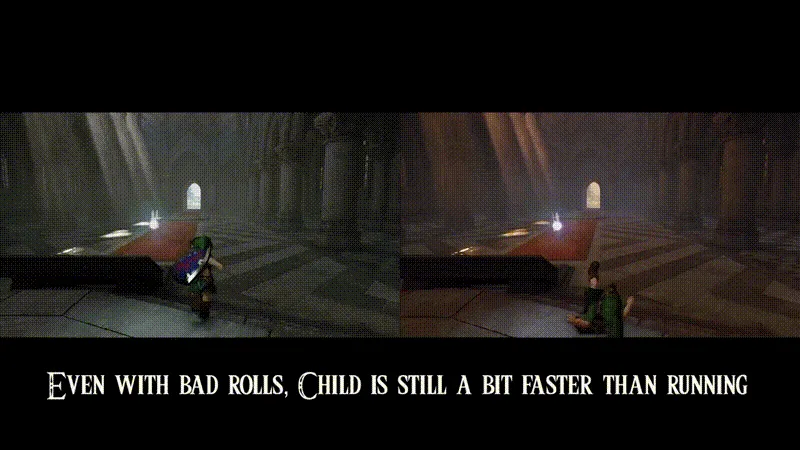
Ocarina of Time remake speed tests give Young Link’s old habit of rolling across Hyrule Field a reason to survive on Nintendo Switch 2. Early player comparisons demonstrated that repeatedly performing forward rolls could put him slightly ahead of a continuous dash. However, the most significant time saving came from incorporating a jump into the movement sequence. During the journey from Kokiri Forest toward Hyrule Castle, speedrunner Kethaldo reached the castle approach approximately four seconds sooner by alternating targeted forward hops and landing rolls. The results demonstrate that Nintendo’s new dashing mechanic offers a convenient alternative to traditional rolling, although experienced players can achieve faster movement by combining several actions.
The size of the advantage depends on the course and movement technique being tested. GameXplain timed six methods of crossing the Temple of Time and discovered that repeated rolling and continuous dashing finished within a fraction of a second of each other. On a clearer subsequent course, the two techniques finished together. Ordinary forward movement using the left stick was considerably slower than either method. Holding A therefore provides an accessible way to travel quickly across Hyrule, while learning to time a roll immediately after a forward hop offers players an opportunity to reduce travel times further. The approximately four second advantage demonstrated on the castle route belongs specifically to the combined technique rather than ordinary repeated rolling.
During Nintendo’s September 8, 2026, gameplay demonstration, series producer Eiji Aonuma recalled that players of the original Ocarina of Time frequently rolled to reach destinations faster. He then demonstrated the remake’s new movement mechanic, showing what happens when players continue holding A after initiating a roll. Aonuma explained that dashing is recommended when travelling longer distances. However, his recommendation concerned the practicality of overworld travel rather than establishing that dashing would always outperform repeated rolling in a timed comparison. Nintendo’s demonstration introduced a more convenient movement option without removing the familiar technique that players had used throughout the original adventure.
Design Choices Preserve Classic Rolling and Add Dash
Remake director HokWai Ng expanded on this design decision during Nintendo’s Ask the Developer interview. The development team wanted players who remembered repeatedly rolling across Hyrule Field to recreate that experience on Nintendo Switch 2. Assigning the dash to the same button preserved the original movement while introducing a convenient alternative. Aonuma also discussed an experiment involving additional warp points, which he initially requested before asking the developers to remove them. Using those shortcuts reduced opportunities to notice interesting locations and make unexpected discoveries along the way. Dashing offered a compromise by reducing travel time while allowing players to observe their surroundings and investigate anything that attracted their attention.
On the default Nintendo Switch 2 controls, Young Link can dash by moving the left stick in the desired direction and pressing and holding A. Link initially performs a forward roll before returning to his feet and transitioning into a continuous sprint. Players do not need to press A again after the opening somersault. Maintaining pressure on the button keeps the dash active while the left stick controls direction. The open road leading away from Kokiri Forest provides a suitable location to practise this mechanic, particularly because the Castle Town drawbridge eventually becomes a recognizable landmark that players can use to maintain their direction.
Understanding the difference between tapping and holding A is essential when comparing movement methods. A quick press and release while moving forward produces a single roll, while holding the button allows Link to transition into a dash. Players can practise the distinction by performing two consecutive rolls before beginning a sprint. Tap and release A for the first roll, then press A again for the second and continue holding it. Link should emerge from the second somersault and begin dashing. This sequence also allows players to switch conveniently between movement methods without stopping or changing direction.
The main movement controls include:
- Ordinary forward movement: Push the left stick in the desired direction without pressing A.
- Forward roll: Tap and release A while moving forward through open space.
- Repeated forward rolls: Press A again as Link completes each previous roll.
- Continuous dash: Press and hold A while moving forward, maintaining the input after the opening roll.
- Targeted forward hop: Use ZL to enter the targeting stance, push the left stick forward, and press X.
- Forward hop followed by a roll: Perform a targeted forward hop and tap A when Link reaches the ground.
Players should also consider their surroundings when practising these movements because A functions as an action button. Standing near a character, interactive object, or item can cause Link to perform the action displayed on screen instead of rolling. Movement comparisons are consequently easier to conduct in open areas without nearby interactions. Starting several steps away from anything Link can examine, collect, or speak to helps ensure that each button press produces the intended movement and prevents unrelated actions from influencing the recorded travel time.
Original N64 Speed Data Explains Rolling Popularity
The popularity of rolling originated in the Nintendo 64 release, where the movement offered a measurable advantage over ordinary running. ZeldaSpeedRuns records Young Link’s standard forward movement speed at 8.25 units per frame, compared with 12.375 units per frame for rolling or walking backward. These recorded values indicate that Young Link’s maximum rolling speed was approximately 50% higher than his ordinary forward movement speed. Adult Link also possessed a higher recorded rolling speed than his standard forward movement, making repeated rolls a useful technique throughout different stages of the original adventure.
However, these Nintendo 64 movement values represent recorded speeds rather than the complete duration of an actual journey. Acceleration, recovery animations, steering, and the timing of repeated inputs influence how quickly players reach their destinations. Rolling also offered a practical advantage over backward walking because Link could continue facing the direction of travel. Players could maintain a clear view of roads, obstacles, and distant landmarks while benefiting from increased movement speed. The remake preserves this familiar method while introducing dashing as an alternative that requires considerably less repeated input.

Speedrunning Tests, Temple of Time Results, and Forward Hop Roll Cancelling
The Ocarina of Time remake movement comparisons examined different techniques across several courses, providing a clearer understanding of how Young Link travels on Nintendo Switch 2. GameXplain’s André Segers organized a race involving six movement methods across the same stretch of the Temple of Time. Presenting the attempts alongside one another made it possible to identify the fastest techniques and observe substantial differences between movements that had previously been popular among Nintendo 64 players. A subsequent comparison focused on rolling and dashing across a clearer course, reducing the influence of obstacles and differences in the routes followed.
Kethaldo approached movement testing from the perspective of an actual playthrough by comparing techniques along the journey from Kokiri Forest toward Hyrule Castle. This route provided a longer benchmark, allowing small advantages from individual movements to accumulate into a noticeable difference at the finish. The longer crossing also introduced additional opportunities for mistimed inputs, imperfect landings, and steering mistakes. Kethaldo acknowledged that the demonstration contained errors, making the final result particularly interesting because the combined movement technique maintained an advantage despite imperfect execution.
Other players investigated movement under more controlled input conditions. In a November 11 comparison shared with the speedrunning community, one tester used a turbo function to perform ordinary rolls with nearly perfect repetition and a macro to examine a separate technique involving the cancellation of a roll animation. Ordinary repeated rolls won that particular comparison. However, cancelling the recovery from a roll and cancelling the landing recovery from a forward hop are different techniques. The results from one experiment cannot automatically be applied to the other, even though players commonly use similar terminology when discussing animation cancellation.
Temple of Time Movement Race Rankings
GameXplain’s Temple of Time comparison found that repeated forward rolls finished first, with continuous dashing following almost immediately. Both methods completed the crossing in approximately 23 seconds, with ordinary rolling saving only a fraction of a second. Backflips finished third, followed by sidehops, ordinary forward movement, and backward walking. Reporting on the comparison placed rolling and dashing at approximately 20% faster than ordinary forward movement, while backflipping offered an advantage of around 16% and sidehopping approximately 8%. Walking backward performed considerably worse, finishing close to 20% slower than ordinary forward movement.
The movement methods finished in the following order:
- Repeated forward rolls: Finished first, narrowly outperforming continuous dashing.
- Continuous dashing: Finished almost immediately after repeated rolling.
- Backflips: Offered approximately 16% faster movement than ordinary forward travel.
- Sidehops: Provided an advantage of approximately 8% over ordinary forward movement.
- Ordinary forward movement: Established the standard running speed used for comparison.
- Backward walking: Finished last, performing approximately 20% slower than ordinary forward movement.
These findings demonstrate that several movement assumptions from the Nintendo 64 version do not necessarily apply to the remake. Backward walking, which previously shared Young Link’s recorded maximum rolling speed, performed poorly in the Temple of Time comparison. The difference between choosing an efficient movement method and relying on backward walking was considerably larger than the difference between repeated rolling and dashing. Players attempting to improve their travel times may therefore benefit more from selecting an appropriate movement technique than from concentrating exclusively on achieving perfect timing with ordinary rolls.
The narrow advantage demonstrated by repeated rolling was also sensitive to the precise route followed. Even a small difference in steering around an obstacle could influence the finishing time when two movement methods perform at nearly identical speeds. GameXplain addressed this issue by conducting another comparison across a clearer section of Hyrule, where repeated rolls and continuous dashing finished together. The documented results therefore range from a narrow rolling victory to a tie, giving ordinary players little reason to consider continuous dashing an inefficient method of travelling longer distances.
Forward Hop Roll Cancelling Technique and Practice
Forward hop roll cancelling introduces a separate movement technique that combines the speed of a targeted forward hop with the ability to replace its landing recovery with a roll. Young Link gains ground rapidly during the hop, but the landing animation introduces a short recovery period before the next movement begins. Performing a roll immediately upon landing replaces part of that recovery with another action that continues carrying Link forward. Following the roll with another targeted hop allows players to repeat the process and accumulate time savings across a sufficiently long route. This was the technique responsible for Kethaldo’s strongest result.
The remake’s dedicated jump button makes this sequence particularly relevant. In the original Ocarina of Time, Link automatically jumped when approaching certain edges. The Nintendo Switch 2 remake allows players to initiate jumps on open ground, creating additional movement possibilities even when there are no gaps or obstacles to cross. The forward hop used in Kethaldo’s demonstration also differs from an ordinary sidehop because players remain directed toward their destination. Consequently, the sidehop result recorded during GameXplain’s Temple of Time comparison does not establish the speed of the combined forward hop and landing roll technique.
Players can practise forward hop roll cancelling by following these steps:
- Find a clear, level area with enough room to perform consecutive movements.
- Ensure Young Link’s sword is put away.
- Use ZL to enter the targeting stance.
- Push the left stick forward toward the intended destination.
- Press X to perform a targeted forward hop.
- Tap A immediately as Link’s feet touch the ground.
- Begin another targeted forward hop as soon as the previous roll allows.
- Repeat the sequence while maintaining a consistent direction and landing rhythm.
Learning to recognize the landing animation is more useful than immediately attempting to perform the entire sequence at maximum speed. Players can begin by executing a forward hop without rolling, observing how Link normally recovers after touching the ground. Performing another hop and tapping A at the moment of landing reveals how the roll replaces that recovery. A successful transition carries Link directly into the somersault, while a noticeable pause before the roll indicates that the input arrived late. A sideways jump suggests an incorrect stick direction, and entering a dash after the roll indicates that A remained pressed for too long.
Maximizing Time Savings Through Consistent Transitions
The time saving comes from reducing the interval between consecutive forward hops rather than increasing the distance travelled during an individual jump. A player who executes a successful landing roll but spends several additional steps jogging before performing the next hop reduces the overall benefit of the technique. Consistent transitions are therefore particularly important. Watching the movement between a completed roll and the following jump can help identify where unnecessary time is being lost, allowing players to improve the sequence gradually rather than attempting to press every button more rapidly.

Kokiri Forest to Hyrule Castle Speed Results and the Best Movement Techniques for Young and Adult Link
The speedrunner identified as Kethnaldo in Nintendo Life’s coverage publishes on YouTube under the name Kethaldo. His demonstration follows Young Link from the Kokiri Forest side of Hyrule Field toward Hyrule Castle, comparing movement sequences across one of the adventure’s earliest major overworld journeys. The course provides a recognizable benchmark because players can follow the route themselves rather than relying entirely on abstract movement values. It also demonstrates how the advantages of repeated movement techniques can accumulate across a substantial distance.
The route takes place after Young Link completes the Great Deku Tree and prepares to leave Kokiri Forest. Following his departure and receipt of the Fairy Ocarina from Saria, Link enters Hyrule Field and begins travelling toward Castle Town. The road leads north toward the drawbridge, providing an identifiable destination for players measuring their travel times. The movement comparison concerns this field crossing and the castle approach rather than the subsequent process of navigating the castle grounds to reach Princess Zelda.
Kethaldo demonstrated that repeatedly combining targeted forward hops with landing rolls saved approximately four seconds compared with continuous dashing. Although ordinary rolls performed well in separate comparisons, the larger saving should not be attributed simply to repeatedly pressing A. The forward hop provides a burst of movement, while the landing roll reduces the recovery period and prepares Link for another hop. Alternating these actions throughout the crossing produced the documented advantage, despite the speedrunner acknowledging mistakes during the demonstration.
The result does not establish a universal time saving for every route through Hyrule. Longer journeys offer more opportunities for small advantages to accumulate, while complicated terrain, sharp turns, obstacles, and inconsistent timing can reduce the effectiveness of the technique. A single fast attempt demonstrates what is possible under particular conditions, but repeated comparisons provide a stronger indication of whether players can reproduce that advantage consistently. Practising difficult landings and maintaining a direct route may produce more useful improvements than concentrating solely on the fastest individual attempt.
Testing Conditions and Adult Link Movement
Players conducting their own movement comparisons should keep the following conditions consistent:
- Use the same version of Link for every attempt.
- Begin from the same recognizable starting position.
- Give each movement method an equivalent starting condition.
- Follow the same route and avoid unnecessary differences in steering.
- Select a visible finishing landmark, such as the Castle Town drawbridge.
- Avoid conversations, interactive objects, and other interruptions.
- Repeat each movement method several times before comparing the results.
Young Link’s approximately four second advantage should not automatically be applied to Adult Link. During Nintendo’s developer interview, art director Aya Shida explained that Young Link and Adult Link jump slightly different distances, a distinction the development team considered when designing gaps. Because forward hop roll cancelling repeatedly incorporates jumping, those differences could influence the performance of the technique. Separate comparisons are therefore necessary to determine how effectively Adult Link can use the same sequence.
GameXplain’s follow up comparison, reported as taking place on the horseback archery track at Gerudo Fortress, provides a separate result for Adult Link. Repeated forward rolls and continuous dashing finished together across the clearer course, demonstrating that holding A is a competitive movement option during adult travel. However, the comparison examined ordinary rolling and dashing rather than an Adult Link equivalent of Kethaldo’s combined forward hop sequence. The original Nintendo 64 movement records also distinguished the two characters, listing Adult Link’s rolling speed at 13.5 units per frame when wearing Kokiri Boots, compared with Young Link’s 12.375 units per frame.
Continuous dashing remains the most practical technique for players exploring unfamiliar areas or simply travelling toward their next destination. Holding A requires less attention than repeatedly timing forward rolls or monitoring landing animations. Players can concentrate on following roads, locating entrances, avoiding obstacles, and noticing potentially interesting locations along the way. Given the narrow difference between repeated rolling and dashing during the Temple of Time comparison, the convenience of continuous movement makes it particularly suitable for ordinary exploration.
Rear-Button Camera Control and Technique Switching
Players using a Nintendo Switch 2 Pro Controller or a Joy Con 2 Charging Grip with rear buttons can also address the difficulty of operating the camera while holding A. Nintendo supports assigning A to the GL or GR rear buttons through Quick Settings during gameplay. Holding the assigned rear button allows players to maintain a continuous dash while keeping their right thumb available to operate the camera. This arrangement makes it easier to observe surrounding areas without interrupting movement.
The most effective movement method can change according to the circumstances. Continuous dashing is convenient for general exploration, repeated forward rolls offer competitive speed on familiar routes, and forward hop roll cancelling provides additional opportunities to reduce travel times when players have enough clear ground and consistent execution. Players can switch between these techniques during the same journey, using whichever method best suits the surrounding terrain and immediate objective.

Frequently Asked Questions (FAQs)
- What is the quickest simple way for Young Link to travel on foot?
Repeated forward rolls can narrowly outperform continuous dashing, although the difference is extremely small. Holding A is considerably easier and produced a tie with rolling during a clearer movement comparison. Players seeking a larger speed advantage can practise combining targeted forward hops with immediate landing rolls. - Why does Link roll when I try to sprint?
The remake uses the same button for rolling and dashing. Pressing and holding A while moving forward initially causes Link to perform a somersault. Keeping the button pressed allows him to transition into a continuous dash after standing up. Releasing A during the opening roll instead produces a single forward roll. - Is pushing the left stick all the way forward the same as dashing?
No. Moving the left stick fully forward produces ordinary running, while dashing requires players to hold A in addition to directing Link with the stick. GameXplain tested these movements separately and found that dashing was approximately 20% faster than ordinary forward movement during its Temple of Time comparison. - Which button makes Young Link jump on Switch 2?
X is the default jump button in the Ocarina of Time remake, while ZL controls targeting. To perform the forward hop used in Kethaldo’s speed test, enter the targeting stance, push the left stick forward, and press X. Tap A immediately upon landing to transition into a forward roll. - Did the Temple of Time race include the four-second technique?
No. GameXplain’s Temple of Time comparison examined repeated rolls, continuous dashing, backflips, sidehops, ordinary forward movement, and backward walking. The approximately four second advantage came from Kethaldo’s separate Kokiri Forest to Hyrule Castle demonstration, which combined targeted forward hops with landing rolls. - Is walking backward still a good shortcut in the remake?
No. Backward walking finished last in GameXplain’s Temple of Time comparison and was approximately 20% slower than ordinary forward movement. Although backward walking shared Young Link’s recorded maximum rolling speed in the Nintendo 64 original, the remake’s movement results make rolling and dashing considerably more practical alternatives. - Does each forward hop save four seconds?
No. Approximately four seconds was the accumulated time saving across the entire journey from Kokiri Forest toward Hyrule Castle. The advantage resulted from repeatedly combining forward hops and landing rolls throughout the route. The demonstration did not establish a fixed saving for each individual hop or every possible journey. - How can I tell whether I cancelled the landing successfully?
Observe Young Link’s feet as he reaches the ground. A successful cancellation transitions directly from the landing into a forward roll without a noticeable recovery pause. If Link visibly settles before beginning the somersault, the A input probably arrived too late. Practising individual landings can help establish a consistent timing rhythm. - Did Nintendo intend players to keep rolling across Hyrule?
Yes. Remake director HokWai Ng explained that the development team wanted to preserve the familiar experience of repeatedly rolling across Hyrule Field. Introducing continuous dashing through the same button gave players a convenient alternative for longer journeys without removing one of the original game’s recognizable movement techniques. - Where is a good place to compare my own dash and roll times?
An unobstructed stretch of Hyrule Field leading toward the Castle Town drawbridge provides a suitable benchmark. Use the same starting position, character, direction, route, and finishing landmark for each attempt. Repeating both movement methods several times helps determine whether a small finishing difference reflects the technique itself or inconsistent execution.

Conclusion
Young Link’s traditional forward roll remains an effective movement technique in the Ocarina of Time remake on Nintendo Switch 2. However, combining targeted forward hops with precisely timed landing rolls offers a greater advantage, allowing Kethaldo to save approximately four seconds when travelling from Kokiri Forest toward Hyrule Castle.
Continuous dashing remains the most practical option for general exploration, offering nearly identical performance to ordinary repeated rolls. Players interested in speedrunning can achieve additional time savings by mastering forward hop roll cancelling and maintaining consistent movement transitions.
Sources and Citations
- Nintendo, September 8, 2026: Nintendo’s official Zelda 40th Anniversary Direct announcement confirms the first gameplay presentation for the Ocarina of Time remake, including its redesigned movement controls and November 5 launch. Nintendo Co., Ltd.
Nintendo: Zelda 40th Anniversary Direct announcement - Nintendo, Ask the Developer Chapter 1: Eiji Aonuma discusses how players traditionally rolled repeatedly across Hyrule Field, why the team experimented with extra warp points, and why those shortcuts were ultimately removed to preserve exploration and discovery. Nintendo Co., Ltd.
Nintendo: Ask the Developer, Ocarina of Time Chapter 1 - Nintendo, Ask the Developer Chapter 3: Director HokWai Ng explains that the team deliberately preserved repeated rolling while allowing players to dash by holding the Roll Attack button. Aya Shida also confirms that Young Link and Adult Link have slightly different jumping distances. Nintendo Co., Ltd.
Nintendo: Ask the Developer, Ocarina of Time Chapter 3 - GameXplain, November 6, 2026: André Segers’ six way movement race compares rolling, dashing, backflips, sidehops, normal movement, and backward walking. The Temple of Time test puts rolling narrowly ahead of dashing, while a follow up test shows rolling and dashing finishing together. YouTube GameXplain: Is Rolling Faster Than Sprinting in Ocarina of Time Remake?youtube.com
- Nintenderos, November 7, 2026: Provides a written breakdown of GameXplain’s tests. It reports rolling and sprinting at roughly 20% faster than normal forward movement, backflips around 16% faster, sidehops around 8.4% faster, and backward walking almost 20% slower. It also documents the later rolling versus dashing tie. Nintenderos
Nintenderos: Fastest movement methods in Ocarina of Time Remake - Nintendo Life, November 12, 2026: Reports on speedrunner Kethaldo’s movement testing and the forward hop roll cancelling technique. Nintendo Life says the Kokiri Forest to Hyrule Castle demonstration reaches the destination roughly four seconds sooner than ordinary dashing, even with execution mistakes. Nintendo Life
Nintendo Life: Young Link is still quicker when he rolls - Kethaldo: Kethaldo’s YouTube channel is the speedrunning source behind the movement demonstrations cited by Nintendo Life. His September video also covers the remake’s movement changes following Nintendo’s gameplay reveal. YouTube Kethaldo: The New Ocarina of Time Remake Looks…youtube.com
- ZeldaSpeedRuns, Movement Speeds: Documents movement values from the original Nintendo 64 version. Young Link’s ordinary walking speed is listed at 8.25 units per frame, while Child Link rolling and backwalking reach 12.375 units per frame. Adult Link with Kokiri Boots reaches 13.5 units per frame when rolling or backwalking. ZeldaSpeedRuns
ZeldaSpeedRuns: Ocarina of Time Movement Speeds - Nintendo Life, November 2026, speedrunning community coverage: Documents another remake movement experiment in which players interrupt roll animations to preserve speed, showing how quickly the community began testing animation cancelling and movement exploits after release. Nintendo Life
Nintendo Life: Speedrunners find new ways to break Ocarina of Time - VULKK, November 6, 2026: Detailed Switch 2 control documentation confirming A to dash when held, A with movement for Roll Attack, X to jump, ZL to target, and the related side jump, backflip, and jump attack controls. It also recommends mapping A to GL or GR so players can dash while independently controlling the camera. VULKK
VULKK: Ocarina of Time Controls Guide - Nintendo Support: Official Nintendo Switch 2 documentation confirms that compatible controllers’ GL and GR rear buttons can be mapped to other buttons through Quick Settings, with mappings stored per game and user. Nintendo Support
Nintendo Support: Nintendo Switch 2 Quick Settings - Zelda Central, Ocarina of Time Remake Walkthrough: Documents Young Link leaving Kokiri Forest, receiving the Fairy Ocarina from Saria, entering Hyrule Field, following the road toward Hyrule Castle, and crossing the drawbridge into Castle Town, making it useful for establishing the route used in the speed comparison. zeldacentral.com
Zelda Central: Leaving Kokiri Forest to Hyrule Field
Recommendations
- Where Winds Meet, Official Imperial Palace Gameplay Trailer Explained: Release Date, Story, Combat Details & Everything We Know
- Diablo 4 3Rd Anniversary Event: Goblins, Massive XP Boost, Free Cosmetics, and Full June 2–9 Celebration Guide
- IO Interactive and Build A Rocket Boy End MindsEye Partnership as Hitman Crossover DLC Is Canceled
- All Anomalies in Animal Hospital Guide: Every Roblox Anomaly Explained
- Every Release Date from Every Event at Summer Game Fest 2026
- First Gameplay Trailer of Silent Hill: Townfall: It’s a First-Person Game and Everything We Know (2026)
- Best New Anime to Watch Right Now: Spring 2026 Picks
- Switch 2 Software Update Adds “Handheld Mode Boost” for Old Games – Performance Upgrade Explained
- We Build LEGO Winnie the Pooh: A 100th Anniversary Set Worth the Hype for Disney and LEGO Fans
- Echoes of Aincrad: Complete Guide to Growth Points (Best Stat Builds & Leveling Tips)



































































































